
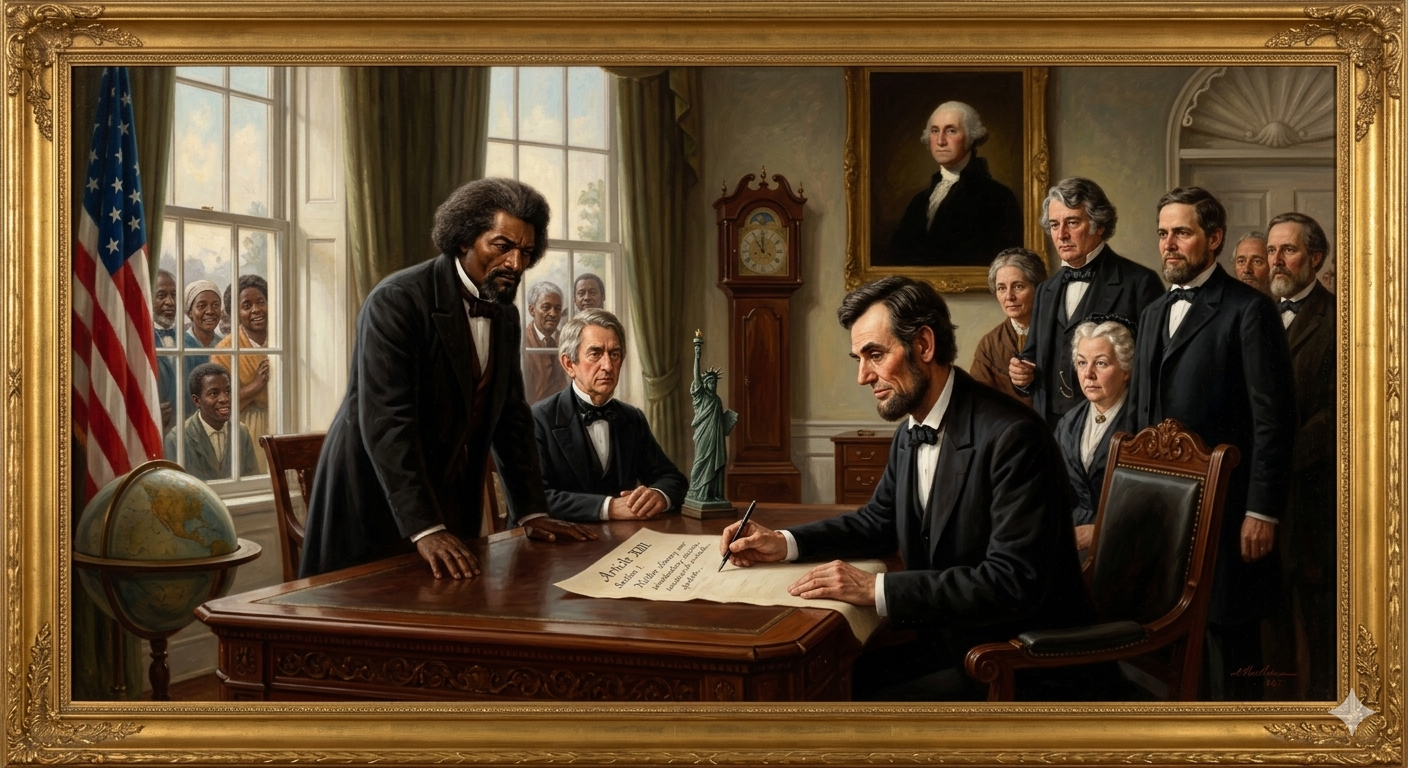
On February 1, 1865, President Abraham Lincoln made history by signing the joint resolution of Congress that would forever change the fabric of American society when he approved the 13th Amendment to the United States Constitution, formally abolishing slavery throughout the entire nation and marking the culmination of his lifelong commitment to the principle that America could not endure permanently half slave and half free. This momentous act represented far more than a simple presidential signature, as it embodied the transformation of Lincoln’s wartime Emancipation Proclamation from a temporary military measure into a permanent constitutional guarantee that would ensure the complete and irrevocable end of human bondage in the United States for all future generations. The amendment’s passage through Congress on January 31, 1865, after months of intense political maneuvering and moral debate, demonstrated the profound shift in American values and priorities that had occurred during four years of devastating civil war that had tested the nation’s commitment to its founding principles of equality and human dignity. Lincoln’s signature on the joint resolution, though not constitutionally required for the amendment process, symbolized the executive branch’s full endorsement of this revolutionary change to the fundamental law of the land and reflected his understanding that presidential leadership would be essential for ensuring the amendment’s successful ratification by the required three-fourths of the states. The 13th Amendment would ultimately become the first of three Reconstruction Amendments that would fundamentally reshape American society by establishing constitutional protections for civil rights and human equality that would serve as the foundation for ongoing struggles for justice and equality throughout the nation’s subsequent history, making Lincoln’s signature on February 1, 1865, one of the most significant presidential acts in American history.
The Constitutional Foundation: From Emancipation Proclamation to Permanent Amendment
The journey toward the 13th Amendment began with Abraham Lincoln’s recognition that his Emancipation Proclamation, issued on January 1, 1863, while morally and politically transformative, remained vulnerable to legal challenges and potential reversal once the Civil War ended and his wartime presidential powers were no longer applicable to justify such extraordinary executive action. The proclamation had freed enslaved people only in the rebellious Confederate states and had been issued under Lincoln’s constitutional authority as Commander-in-Chief during wartime, creating uncertainty about whether future presidents or federal courts might declare the proclamation invalid or unconstitutional once peace was restored and normal constitutional processes resumed. This legal vulnerability became increasingly concerning to Lincoln and his advisors as Union military victories mounted throughout 1864 and the prospect of Confederate defeat made it necessary to consider the post-war legal status of the millions of formerly enslaved people whose freedom depended entirely on a wartime proclamation that might not survive judicial scrutiny or political opposition.
The constitutional arguments for a slavery abolition amendment were grounded in the understanding that only a formal amendment to the Constitution could provide the permanent and unassailable legal foundation necessary to ensure that slavery would never again exist in the United States, regardless of changing political circumstances or judicial interpretations that might threaten the gains achieved through wartime emancipation policies. Legal scholars and Republican leaders recognized that the Constitution’s original provisions had implicitly protected slavery through clauses like the Three-Fifths Compromise and the Fugitive Slave Clause, making it essential to explicitly prohibit slavery through constitutional amendment that would supersede any previous constitutional protections for human bondage.
The political feasibility of a constitutional amendment abolishing slavery had been transformed by the Civil War experience, which had demonstrated both the moral bankruptcy of slavery and its fundamental incompatibility with American democratic principles and national unity that the war was being fought to preserve. The enormous human and economic costs of the war had convinced many Americans who had previously been willing to tolerate slavery as a necessary evil that the institution was so fundamentally destructive to American society that it must be completely eliminated rather than merely contained or regulated through political compromise.
The strategic timing of the amendment proposal reflected Lincoln’s understanding that the political window for such radical constitutional change might be limited to the immediate post-war period when memories of the conflict’s costs and moral clarity about slavery’s role in causing the war would provide maximum motivation for the dramatic action required to secure the necessary congressional majorities and state ratifications. The president recognized that postponing the amendment effort might allow opposition to rebuild and political compromises to emerge that could undermine the comprehensive abolition that he believed was essential for national healing and progress.
The Legislative Battle: Congressional Passage and Political Maneuvering
The passage of the 13th Amendment through Congress required unprecedented political skill and determination from Lincoln and his Republican allies, who faced significant opposition from Democratic members who argued that the proposed amendment exceeded federal constitutional authority and would fundamentally alter the balance between federal and state power in ways that violated the original understanding of American federalism. The amendment first passed the Senate on April 8, 1864, by a comfortable margin of 38 to 6, reflecting the strong Republican majority in the upper chamber and the support of some Democratic senators who had been convinced that slavery’s abolition was necessary for national reunification and progress following the war.
However, the House of Representatives initially rejected the amendment on June 15, 1864, by a vote of 93 in favor to 65 opposed, falling thirteen votes short of the required two-thirds majority needed for constitutional amendments, demonstrating the continued strength of Democratic opposition and the challenges facing Republican efforts to achieve the supermajority necessary for constitutional change. This initial defeat forced Lincoln and his supporters to develop more sophisticated political strategies that would combine moral persuasion with practical incentives designed to win over enough Democratic votes to achieve passage during the lame-duck session of Congress following Lincoln’s reelection in November 1864.
The political maneuvering that led to the amendment’s eventual passage involved intensive lobbying efforts coordinated by Lincoln himself, working with Secretary of State William Seward, Representative John Alley, and other administration officials who promised federal appointments, campaign contributions, and other inducements to outgoing Democratic representatives who would not face electoral consequences for supporting the amendment during their final months in office. These efforts reflected Lincoln’s pragmatic understanding that achieving moral progress often required political compromise and that the historical importance of ending slavery justified extraordinary measures to secure the necessary votes.
The role of Radical Republicans like Thaddeus Stevens and Charles Sumner proved crucial in maintaining pressure for the amendment while providing intellectual and moral leadership that helped frame the debate in terms of fundamental human rights and national moral progress rather than narrow partisan politics or constitutional technicalities. Stevens, in particular, used his position as chairman of the powerful Ways and Means Committee to influence wavering members while Sumner’s eloquent speeches helped establish the moral framework that justified such dramatic constitutional change.
The final push for passage in January 1865 involved Lincoln’s personal intervention with individual members of Congress, as the president made direct emotional appeals to representatives whose votes remained uncertain and demonstrated his willingness to stake his political reputation on achieving this historic reform. The dramatic vote on January 31, 1865, which saw the amendment pass by just three votes more than the required two-thirds majority, created scenes of celebration in the House chamber that reflected the participants’ understanding that they were witnessing one of the most important moments in American history.
Lincoln’s Historic Signature: Presidential Leadership and Constitutional Precedent
Abraham Lincoln’s decision to sign the 13th Amendment joint resolution on February 1, 1865, established an important precedent for presidential involvement in the constitutional amendment process, even though the Constitution does not explicitly require or authorize presidential approval for amendments that have been proposed by the required congressional majorities and are being submitted to the states for ratification. Lincoln’s signature reflected his understanding that presidential leadership would be essential for building public support for the amendment and encouraging state ratification, while also demonstrating his personal commitment to the cause of abolition that had become central to his presidency and his vision for America’s future.
The symbolic significance of Lincoln’s signature extended far beyond its legal implications, as it represented the culmination of his lifelong evolution from a politician who sought merely to contain slavery’s expansion to a leader willing to risk everything to achieve its complete abolition throughout the United States. The president’s decision to formally endorse the amendment through his signature demonstrated his recognition that moral leadership required clear and unambiguous action that would leave no doubt about his commitment to the cause of human freedom and equality.
The practical implications of Lincoln’s signature included his administration’s commitment to actively promoting ratification by state legislatures, particularly in the border states and reconstructed Southern states where support for the amendment was uncertain and where federal influence might prove decisive in securing the necessary three-fourths majority for constitutional ratification. Lincoln understood that his signature would be interpreted as a signal to Republican politicians and Union supporters throughout the country that the amendment deserved their full support and that opposition would be viewed as disloyalty to the Union cause and the president’s leadership.
The constitutional questions raised by Lincoln’s signature were addressed by Congress itself on February 7, 1865, when both houses passed a resolution clarifying that presidential approval was unnecessary for constitutional amendments, though this clarification did not diminish the political importance of Lincoln’s action or its role in building momentum for ratification. The resolution reflected congressional understanding that the amendment process was designed to be independent of executive influence, while acknowledging that Lincoln’s signature had already created important political benefits for the ratification campaign.
The historical precedent established by Lincoln’s signature would be followed only once more in American history, when President Richard Nixon signed the certification of the 26th Amendment in 1971, reflecting the rarity of presidential involvement in the amendment process and the special circumstances that made such involvement both appropriate and effective in building public support for constitutional change.
The Text and Legal Framework: Crafting Constitutional Language
The specific language of the 13th Amendment was carefully crafted to provide the broadest possible prohibition against slavery and involuntary servitude while incorporating historical precedents and legal terminology that would ensure its constitutional validity and enforceability through federal legislation and judicial interpretation. The amendment’s first section declared that “Neither slavery nor involuntary servitude, except as a punishment for crime whereof the party shall have been duly convicted, shall exist within the United States, or any place subject to their jurisdiction,” using language that drew directly from the Northwest Ordinance of 1787 to ensure constitutional continuity and legal precision.
The inclusion of the phrase “involuntary servitude” alongside “slavery” was designed to prevent circumvention of the amendment through systems of forced labor that might technically avoid the legal definition of slavery while maintaining the economic and social relationships that characterized human bondage. This comprehensive language reflected the drafters’ understanding that creative legal interpretation might otherwise allow the continuation of slavery-like conditions under different names or through contractual arrangements that maintained the substance of slavery while avoiding its formal legal designation.
The exception clause permitting involuntary servitude “as a punishment for crime” reflected contemporary understanding of legitimate state authority over convicted criminals while also ensuring that the amendment would not interfere with established penal practices that were considered appropriate and constitutional under existing legal frameworks. However, this exception would later become controversial as Southern states developed systems of convict leasing and chain gangs that some critics argued represented attempts to recreate slavery through the criminal justice system.
The second section of the amendment granted Congress “power to enforce this article by appropriate legislation,” providing the constitutional foundation for extensive federal civil rights legislation that would be necessary to implement the practical consequences of abolition and protect formerly enslaved people from attempts to restore slavery through state and local laws or private violence and intimidation. This enforcement provision represented a significant expansion of federal constitutional authority and would become the basis for landmark civil rights legislation throughout the Reconstruction period and beyond.
The amendment’s broad geographic scope, applying to “the United States” and “any place subject to their jurisdiction,” ensured that abolition would be complete and universal, covering not only the individual states but also federal territories, the District of Columbia, and any future acquisitions that might be added to American territory through expansion or conquest.
State Ratification Process: Building National Consensus
The ratification process for the 13th Amendment required approval by 27 of the 36 states that existed at the time, creating the need for extensive political organizing and persuasion that would test the depth of national commitment to abolition and demonstrate whether the moral transformation evidenced by congressional passage could be sustained at the state level, where local interests and prejudices might override national ideological commitments. The amendment’s supporters recognized that achieving ratification would require not only the support of Republican-controlled Northern states but also approval from enough border states and reconstructed Southern states to reach the required three-fourths threshold.
Illinois became the first state to ratify the amendment on February 1, 1865, the same day that Lincoln signed the congressional resolution, demonstrating the Prairie State’s commitment to the president who had launched his political career there and reflecting the strong Republican support that existed in Lincoln’s home state. The rapid ratification by Illinois was followed by approval from seventeen additional states by the end of February 1865, creating momentum that suggested the amendment would achieve the necessary support well before the December deadline that Lincoln hoped to meet.
The ratification by border states proved crucial for achieving the required majority, as states like Maryland, Missouri, and West Virginia provided evidence that support for abolition extended beyond the purely Republican strongholds and reflected genuine national consensus about slavery’s incompatibility with American principles. These border state ratifications were particularly significant because they came from states where slavery had remained legal throughout the war and where economic interests might have argued against constitutional abolition.
The role of reconstructed Southern states in the ratification process created complex political and constitutional questions about the legitimate authority of provisional governments that had been established under federal oversight and the appropriate requirements for readmission to the Union that would affect their participation in the amendment process. Lincoln and his successor, Andrew Johnson both viewed Southern ratification as essential for national reconciliation and for demonstrating that the amendment enjoyed broad national support rather than representing merely the will of the victorious North imposed upon a defeated South.
The final ratification by Georgia on December 6, 1865, provided the 27th state needed to achieve the three-fourths majority required for constitutional amendments, making the 13th Amendment officially part of the Constitution and marking the achievement of Lincoln’s goal of permanent, constitutional abolition throughout the United States. Secretary of State William Seward’s formal certification of the amendment’s ratification on December 18, 1865, completed the legal process and marked the beginning of the new constitutional era in which slavery was forever prohibited in American territory.
Opposition and Debate: Arguments Against Constitutional Abolition
The opposition to the 13th Amendment came primarily from Democratic politicians and conservative legal scholars who argued that the proposed constitutional change exceeded the appropriate scope of federal authority and violated fundamental principles of federalism and states’ rights that had been central to American constitutional interpretation since the founding era. Democratic opponents contended that slavery was a state institution protected by the original Constitution and that federal interference through constitutional amendment represented a dangerous precedent that could lead to unlimited federal power over local institutions and social relationships that had traditionally been governed by state authority.
Constitutional arguments against the amendment focused on the claim that such fundamental changes to the social and economic system went beyond the appropriate scope of constitutional amendment and instead represented a revolutionary transformation that required more extensive democratic deliberation and consent than the amendment process could provide. Critics like Representative Chilton White warned that constitutional abolition would lead inevitably to full political and social equality for formerly enslaved people, creating social upheaval and racial conflict that would undermine American stability and traditional social hierarchies.
The federalism concerns raised by amendment opponents reflected genuine anxieties about the expansion of federal power that the Civil War had already dramatically accelerated and the precedent that constitutional abolition might establish for future federal intervention in areas that had traditionally been reserved to state authority. Some critics argued that the amendment would fundamentally alter the nature of the federal union by establishing federal supremacy over local institutions and social relationships that had been protected by the Tenth Amendment’s reservation of powers to the states.
Economic arguments against the amendment emphasized the massive property losses that would result from immediate abolition without compensation to slaveholders, with critics arguing that such uncompensated takings violated fundamental principles of property rights and due process that were essential to American economic and legal systems. These arguments reflected the substantial financial investments that had been made in slave property and the concerns of slaveholders about their economic survival following abolition.
The religious and moral arguments advanced by amendment opponents attempted to challenge the growing consensus that slavery was incompatible with Christian principles and American values, with some critics arguing that biblical precedent and natural law supported hierarchical social relationships that included forms of bondage and that immediate abolition would create social chaos and moral confusion rather than promoting justice and human dignity.
Implementation and Early Enforcement: Making Freedom Real
The immediate implementation of the 13th Amendment following its ratification required extensive federal action to transform the constitutional prohibition against slavery into practical reality for the millions of formerly enslaved people who suddenly found themselves legally free but without resources, education, or protection from former masters who might attempt to maintain control through violence, intimidation, or economic coercion. The Freedmen’s Bureau, established by Congress in March 1865, became the primary federal agency responsible for managing the transition from slavery to freedom by providing emergency assistance, education, legal protection, and economic opportunities for formerly enslaved people throughout the South.
The passage of the Civil Rights Act of 1866 represented Congress’s first major effort to use the enforcement powers granted by the 13th Amendment’s second section, establishing federal protections for the basic civil rights of all Americans regardless of race and providing legal mechanisms for challenging state and local laws that attempted to circumvent constitutional abolition through discriminatory legislation known as Black Codes. The Act’s definition of citizenship and civil rights provided the legal foundation for federal intervention against state and local efforts to recreate slavery-like conditions through legal restrictions on formerly enslaved people’s movement, employment, and legal rights.
The constitutional challenges to early enforcement legislation tested the scope and meaning of the 13th Amendment’s prohibition against slavery and involuntary servitude, with federal courts gradually developing interpretations that recognized the amendment’s authority to prohibit not only formal slavery but also the “badges and incidents of slavery” that included various forms of racial discrimination and legal disabilities that had been associated with slave status. These judicial interpretations established important precedents for using the amendment as a tool for civil rights protection that would influence constitutional law for generations.
The resistance to federal enforcement efforts in many Southern states demonstrated the practical challenges involved in transforming constitutional principles into social and economic reality, as former slaveholders and their political allies attempted to use violence, economic pressure, and discriminatory laws to maintain white supremacy and black subordination despite constitutional abolition. The emergence of the Ku Klux Klan and other terrorist organizations represented organized efforts to use violence and intimidation to prevent formerly enslaved people from exercising their constitutional rights and to restore white control over Southern society.
The economic transformation required by abolition involved not only the immediate end of unpaid slave labor but also the development of new systems of free wage labor that would provide formerly enslaved people with genuine economic opportunities while maintaining agricultural production that was essential for Southern and national economic recovery. The failure to provide land redistribution or other forms of economic assistance to formerly enslaved people created ongoing challenges for implementing the promise of freedom in meaningful ways that would provide genuine alternatives to the economic dependence that had characterized slavery.
Lincoln’s Assassination and Johnson’s Continuation: Leadership Transition
The assassination of Abraham Lincoln on April 14, 1865, just ten weeks after he signed the 13th Amendment, deprived the nation of the president who had provided the moral and political leadership essential for achieving constitutional abolition and created uncertainty about whether his successor would continue the commitment to civil rights and racial equality that had motivated the amendment’s passage. Andrew Johnson’s assumption of the presidency brought to power a Southern Democrat who had remained loyal to the Union during the Civil War but whose racial attitudes and constitutional philosophy differed significantly from Lincoln’s evolving views on slavery, equality, and federal authority.
Johnson’s initial support for the 13th Amendment’s ratification reflected his understanding that constitutional abolition was irreversible and politically necessary for national reunification, but his opposition to subsequent civil rights legislation and his lenient policies toward former Confederate leaders suggested that he viewed abolition as the end rather than the beginning of federal responsibility for protecting the rights of formerly enslaved people. The new president’s approach to Reconstruction emphasized rapid restoration of Southern states to full political participation with minimal requirements for protecting black civil rights or ensuring genuine social and economic transformation.
The conflict between Johnson and Radical Republicans in Congress over the meaning and implementation of the 13th Amendment reflected broader disagreements about the scope of federal authority and the appropriate goals of Reconstruction that would ultimately lead to Johnson’s impeachment and the passage of additional constitutional amendments designed to protect civil and political rights for formerly enslaved people. These conflicts demonstrated that Lincoln’s death had created a leadership vacuum that would complicate efforts to fulfill the promise of freedom embodied in the 13th Amendment.
The political battles over Johnson’s Reconstruction policies illustrated the importance of presidential leadership for implementing constitutional change and the dangers that could arise when constitutional amendments were not supported by sustained political commitment to their underlying principles and practical enforcement. Johnson’s willingness to allow Southern states to enact Black Codes and other discriminatory legislation demonstrated how constitutional abolition could be undermined by inadequate federal enforcement and presidential opposition to civil rights protection.
The eventual passage of the 14th and 15th Amendments represented congressional efforts to address the limitations of relying solely on the 13th Amendment for protecting the rights of formerly enslaved people and reflected recognition that constitutional abolition required additional constitutional protections for citizenship, civil rights, and political participation that Johnson’s administration was unwilling to provide through ordinary legislation and enforcement.
Global Impact and International Recognition: America’s Moral Leadership
The ratification of the 13th Amendment had profound implications for American international relations and moral leadership, as it finally brought the United States into alignment with the global movement toward abolition that had already eliminated slavery in most European colonies and independent nations throughout the world during the early and mid-19th century. The amendment’s passage removed a significant source of international criticism and moral isolation that had undermined American claims to represent democratic principles and human rights in international affairs, particularly during the Civil War when European powers had considered recognizing Confederate independence partly because of their opposition to slavery.
The timing of American abolition, coming more than thirty years after British abolition in 1833 and decades after similar actions by other European powers, reflected poorly on American moral leadership and democratic institutions, but the 13th Amendment’s passage demonstrated that American democracy was capable of self-correction and moral progress even when such progress required fundamental constitutional change. The amendment’s achievement through democratic processes rather than imperial decree provided evidence that republican institutions could address moral issues and implement social reform through constitutional means.
The international attention focused on the 13th Amendment and its ratification process provided opportunities for American diplomats and political leaders to emphasize themes of democratic progress and moral advancement that would enhance American influence and prestige throughout the world, particularly in regions where slavery and other forms of forced labor remained significant issues. The amendment’s success offered evidence that democratic societies could achieve moral progress through constitutional processes that protected both majority will and minority rights.
The influence of American constitutional abolition on liberation movements and reform efforts throughout the world reflected the global significance of the 13th Amendment and its demonstration that even deeply entrenched systems of oppression could be eliminated through sustained political organizing and moral commitment. The amendment provided inspiration and practical examples for activists in other countries who were working to eliminate various forms of forced labor and social subordination.
The long-term impact of the 13th Amendment on American international relations included enhanced moral authority for promoting human rights and democratic values throughout the world, though this moral authority would be complicated by the failure to fully implement racial equality and the continuation of discriminatory practices that undermined claims about American commitment to universal human rights and democratic principles.
Legal Legacy and Constitutional Interpretation: The Amendment’s Enduring Influence
The constitutional interpretation of the 13th Amendment has evolved significantly since its ratification, with federal courts gradually expanding their understanding of the amendment’s scope and enforcement provisions to address various forms of discrimination and involuntary servitude that were not explicitly contemplated by its original drafters but that reflect its underlying principles of human freedom and dignity. The Supreme Court’s early decisions in cases like the Civil Rights Cases of 1883 established important precedents for using the amendment to prohibit not only formal slavery but also practices that represented “badges and incidents of slavery” that maintained racial subordination and economic exploitation.
The amendment’s enforcement clause has provided constitutional authority for extensive federal civil rights legislation throughout American history, including not only the immediate Reconstruction-era statutes but also the major civil rights laws of the 1960s and subsequent federal efforts to address various forms of discrimination and exploitation that can be characterized as modern forms of slavery or involuntary servitude. This broad interpretive approach has allowed the amendment to remain relevant and effective despite dramatic changes in American society and the evolution of new forms of discrimination and exploitation.
The Supreme Court’s recognition that the 13th Amendment applies to private as well as governmental action distinguishes it from most other constitutional provisions and provides unique constitutional authority for federal intervention against discrimination and exploitation by private parties, making it a particularly powerful tool for addressing civil rights violations that might not be covered by other constitutional amendments that are limited to state action. This private action doctrine has proven especially important for addressing employment discrimination, human trafficking, and other forms of private exploitation.
The amendment’s application to modern forms of involuntary servitude has included federal efforts to combat human trafficking, debt peonage, and other contemporary forms of forced labor that demonstrate the continuing relevance of constitutional abolition principles for addressing evolving forms of human exploitation. The federal government’s use of the amendment to prosecute human trafficking cases reflects recognition that the constitutional prohibition against involuntary servitude extends beyond the historical context of chattel slavery to encompass all forms of forced labor and human bondage.
The scholarly debate over the amendment’s meaning and scope continues to influence constitutional interpretation and civil rights law, with legal historians and constitutional scholars offering different perspectives on the original understanding of the amendment’s language and the appropriate scope of its enforcement provisions. These ongoing debates reflect the complexity of translating 19th-century constitutional language into contemporary legal frameworks while preserving the amendment’s essential commitment to human freedom and dignity.
Long-term Historical Significance: Transforming American Society
The historical significance of Lincoln’s signature on the 13th Amendment extends far beyond the immediate accomplishment of constitutional abolition to encompass the fundamental transformation of American society and constitutional government that the amendment represented and enabled throughout subsequent decades of social and political development. The amendment established the principle that the Constitution could be used as an instrument of social reform and moral progress rather than merely a framework for limited government and individual liberty, creating precedents for constitutional activism that would influence reform movements throughout American history.
The amendment’s role as the first of three Reconstruction Amendments established the constitutional foundation for the modern civil rights movement and ongoing efforts to achieve racial equality and social justice that would define much of American political and social development throughout the 20th century and beyond. The legal precedents and moral principles established by the amendment would provide inspiration and constitutional authority for generations of activists and reformers seeking to expand human rights and democratic participation.
The economic transformation required by constitutional abolition contributed to the development of modern American capitalism and the shift from an agricultural economy based on forced labor to an industrial economy based on free wage labor, though the failure to provide adequate support for formerly enslaved people created ongoing patterns of economic inequality and racial discrimination that would persist long after legal abolition. The amendment’s economic impact demonstrates both the potential for constitutional change to drive social transformation and the limitations of legal reform without accompanying economic and social support systems.
The political consequences of the 13th Amendment included the expansion of federal authority and the development of modern constitutional interpretation that recognized broader federal responsibility for protecting civil rights and promoting social welfare, though these developments would be contested and partially reversed during subsequent periods of conservative reaction and limited government philosophy. The amendment’s influence on American federalism and constitutional law established important precedents that would be invoked by later reform movements seeking federal protection for various forms of civil and human rights.
The international influence of the 13th Amendment as a model for constitutional reform and democratic progress has continued throughout American history, with the amendment’s achievement serving as evidence that democratic societies can address fundamental moral issues and achieve social progress through constitutional processes. The amendment’s legacy thus extends beyond American borders to encompass its role in global movements for human rights and democratic governance that continue to draw inspiration from the American example of constitutional abolition and moral progress through democratic means.