On June 30, 1985, the 17-day hijacking ordeal of Trans World Airlines Flight 847 finally came to an end when the last 39 American hostages were released in Damascus, Syria, marking the conclusion of one of the most prolonged and politically charged aviation crises in modern history that had captivated global attention and fundamentally altered international approaches to terrorism and airline security. This harrowing incident, which began as a routine flight from Athens to Rome on June 14, 1985, evolved into a complex international hostage situation that saw the aircraft crisscross the Mediterranean between Beirut and Algiers while demanding the release of 766 Shiite Muslim prisoners held by Israel in exchange for the lives of innocent passengers and crew members. The crisis reached its most tragic moment when United States Navy Seabee Robert Dean Stethem was brutally murdered by the Hezbollah hijackers and his body thrown onto the tarmac at Beirut International Airport, transforming what had been a tense diplomatic situation into an international incident that would influence U.S. foreign policy and counter-terrorism strategies for decades to come. The eventual resolution of the crisis required complex negotiations involving multiple governments, religious leaders, and intermediaries, ultimately resulting in the quiet release of many of the Lebanese Shiite prisoners that Israel had been holding, though official denials and diplomatic face-saving measures obscured the exact nature of the agreements that secured the hostages’ freedom. The TWA 847 hijacking represented a watershed moment in the history of international terrorism, demonstrating both the vulnerability of commercial aviation to politically motivated attacks and the challenges facing democratic governments in responding to hostage situations without appearing to negotiate with terrorists or compromise their stated policies of refusing to give in to terrorist demands.
The Initial Hijacking: Flight 847’s Journey from Routine to Crisis
Trans World Airlines Flight 847 began as an ordinary scheduled passenger service on the morning of June 14, 1985, departing Cairo with planned stops in Athens, Rome, Boston, and Los Angeles before reaching its final destination of San Diego, carrying 153 passengers and crew members who had no indication that they were about to become participants in one of the most significant aviation security incidents of the 1980s. The aircraft, a Boeing 727-200 with registration number N64339, had completed its Cairo to Athens segment without incident and was preparing for what should have been a routine 90-minute flight to Rome when two Lebanese Shiite terrorists managed to board the aircraft in Athens despite carrying weapons that should have been detected by airport security screening procedures that were considered adequate by international standards of the time.
The hijacking began at approximately 10:10 AM Eastern European Time when the aircraft was just 20 minutes into its flight from Athens to Rome, as Mohammed Ali Hammadi and his accomplice Hassan Izz-al-Din suddenly produced a pistol and two hand grenades that they had successfully smuggled through the notoriously lax security checkpoint at Athens International Airport. The terrorists immediately took control of the aircraft by assaulting flight attendant Uli Derickson, dragging her by her hair through the cabin while demanding access to the cockpit, and then proceeding to pistol-whip Captain John Testrake, First Officer Philip Maresca, and Flight Engineer Christian Zimmerman in a violent display designed to establish their complete authority over the aircraft and terrorize the passengers into submission.
Captain Testrake, a veteran TWA pilot with extensive experience in international flights, found himself thrust into the role of primary communicator between the hijackers and ground control authorities as the terrorists forced him to request emergency landing permission at various airports throughout the Mediterranean region. The hijackers’ initial demands were communicated through Captain Testrake to air traffic controllers, with the pilot forced to relay increasingly desperate messages about the terrorists’ willingness to destroy the aircraft and kill all aboard if their demands for landing permission and fuel were not immediately met by ground authorities who were still trying to understand the scope and nature of the unfolding crisis.
The selection of Flight 847 appeared to be opportunistic rather than the result of extensive planning, as the hijackers had apparently boarded the aircraft in Athens without specific advance knowledge of the passenger manifest or detailed intelligence about the flight’s route and schedule, suggesting that their primary objective was to seize any available American commercial aircraft that could provide them with the international attention and negotiating leverage necessary to achieve their political goals. This spontaneous nature of the hijacking would contribute to the chaotic and unpredictable character of the subsequent 17-day crisis, as the terrorists were forced to improvise their strategy and tactics in response to changing circumstances and the reactions of various government and airport authorities throughout the Mediterranean region.
The Hijackers: Hezbollah Operatives and Their Political Motivations
The two primary hijackers of TWA Flight 847 were identified as Mohammed Ali Hammadi, a 21-year-old Lebanese Shiite militant with known connections to the emerging Hezbollah organization, and Hassan Izz-al-Din, a more experienced terrorist who had been involved in previous attacks against Western targets and possessed the operational expertise necessary to execute complex hijacking operations that required coordination with ground-based support networks throughout Lebanon and the broader Middle East region. Hammadi, despite his youth, had been trained in terrorist tactics and weapons handling by Hezbollah operatives who were receiving support and guidance from Iranian Revolutionary Guard advisors stationed in the Bekaa Valley region of Lebanon, where Shiite militant groups had established training camps and operational bases that served as centers for anti-Western terrorist activities throughout the 1980s.
The political motivations driving the hijacking were rooted in the complex sectarian conflicts that had engulfed Lebanon since the beginning of the Lebanese Civil War in 1975, particularly the grievances of Shiite Muslims who felt marginalized by the country’s political system and targeted by Israeli military operations in southern Lebanon that had resulted in the detention of hundreds of Shiite fighters and civilians in Israeli prisons and detention facilities. The hijackers’ primary demand was the release of 766 Lebanese Shiite prisoners who had been transferred to Israel’s Atlit detention facility following Israeli military operations in southern Lebanon, along with the release of the “Kuwait 17,” a group of Shiite terrorists who had been imprisoned in Kuwait following their involvement in a series of bombings against American and French targets in Kuwait City in 1983.
Hezbollah, the Iranian-backed Shiite organization that provided ideological and operational support for the hijacking, had emerged as a major force in Lebanese politics and militant activities following Israel’s 1982 invasion of Lebanon and the subsequent establishment of Israeli occupation zones in the southern part of the country. The organization’s leadership, including figures like Sheikh Mohammed Hussein Fadlallah and later Hassan Nasrallah, viewed attacks against American targets as legitimate responses to what they characterized as American support for Israeli occupation and aggression against the Lebanese Shiite community, making commercial aviation an attractive target for terrorist operations designed to maximize international attention and pressure on Western governments.
The hijackers’ operational support network extended throughout Lebanon and included safe houses, weapons caches, and communication systems that had been established by Hezbollah with Iranian assistance as part of a broader strategy to conduct asymmetric warfare against Western interests in the Middle East region. This infrastructure would prove crucial during the 17-day crisis, as the terrorists were able to move passengers and crew members between various locations in Beirut while maintaining communication with their handlers and negotiating with intermediaries who attempted to resolve the hostage situation without direct government-to-government negotiations that might legitimize terrorist tactics or compromise official policies against negotiating with terrorist organizations.
The Mediterranean Odyssey: Between Beirut and Algiers
The hijacked Boeing 727 began a complex pattern of flights between Beirut, Lebanon and Algiers, Algeria that would continue for three days and involve multiple stops, passenger releases, and escalating demands as the terrorists sought to maximize their negotiating leverage while also managing the practical challenges of maintaining control over a large aircraft and its human cargo in hostile or uncertain environments. The first destination was Beirut International Airport, where the hijackers initially encountered resistance from Lebanese air traffic controllers who were reluctant to grant landing permission to an aircraft under terrorist control, forcing Captain Testrake to relay increasingly desperate warnings that the hijackers were prepared to detonate hand grenades and destroy the aircraft unless immediate landing clearance was granted.
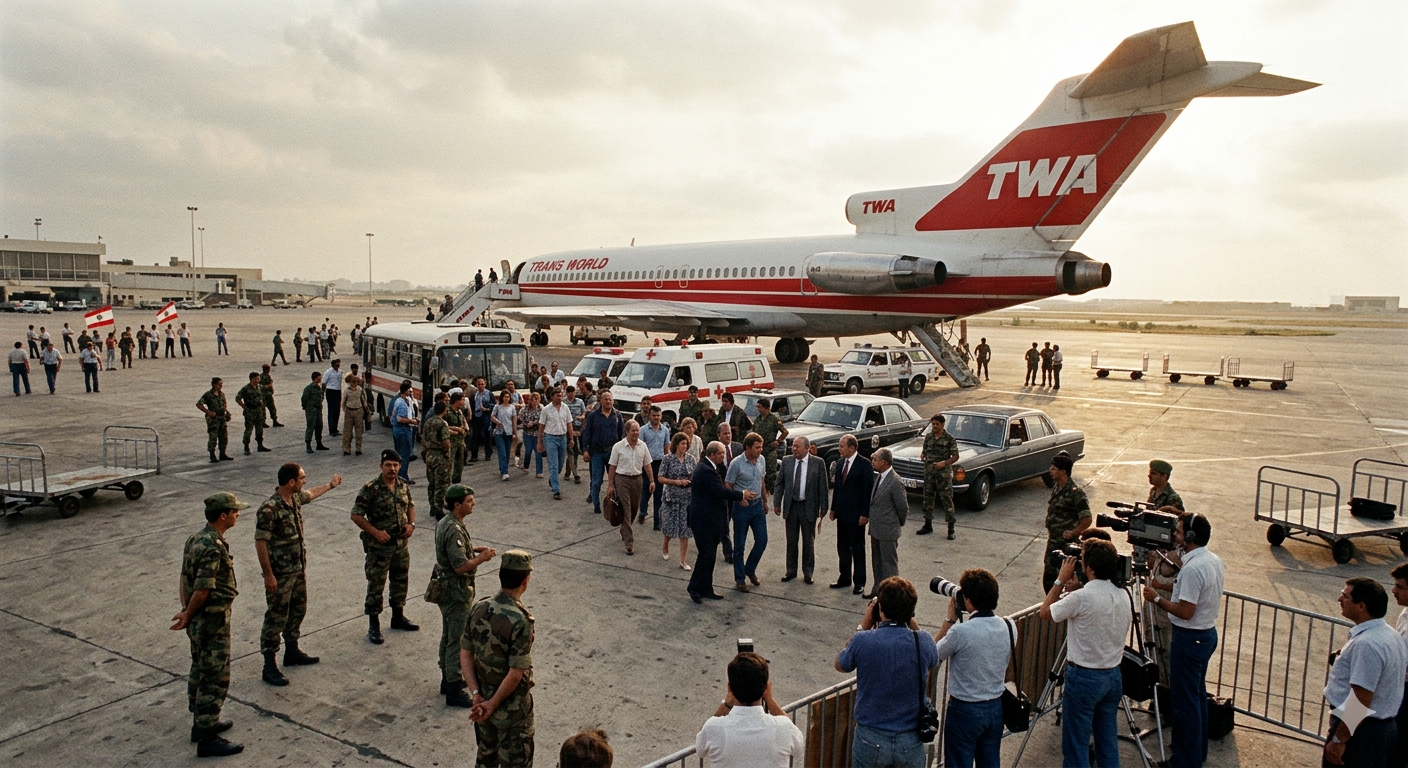
The arrival at Beirut International Airport at 11:55 AM local time marked the beginning of the most dangerous phase of the hijacking, as the aircraft entered the chaotic environment of Lebanon’s ongoing civil war where multiple armed factions controlled different sections of the country and the central government possessed limited authority to guarantee the safety of international flights or their passengers and crew members. During this first stop in Beirut, which lasted several hours, the hijackers released 19 passengers in exchange for additional fuel, demonstrating their willingness to negotiate and suggesting that they possessed a coherent strategy for managing the crisis rather than simply seeking martyrdom or maximum destruction of life and property.
The decision to fly from Beirut to Algiers represented a calculated move by the hijackers to involve additional governments in the crisis while also seeking a more secure operational environment where they could issue formal demands and begin serious negotiations with international mediators and government representatives. Algeria’s willingness to accept the hijacked aircraft reflected the country’s complex relationship with Palestinian and other Arab militant organizations, as well as its general opposition to Israeli policies and American support for Israel, making Algiers a logical destination for terrorists seeking sympathetic treatment and protection from immediate military intervention by Western forces.
During the five-hour stopover at Algiers International Airport, the hijackers issued their comprehensive list of demands, which included not only the release of the Lebanese Shiite prisoners held by Israel but also international condemnation of Israeli and American policies in the Middle East, demonstrating that their objectives extended beyond the immediate prisoner exchange to encompass broader political goals related to the Palestinian-Israeli conflict and American involvement in Middle Eastern affairs. The Algerian government’s role as an intermediary during these negotiations reflected its position as a leader of the Non-Aligned Movement and its historical support for various liberation movements throughout Africa and the Middle East, though Algerian officials also sought to minimize their direct involvement in activities that might provoke retaliation from Western governments.
Robert Dean Stethem: The Ultimate Sacrifice and American Hero
United States Navy Seabee Robert Dean Stethem emerged as the most tragic figure of the TWA Flight 847 hijacking when he became the target of the terrorists’ escalating violence during the aircraft’s second stop in Beirut on June 15, 1985, ultimately sacrificing his life in a heroic attempt to protect fellow passengers from the hijackers’ brutality while demonstrating the courage and dedication to duty that characterized American military personnel serving in dangerous overseas assignments during the height of Cold War tensions. The 23-year-old naval construction specialist from Waldorf, Maryland, had been returning from a deployment in the Middle East where he had been involved in construction and engineering projects related to American military operations in the region, making him a particularly attractive target for terrorists seeking to strike directly at American military capabilities and morale.
Stethem’s ordeal began during the flight’s first day when the hijackers systematically identified and targeted passengers with military connections or Jewish-sounding names, subjecting these individuals to particular brutality and psychological intimidation designed to terrorize other passengers while also serving the terrorists’ ideological objectives of striking at representatives of American and Israeli power. Witness testimony from fellow passengers later revealed that Stethem had been repeatedly beaten and tortured by the hijackers, who seemed to take particular pleasure in abusing a representative of the American military that they viewed as an occupying force in their homeland and a supporter of Israeli actions against Lebanese Shiite communities.
During the aircraft’s second stop in Beirut on June 15, the hijackers’ violence against Stethem escalated to murder when they shot him in the head and then threw his body from the aircraft onto the tarmac of Beirut International Airport, creating a shocking image that was broadcast around the world and transformed the hijacking from a hostage situation into an international incident requiring decisive American response. The cold-blooded murder of an unarmed American serviceman demonstrated the hijackers’ complete disregard for international law and humanitarian norms while also serving their strategic objective of escalating the crisis to a level that would force American government involvement and international attention to their demands.
Australian passenger Ruth Henderson later testified that Stethem had expressed his willingness to die to save the lives of other passengers, demonstrating the selfless courage and commitment to protecting innocent civilians that exemplified the best traditions of American military service and would later inspire the naming of USS Stethem, an Arleigh Burke-class destroyer commissioned in 1995 to honor his memory and sacrifice. Henderson’s emotional testimony during the subsequent trial of Mohammed Ali Hammadi revealed that she had attempted to comfort Stethem during his final hours, engaging him in conversation about everyday topics in an effort to maintain his spirits and provide human companionship during his ordeal.
The murder of Robert Stethem fundamentally changed the character of the TWA 847 crisis, transforming it from a complex hostage situation into a direct attack on American military personnel that required a response commensurate with the seriousness of the provocation while also creating political pressure on the Reagan administration to take decisive action against the perpetrators and their sponsors, even if such action might endanger the lives of the remaining hostages who continued to be held by the terrorists in various locations throughout Beirut.
The Hostage Experience: Terror, Survival, and Psychological Warfare
The 153 passengers and crew members aboard TWA Flight 847 endured a terrifying 17-day ordeal that combined physical abuse, psychological intimidation, and constant uncertainty about their fate as the hijackers employed sophisticated terrorist tactics designed to maximize their negotiating leverage while also serving their ideological objectives of punishing Americans and demonstrating the vulnerability of Western civilization to attacks by committed militants. The hijackers systematically divided the passengers into different categories based on nationality, religion, and perceived military connections, with American passengers, particularly those with Jewish-sounding names or military identification, receiving the harshest treatment and facing the greatest risk of execution or severe physical abuse throughout the crisis.
Flight attendant Uli Derickson emerged as a crucial figure during the hijacking, using her ability to speak German (the only European language understood by the hijackers) to communicate with the terrorists and serve as an intermediary between the hijackers and passengers, often placing herself at considerable personal risk to protect other passengers from violence and abuse. Derickson’s courageous actions included refusing to identify passengers with Jewish-sounding names despite repeated demands from the hijackers, intervening to prevent additional violence against passengers and crew members, and even using her personal Shell Oil credit card to pay for jet fuel when Algerian authorities initially refused to refuel the aircraft without payment, demonstrating the kind of quick thinking and personal sacrifice that helped prevent an even greater tragedy.
The psychological impact of the hijacking on passengers was severe and lasting, with many hostages developing symptoms consistent with what would later be recognized as Stockholm syndrome, as they began to express sympathy for their captors’ political objectives and to view the hijackers as protectors rather than threats to their survival. This psychological transformation reflected the complex dynamics of hostage situations where victims become dependent on their captors for survival and may begin to identify with their captors’ perspectives as a coping mechanism for dealing with extreme stress and the constant threat of violence or death.
The physical conditions endured by the hostages deteriorated significantly during the latter stages of the crisis, as passengers and crew members were moved from the aircraft to various safe houses and detention facilities throughout Beirut where they faced overcrowding, poor sanitation, inadequate food and water supplies, and constant threats from armed guards who had been instructed to execute hostages if rescue attempts were made by Western military forces. The hostages’ experiences during this period provided valuable intelligence about terrorist operational methods and the support networks that enabled extended hostage operations in the chaotic environment of civil war-torn Lebanon.
The eventual release of the hostages revealed the extent of their physical and psychological trauma, with many requiring extensive medical treatment and counseling to recover from their ordeal and return to normal lives and activities, while others struggled with survivor’s guilt and post-traumatic stress disorder that affected their ability to function effectively in their personal and professional lives for years after their return to freedom.
International Negotiations: Diplomacy Under Duress
The resolution of the TWA Flight 847 crisis required complex multilateral negotiations involving the governments of the United States, Israel, Lebanon, Syria, Algeria, and various intermediaries including religious leaders, international organizations, and private individuals who possessed the trust and credibility necessary to communicate with both the terrorists and the various government officials who held decision-making authority over the crisis. The Reagan administration found itself in the difficult position of maintaining its stated policy of refusing to negotiate with terrorists while also seeking the safe return of American hostages whose lives depended on finding some form of accommodation with the hijackers’ demands.
President Ronald Reagan and his national security team, including Secretary of State George Shultz and National Security Advisor Robert McFarlane, faced intense public pressure to take decisive action to secure the hostages’ release while also confronting the strategic challenge of avoiding actions that might encourage future terrorist attacks by demonstrating that hostage-taking could successfully extract concessions from the American government. The administration’s response strategy involved public statements emphasizing American determination not to negotiate with terrorists while simultaneously engaging in private diplomatic efforts to identify face-saving solutions that might satisfy the hijackers’ demands without appearing to reward terrorist tactics or compromise established counter-terrorism policies.
Israel’s role in the negotiations proved particularly complex, as the hijackers’ primary demand involved the release of Lebanese Shiite prisoners held in Israeli detention facilities, creating a situation where American citizens’ lives depended on decisions made by a foreign government that had its own security concerns and political considerations to balance against American requests for cooperation. Israeli officials, led by Prime Minister Shimon Peres, initially resisted American pressure to release the prisoners, arguing that such concessions would encourage additional terrorist attacks against Israeli targets and undermine Israel’s deterrent credibility in its ongoing conflicts with Palestinian and Lebanese militant organizations.
The involvement of Syrian President Hafez al-Assad as a key mediator in the final stages of the crisis reflected the complex regional politics of the Middle East, where Syria’s relationship with various Lebanese factions and its broader competition with Israel for influence in Lebanon created both opportunities and constraints for resolving the hostage situation. Assad’s willingness to serve as an intermediary was motivated partly by his desire to demonstrate Syrian influence and gain international recognition as a responsible regional power, while also advancing Syrian strategic objectives related to the Lebanese civil war and the broader Arab-Israeli conflict.
The negotiations’ ultimate success depended on the creation of face-saving formulas that allowed all parties to claim victory while avoiding explicit acknowledgment of concessions to terrorist demands, with the final resolution involving the ostensibly separate Israeli decision to release many of the Lebanese prisoners as part of a previously planned prisoner exchange program that had been accelerated and expanded in response to the crisis, though all parties involved maintained public denials of any connection between the prisoner releases and the hostage situation.
The Role of Media and Public Opinion in Crisis Resolution
The TWA Flight 847 hijacking unfolded during an era when international television news coverage had become increasingly sophisticated and immediate, allowing viewers around the world to follow the crisis in real-time and creating unprecedented public pressure on government officials to take action while also providing the terrorists with a global platform for presenting their political messages and demands. The most memorable image of the crisis was the photograph of a gun being held to Captain John Testrake’s head as he was interviewed from the cockpit window by ABC News correspondent Charles Glass, creating a powerful visual symbol of American vulnerability that was broadcast repeatedly on television networks throughout the world and intensified public demands for decisive government action.
The terrorists demonstrated sophisticated understanding of media manipulation and psychological warfare, carefully staging dramatic scenes and providing interviews designed to maximize public sympathy for their political objectives while also maintaining pressure on Western governments through the constant threat of violence against innocent hostages. The hijackers’ media strategy included allowing selected hostages to appear on television to describe their treatment and express support for the terrorists’ demands, creating complex moral and political dilemmas for news organizations that were simultaneously covering a major news story and potentially serving as instruments of terrorist propaganda and psychological manipulation.
American public opinion polls conducted during the crisis revealed strong support for military action to rescue the hostages, with many Americans expressing frustration with what they perceived as government inaction in the face of terrorist intimidation and violence, though this public pressure was balanced by concerns about the risks such action might pose to the hostages’ survival and the potential for military intervention to escalate into broader regional conflict involving American forces in Lebanon’s complex civil war. The tension between public demands for decisive action and the practical constraints facing policymakers created additional pressure on the Reagan administration to find diplomatic solutions that could satisfy domestic political demands while also preserving the hostages’ lives.
The international media coverage of the crisis also influenced the behavior of various regional governments and non-state actors who recognized that their actions would be scrutinized by global audiences and could affect their international reputations and relationships with major powers, creating incentives for moderate and responsible behavior while also providing opportunities for grandstanding and political theater by leaders seeking to enhance their domestic and international standing through high-profile involvement in crisis resolution efforts.
The lessons learned from media coverage of the TWA 847 crisis would influence later government policies regarding press access during terrorist incidents and hostage situations, with officials recognizing both the important public information function served by news coverage and the potential for such coverage to complicate crisis resolution efforts by providing terrorists with intelligence about government actions and by creating additional pressures that might constrain diplomatic flexibility and negotiating options.
The Final Resolution: Freedom Through Negotiated Compromise
The conclusion of the TWA Flight 847 hijacking on June 30, 1985, resulted from a carefully orchestrated series of diplomatic agreements and face-saving measures that allowed all parties to claim success while avoiding explicit acknowledgment of negotiations with terrorists or concessions to terrorist demands, though the practical reality involved significant Israeli prisoner releases and Syrian mediation that satisfied the hijackers’ primary objectives while providing the Reagan administration with a formula for hostage recovery that preserved the appearance of maintaining established counter-terrorism policies. The final phase of negotiations was conducted primarily through Syrian intermediaries who possessed the credibility and regional influence necessary to communicate with the various Lebanese factions holding American hostages while also maintaining dialogue with Israeli and American officials who held decision-making authority over the prisoner releases and other concessions required for crisis resolution.
President Hafez al-Assad of Syria emerged as the crucial mediator in the final negotiations, leveraging Syria’s complex relationships with various Lebanese militias and its broader regional influence to create conditions for hostage release while also advancing Syrian strategic interests in Lebanon and the broader Middle East region. Assad’s involvement provided the terrorists with a face-saving exit strategy that allowed them to claim victory in forcing international attention to their grievances while also providing the American government with a negotiating partner who could deliver hostage releases without appearing to legitimize terrorist tactics or compromise established policies against negotiating with terrorist organizations.
The specific terms of the final agreement remained deliberately ambiguous, with all parties maintaining public positions that obscured the exact nature of the concessions and exchanges that secured the hostages’ freedom, though it was widely understood that Israel had accelerated and expanded its planned release of Lebanese Shiite prisoners while Syria had provided guarantees about the hostages’ safety and eventual freedom in exchange for various political and economic considerations from the United States. This deliberate ambiguity allowed each government to present the crisis resolution to its domestic constituencies in ways that preserved political credibility and demonstrated adherence to stated policies while also acknowledging the practical necessity of compromise and accommodation in securing the hostages’ safe return.
The actual hostage release was staged as a humanitarian gesture by Syrian authorities rather than as the result of negotiations with the terrorists, allowing the Reagan administration to express gratitude to Syria for its assistance while avoiding any acknowledgment of concessions to terrorist demands or recognition of the hijackers as legitimate political actors with valid grievances against American and Israeli policies. The 39 American hostages were transported to Damascus International Airport where they were officially received by Syrian officials and then transferred to American custody for medical evaluation and repatriation to the United States, marking the end of their 17-day ordeal and creating scenes of emotional reunion and relief that were broadcast worldwide.
The aftermath of the crisis resolution involved extensive debriefing of the released hostages by American intelligence and law enforcement agencies seeking to gather information about terrorist operational methods, support networks, and potential future threats, while also providing the former hostages with medical and psychological support services to help them recover from their traumatic experiences and readjust to normal life after their extended captivity and abuse at the hands of international terrorists.
Legal Consequences and Justice Delayed: Pursuing the Perpetrators
The pursuit of justice for the TWA Flight 847 hijacking proved to be a complex and prolonged process that demonstrated both the challenges of prosecuting international terrorists and the determination of American law enforcement agencies to hold perpetrators accountable for their crimes against American citizens and interests, even when such prosecutions required years of investigation and international cooperation to identify, locate, and apprehend suspected terrorists who enjoyed protection from sympathetic governments and organizations throughout the Middle East region. The primary breakthrough in the legal case came in January 1987 when Mohammed Ali Hammadi was arrested by West German authorities at Frankfurt International Airport while attempting to smuggle liquid explosives into the country, providing American prosecutors with their first opportunity to seek justice for Robert Stethem’s murder and the other crimes committed during the hijacking.
Hammadi’s arrest created significant diplomatic tensions between the United States and West Germany, as American officials sought his extradition to face charges in American courts while West German authorities preferred to prosecute him under their own legal system for crimes committed on German soil, reflecting broader European concerns about American capital punishment policies and the potential for extraditing defendants to face execution in American courts. The West German decision to prosecute Hammadi locally rather than extraditing him to the United States created frustration among American officials and Stethem’s family members who viewed the German legal system as insufficiently severe in its treatment of international terrorists and murderers.
The trial of Mohammed Ali Hammadi in Frankfurt during 1988 and 1989 provided the first detailed public account of the hijacking events and the terrorists’ planning and execution of their operation, with surviving passengers and crew members providing emotional testimony about their ordeal and Stethem’s heroic conduct during his final hours. Australian passenger Ruth Henderson’s testimony proved particularly powerful, as she described Stethem’s willingness to sacrifice his life to protect other passengers and his stoic acceptance of his fate even as he endured repeated torture and abuse at the hands of his captors.
Hammadi’s eventual conviction and sentencing to life imprisonment in West Germany represented a partial victory for justice, though American officials and Stethem’s family continued to argue that the German sentence was inadequate punishment for murder and international terrorism, particularly given Hammadi’s unrepentant attitude and his continued expression of support for terrorist tactics and anti-American violence. The case was further complicated by Hammadi’s release from German prison in December 2005 after serving only 17 years of his life sentence, allowing him to return to Lebanon where he was welcomed as a hero by Hezbollah supporters and officials who viewed his actions as legitimate resistance to American and Israeli occupation and aggression.
The failure to prosecute other participants in the hijacking, including Hassan Izz-al-Din and various Hezbollah commanders who provided support and direction for the operation, demonstrated the continuing challenges facing international law enforcement efforts to combat terrorism and hold terrorist organizations accountable for their crimes against innocent civilians and international law, though American authorities continued to seek opportunities to apprehend and prosecute other suspects connected to the TWA 847 case and related terrorist activities throughout the Middle East region.
Impact on Aviation Security: Revolutionary Changes in Air Travel
The TWA Flight 847 hijacking served as a watershed moment in the evolution of international aviation security, exposing critical vulnerabilities in existing airport screening procedures and passenger verification systems while also demonstrating the sophistication and determination of international terrorist organizations that were willing to exploit these weaknesses to achieve their political and ideological objectives through spectacular attacks on civilian targets that would guarantee worldwide media attention and government response. The hijackers’ ability to smuggle weapons through the Athens International Airport security checkpoint highlighted the inadequacy of screening procedures at many international airports, particularly those in regions affected by political instability and limited security resources.
The immediate response to the hijacking included comprehensive reviews of security procedures at airports throughout the world, with particular attention paid to facilities that served as transit points for flights to and from the United States and other Western countries that were considered likely targets for terrorist attacks. The International Civil Aviation Organization worked with national aviation authorities to develop enhanced screening standards and procedures that would be more effective in detecting weapons and explosives while also providing better verification of passenger identities and travel documents that could help prevent known terrorists from boarding commercial aircraft.
The establishment of more rigorous passenger profiling systems represented one of the most significant changes in aviation security procedures following the TWA 847 incident, with airlines and security agencies developing sophisticated databases and screening criteria designed to identify potentially dangerous passengers before they could board aircraft or gain access to secure airport areas. These profiling systems, while controversial due to concerns about discrimination and civil liberties, proved effective in identifying and interdicting numerous terrorist suspects and preventing potential attacks on commercial aviation targets throughout the subsequent decades.
The enhancement of international cooperation in aviation security also accelerated following the hijacking, with governments recognizing that terrorist threats to commercial aviation required coordinated responses and shared intelligence that could help identify and track terrorist organizations and their supporters across national boundaries. The development of more effective information sharing systems and joint training programs for security personnel helped create a more comprehensive and effective international aviation security network that was better equipped to prevent and respond to terrorist attacks on commercial aircraft.
The long-term impact of the TWA 847 hijacking on aviation security extended well beyond specific procedural changes to encompass fundamental shifts in how governments, airlines, and passengers approached air travel security, with the recognition that commercial aviation represented an attractive target for international terrorists requiring constant vigilance and continuous adaptation of security measures to address evolving threats and terrorist capabilities that would continue to challenge aviation security throughout the coming decades.
Cold War Context and Regional Implications: Superpower Competition in the Middle East
The TWA Flight 847 hijacking occurred during a particularly tense period of Cold War competition between the United States and Soviet Union, with both superpowers seeking to expand their influence in the Middle East through support for various regional allies and proxy organizations, creating a complex strategic environment where terrorist attacks on American targets served broader Soviet objectives of undermining Western influence and credibility in the region while also advancing the specific political goals of local militant organizations like Hezbollah that received support and training from Iranian Revolutionary Guard forces allied with Moscow. The timing of the hijacking coincided with increased American military involvement in Lebanon through the deployment of peacekeeping forces and support for the Lebanese government, creating additional motivation for Shiite militants to target American interests and demonstrate the costs of continued American engagement in Lebanese affairs.
The Reagan administration’s response to the hijacking was shaped by broader Cold War strategic considerations, including concerns that decisive military action might escalate into broader regional conflict that could draw in Soviet forces or allies, while also recognizing that failure to respond effectively to terrorist attacks could encourage additional attacks and undermine American credibility with regional allies who depended on American security guarantees and support for their own counter-terrorism efforts. The delicate balance between demonstrating American resolve and avoiding escalation created significant constraints on American policy options while also providing opportunities for diplomatic solutions that could satisfy immediate humanitarian concerns while preserving longer-term strategic relationships and objectives.
The involvement of Syria as a mediator in resolving the crisis reflected the complex regional dynamics of the Middle East during the 1980s, where Syrian President Hafez al-Assad sought to position his country as an influential regional power capable of mediating between various factions while also advancing Syrian strategic interests related to Lebanon, Israel, and the broader Arab-Israeli conflict. Assad’s successful mediation of the hostage crisis enhanced Syrian regional prestige and provided opportunities for improved relations with the United States, though these diplomatic gains were balanced by American concerns about Syrian support for various terrorist organizations and its alliance with the Soviet Union.
The long-term regional implications of the TWA 847 crisis included increased American support for Israeli counter-terrorism efforts and enhanced cooperation between American and Israeli intelligence agencies in tracking and combating Hezbollah and other Iranian-backed terrorist organizations that posed threats to Western interests throughout the Middle East region. This cooperation would prove crucial in subsequent years as Hezbollah expanded its terrorist operations to include attacks on American and Israeli targets in various countries around the world, requiring sustained intelligence sharing and joint operations to prevent additional attacks and apprehend terrorist operatives.
The crisis also demonstrated the growing importance of non-state actors in Middle Eastern politics and international affairs, with organizations like Hezbollah proving capable of conducting sophisticated operations that could influence the policies of major world powers and shape international diplomatic relationships in ways that traditional state-to-state diplomacy could not achieve, foreshadowing the increased role that terrorist and militant organizations would play in international affairs throughout the subsequent decades of the late Cold War and post-Cold War periods.
Long-term Consequences and Historical Legacy: Lessons for Counter-Terrorism
The TWA Flight 847 hijacking established important precedents and lessons for international counter-terrorism efforts that would influence government policies and security procedures for decades to come, demonstrating both the vulnerabilities of democratic societies to terrorist attacks and the complex challenges facing governments seeking to balance security concerns with civil liberties, diplomatic relationships, and humanitarian obligations to their citizens who might become victims of international terrorism. The crisis revealed the limitations of existing international legal frameworks for combating terrorism and the need for enhanced cooperation between governments, law enforcement agencies, and intelligence services to track and apprehend international terrorists who operated across national boundaries and enjoyed support from various state and non-state sponsors.
The psychological and political impact of the hijacking extended far beyond its immediate consequences to influence American public attitudes toward terrorism and Middle Eastern affairs, contributing to growing support for more aggressive counter-terrorism policies and military intervention in regions where terrorist organizations operated with impunity under the protection of sympathetic governments or in areas where central government authority had collapsed due to civil war or political instability. The murder of Robert Stethem became a powerful symbol of terrorist brutality and American vulnerability that would be invoked repeatedly by politicians and policymakers seeking public support for military action against terrorist targets and their sponsors.
The diplomatic lessons learned from the crisis influenced subsequent American approaches to hostage situations and terrorist incidents, with policymakers recognizing the importance of maintaining flexibility and creative problem-solving capabilities while also preserving the credibility of stated policies against negotiating with terrorists, leading to the development of more sophisticated approaches to crisis management that could achieve humanitarian objectives while minimizing political costs and avoiding the appearance of weakness or capitulation to terrorist demands. These approaches would prove crucial in managing subsequent hostage crises and terrorist incidents throughout the 1980s and beyond.
The technological and procedural innovations in aviation security that resulted from the TWA 847 hijacking contributed to significant improvements in international aviation security that helped prevent numerous subsequent terrorist attacks while also creating the foundation for the more comprehensive security measures that would be implemented following the September 11, 2001 attacks on the United States. The lessons learned about terrorist tactics, operational methods, and support networks provided valuable intelligence that informed counter-terrorism strategies and helped identify and disrupt terrorist organizations throughout the Middle East and other regions where such groups operated.
The enduring legacy of the TWA Flight 847 hijacking lies in its demonstration of both the continuing vulnerability of democratic societies to terrorist attacks and the resilience and adaptability of democratic institutions and values in responding to such challenges while preserving the fundamental principles of freedom, human rights, and international cooperation that define the modern international system. The crisis serves as a reminder of the ongoing need for vigilance, international cooperation, and creative diplomacy in addressing the complex security challenges posed by international terrorism and political extremism in an interconnected world where local conflicts can have global consequences and where the actions of small groups of dedicated militants can influence the policies and relationships of major world powers.