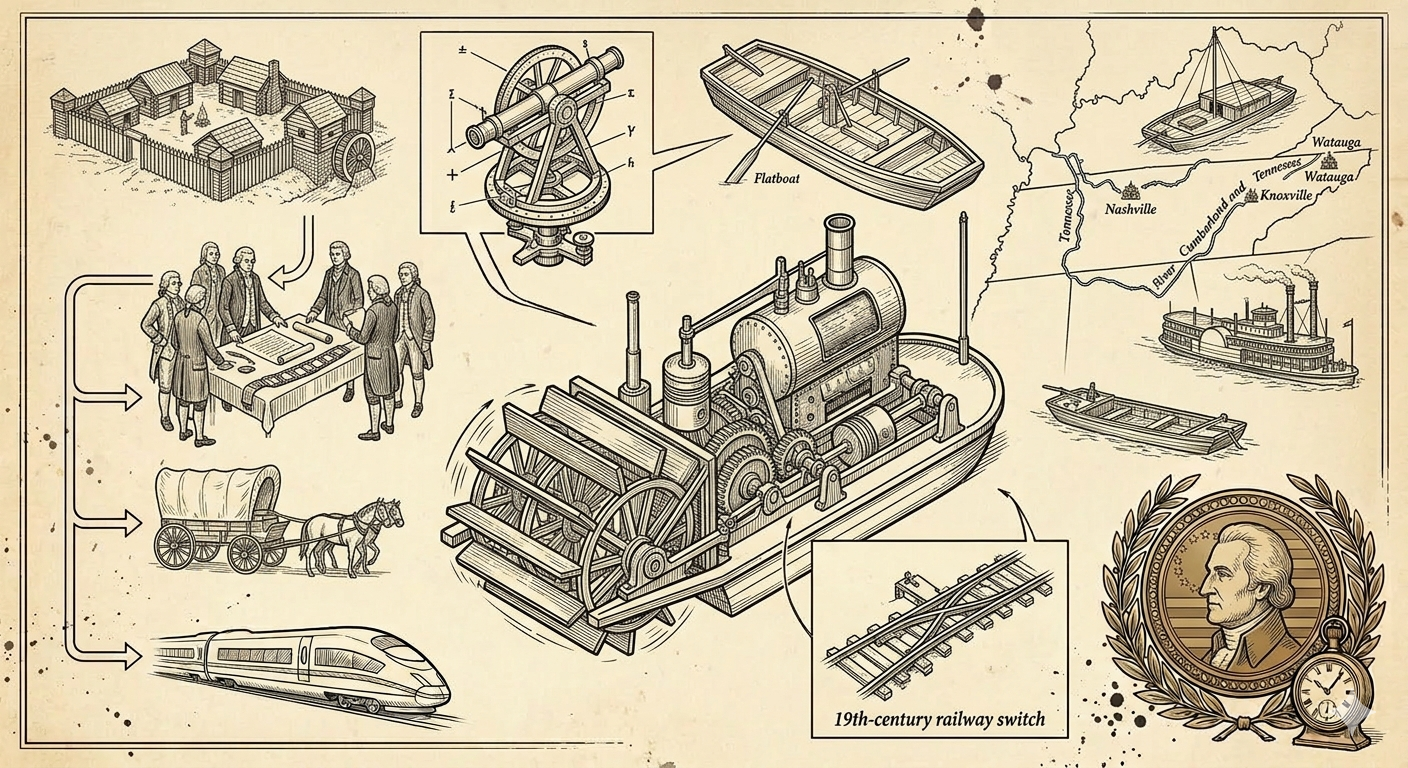
Introduction: The Volunteer State Joins the Union
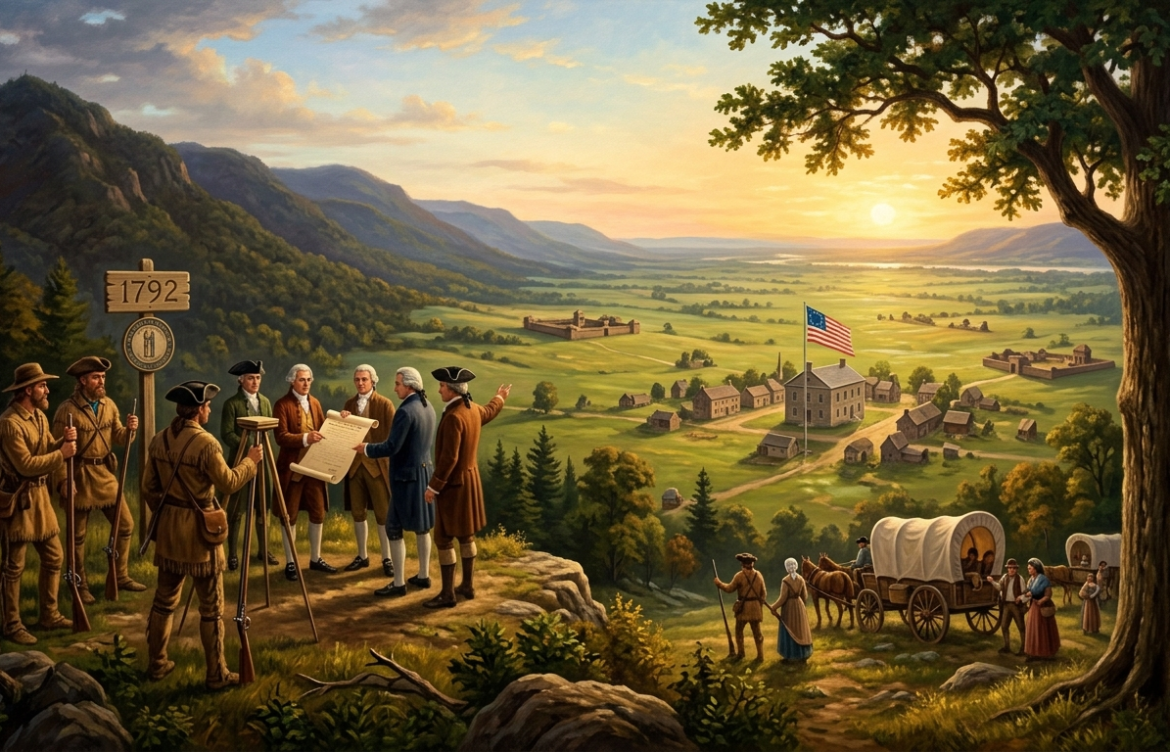
On June 1, 1796, President George Washington signed the legislation that admitted Tennessee as the sixteenth state of the United States of America. It was the culmination of a journey that had begun nearly a century earlier with the first European explorations of a land already home to ancient Native nations, and that had passed through decades of frontier conflict, failed self-governance, territorial administration, constitutional innovation, and fierce partisan political combat in the halls of Congress. Tennessee’s path to statehood was unlike that of any state before or after it, shaped by the audacity of its frontier leaders, the determined ambitions of a territorial governor who owned a million acres of the land he administered, and the sharp partisan divisions of a young republic whose very identity was still being contested.
The state that emerged from this turbulent process was, in many respects, a reflection of the people who had made it. They were Overmountain Men — settlers who had crossed the Blue Ridge not as subjects of a distant crown or dependents of a coastal government, but as self-governing pioneers who had drafted their own constitutions, elected their own magistrates, and fought their own wars before any formal government reached them. Their political instincts were intensely democratic and fiercely independent, and the constitution they produced in January 1796 was praised by Thomas Jefferson himself as ‘the least imperfect and most republican’ of any state constitution then in existence. In the story of Tennessee’s journey from wilderness to statehood lies the story of the early American republic itself — its democratic promise, its frontier contradictions, its partisan rivalries, and its extraordinary westward energy.
June 1 is celebrated as Statehood Day in Tennessee, a recognition formalized by the state legislature in 1929. The Tennessee state legislature designated this day to honor the heritage of a commonwealth that gave the nation three presidents, earned the nickname ‘The Volunteer State’ for the citizen-soldier tradition its founders established, and became, through its unique path to admission, the model that six subsequent states would follow in seeking entry to the Union.
Part I: The Ancient Land and Its First Peoples — Native Nations of Tennessee
Prehistory and the Mound Builders of the Tennessee Valley
The territory that would become Tennessee had been home to human communities for at least twelve thousand to fifteen thousand years before any European set eyes on it. Archaeological evidence, including artifacts found primarily in the western valley of the Tennessee River and the Central Basin, indicates continuous occupation by Paleo-Indian cultures stretching back to the end of the last Ice Age. Over the following millennia, the region’s inhabitants transitioned from hunter-gatherer lifestyles to increasingly complex agricultural societies, and by approximately 800 CE, elaborate Mississippian cultures had emerged across much of the territory. These Mississippian peoples are often called the Mound Builders because of the earthen mounds they constructed for use as burial places, temple platforms, and the elevated foundations of chiefs’ dwellings. Some of these mounds were enormous structures built without the assistance of horses or oxen, requiring the coordinated labor of entire communities over many generations. Some, when viewed from above, were shaped to resemble animals; others were constructed in precise geometric forms. The sophistication of these constructions attests to the complexity of the societies that built them.
By the early eighteenth century, most of the surviving Native American population of what is now Tennessee was concentrated in two major groups. The Cherokee, who had migrated into the eastern portions of present-day Tennessee from Virginia in the latter seventeenth century — possibly to escape expanding European settlement and epidemic diseases in the north — occupied the Appalachian highlands and river valleys of the east. They had forced the Creek, Yuchi, and Shawnee out of much of the state by the early 1700s. The Chickasaw, one of the most formidable military nations in the entire Southeast, held the western portions of the territory. The middle section of the state contained comparatively few permanent Native settlements, though both the Cherokee and the Shawnee claimed it as vital hunting ground, and their competing claims over this territory would generate decades of violent conflict as European settlers began to encroach from the east.
Spanish Exploration in the Sixteenth Century — Hernando de Soto and Juan Pardo
The first Europeans to leave a recorded account of what is now Tennessee were Spanish conquistadors seeking gold and a path to the Pacific. The expedition of Hernando de Soto, which had landed on the Florida coast in 1539 and spent years pushing through the interior of the continent, entered the Tennessee Valley via the Nolichucky River in June 1540. De Soto’s party rested for several weeks at the Cherokee town of Chiaha, near the site of the modern Douglas Dam, before pressing southward toward the Coosa chiefdom in what is now northern Georgia. De Soto’s expedition is also believed to have reached the Mississippi River in 1541, possibly at or near the site of present-day Memphis, making him the first European to view that mighty waterway. His chronicles constitute the earliest written accounts of the Tennessee Valley’s sixteenth-century inhabitants, describing complex agrarian communities speaking a Muskogean dialect, living in fortified villages, and organized within the sphere of the Coosa chiefdom’s regional influence.
Two more Spanish expeditions followed in subsequent decades. In 1559, the expedition of Tristán de Luna, which had been resting at Coosa, ventured into the Chattanooga area to assist a Cherokee chief in subduing a rival tribe. In 1567, Captain Juan Pardo led an expedition inland from the South Carolina coast, traveling through the French Broad River into the Tennessee Valley and encountering a Native village he recorded as ‘Tanasqui’ — a name that may be the earliest recorded approximation of the word that would eventually become ‘Tennessee.’ Pardo’s expedition reached as far as the upper Little Tennessee River before being forced to turn back. The name Tennessee derives most directly from the Cherokee town of Tanasi, located on the Little Tennessee River in present-day Monroe County, Tennessee. Modern research suggests the Cherokees may have adapted the name from the Yuchi word Tana-tsee-dgee, meaning ‘brother-waters-place’ or ‘where the waters meet.’ The name appeared on British maps as early as 1725, and the modern spelling ‘Tennessee’ is attributed to Governor James Glen of South Carolina, who used this form in official correspondence during the 1750s.
French and English Rivalry — The Colonial Struggle for the Interior
After the Spanish explorations of the sixteenth century, Tennessee lay largely outside the direct sphere of European colonial attention for nearly a century. French traders and explorers pushing southward from Canada through the Great Lakes and down the Mississippi River system became the next Europeans to engage seriously with the Tennessee region. Father Jacques Marquette and Louis Jolliet, who together mapped much of the Mississippi in 1673, contributed to the French geographical understanding of the region. René-Robert Cavelier de La Salle’s explorations of the Mississippi Valley in the 1680s further extended French knowledge of the interior. The French established Fort Toulouse at the confluence of the Coosa and Tallapoosa rivers in present-day Alabama, providing a base from which French traders and diplomats cultivated alliances with the Cherokee and other nations, challenging English commercial and diplomatic influence in the interior.
From the English colonial side, the Virginia traders James Needham and Gabriel Arthur made an exploratory journey into the Tennessee Valley in 1673, representing the first documented English contact with the region’s Native nations. English traders from the Carolina colonies followed throughout the early eighteenth century, traveling primarily by way of the Ohio River or through the mountain gaps that provided the only practicable overland routes from the coastal settlements. The French and Indian War of 1754 to 1763, which ended with the decisive defeat of France and the transfer of French territories east of the Mississippi to Britain, settled the contest for continental dominance in Britain’s favor and opened the trans-Appalachian interior to an accelerating wave of English-speaking settlement.
Part II: The Watauga Association — America’s First Constitutional Government West of the Mountains
The Overmountain Settlers and the Origins of Self-Governance
The first permanent European-American settlements in what is now Tennessee took root in the early 1770s along the Watauga and Nolichucky rivers in the northeastern corner of the present state. These settlers — many of them Scots-Irish and German immigrants from western Pennsylvania, Maryland, and the Carolina backcountry, joined by Virginians moving southwest along the Great Wagon Road — had crossed the Blue Ridge Mountains into territory that was technically beyond the recognized boundaries of any British colonial government. The land on which they settled belonged to the Cherokee nation and had not been legally opened for European settlement. British colonial authorities regarded their presence as illegal, and royal edicts forbade the settlement of western lands by those fleeing debts or legal troubles in the settled colonies.
Among the earliest and most significant of these pioneers were William Bean, who is credited as the first recorded European-American settler in present-day Tennessee, establishing a homestead along the Watauga River around 1769, and James Robertson, who had emigrated from Orange County, North Carolina, and arrived in the Watauga settlements around 1770. Robertson recognized immediately both the potential and the danger of the settlers’ precarious position. Living outside the jurisdiction of any colonial government, they had no courts to register deeds, no legal mechanism for resolving disputes, no officially recognized authority to protect them from the violence of those who might prey on an unprotected frontier community. In 1772, Robertson and Bean negotiated directly with local Cherokee leaders to secure a ten-year lease for the Watauga lands, providing at least a formal recognition of the settlers’ presence in Cherokee territory.
The Articles of the Watauga Association — 1772
With the land lease secured, the Watauga settlers faced the challenge of creating the governmental structure they so urgently needed. In May 1772, they drafted the Articles of the Watauga Association — a compact that established one of the first written constitutional governments ever created by American-born colonists west of the Appalachian Mountains. The association incorporated the Virginia code of laws and established a five-man court of elected magistrates to conduct the business of government, covering executive, legislative, and judicial functions. A clerk recorded the court’s deliberations, and a sheriff executed its judgments. John Carter likely served as the first chairman of the court. James Robertson was almost certainly a member — it has been suggested that he proposed the name ‘Watauga Association’ — and John Sevier, who would become the dominant figure in Tennessee’s subsequent history, joined the court as a clerk in 1775 and was elected to it in 1776.
The Watauga Association has been celebrated by historians ever since as a founding moment of American democratic self-governance. Historian Andrew C. McLaughlin wrote that ‘one can find no more striking fact in American history, nor one more typical, than the simple ease with which those frontiersmen formed an association and extended the rights and privileges of self-government.’ His colleague Claude Van Tyne compared the Wataugans to the Pilgrim Fathers: ‘like the Pilgrim Fathers they were without formal laws and institutions, and they made them.’ Theodore Roosevelt, in The Winning of the West, went further still, writing that ‘the Watauga settlers outlined in advance the nation’s work. They tamed the rugged and shaggy wilderness, they bid defiance to outside foes, and they successfully solved the difficult problem of self-government.’ Lord Dunmore, the colonial governor of Virginia, took a darker view, calling the Watauga Association ‘a dangerous example’ of Americans forming a government ‘distinct from and independent of His Majesty’s authority’ — a charge that was, by 1772, not entirely inaccurate in spirit, even if the Wataugans made no formal claim of independence.
John Sevier — The Dominant Figure of Early Tennessee
John Sevier was born on September 23, 1745, in Augusta County in the Colony of Virginia, near the present-day town of New Market. He received a basic education and worked early in life as a farmer and land speculator before making his way to the trans-Appalachian frontier in the early 1770s. In late 1773, he moved his family to the Carter Valley settlements along the Holston River in what is now northeastern Tennessee, and three years later relocated further south to the Watauga settlements. He was a man of extraordinary personal energy and charisma — described by contemporaries as physically imposing, personally charming, and possessed of a natural authority that made men follow him in both war and politics. John Sevier would go on to serve as governor of the State of Franklin, as brigadier general of the Southwest Territory militia, and as Tennessee’s first governor, serving an unprecedented six two-year terms between 1796 and 1809. He was also elected to three terms in the United States House of Representatives from Tennessee, serving from 1811 until his death on September 24, 1815. He was, by any measure, the single most consequential figure in the founding of the state of Tennessee.
The Cherokee Wars, Fort Watauga, and the Battle of 1776
The Cherokee invasion of July 1776 put the Watauga settlements to their first great military test. The British, seeking to suppress the colonial rebellion and aware that the Overmountain settlements were providing men and supplies to the Patriot cause, encouraged and supplied a coordinated Cherokee offensive against the frontier settlements. The invasion was forewarned to the settlers by Nancy Ward, a Cherokee Beloved Woman who held significant political authority within the Cherokee nation and who opposed the attacks. The Holston settlers, led by Colonel John Sevier and Colonel Isaac Shelby among others, repulsed the attack at the Battle of Island Flats near modern Kingsport on July 20, 1776. The following day, a Cherokee force led by Old Abraham of Chilhowee attacked Fort Watauga — also known as Fort Caswell — where 75 militia under the command of John Carter held out, with Sevier and James Robertson as subordinates. In a moment that became legendary in the annals of early Tennessee, Sevier pulled his future wife Catherine Sherrill to safety over the fort’s palisades when she could not make it inside before the gate was locked. The fort held for two weeks before Old Abraham retreated. The Cherokee nation eventually sued for peace following a punitive expedition by William Christian against the Overhill towns in October 1776.
Part III: The Revolutionary War, the Overmountain Men, and the Battle of Kings Mountain
James Robertson and the Cumberland Settlements — The Founding of Nashville
While the Watauga settlements were consolidated in the northeastern corner of present-day Tennessee, another major center of frontier settlement was taking shape in the central region. James Robertson — the same James Robertson who had been among the founders of the Watauga Association — led a major overland expedition in 1779 and 1780 to establish settlements in the Cumberland River basin. Robertson and his party traveled overland in the autumn of 1779 to the French Salt Lick at the Big Bend of the Cumberland River, reaching it on Christmas Day 1779. A second party, led by John Donelson, made the famous ‘Donelson Voyage’ in the spring of 1780, traveling by flatboat from Fort Patrick Henry down the Holston, Tennessee, and Cumberland rivers to reach the same destination. The settlement they established there, initially called Fort Nashborough and later Nashville, became the administrative and commercial center of Middle Tennessee and would eventually serve as the state’s capital from 1812 onward. Robertson is honored today as one of the two founding fathers of Nashville, alongside Donelson. The Cumberland Compact, drafted in 1780 to govern these new settlements, was directly inspired by the earlier Watauga Association and carried its democratic self-governance principles into the heart of the Tennessee region.
Patrick Ferguson’s Threat and the Muster at Sycamore Shoals
The defining military event in the story of pre-statehood Tennessee was the Battle of Kings Mountain on October 7, 1780, which Thomas Jefferson would later call ‘the turn of the tide of success’ in the Revolutionary War. It began with a threat. British Major Patrick Ferguson, a Scottish infantry specialist commanding a force of American Loyalists and serving as the left flank protection for General Lord Charles Cornwallis’s invasion of the Carolinas, had been moving through the South Carolina backcountry routing Patriot militias and building Loyalist strength. In September 1780, Ferguson sent a message directly to the Overmountain leaders across the mountains. His threat was blunt: if they did not lay down their arms and cease resistance to British authority, he would ‘march this army over the mountains, hang your leaders, and lay waste your country with fire and sword.’
The threat achieved precisely the opposite of its intended effect. Upon receiving Ferguson’s message, Isaac Shelby — the same Isaac Shelby who had been a figure of the Watauga Association and who would later become Kentucky’s first governor — rode forty miles to the home of John Sevier to discuss the response. The two militia colonels quickly agreed that they would not wait for Ferguson to come to them; they would cross the mountains and find him. Express riders went out in every direction calling for a muster of frontier militiamen. On September 25, 1780, more than one thousand Overmountain Men assembled at Sycamore Shoals on the Watauga River — the same place where the Treaty of Sycamore Shoals had been signed five years earlier — to begin the long march over the mountains. Sevier brought 240 men from Washington County. Shelby brought an equal number from Sullivan County. Colonel William Campbell arrived from Virginia with 400 men. A young woman named Mary Patton, who owned a powder mill along nearby Powder Branch, supplied the expedition with 500 pounds of gunpowder for their muskets and rifles.
The Battle of Kings Mountain — October 7, 1780
The Overmountain Men crossed Roan Mountain in late September 1780, marching through cold and rain, and gathered strength as they moved. They were joined at Quaker Meadows by the North Carolina militia of Colonel Charles McDowell and, later, by additional forces led by Colonel Benjamin Cleveland. By October 1, the combined force numbered approximately 1,400 men, all of them frontier militiamen, none of them trained regular soldiers. The five colonels commanding the force — Shelby, Sevier, Campbell, McDowell, and Cleveland — elected William Campbell as nominal overall commander. Ferguson, receiving intelligence of the large force advancing toward him, began a retreat toward Cornwallis and the main British army. He sent a message to Cornwallis requesting reinforcements but chose to halt his retreat and make a stand atop Kings Mountain, a rocky wooded ridge straddling the North Carolina-South Carolina border, believing the elevated position gave him a tactical advantage.
Ferguson’s confidence proved fatal. On the morning of October 7, after an all-night ride through cold rain, the Overmountain Men surrounded Kings Mountain and launched a four-pronged attack. The frontier sharpshooters used the trees on the mountain’s slopes for cover and steadily picked off the Loyalists on the exposed summit. Ferguson, wearing a distinctive checkered hunting shirt to identify himself to his troops and waving a sword, rode back and forth directing the defense, occasionally blowing his silver officer’s whistle to signal commands. He died in the battle when he was shot while attempting a desperate breakout through Sevier’s line. Captain Abraham de Peyster, who took command after Ferguson’s death, attempted to surrender, but the Overmountain Men — remembering the massacre of surrendering Patriots at the Battle of Waxhaws months earlier — continued fighting for several minutes before the colonels regained control and accepted the surrender. The battle lasted approximately one hour. One hundred fifty-seven Loyalists were killed, 163 badly wounded, and 698 taken prisoner. The Patriot forces lost 28 killed and 62 wounded.
The significance of Kings Mountain extended far beyond its immediate casualties. British commander Henry Clinton later wrote that the American victory ‘proved the first link of a chain of evils that followed each other in regular succession until they at last ended in the total loss of America.’ Cornwallis, deprived of Ferguson’s force and alarmed by the fighting capacity of the frontier militia, abandoned his invasion of North Carolina and retreated to South Carolina. The momentum of the war in the South shifted decisively to the Patriot side, beginning the chain of events that would lead to Yorktown and the end of the war. For the Overmountain people who would become Tennesseans, Kings Mountain was far more than a military victory — it was the foundational act of a collective identity, the proof that the trans-Appalachian frontier communities could defend themselves against the most formidable military power in the world and shape the destiny of the republic.
Part IV: North Carolina’s Cession, the State of Franklin, and the Road to Federal Territory
North Carolina Cedes Its Western Lands — 1784
The end of the Revolutionary War left the trans-Appalachian settlers in a precarious political position. They had fought effectively for American independence, but the eastern states that had organized and led that struggle now controlled a national government under the Articles of Confederation that was barely capable of governing its own territory, let alone providing meaningful protection and services to frontier communities hundreds of miles from the nearest center of established authority. North Carolina technically claimed sovereignty over the Tennessee settlements, but showed little inclination to spend money or military resources on their defense. Settlers in Washington, Sullivan, Greene, Davidson, Sumner, and Tennessee Counties endured near-constant attacks from Cherokee, Chickamauga, and Creek warriors without adequate military support from the state government in New Bern or Raleigh.
In June 1784, the North Carolina legislature voted to cede its western lands — the territory that is now Tennessee — to the Congress of the Confederation, citing the state’s inability to maintain effective governance over such a remote region and the financial burden of defending it. The cession was enormously welcome to the settlers, who believed that the federal government, however weak, would do a better job of protecting them than North Carolina had managed. Congress, however, facing its own fiscal and organizational difficulties, did not immediately accept the cession, leaving the region in a jurisdictional vacuum. North Carolina then complicated matters further by rescinding its cession in November 1784, reasserting its authority over the western territory before the federal government had formally accepted it. This whiplash of governance — ceded, then reclaimed — left the western settlers furious and feeling abandoned by both the state and the federal government.
The State of Franklin — America’s Forgotten State, 1784–1788
The settlers’ response to North Carolina’s political instability was characteristically direct. On August 23, 1784, approximately fifty frontier leaders met in Jonesborough — the oldest permanent European-American settlement in present-day Tennessee, founded in 1779 — and signed a declaration of independence from North Carolina, announcing their intention to form a separate state. Within months they had established a functioning government with courts, a militia, and a legislature, and had chosen a name for their new polity: Franklin, in honor of Benjamin Franklin, the republic’s elder statesman, whose wisdom and prestige they hoped would lend their enterprise legitimacy. William Cocke, one of the new constitution’s authors, was dispatched to Philadelphia to petition Congress for admission as a state. The state of Franklin sent delegates to the Continental Congress and eventually established a permanent capital at Greeneville.
The man who stepped forward — somewhat reluctantly — to lead the new state as its governor was John Sevier, already the most celebrated military and political figure in the region. Sevier served as Franklin’s only governor, presiding over a state that functioned as an independent but unrecognized government from 1784 until its final collapse in 1788. The State of Franklin’s constitution borrowed heavily from the North Carolina constitution, and the state organized eight counties: Greene, Sullivan, Washington, Sevier, Blount, Spencer, Caswell, and Wayne. Had North Carolina’s opposition not been decisive — the state refused to recognize Franklin and organized its own parallel county governments in the territory — and had the Confederation Congress been more willing to admit a new state from disputed territory, Franklin might well have entered the Union as the fourteenth state rather than remaining a footnote in history. Congress never mustered the two-thirds majority needed to admit Franklin, and North Carolina’s fierce opposition made the project untenable. By 1788, the State of Franklin had ceased to exist as a functioning government, and its territory was back under North Carolina’s nominal authority.
William Blount and the Southwest Territory — 1790
North Carolina, having reabsorbed the Franklin territory, again ceded its western lands to the federal government in 1789, this time definitively. Congress accepted the cession, and on May 26, 1790, created the ‘Territory of the United States South of the River Ohio’ — a name so cumbersome that it was almost immediately shortened to the Southwest Territory. President George Washington appointed William Blount as the territory’s governor. Blount was a North Carolina businessman, politician, and land speculator who had served as a member of the Continental Congress and as a delegate to the federal Constitutional Convention in 1787. He was also, by the time of his appointment, the owner of claims to approximately one million acres of land within the territory he was being appointed to govern — a fact that shaped every decision he would make as territorial administrator and that gave him a powerful personal financial incentive to see the territory’s population grow, its land values rise, and its eventual transition to statehood proceed as rapidly as possible.
Blount arrived in the territory in October 1790, establishing himself first at Rocky Mount in upper East Tennessee and later moving to Knoxville — then still known as White’s Fort — which was being developed as the territorial capital by James White, one of the territory’s founding settlers. White had established his fort at the confluence of the Holston and French Broad rivers in 1786, and it had quickly grown into the largest settlement in the territory. Blount organized the territorial government along the lines of the Northwest Ordinance, established three sub-district militia commands under John Sevier, James Robertson, and James White respectively, and began the process of building the administrative infrastructure that a functioning territory required.
Part V: William Blount, the Southwest Territory, and the Drive Toward Statehood
The Treaty of the Holston — 1791
One of William Blount’s first and most pressing responsibilities as territorial governor was to negotiate a new treaty with the Cherokee nation, whose territory overlapped significantly with the growing settler population. In June 1791, Blount called the Cherokee to a meeting at White’s Fort on the Holston River in present-day Knoxville. The resulting Treaty of the Holston, signed on July 2, 1791, began with a call for peace between the United States and the Cherokee and included an exchange of prisoners. Its most significant provision required the Cherokee to cede additional lands to the United States, pushing the boundary of Cherokee territory further south and west and opening new areas to legal settlement. The treaty also affirmed that United States citizens could not settle on remaining Cherokee lands — a provision that settlers regularly ignored, providing a continuing source of conflict throughout the territorial period.
The increase in illegal squatting on Cherokee lands that followed the treaty angered the Cherokee and the Creek nations, who launched a series of attacks on frontier settlements beginning in 1792. The remote Cumberland Settlements — the communities around Nashville — were particularly vulnerable to Creek raiding parties operating from the south. James Robertson organized military responses that destroyed Lower Town Cherokee communities in the Chickamauga territory, and additional militia operations eventually suppressed the raids and produced a period of relative peace and population growth in the region. With the threat of major Native warfare temporarily reduced, Blount moved ahead with his plans for territorial development and eventual statehood.
The 1795 Census, the Statehood Referendum, and the Constitutional Convention
The path to statehood under the Northwest Ordinance required that a territory’s population reach 60,000 free inhabitants before it could apply for admission to the Union. On June 29, 1795, a special session of the Territorial Assembly called for a census to be taken to determine whether this threshold had been reached. Blount, who had strong personal financial incentives for seeing statehood achieved quickly, ensured that the census-takers had adequate motivation by tying the pay of the sheriffs conducting the count to the totals they reported. Critics noted that this arrangement gave census-takers a powerful incentive to overcount. Nonetheless, the results announced on November 28, 1795, showed a population of 77,262 inhabitants in the Southwest Territory — comfortably exceeding the required 60,000 and clearing the final numerical hurdle to statehood.
Following the census, a referendum was held on the question of statehood itself. The results were overwhelmingly in favor: 6,504 to 2,562, a margin of approximately three to one. The Cumberland region, more recently settled and somewhat less confident about the immediate benefits of statehood versus continued territorial administration, provided most of the dissenting votes. With the referendum result establishing the popular mandate for statehood, Blount called for the election of delegates to a constitutional convention. Fifty-five delegates — five from each of the territory’s eleven counties — were chosen by the voters in December 1795. They were instructed to assemble in Knoxville on January 11, 1796, to begin drafting a constitution.
The Knoxville Constitutional Convention — January 11 to February 6, 1796
The constitutional convention that met in Knoxville in January 1796 was the most consequential political gathering in Tennessee’s pre-statehood history. Fifty-five delegates assembled at William Blount’s elegant frame house — now known as Blount Mansion and preserved today as Knoxville’s only National Historic Landmark — beginning on January 11 and completing their work on February 6, when the convention approved the constitution and the name of the new state by a unanimous vote. Blount was elected to chair the convention, giving the territorial governor, already the dominant figure in regional politics, a controlling hand in shaping the founding document of the state whose creation he had done so much to engineer.
The fifty-five delegates represented the diverse origins of the frontier population. Approximately 42 percent had originally come from Virginia, 21 percent from Pennsylvania, 18 percent from North Carolina, and 11 percent from South Carolina. The Scots-Irish cultural tradition, which emphasized individual rights, religious dissent, and a deep suspicion of distant authority, was particularly influential in the convention’s deliberations. John Sevier, earmarked from the beginning to serve as the new state’s first governor and therefore not directly chairing the proceedings, played an active role behind the scenes in supporting Blount’s agenda and steering the convention toward a document that reflected the political values of the territorial establishment. The physical location of the convention’s work — on the Statehood Desk in Blount’s office, on which all fifty-five delegates affixed their signatures — is preserved today for visitors to Blount Mansion.
The 1796 Tennessee Constitution — Jefferson’s ‘Least Imperfect’ Document
The constitution that the Knoxville convention produced was a remarkable document for its era. Thomas Jefferson — the principal author of the Declaration of Independence, a man who had served as the governor of Virginia and was intimately familiar with the constitutions of every state in the union, including the Virginia constitution drafted largely by his mentor George Mason and the Massachusetts constitution authored by his political rival John Adams — pronounced Tennessee’s founding document ‘the least imperfect and most republican’ of any state constitution then in existence. This was not a casual compliment; it was a considered judgment from the most intellectually demanding constitutional theorist of his generation.
The Tennessee constitution established a bicameral legislature as the dominant branch of government, drawing on the model of the United States Constitution and the North Carolina constitution. The executive power was vested in a governor, but the legislature was given broad authority to fill most county and state offices. There was no formally distinct judicial branch; instead, the legislature was empowered to create courts and appoint judges as needed, a flexible arrangement that reflected the frontier’s pragmatic approach to institutional design. A bill of rights modeled on those of existing state constitutions enumerated the fundamental rights of free citizens. The franchise was extended to all free males twenty-one years of age or older who owned property in the state and had resided in their county for at least six months. Crucially, this provision made no distinction on the basis of race: both white and free Black men who met the property and residency requirements could vote, making Tennessee’s 1796 constitution one of the more racially inclusive founding documents of the early republic. Similarly, at the constitutional convention of 1796, free Black men were given the right to vote if they met the residency and property requirements, though this progressive provision would be retracted by the constitutional convention of 1834.
The convention also unanimously adopted the name ‘Tennessee’ for the new state, drawing on the Cherokee place name that had been in common use since at least the 1720s and that had been applied to both a county and the territory since the late eighteenth century. On February 6, 1796, Blount declared the constitution operational without submitting it for popular ratification — a decision that mirrored the approach taken in other early state constitutions but that reflected the territorial leadership’s desire to move quickly. He immediately instructed Governor Blount to send a copy of the constitution by express to Secretary of State Timothy Pickering in Philadelphia so that it could be brought before Congress before the end of the current session.
Part VI: The Tennessee Plan — An Audacious Bid for Statehood and the Congressional Battle of 1796
Acting as a State Before Congress Had Agreed — The Tennessee Plan
The approach that William Blount and Tennessee’s leaders chose for seeking congressional approval of statehood was unlike anything that had been attempted before in American history. Rather than submitting their constitutional documents to Congress and waiting for that body to deliberate, debate, and ultimately pass enabling legislation before organizing a state government, Blount proceeded on the assumption that statehood was effectively a fait accompli. After the constitution was adopted on February 6, 1796, he issued writs of election to the sheriffs of all counties, ordering elections for governor, members of the General Assembly, members of the United States House of Representatives, and United States Senators. The elections were held in March 1796. John Sevier was chosen as the first governor of the State of Tennessee. The first Tennessee General Assembly convened on March 29, 1796. William Blount and William Cocke were elected as Tennessee’s two United States Senators by the legislature. Andrew Jackson — a thirty-one-year-old attorney who had come to Tennessee in 1788 and rapidly established himself in Knoxville’s legal and political circles — was elected as Tennessee’s representative in the United States House.
Having organized a fully functioning state government, Blount then sent the constitution, the census figures, and other relevant documents to President Washington with the message that the government of the Territory of the United States South of the River Ohio had ‘terminated’ and the government of the State of Tennessee had been organized and established. Blount, Cocke, and Jackson then traveled to Philadelphia — then the seat of the federal government, before the creation of Washington, D.C. — and essentially presented Congress with the accomplished fact of Tennessee’s statehood. This audacious strategy, which came to be called the ‘Tennessee Plan,’ was without precedent: no territory had ever organized itself as a state, elected its government, and sent its representatives to Congress before receiving formal admission. Six states would eventually follow Tennessee’s example in pursuing statehood through this method: Michigan, Iowa, California, Oregon, Kansas, and Alaska all gained statehood by employing variations of the Tennessee Plan.
The Congressional Debate — Federalist Opposition and the 1796 Presidential Election
Tennessee’s application for statehood arrived in Congress at a moment of acute partisan tension. The presidential election of 1796 — the first contested presidential election in American history, pitting John Adams for the Federalists against Thomas Jefferson for the Democratic-Republicans — was only months away, and Tennessee’s admission to the Union was entangled with its partisan implications in ways that would prove decisive to the outcome of the congressional debate. President Washington submitted Tennessee’s constitution, the census, and related documents to both houses of Congress on April 8, 1796, without offering any personal recommendation on the question of admission.
The Federalists in Congress were well aware that Tennessee’s political culture was overwhelmingly sympathetic to Thomas Jefferson and the Democratic-Republican cause. The territory’s alignment with Jefferson was the product of years of southwestern antagonism toward Federalist policies, including the Jay Treaty of 1794 — which had appeared to sacrifice western navigation rights on the Mississippi in exchange for commercial concessions with Britain — and the general perception that the Adams-Hamilton wing of the Federalist party was more interested in the commercial and financial interests of the eastern seaboard than in the practical needs of the frontier. Tennessee’s admission to the Union would bring with it four electoral votes in the approaching presidential election, votes that the Federalists correctly calculated would go to Jefferson. Their strategy was therefore to delay Tennessee’s admission until after election day — to prevent the new state from participating in the election at all, or at least to limit its electoral influence.
In the House of Representatives, the issue was debated and resolved relatively quickly. After considerable discussion, the House voted forty-three to thirty on May 6, 1796, in favor of admitting Tennessee. The Senate, with its Federalist majority, was a different matter. The Federalist senators maneuvered to delay a Senate vote on admission, hoping to push it past the date by which the new state would need to appoint electors to participate in the presidential election. The political genius that broke the deadlock came from an unlikely source: Aaron Burr of New York, a Republican senator who would later become Vice President and kill Alexander Hamilton in a duel, proposed an amendment to the admission bill that allowed Tennessee statehood on the condition that the state would initially receive only one seat in the House of Representatives rather than the two it would have been entitled to based on its census population. This reduction cut Tennessee’s Electoral College votes from four to three, limiting the state’s ability to influence the presidential outcome.
The Senate Federalists, their most feared electoral consequence partially mitigated by Burr’s amendment, ultimately chose not to block admission entirely. On June 1, 1796, the last day of the congressional session, the Senate passed the admission bill. President George Washington signed the legislation the same day, making Tennessee the sixteenth state of the United States. The single House seat allotted to Tennessee by the compromise was filled by Andrew Jackson — the young Tennessee lawyer whose entire career in national politics was just beginning.
Andrew Jackson — From Tennessee Congressman to President
Andrew Jackson was born on March 15, 1767, on the border of North and South Carolina, the son of Irish immigrants. He had come to Tennessee in 1788 as a young lawyer seeking opportunity on the frontier, riding over the Clinch Mountain with Judge John McNairy and quickly establishing himself in Jonesborough and later Nashville as a prosecutor and land speculator. He had studied law under the mentorship of established North Carolina lawyers, and his aggressive, combative personal style suited perfectly the rough-and-tumble political culture of the Tennessee frontier. By the time of Tennessee’s statehood in 1796, Jackson was already a significant figure in Nashville’s political and legal establishment, having served as Tennessee’s first prosecuting attorney and acquired substantial land holdings. His election as Tennessee’s first representative in the United States House of Representatives at the age of twenty-nine launched a national political career that would carry him to the presidency in 1829, making him the seventh President of the United States and the first president from a state west of the Appalachian Mountains. Jackson’s entire political identity was formed by the Tennessee frontier experience — his beliefs in democratic equality, his hostility to the eastern financial establishment, his martial values, and his passionate defense of western settlers’ interests all bore the unmistakable imprint of the society that Tennessee’s founding had created.
Part VII: June 1, 1796 — The Significance of Tennessee’s Statehood
The First State Created from Federal Territory
Tennessee’s admission as the sixteenth state was significant for reasons that extended well beyond the political history of the frontier. It was the first state to be created from federal territory — the first time that the young republic’s constitutional machinery for the transformation of territorial governance into full statehood was applied to a region that had been administered directly by the federal government rather than ceded by a previously existing state in its constitutional form. Kentucky, Tennessee’s immediate predecessor as a new western state, had been carved out of Virginia through a negotiated separation. Tennessee was different: it had passed through the Southwest Territory, a federally administered entity, on its way to statehood. This precedent established the template for every subsequent state admission from territory — an enormously consequential contribution to the structure of American constitutional development, given that approximately thirty of the fifty states would eventually enter the Union through the territorial pathway that Tennessee had pioneered.
Tennessee’s constitution was also notable for the breadth of its democratic provisions, including the racially inclusive franchise that extended voting rights to all free men who met property and residency requirements without regard to race. This provision, however enlightened by the standards of 1796, coexisted with the institution of slavery, which the same constitution implicitly protected. The first Tennessee settlers had brought enslaved people westward with them from Virginia, Kentucky, and the Carolinas, and the plantation economy — built on tobacco and livestock in Middle Tennessee’s fertile bluegrass country — was already a significant feature of the state’s agricultural landscape. The contradictions between the democratic ideals of the frontier constitution and the brutal realities of enslaved labor were baked into Tennessee’s founding, as they were into the founding of the republic itself.
John Sevier as First Governor — Organizing the New State
John Sevier delivered his first address to the Tennessee General Assembly in the spring of 1796, informing the legislators of the state’s admission to the Union and outlining the organizational tasks ahead. The state government was initially centered in Knoxville, which served as the first capital. Sevier was an enormously popular figure — beloved by the frontier population for his military record, his personal accessibility, and his identification with the values and interests of the ordinary settler. He served six two-year terms as governor, totaling eleven years in office across two separate periods: 1796 to 1801, and 1803 to 1809. Term limits prevented him from serving a fourth consecutive term in both instances. His political career was marked in its later years by a growing and intensely personal rivalry with Andrew Jackson, which nearly culminated in a duel in 1803 when the two men’s political and personal antagonisms reached a breaking point. Sevier died on September 24, 1815, while on a survey mission, and was buried on the Tallapoosa River in what is now Alabama. His remains were later exhumed and reinterred in Knoxville’s Courthouse Square.
William Blount’s Fate and Tennessee’s Early Congressional Representation
William Blount’s ambitions extended beyond the governorship he had held in the Southwest Territory to the Senate seat the new state’s legislature awarded him. But his career as a senator proved short-lived. In July 1797, documents surfaced suggesting that Blount had been involved in a scheme to support a British military expedition against Spanish Florida and Louisiana — an enterprise that would have served his enormous land speculations in the western territories by displacing Spanish influence. The Senate expelled him on July 8, 1797 — the first time any senator had been expelled from that body. Blount returned to Tennessee, where, far from being politically destroyed, he remained popular. He was elected to the state senate and served until shortly before his death. He died in March 1800, reportedly after a brief illness. William Cocke, the second of Tennessee’s first two senators, was a veteran of the Revolutionary War, a former delegate to the North Carolina legislature, and one of the drafters of the State of Franklin’s constitution. He served in the Senate until 1797 and again from 1799 to 1805.
Part VIII: The Legacy of Tennessee Statehood — Democracy, Expansion, and the Volunteer Spirit
The Tennessee Plan and Its Influence on American Statehood
The audacity of the Tennessee Plan — the strategy of organizing a state government and presenting Congress with a completed institutional fact before receiving formal admission — left a permanent mark on the process of American territorial expansion. The six states that followed Tennessee’s example in pursuing statehood through some version of this approach — Michigan, Iowa, California, Oregon, Kansas, and Alaska — each drew on the precedent that William Blount, John Sevier, and their colleagues had established in 1796. Puerto Rico has in more recent times considered following the same strategy. The Tennessee Plan’s essential insight — that the most effective way to overcome congressional delay and partisan obstruction in the admission process is to present an accomplished fact rather than a petition — has proven remarkably durable as a political strategy.
The Volunteer State — A Tradition Born in the Creek and Cherokee Wars
Tennessee earned its enduring nickname, ‘The Volunteer State,’ from the extraordinary citizen-soldier tradition that manifested most dramatically during the War of 1812. When General Andrew Jackson sent out a call for volunteers to defend New Orleans from the British in the winter of 1814-1815, Tennessee responded with a flood of men that vastly exceeded the official quota. The subsequent American victory at the Battle of New Orleans on January 8, 1815, in which Jackson’s Tennessee militia and frontier forces routed a veteran British army, catapulted Jackson to national prominence and confirmed Tennessee’s identity as a state that answered its country’s military call with extraordinary generosity. The tradition continued in the Mexican-American War, when President James K. Polk — himself a Tennessee native — requested 2,800 volunteer soldiers from the state and received offers from 30,000. In the Civil War, approximately 187,000 Tennesseans fought for the Confederacy and 51,000 for the Union.
This volunteer tradition had roots that stretched back before statehood to the frontier communities that had defended themselves against Cherokee and British threats without waiting for any government to organize their defense. The Overmountain Men who mustered at Sycamore Shoals in September 1780, the Watauga settlers who built Fort Caswell on their own initiative, the members of the Nashville Station who organized punitive expeditions against the Lower Towns when the Cumberland settlements were under attack — all of these acts of voluntary collective defense expressed the same fundamental spirit that would later define Tennessee’s military identity. The Volunteer State’s nickname was not a marketing invention; it was the distilled expression of a culture that had been built, generation by generation, on the principle that the community’s defense was the responsibility of every capable man within it.
Three Presidents from Tennessee — Jackson, Polk, and Johnson
Tennessee’s most extraordinary contribution to the national political history of the United States may be the fact that it produced three presidents in the nineteenth century, each of whom embodied in distinctive ways the frontier values that the state’s founding had crystallized. Andrew Jackson, the seventh president, serving from 1829 to 1837, was the paradigmatic figure of Jacksonian democracy — the champion of the common man against the entrenched privileges of the eastern financial and commercial establishment, the general who had beaten the British at New Orleans and the Creek at Horseshoe Bend, the rough-hewn frontier lawyer who had risen from nothing to become the most powerful man in the country. His presidency fundamentally reoriented American politics around the democratic impulses that the Tennessee frontier had always expressed.
James K. Polk, Tennessee’s eleventh governor and the eleventh president, serving from 1845 to 1849, is remembered primarily for the continental expansion his presidency achieved. Under Polk’s leadership, the United States annexed Texas, settled the Oregon boundary dispute with Britain, and acquired California and the Southwest from Mexico — completing, in a single presidential term, the territorial framework of the continental republic. Polk was a more disciplined and methodical figure than Jackson, but his commitment to westward expansion reflected the same fundamental orientation toward continental destiny that the Tennessee frontier experience had instilled. Andrew Johnson, who served as the seventeenth president from 1865 to 1869 following Lincoln’s assassination, guided the nation through the turbulent early phase of post-Civil War Reconstruction, struggling to implement a lenient reunification policy against the resistance of Radical Republicans in Congress. Johnson’s career was marked throughout by his identification with the interests of working-class white Southerners — the small farmers and tradespeople of East Tennessee who had little sympathy for the planter aristocracy and who had provided the backbone of Tennessee’s Unionist sentiment during the Civil War. His impeachment by the House of Representatives in 1868 and his acquittal by the Senate by a single vote remains one of the most dramatic constitutional crises in American history.
Tennessee’s Constitutional Evolution and Its Role in Women’s Suffrage
Tennessee’s constitution was revised in 1799, replaced in 1834, and again in 1870, reflecting the dramatic changes in the state’s political culture over the course of the nineteenth century. The 1834 revision notably retracted the voting rights that had been available to free Black men under the 1796 constitution, marking a regression in democratic principles that mirrored the broader hardening of racial attitudes in antebellum Southern society. The 1870 constitution was adopted in the immediate aftermath of the Civil War and shaped the state’s legal structure for the remainder of the nineteenth century and well into the twentieth. Tennessee’s most celebrated constitutional moment came in August 1920, when the state legislature became the thirty-sixth state to ratify the Nineteenth Amendment to the United States Constitution, providing the decisive vote that secured women’s right to vote nationwide. The pivotal vote was cast by a twenty-four-year-old legislator named Harry T. Burns, who had received a letter from his mother urging him to ‘be a good boy’ and support the amendment. Tennessee’s ratification of the Nineteenth Amendment, coming at the critical moment when the amendment needed exactly one more state to reach the three-quarters threshold required for ratification, was perhaps the single most consequential act of any state legislature in the entire history of constitutional amendment in America.
Conclusion: What June 1, 1796 Meant for Tennessee and for America
On June 1, 1796, President George Washington’s signature on the admission bill completed the transformation of the Territory of the United States South of the River Ohio into the Commonwealth of Tennessee — the sixteenth state of the American union, the first created from federal territory, and the state that would serve as the model for nearly all that followed it along the territorial-to-statehood pathway. The journey that culminated in that signature had taken more than two decades, traveling through the Watauga Association’s frontier democracy of 1772, the fire of the Battle of Kings Mountain in 1780, the frustrated ambitions of the State of Franklin in the 1780s, the territorial administration of William Blount in the 1790s, and the audacious Tennessee Plan that forced a reluctant Congress to accept what had already been accomplished on the ground.
The men and women who made Tennessee’s statehood possible deserve their place in the record of American history. William Bean established the first settlement. James Robertson drafted the first government and later founded Nashville. The members of the Watauga Association created the continent’s first constitutional government west of the mountains. John Sevier fought Cherokee, led the Battle of Kings Mountain’s decisive flank attack, governed the State of Franklin through its brief existence, and became Tennessee’s first governor. Isaac Shelby organized the Overmountain Men and helped win the battle that turned the Revolutionary War in the South. William Blount engineered the territorial administration that built the infrastructure of statehood and devised the Tennessee Plan that secured it. William Cocke drafted constitutions for both Franklin and Tennessee. Andrew Jackson launched his national political career as Tennessee’s first congressman and went on to define an era of American democracy. James Robertson and John Donelson settled the Cumberland. Mary Patton provided the gunpowder that armed the men who went to Kings Mountain.
Tennessee’s statehood was not merely a political event; it was the culmination of a social experiment in frontier democracy that had been running since 1772. The results of that experiment — an intensely egalitarian political culture, a fierce tradition of voluntary military service, a deep suspicion of distant authority, and an equally deep commitment to self-governance — shaped the character of the state and, through the three presidents it gave to the nation, the character of American democracy itself. June 1, 1796, is remembered in Tennessee as Statehood Day. It is a date that deserves to be remembered by every American.
Key Dates and Complete Timeline of Tennessee Statehood
c. 12,000–15,000 BCE — Paleo-Indian peoples establish the first human occupation of the Tennessee region.
c. 800 CE — Mississippian cultures emerge across western and central Tennessee; the Mound Builders construct elaborate earthen mounds across the region.
1540 (June) — Hernando de Soto’s Spanish expedition enters the Tennessee Valley, resting at the Cherokee town of Chiaha. De Soto may reach the Mississippi in 1541 near present-day Memphis.
1567 — Spanish Captain Juan Pardo’s expedition encounters a village called ‘Tanasqui’ — one of the earliest recorded forms of the name ‘Tennessee.’
1673 — English traders James Needham and Gabriel Arthur make the first documented English contact with the Tennessee Valley. Father Marquette and Louis Jolliet map the Mississippi River system.
1745 (September 23) — John Sevier is born in Augusta County, Virginia.
1767 (March 15) — Andrew Jackson is born on the North Carolina-South Carolina border.
1769 — William Bean establishes the first permanent European-American settlement in present-day Tennessee along the Watauga River.
1770 — James Robertson arrives in the Watauga settlements from Orange County, North Carolina.
1772 (May) — The Articles of the Watauga Association are drafted, establishing the first constitutional government west of the Appalachian Mountains. John Carter serves as first chairman; James Robertson and John Sevier are members.
1775 — John Sevier appointed clerk of the Watauga Association’s five-man court.
1776 (July) — Cherokee invasion of the Watauga settlements; the Battle of Island Flats (July 20) and the siege of Fort Watauga are repulsed by Sevier, Robertson, and other militia leaders, aided by intelligence from Cherokee Beloved Woman Nancy Ward.
1776 (November) — North Carolina annexes the Watauga settlement area as the Washington District; it becomes Washington County, North Carolina, in 1777.
1779 (Christmas Day) — James Robertson leads an overland expedition reaching the French Salt Lick on the Cumberland River, beginning the settlement of Nashville (then Fort Nashborough).
1780 (Spring) — John Donelson completes the famous ‘Donelson Voyage’ by flatboat, reaching the Cumberland River settlement. The Cumberland Compact is drafted.
1780 (September 25) — More than one thousand Overmountain Men, led by John Sevier, Isaac Shelby, and William Campbell, muster at Sycamore Shoals and begin the march over the mountains. Mary Patton provides 500 pounds of gunpowder.
1780 (October 7) — The Battle of Kings Mountain. Ferguson killed; 157 Loyalists killed, 163 wounded, 698 taken prisoner. Thomas Jefferson later calls it ‘the turn of the tide of success’ in the Revolutionary War.
1783 — The Revolutionary War ends; North Carolina retains nominal governance of its western counties.
1784 (June) — North Carolina cedes its western lands to Congress; the cession is rescinded in November.
1784 (August 23) — Approximately fifty frontier leaders meet in Jonesborough and declare independence from North Carolina, beginning the State of Franklin.
1784 (December) — Convention at Jonesborough writes a constitution; John Sevier is named first and only governor of the State of Franklin. The state is named after Benjamin Franklin.
1785–1788 — The State of Franklin establishes a capital at Greeneville, organizes eight counties, and unsuccessfully seeks congressional admission. Congress never achieves the two-thirds majority needed to admit Franklin.
1788 — The State of Franklin collapses; the territory reverts to North Carolina’s authority.
1789 — North Carolina definitively cedes its western lands to the federal government.
1790 (May 26) — Congress creates the ‘Territory of the United States South of the River Ohio’ (Southwest Territory). President Washington appoints William Blount as territorial governor.
1790 (October) — Blount arrives in the territory, establishing himself at Rocky Mount and later moving to Knoxville.
1791 (July 2) — The Treaty of the Holston is signed between Blount and the Cherokee, ceding additional lands and establishing a peace framework.
1791 (October) — William Blount establishes Knoxville as the territorial capital, operating from what would become Blount Mansion.
1792 — Cherokee and Creek raids intensify; James Robertson organizes military responses protecting the Cumberland settlements.
1794 (August 26) — The Territorial Assembly convenes for the first time; calls for immediate steps toward statehood.
1795 (June 29) — Special session of Territorial Assembly orders a census to determine if the 60,000 population threshold has been reached.
1795 (November 28) — Census results announced: 77,262 inhabitants in the Southwest Territory.
1795 (December) — Referendum on statehood: 6,504 in favor, 2,562 against. Counties elect delegates for the constitutional convention.
1796 (January 11) — Fifty-five delegates convene at Knoxville for the constitutional convention. William Blount chairs the proceedings.
1796 (February 6) — Convention unanimously approves the Tennessee constitution and the name ‘Tennessee.’ Blount declares it operational without popular ratification. Thomas Jefferson later calls it ‘the least imperfect and most republican’ of any state constitution.
1796 (March) — Elections held for governor, legislature, congressional representative, and U.S. senators. John Sevier elected first governor; William Blount and William Cocke elected as first two senators; Andrew Jackson elected as Tennessee’s first congressman.
1796 (March 29) — First Tennessee General Assembly convenes.
1796 (April 8) — President Washington submits Tennessee’s documents to Congress without personal recommendation.
1796 (May 6) — House of Representatives votes 43–30 to admit Tennessee.
1796 (June 1) — Senate passes the admission bill on the last day of the congressional session; President George Washington signs the legislation admitting Tennessee as the 16th state. Aaron Burr’s amendment limits Tennessee to one House seat initially, reducing its Electoral College votes from four to three.
1796 — Knoxville designated as Tennessee’s first state capital.
1797 (July 8) — Senator William Blount is expelled from the U.S. Senate — the first senator ever expelled — for his role in a scheme to support a British expedition against Spanish territory.
1799 — Tennessee adopts its second constitution.
1800 (March) — William Blount dies.
1812 — State capital relocated to Nashville.
1815 (January 8) — Battle of New Orleans: Andrew Jackson and Tennessee militia decisively defeat British forces, earning Tennessee the nickname ‘The Volunteer State.’
1815 (September 24) — John Sevier dies while on a survey mission; later reinterred in Knoxville.
1829–1837 — Andrew Jackson serves as seventh president of the United States, the first president from a state west of the Appalachians.
1834 — Tennessee adopts its third constitution; the franchise is restricted to white men, revoking the voting rights available to free Black men under the 1796 constitution.
1845–1849 — James K. Polk of Tennessee serves as eleventh president; oversees the continental expansion that completes the framework of the United States.
1861 — Tennessee is the last state to secede from the Confederacy; East Tennessee remains strongly Unionist.
1866 — Tennessee, under Andrew Johnson’s leadership, becomes the first former Confederate state readmitted to the Union after the Civil War.
1870 — Tennessee adopts its fourth and current constitution.
1920 (August) — Tennessee becomes the thirty-sixth state to ratify the Nineteenth Amendment, providing the decisive vote that secures women’s right to vote nationwide. The critical vote is cast by twenty-four-year-old legislator Harry T. Burns.
1929 — Tennessee legislature formally designates June 1 as Statehood Day.