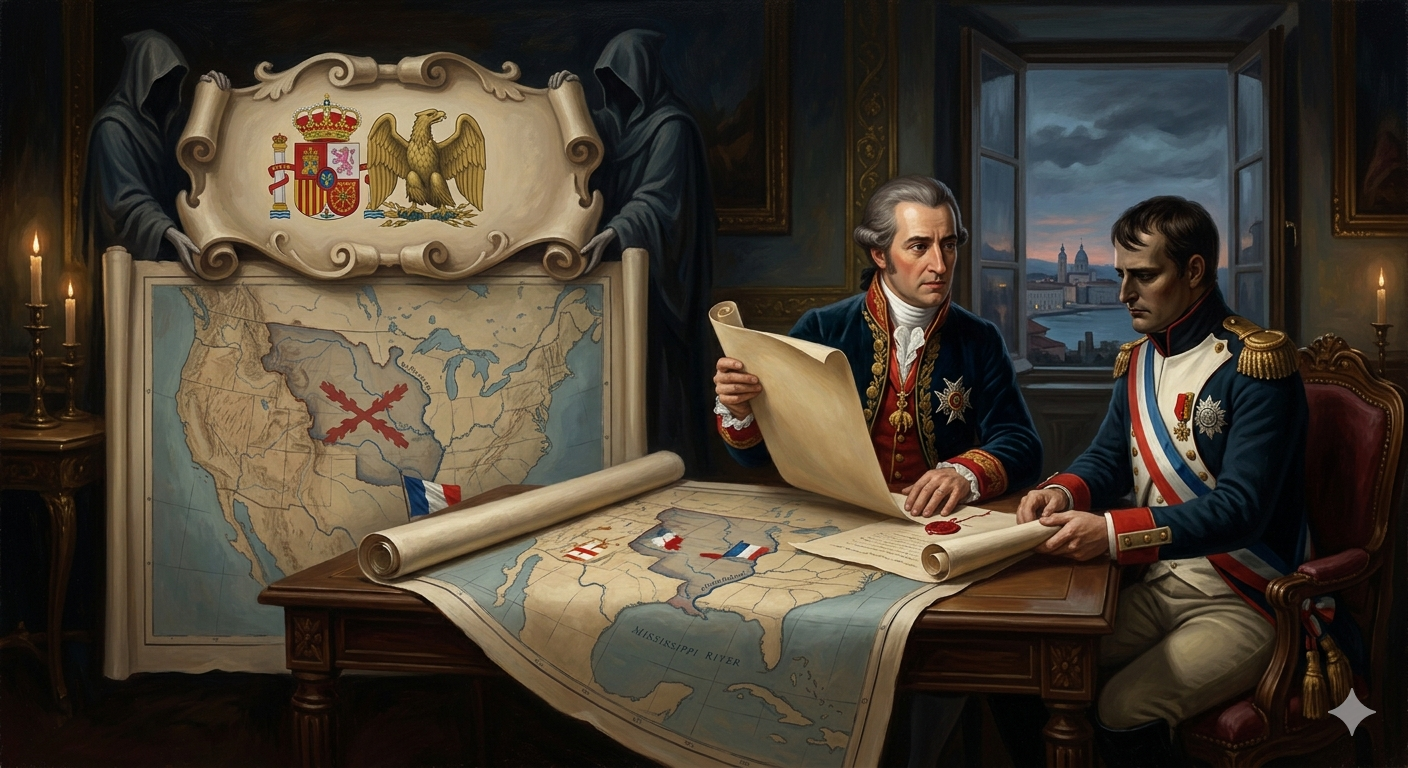
On October 1, 1800, in the royal palace of San Ildefonso, Spain, a secret treaty was signed that would dramatically alter the balance of power in North America and set in motion a chain of events leading to the United States’ greatest territorial acquisition. The Third Treaty of San Ildefonso represented Spain’s clandestine return of the vast Louisiana Territory to France, a deal negotiated behind closed doors while the world remained unaware of this monumental shift in colonial control. King Charles IV of Spain agreed to transfer the enormous province that stretched from the Mississippi River to the Rocky Mountains in exchange for Italian territories for his family, marking the end of nearly four decades of Spanish administration over this crucial North American region. This secret diplomatic maneuver by Napoleon Bonaparte represented his ambitious vision to rebuild the French colonial empire in the Americas, though it would ultimately lead to consequences neither Spain nor France anticipated when the United States purchased Louisiana just three years later for $15 million.
The Historical Context: Louisiana Under Spanish Rule Since 1762
The Louisiana Territory had been under Spanish control since 1762, when France secretly ceded the vast region to Spain through the Treaty of Fontainebleau during the closing stages of the Seven Years’ War. This transfer occurred as France faced devastating military defeats and sought to prevent the territory from falling into British hands, viewing Spanish control as preferable to British expansion in North America. For Spain, Louisiana served as a crucial strategic buffer zone protecting its far more valuable Mexican colonies from British encroachment, while also providing administrative control over the vital Mississippi River and the port of New Orleans.
During nearly four decades of Spanish administration, Louisiana had proven to be more of a financial burden than a profitable venture for the Spanish crown. The territory required constant military presence to defend against British, American, and Native American threats, while generating limited revenue compared to Spain’s silver-rich colonies in Mexico and South America. Spanish Louisiana encompassed an enormous area that was sparsely populated, difficult to govern effectively from distant Spain, and expensive to maintain with adequate military forces and administrative personnel.
The strategic importance of Louisiana to Spain lay primarily in its role as a defensive barrier rather than as a source of immediate wealth. Spanish officials recognized that controlling the Mississippi River and New Orleans gave them significant leverage over American western expansion and trade, as settlers beyond the Appalachian Mountains depended on river transport to move their goods to market. This geographic advantage allowed Spain to influence American domestic politics and foreign policy through control of western commerce, making Louisiana valuable despite its administrative costs.
By 1800, however, Spain’s strategic calculations regarding Louisiana had begun to shift as the international situation in Europe changed dramatically. The rise of Napoleon Bonaparte and the renewal of European conflicts created new pressures on Spanish colonial policy, while American population growth and westward migration increased pressure on Louisiana’s eastern borders. Spanish administrators found themselves governing a territory that was becoming increasingly difficult to defend against American expansion while providing limited benefits to compensate for its mounting costs.
The demographic reality of Louisiana under Spanish rule also contributed to Madrid’s willingness to consider retrocession to France. The territory contained diverse populations including French-speaking Creoles, Spanish settlers, enslaved Africans, free people of color, Native American tribes, and growing numbers of American immigrants, creating complex administrative challenges that strained Spanish resources. Managing these diverse communities with their different languages, legal traditions, and economic interests required sophisticated governance capabilities that Spain struggled to maintain across such a vast distance from the metropolitan center.
Napoleon’s Grand American Strategy: The Vision Behind Retrocession
Napoleon Bonaparte’s interest in reacquiring Louisiana Territory for France stemmed from his ambitious vision to restore French colonial dominance in the Americas and create a new empire that would rival British global power. The First Consul understood that controlling Louisiana would provide France with enormous strategic advantages, including dominance over North American river systems, access to valuable agricultural and natural resources, and the ability to pressure both Britain and the United States through control of western trade routes. This grand strategy represented Napoleon’s belief that French power could be rebuilt through colonial expansion as well as European conquest.
The French leader’s plans for Louisiana were intrinsically connected to his broader Caribbean strategy, particularly his efforts to maintain French control over the valuable sugar colony of Saint-Domingue (modern Haiti). Napoleon envisioned Louisiana as the breadbasket that would supply food and raw materials to France’s Caribbean possessions, creating an integrated colonial economy that would generate enormous revenues for the French state. This economic integration would make French Caribbean colonies less dependent on foreign suppliers while providing Louisiana with profitable export markets for its agricultural production.
Napoleon’s strategic thinking also encompassed the geopolitical advantages that French control of Louisiana would provide in the broader struggle against British global supremacy. By controlling both the Caribbean sugar islands and the Louisiana Territory, France could potentially strangle British trade in the western hemisphere while building a colonial empire capable of supporting French military ambitions in Europe. The First Consul recognized that successful colonial reconstruction would provide the financial resources necessary to sustain his European campaigns while simultaneously weakening British economic interests.
The timing of Napoleon’s interest in Louisiana reflected his assessment of international conditions in 1800, when European warfare had temporarily subsided and France had achieved a stronger negotiating position through military victories. The brief peace created an opportunity for colonial reorganization that might not be available once European hostilities resumed, making immediate action essential to secure French territorial gains. Napoleon understood that successful acquisition of Louisiana required taking advantage of this diplomatic window before circumstances changed to make such territorial transfers impossible.
French military and administrative capabilities in 1800 appeared adequate to support colonial expansion, as Napoleon commanded experienced armies, competent administrators, and sufficient naval resources to project French power across the Atlantic. The First Consul’s confidence in French institutional capacity encouraged his belief that Louisiana could be successfully integrated into a renewed French colonial system, despite the challenges that such distant territories would present for effective governance and defense.
The Secret Negotiations: Diplomacy Behind Closed Doors
The secret negotiations leading to the Third Treaty of San Ildefonso began in earnest during July 1800, when French Foreign Minister Charles Maurice de Talleyrand opened discussions with Spain’s Secretary of State for Foreign Affairs, Mariano Luis de Urquijo. These preliminary talks explored the possibility of territorial exchanges that would benefit both nations while advancing their respective strategic interests in Europe and the Americas. The secretive nature of these negotiations reflected both countries’ recognition that public knowledge of potential territorial transfers could provoke unwanted international complications or domestic opposition.
Napoleon appointed General Louis-Alexandre Berthier as his special envoy to Spain with specific instructions to negotiate the acquisition of Louisiana Territory along with additional concessions that would strengthen France’s position in the Americas. Berthier’s mission included demands for the Florida territories and ten Spanish warships in addition to Louisiana, demonstrating the ambitious scope of French territorial ambitions. The general’s instructions emphasized the importance of maintaining absolute secrecy during negotiations to prevent British or American interference in the diplomatic process.
The Spanish negotiating position reflected King Charles IV’s personal interests as well as broader strategic considerations affecting the Spanish Empire. The Spanish monarch was particularly concerned about securing advantageous arrangements for his son-in-law Louis, Duke of Parma, whose Italian territories were threatened by French expansion. Charles IV’s willingness to consider ceding Louisiana stemmed partly from his desire to obtain compensation in Italy that would benefit his extended family while potentially reducing Spanish administrative burdens in distant North America.
Spanish resistance to French demands became evident when Urquijo rejected Berthier’s requests for the Florida territories, recognizing that these regions were far more strategically valuable to Spain than Louisiana due to their proximity to Spanish Caribbean possessions and their role in defending Spanish shipping routes. However, Spain proved willing to negotiate regarding Louisiana itself, particularly when offered attractive compensation in the form of Italian territories that would enhance Spanish influence in European affairs. The Spanish negotiators also agreed to provide six warships to France, though fewer than the ten vessels initially demanded.
The final breakthrough in negotiations came when both sides recognized that their fundamental interests could be satisfied through carefully structured territorial exchanges. Spain would receive Italian territories that enhanced the dynasty’s European position while relieving themselves of Louisiana’s administrative burdens, while France would acquire the North American territory essential to Napoleon’s colonial strategy. The agreement to maintain absolute secrecy allowed both parties to avoid immediate international complications while pursuing their respective strategic objectives.
The Treaty Terms: What Spain Gained and Lost
The Third Treaty of San Ildefonso established the specific terms governing Spain’s retrocession of Louisiana Territory to France in exchange for Italian territories and other considerations that reflected both nations’ strategic priorities. Article II of the treaty specified that Spain would cede Louisiana “with the same extent that it now has in the hand of Spain, and that it had when France possessed it,” deliberately using vague language that would later create boundary disputes when the United States acquired the territory. This imprecise geographical description reflected the negotiators’ incomplete knowledge of Louisiana’s actual boundaries and their focus on broader strategic considerations rather than detailed territorial definitions.
In compensation for Louisiana, Spain was to receive Italian territories for the Duke of Parma, though the treaty language remained deliberately vague about which specific regions would be provided. The agreement mentioned that compensation “may consist of Tuscany or the three Roman legations or of any other continental provinces of Italy which form a rounded state,” giving France considerable flexibility in determining the exact territories to be transferred. This vagueness reflected Napoleon’s desire to maintain options regarding Italian territorial arrangements while ensuring Spanish agreement to the Louisiana transfer.
The naval component of the agreement required Spain to provide France with six warships “in good condition built for seventy-four guns, armed and equipped and ready to receive French crews and supplies.” The specific vessels transferred were the San Antonio, Intrepido, San Genaro, Atlante, Conquistador, and Infante Don Pelayo, representing significant additions to French naval capacity during a period when maritime power was crucial for colonial administration and defense. These ships would enhance France’s ability to project power across the Atlantic while reducing Spanish naval capabilities in proportion.
Spain insisted on including a crucial clause requiring France to promise not to sell or alienate Louisiana to any third party, reflecting Spanish concerns that the territory might eventually fall into British or American hands. This provision, often called the “no alienation clause,” was intended to ensure that if France could not maintain control of Louisiana, the territory would be returned to Spain rather than transferred to a potentially hostile power. King Charles IV’s negotiators viewed this guarantee as essential protection for Spanish strategic interests in North America.
The treaty also reaffirmed the military alliance between France and Spain that had been established in earlier agreements, strengthening the partnership between the two Bourbon monarchies against their common British enemy. This alliance provision enhanced the treaty’s value to both parties by providing mutual security guarantees that extended beyond the specific territorial exchanges covered in the Louisiana agreement. The military cooperation aspects of the treaty would prove significant as European warfare resumed and both nations faced renewed British hostility.
The Italian Compensation: The Kingdom of Etruria
The creation of the Kingdom of Etruria represented the Italian compensation that Spain received for ceding Louisiana Territory to France, though this arrangement would prove far less valuable and durable than Spanish negotiators had anticipated. The Treaty of Aranjuez, signed in March 1801, formally established this new Italian kingdom from portions of Tuscany for Louis, Duke of Parma, who was the son-in-law of Spanish King Charles IV. This arrangement satisfied Spanish dynastic interests by providing a royal title and territory for a family member while theoretically giving Spain influence over an important Italian region.
The Kingdom of Etruria was carved from the former Grand Duchy of Tuscany, which had been under Austrian Habsburg control before French victories in Italy altered the peninsula’s political map. Napoleon’s willingness to create this new kingdom reflected his broader strategy of reorganizing Italian territories to serve French interests while providing attractive compensation to potential allies. The choice of Tuscany for this purpose was particularly significant because of the region’s agricultural wealth, cultural importance, and strategic location in central Italy.
Louis, Duke of Parma, became Louis I of Etruria upon the kingdom’s creation, though his reign would be brief and his authority limited by French oversight and intervention. The new monarch faced immediate challenges in establishing effective governance over territories that had recently experienced military occupation, political upheaval, and economic disruption due to ongoing European conflicts. The Kingdom of Etruria’s dependence on French military protection and diplomatic support made it essentially a French satellite state rather than a truly independent kingdom.
The practical value of the Kingdom of Etruria as compensation for Louisiana became questionable almost immediately, as the new kingdom faced constant financial difficulties, military threats, and political instability. Unlike Louisiana, which represented vast territorial expanses with significant potential for development, Etruria was a small, war-torn region that required substantial investment and protection to maintain its viability. The kingdom’s revenues were insufficient to support royal court expenses, military forces, and administrative machinery necessary for effective governance.
When Louis I of Etruria died in 1803, the kingdom faced a succession crisis that further undermined its stability and value to Spain. His son Louis II was only a child, requiring a regency government that proved unable to maintain effective control or resist French interference in Etrurian affairs. Napoleon eventually abolished the Kingdom of Etruria in 1807, incorporating its territories directly into the French Empire, thereby eliminating any remaining value this arrangement had provided to Spain in exchange for Louisiana Territory.
The Delayed Implementation: Why Transfer Took Two Years
Despite the signing of the Third Treaty of San Ildefonso in October 1800, the actual transfer of Louisiana from Spanish to French control would not occur until November 1803, reflecting complex diplomatic, military, and administrative challenges that delayed implementation of the agreement. Spanish hesitation to complete the transfer stemmed partly from dissatisfaction with French fulfillment of their obligations regarding Italian compensation, as well as growing concerns about Napoleon’s ultimate intentions regarding Louisiana’s future disposition. King Charles IV’s government demanded complete implementation of French commitments before surrendering control of such a valuable North American territory.
The European military situation also contributed to delays in Louisiana’s transfer, as resumed warfare between France and other European powers created competing priorities for French attention and resources. Napoleon’s focus on European campaigns reduced the urgency he placed on North American colonial administration, while Spanish concerns about French military intentions made Charles IV’s government reluctant to strengthen French capabilities through territorial transfers. The complex relationship between European warfare and American colonial arrangements created diplomatic complications that prolonged negotiations over implementation details.
Administrative challenges in organizing the actual transfer of governmental authority also contributed to delays, as both French and Spanish bureaucracies struggled to coordinate the complex logistics of transferring control over such a vast territory. French authorities needed to identify and train administrators capable of governing Louisiana, while Spanish officials required detailed instructions regarding the transfer of governmental records, military installations, and administrative responsibilities. These practical considerations proved more time-consuming than either government had initially anticipated.
American pressure regarding access to New Orleans and Mississippi River navigation rights created additional complications for both Spain and France during the delay period. Spanish administrators found themselves managing growing American concerns about potential French control of river commerce while maintaining secrecy about the territory’s already-negotiated transfer to France. These diplomatic pressures from the United States added complexity to the transfer arrangements and contributed to Spanish reluctance to proceed rapidly with implementation.
The situation was further complicated by Napoleon’s evolving strategic thinking regarding Louisiana’s value to French colonial strategy, particularly as his Saint-Domingue campaign encountered unexpected difficulties. By 1802, French military failures in the Caribbean had begun to undermine the economic rationale for acquiring Louisiana, though Napoleon was not yet prepared to abandon his American colonial ambitions entirely. This strategic uncertainty contributed to French delays in completing the transfer arrangements with Spain.
American Concerns and Diplomatic Pressure
The prospect of French control over Louisiana Territory and the vital port of New Orleans created intense concern among American political leaders, who understood that such a transfer would dramatically alter the balance of power in North America to the disadvantage of the United States. President Thomas Jefferson recognized that French control of the Mississippi River mouth would give Napoleon significant leverage over American western development and could potentially strangle the economic growth of American settlements beyond the Appalachian Mountains. These strategic concerns prompted Jefferson to begin diplomatic efforts aimed at securing American access to New Orleans even before the Spanish-French transfer was completed.
American western settlers and merchants had grown accustomed to Spanish administration of Louisiana, which generally permitted American use of the Mississippi River for commercial purposes despite occasional diplomatic tensions. The prospect of French administration raised fears that Napoleon might adopt more restrictive policies that could isolate American western territories from international markets. These economic concerns created domestic political pressure on Jefferson’s administration to take preventive diplomatic action that would secure American commercial rights regardless of Louisiana’s eventual political control.
Jefferson’s initial response to intelligence about the secret Spanish-French treaty involved sending Robert Livingston to Paris as American minister with instructions to explore the possibility of purchasing New Orleans from France. This diplomatic mission reflected Jefferson’s understanding that direct negotiation with Napoleon offered the best prospect for resolving American concerns about French control of the Mississippi River. The president’s willingness to consider purchasing territory from France also demonstrated his pragmatic approach to territorial expansion despite his constitutional concerns about federal authority to acquire new territory.
The American diplomatic pressure on both Spain and France regarding Louisiana’s status created additional complications for European negotiations over the territory’s transfer. Spanish administrators found themselves managing American demands for assurances about continued Mississippi River access while maintaining secrecy about their agreement to transfer Louisiana to France. French officials similarly faced American diplomatic pressure regarding their intentions for Louisiana administration even before they had gained actual control of the territory.
Jefferson’s threat to seek a British alliance if France proved uncooperative regarding American access to Louisiana represented a significant escalation in diplomatic pressure that both Spanish and French leaders took seriously. The prospect of American-British cooperation against French interests in North America threatened to undermine Napoleon’s colonial strategy before it could be successfully implemented. This diplomatic leverage would eventually prove crucial when Napoleon decided to sell Louisiana to the United States rather than risk military confrontation over the territory.
Napoleon’s Strategic Calculations and the Saint-Domingue Crisis
Napoleon’s ultimate decision to sell Louisiana to the United States rather than develop it as planned stemmed primarily from the catastrophic failure of French military efforts to suppress the slave rebellion in Saint-Domingue led by Toussaint Louverture and later Jean-Jacques Dessalines. The First Consul had originally conceived Louisiana and Saint-Domingue as complementary components of a restored French colonial empire, with Louisiana providing food and raw materials to support the profitable sugar production of the Caribbean colony. When French forces proved unable to maintain control over Saint-Domingue, the economic rationale for retaining Louisiana largely evaporated.
The French military expedition to Saint-Domingue, commanded by Napoleon’s brother-in-law Charles Leclerc, had initially achieved tactical successes against rebel forces and even captured Toussaint Louverture through treachery. However, the combination of fierce resistance from enslaved populations fighting for their freedom and devastating yellow fever epidemics that decimated French forces created an military disaster that consumed enormous French resources without achieving lasting success. By 1803, Napoleon recognized that continued efforts to suppress the Saint-Domingue rebellion would drain French treasury and military capabilities needed for European campaigns.
The failure in Saint-Domingue forced Napoleon to reconsider his entire American colonial strategy, including the value of Louisiana Territory to French strategic interests. Without profitable Caribbean sugar colonies to supply with Louisiana agricultural products, the North American territory offered limited economic benefits to compensate for the substantial costs of administration and defense. Napoleon’s practical assessment of Louisiana’s value was further reduced by recognition that American demographic pressure and British naval superiority would make French control of the territory difficult to maintain during renewed European warfare.
Napoleon’s decision-making regarding Louisiana was also influenced by his assessment of the broader strategic situation facing France in 1803, as the brief peace established by the Treaty of Amiens was clearly breaking down and renewed conflict with Britain appeared inevitable. The First Consul recognized that British naval supremacy would make it extremely difficult to maintain communications and supply lines between France and Louisiana during wartime, potentially resulting in British conquest of the territory regardless of French preferences. Selling Louisiana to the United States would at least provide immediate financial benefits while preventing British acquisition of the territory.
The financial pressures facing Napoleon in 1803 also contributed to his willingness to sell Louisiana, as the costs of European military preparations and the failed Saint-Domingue expedition had strained French resources. The $15 million that the United States was willing to pay for Louisiana represented substantial immediate revenue that could support French military efforts in Europe while eliminating the ongoing costs of Louisiana administration. This financial calculation proved decisive when combined with the strategic considerations that made French retention of Louisiana appear increasingly impractical.
The Louisiana Purchase Negotiations and Spanish Protests
When Napoleon decided to sell Louisiana to the United States in April 1803, Spanish officials learned of this decision with shock and anger, recognizing that the sale violated both the spirit and specific terms of the Third Treaty of San Ildefonso. The Spanish government immediately protested that France had broken its promise not to alienate Louisiana to a third party, pointing to the explicit “no alienation clause” that King Charles IV had insisted upon including in the original agreement. Spanish Foreign Minister Pedro Cevallos denounced the sale as a violation of international law and demanded that France return Louisiana to Spanish control rather than transfer it to the United States.
The rapid pace of American-French negotiations caught Spanish administrators off guard, as they had expected consultation or at least notification before any decision to dispose of Louisiana Territory. Robert Livingston and James Monroe, the American negotiators in Paris, had originally been authorized only to purchase New Orleans and perhaps West Florida, but they quickly agreed to buy the entire Louisiana Territory when Napoleon’s representative François Barbé-Marbois made this unexpected offer. The American negotiators recognized that this was an extraordinary opportunity that might not be repeated if they delayed to seek additional authorization from Washington.
Spanish legal arguments against the Louisiana sale focused on two main points: first, that France had explicitly promised not to alienate the territory to any third party, and second, that France had not fully complied with its obligations under the San Ildefonso treaty regarding Italian compensation. Spanish officials pointed out that the Kingdom of Etruria had not been recognized by all European powers as required by the treaty terms, and that French occupation forces remained in Italian territories that should have been transferred to Spanish control. These legal arguments provided a foundation for Spanish claims that the entire Louisiana transaction was invalid under international law.
French responses to Spanish protests revealed Napoleon’s dismissive attitude toward Spanish concerns and his determination to complete the Louisiana sale regardless of previous commitments to Spain. French officials argued that the promise not to alienate Louisiana was contained in a separate note rather than the treaty itself and therefore lacked legal force, a technical distinction that Spanish negotiators rejected as contrary to the spirit of their agreement. Napoleon’s government also contended that Spain had itself ordered the transfer of Louisiana to France despite knowing about European non-recognition of the Kingdom of Etruria, thereby waiving any right to object to subsequent French disposal of the territory.
The American position regarding Spanish protests was pragmatic but legally questionable, as Jefferson’s administration sought to complete the Louisiana Purchase while avoiding direct confrontation with Spanish claims. American Secretary of State James Madison noted that the United States had initially approached Spain about purchasing Louisiana territory but had been told to negotiate with France, implying Spanish acknowledgment of French authority over the region. However, this argument ignored the fact that Spanish officials may not have been aware of Napoleon’s intention to sell the territory when they made such statements.
The Formal Transfer: From Spain to France to America
The actual transfer of Louisiana Territory from Spanish to French control occurred on November 30, 1803, in New Orleans, just three weeks before France surrendered the territory to the United States on December 20, 1803. This compressed timeline reflected Napoleon’s desire to complete the transaction with the United States as quickly as possible while fulfilling the technical requirements of the Spanish-French agreement. Pierre Clément de Laussat, the French colonial prefect sent by Napoleon to assume control of Louisiana, found himself in the unusual position of governing a territory for less than a month before transferring it to American authorities.
The ceremonial aspects of these transfers emphasized the historical significance of Louisiana’s changing political control, as flags were lowered and raised in formal ceremonies that marked the end of Spanish rule and the brief restoration of French authority before American annexation. The November 30 ceremony in New Orleans saw Spanish officials formally transfer governmental authority to Laussat, who then spent three weeks attempting to organize French administration of a territory he knew would soon be transferred to the United States. This brief period of French control was largely symbolic, as effective governmental authority had already begun transitioning to American officials.
Laussat’s challenging position as temporary French administrator required him to manage the complex logistics of governmental transition while maintaining public order and confidence during a period of political uncertainty. The French prefect had arrived in Louisiana in March 1803 expecting to establish long-term French colonial government, only to learn of Napoleon’s decision to sell the territory as “a bolt out of the blue” that fundamentally altered his mission. Despite this dramatic change in circumstances, Laussat performed his duties professionally and ensured smooth transfers of authority that avoided potential conflicts or administrative chaos.
The December 20, 1803 ceremony transferring Louisiana from France to the United States took place at the Cabildo in New Orleans’ Place d’Armes (now Jackson Square), with appropriate diplomatic protocol and public celebration of American territorial expansion. This final ceremony completed the remarkable sequence of events that had begun with Spain’s secret cession to France in 1800 and culminated in American acquisition of the territory that would double the size of the United States. The American officials present, including territorial governor William C.C. Claiborne and General James Wilkinson, understood the historical significance of assuming control over territory that would eventually become all or part of fifteen American states.
The complex sequence of Louisiana transfers illustrated the unpredictable nature of early 19th-century international relations, where secret treaties, shifting strategic priorities, and unexpected military developments could rapidly alter territorial arrangements. Spanish officials who had negotiated the original retrocession to France never anticipated that their agreement would lead to American acquisition of Louisiana within three years. Similarly, Napoleon’s grand strategy for rebuilding French colonial empire collapsed so quickly that Louisiana became a financial asset to be sold rather than a territorial prize to be developed.
Long-term Consequences: Impact on Spanish Colonial Strategy
The loss of Louisiana Territory fundamentally altered Spain’s strategic position in North America and marked the beginning of a long period of territorial retreat that would eventually result in Spanish withdrawal from most of continental North America. Without Louisiana as a buffer zone, Spanish Mexico faced direct American pressure along the undefined borders of Texas and other frontier regions, creating security challenges that would plague Spanish colonial administrators for the remainder of their tenure. The reduced strategic depth available to defend Mexico made Spanish colonial positions increasingly vulnerable to American expansion and diplomatic pressure.
Spanish colonial authorities recognized that the Louisiana sale had eliminated their primary leverage over American western development, as control of the Mississippi River mouth had previously given Spain significant influence over American domestic politics and economic development. The loss of this strategic advantage forced Spain to develop new approaches to managing relations with the expanding United States while protecting remaining Spanish territories in North America. Spanish diplomats found themselves negotiating from increasingly weak positions as American power and confidence grew following the Louisiana Purchase.
The financial implications of the Louisiana transaction also affected Spanish colonial strategy, as the territory’s sale to the United States provided France with resources that enhanced Napoleon’s military capabilities in European conflicts that directly threatened Spanish interests. Spanish officials understood that they had inadvertently contributed to strengthening their French ally in ways that could ultimately prove disadvantageous to Spanish interests in Europe and other colonial regions. The complex relationship between colonial arrangements and European warfare created long-term strategic complications for Spanish policymakers.
The successful American acquisition of Louisiana demonstrated the growing diplomatic and financial capabilities of the United States, encouraging American leaders to pursue additional territorial expansion at Spanish expense. The precedent established by the Louisiana Purchase suggested that American offers to purchase Spanish territories might provide acceptable alternatives to military conquest, creating new pressures on Spanish colonial administrators to consider territorial sales rather than risk losing territories without compensation through warfare or diplomatic pressure.
Spanish colonial strategy in the aftermath of Louisiana’s loss focused increasingly on defensive arrangements designed to preserve core territories rather than expanding Spanish influence in North America. The establishment of firmer boundaries with the United States through treaties like the Adams-Onís Treaty of 1819 reflected Spanish recognition that territorial retreat was preferable to continued confrontation with American expansion. These strategic adjustments marked a fundamental shift from Spanish colonial expansion to a focus on consolidating control over remaining territories that could be effectively defended and governed.
Conclusion: The End of an Era and the Beginning of American Expansion
The secret cession of Louisiana Territory from Spain to France in 1800, followed by its sale to the United States in 1803, represented one of the most consequential diplomatic arrangements in North American history, fundamentally altering the continental balance of power and setting the stage for American expansion to the Pacific Ocean. What began as Napoleon’s ambitious plan to rebuild French colonial empire ultimately resulted in the United States doubling its territorial size and establishing itself as a continental power capable of competing with European empires. The Third Treaty of San Ildefonso, negotiated in secret and implemented reluctantly, became the first link in a chain of events that transformed North American political geography.
The failure of European colonial strategies in North America demonstrated the limitations of distant imperial control in an age of growing American demographic and economic power. Both Spain and France discovered that governing vast North American territories required resources and sustained commitment that European powers found difficult to maintain while simultaneously managing complex European political and military challenges. The ultimate American acquisition of Louisiana illustrated the advantages that a growing continental nation possessed over distant European colonial administrators in securing and developing North American territories.
The Louisiana transaction also revealed the unpredictable nature of early 19th-century international relations, where secret treaties, military failures, and shifting strategic priorities could rapidly alter territorial arrangements with long-lasting consequences. Spanish negotiators who agreed to the retrocession of Louisiana could not have anticipated that their diplomatic arrangement would lead to American acquisition of the territory within three years, while Napoleon’s grand colonial strategy collapsed so completely that territorial prizes became financial assets to be sold for immediate European advantages.
For Spain, the loss of Louisiana marked the beginning of a long retreat from North American territorial control that would continue throughout the 19th century as American expansion pressure mounted and Spanish resources proved inadequate to defend such extensive frontiers. The strategic buffer that Louisiana had provided for Spanish Mexico was eliminated, creating security challenges that would contribute to eventual Spanish loss of additional territories including Florida and ultimately Mexican independence. The Third Treaty of San Ildefonso thus initiated a process of Spanish territorial contraction that reflected the broader decline of European colonial power in the Americas.
The Louisiana Purchase that resulted from Spain’s secret cession to France established precedents for American territorial expansion that would influence continental development throughout the 19th century. The successful negotiation, constitutional ratification, and peaceful occupation of such vast territories demonstrated American institutional capabilities while providing resources and space for demographic and economic growth that would transform the United States into a major world power. The transformation of Louisiana from Spanish colony to French territory to American states illustrated the dynamic nature of North American political development during a crucial period when European imperial arrangements gave way to American continental expansion.