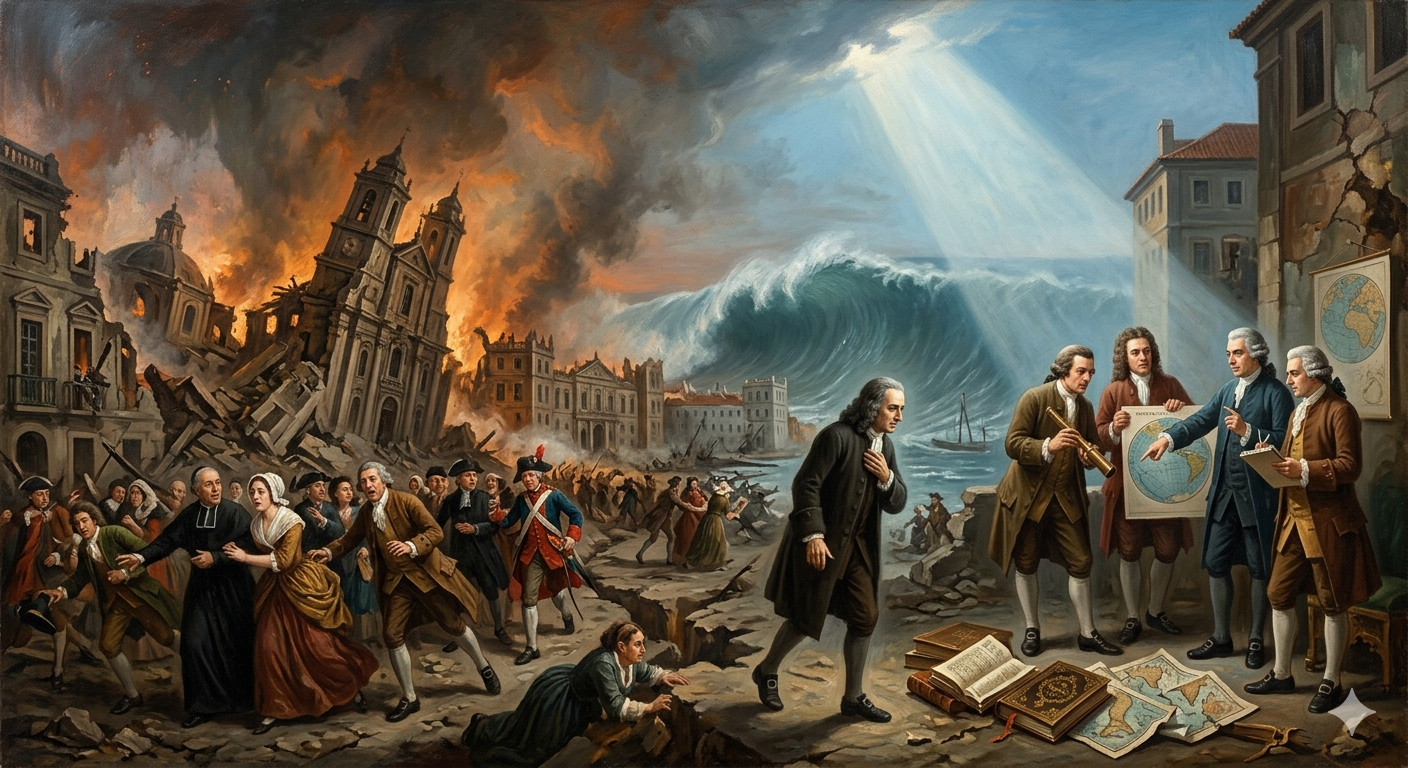
On the morning of November 1, 1755, All Saints’ Day, one of history’s most devastating natural disasters struck the Portuguese capital of Lisbon, forever changing the course of European civilization and philosophical thought. At approximately 9:40 AM local time, a massive earthquake estimated at magnitude 8.5 to 9.0 on the modern Richter scale shook the Iberian Peninsula with unprecedented fury, followed by towering tsunami waves and citywide fires that reduced Europe’s fourth-largest city to rubble and ash within hours. The catastrophic trilogy of earthquake, tsunami, and fire claimed the lives of an estimated 40,000 to 60,000 people in Portugal alone, with additional thousands perishing across Morocco and Spain, making it one of the deadliest natural disasters in recorded European history. This monumental catastrophe not only devastated the physical landscape of Lisbon and surrounding regions but also profoundly impacted European Enlightenment philosophy, sparked the birth of modern seismology, and demonstrated the first international humanitarian response in modern history. The earthquake’s epicenter, located approximately 200 kilometers west-southwest of Cape St. Vincent in the Atlantic Ocean, generated destructive waves that reached as far as North Africa, the British Isles, and even the Caribbean, proving that natural disasters could have truly global consequences in an interconnected world.
The Morning of Catastrophe: All Saints’ Day Turned to Tragedy
The devastating earthquake struck on one of the most sacred days in the Catholic calendar, All Saints’ Day, when churches throughout Lisbon were packed with worshippers attending morning masses and lighting countless candles in remembrance of the departed. The timing could not have been more tragic, as the religious observance had drawn thousands of faithful into the city’s magnificent churches, convents, and cathedrals, structures that would prove tragically vulnerable to the violent seismic forces about to be unleashed. Contemporary accounts describe the morning as calm and pleasant, with clear skies giving no indication of the natural catastrophe that was about to transform one of Europe’s greatest cities into a scene of unprecedented devastation and human suffering.
The first tremor began at approximately 9:40 AM, initially felt as a gentle rolling motion that quickly intensified into violent shaking that lasted between three and six minutes according to eyewitness accounts. The earthquake’s intensity was such that it created fissures up to five meters wide in Lisbon’s city center, while the prolonged duration of the shaking ensured that virtually no structure in the city could withstand the relentless assault of seismic energy. The timing during morning religious services proved catastrophic, as the collapse of churches filled with worshippers accounted for a significant portion of the immediate casualties, with heavy stone vaulting and elaborate baroque decorations becoming deadly projectiles as buildings pancaked under the earthquake’s tremendous force.
Contemporary survivors described the terrifying sound of the earthquake as resembling continuous thunder mixed with the grinding and crashing of countless buildings simultaneously collapsing. The Reverend Charles Davy, a British merchant who experienced the earthquake, wrote that “there was a sound heard underground like thunder, and immediately we felt the first shock, which was succeeded by a second and third shock, the buildings continually falling around us.” The psychological impact of witnessing an entire city’s destruction in mere minutes was so profound that many survivors would suffer from what we would now recognize as post-traumatic stress disorder for years afterward.
The earthquake’s impact extended far beyond Lisbon itself, affecting virtually the entire Iberian Peninsula and reaching as far as Morocco and southern Spain. In the Portuguese Algarve region, coastal fortifications were damaged or destroyed, while inland cities like Covilhã experienced significant structural damage to castles and public buildings. The seismic waves were felt across Europe, with tremors recorded as far away as Finland, demonstrating the extraordinary magnitude of the geological event that had just transformed the landscape of southwestern Europe in a matter of minutes.
The immediate aftermath of the earthquake presented scenes of apocalyptic devastation, with survivors emerging from collapsed buildings to find their familiar city transformed into an unrecognizable landscape of rubble, dust, and human suffering. Those fortunate enough to survive the initial collapse rushed toward the apparent safety of the Tagus River waterfront and the open spaces of the docks, unknowingly positioning themselves directly in the path of the next phase of the natural catastrophe that would soon compound the earthquake’s destruction with the devastating power of tsunami waves.
The Scientific Context: Understanding the Geological Forces Behind the Disaster
The 1755 Lisbon earthquake originated from a complex system of tectonic faults located in the Atlantic Ocean approximately 200 kilometers west-southwest of Cape St. Vincent, marking one of the most significant seismic events ever recorded in the Atlantic region. Modern seismological analysis suggests that the earthquake resulted from movement along the Gorringe Ridge fault system, a submarine mountain range that represents the boundary between the African and Eurasian tectonic plates. The fault rupture is estimated to have extended over 100 kilometers in length and 50 kilometers in width, displacing the ocean floor by as much as 20 meters and generating the massive tsunami waves that would prove as deadly as the earthquake itself.
The geological setting that produced this catastrophic earthquake reflects the ongoing collision between the African and Eurasian plates, a process that has been shaping the Mediterranean region for millions of years. The convergent plate boundary in this region is characterized by complex fault systems that accumulate enormous stress over centuries before releasing it in violent seismic events. The 1755 earthquake represented the rupture of one of these major fault segments, releasing energy equivalent to approximately 32,000 Hiroshima-sized atomic bombs and ranking among the most powerful earthquakes ever recorded in the Atlantic Ocean basin.
The depth of the earthquake’s focus, estimated at approximately 40 kilometers below the ocean floor, contributed to its widespread destructive effects across such a vast geographical area. Earthquakes originating at this intermediate depth tend to generate efficient seismic wave propagation that can travel great distances without significant attenuation, explaining how the tremors were felt across the entire Iberian Peninsula and even reached northern Europe and North Africa. The submarine location of the epicenter also meant that the tremendous energy release displaced vast quantities of seawater, generating the devastating tsunami that would compound the earthquake’s destruction along thousands of kilometers of Atlantic coastline.
Scientific understanding of the 1755 earthquake has been greatly enhanced by modern computational modeling and historical seismology research that has reconstructed the likely rupture characteristics and wave propagation patterns. These studies suggest that the earthquake involved reverse faulting, where one side of the fault moved upward relative to the other, typical of convergent plate boundaries where tectonic compression dominates. The upward displacement of such a large area of ocean floor created the initial wave displacement necessary to generate a transoceanic tsunami, with waves radiating outward from the source region at speeds approaching 800 kilometers per hour in the deep Atlantic.
The 1755 earthquake occurred during a period of heightened seismic activity in the region, following smaller but significant earthquakes in 1531 and 1356 that had previously damaged Lisbon and demonstrated the area’s vulnerability to major seismic events. This pattern of recurring large earthquakes separated by intervals of several centuries reflects the long-term accumulation and release of tectonic stress along the plate boundary system. Modern probabilistic seismic hazard assessments suggest that similar magnitude earthquakes may recur in this region with return periods of 500 to 1,000 years, indicating that the geological conditions responsible for the 1755 disaster remain active and pose ongoing risks to the heavily populated coastal regions of Portugal, Spain, and Morocco.
The Tsunami’s Devastating Arrival: When the Sea Became a Weapon of Destruction
Approximately 40 to 60 minutes after the earthquake’s violent shaking subsided, survivors who had sought refuge near Lisbon’s waterfront witnessed one of the most terrifying sights in recorded history as the Tagus River suddenly receded, revealing a vast muddy plain littered with shipwrecks, lost cargo, and marine debris that had accumulated over centuries on the river bottom. This dramatic retreat of the waters, now recognized as the classic warning sign of an approaching tsunami, initially attracted curious onlookers who ventured onto the exposed riverbed to examine the revealed artifacts and stranded fish, unknowingly placing themselves in mortal danger as the first massive wave approached the Portuguese capital.
The first tsunami wave struck Lisbon with devastating force, described by contemporary witnesses as a wall of water that “rose like a mountain” as it surged up the Tagus River with such speed and power that horsemen galloping at full speed could barely outrun its advancing waters. The wave, estimated to have reached heights of 12 to 15 meters above normal sea level, penetrated deep into the city center, reaching approximately to where the Arco da Rua Augusta stands today. The enormous volume of water swept away everything in its path, including the thousands of earthquake survivors who had gathered at the waterfront believing they had found safety from the collapsed buildings behind them.
The tsunami’s impact was not limited to a single wave, as is commonly misunderstood, but consisted of a series of three major wave arrivals separated by intervals of approximately 30 to 40 minutes. Each successive wave brought fresh destruction, carrying debris from previous waves and combining the remains of destroyed buildings, ships, and human casualties into a deadly mixture that scoured the riverfront clean of recognizable structures. Contemporary accounts describe the horrifying sight of the waves carrying the bodies of thousands of victims, along with the remnants of Lisbon’s once-magnificent palaces, churches, and commercial buildings, back toward the Atlantic Ocean as each wave eventually receded.
The tsunami’s destructive power extended far beyond Lisbon itself, affecting virtually the entire Portuguese coast and reaching remarkable heights in some locations. In the coastal city of Lagos in the Algarve, the waves reportedly reached the top of the city walls, estimated at 30 meters above sea level, while other Algarve coastal towns were completely inundated except for Faro, which was protected by the natural barrier of the Ria Formosa lagoon system. The waves penetrated up to 150 meters inland in many coastal areas, destroying fortifications, harbors, and entire fishing communities that had existed for centuries.
The tsunami’s effects were not confined to Portugal, as the waves propagated across the Atlantic Ocean and along the coasts of Spain and North Africa with deadly consequences. In Cadiz, Spain, the waves reached heights exceeding 10 meters and caused significant damage to the port and surrounding areas. Along the Moroccan coast, cities like Agadir and Safi experienced devastating impacts, with contemporary reports indicating that approximately 10,000 additional lives were lost in Morocco alone. The waves continued their deadly journey northward, causing flooding in Cornwall, England, where a three-meter tsunami wave struck the coast, and even reaching Ireland where low-lying areas of Cork were extensively flooded, demonstrating the truly transoceanic scale of this natural disaster.
The Inferno That Followed: Fire Completes the Destruction
As if the earthquake and tsunami were not devastating enough, the thousands of candles that had been lit in churches and homes throughout Lisbon in observance of All Saints’ Day ignited a catastrophic firestorm that would burn for six consecutive days and nights, completing the destruction that the natural disasters had begun. The countless overturned candles, combined with cooking fires, oil lamps, and the debris of collapsed wooden structures, created multiple ignition sources throughout the ruined city. The fires quickly merged into a massive conflagration that consumed virtually everything combustible that had survived the earthquake and tsunami, reducing centuries of architectural heritage, artistic treasures, and human knowledge to ash and smoke.
The fire’s intensity was such that it created its own weather system, generating powerful updrafts and downdrafts that spread burning embers across wide areas of the city and making firefighting efforts virtually impossible with the rudimentary equipment available in the 18th century. Contemporary accounts describe the flames reaching such heights that they could be seen from ships far out at sea, while the smoke created a pall of darkness over the city that blocked out the sun for days. The extreme heat generated by the fires was so intense that it melted church bells and precious metal objects, while stone structures that had survived the earthquake cracked and collapsed under the thermal stress of the prolonged exposure to extreme temperatures.
The firestorm proved particularly deadly for those who had taken refuge in partially collapsed buildings or underground spaces, as the flames consumed the available oxygen and created toxic smoke that asphyxiated victims up to 30 meters away from the actual flames. The Royal Hospital of All Saints, located in the Rossio square and filled with hundreds of earthquake victims seeking medical treatment, became a death trap when the fire reached the building and burned hundreds of patients to death who were unable to evacuate. This tragedy within a tragedy exemplified how the cascading effects of the natural disasters created multiple hazards that claimed lives long after the initial earthquake had subsided.
The fire’s appetite for destruction was indiscriminate, consuming priceless cultural treasures alongside common dwellings and reducing centuries of Portuguese achievement to ashes. The magnificent Royal Ribeira Palace, seat of Portuguese royal power and repository of the nation’s most valuable art collections, was completely consumed by the flames after being damaged by the earthquake and flooded by the tsunami. Inside the palace, a 70,000-volume royal library containing irreplaceable manuscripts and historical documents was lost forever, along with hundreds of paintings by masters like Titian, Rubens, and Correggio that had been collected over generations of Portuguese patronage of the arts.
The newly constructed Opera House, the Ópera do Tejo, which had opened just seven months before the earthquake and represented the pinnacle of contemporary theatrical architecture, was completely destroyed by the fire despite having suffered relatively minor earthquake damage. The loss of this cultural landmark, along with numerous churches, libraries, and private palaces, represented not just material destruction but the obliteration of centuries of Portuguese cultural achievement and artistic heritage. The fire also consumed the national archives containing detailed records of Portuguese explorations and discoveries, including invaluable documents related to the voyages of Vasco da Gama and other pioneering navigators who had expanded European knowledge of the world’s geography during the Age of Discovery.
King Joseph I: From Monarch to Traumatized Refugee
King Joseph I of Portugal, who was residing in the royal palace at the time of the earthquake, experienced one of history’s most dramatic royal escapes from natural disaster when the violent tremors struck while he was attending to morning affairs of state. The 41-year-old monarch, known for his patronage of the arts and relatively peaceful reign, found his world literally collapsing around him as the earthquake reduced his magnificent palace to rubble within minutes. By remarkable fortune, the king managed to escape from the collapsing structure along with his immediate family, but the traumatic experience would permanently alter his personality and reign, transforming him from a confident ruler into a psychologically damaged man who would live the remainder of his life in constant fear of enclosed spaces.
The psychological impact of the earthquake on King Joseph I was so severe that he developed what modern medicine would recognize as acute claustrophobia and post-traumatic stress disorder, conditions that were not understood in the 18th century but which profoundly affected his ability to function as a monarch. The king became unable to enter any stone building, including churches, palaces, or government offices, living instead in a complex of elaborate tents and temporary wooden pavilions erected in the hills outside Lisbon. This improvised royal residence, known as the Real Barraca, became the de facto seat of Portuguese government for the remainder of his reign, with state business conducted in canvas structures that could be quickly dismantled if the king’s fears overwhelmed him.
The transformation of the Portuguese royal court from one of Europe’s most elegant and ceremonial to a collection of temporary structures reflected not only the king’s personal trauma but also the broader impact of the disaster on Portuguese society and governance. Foreign ambassadors and dignitaries found themselves conducting formal diplomatic business in tents, while court ceremonies and state functions were adapted to outdoor settings that would have been unthinkable before the earthquake. The king’s condition became an open secret in European diplomatic circles, with reports reaching other courts describing the Portuguese monarch’s inability to function in normal royal surroundings.
Despite his psychological condition, King Joseph I demonstrated remarkable resilience in supporting the reconstruction efforts led by his prime minister, the Marquis of Pombal, providing royal authority and resources for the ambitious rebuilding program that would transform Lisbon into a model of Enlightenment urban planning. The king’s personal tragedy became intertwined with his kingdom’s recovery, as his determination to rebuild demonstrated that even the most traumatic experiences could be channeled into constructive action. His willingness to grant unprecedented authority to Pombal for the reconstruction efforts reflected both his recognition of his own limitations and his commitment to Portugal’s renewal following the disaster.
The king’s fear of stone buildings persisted for the remainder of his 25-year reign, with the royal court remaining in temporary structures until his death in 1777. Only after Joseph I’s death did his daughter, Queen Maria I, begin construction of the permanent royal Palace of Ajuda on the site of the old tented camp, marking the end of an era in which one of Europe’s monarchs ruled from structures that could have been mistaken for a military encampment rather than a royal court. The king’s personal response to trauma became emblematic of his nation’s struggle to come to terms with unprecedented devastation while finding the strength to rebuild and recover from one of history’s most comprehensive natural disasters.
The Marquis of Pombal: Enlightened Leadership in Crisis
Sebastião José de Carvalho e Melo, later ennobled as the Marquis of Pombal, emerged as one of history’s most capable crisis managers when he took charge of Portugal’s response to the earthquake disaster with legendary efficiency and determination. The 56-year-old prime minister, who had been serving King Joseph I since 1750, demonstrated the practical application of Enlightenment principles by approaching the catastrophe with rationality, scientific thinking, and systematic organization rather than the religious fatalism that characterized many contemporary responses to natural disasters. His famous response to the crisis, reportedly declaring “We bury the dead and heal the living,” became emblematic of the pragmatic, forward-looking approach that would guide Portugal’s remarkable recovery from devastation.
Pombal’s immediate response to the disaster demonstrated extraordinary organizational capabilities as he simultaneously coordinated emergency relief efforts, maintained civil order, and began planning for long-term reconstruction within hours of the earthquake’s occurrence. His first priority involved preventing the spread of disease by organizing the rapid disposal of thousands of corpses, a task that required overriding religious customs that demanded proper burial rites for the dead. Against the opposition of Church authorities, Pombal ordered that bodies be loaded onto barges and buried at sea beyond the mouth of the Tagus River, a controversial but necessary public health measure that prevented the epidemics that typically followed major disasters in the pre-modern era.
The maintenance of law and order in the devastated city required decisive action, as the collapse of normal governmental authority created opportunities for looting, profiteering, and social disorder that could have compounded the disaster’s effects. Pombal deployed Portuguese Army units throughout Lisbon and established military tribunals with the authority to impose immediate justice on those who would exploit the city’s vulnerability. Gallows were erected at prominent locations throughout the ruined city as a deterrent to potential criminals, and more than thirty people were publicly executed for looting or other crimes against the disaster victims. This harsh but effective approach prevented the social breakdown that often accompanies major disasters and allowed reconstruction efforts to proceed without the additional burden of civil disorder.
Perhaps Pombal’s most far-sighted contribution to disaster response involved the systematic collection of scientific data about the earthquake’s effects through a comprehensive survey that represents one of the earliest examples of systematic seismological research. The prime minister designed and distributed a detailed questionnaire to every parish in Portugal, asking specific questions about the earthquake’s duration, intensity, and effects, as well as observations about unusual animal behavior before the earthquake, changes in water levels in wells, and the types of buildings that suffered the most damage. The responses to this survey provided modern Portuguese scientists with the data necessary to precisely reconstruct the earthquake and understand its characteristics more than two centuries after the event occurred.
The Marquis of Pombal’s approach to reconstruction combined practical engineering with Enlightenment ideals, as he rejected proposals to simply rebuild Lisbon as it had been in favor of creating a completely new urban design that would be both more beautiful and more resilient to future earthquakes. Working with chief engineer Manuel da Maia, Pombal chose the most ambitious of four reconstruction options presented to the government: razing the entire Baixa quarter and laying out new streets and buildings according to rational principles of urban planning. This decision resulted in the creation of the Pombaline Downtown, featuring wide, straight streets arranged in a grid pattern, uniform building heights, and architectural designs that incorporated the world’s first earthquake-resistant construction techniques, including flexible wooden frameworks within masonry walls that could absorb seismic energy without collapse.
The Birth of Modern Seismology: Science Emerges from Catastrophe
The 1755 Lisbon earthquake marked a revolutionary turning point in human understanding of seismic phenomena, transforming earthquakes from mysterious acts of divine wrath into natural events that could be studied, analyzed, and potentially predicted through scientific observation and rational investigation. The systematic approach taken by the Marquis of Pombal in documenting the earthquake’s effects represents one of the first examples of scientific disaster response, establishing methodologies and principles that would eventually evolve into the modern science of seismology and earthquake engineering that helps protect millions of people today from similar natural hazards.
Pombal’s comprehensive questionnaire, distributed to every parish throughout Portugal in the weeks following the earthquake, asked specific questions designed to collect quantitative data about the disaster’s effects rather than simply recording general impressions or religious interpretations of the event. The survey inquired about the precise timing and duration of the tremors, the direction of building collapses, changes in groundwater levels, unusual animal behavior observed before the earthquake, and detailed descriptions of damage patterns in different types of structures. This systematic data collection represented a revolutionary approach to understanding natural disasters, replacing superstition and speculation with empirical observation and quantitative analysis.
The responses to Pombal’s earthquake questionnaire provided researchers with an unprecedented database of information that allowed them to map the earthquake’s intensity across Portugal and develop the first scientific understanding of how seismic energy propagates through the earth and affects different types of structures. Modern seismologists have used these 18th-century observations to reconstruct the likely magnitude, epicenter location, and rupture characteristics of the 1755 earthquake with remarkable precision, demonstrating the enduring scientific value of Pombal’s pioneering data collection efforts. The survey results showed clear patterns in damage distribution that helped establish fundamental principles of earthquake engineering, including the recognition that certain building types and construction methods are more vulnerable to seismic forces than others.
The scientific approach to earthquake engineering pioneered during Lisbon’s reconstruction involved the world’s first systematic testing of earthquake-resistant building designs through physical modeling and controlled experiments. Pombal ordered the construction of architectural models that could be subjected to simulated earthquake forces by having troops march around them in rhythm, creating controlled vibrations that allowed engineers to observe how different structural designs responded to seismic motions. These primitive but ingenious tests led to the development of the gaiola pombalina (Pombaline cage), a flexible wooden framework incorporated within masonry walls that could absorb and dissipate earthquake energy without allowing the building to collapse.
The influence of the Lisbon earthquake on European intellectual development extended beyond Portugal to inspire scientific inquiry throughout the continent, with prominent scholars like Immanuel Kant publishing detailed analyses of earthquake causes and effects that helped establish the foundations of modern earth sciences. Kant’s three treatises on the Lisbon earthquake, published in 1756, represented some of the earliest attempts to explain seismic phenomena through natural rather than supernatural causes, proposing theories about underground gas explosions and cavern collapses that, while ultimately incorrect, demonstrated the power of rational scientific thinking to address previously mysterious natural phenomena. This shift from religious to scientific explanations of earthquakes represented a fundamental change in European intellectual culture that would influence scientific development for centuries to come.
Philosophical Revolution: Voltaire, Kant, and the Question of Divine Providence
The 1755 Lisbon earthquake profoundly disrupted European philosophical and religious thought, challenging fundamental assumptions about divine providence, natural theology, and the relationship between human suffering and cosmic justice that had dominated Western intellectual culture since the Middle Ages. The disaster’s occurrence on All Saints’ Day, the destruction of churches filled with worshippers, and the indiscriminate nature of the casualties forced European intellectuals to confront difficult questions about whether the world was indeed governed by a benevolent deity who ensured that events unfolded according to divine justice and moral order.
François-Marie Arouet, better known as Voltaire, became the most prominent philosophical voice responding to the Lisbon earthquake through his satirical masterpiece “Candide” and his poetic meditation “Poème sur le désastre de Lisbonne” (Poem on the Lisbon Disaster), works that fundamentally challenged the optimistic philosophy popularized by Gottfried Wilhelm Leibniz and Alexander Pope. Leibniz’s doctrine that this world represents “the best of all possible worlds” and Pope’s assertion that “whatever is, is right” seemed absurdly inadequate to explain the suffering of thousands of innocent victims who had been attending religious services when the earthquake struck. Voltaire’s devastating critique of philosophical optimism through the character of Dr. Pangloss, who maintains his belief that everything happens for the best even in the face of overwhelming evidence to the contrary, helped establish a more skeptical and empirically grounded approach to understanding human suffering and natural disasters.
Immanuel Kant’s intellectual response to the Lisbon earthquake proved even more influential in the long term, as the young German philosopher published three separate treatises in 1756 that attempted to provide natural rather than supernatural explanations for seismic phenomena. Kant’s essays, written when he was only 32 years old and still developing the philosophical system that would make him one of history’s most important thinkers, represent some of the earliest examples of modern scientific thinking about earthquakes and natural disasters. Although his specific theories about underground gas explosions and cavern collapses proved incorrect, Kant’s systematic approach to gathering empirical evidence and developing testable hypotheses helped establish the methodological foundations for modern earth sciences and disaster research.
The earthquake’s impact on philosophical vocabulary and metaphorical thinking proved as significant as its influence on specific doctrines and theories, as scholars like Werner Hamacher have noted that the disaster fundamentally undermined the stability of language and concepts that had previously seemed unshakeable. Philosophical metaphors about solid “grounding” for arguments and theories became problematic after Lisbon demonstrated that even the earth itself could not be relied upon for stability and permanence. This linguistic and conceptual disruption contributed to the broader skepticism about absolute truths and eternal verities that would characterize Enlightenment thought and eventually contribute to the development of more relativistic and empirically based approaches to knowledge and understanding.
The theological responses to the Lisbon earthquake revealed deep divisions within European Christianity about the relationship between natural disasters and divine judgment, with some religious authorities interpreting the catastrophe as punishment for human sinfulness while others struggled to reconcile the indiscriminate nature of the suffering with doctrines of divine justice and mercy. The Jesuit priest Gabriel Malagrida’s pamphlet “Juízo da verdadeira causa do terremoto” (Judgment on the True Cause of the Earthquake) argued that the disaster resulted from Lisbon’s moral corruption and called for repentance and spiritual renewal, a position that put him into direct conflict with the Marquis of Pombal’s secular and scientific approach to understanding and responding to the catastrophe. This theological controversy reflected broader tensions between traditional religious explanations of natural phenomena and the emerging scientific worldview that would ultimately transform European intellectual culture during the later Enlightenment period.
International Response: The First Modern Humanitarian Crisis
The 1755 Lisbon earthquake generated the first truly international humanitarian response in modern European history, as news of Portugal’s devastation spread rapidly through diplomatic networks and commercial relationships to inspire unprecedented levels of foreign aid and assistance from nations across the continent. This coordinated international relief effort represented a fundamental shift in European political culture, moving away from the zero-sum thinking that had previously characterized international relations toward recognition that humanitarian disasters required collective response regardless of political rivalries and religious differences between nations.
Great Britain led the international relief effort with remarkable speed and generosity, demonstrating the strength of the Anglo-Portuguese alliance that had been formalized in the Treaty of Methuen in 1703 and would endure as one of Europe’s longest-lasting diplomatic partnerships. Within days of receiving news of the earthquake, the British government organized massive shipments of food, medical supplies, building materials, and financial assistance totaling approximately £100,000, equivalent to roughly $55 million in contemporary purchasing power. Additional British relief shipments followed regularly throughout the winter of 1755-1756, providing essential resources that helped prevent famine and disease outbreaks that could have compounded the disaster’s effects and claimed thousands of additional lives.
Hamburg, which served as Portugal’s second most important trading partner after Britain, demonstrated the commercial networks that connected European cities could also serve as conduits for humanitarian assistance when news of Lisbon’s destruction reached the German port city exactly four weeks after the catastrophe. Within two weeks of receiving the devastating news, Hamburg merchants and city authorities had organized the first of four relief ships laden with money, food, and manufactured goods worth approximately £160,000 (equivalent to $44 million today). The speed and efficiency of Hamburg’s response illustrated how the growth of international commerce and improved communications had created new possibilities for rapid humanitarian assistance across national boundaries.
France, despite ongoing political tensions with Portugal related to broader European conflicts, provided significant assistance that reflected both humanitarian impulses and recognition that the earthquake’s effects could destabilize the entire Iberian Peninsula with potential consequences for French security interests. French relief efforts included both official government assistance and private charitable contributions organized through Catholic Church networks that maintained connections between French and Portuguese religious communities. The French response demonstrated that humanitarian considerations could temporarily override political rivalries, establishing precedents for international cooperation that would influence European diplomacy during future crises.
Spain’s response to the Lisbon earthquake was complicated by the fact that Spanish territories, particularly Andalusia and Extremadura, had also suffered significant damage from the same seismic event, limiting the resources available for assisting their Portuguese neighbors while creating opportunities for cooperation in addressing shared challenges. Spanish authorities provided what assistance they could while dealing with their own earthquake damage, demonstrating the regional nature of the disaster and the need for coordinated response efforts that transcended national boundaries. The Spanish experience illustrated how major natural disasters often affect multiple countries simultaneously, requiring international cooperation not just for humanitarian reasons but for practical recovery and reconstruction efforts.
The international response to the Lisbon earthquake established important precedents for humanitarian assistance that would influence European diplomacy and international law for centuries to come, creating expectations that civilized nations should provide mutual assistance during major disasters regardless of political differences or commercial competition. This shift toward humanitarian internationalism represented one of the earthquake’s most significant long-term consequences, helping to establish norms and institutions that would eventually evolve into modern international disaster relief organizations and humanitarian law that continues to guide global responses to natural disasters and human suffering today.
Economic Devastation and the Transformation of Global Trade
The economic impact of the 1755 Lisbon earthquake extended far beyond Portugal’s borders, disrupting global trade networks and commercial relationships that had developed during centuries of Portuguese exploration and empire-building throughout Africa, Asia, and the Americas. Lisbon’s position as one of Europe’s most important commercial centers meant that its destruction sent shock waves through international markets, affecting commodity prices, shipping routes, and financial institutions across the Atlantic world. The immediate destruction of the city’s commercial infrastructure, including warehouses, banks, shipping facilities, and the records of countless commercial transactions, created a commercial crisis that took years to resolve and permanently altered patterns of international trade.
The destruction of Lisbon’s port facilities and commercial quarter eliminated one of Europe’s most important entrepôts for colonial goods, disrupting the flow of gold, diamonds, sugar, tobacco, and other valuable commodities from Brazil and other Portuguese territories to European markets. The earthquake’s timing proved particularly devastating for merchants who had significant inventories of valuable goods stored in Lisbon warehouses awaiting transshipment to other European markets. Contemporary estimates suggest that millions of cruzados worth of colonial products were lost in the fires that consumed the commercial districts, representing not only immediate financial losses for individual merchants but also broader disruptions to supply chains that affected consumer prices throughout Europe.
The financial sector’s destruction proved even more consequential for long-term economic recovery, as the earthquake destroyed banking records, commercial contracts, bills of exchange, and other financial instruments that documented complex networks of credit and debt relationships spanning multiple continents. Many commercial disputes arising from the earthquake’s destruction of financial records required years or even decades to resolve through European courts, creating legal precedents for dealing with natural disasters that destroy evidence of contractual obligations. The loss of these financial records also disrupted the flow of colonial revenues to the Portuguese crown, significantly reducing royal income and requiring new taxation and borrowing to finance reconstruction efforts.
The reconstruction of Lisbon created enormous economic opportunities that attracted investment and expertise from across Europe, transforming the disaster’s immediate economic devastation into a longer-term stimulus that helped modernize Portuguese infrastructure and commercial practices. The Marquis of Pombal’s decision to rebuild the city according to modern urban planning principles required massive investments in construction, transportation, and public infrastructure that provided employment for thousands of workers and created markets for building materials, skilled craftsmen, and professional services. This reconstruction boom attracted foreign investment and expertise that helped integrate Portugal more fully into European economic networks while demonstrating how effective disaster response could transform short-term crisis into long-term development opportunities.
The earthquake’s impact on global trade patterns proved permanent in some respects, as British and Dutch merchants expanded their direct commercial relationships with Brazilian ports and other Portuguese colonies while Lisbon’s commercial infrastructure was being rebuilt. These alternative trade routes, initially developed as emergency measures to bypass the destroyed Portuguese entrepôt, became established commercial practices that reduced Lisbon’s relative importance in global trade networks even after the city’s reconstruction was complete. The earthquake thus accelerated trends toward commercial decentralization and direct colonial trade that were already beginning to challenge traditional patterns of European mercantilism, contributing to the gradual transformation of global economic relationships during the later 18th century.
Cultural and Artistic Losses: The Destruction of Centuries of Achievement
The cultural and artistic devastation caused by the 1755 Lisbon earthquake represents one of history’s most catastrophic losses of human creative achievement, as the fires that followed the seismic disaster consumed centuries of Portuguese and European artistic treasures, literary works, historical documents, and architectural monuments that could never be replaced or reconstructed. The magnitude of these cultural losses became apparent only gradually as survivors and officials began to catalog what had been destroyed, revealing that the earthquake had eliminated not just individual masterpieces but entire categories of Portuguese cultural heritage that had been accumulating since the Age of Discovery.
The destruction of the Royal Ribeira Palace represented perhaps the single most devastating cultural loss, as this magnificent complex had served not only as the seat of Portuguese royal power but also as the repository for the nation’s most valuable artistic collections and historical archives. The palace’s 70,000-volume royal library, which had been assembled over generations of Portuguese monarchs and contained irreplaceable manuscripts, chronicles, maps, and scientific treatises documenting Portuguese exploration and empire-building, was completely consumed by the fires. Among the lost treasures were original accounts of the voyages of Vasco da Gama, Pedro Álvares Cabral, and other pioneering navigators whose expeditions had expanded European knowledge of global geography and established Portugal as a world power during the 15th and 16th centuries.
The palace’s art collections, which included hundreds of paintings by masters like Titian, Peter Paul Rubens, and Antonio da Correggio, represented the accumulation of Portuguese royal patronage and diplomatic gift-giving over several centuries. These works, many of which were unique pieces commissioned specifically for the Portuguese court or acquired through the royal family’s extensive European connections, provided irreplaceable insights into the artistic tastes and cultural aspirations of Portuguese royalty during the height of the empire’s power and influence. The loss of these masterpieces eliminated important examples of how European Renaissance and Baroque art had been adapted and interpreted within Portuguese cultural contexts.
The destruction of Lisbon’s churches and religious institutions eliminated some of the finest examples of Portuguese religious art and architecture, including elaborate baroque altarpieces, sculptural programs, and decorative schemes that had been created by the most talented