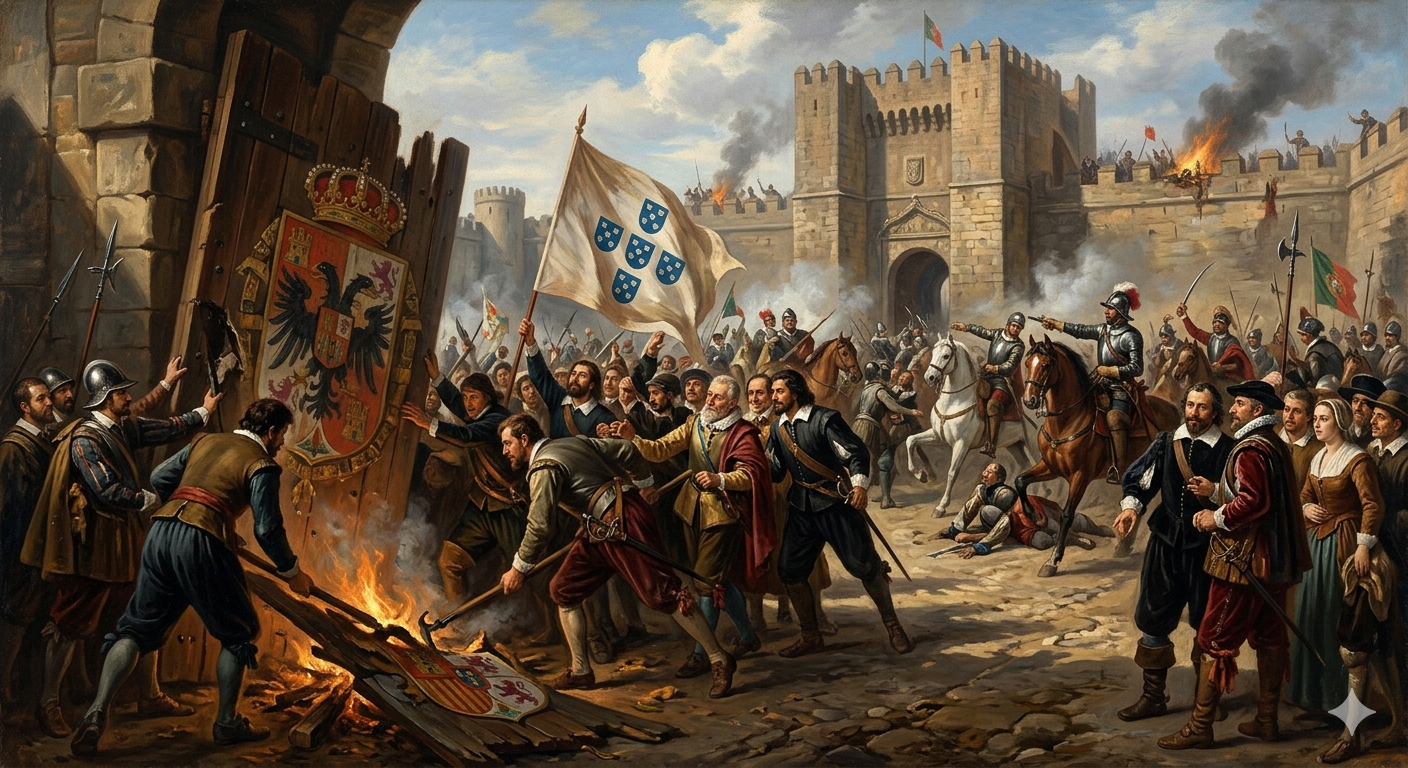
On December 1, 1640, a small group of Portuguese nobles known as the “Forty Conspirators” stormed the royal palace in Lisbon and launched a revolution that would end six decades of Spanish domination over Portugal, restoring the nation’s independence and establishing the House of Braganza as the new ruling dynasty. This momentous uprising, which began as a carefully orchestrated coup d’état, marked the beginning of the Portuguese Restoration War and brought an end to the Iberian Union that had united Portugal and Spain under a single Habsburg monarch since 1580. The revolution’s success was immediate and dramatic, with John, 8th Duke of Braganza, being acclaimed as King John IV of Portugal within hours of the palace coup, while Spanish forces found themselves isolated and overwhelmed by the widespread popular support for Portuguese independence. The events of December 1, 1640, represented far more than a simple change of government; they marked the rebirth of Portuguese sovereignty and the beginning of a 28-year struggle that would ultimately secure Portugal’s place as an independent nation in European politics. This revolutionary moment transformed Portugal from a Spanish province back into a proud, independent kingdom that would maintain its autonomy and continue to control its vast overseas empire despite nearly three decades of intermittent warfare with one of Europe’s most powerful monarchies.
The Iberian Union: Six Decades of Spanish Domination and Growing Portuguese Resentment
The roots of Portuguese discontent that culminated in the 1640 revolution can be traced back to 1580, when Portugal lost its independence following the Portuguese succession crisis that left the throne vacant after the death of King Sebastian I at the Battle of Alcácer Quibir in 1578 and the subsequent death of his great-uncle and successor, Cardinal Henry, in 1580. Philip II of Spain, who had a legitimate claim to the Portuguese throne through his mother Isabella of Portugal, successfully pressed his claim through a combination of diplomatic negotiation, military pressure, and political maneuvering that resulted in his recognition as Philip I of Portugal. The union of the two Iberian crowns created the largest European empire of the early modern period, encompassing not only the entire Iberian Peninsula but also the vast overseas possessions of both Spain and Portugal spanning four continents.
Initially, the Iberian Union was structured as a personal union rather than a complete political integration, with Philip II promising to respect Portuguese laws, customs, and administrative autonomy while maintaining separate Portuguese institutions and governance structures. The Spanish monarch assured the Portuguese nobility that their kingdom would retain its distinct identity and that Portuguese interests would be protected within the larger Habsburg imperial framework. These early guarantees included commitments to staff Portuguese colonial administration with Portuguese officials, respect Portuguese commercial privileges, and maintain Portuguese legal traditions that had developed over centuries of independent governance.
However, as the Union progressed through the reigns of Philip III (Philip II of Portugal) and Philip IV (Philip III of Portugal), Spanish policy toward Portugal became increasingly centralized and exploitative, gradually eroding the autonomy that had originally been promised to the Portuguese people and their nobles. The Spanish crown began treating Portugal more like a provincial territory than a partner kingdom, imposing new taxes to finance Spain’s costly European wars, replacing Portuguese officials with Spanish appointees, and diverting Portuguese colonial resources to support Spanish imperial projects that had little direct benefit for Portuguese interests.
The economic burden placed on Portugal by Spanish imperial policy became particularly onerous during the reign of Philip IV, who needed enormous financial resources to fund Spain’s involvement in the Thirty Years’ War and ongoing conflicts with France and the Dutch Republic. Portuguese merchants found themselves subject to new taxation schemes designed to extract revenue for Spanish military campaigns, while Portuguese colonial trade was increasingly redirected to serve Spanish rather than Portuguese commercial interests. The requirement that Portugal contribute ships and resources to ill-fated Spanish ventures, including the disastrous Spanish Armada of 1588, further alienated Portuguese opinion and demonstrated that their country’s resources were being squandered on Spanish military adventures.
The gradual erosion of Portuguese autonomy accelerated during the 1630s, when Spanish ministers began openly discussing plans to transform Portugal from a partner kingdom into a simple Spanish province, completely eliminating the remaining vestiges of Portuguese self-governance and administrative independence. Count-Duke Olivares, Philip IV’s chief minister, advocated for a policy of complete integration that would have abolished Portuguese institutions, imposed Spanish law throughout Portuguese territories, and reduced Portugal to the same status as other Spanish provinces such as Catalonia or Aragon. These centralizing policies represented a fundamental betrayal of the original terms under which the Iberian Union had been established and created the political grievances that would eventually fuel the independence movement of 1640.
The Catalyst for Revolution: Spain’s Military Overstretch and the Catalonian Revolt
The immediate circumstances that made the Portuguese revolution of 1640 possible arose from Spain’s dangerous military overextension during the late 1630s, when Philip IV’s government found itself simultaneously fighting wars on multiple fronts while facing serious domestic rebellions that strained Spanish military resources to the breaking point. The Spanish monarchy’s involvement in the Thirty Years’ War, ongoing conflict with France, Dutch independence struggles, and various colonial wars had created an enormous drain on Spanish manpower and financial resources, leaving insufficient forces available to maintain effective control over potentially rebellious territories within the Iberian Peninsula itself.
The most immediate trigger for Portuguese action came from the outbreak of the Reapers’ War in Catalonia during May 1640, when Catalonian peasants and nobles rose in revolt against Spanish tax policies and military recruitment demands that they viewed as violations of traditional Catalonian privileges and autonomy. The Catalonian rebellion tied down significant Spanish military forces and created a precedent for successful resistance against Spanish centralization policies, demonstrating that Habsburg authority could be effectively challenged when local populations were sufficiently united in opposition to Spanish rule. Portuguese conspirators closely monitored the Catalonian situation and recognized that Spanish military responses to the rebellion had created a window of opportunity for their own independence movement.
The Spanish government’s handling of the Catalonian crisis also revealed the weakness of Spanish administrative control and the extent to which Philip IV’s ministers were struggling to maintain effective governance across their diverse territorial possessions. Spanish attempts to suppress the Catalonian revolt through military force had proven largely unsuccessful, while diplomatic efforts to negotiate a settlement had failed to address the fundamental grievances that had sparked the rebellion in the first place. This pattern of Spanish weakness and incompetence encouraged Portuguese conspirators to believe that their own independence movement might succeed if properly organized and timed to coincide with continued Spanish difficulties elsewhere.
Portuguese nobles also recognized that the Spanish government’s financial desperation had created additional opportunities for successful rebellion, as Philip IV’s chronic need for revenue had led to increasingly unpopular taxation policies that were alienating populations throughout Spanish territories. The Spanish crown’s demands for new taxes from Portugal to finance military campaigns in Catalonia and elsewhere had created widespread resentment among Portuguese taxpayers who saw no benefit from Spanish military ventures and felt that their resources were being exploited to support foreign wars. This fiscal pressure provided Portuguese conspirators with popular grievances that could be used to mobilize broader support for independence.
The strategic situation in December 1640 was particularly favorable for Portuguese action because Spanish forces were concentrated in Catalonia and along the French frontier, leaving Portugal defended by only minimal Spanish garrisons that would be unable to mount effective resistance to a well-coordinated independence movement. Portuguese military analysis suggested that Spanish forces in Portugal numbered fewer than 3,000 troops, most of whom were Portuguese soldiers whose loyalty to the Spanish crown was questionable at best. This military weakness meant that a successful coup in Lisbon could potentially secure Portuguese independence before Spanish reinforcements could arrive to restore Habsburg control over the rebellious territory.
The Forty Conspirators: Organizing Portugal’s Path to Independence
The Portuguese independence movement was organized by a secret group of Portuguese nobles and intellectuals known as the “Forty Conspirators,” led by three primary figures: Antão Vaz de Almada, Miguel de Almeida, and João Pinto Ribeiro, who coordinated the political and military planning necessary to mount a successful revolution against Spanish rule. These conspirators represented the cream of Portuguese aristocracy and included influential nobles, military officers, legal scholars, and church officials who possessed the social connections, financial resources, and political expertise necessary to organize and execute a complex coup d’état while simultaneously building popular support for Portuguese independence.
Antão Vaz de Almada, one of the conspiracy’s principal leaders, was a prominent Portuguese nobleman who had served in various administrative positions under Spanish rule but had become increasingly disillusioned with Spanish policies that marginalized Portuguese interests and reduced Portugal’s status within the Habsburg empire. Vaz de Almada’s extensive connections within Portuguese noble society made him an ideal coordinator for recruiting additional conspirators and building the broad-based coalition that would be necessary to ensure the revolution’s success. His knowledge of Spanish administrative procedures and military dispositions also provided crucial intelligence for planning the timing and execution of the independence movement.
Miguel de Almeida brought military expertise to the conspiracy, having served as a Portuguese officer in Spanish armies and possessing detailed knowledge of Spanish military capabilities, troop dispositions, and fortification systems that would be crucial for planning successful resistance to Spanish attempts to suppress the independence movement. Almeida’s military background also enabled him to assess Portuguese defensive capabilities and develop strategies for maintaining independence once the initial revolution had been successful. His contacts within the Portuguese military establishment helped ensure that significant portions of the Portuguese garrison would support the independence movement rather than remaining loyal to Spanish authority.
João Pinto Ribeiro, a distinguished jurist and legal scholar, provided the intellectual and constitutional framework for the independence movement by developing legal arguments that justified Portuguese rebellion against Spanish rule and established the legitimate basis for restoring Portuguese monarchy under the House of Braganza. Ribeiro’s legal expertise was crucial for demonstrating that the Spanish crown had violated the original terms of the Iberian Union and that Portuguese resistance was therefore a legitimate response to Spanish breaches of contract rather than mere rebellion against lawful authority. His constitutional theories also helped establish the legal foundation for John IV’s claim to the Portuguese throne.
The recruitment process for the conspiracy was necessarily cautious and secretive, as discovery by Spanish authorities would have resulted in the execution of all participants and the permanent suppression of Portuguese independence hopes. The conspirators used their social networks within Portuguese noble society to gradually identify and approach potential supporters, testing their attitudes toward Spanish rule and their willingness to participate in an independence movement. This careful recruitment process took several years to complete but ultimately assembled a coalition that included representatives from all major sectors of Portuguese society, including the nobility, military, clergy, and merchant classes.
The conspirators’ planning process involved detailed consideration of the timing, logistics, and political dimensions of their independence movement, recognizing that success would require not only the initial seizure of power in Lisbon but also the subsequent maintenance of independence against inevitable Spanish attempts at reconquest. They developed contingency plans for various scenarios, including the possibility of Spanish military intervention, foreign diplomatic pressure, and internal Portuguese opposition to the independence movement. This comprehensive planning proved crucial to the revolution’s ultimate success and the establishment of a viable independent Portuguese state.
December 1, 1640: The Day That Restored Portuguese Independence
The Portuguese revolution began at approximately 10:00 AM on December 1, 1640, when the Forty Conspirators and their supporters simultaneously struck at key points throughout Lisbon, seizing control of strategic locations while eliminating Spanish resistance with remarkable speed and efficiency that demonstrated the thoroughness of their planning and the extent of popular support for Portuguese independence. The primary target of the revolution was the royal palace in Lisbon, where Spanish authority was embodied in the person of Margaret of Savoy, Duchess of Mantua, who served as Philip IV’s vicereine in Portugal and exercised Spanish governmental authority in the king’s absence.
The assault on the royal palace was led by a group of armed conspirators who overwhelmed the Spanish guards and quickly gained control of the building, capturing Margaret of Savoy and imprisoning her while she attempted to rally Portuguese loyalists to resist the independence movement. The duchess’s efforts to maintain Spanish authority proved futile in the face of overwhelming Portuguese opposition, and her capture effectively eliminated organized Spanish resistance to the revolution. The conspirators treated Margaret with appropriate respect due to her royal status while making clear that Spanish rule in Portugal had ended and that a new political order was being established.
The revolution’s most dramatic moment occurred when the conspirators cornered Miguel de Vasconcelos, the Spanish Secretary of State for Portuguese affairs, who had become a symbol of Spanish oppression due to his harsh enforcement of Spanish tax policies and his dismissive attitude toward Portuguese grievances. Vasconcelos attempted to escape the conspirators by hiding in a palace closet, but he was discovered and killed when he was thrown from a palace window, an act that symbolically demonstrated the violent end of Spanish administrative control over Portugal. This dramatic execution sent a clear message that the independence movement was serious and that Spanish officials could no longer expect to exercise authority over Portuguese territory with impunity.
Simultaneously with the palace coup, other groups of conspirators moved to secure key strategic points throughout Lisbon, including the city’s fortifications, arsenals, and communication centers, ensuring that Spanish forces could not mount a coordinated counterattack or summon reinforcements from other Spanish-controlled territories. The revolutionaries also took control of Lisbon’s port facilities, preventing Spanish ships from landing reinforcements while simultaneously securing escape routes should the revolution fail and its leaders need to flee Portuguese territory. This coordinated action across multiple objectives demonstrated the sophistication of the conspirators’ planning and their understanding of the military and political requirements for successful revolution.
The speed with which news of the revolution spread throughout Lisbon and the enthusiastic popular response it generated revealed the depth of Portuguese dissatisfaction with Spanish rule and the extent to which the independence movement enjoyed broad-based support across all social classes. Within hours of the palace coup, crowds of Portuguese citizens were gathering in the streets to celebrate the end of Spanish domination and to demonstrate their support for the restoration of Portuguese independence. This popular enthusiasm provided crucial political legitimacy for the revolution and demonstrated that the conspirators had correctly assessed Portuguese public opinion regarding Spanish rule.
By the end of December 1, 1640, the revolutionaries had achieved complete control of Lisbon and had begun the process of establishing a new Portuguese government under John, 8th Duke of Braganza, who was acclaimed as King John IV of Portugal by enthusiastic crowds gathered in Lisbon’s main squares. The duke’s acceptance of the crown marked the formal restoration of Portuguese monarchy and the beginning of a new chapter in Portuguese history that would see the country regain its independence and restore its position as a significant European power with a global empire spanning four continents.
John IV: From Duke of Braganza to King of Portugal
John, 8th Duke of Braganza, who became King John IV of Portugal following the successful revolution of December 1640, was uniquely qualified to serve as the restored Portuguese monarchy’s first ruler due to his legitimate hereditary claim to the Portuguese throne, his extensive landholdings and wealth, and his reputation as a capable leader who had maintained Portuguese noble traditions during the long period of Spanish rule. Born on March 19, 1604, John had inherited the Braganza dukedom as the senior representative of the Portuguese royal house, making him the obvious choice for Portuguese nobles seeking to restore legitimate monarchy after overthrowing Spanish rule. His grandmother, Catherine, Duchess of Braganza, had been the daughter of King Edward of Portugal, providing John with an unquestionable bloodline connection to the medieval Portuguese royal dynasty.
The Duke of Braganza’s initial reluctance to accept the Portuguese crown reflected both his cautious temperament and his realistic assessment of the enormous challenges that would face any restored Portuguese monarch, including the certainty of prolonged warfare with Spain, the need to rebuild Portuguese institutions that had been weakened by decades of Spanish rule, and the diplomatic difficulties of securing international recognition for Portuguese independence. John understood that accepting the crown would make him a target for Spanish military action and would require him to dedicate his life to defending Portuguese independence against one of Europe’s most powerful monarchies. His eventual acceptance of the throne demonstrated his commitment to Portuguese national interests and his willingness to sacrifice personal security for the cause of national independence.
The new king’s coronation took place amid scenes of tremendous popular enthusiasm, as Portuguese citizens throughout the country celebrated the restoration of their national monarchy and the end of six decades of foreign rule that had reduced their proud kingdom to the status of a Spanish province. The coronation ceremony itself was deliberately designed to emphasize the continuity between the new Braganza dynasty and Portugal’s medieval royal traditions, incorporating ancient Portuguese royal symbols and ceremonies that had been suppressed or marginalized during the Spanish period. This symbolic connection to Portugal’s independent past helped legitimize John IV’s rule and demonstrated that the revolution represented a restoration of traditional Portuguese monarchy rather than the establishment of an entirely new political system.
John IV’s personality and leadership style proved well-suited to the challenges of his reign, as he combined strategic caution with determined resistance to Spanish attempts at reconquest while simultaneously working to rebuild Portuguese institutions and restore the country’s international prestige. The king demonstrated remarkable diplomatic skill in securing foreign support for Portuguese independence, establishing alliances with France, Sweden, and eventually England that provided crucial military and financial assistance during the long war with Spain. His diplomatic efforts were particularly successful in exploiting Spanish conflicts with other European powers, ensuring that Spain would be unable to concentrate its full military strength against Portugal.
The king’s domestic policies focused on rebuilding Portuguese military capabilities, reforming the country’s administrative systems, and restoring Portuguese control over the nation’s overseas empire, much of which had been lost to Dutch and other foreign competitors during the period of Spanish rule when Portuguese defenses had been weakened by Spanish neglect and mismanagement. John IV established new military academies, reformed Portuguese fortifications, and recruited experienced foreign military advisors to help modernize Portuguese armed forces for the anticipated conflict with Spain. His reign also saw significant cultural and intellectual revival as Portuguese writers, artists, and scholars celebrated their country’s restored independence and began reasserting distinctly Portuguese cultural traditions that had been suppressed during the Spanish period.
The Portuguese Restoration War: Twenty-Eight Years of Struggle for Independence
The Portuguese Restoration War, which lasted from 1640 to 1668, represented one of the longest and most complex conflicts of the 17th century, involving not only Portugal and Spain but also major European powers including France, England, and the Dutch Republic, whose own conflicts with Spain created opportunities for Portuguese independence while simultaneously complicating the diplomatic and military situation throughout southwestern Europe. The war’s duration reflected both the determination of successive Spanish kings to reclaim what they considered their rightful inheritance and the equally strong Portuguese commitment to maintaining the independence they had fought so hard to achieve. The conflict’s resolution would ultimately establish Portugal as a permanently independent nation and demonstrate that even relatively small countries could successfully resist the imperial ambitions of major European powers when they possessed sufficient determination and effective leadership.
The war’s first phase, lasting from 1640 to 1646, was characterized by Spanish attempts to quickly suppress the Portuguese rebellion through direct military intervention, combined with Portuguese efforts to consolidate their independence and build the military capabilities necessary to resist Spanish reconquest attempts. Spain initially committed seven regiments to the Portuguese frontier under the command of the Count of Monterrey, but delays and poor coordination allowed Portuguese forces to establish defensive positions and organize their resistance to Spanish attack. The early engagements of this period demonstrated that Portuguese independence could not be easily eliminated and that Spain would need to commit far greater resources to any successful reconquest attempt.
The Battle of Montijo on May 26, 1644, marked a crucial early Portuguese victory when a large Spanish column commanded by Neapolitan nobleman Carlo Andrea Caracciolo was defeated by Portuguese forces led by Matias de Albuquerque, one of several experienced Portuguese colonial officers who emerged as key military leaders during the independence struggle. This victory demonstrated Portuguese military competence and boosted national morale while simultaneously revealing Spanish tactical limitations and logistical difficulties in supporting military operations in Portuguese territory. The battle also established important strategic principles that would guide Portuguese military strategy throughout the war, emphasizing the advantages of defensive warfare and the importance of choosing favorable terrain for engagements with Spanish forces.
The war’s second phase, spanning 1646 to 1660, was characterized by military stalemate and limited engagement as both sides were distracted by other conflicts and neither possessed the resources necessary to achieve decisive victory. During this period, Spain was heavily engaged in the Thirty Years’ War and subsequent conflicts with France, while Portugal focused on diplomatic efforts to secure foreign allies and rebuilding its military capabilities for anticipated future Spanish offensives. This phase of the war was marked by small-scale frontier skirmishes, raids, and sieges rather than major battles, creating a pattern of low-intensity conflict that drained both sides’ resources without producing clear strategic advantages for either Portugal or Spain.
The war’s final phase, from 1660 to 1668, saw renewed Spanish attempts to achieve decisive victory over Portugal, culminating in major battles that would ultimately confirm Portuguese independence and force Spain to recognize the legitimacy of the Braganza dynasty. The Battle of Montes Claros on June 17, 1665, represented the war’s most important engagement when Portuguese forces under António Luís de Meneses, 1st Marquess of Marialva, and the German general Frederick Schomberg decisively defeated a Spanish army of over 20,000 men, inflicting more than 10,000 casualties and effectively ending Spanish hopes of reconquering Portugal through military force. This stunning Portuguese victory demonstrated the effectiveness of their military reforms and foreign military assistance while revealing the declining quality of Spanish forces and the unsustainable nature of Spain’s military commitments across multiple theaters.
International Diplomacy and Foreign Support for Portuguese Independence
Portugal’s successful struggle for independence was significantly aided by the diplomatic skill of successive Portuguese monarchs and ministers who expertly exploited the complex web of European international relations to secure crucial foreign support for their independence movement while simultaneously preventing Spain from assembling the coalition of allies that might have been necessary to overwhelm Portuguese resistance. The Portuguese diplomatic strategy focused primarily on allying with Spain’s enemies and exploiting ongoing European conflicts to ensure that Spanish military resources would be divided among multiple theaters rather than concentrated against Portugal. This diplomatic approach proved essential to Portuguese survival during the long war and demonstrated the importance of international relations in determining the outcomes of early modern European conflicts.
France provided the most significant foreign support for Portuguese independence, motivated by its longstanding rivalry with Spain and its desire to weaken Spanish power by supporting separatist movements throughout Spanish territories. The Franco-Portuguese alliance, signed on June 1, 1641, provided Portugal with crucial financial subsidies, military advisors, and diplomatic recognition that helped legitimize Portuguese independence claims in European courts while simultaneously putting additional pressure on Spanish resources by forcing Spain to defend against French attacks on multiple fronts. French support proved particularly valuable during critical moments of the war when Spanish offensives threatened Portuguese independence and foreign assistance was essential to maintain Portuguese resistance.
Sweden also provided important early support for Portuguese independence through an alliance signed in August 1641, reflecting Swedish involvement in the Thirty Years’ War and Swedish interest in weakening Habsburg power throughout Europe. Although Swedish support was primarily diplomatic rather than military, Swedish recognition of Portuguese independence helped establish international legitimacy for the Portuguese cause and demonstrated that major European powers viewed Portugal as a viable independent state rather than merely a rebellious Spanish province. Swedish diplomatic support also helped Portugal gain access to broader European diplomatic networks and intelligence regarding Spanish military plans and capabilities.
The eventual British support for Portuguese independence proved decisive in the war’s final phases, when English military advisors and troops provided crucial assistance that enabled Portuguese forces to achieve the decisive victories that forced Spain to recognize Portuguese independence. The arrival of a British brigade numbering 3,000 veterans of the English Civil War in August 1662 significantly strengthened Portuguese military capabilities and provided experienced professional soldiers whose expertise proved crucial in subsequent battles against Spanish forces. Many of these British soldiers were veterans of Cromwell’s New Model Army, and their involvement in Portuguese service represented King Charles II’s solution to the problem of demobilized republican soldiers whose presence in England was politically problematic.
Dutch support for Portuguese independence was more indirect but still significant, as Dutch conflicts with Spain in the Netherlands and competition for Portuguese colonial territories created additional pressures on Spanish resources while simultaneously providing Portugal with opportunities to regain control of overseas possessions that had been lost during the Spanish period. Dutch military success against Spanish forces in the Netherlands demonstrated Spanish military limitations and encouraged Portuguese resistance by showing that Spanish power could be successfully challenged by smaller nations with sufficient determination and effective military organization. The Dutch example also provided Portuguese strategists with valuable lessons regarding defensive warfare techniques and the importance of naval power in maintaining independence against larger continental powers.
The Treaty of Lisbon 1668: Spain Finally Recognizes Portuguese Independence
The Treaty of Lisbon, signed on February 13, 1668, formally ended the Portuguese Restoration War and established the definitive recognition of Portuguese independence by the Spanish crown, marking the successful conclusion of nearly three decades of struggle that had restored Portugal’s status as a sovereign European nation with full control over its domestic affairs and overseas empire. The treaty negotiations reflected the changing balance of power between Portugal and Spain, as Spanish military failures and domestic difficulties had weakened Madrid’s negotiating position while Portuguese diplomatic and military successes had strengthened Lisbon’s ability to demand favorable terms for any peace settlement.
The Spanish decision to negotiate seriously with Portugal reflected the practical realities of Spain’s declining military capabilities and the unsustainable financial costs of continuing the Portuguese war while simultaneously facing other military challenges throughout Spanish territories. The devastating Spanish defeat at Montes Claros in 1665 had demonstrated that continued military efforts against Portugal were unlikely to succeed and would only drain additional resources from the Spanish treasury without achieving Spanish strategic objectives. Spanish domestic opposition to the Portuguese war had also intensified as the conflict’s costs became apparent and Spanish taxpayers questioned the wisdom of continuing expensive military campaigns that seemed unlikely to produce beneficial results.
The treaty’s terms were generally favorable to Portugal, confirming Portuguese independence under the House of Braganza while allowing Portugal to retain control of virtually all Portuguese territories that had been recovered during the independence war. Spain recognized John IV’s successor, Alfonso VI, as the legitimate King of Portugal and formally renounced any Spanish claims to the Portuguese throne, thereby acknowledging that the Iberian Union had been permanently dissolved and that Portugal had resumed its status as an independent European monarchy. The treaty also confirmed Portuguese control over the vast Portuguese colonial empire, including Brazil, Angola, Mozambique, Goa, and other overseas territories that represented much of Portugal’s wealth and international importance.
The most significant territorial concession that Portugal was required to make involved the North African city of Ceuta, which had been conquered by Portuguese forces in 1415 but chose to remain under Spanish rule during the independence war rather than recognizing the Braganza dynasty. Spain’s retention of Ceuta was a relatively minor loss for Portugal compared to the enormous gains represented by the confirmation of Portuguese independence and the retention of Portuguese control over the rest of the Portuguese Empire. The Ceuta situation also reflected the practical difficulties of maintaining Portuguese authority over territories that were geographically isolated from the Portuguese mainland and surrounded by Spanish-controlled territory.
The treaty’s diplomatic implications extended far beyond the immediate Portuguese-Spanish relationship, as international recognition of Portuguese independence confirmed the legitimacy of successful resistance movements against Habsburg imperial authority and demonstrated that the balance of European power was shifting away from Spanish hegemony toward a more pluralistic system of competing nation-states. The Portuguese success story inspired other independence movements throughout Spanish territories and contributed to the gradual decline of Spanish imperial power that would characterize the remainder of the 17th century and beyond.
The Long-Term Impact of Portuguese Independence on European Politics
The successful Portuguese independence movement of 1640 and the subsequent Restoration War had profound and lasting effects on European political development, demonstrating that even relatively small nations could successfully resist the imperial ambitions of major powers and maintain their independence through effective military organization, diplomatic skill, and popular determination. The Portuguese example inspired similar independence movements throughout Europe and contributed to the gradual transformation of European politics from a system dominated by large multi-ethnic empires toward a more pluralistic arrangement of sovereign nation-states, each controlling relatively homogeneous territories and populations.
The collapse of the Iberian Union marked a significant step in the decline of Spanish hegemony that had dominated European international relations during the 16th and early 17th centuries, as Spanish military failures in Portugal demonstrated Spanish military limitations while Spanish diplomatic isolation during the Portuguese war revealed the extent to which other European powers were willing to support anti-Spanish movements. The Portuguese success encouraged French, Dutch, and English efforts to further weaken Spanish power while simultaneously providing a model for other separatist movements within Spanish territories who sought to emulate Portuguese achievements in their own struggles for independence or autonomy.
The restoration of Portuguese independence also had important implications for global colonial competition, as Portuguese control over Brazil, Angola, Mozambique, and other strategic territories ensured that the Portuguese Empire would remain a significant factor in international trade and colonial development rather than being absorbed into the larger Spanish imperial system. Portuguese independence thus helped maintain competitive balance among European colonial powers and prevented Spanish monopolization of key colonial territories and trade routes that might have fundamentally altered the development of global commerce during the early modern period.
The diplomatic precedents established during the Portuguese independence struggle, particularly the effective use of alliance systems and the exploitation of international conflicts to secure foreign support for independence movements, became important models for later European diplomatic practice and contributed to the development of more sophisticated approaches to international relations. Portuguese diplomatic success demonstrated the importance of timing, alliance building, and strategic communication in achieving foreign policy objectives, while also showing how smaller powers could effectively compete with larger neighbors through superior diplomatic organization and more flexible strategic thinking.
The Portuguese experience also contributed to important developments in military organization and strategy, as Portuguese success in resisting Spanish reconquest attempts demonstrated the effectiveness of defensive warfare strategies combined with limited offensive operations designed to exploit enemy weaknesses rather than seeking decisive pitched battles. Portuguese military innovations, particularly their use of fortified positions and their integration of foreign military advisors into Portuguese command structures, influenced military thinking throughout Europe and contributed to broader changes in early modern European warfare that emphasized professional military organization over traditional feudal military arrangements.
The ultimate recognition of Portuguese independence through the Treaty of Lisbon established important precedents for the peaceful resolution of territorial disputes and the diplomatic recognition of successful independence movements, contributing to the gradual development of international law concepts that would become increasingly important in subsequent European and global political development. The Portuguese case demonstrated that independence movements could achieve international legitimacy and legal recognition when they could demonstrate effective governance, military competence, and popular support, providing a model that would influence later independence struggles throughout Europe and eventually in other parts of the world as European colonial empires began to decline during the 18th, 19th, and 20th centuries.