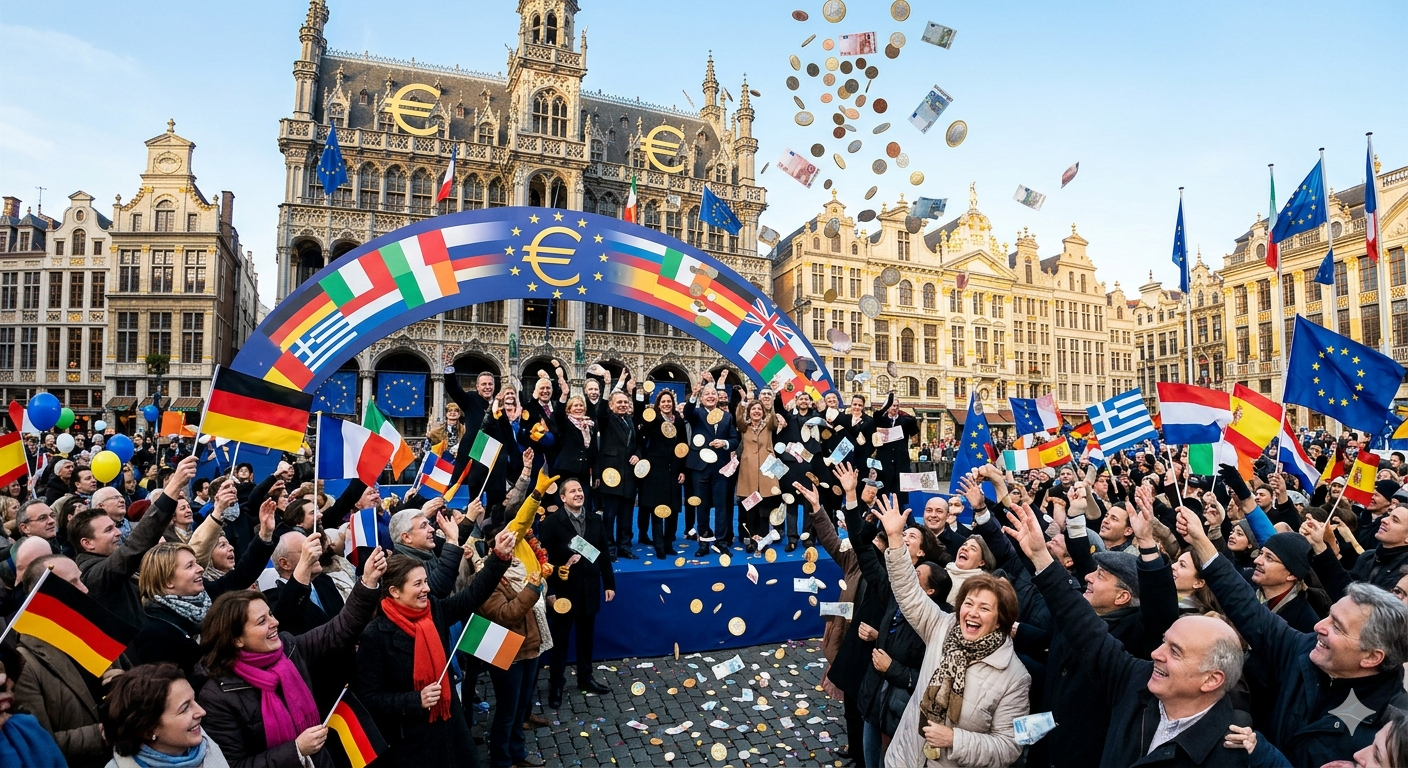
On January 1, 1999, the European Union achieved what had seemed improbable to many observers only a decade earlier: eleven sovereign nations simultaneously surrendered control of their individual monetary policies and adopted a single shared currency, the euro. At the stroke of midnight, the Deutsche Mark, the French franc, the Italian lira, the Spanish peseta, and seven other national currencies ceased to exist as independent monetary instruments, subsumed into a unified monetary order overseen by a single institution — the newly established European Central Bank headquartered in Frankfurt, Germany. Though the euro would not appear in the form of physical banknotes and coins until January 1, 2002, its launch on January 1, 1999, as an accounting and electronic currency marked one of the most ambitious and consequential acts of economic cooperation in the history of the modern world.
The introduction of the euro was not a sudden event but the culmination of more than three decades of political negotiation, economic theory, institutional construction, and often painful compromise. It represented the fulfillment of a vision articulated by European statesmen in the late 1960s — that the member states of what was then the European Economic Community could transcend the volatility of floating national currencies and forge a common monetary identity that would cement their economic integration and project European influence on the global stage. To understand the full significance of what happened on that New Year’s Day in 1999, it is necessary to trace the long and turbulent path that led to the eurozone’s birth.
The Earliest Vision of a European Single Currency: From the 1960s to the Werner Report of 1970
The idea of a unified European currency predates the European Union itself. As early as 1929, German statesman Gustav Stresemann raised the concept of a European currency at the League of Nations, recognizing that economic fragmentation across the continent was a source of political instability as much as economic inefficiency. However, the practical pursuit of monetary union within the framework of post-war European integration began in earnest in the late 1960s, when the leaders of the European Economic Community recognized that the existing international monetary framework — the Bretton Woods system of fixed exchange rates anchored to the US dollar — was under increasing strain.
The first formal blueprint for European monetary union was produced in October 1970 by an expert group chaired by Pierre Werner, then Prime Minister and Finance Minister of Luxembourg. The Werner Report, as it came to be known, proposed achieving full economic and monetary union within ten years, proceeding through three distinct stages toward the irrevocable fixing of exchange rates and the eventual replacement of national currencies with a single European currency. The report was accepted in principle by the Council of the European Communities in 1971, but its implementation was almost immediately derailed by external events. In August 1971, President Richard Nixon of the United States unilaterally suspended the convertibility of the US dollar to gold, collapsing the Bretton Woods system and triggering widespread currency instability across the world’s major economies. The oil crises of 1973 and 1979 compounded the disruption, making the kind of macroeconomic convergence that monetary union required extremely difficult to achieve. The Werner Plan effectively died without being implemented.
The European Monetary System and the Exchange Rate Mechanism: Building Stability Before Union
Despite the failure of the Werner Plan, European leaders did not abandon the quest for monetary stability. In March 1979, the European Monetary System (EMS) was created, establishing the Exchange Rate Mechanism (ERM) as a means of coordinating the currencies of EEC member states within defined fluctuation bands centered on a reference unit called the European Currency Unit (ECU). The ECU was itself an accounting currency — a weighted basket of the participating national currencies — and it served as the conceptual predecessor of the euro. Under the ERM, member states agreed to keep their currencies within a narrow band of fluctuation against each other, intervening in foreign exchange markets whenever their currency approached the boundary of its permitted range.
The EMS achieved significant results during the 1980s, substantially reducing exchange rate volatility among its members and providing the monetary stability that cross-border trade and investment required. France, Germany, Italy, Belgium, the Netherlands, Luxembourg, Denmark, and Ireland were among the original participants; the United Kingdom, characteristically skeptical of European monetary integration, did not join the ERM until October 1990, only to be humiliatingly forced out again in September 1992 — an episode that became known as Black Wednesday. On that date, September 16, 1992, speculative attacks on the pound sterling, led most prominently by hedge fund manager George Soros, overwhelmed the Bank of England’s attempts to keep the pound within its ERM bands, forcing the British government to withdraw from the mechanism at enormous financial cost and personal political embarrassment to Chancellor of the Exchequer Norman Lamont and Prime Minister John Major.
The ERM crisis of 1992-1993, which also forced Italy to suspend its participation and compelled France to defend its franc at great cost, paradoxically accelerated the case for full monetary union among the core European states. The experience demonstrated vividly that a system of coordinated but still independent national currencies remained vulnerable to speculative attack, particularly in an era of liberalized capital markets where enormous sums could be moved across borders in seconds. For France and Germany especially, the argument grew stronger that only the complete elimination of separate currencies and their replacement with a single currency managed by a single central bank could provide the stability that the single market required.
The Delors Report of 1989: The Three-Stage Roadmap to Economic and Monetary Union
The decisive intellectual and institutional push toward full monetary union came in June 1989, when a committee established by the European Council and chaired by Jacques Delors, President of the European Commission, presented its landmark report on Economic and Monetary Union (EMU). Jacques Delors, a French economist and politician of formidable influence, had been Commission President since 1985 and was the driving force behind both the Single European Act of 1986 — which created the program for completing the European single market — and the broader deepening of European integration. The Delors Committee, composed of the central bank governors of all twelve EEC member states along with three independent experts, produced a detailed three-stage plan for achieving full monetary union.
The Delors Report proposed that Stage One should begin by July 1, 1990, with the complete liberalization of capital movements across EEC member states and the full participation of all currencies in the ERM. Stage Two would involve the creation of a European Monetary Institute (EMI) to coordinate central bank policies and begin the institutional groundwork for a future European Central Bank. Stage Three would culminate in the irrevocable fixing of exchange rates and the transfer of monetary policy authority to a new European Central Bank. The report was not merely a technical document; it was a political manifesto for a qualitative leap in European integration, and its acceptance by the European Council at the Madrid Summit in June 1989 set the EMU project formally in motion.
The Maastricht Treaty of 1992: The Legal Foundation of the Euro
The legal framework for the euro was laid by one of the most ambitious international treaties of the twentieth century: the Treaty on European Union, signed in the Dutch city of Maastricht on February 7, 1992. Negotiated by the twelve member states of the European Community — Belgium, Denmark, France, Germany, Greece, Ireland, Italy, Luxembourg, the Netherlands, Portugal, Spain, and the United Kingdom—the Maastricht Treaty created the European Union and established Economic and Monetary Union as one of its core objectives. The treaty set out a specific timetable for achieving a single currency by January 1, 1999 at the latest, though the United Kingdom and Denmark negotiated formal opt-out clauses that exempted them from the obligation to adopt the single currency.
Central to the Maastricht Treaty’s monetary provisions were the so-called convergence criteria — a set of strict economic conditions that member states had to meet before they would be admitted to the third stage of EMU and permitted to adopt the euro. The convergence criteria required that: the annual government budget deficit must not exceed 3 percent of gross domestic product (GDP); total government debt must not exceed 60 percent of GDP; the inflation rate must not exceed the average of the three lowest inflation rates in the EU by more than 1.5 percentage points; long-term interest rates must not exceed the average of the three lowest interest rates in the EU by more than 2 percentage points; and the national currency must have participated in the ERM for at least two years without undergoing devaluation. These criteria were designed, primarily at German insistence, to ensure that only genuinely convergent economies with sound fiscal and monetary policies would be admitted to the currency union, protecting the euro’s stability from the outset.
Gaining ratification of the Maastricht Treaty proved considerably more difficult than its architects had anticipated. In Denmark, a June 1992 referendum rejected the treaty, sending shockwaves through European capitals; a revised treaty was eventually approved in a second Danish referendum in May 1993, after Denmark secured opt-outs from monetary union and several other treaty provisions. In France, a September 1992 referendum approved the treaty by the narrowest of margins — just 50.8 percent in favor — in a result so close that it became known as the petit oui (the little yes). In the United Kingdom, ratification in Parliament became a full-scale political crisis, with Prime Minister John Major forced to tie the ratification vote to a motion of confidence in his government to overcome the rebellion of Eurosceptic Conservative MPs. The treaty finally came into force on November 1, 1993, after the German Constitutional Court upheld its legality following legal challenges from German citizens.
Key Figures Who Shaped the Euro: Delors, Kohl, Mitterrand, Waigel, and Duisenberg
Several individuals stand out as particularly decisive in the creation of the euro. Jacques Delors, born in 1925, was the European Commission President who provided the intellectual architecture and the political determination that drove the EMU project forward in the late 1980s and early 1990s. Delors came from the French tradition of economic planning and saw monetary union as inseparable from deeper political integration; his combination of technocratic expertise and political vision made him uniquely effective as the project’s champion.
Helmut Kohl, the German Chancellor from 1982 to 1998, was perhaps the single most important political figure in making the euro a reality. Kohl was a committed European federalist who saw German reunification — achieved in 1990 — as inextricably linked to deeper European integration. He understood that France and other European neighbors were anxious about the prospect of a reunified Germany becoming too powerful and potentially destabilizing, and he offered the euro as Germany’s contribution to a binding, irrevocable commitment to European integration. Kohl’s willingness to sacrifice the deeply loved Deutsche Mark — the symbol of German postwar economic recovery and stability — was an act of considerable political courage, and he faced significant domestic opposition from German economists and public opinion polls that consistently showed a majority of Germans reluctant to give up their currency.
French President Francois Mitterrand, who served from 1981 to 1995, was Kohl’s essential partner in the project. Mitterrand saw monetary union primarily through a geopolitical lens: a shared currency would bind a reunified Germany firmly into a European framework in which France would retain significant influence, including influence over European monetary policy — something that the Bundesbank’s de facto dominance of the ERM had denied France. The Franco-German partnership between Mitterrand and Kohl was the political engine that drove the Maastricht Treaty negotiations forward.
Theo Waigel, Germany’s Finance Minister from 1989 to 1998, played a crucial role in shaping the euro’s institutional design. It was Waigel who proposed, at the December 1995 Madrid European Council, that the new currency should be named the euro — replacing the earlier designation ECU (European Currency Unit) that had been widely used in official documents. Waigel argued that the ECU name carried too many associations with the old accounting unit and that a new name was needed to symbolize the new currency’s fresh start. His proposal was accepted, and on December 16, 1995, the name euro was officially adopted. Waigel was also the driving force behind the Stability and Growth Pact, agreed at the Amsterdam European Council in June 1997, which required eurozone members to maintain fiscal discipline — keeping deficits below 3 percent of GDP — after joining the single currency.
Wim Duisenberg, a Dutch economist and central banker, became the first President of the European Central Bank on June 1, 1998, when the ECB formally succeeded the European Monetary Institute. Duisenberg had previously served as president of the Dutch central bank (De Nederlandsche Bank) and as the first president of the EMI, giving him deep experience in both national and European monetary policy. His appointment was the subject of intense Franco-German diplomatic wrangling: France pressed for its own candidate, Jean-Claude Trichet, governor of the Banque de France, on the grounds that since the ECB was based in Germany, its president should be French. A compromise was eventually reached under which Duisenberg would serve as first president but would voluntarily step down before completing his full eight-year term to allow Trichet to succeed him — a compromise that Duisenberg himself notably refused to formalize in public, insisting that he would resign in his own time, which he eventually did in 2003.
The Selection of the 11 Founding Euro Member States in May 1998
On May 2-3, 1998, at the European Council meeting in Brussels, European Union heads of state and government made the historic decision to confirm which member states had met the Maastricht convergence criteria and would therefore join the euro from January 1, 1999. The eleven founding members of the eurozone were Austria, Belgium, Finland, France, Germany, Ireland, Italy, Luxembourg, the Netherlands, Portugal, and Spain. These eleven nations together represented a combined economy of enormous scale — accounting for a substantial share of world trade and financial activity — and their commitment to a single currency represented an unprecedented voluntary pooling of monetary sovereignty.
Greece was the notable absentee from the founding eleven: the Greek economy had not met the convergence criteria, with inflation and public debt levels that remained too high for admission. Greece would later join the eurozone on January 1, 2001 — one year before the physical introduction of euro banknotes and coins — after implementing significant economic reforms, though it subsequently emerged that some of Greece’s reported statistics at the time of its admission had been misreported, a revelation that contributed to the Greek debt crisis that erupted in 2009. Of the four EU member states that did not join in 1999 — Greece, the United Kingdom, Denmark, and Sweden — the United Kingdom and Denmark had formal opt-outs. Sweden, which had no opt-out but was obligated by treaty to adopt the euro once it met the criteria, deliberately avoided meeting the Exchange Rate Mechanism requirement, in effect choosing not to adopt the currency despite a legal obligation to do so.
At the same Brussels meeting in May 1998, the participating member states confirmed the conversion rates that would be used to fix their national currencies permanently to the euro. These were based on the central ERM rates that had been in use, though the precise final conversion rates could not be set until December 31, 1998, since they depended on the closing exchange rates of non-euro currencies — particularly the British pound — on that final day. The conversion rates were formally set by Council Regulation 2866/98 (EC), passed on December 31, 1998. The German Deutsche Mark was fixed at 1.95583 per euro; the French franc at 6.55957; the Italian lira at 1936.27; the Spanish peseta at 166.386; and the Dutch guilder at 2.20371, among others.
January 1, 1999: The Euro Launches as an Accounting Currency and Electronic Money
At midnight on December 31, 1998, the national currencies of eleven European nations ceased to exist as independent monetary units and became fixed-denomination expressions of the euro. The transition was, in the most literal sense, invisible to most citizens — there were no new banknotes slipped into wallets, no new coins jangling in pockets. The euro’s launch on January 1, 1999, was a wholesale change that took place in financial markets, banking systems, government accounting, and electronic payment infrastructure, but left the physical texture of daily commerce — the francs, marks, and liras that people handled in shops, restaurants, and ATMs — temporarily unchanged.
From January 1, 1999, all government bonds issued by eurozone member states were denominated in euros. All interbank transactions, financial derivatives, and foreign exchange contracts within the eurozone were quoted and settled in euros. The European Central Bank assumed responsibility for setting the single monetary policy for the entire eurozone area, determining interest rates and managing the money supply for a combined economic area of over 300 million people. The national central banks of the eleven member states — the Bundesbank in Germany, the Banque de France in France, the Banca d’Italia in Italy, and their counterparts in the other eight countries — remained in existence but lost their independent monetary policy authority, becoming operational arms of the Eurosystem under ECB direction. Their governors joined the ECB’s Governing Council, which made collective decisions on interest rate policy.
The euro’s exchange rate against the US dollar was established on its first trading day, January 4, 1999 (markets were closed on January 1), at approximately 1.17 dollars per euro. This represented a strong start for the new currency, which many had predicted would rival the US dollar as a global reserve currency. However, the euro then declined steadily against the dollar over the following two years, falling below parity with the dollar in late 1999 and reaching its lowest point in October 2000, when it traded at approximately 0.82 dollars per euro. This early weakness generated considerable political controversy and concern among eurozone governments, though the ECB maintained that its primary mandate was price stability, not exchange rate management, and that the market would eventually recognize the euro’s fundamental strength.
The Stability and Growth Pact: Enforcing Fiscal Discipline in the New Currency Union
One of the most important institutional innovations accompanying the euro’s launch was the Stability and Growth Pact (SGP), adopted at the Amsterdam European Council in June 1997. The SGP was above all a German demand, reflecting Germany’s deep-seated concern — rooted in the traumatic experience of the hyperinflation of 1923 — that the euro could be undermined by irresponsible fiscal policies in other member states. The pact required all eurozone members to maintain government budget deficits below 3 percent of GDP and total government debt below 60 percent of GDP, with financial penalties for countries that ran excessive deficits. The SGP was intended to prevent member states from pursuing fiscally reckless policies that might force the ECB to accommodate loose fiscal conditions with loose monetary policy, thus importing inflation into the eurozone.
The pact’s credibility was tested almost immediately when France and Germany — its two most powerful proponents — themselves breached the 3 percent deficit ceiling in 2002 and 2003. The Council of the European Union, faced with the prospect of penalizing its two largest members, controversially chose not to impose sanctions, effectively suspending the pact’s enforcement mechanism. This episode revealed the political tensions inherent in a monetary union without a corresponding fiscal union, tensions that would become enormously consequential during the European sovereign debt crisis a decade later.
The European Central Bank: Architecture, Independence, and Mandate
The European Central Bank, formally established on June 1, 1998, was designed from the outset to be among the most independent central banks in the world. Modeled primarily on the German Bundesbank — widely regarded as the gold standard of central bank independence and inflation-fighting credibility — the ECB’s primary mandate was defined in the Maastricht Treaty as the maintenance of price stability, defined as keeping inflation below but close to 2 percent in the eurozone as a whole. The ECB’s independence was explicitly enshrined in the treaty: neither the ECB nor the national central banks of the Eurosystem, nor any member of their decision-making bodies, could seek or take instructions from any government, EU institution, or other body. This was not merely a legal formality but a fundamental constitutional principle of the new monetary order.
The ECB’s governance structure reflected the federal nature of the eurozone. The Governing Council — the ECB’s main decision-making body on monetary policy — comprised the six members of the Executive Board, appointed by the European Council for eight-year non-renewable terms, and the governors of the national central banks of all eurozone member states. Monetary policy decisions were made by majority vote, with each governor having equal weight regardless of the size of their country’s economy. The design of euro banknotes was selected through a competition. The winning entries for the seven denominations — 5, 10, 20, 50, 100, 200, and 500 euros — were created by Robert Kalina from the Austrian central bank, selected in December 1996. The designs featured stylized architectural imagery — windows, gateways, arches, and bridges representing different periods of European architecture — deliberately avoiding any depiction of real people or specific national landmarks that might favor one country over others.
The Three-Year Transition Period: Life with Two Currencies from 1999 to 2002
From January 1, 1999, to January 1, 2002, the eurozone existed in an unusual dual-currency limbo. The euro was the official currency for all financial, banking, and governmental purposes; the national legacy currencies — the Deutsche Mark, franc, lira, peseta, and others — were legally defined as subdivisions of the euro at the irrevocably fixed conversion rates, but they continued to circulate as the physical medium of everyday commerce. Businesses were required to display prices in both euros and legacy currencies, a practice that familiarized the public with the new denomination equivalences while also generating some controversy: consumer groups in several countries accused businesses of using the conversion as a pretext for surreptitious price increases.
The logistical preparation required for the physical introduction of euro cash on January 1, 2002 was of extraordinary scale. The national mints of the twelve participating countries (Greece having joined on January 1, 2001) produced a combined total of approximately 7.4 billion euro banknotes and 38.2 billion euro coins in the months leading up to the changeover. Beginning in December 2001, banks across the eurozone began distributing starter packs of euro coins to the public, allowing people to familiarize themselves with the new denominations before they became legal tender. The distribution of vast quantities of notes and coins to bank branches, ATMs, retailers, and vending machine operators across twelve countries required military-scale logistics, conducted in secrecy to minimize the risk of robbery.
On January 1, 2002, euro banknotes and coins became legal tender across the twelve participating countries simultaneously. The very first official purchase using euro coins and notes took place, appropriately enough, on the French island of Reunion in the Indian Ocean — where midnight arrived earlier than in continental Europe — when a resident used the new coins to buy one kilogram of lychees. In the days that followed, hundreds of millions of Europeans used their new currency for the first time, withdrawing euro notes from ATMs and exchanging their old notes and coins at bank branches. Over the next two months, the legacy currencies were withdrawn from circulation; by February 28, 2002, the deadline for the national currencies of all twelve participating countries to cease being legal tender, the transition was complete. The euro had become the sole currency of approximately 308 million people.
Countries That Chose to Stay Out: The UK, Denmark, and Sweden
The three EU member states that did not adopt the euro at its launch — and in the case of the United Kingdom and Denmark, exercised formal legal opt-outs — each had their own distinct reasons for staying outside the single currency. The United Kingdom, under both Conservative and Labour governments, maintained deep reservations about surrendering monetary sovereignty to an institution in which British interests would be outvoted. The experience of Black Wednesday in 1992 — when sterling was forced out of the ERM — had severely damaged British political confidence in European monetary arrangements. Chancellor of the Exchequer Gordon Brown, under Prime Minister Tony Blair, established in 1997 five economic tests that would need to be satisfied before the UK could contemplate joining the euro; these tests were assessed in 2003 and found not to have been met, effectively removing euro membership from the political agenda. The UK ultimately left the European Union entirely in 2020.
Denmark had negotiated a formal opt-out from monetary union at the Edinburgh European Council in December 1992, securing the right to hold a referendum before adopting the euro. A Danish referendum in September 2000 rejected euro membership by 53.2 percent to 46.8 percent, reflecting concerns about sovereignty and the loss of an independent monetary policy. Sweden, which joined the EU in 1995 and had no formal opt-out, was legally obligated to adopt the euro once it met the convergence criteria. However, a Swedish referendum in September 2003 rejected euro membership by 56 percent to 42 percent. Sweden subsequently maintained this position by deliberately staying outside the European Exchange Rate Mechanism, technically failing to meet one of the convergence criteria and thereby avoiding an obligation it had no political will to fulfill.
The Euro’s Impact on Trade, Finance, and the Global Monetary Order
The introduction of the euro had profound and immediate effects on European and global financial markets. The most direct impact was the disappearance of eleven major currencies from global foreign exchange markets, replaced by a single currency whose combined economic weight made it an immediate rival to the US dollar as a medium for international trade and finance. In the first quarter of 1999, bonds denominated in euros accounted for approximately 50 percent of all bonds issued internationally, demonstrating the rapid acceptance of the euro as a global reserve and investment currency. The euro quickly became the second most widely held reserve currency in the world after the US dollar, a position it has maintained ever since.
Within the eurozone, the elimination of exchange rate risk and currency conversion costs produced tangible benefits for cross-border trade and investment. Companies could now quote prices, sign contracts, and conduct transactions across twelve countries in a single currency, eliminating the costs — both direct transaction costs and indirect uncertainty costs — that had previously made intra-European commerce more expensive. European capital markets became more integrated, allowing businesses to tap larger pools of capital at lower cost. The ECB’s integrated euro area money market was functioning smoothly within just one to two weeks of the euro’s launch — faster even than the ECB itself had predicted — reflecting the efficiency with which the new payment infrastructure had been established.
The Euro’s Growth: From 11 to 20 Member States and Beyond
The eurozone that launched with 11 member states in 1999 has grown significantly in the decades since. Greece joined on January 1, 2001. Slovenia became the first former communist country to adopt the euro, joining on January 1, 2007. Cyprus and Malta followed in January 2008. Slovakia joined in January 2009. Estonia joined in January 2011. Latvia joined in January 2014. Lithuania joined in January 2015. Croatia joined in January 2023. Bulgaria became the most recent addition, adopting the euro on January 1, 2026 — bringing the total eurozone membership to 21 EU member states. The euro is also used in several non-EU territories: the four European microstates of Andorra, Monaco, San Marino, and Vatican City use it under formal monetary agreements with the EU, and Montenegro and Kosovo use it unilaterally as their currency without formal EU agreement.
Today, the euro is used as a primary currency by approximately 358 million people across the eurozone, with more than 200 million additional people worldwide living in countries whose currencies are pegged to the euro. It is the world’s second largest reserve currency after the US dollar and the second most traded currency in the global foreign exchange market. As of late 2023, more than 29 billion euro banknotes were in circulation across the eurozone, with a total value exceeding 1.5 trillion euros. The dream articulated by Pierre Werner in 1970, formally committed to in the Maastricht Treaty of 1992, and realized on January 1, 1999, had become one of the defining institutional achievements of the late twentieth century.
The Euro’s Greatest Challenge: The European Sovereign Debt Crisis of 2009 to 2015
The most severe test of the euro’s durability came with the European sovereign debt crisis that erupted in late 2009, when Greece’s newly elected government revealed that the country’s budget deficit was dramatically larger than previously reported — nearly 13 percent of GDP rather than the 6 percent that had been officially declared. The revelation triggered a collapse in confidence in Greek government bonds, causing interest rates on Greek debt to spike to unsustainable levels. The crisis rapidly spread to other eurozone member states with high levels of public debt and weak economic growth, particularly Ireland, Portugal, Spain, and Italy, in what became known as the GIIPS crisis. The fundamental problem was structural: the eurozone had created a monetary union without a corresponding fiscal union, leaving member states that could no longer devalue their currency or set their own interest rates with very limited tools for responding to severe economic shocks.
The crisis required unprecedented interventions by the ECB, the European Commission, and the International Monetary Fund, including multi-billion euro bailout programs for Greece, Ireland, Portugal, and Cyprus. ECB President Jean-Claude Trichet and his successor Mario Draghi, who took office in November 2011, played pivotal roles in managing the crisis. Draghi’s declaration in July 2012 that the ECB would do ‘whatever it takes’ to preserve the euro — followed by the announcement of the Outright Monetary Transactions (OMT) program — is widely credited with ending the acute phase of the crisis by reassuring markets that the ECB stood fully behind the euro and the eurozone governments. The sovereign debt crisis forced a fundamental reckoning with the institutional design of the eurozone and led to the creation of new mechanisms for fiscal coordination and financial stability, including the European Stability Mechanism and the Banking Union.
The Euro as a Symbol of European Identity and Political Integration
Beyond its economic function, the euro was always intended to serve as a symbol and instrument of European political integration — a tangible, daily reminder for hundreds of millions of citizens of their shared European identity. Wim Duisenberg articulated this aspiration in 1998, and Romano Prodi, President of the European Commission, reiterated it in 2002, describing the euro as more than a currency but as a symbol of European unity. The design of euro banknotes reflected this ambition: featuring stylized windows, gateways, and bridges rather than specific national monuments or historical figures, the notes were deliberately designed to be recognizably European without privileging any one national tradition or identity.
Whether the euro has succeeded in fostering a stronger sense of shared European identity remains debated. A study conducted fifteen years after the euro’s introduction found little empirical evidence that the currency had meaningfully strengthened European identity compared to what would have been expected without it. The currency has proven far more consequential as an economic instrument than as an identity-forming one — a testament to the pragmatic, economic-functional logic that ultimately drove its creation even more than the idealistic, political-symbolist logic that surrounded it. Yet as a feat of cooperative institutional engineering — the voluntary pooling of monetary sovereignty by sovereign democratic nations on a scale never before attempted — the euro remains one of the most remarkable achievements in the history of international economic relations.
Key Facts: The Euro Currency Launch
Date of Launch as Accounting Currency: January 1, 1999 | Symbol: EUR (€)
Founding 11 Member States: Austria, Belgium, Finland, France, Germany, Ireland, Italy, Luxembourg, Netherlands, Portugal, Spain
Physical Cash Introduction: January 1, 2002 | Legacy Currencies Ceased Legal Tender: February 28, 2002
Founding Treaty: Maastricht Treaty, signed February 7, 1992, entered into force November 1, 1993
ECB Established: June 1, 1998 | First ECB President: Wim Duisenberg (Netherlands)
Name ‘Euro’ Officially Adopted: December 16, 1995, Madrid European Council — proposed by German Finance Minister Theo Waigel
Conversion Rates Fixed: December 31, 1998 by Council Regulation 2866/98 (EC)
Deutsche Mark fixed at: 1.95583 per euro | French Franc: 6.55957 | Italian Lira: 1936.27
Euro Opening Exchange Rate vs USD: approximately $1.17 per euro (January 4, 1999)
Key Architects: Jacques Delors (Commission President), Helmut Kohl (German Chancellor), Francois Mitterrand (French President), Theo Waigel (German Finance Minister), Wim Duisenberg (ECB President)
Greece Joined: January 1, 2001 | Current Eurozone Members (2026): 21 EU member states
Total Banknotes and Coins for 2002 Launch: 7.4 billion notes and 38.2 billion coins
First Physical Purchase with Euro: Kilogram of lychees, island of Reunion, January 1, 2002