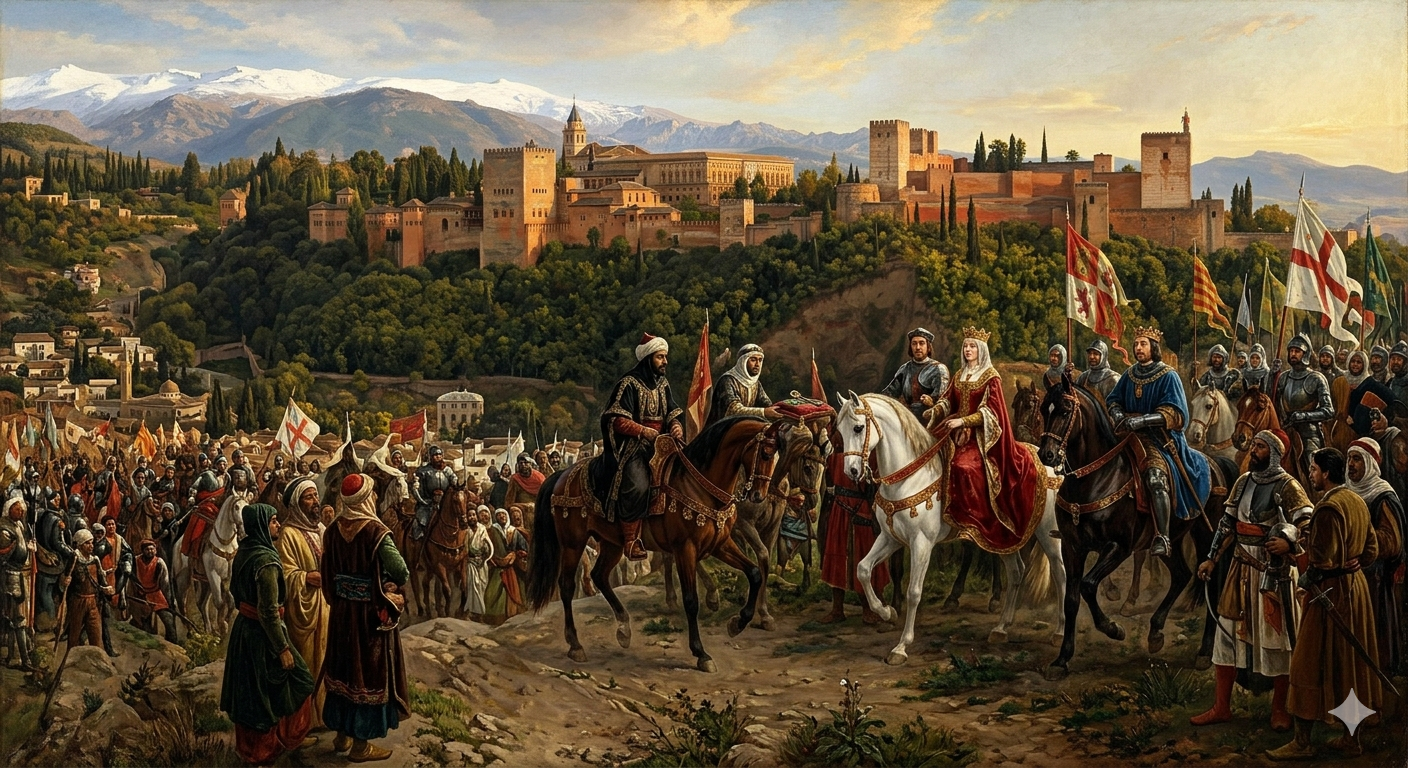
On January 2, 1492, one of the most consequential moments in the history of the Iberian Peninsula unfolded beneath the walls of the magnificent Alhambra palace. Muhammad XII — known to the Spanish as Boabdil — handed the keys of the city of Granada to the Catholic Monarchs, King Ferdinand II of Aragon and Queen Isabella I of Castile, formally surrendering the last Muslim emirate in Western Europe. This single act brought to a close nearly eight centuries of Muslim political presence in Spain, concluded the ten-year Granada War that had raged since 1482, and completed the centuries-long Christian campaign known as the Reconquista. The Fall of Granada did not merely end a kingdom; it reshaped the religious, cultural, and geopolitical identity of an entire continent and opened the door to a new age of Spanish imperial ambition.
The Emirate of Granada: The Last Stronghold of Al-Andalus
The story of the Fall of Granada cannot be understood without tracing the deep historical roots of Muslim Spain, known throughout the medieval world as Al-Andalus. Muslim forces first crossed the Strait of Gibraltar in 711 AD under the command of Tariq ibn Ziyad, rapidly overwhelming the Visigothic kingdom and establishing Islamic rule over much of the Iberian Peninsula. At the height of its territorial reach around 719 AD, Muslim authority extended across most of present-day Spain and Portugal, creating one of the most culturally sophisticated civilizations in medieval Europe. Córdoba, the capital of the Umayyad Caliphate of Córdoba, became a beacon of learning, science, philosophy, and the arts — a city that rivaled Constantinople and Baghdad in prestige and intellectual output.
Over the following centuries, Christian kingdoms in the north — Castile, Aragon, León, Navarre, and Portugal — steadily pushed southward in what historians call the Reconquista. By the early thirteenth century, the great caliphate had fragmented into smaller successor states known as taifas, and one by one these territories fell to Christian armies. By 1250, only one Muslim polity survived on the Iberian Peninsula: the Emirate of Granada, ruled by the Nasrid dynasty, founded by Muhammad I Ibn al-Ahmar around 1232. The emirate encompassed roughly the modern Spanish provinces of Granada, Málaga, and Almería — a mountainous, relatively defensible territory along the Mediterranean coast in the far south of the peninsula.
For more than two and a half centuries following the consolidation of Christian control over the rest of Iberia, the Emirate of Granada endured as an independent Muslim state through a combination of geography, diplomacy, and shrewd political maneuvering. The Nasrid rulers navigated the competing interests of Castile and Aragon, playing one against the other to ensure their own survival. They paid tribute — known in Old Spanish as paria — to the Crown of Castile to avoid outright military attack, and they occasionally served as tributaries or vassals to the Christian monarchs when circumstances demanded. The Alhambra palace-fortress complex, constructed on a strategic hilltop overlooking the city, became the jewel of Nasrid Granada and a monument to Islamic architectural achievement that still stands to this day.
The Catholic Monarchs: Ferdinand II and Isabella I Unite Christian Spain
The political transformation of Christian Iberia in the second half of the fifteenth century fundamentally altered the balance of power on the peninsula. For much of the 1400s, Castile was consumed by internal strife, succession crises, and civil war. The situation began to change decisively in 1469 when Isabella, daughter of John II of Castile and heir to the Castilian throne, married Ferdinand, the son of John II of Aragon. Their marriage was a union of the two most powerful Christian crowns on the Iberian Peninsula. When Henry IV of Castile died in 1474, Isabella ascended to the Castilian throne; when John II of Aragon died in 1479, Ferdinand became king of Aragon. Together, they ruled as the Catholic Monarchs — a title formally granted to them by Pope Alexander VI in 1494 — presiding over a newly unified Christian Spain.
This union fundamentally undermined Granada’s centuries-old strategy of playing Castile and Aragon against each other. For the first time in Spanish history, the two dominant Christian kingdoms were governed as one. Ferdinand and Isabella were not merely politically united; they were united in their religious and dynastic ambitions. The conquest of Granada offered them several overlapping advantages: it would complete the Reconquista, earning them religious glory and papal favor; it would channel the restless martial energies of the Castilian nobility against a common enemy rather than against each other; and it would bring a wealthy, strategically vital territory under their control. From the outset, the destruction of the Emirate of Granada was not merely a military objective but a crusading mission clothed in religious symbolism.
The Spark That Ignited the Granada War: The Attack on Zahara (1481)
The Granada War was triggered in December 1481 by an act of remarkable miscalculation on the part of the Granadan emir Abu al-Hasan Ali, who had been ruling since 1464 as the twenty-first ruler of the Nasrid dynasty. Frustrated by the growing pressure from Castile and having already refused to pay the customary tribute to Ferdinand and Isabella in 1477, Abu al-Hasan Ali ordered a surprise attack on the Castilian frontier town of Zahara de la Sierra, near Ronda. His forces captured the town and enslaved its inhabitants. It was an aggressive move, but the timing proved disastrous. Ferdinand and Isabella, though not yet fully prepared militarily, could not allow such an act of aggression to go unanswered. In early 1482, the Marquis of Cádiz, Rodrigo Ponce de León, launched a furious counterattack, recapturing the fortress of Alhama de Granada deep inside Granadan territory. The war had begun.
The seizure of Alhama was a significant blow to Granada, both strategically and psychologically. The city sat close to the Granadan capital, and its loss exposed the vulnerability of the emirate’s defenses. Abu al-Hasan Ali attempted to retake the city but failed, and the emotional weight of the loss was reflected in a famous Arabic lamentation, the “Ay de mi Alhama,” which mourned the fall of the town and presaged the wider catastrophe to come. Pope Sixtus IV, recognizing the religious dimension of the campaign, declared a crusade in support of Ferdinand and Isabella, enabling them to raise additional funds for the war effort. Jewish bankers and merchants also provided crucial financial backing, helping the Catholic Monarchs sustain what would prove to be a very expensive decade-long campaign.
The Nasrid Civil War and the Rise of Boabdil: Internal Division Weakens Granada
While the Catholic Monarchs prosecuted an increasingly organized military campaign from the outside, the Emirate of Granada was simultaneously tearing itself apart from within. In 1482, Muhammad XII — the son of Abu al-Hasan Ali — staged a partially successful coup against his father, declaring himself emir and fracturing the emirate into two competing factions. This internal civil war proved enormously valuable to Ferdinand and Isabella, who adeptly exploited the dynastic feud to weaken both sides. In 1483, during a disastrous military engagement, Muhammad XII himself was captured by Castilian forces near Lucena and held prisoner. Rather than executing him or holding him indefinitely, the Catholic Monarchs recognized his political usefulness and released him under the terms of the Pact of Córdoba.
Under the Pact of Córdoba, Muhammad XII agreed to hold Granada as a vassal state of the Crown of Castile in exchange for Christian support in reclaiming his throne from his father. He further agreed to surrender the eastern cities of the emirate and to refrain from obstructing Christian military operations elsewhere in the kingdom. It was a deeply compromising arrangement, and many Granadans viewed Muhammad XII as a collaborator. His nickname “Boabdil” — the Spanish corruption of his Arabic name Abu Abdullah — became synonymous with this ambiguous legacy. After the death of Abu al-Hasan Ali in 1485, power nominally passed to Boabdil’s uncle, Muhammad ibn Sa’d, known as al-Zagal (“The Brave”), who proved a far more tenacious and effective military opponent than either his brother or his nephew.
Al-Zagal led fierce resistance against the advancing Castilian armies from outside the city of Granada, while Boabdil maneuvered politically within it. The Catholic Monarchs were forced to deal with al-Zagal’s military threat first before they could focus exclusively on the capital. This complex triangular dynamic — with the Catholic Monarchs on one side, Boabdil’s faction on another, and al-Zagal’s forces on a third — defined the military and political character of the Granada War throughout the 1480s.
The Siege of Málaga (1487): A Turning Point in the Granada War
The military campaign that Ferdinand and Isabella prosecuted was not a single continuous offensive but a carefully planned series of seasonal campaigns, typically launched in spring and broken off in winter. They systematically dismantled Granada’s outlying cities and fortresses before closing in on the capital itself. Among the most critical engagements of the war was the siege of Vélez-Málaga, which capitulated to Christian forces on April 27, 1487. This opened the path to Málaga itself — the principal seaport of the emirate and the gateway through which any external Muslim aid might arrive.
The siege of Málaga, which lasted from May 7 to August 18, 1487, was one of the most brutal and prolonged engagements of the entire war. Ferdinand led an army of over twenty thousand soldiers against the city, whose garrison — composed of Granadan regulars, North African fighters, and Christian renegades who had converted to Islam — resisted with exceptional tenacity. Al-Zagal, tied down defending against Boabdil’s forces elsewhere in the emirate, was unable to relieve the siege. After three months of grueling combat and starvation, the city’s commander chose death over surrender. When Málaga finally fell on August 13, 1487, the inhabitants received little mercy: they were either killed or enslaved. The harsh treatment of Málaga’s population was a deliberate message to other Granadan cities, encouraging them to surrender early rather than resist to the last.
The fall of Málaga devastated al-Zagal’s reputation within Granada and effectively eliminated the emirate’s ability to receive reinforcements or supplies by sea. Boabdil, who had effectively cooperated with or stood aside during the Christian campaign, was now able to return to the Alhambra and consolidate his position as the nominal emir of Granada. Al-Zagal continued to lead resistance from Guadix and Almería, but the Catholic Monarchs dealt with him methodically. After an extended siege of Baza in 1489 — during which Queen Isabella herself came personally to the siege camp to maintain the morale of her troops — al-Zagal finally surrendered despite his garrison being largely intact. With the fall of Baza and the capture of al-Zagal in 1490, the war seemed all but over.
The Role of Artillery and Military Innovation in the Christian Conquest of Granada
One of the most significant military aspects of the Granada War was the effective deployment of artillery by the Catholic Monarchs’ armies. By the 1480s, advances in cannon technology and siege warfare had fundamentally altered the nature of medieval conflict, and Ferdinand and Isabella were among the first European monarchs to fully integrate artillery into a sustained military campaign. The use of heavy cannons allowed Castilian forces to rapidly breach the walls of towns and fortresses that would otherwise have required months or even years of traditional siege work. Cities that might have held out indefinitely against conventional investment fell within days or weeks once artillery was brought to bear.
The Granada War also served as a crucial training ground for the armies that would later carry Spanish power into Italy and the Americas. The tactical innovations developed during the campaign, including the use of combined arms — infantry, cavalry, and artillery working in coordinated fashion — laid the groundwork for the formidable Spanish military machine of the early sixteenth century. The tercio formation, which would make Spanish armies the dominant military force in Europe for over a century, had its origins in the operational experience gained during the decade-long campaign against Granada.
Boabdil’s Final Rebellion and the Siege of Granada (April 1491)
With al-Zagal neutralized and most of the emirate’s territory in Christian hands, Ferdinand and Isabella expected Boabdil to honor his long-standing vassal arrangement and surrender the city of Granada without further resistance. Boabdil, however, was dissatisfied with the terms he had been offered. He had been promised extensive lands in exchange for his cooperation, but disagreements over the specific territories — whether they would be in Castile or Aragon, and how much autonomy he would retain — left him feeling cheated. In an act of desperate defiance or genuine patriotism — historians have debated which — he broke off his vassalage in late 1490 and refused to hand over the capital.
By this point, Boabdil’s position was militarily hopeless. The Emirate of Granada had been reduced to little more than the city itself and its immediate mountain hinterland. Boabdil desperately sought external military aid, sending appeals to the Marinid rulers in Morocco, to the Mamluk Sultanate in Egypt, and to the Ottoman Sultan Bayezid II. None came to his rescue. Egypt was preoccupied with its own war against the Ottoman Turks and had aligned diplomatically with Spain; Morocco claimed not to have received the messages; and Sultan Bayezid II, though troubled by the plight of the Granadan Muslims, was absorbed in Ottoman internal politics and contented himself with sending a formal letter of protest to Ferdinand and Isabella, which they ignored.
In April 1491, the Catholic Monarchs laid siege to the city of Granada in earnest. Rather than a rapid assault, they chose a methodical approach designed to starve the city into submission. They constructed a permanent siege encampment outside the city walls — a planned town called Santa Fe (Holy Faith) — as a deliberate signal that they intended to stay as long as it would take. The city of Granada, crowded with refugees from across the former emirate, found its supplies dwindling and its leadership in disarray. Bribery of key officials was rampant, and at least one of Boabdil’s chief advisers is believed to have been in the pay of Castile throughout the siege. For eight months, the city endured progressively worsening conditions, its garrison’s capacity to interfere with the siege gradually diminishing.
The Treaty of Granada (November 25, 1491): Terms of Surrender and the Illusion of Tolerance
On October 28, 1491, Boabdil formally agreed to surrender the city within sixty days. The detailed terms of the capitulation were then negotiated and formalized in the Treaty of Granada, signed on November 25, 1491. The treaty — also known as the Capitulations of Granada — was a remarkably comprehensive document of approximately sixty-seven articles that provided extensive guarantees to the Muslim population of the emirate in exchange for their peaceful submission. The delay between the signing of the treaty and the formal handover of the city on January 2, 1492 was not due to disagreement between the two sides but largely to the inability of the fractured Granadan government to organize itself amid the chaos that gripped the city.
The terms of the Treaty of Granada were, on paper, genuinely generous and reflected a degree of pragmatic tolerance. The Muslim inhabitants of Granada — known as Moors or Mudéjars — were guaranteed the right to practice their religion, Islam, without interference or forced conversion. They were allowed to keep their mosques, observe their religious festivals, and be governed according to Islamic law by their own officials. Their property, movable goods, and estates were to be protected from arbitrary seizure or confiscation. Muslims who wished to emigrate to North Africa were granted safe passage and permitted to take their possessions with them. The treaty even exempted Granadan Muslims from certain taxes for an interim period. For Boabdil personally, the Catholic Monarchs offered the title of lord of certain territories in the Alpujarras mountains, where he could live as a noble.
The treaty also addressed the status of Jews living within the surrendered territories. Native Jews in Granada were to be given the choice of either converting to Christianity or emigrating to North Africa within three years. This provision was almost immediately superseded by a far harsher measure: the Alhambra Decree of March 31, 1492, also known as the Edict of Expulsion, which ordered all Jews throughout Spain — not merely in Granada — to convert to Christianity or leave the country within four months. The decree resulted in the expulsion of an estimated 100,000 to 200,000 Jews from Spain and created the Sephardic Jewish diaspora that settled across North Africa, the Ottoman Empire, and other parts of Europe.
January 2, 1492: The Day Granada Fell — The Surrender of Boabdil and the Handover of the Alhambra
The formal surrender of Granada took place in the early hours of January 2, 1492. In a carefully choreographed ceremony heavy with pageantry and symbolism, Boabdil descended from the Alhambra with a small retinue and rode out to meet Ferdinand and Isabella. According to historical accounts, he handed over the keys to the city in the Comares Tower of the Alhambra — though the keys had technically already been delivered to a representative of the monarchs the day before — and kissed Ferdinand’s hand in the traditional act of submission. Ferdinand and Isabella then rode triumphantly into Granada, and the Christian cross and the royal banners of Castile and Aragon were raised above the towers of the Alhambra.
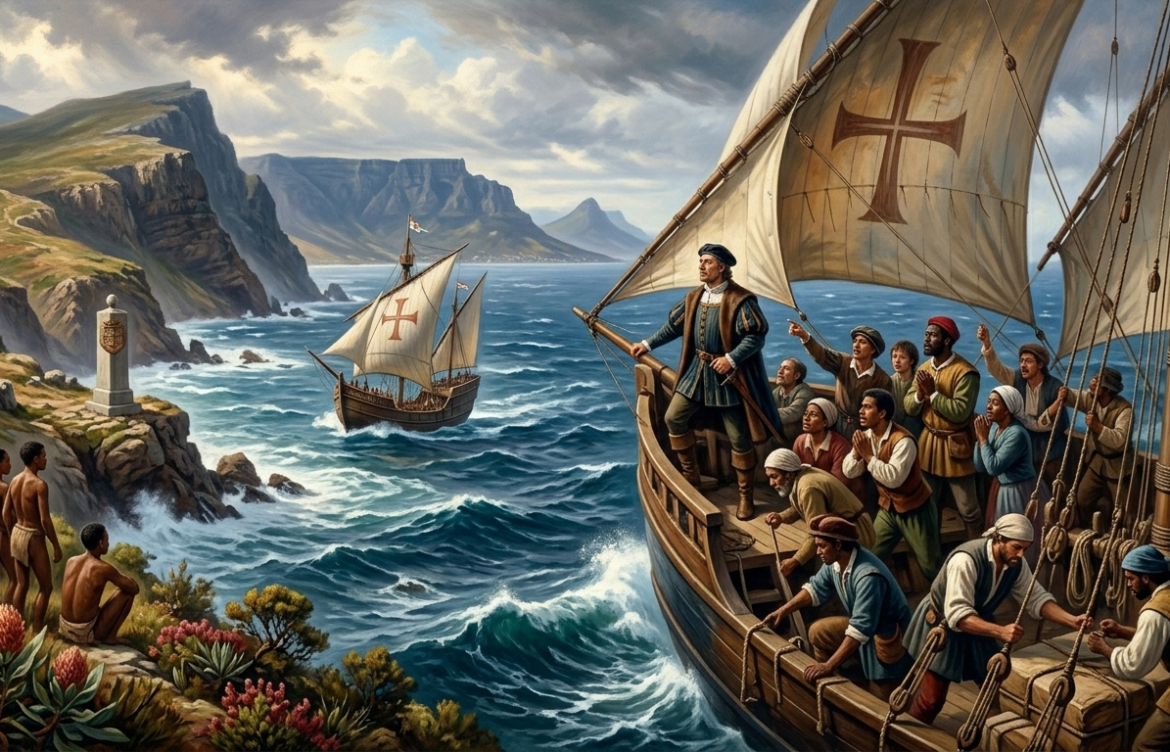
Among those who witnessed the entry of the Catholic Monarchs into Granada that day was a Genoese sailor-navigator named Christopher Columbus, who had been waiting at the Spanish court for royal patronage for his proposed westward voyage to Asia. Columbus had been following the court during the siege in hopes of securing an audience with Ferdinand and Isabella. Eight months after witnessing the fall of Granada, on August 3, 1492, Columbus would set sail from the port of Palos de la Frontera with three ships and the backing of the Catholic Monarchs — a voyage that would lead him to the Caribbean and open the age of European colonization of the Americas. The same year that Islamic rule ended in the Old World’s far west, European reach into the New World began.
A legendary account, though debated by historians, describes Boabdil pausing on a mountain pass called the Puerto del Suspiro del Moro — “the Pass of the Moor’s Sigh” — and looking back for a last time at the Alhambra and the city he had lost. According to the tale, he wept. His mother, the formidable Aixa, reportedly said to him: “You weep like a woman for what you could not defend as a man.” Whether or not the exchange actually occurred, it has endured for centuries as one of history’s most poignant images of loss — a ruler stripped of everything, gazing back at a world that no longer existed.
The Fate of Boabdil After the Fall of Granada
Following the surrender, Boabdil remained for a little over a year at a country estate in the mountainous Alpujarras region as lord of Mondújar, the territory that had been promised to him under the treaty. However, as conditions for the Muslim population deteriorated and it became clear that the Catholic Monarchs had little intention of honoring the spirit of the treaty’s generous terms, Boabdil chose exile. He departed for Fez in North Africa, where a community of Granadan Muslim exiles had begun to gather. Historical accounts disagree on the circumstances and date of his death: the Arab historian al-Maqqari, writing in the early seventeenth century, reported that Boabdil died in 1518 or 1533 and was buried in Fez; the sixteenth-century Spanish writer Luis del Mármol Carvajal claimed instead that he died in battle in 1536. What is certain is that al-Maqqari, writing around 1617, noted that Boabdil’s descendants were living in poverty in Fez at that time.
The Breaking of the Treaty: Forced Conversions, the Moriscos, and the Spanish Inquisition
The generous promises of the Treaty of Granada survived for less than a decade. The first major breach came in 1499 when Francisco Jiménez de Cisneros, the Archbishop of Toledo and one of the most powerful religious figures in Spain, arrived in Granada and began conducting an aggressive campaign of forced conversions. Cisneros had little patience for the policy of gradual, voluntary persuasion that the treaty implied. He organized military expeditions into the Alpujarras mountains to suppress resistance, used captured rebels as leverage for mass baptisms, and created an atmosphere of coercion that made the treaty’s religious guarantees meaningless. A rebellion in the Albayzín quarter of Granada broke out on December 18, 1499, partly in response to these pressures.
The uprising was quickly suppressed, and the Catholic Monarchs used it as a justification for tearing up the Treaty of Granada entirely. By 1501, all Muslims in the former Kingdom of Granada were formally required to choose between converting to Christianity or leaving Spain. By 1526, this forced conversion decree was extended to the rest of Spain. Those Muslims who converted became known as Moriscos — “New Christians” — but they were viewed with deep suspicion by the broader Christian population and by the Spanish Inquisition, which suspected them of secretly continuing to practice Islam, a practice known as crypto-Islam.
The treatment of the Moriscos grew progressively harsher throughout the sixteenth century. Pragmatic decrees in 1566 and 1567 banned the use of the Arabic language and traditional Moorish dress, in a deliberate effort to erase cultural identity. These measures provoked the Rebellion of the Alpujarras from 1568 to 1571, a bloody uprising during which most Moriscos from the former Kingdom of Granada were expelled to other parts of Spain. The final chapter came when King Philip III issued the Expulsion of the Moriscos decrees between 1609 and 1614, ordering the removal of an estimated 275,000 to 300,000 individuals from Spain. They were transported in approximately four thousand ships to North Africa, bringing to a definitive end the long history of Muslim community life on the Iberian Peninsula.
The Cultural and Demographic Legacy of the Fall of Granada
The human cost of the fall of Granada and its aftermath was enormous. At the time of the surrender in 1492, the Muslim population of the emirate is estimated to have been approximately 500,000 people. In the immediate aftermath of the capitulation, around 200,000 Muslims emigrated voluntarily to North Africa, following the emir into exile. Many settled in Morocco, while others moved to Egypt and the Levant, carrying with them the language, customs, and architectural traditions of Al-Andalus. The influence of these Granadan exiles is still visible today in the architecture, music, and culinary traditions of Morocco and other parts of the Arab world.
The year 1492 was also extraordinary for its cultural productivity in Spain itself. In that single year, the humanist scholar Antonio de Nebrija published the first grammar of the Castilian Spanish language — the first grammar of any modern European vernacular language — as well as the first Latin-Spanish dictionary. These publications were not coincidental; they were part of a deliberate project of cultural and linguistic consolidation that accompanied the political unification of Spain. The Reconquista’s completion created the conditions for a new Spanish national identity rooted in Catholic faith and Castilian language, and the publication of a formal grammar was a key instrument in that cultural project.
The fall of Granada also sent shockwaves across the Islamic world. In Istanbul, the Ottoman Sultan Bayezid II — who had already sent a protest letter to Ferdinand and Isabella — reportedly wept upon hearing the news. The loss of Granada was viewed throughout the Muslim world as a profound civilizational blow: the end of a sophisticated Islamic culture that had flourished in Western Europe for nearly eight centuries. The romances fronterizos — a literary genre of Spanish ballads celebrating heroism and chivalry on both sides of the Granadan frontier — emerged from this period, reflecting a cultural fascination with the drama and tragedy of the war on both the Christian and Muslim sides.
The Fall of Granada and Its Connection to the Discovery of the Americas
The connection between the fall of Granada and Christopher Columbus’s first voyage to the Americas is not merely symbolic or coincidental — it is deeply structural. For years, Columbus had been seeking royal patronage for his proposed westward Atlantic voyage, and Ferdinand and Isabella had been too preoccupied with the Granada campaign to give him serious attention. With the emirate finally subdued and the Reconquista complete, the Catholic Monarchs were free to look outward. The enormous financial and organizational capacity that had been directed toward the conquest of Granada could now be redirected toward overseas exploration.
Columbus received his royal commission from Ferdinand and Isabella at Santa Fe — the very siege camp built outside Granada — in April 1492, just months after the city’s fall. He set sail on August 3, 1492, and made landfall in the Caribbean on October 12, 1492. In a single year, Spain completed its centuries-long campaign of territorial consolidation on the Iberian Peninsula and simultaneously launched the process of building a global empire. The wealth and administrative experience gained from the Granada campaign directly informed the ambitions and methods that Spain would bring to its colonization of the Americas, setting in motion a chain of consequences whose effects are still felt across the globe today.
How Different Cultures Remember the Fall of Granada: Triumph and Tragedy Across Perspectives
The Fall of Granada is remembered very differently depending on cultural and religious perspective, and understanding that divergence is essential to appreciating the full weight of the event. For Christian Spain and for Catholic Europe more broadly, January 2, 1492 was a day of exultant triumph — the culmination of nearly eight centuries of struggle, the final vindication of the Reconquista, and a demonstration of Spanish military power and Catholic faith. Pope Innocent VIII ordered bonfires lit throughout Rome in celebration. To this day, January 2 is a day of civic celebration in the modern city of Granada, and the event is commemorated annually by the City Council.
For Muslims, and particularly for the descendants of the Andalusian diaspora scattered across North Africa and the wider Arab world, the fall of Granada has been mourned for over five centuries as a catastrophic cultural and political loss. The concept of Al-Andalus has become freighted with nostalgia and grief — a golden age of pluralism, learning, and sophistication brought to a violent end. This sense of loss has been expressed in literature, music, poetry, and political discourse from the fifteenth century to the present day, most recently in modern Islamist movements that cite the loss of Al-Andalus as part of a broader historical narrative of Muslim civilization under siege.
Contemporary historians tend to complicate both the triumphalist and the elegiac narratives. They point out that Al-Andalus was never a simple paradise of interfaith coexistence — it was a society that experienced periods of both remarkable tolerance and bitter religious persecution depending on who held power and when. They also note that the Catholic Monarchs’ treatment of the Muslim and Jewish populations after the fall of Granada represented one of the early modern world’s most comprehensive programs of ethnic and religious cleansing, with consequences that resonate to this day in the demographics and cultures of both Spain and North Africa.
The Alhambra Palace: A Physical Monument to the Legacy of Granada
Perhaps the most enduring physical legacy of the Nasrid Emirate of Granada is the Alhambra palace complex, which still stands on its hilltop above the modern city of Granada. Constructed primarily in the thirteenth and fourteenth centuries under successive Nasrid rulers, the Alhambra represents the apex of Islamic architectural achievement in the western Mediterranean world. Its intricate geometric tilework, carved stucco arabesques, muqarnas vaulting, and serene courtyard gardens — including the famous Court of the Lions with its twelve stone lions supporting a central fountain — remain among the most celebrated architectural achievements of any civilization. After the Christian conquest, Ferdinand and Isabella used parts of the Alhambra as their royal residence, and later rulers added Renaissance-style buildings to the complex. Today the Alhambra is a UNESCO World Heritage Site and one of Spain’s most visited cultural monuments, receiving millions of visitors annually.
Key Figures in the Fall of Granada: A Who’s Who of the Principal Stakeholders
Understanding the Fall of Granada requires familiarity with the key individuals who shaped its outcome. Ferdinand II of Aragon (1452–1516) was the driving military and political strategist of the Granada campaign. Born the son of John II of Aragon, he married Isabella of Castile in 1469 and co-ruled Spain with her. A skilled military commander and cunning political operator, Ferdinand directed most of the Granada War’s campaigns in the field and negotiated the treaty terms with Boabdil. Isabella I of Castile (1451–1504) was the religious and moral force behind the campaign. She provided the ideological framework of the Reconquista as a divine mission, raised crucial funds, personally visited siege camps to maintain troop morale, and co-signed the Treaty of Granada and the Alhambra Decree. Together, Ferdinand and Isabella are considered the founders of modern Spain.
Muhammad XII, known as Boabdil (circa 1464–1527 or 1536 or 1538), was the last Nasrid emir of Granada. His reign was defined by compromise, collaboration, and ultimately surrender — though some historians have argued that his apparent collusion with Ferdinand and Isabella reflected a pragmatic effort to save his people from the total destruction that would have followed prolonged resistance. Abu al-Hasan Ali (died 1485) was Boabdil’s father and the emir who triggered the Granada War with the ill-fated attack on Zahara. Muhammad ibn Sa’d, known as al-Zagal (The Brave), was Boabdil’s uncle and the most effective military commander the emirate produced during the war. His resistance was fierce but ultimately futile, and he spent his final years in poverty in North Africa after surrendering to the Catholic Monarchs.
Rodrigo Ponce de León, the Marquis of Cádiz, was among the most important Christian military commanders of the war, responsible for the recapture of Alhama in 1482 that effectively launched the conflict. Cardinal Francisco Jiménez de Cisneros, Archbishop of Toledo, was the ecclesiastical hardliner whose aggressive missionary campaign after 1499 destroyed the religious protections of the Treaty of Granada and helped trigger the Morisco rebellions. Antonio de Nebrija was the humanist scholar whose 1492 grammar of Castilian Spanish marked the cultural consolidation of a unified Spanish nation. And Christopher Columbus, the Genoese navigator whose presence at the fall of Granada and subsequent commission from Ferdinand and Isabella linked the conclusion of the Reconquista directly to the opening of the age of European exploration.
The Historical Significance of the Fall of Granada: Why January 2, 1492 Still Matters
The fall of Granada on January 2, 1492 stands as one of the true pivot points of world history — a moment when multiple trajectories of civilization converged and then diverged into new directions. At the most immediate level, it completed the Reconquista and ended nearly eight centuries of Islamic political sovereignty on the Iberian Peninsula. At a wider European level, it confirmed Spain as the continent’s preeminent Catholic power and provided the religious legitimacy and organizational momentum that would fuel Spanish imperialism in the Americas and beyond. At a global level, it was the event that cleared the path for Columbus’s voyage and the subsequent European colonization of the New World — arguably the single most consequential series of events in the history of the modern world.
The fall of Granada also matters because of what was lost. The Nasrid Emirate of Granada had, at its best, represented a continuation of the sophisticated Islamic culture that had made Al-Andalus one of the intellectual and artistic beacons of medieval civilization. The scholars, architects, musicians, and craftspeople of Granada had preserved and developed traditions of Islamic learning, art, and architecture that had no parallel in Western Europe at the time. Much of this was destroyed, dispersed, or suppressed in the decades following the conquest. The approximately 200,000 Muslims who emigrated to North Africa carried with them the last living memory of Andalusian civilization, and their cultural influence can still be traced in the music, architecture, and cuisine of Morocco today.
For Spain, the fall of Granada was both a triumph and a turning point that shaped the country’s identity for centuries. The model of Spain as the guardian of Catholic Christianity — forged in the fires of the Reconquista and symbolized by the raising of the cross above the Alhambra — defined Spanish foreign and domestic policy for generations. The Spanish Inquisition, already operating since 1478, accelerated its activities in the wake of the conquest, and the pursuit of religious uniformity became a defining feature of Spanish society. The expulsion of the Jews in 1492 and the eventual forced conversion and expulsion of the Moriscos stripped Spain of two of its most economically and intellectually productive communities — losses whose long-term consequences for Spanish development have been debated by historians ever since.
In the end, the fall of Granada is inseparable from the wider story of 1492 — the year that, more than any other, marks the threshold between the medieval world and the modern one. In that single year, the last medieval Islamic state in Western Europe fell; the Jewish community that had lived in Spain since Roman times was expelled; the first grammar of a modern European language was published; and a Genoese sailor set out across an uncharted ocean under Spanish colors and changed the world forever. All of these events were connected. All of them flowed from the moment when Boabdil handed over the keys of the Alhambra, looked back one last time at the red towers above the city, and rode south into exile.
Conclusion: The End of Al-Andalus and the Making of the Modern World
The surrender of the Emirate of Granada on January 2, 1492, brought eight centuries of Muslim political presence on the Iberian Peninsula to a formal close. What followed — the expulsions, the forced conversions, the Inquisition, the colonial project in the Americas — was set in motion by this single act of capitulation. The Fall of Granada is not merely a chapter in Spanish history or Islamic history; it is a chapter in the history of the entire world. Its consequences shaped the Americas, North Africa, and Europe for centuries. The tears of Boabdil at the Pass of the Moor’s Sigh — real or legendary — are a reminder that history is not only made by the victors. It is also made by what is lost, by what is mourned, and by what endures in memory long after empires have fallen and kingdoms have turned to dust.