
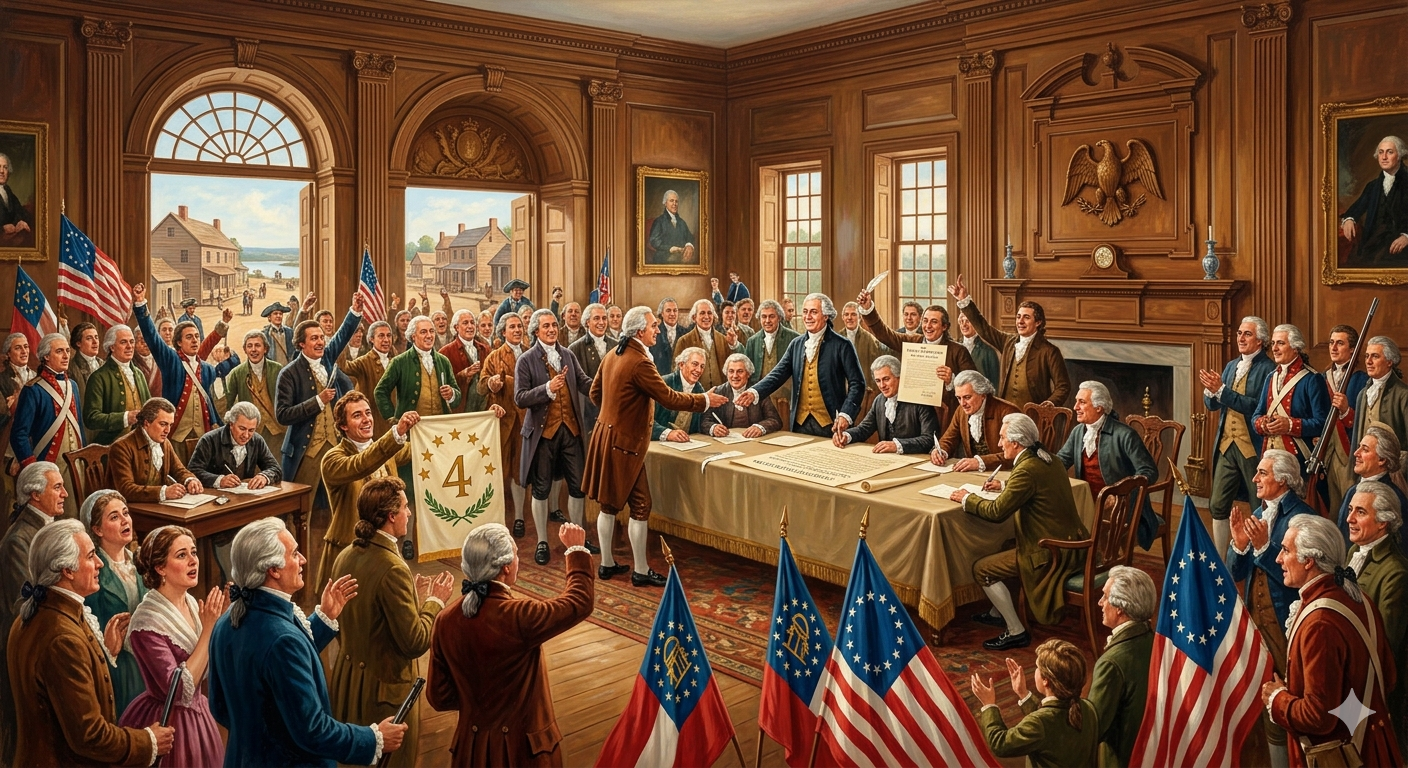
On January 2, 1788, in the city of Augusta, Georgia, a specially elected convention of delegates cast a unanimous vote to ratify the United States Constitution, making Georgia the fourth state to formally adopt the new framework of American government. The vote was not close, not contested, and not delayed — it was swift, decisive, and unanimous. In a young nation still testing whether the grand republican experiment could hold together, Georgia’s rapid and unambiguous embrace of the Constitution stood as a powerful signal of early solidarity. Yet behind that unanimity lay a complex story of frontier danger, political ambition, economic calculation, and the visionary leadership of men who understood that the weak confederation of states formed after the Revolution could not survive without a stronger national government. This is the story of how Georgia, the youngest and most vulnerable of the original thirteen colonies, became a defining voice in the founding of the United States.
Georgia’s Colonial Origins and Its Role as the Youngest of the Thirteen Colonies
To understand why Georgia ratified the Constitution with such speed and unanimity, it is essential to understand the unique character of the colony and state. Georgia was founded in 1732 when King George II of Great Britain granted a charter to a group of philanthropic trustees led by General James Edward Oglethorpe. The colony’s first settlement, Savannah, was established on February 12, 1733, along the banks of the Savannah River. Unlike other British colonies in North America, Georgia was conceived with an explicitly humanitarian mission: to provide a fresh start for England’s imprisoned debtors and to create a buffer settlement between the prosperous Carolinas to the north and Spanish Florida to the south. Named in honor of King George II, it was the last and southernmost of the original thirteen colonies, and it would remain the youngest, smallest, and most exposed of all.
In its early decades, Georgia struggled. The trustees’ idealistic rules — which initially prohibited slavery, limited land holdings, and banned rum — proved unworkable in the competitive colonial economy of the American South. By 1752, the trustees surrendered their charter and Georgia became a royal colony under direct British governance. Slavery was introduced, large plantations took hold, and the colony began to grow more rapidly. By the time of the American Revolution, Georgia had developed a prosperous agricultural economy centered on rice, indigo, and timber exports, with Savannah serving as the colony’s chief commercial port and Augusta as the gateway to the inland frontier.
Georgia’s experience of the Revolutionary War was more violent and chaotic than that of most other colonies. The state was deeply divided between Loyalists — those who remained loyal to the British Crown — and Patriots who supported independence. British forces occupied Savannah in December 1778 and held it until 1782, making Georgia one of the most thoroughly contested battlegrounds of the entire war. The political and social disruption caused by years of occupation and internal conflict left Georgia considerably weakened in its institutions and infrastructure as the Revolutionary period drew to a close. This vulnerability would prove highly relevant to the state’s attitude toward the new federal Constitution just a few years later.
The Failure of the Articles of Confederation and Why Georgia Needed a Stronger Union
When the thirteen colonies declared independence in 1776, they needed a governing framework to hold them together as a nation. The result was the Articles of Confederation, drafted in 1777 and ratified by all thirteen states by 1781. Georgia was the tenth state to ratify the Articles of Confederation, doing so on July 24, 1778. The Articles created what was essentially a loose league of sovereign states rather than a true national government. Congress under the Articles had no power to levy taxes, regulate interstate or foreign commerce, or enforce its own laws and treaties. It could make requests of the states but had no means of compelling compliance. Each state, regardless of size or population, had a single vote in Congress, and any amendment to the Articles required the unanimous consent of all thirteen states — a near-impossible threshold.
The weaknesses of the Articles of Confederation became painfully apparent in the years following the Revolutionary War. The federal government was unable to pay its war debts, regulate trade between the states, or negotiate effectively with foreign powers. In Georgia specifically, the consequences were severe and immediate. The state’s commercial interests in Savannah suffered from the lack of a federal authority capable of regulating trade and protecting American merchants from foreign discrimination. More critically, Georgia faced an existential security threat from the Creek Nation, which claimed enormous swaths of Georgia’s western lands and was increasingly supported by Spanish authorities in Florida. Under the Articles of Confederation, Congress could do virtually nothing to help Georgia defend its frontiers, and the state lacked the military and financial resources to defend itself alone.
Georgia’s relationship with the Continental Congress under the Articles was notably strained. The state was chronically underrepresented in Congress — it was not represented at all in 1783, and for much of the 1780s sent fewer delegates than it was entitled to, with the result that Georgia often had no official vote at all. Congress had assigned Georgia a war requisition of $14,400 out of a national total of $1,200,000 — one of the smallest quotas of any state — yet Georgia repeatedly failed to pay even that modest sum until 1786, when it resolved to pay but then did not actually do so. The relationship between Georgia and the national government under the Articles was, in short, one of mutual neglect. Both the state and the confederation government ignored each other when it was convenient, with increasingly dangerous consequences.
The Creek Nation Threat: How Frontier Warfare Drove Georgia Toward the Constitution
Of all the factors that motivated Georgia’s rapid and unanimous ratification of the Constitution, none was more powerful or more immediate than the ongoing conflict with the Creek Nation on its western and southern frontiers. The Muscogee Creek Indians controlled vast territories that overlapped with Georgia’s western land claims, and the disputes over these lands had been simmering since the end of the Revolutionary War. Georgia had negotiated a series of land cession treaties with Creek and Cherokee representatives — at Augusta in 1783, at Galphinton in 1785, and at Shoulderbone in 1786 — but the legitimacy of these treaties was disputed by much of the Creek leadership, particularly by the powerful and charismatic Alexander McGillivray, the mixed-heritage Creek chief who led the nation’s resistance to Georgian expansion.
Alexander McGillivray was a formidable adversary. The son of a Scottish trader, Lachlan McGillivray, and a Creek woman of the powerful Wind Clan, he had been educated in Charleston and possessed both the political skills needed to navigate colonial society and the tribal authority needed to lead his people. During the Revolutionary War, the Creeks had allied with the British, and after the war McGillivray aligned himself with Spanish authorities in Florida, who supplied the Creeks with arms and support as a means of checking American expansion. By 1786 and 1787, Creek raids on Georgia’s frontier settlements had become a constant menace. Governor George Mathews reported to Congress in November 1787 that Indians had killed thirty-one white settlers since August, destroyed the town and courthouse at Greensboro, and burned many houses on the frontier. The state’s ability to defend itself under the Articles of Confederation was essentially nil.
It was this security crisis that directly accelerated the pace of Georgia’s ratification process. On July 3, 1787, Governor Mathews called the Georgia legislature into a special emergency session to address the Indian situation, but failed to achieve a quorum. He tried again on September 20, and a quorum finally assembled in Augusta by October 18, 1787. The session, which lasted two weeks, concerned itself almost entirely with the Creek threat and a boundary dispute with South Carolina. It was in the middle of this emergency session — convened specifically because of the Indian wars — that the Georgia legislature received and acted upon news of the newly drafted United States Constitution. The timing was not coincidental. Georgians saw a powerful federal government with the authority to raise armies, regulate diplomacy, and deal with Native American nations as their best and perhaps only hope of frontier survival.
The Constitutional Convention of 1787: Georgia’s Delegates in Philadelphia
When the Continental Congress called for a Constitutional Convention to meet in Philadelphia in May 1787 for the purpose of revising the Articles of Confederation, the Georgia legislature appointed six delegates to represent its interests: Abraham Baldwin, William Few, William Houstoun, William Pierce, former Governor George Walton, and Nathaniel Pendleton. Of these six, only four actually traveled to Philadelphia. George Walton and Nathaniel Pendleton either declined to serve or failed to attend, and their absence reduced the Georgia contingent to four men. William Few, a member of the Continental Congress who was already in New York, arrived in Philadelphia on May 14, the scheduled opening date of the convention, and was present at its first official session on May 25. William Pierce arrived on May 31, followed by Abraham Baldwin and William Houstoun on June 1 and June 11, respectively.
William Few was the nominal head of the Georgia delegation. Born in Maryland in 1748 and raised in North Carolina, Few had moved to Georgia after the Revolutionary War and established himself as a lawyer and politician. He was a self-educated man of considerable practical intelligence who had risen through the ranks of Georgia’s political class to serve in the Continental Congress. His fellow delegate William Pierce, who wrote a famous series of character sketches of the convention’s members, described Few as a man whose “powers of oratory are not the most engaging” but who possessed “substantial judgment” and a “strong mind.” Despite Pierce’s faint praise of his rhetorical gifts, Few was a steady, reliable presence throughout the convention and remained in Philadelphia until its conclusion.
William Houstoun was the wealthiest member of the Georgia delegation. He had attended the Inner Temple in London to study law, came from a family with deep ties to Georgia’s colonial establishment, and combined the practice of law with the management of a large plantation. Despite his impressive background, William Pierce’s assessment of Houstoun was less than flattering: Pierce wrote that “Nature seems to have done more for his corporeal than mental powers. His person is striking, but his mind very little improved with useful or elegant knowledge.” Houstoun attended the convention sporadically and departed before its conclusion, joining the ranks of the Georgia delegates who did not sign the final document.
William Pierce was a colorful figure whose most lasting contribution to history may have been his written portraits of the other delegates rather than his own participation in the proceedings. Born probably in Georgia around 1740, Pierce had served with distinction in the Revolutionary War, emerging as a major with special citations and a ceremonial sword from Congress. After the war he became a merchant in Savannah engaged in the import-export business and also served as a member of the Continental Congress. He kept detailed notes on the convention’s early debates from May 31 through June 6, though his note-taking grew shorter each day and stopped entirely before the convention ended. Pierce was characteristically self-deprecating about his own qualities — he declined to write a self-portrait, saying he would leave evaluation of his personality “to those who may choose to speculate on it, to consider it in any light their fancy or imagination may depict.” Pierce left the convention in mid-July to attempt to save his failing business in New York, went bankrupt in 1788, and died in debt in 1789.
Abraham Baldwin: Georgia’s Greatest Founding Father and the Man Who Saved the Constitution
Among Georgia’s four delegates to the Constitutional Convention, one stood far above the rest in ability, influence, and lasting historical importance: Abraham Baldwin. Born on November 22, 1754, in North Guilford, Connecticut, Baldwin was the son of Michael Baldwin, a blacksmith who took on heavy debts to provide his twelve children with good educations. Abraham attended Yale College, graduating in 1772, and afterward taught as a tutor at his alma mater and studied theology, preparing for a career as a minister. In 1779, as the Revolutionary War intensified, he joined the Continental Army as a chaplain. Military service broadened his social outlook and exposed him to men of diverse backgrounds from across the colonies. After the war, he turned to law, was admitted to the Connecticut bar in 1783, and then made a decision that would alter the course of American history: he moved to Georgia.
In Georgia, Baldwin quickly established himself as an indispensable figure. He obtained a land grant in Wilkes County, was elected to the Georgia legislature, and served as a delegate to the Confederation Congress beginning in 1785. He also drafted the charter for the University of Georgia, becoming one of the founding fathers of American public higher education, and served as the university’s first president from 1786 to 1801. By 1787, at the age of thirty-three, he was recognized as one of Georgia’s outstanding civic leaders and was accordingly appointed as a delegate to the Constitutional Convention in Philadelphia. His fellow delegate William Pierce described him as “a Gentleman of superior abilities” who “joins in a public debate with great art and eloquence.”
Baldwin’s most consequential contribution at the convention came during the great debate over congressional representation — the defining crisis that nearly destroyed the convention before it could produce a constitution. The central conflict was between the large states, which wanted representation in both houses of Congress to be based on population, and the small states, which demanded equal representation for all states regardless of size. On July 2, 1787, the convention held a critical vote on whether to give each state equal representation in the upper house of Congress. Five states voted in favor, and five states — including Georgia, where Baldwin had initially prepared to vote against the proposal — voted against. The Georgia delegation was divided, and that division was entirely Baldwin’s doing.
Baldwin had concluded that if the small states lost this vote and felt their interests were being trampled, they might walk out of the convention entirely — and the convention would collapse. He therefore changed his vote at the last moment, deliberately producing a tie of five states to five, with Georgia’s delegation equally divided. This maneuver took the vote off the table without a decisive loss for either side and forced the convention to refer the dispute to a special committee. That committee eventually produced the Great Compromise — also called the Connecticut Compromise — establishing the bicameral legislature with equal state representation in the Senate and population-based representation in the House of Representatives. This foundational architecture of the United States government might never have been achieved without Baldwin’s strategic sacrifice of his own position to keep the small states at the table. His action secured his legacy as one of the most important Founding Fathers.
Baldwin also served on the Committee of Postponed Matters — later called the Grand Committee — which was charged with working out the details of transitioning from the government under the Articles of Confederation to the new government under the Constitution. He was, as the University of Georgia history noted, “easily Georgia’s outstanding delegate in the constitutional convention,” though he spoke only eight times during the proceedings. His influence was exercised less through oratory than through behind-the-scenes diplomacy, strategic calculation, and genuine intellectual mastery of the constitutional questions before the convention. Baldwin remained in Philadelphia until the convention concluded on September 17, 1787, and was one of only two Georgians to sign the final document.
The Constitution Reaches Georgia: October 1787 and the Decision to Call a Ratifying Convention
The Constitutional Convention concluded on September 17, 1787, and the completed document was sent to the states for ratification. The process by which the Constitution reached Georgia was itself revealing of the state’s situation. William Pierce, returning to the South by sea, arrived in Savannah on October 10, 1787, carrying a copy of the new Constitution with him. Three days later, on October 13, the Constitution was first published in the Georgia State Gazette — Georgia’s first and, at the time, only newspaper — giving citizens their initial opportunity to read and discuss the proposed new form of government. The document had arrived in Georgia almost a month after the Philadelphia convention had adjourned, a delay that reflected the state’s geographic remoteness from the centers of national political life.
The Georgia legislature was already in emergency session in Augusta, convened to address the Creek Indian threat, when the Constitution arrived. Rather than waiting for a regular legislative session, the assembled lawmakers immediately took up the question of ratification. The urgency of the Indian wars and the obvious connection between the state’s frontier security needs and the promise of a stronger federal government meant that there was no appetite for delay. The legislature quickly passed a resolution calling for a specially elected ratifying convention. The resolution specified that the convention would consist of not more than three members from each county, to be elected on the day of the next general election, and that the convention would meet in Augusta on the fourth Tuesday of December — Christmas Day, December 25, 1787.
The elections for convention delegates, held in the first week of December 1787, resulted in a sweeping victory for supporters of the Constitution. This was hardly surprising given the political climate. There was virtually no organized anti-Federalist opposition in Georgia of the kind that emerged in other states such as New York, Massachusetts, and Virginia. The combination of frontier security concerns, commercial interests on the coast, and a broad consensus that the Articles of Confederation were inadequate meant that the overwhelming majority of Georgia’s politically active citizens were disposed to support the new Constitution. The French consul stationed in Georgia, Monsieur Ducher, reported to his government that it was clearly in Georgia’s interest “to appear federally inclined in order to obtain help from the present Union” — a cynical but accurate assessment of the political calculation involved.
The Augusta Ratifying Convention: December 25, 1787 to January 2, 1788
Georgia’s ratifying convention assembled in Augusta on Christmas Day, December 25, 1787, as the legislature had directed. Augusta was at this time the capital of Georgia — a role it had assumed during the Revolutionary War when Savannah was occupied by British forces, and which it would hold until the capital was moved to Louisville in 1796. The city sat at the head of navigation on the Savannah River, at the junction between the coastal lowcountry and the inland frontier, making it a natural meeting point for Georgia’s diverse political and economic interests. Twenty-four delegates were present at the convention’s opening, representing ten of the state’s eleven counties.
The convention elected John Wereat, a former governor of Georgia and a delegate from Richmond County, as its president. Isaac Biggs, who would shortly after the convention be granted patent rights for steam navigation of the Savannah River alongside William Longstreet, was chosen as the convention’s secretary. The composition of the 26-member body reflected the broad cross-section of Georgia’s society: the delegates included two physicians, two lawyers, three merchants, ten planters, three small farmers, three frontiersmen, one full-time public officeholder, and two others about whom historical records tell us little. This diversity was significant — it meant that the ratification vote, when it came, would represent not just the interests of Georgia’s legal and commercial elite but the full spectrum of the state’s white male citizenry.
William Few, the only one of Georgia’s Philadelphia delegates who was both present at the ratifying convention and who had signed the Constitution, played an active role in pushing for ratification. His presence gave the convention the benefit of a firsthand participant in the drafting process, someone who could explain the reasoning behind individual provisions and answer questions about the intent of the framers. William Pierce, the other Georgia signer, was probably in Georgia at the time of the ratifying convention, though whether he attended is not entirely clear from the historical record. Edward Telfair, Nathan Brownson, Joseph Habersham — who would later serve as Postmaster General under President George Washington — and George Handley, who would be appointed collector of the port of Brunswick in 1789, are all known to have supported ratification.
The convention began its formal deliberations on Friday, December 28, 1787. Unlike the bitter and prolonged ratification debates in Massachusetts, New York, and Virginia — where Anti-Federalists mounted organized and vigorous opposition — the proceedings in Augusta were remarkably brief and harmonious. The journal of the convention records only formal actions and reveals virtually nothing about the substance of the debates, a silence that historians interpret as evidence that there was very little serious opposition to record. The only known dissenting voice was a letter from Lachlan McIntosh, a prominent Georgia military figure, who wrote to a convention delegate suggesting that ratification should be conditioned on the provision that another convention be called at some future date to reconsider the Constitution so that the interests of the Southern states — which he worried would be in a minority in the new federal government — might be better protected. His suggestion was considered and rejected.
After approximately one week of formal proceedings, on January 2, 1788, the convention voted to ratify the United States Constitution. The vote was unanimous — every delegate present cast a vote in favor. The formal language of the ratification ordinance, taken from the Journal of the Convention of the State of Georgia, read: “Now Know Ye, That We, the Delegates of the People of the State of Georgia in Convention met, pursuant to the Resolutions of the Legislature aforesaid, having taken into our serious consideration the said Constitution, Have assented to, ratified and adopted, and by these presents DO, in virtue of the powers and authority to Us given by the People of the said State for that purpose, for, and in behalf of ourselves and our Constituents, fully and entirely assent to, ratify and adopt the said Constitution.” To celebrate the occasion, a cannon salute of thirteen shots was fired — one for each of the thirteen original states.
Why Georgia’s Ratification Was Unanimous: The Unique Consensus Behind the Vote
Georgia’s unanimous ratification was not simply a reflection of geographic remoteness from the Anti-Federalist intellectual centers of the North. It was the product of a genuine and broadly shared political consensus rooted in the state’s specific circumstances. Several overlapping factors explain why opposition to the Constitution failed to gain a foothold in Georgia in the way it did in other states. The first and most important was the Creek Nation threat. As the historian at the University of Wisconsin-Madison’s Center for the Study of the American Constitution has noted, the ongoing war with the Creeks was “certainly one of the reasons that Georgia favored the constitution.” For frontiersmen and plantation owners alike, a federal government with the power to raise and deploy armies was not an abstract threat to liberty — it was a lifeline.
The second factor was Georgia’s unusual social and demographic profile. Unlike Virginia or New York, Georgia in 1787 lacked the deep-rooted local political establishments that tended to produce powerful resistance to centralization. Many of Georgia’s most important political leaders had been born and raised in other states — several key figures had recently moved from New England, Virginia, and the Carolinas — and this relative newness of the state’s political culture meant that local prejudices against a stronger central government were less entrenched than elsewhere. There was, as historians of the period have noted, no great internal political split in Georgia between the coast and the backcountry, between radicals and conservatives, or between rich and poor, of the kind that complicated ratification politics in states like Massachusetts. Commercial interests in Savannah and frontiersmen on the western border could and did unite in favor of the Constitution.
A third factor was trade. Georgia’s coastal merchants and traders, centered in Savannah, had suffered significantly from the inability of the federal government under the Articles to regulate commerce and protect American interests in foreign markets. A Constitution that gave Congress the power to regulate interstate and foreign trade was in their direct economic interest. A fourth factor was the question of western land claims. Georgia held enormous territorial claims stretching far into what is now Alabama and Mississippi, and these claims would eventually be ceded to the federal government to form parts of the Mississippi Territory. A stronger federal government capable of managing the disposition of western lands in an orderly fashion was preferable to the chaos of competing state and federal claims under the Articles.
Georgia’s Place in the Ratification Sequence: Delaware, Pennsylvania, New Jersey, and Georgia
Georgia’s ratification on January 2, 1788 made it the fourth state to adopt the Constitution, following Delaware on December 7, 1787, Pennsylvania on December 12, 1787, and New Jersey on December 18, 1787. The rapid succession of these four early ratifications in December 1787 and early January 1788 created important early momentum for the Constitution’s ultimate acceptance. Delaware, the first to ratify, did so unanimously in a one-day convention — the smallest state in the union had strong incentives to support equal representation in the Senate. Pennsylvania was next, ratifying in a more contested vote of 46 to 23 after a fierce public debate. New Jersey, like Delaware, ratified unanimously, drawn to the Constitution by the same arguments that appealed to small states everywhere.
Georgia’s unanimous ratification on January 2 made it the third state in a row to ratify without a single dissenting vote, a remarkable run that reflected the constitutional consensus building among the states with the clearest interests in a stronger central government. Connecticut followed Georgia on January 9, 1788, ratifying 128 to 40. Massachusetts, the sixth state to ratify, did so only narrowly on February 6, 1788, in a vote of 187 to 168, and only after Federalist leaders agreed to recommend amendments protecting individual liberties — a promise that eventually led to the Bill of Rights. Maryland ratified on April 28, 1788; South Carolina on May 23, 1788; New Hampshire on June 21, 1788. New Hampshire was the critical ninth state whose ratification formally made the Constitution the law of the land, clearing the required threshold. Virginia and New York followed in quick succession, and North Carolina and Rhode Island, the most reluctant states, eventually ratified in 1789 and 1790 respectively.
Georgia’s position as the fourth state to ratify carried a special symbolic weight. As the first Southern state to ratify the Constitution — preceding even South Carolina and Virginia, the most powerful and influential of the Southern colonies — Georgia’s vote signaled to the broader South that the new constitutional framework was not simply a Northern political project. It helped establish that the Constitution had genuine cross-regional appeal and set a precedent that made it harder for Southern Anti-Federalists to frame the new government as a tool of Northern commercial interests bent on undermining Southern agricultural society and the institution of slavery.
Key Stakeholders in Georgia’s Ratification: The Men Who Made It Happen
Abraham Baldwin (1754-1807) was unquestionably the most important Georgian in the entire constitutional ratification story. His strategic intervention at the Philadelphia Convention to produce the tie vote that led to the Great Compromise may well have saved the entire constitutional project from collapse. After the Constitution was ratified, Baldwin went on to serve in the United States House of Representatives from 1789 to 1799, and then in the Senate from 1799 until his death in 1807. He remained a bachelor throughout his life, raising and educating six of his half-siblings after taking on responsibility for his father’s debts. He was a steady supporter of the Jeffersonian Democratic-Republican Party and a consistent opponent of Alexander Hamilton’s Federalist financial policies. George Washington himself, in a private conversation with Baldwin shortly after the Philadelphia Convention, reportedly confided that he did not expect the Constitution to last more than twenty years — a pessimism that history would spectacularly disprove.
William Few (1748-1828) was the other Georgian whose signature appeared on the original Constitution. Born in Maryland, raised in North Carolina, and established as a lawyer and politician in Georgia, Few had a long and distinguished career in public service. He served in the Continental Congress, signed the Constitution at Philadelphia, participated in Georgia’s ratifying convention, and then went on to serve as one of Georgia’s first two United States Senators from 1789 to 1793. He later moved to New York, where he continued his legal and political career, serving as a state assemblyman and as a bank regulator. Few lived to the impressive age of eighty, long enough to see the Constitution he had helped create endure through wars, territorial expansion, and profound political transformation.
John Wereat, the president of Georgia’s ratifying convention, was a former governor of Georgia and a respected figure in the state’s political establishment. As president of the convention, he guided the proceedings that culminated in the unanimous ratification vote of January 2, 1788. Governor George Mathews, who had been dealing with the Creek Indian crisis and who had called the emergency legislative session that set the ratification process in motion, was a key figure in establishing the political urgency that drove Georgia’s rapid action. Joseph Habersham, a convention supporter who would later serve as Postmaster General of the United States under President Washington, represented the commercial and establishment interests that gave the ratification coalition its broad base. Lachlan McIntosh, the sole known voice for a conditional or delayed ratification, represented the minority view that the Constitution needed further amendment to protect Southern interests before being adopted — a view that was ultimately dismissed by the convention.
Georgia After Ratification: The Constitution Changes the State’s Fortunes
The impact of ratification on Georgia was not immediate, since the new federal government did not begin operating until 1789, when George Washington was inaugurated as the first President of the United States. In the interim, Georgians anxiously awaited news that enough other states had ratified to bring the Constitution into force. When word finally came that New Hampshire had become the ninth state to ratify on June 21, 1788, meeting the constitutional threshold, the news was celebrated in Augusta with appropriate ceremonies. The state then turned to the business of preparing for elections under the new government. In November 1788, however, the Georgia Assembly failed to achieve a quorum at a session called to provide for the election of presidential electors. The 1789 assembly finally designated the electors in January, just one day before the deadline set by Congress — a characteristically last-minute act that reflected Georgia’s ongoing organizational challenges.
Georgia’s first two United States Senators under the new Constitution were William Few and James Gunn. Abraham Baldwin, George Mathews, and James Jackson were elected to the House of Representatives. These early federal officeholders from Georgia brought their state’s particular concerns — frontier security, land claims, and trade — into the new national legislature. The federal government’s early response to Georgia’s Creek Indian problem was promising but also a source of friction. In 1790, President Washington negotiated the Treaty of New York with Creek leader Alexander McGillivray, which guaranteed certain land protections to the Creek Nation and effectively overrode some of Georgia’s prior treaty claims. This outcome illustrated the double-edged nature of a strong federal government: it could protect Georgia from the Creeks, but it could also constrain Georgia’s own expansionist ambitions.
The ratification of the federal Constitution also prompted Georgia to revise its own state constitution. The Georgia Constitution of 1777, which had vested most governmental authority in the state legislature, was increasingly seen as incompatible with the principles of balanced government embodied in the new federal document. In November 1788, a constitutional convention was called in Augusta to modify the existing state constitution. This convention, in a move that echoed the boldness of the Philadelphia convention, went beyond its mandate and produced an entirely new document rather than simply amending the existing one. The resulting Georgia Constitution of 1789 was modeled closely on the federal Constitution and represented a significant modernization of the state’s governing framework. It was adopted on May 6, 1789.
The Historical Significance of Georgia’s Ratification: What January 2, 1788 Means for American History
Georgia’s ratification of the United States Constitution on January 2, 1788, occupies a distinctive place in American constitutional history for several reasons. First, it demonstrated that the constitutional project had genuine support across all regions of the new nation, not just in the more commercially developed and politically organized states of the North. As the first Southern state to ratify the Constitution, Georgia established that the new federal framework was a truly national document with cross-sectional appeal. Its unanimous vote also provided crucial early momentum at a time when the outcome of ratification was far from certain — the eventual ratification by the critical states of Massachusetts, Virginia, and New York was by no means guaranteed in the autumn and winter of 1787-1788.
Second, Georgia’s ratification illustrates a broader truth about the founding era: that the Constitution was not adopted on the basis of abstract political philosophy alone, but because it addressed concrete, immediate needs felt by real people in real communities. For Georgia’s planters, traders, frontiersmen, and farmers, the Constitution was not primarily a philosophical treatise on the nature of republican government — it was a practical instrument for survival. The Creek Nation wars, the commerce problems, the inability of the confederate government to collect taxes or defend its citizens — these were the lived realities that made a stronger federal government not merely desirable but necessary. Georgia’s ratification was, in the most literal sense, a vote for safety.
Third, the role of Abraham Baldwin in both drafting and securing the Constitution’s adoption deserves special recognition in the broader narrative of American constitutional history. Without Baldwin’s strategic intervention at the Philadelphia Convention — his deliberate production of the tie vote that led to the Great Compromise — it is possible that the Constitutional Convention would have collapsed in July 1787 without producing a document at all. The Senate’s structure of equal state representation, which has shaped American politics in every era since, owes something to the quick thinking of a Connecticut-born Georgian who chose the preservation of the process over the victory of his immediate position. Georgia gave to the constitutional founding not just a ratification vote, but one of its most indispensable architects.
Finally, Georgia’s ratification story is a reminder that the path to constitutional government is rarely linear or purely principled. The unanimous vote of January 2, 1788 was driven in significant part by the desire to obtain federal military assistance against the Creek Nation — a goal that, when realized, would have profound and often tragic consequences for Native American peoples throughout the Southeast. The same federal power that Georgians hoped would protect their frontier settlements would, within a generation, be used to enforce the Indian Removal Act of 1830 and the forced deportation of the Cherokee, Creek, and other nations along what became known as the Trail of Tears. The constitutional founding, like all great historical events, contained within it both the promise of a more perfect union and the seeds of future injustice.
Georgia’s Broader Legacy in Early American Constitutional Politics
In the decades following ratification, Georgia’s early federal representatives played notable roles in shaping the new nation’s policies. Abraham Baldwin’s long Senate career made him one of the most consistent voices for the Jeffersonian vision of limited federal power — a seeming paradox for a man who had done so much to create a stronger federal government, but one that illustrates the complexity of the founding generation’s constitutional views. Many of the Founders believed simultaneously in the necessity of a stronger federal government than the Articles provided and in the importance of restraining that government within defined constitutional limits. Baldwin embodied this tension throughout his public life.
Georgia’s western land cessions between 1802 and 1804, in which the state surrendered its vast territorial claims west of its current borders to the federal government, led directly to the creation of the Mississippi Territory and eventually the states of Alabama and Mississippi. This cession, controversial at the time, reflected the ongoing negotiation between state and federal authority that the Constitution had set in motion. It also reflected the practical realities of governance in a rapidly expanding republic: Georgia could not effectively administer or defend territories stretching hundreds of miles into the interior, and the federal government had both the authority and the capacity to do so.
Conclusion: The Fourth State and the Making of a More Perfect Union
On January 2, 1788, in the city of Augusta, Georgia, twenty-six delegates from across the youngest and most vulnerable of the original thirteen colonies cast a unanimous vote that reverberated far beyond the borders of their small state. By ratifying the United States Constitution without a single dissenting voice, they not only added Georgia to the growing roster of states embracing the new federal framework — they sent a message to the entire nation that the Constitution had the power to unite the most disparate of American communities around a common vision of government. From the rice planters of the lowcountry to the frontiersmen of the western border, from the merchants of Savannah to the small farmers of the Georgia interior, a genuine consensus had formed around the idea that a stronger national government was not a threat to liberty but a prerequisite for it.
The story of Georgia’s ratification is inseparable from the story of Abraham Baldwin and William Few, the two Georgians who signed the Constitution in Philadelphia and then worked to ensure its adoption at home. It is inseparable from the story of Governor George Mathews and the Creek Indian wars, which made the urgency of a stronger government painfully real to every Georgian. It is inseparable from the story of John Wereat, who presided over the Augusta convention with quiet authority, and of the twenty-six delegates — planters, lawyers, merchants, frontiersmen, and farmers — whose unanimous vote on that January morning wrote Georgia permanently into the founding narrative of the United States.
Historians mark Georgia as the fourth state to enter the Union not from the moment of its original founding in 1733, nor from its embrace of independence in 1776, but from this single vote in Augusta in January 1788. That convention and that vote remain the defining constitutional moment in Georgia’s history—the instant when a young, exposed, frontier state chose to bind itself to something larger than itself in the hope that a union of free people, governed by a shared document, could offer what no individual state could provide alone: security, prosperity, and the enduring promise of republican self-government.