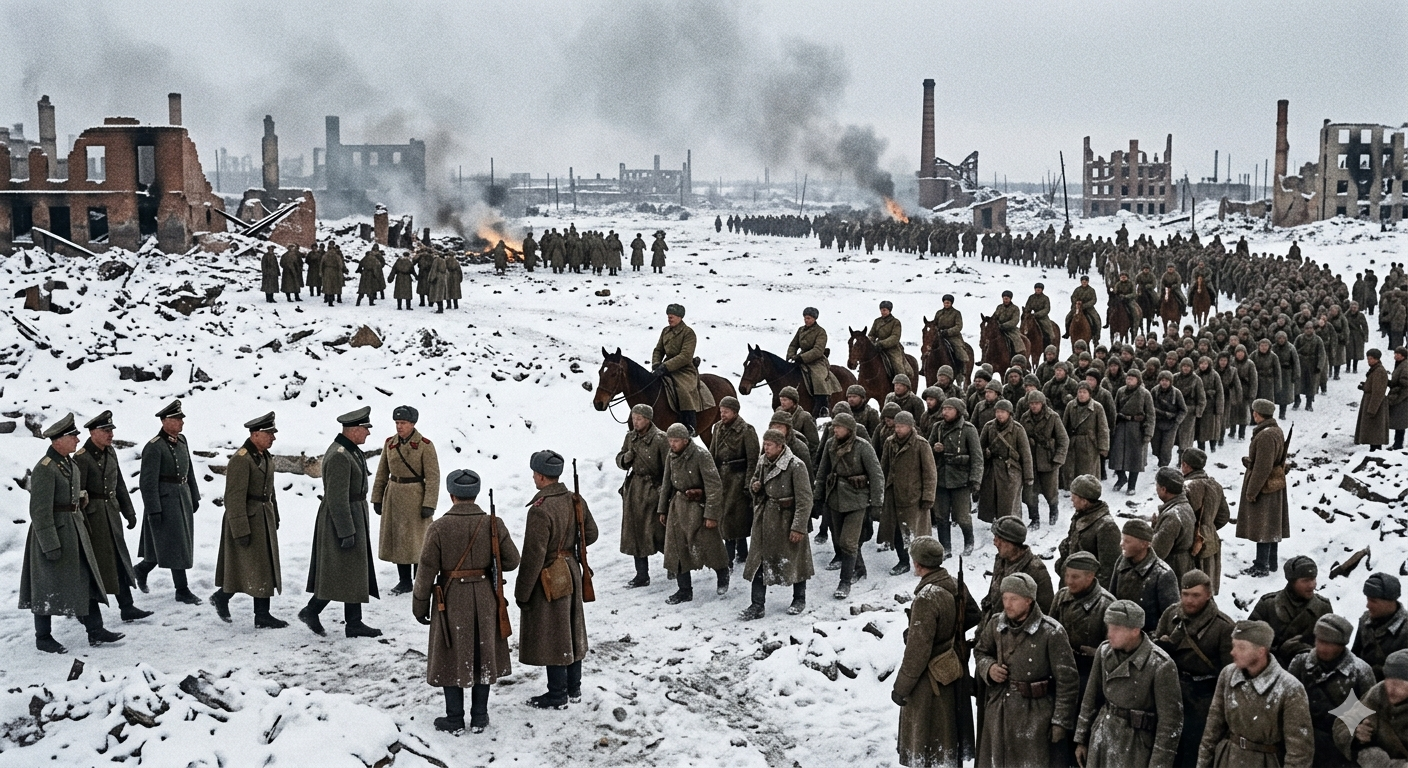
On February 2, 1943, the last German troops inside the ruined city of Stalingrad laid down their weapons and surrendered to the Soviet Red Army. The Battle of Stalingrad was over after more than 200 days of some of the most savage fighting in human history.
Roughly 91,000 frozen, starving German soldiers walked into Soviet captivity that day. Of those men, fewer than 6,000 would ever see their homeland again. The rest died in Soviet prisoner-of-war camps over the years that followed.
The battle consumed an estimated two million military and civilian casualties in total. It stands as the deadliest battle ever fought in all of recorded human history. And it was the moment the tide of World War II turned permanently against Adolf Hitler’s Third Reich.
Why Hitler Wanted Stalingrad: Case Blue and the Drive to the Volga
The battle did not happen by accident. It was the product of Hitler’s ambitious 1942 summer offensive on the Eastern Front, codenamed Case Blue. The plan aimed to seize the Soviet Union’s oil fields in the Caucasus region, cut off the Volga River as a Soviet supply line, and strangle the Red Army’s ability to wage war.
Stalingrad was an industrial city of enormous strategic importance. It produced weapons and artillery for the Red Army and sat directly on the Volga, the great river that served as one of the Soviet Union’s most vital arteries for moving men and materials. Capturing it would cripple Soviet logistics across the entire southern theater.
The city also carried powerful symbolic weight. It bore the name of Soviet leader Joseph Stalin himself. Hitler saw capturing it as both a military prize and a psychological blow to the enemy. Stalin, in turn, was determined to hold it at any cost, making the city a clash of personal pride between the two dictators as much as a military objective.
Hitler ordered General Friedrich Paulus and his German Sixth Army to take Stalingrad. Paulus, commanding one of the most powerful armies in the Wehrmacht, estimated the city would fall in roughly ten days. That estimate would prove catastrophically wrong.
The Battle Begins: German Bombing, Street by Street Fighting, and the “Rat War”
In August 1942, the German Fourth Air Fleet — under the overall command of the Luftwaffe — launched a devastating bombing campaign that reduced Stalingrad to a vast field of rubble. More than 40,000 Soviet civilians were killed in those early raids. The burning ruins of the city stretched for miles along the western bank of the Volga.
Then the infantry moved in. General Paulus ordered the first ground offensives into Stalingrad in early September 1942, believing the conquest was imminent. Instead, his soldiers encountered a nightmare of urban warfare unlike anything they had faced before.
Soviet commander General Vasily Chuikov led the 62nd Army in a brutal defense of the city’s ruins. His forces transformed every bombed-out building, every collapsed factory floor, every pile of rubble into a fortified position. The closer the Germans got to the Volga, the more desperate and intense the fighting became.
The Germans called it the “Rattenkrieg” — the Rat War. Squads of eight or ten men fought each other for control of individual floors, rooms, and staircases. A building might change hands a dozen times in a single day. A soldier’s life expectancy on the front lines could be measured in hours. Stalin issued his famous order: “Ni Shagu Nazad” — “Not One Step Backwards.” Retreat was punishable by death.
By November 1942, the Germans had pushed the Soviet defenders almost to the water’s edge. They controlled roughly 90 percent of the city’s urban area. Victory seemed within reach. That was when everything changed.
Operation Uranus: Zhukov’s Secret Plan to Trap an Entire Army
While the street fighting raged inside Stalingrad, a very different kind of battle was being planned in the deepest secrecy inside Moscow. In mid-September 1942, Joseph Stalin summoned his two most trusted military commanders: Marshal Georgy Zhukov, the hero of Moscow’s defense, and General Alexander Vasilevsky, the brilliant Chief of the General Staff.
The three men studied maps and intelligence reports and asked a fundamental question: what if, instead of reinforcing Stalingrad directly, the Soviets bypassed the German strength in the city entirely and struck the army’s exposed flanks?
The flanks of the German Sixth Army were not guarded by elite German troops. They were protected by the armies of Germany’s Axis allies — Romanian, Italian, and Hungarian forces that were less experienced, less well-armed, and stretched thin across an enormous front. Soviet intelligence identified this as a catastrophic weakness. The plan they devised, codenamed Operation Uranus, would exploit it.
Uranus called for two massive Soviet pincer movements to sweep around Stalingrad from the north and south simultaneously. The northern pincer, under General Konstantin Rokossovsky’s Don Front, would strike from bridgeheads along the Don River. The southern pincer, under General Andrei Yeremenko’s Stalingrad Front, would drive up from the south. The two arms of the attack would meet west of the city, completely encircling the German Sixth Army inside Stalingrad.
To deceive the Germans, the Soviets employed extraordinary measures. Defensive fortifications were built visibly in the open, suggesting the Red Army planned to dig in rather than attack. Bridges on the planned attack routes were constructed several feet underwater to avoid detection from German aircraft. More than one million Soviet soldiers, 900 tanks, and 1,400 aircraft were secretly moved into position. The Germans had almost no idea what was coming.
November 19, 1942: The Trap Is Sprung
At 7:30 in the morning on November 19, 1942, nearly 7,000 Soviet artillery pieces opened fire along the front north of Stalingrad. The bombardment was the largest of the war to that point. Romanian forces on the German northern flank were overwhelmed almost instantly.
The next day, November 20, the southern pincer launched from positions south of Stalingrad. The 4th Romanian Army there collapsed as well. Soviet armored columns poured through the broken lines and drove deep into the open steppe behind the German position.
On November 22, 1942, the forward detachments of the two Soviet spearheads spotted each other near the town of Kalach, west of Stalingrad. The encirclement was complete. More than 300,000 German, Romanian, Italian, and other Axis troops — including the entire German Sixth Army — were now trapped inside a shrinking pocket with no way out.
General Paulus immediately radioed Berlin. He told Hitler that his army was surrounded, that supplies were critically low, and that he needed permission to break out westward while he still had the fuel and ammunition to attempt it. Hitler refused. The Sixth Army would hold its position. It would be supplied by air. Field Marshal Hermann Göring promised the Luftwaffe could deliver 500 tons of supplies per day to the trapped forces.
That promise proved a fantasy. The Luftwaffe managed to deliver an average of only 120 tons per day — far less than the minimum needed to keep the army alive, let alone capable of fighting.
The Pocket Shrinks: Manstein’s Failed Relief Attempt and the Long Agony of Starvation
Hitler appointed Field Marshal Erich von Manstein — one of Germany’s most gifted commanders — to lead a relief operation codenamed Operation Winter Storm. On December 12, 1942, Manstein’s 4th Panzer Army drove northeast toward Stalingrad, initially making rapid progress.
The relief force came within roughly 30 miles of the trapped Sixth Army before Soviet forces halted it. Manstein urged Hitler to allow Paulus to break out westward and link up with the relief force. Hitler refused again. Manstein’s forces, lacking reserves and facing Soviet pressure on their supply lines, were forced to withdraw. By Christmas Eve 1942, the last realistic hope of rescuing the Sixth Army was gone.
Inside the pocket, conditions descended into something barely imaginable. Temperatures dropped to minus 30 degrees Celsius. Soldiers had no winter clothing. Food had run out. Horses, dogs, and rats were consumed. Men with frostbitten limbs received no medical care because there were no medical supplies. Tens of thousands of wounded soldiers lay in frozen basements with no bandages, no drugs, and no chance of evacuation.
On January 10, 1943, the Soviets launched Operation Ring under General Rokossovsky — a massive final assault designed to crush the German pocket from all sides. It employed nearly 7,000 field guns, mortars, and rocket launchers. The trapped Germans, their ammunition nearly exhausted and their men barely able to stand, could offer only desperate resistance.
The two last German airfields inside the pocket fell to Soviet forces. On January 16, Pitomnik fell. On the night of January 21–22, Gumrak fell. With the airfields gone, even the meager Luftwaffe supply flights ceased. The wounded could no longer be flown out. The Sixth Army was now completely sealed.
Paulus Surrenders: January 31, 1943, and the Unthinkable Becomes Reality
On January 30, 1943 — the tenth anniversary of Hitler’s rise to power — the Führer promoted Friedrich Paulus to the rank of field marshal. It was a deliberate message. No German Field Marshal had ever surrendered in the entire history of the German Army. Hitler expected Paulus to die rather than be taken captive.
The next morning, January 31, 1943, Soviet Major Anatoly Soldatov led a team into the basement of the Univermag department store in the center of Stalingrad. Paulus and his staff had established their final headquarters in the filth and darkness of that basement. The building’s condition was described as “unbelievably filthy.”
Paulus surrendered that morning. Twenty-two generals surrendered alongside him — more senior officers in a single capitulation than in any previous event in German military history. Later, Paulus reportedly told fellow officers in Soviet captivity that he had “no intention of shooting myself for this Bohemian corporal” — his contemptuous nickname for Hitler.
The northern pocket, commanded by General Karl Strecker, held out two more days. On February 2, 1943, Strecker’s forces laid down their weapons. The Battle of Stalingrad was officially over.
When Hitler heard news of Paulus’s surrender, witnesses reported that he stared silently at nothing, unable to speak. For three days of national mourning, German radio played only funeral music.
The Scale of the Catastrophe: Casualties, Prisoners, and the Human Cost
The numbers alone cannot fully convey the horror of what happened at Stalingrad, but they are staggering. The German Sixth Army had entered the campaign with approximately 275,000 men. By the time of the surrender, roughly 150,000 had been killed. Some 91,000 went into Soviet captivity, including 24 generals.
Of those 91,000 prisoners, only around 5,000 to 6,000 ever returned to Germany — the last of them not until 1955, a full decade after the war ended. The rest died in Soviet labor camps from disease, starvation, and cold.
Germany’s Axis allies suffered enormously as well. Romania lost approximately 160,000 men, Hungary 143,000, and Italy 110,000. None of those countries could replace such losses. Their ability and willingness to fight alongside Germany never recovered.
On the Soviet side, official Russian military historians estimate Red Army casualties in the Stalingrad campaign at approximately 1.1 million killed, wounded, missing, or captured. Approximately two million Soviet civilians died during the battle from starvation, aerial bombardment, and ground combat.
Why Stalingrad Was the Turning Point of World War II
Military historians are nearly unanimous in their verdict: Stalingrad was the moment the Second World War turned permanently in the Allies’ favor. It was Germany’s first truly catastrophic defeat — the complete destruction of an entire field army.
Before Stalingrad, the German Wehrmacht still believed it could win. After Stalingrad, that belief was shattered. An army of 300,000 men had been encircled, starved, frozen, and destroyed. A Field Marshal had surrendered. The German Army had shown it could be beaten — not just pushed back, but annihilated.
The psychological impact inside Germany was enormous. The German public had been told for months that Stalingrad was holding. When the true scale of the defeat could no longer be concealed, the effect on civilian morale was devastating. Nazi propaganda minister Joseph Goebbels declared three days of national mourning.
On the Soviet side, the victory unleashed a confidence and aggression in the Red Army’s leadership that had never existed before. General Zhukov had demonstrated that Soviet forces could plan and execute a complex strategic operation on the scale of Operation Uranus. Stalin began trusting his generals rather than overruling them, a shift that proved critical to every Soviet victory that followed.
The Germans launched one final major offensive in the east — the Battle of Kursk in July 1943. It failed. From that point forward, the Wehrmacht fought only a retreating defensive war on the Eastern Front. Soviet forces liberated most of Ukraine in 1943 and drove the Germans steadily westward. In April 1945, the Red Army captured Berlin. In May 1945, Germany surrendered unconditionally. The road from Berlin back to that frozen basement in Stalingrad was direct and unbroken.
The Legacy of Stalingrad: Memory, Monuments, and History’s Verdict
The city of Stalingrad was almost completely destroyed during the battle. It was rebuilt in the years after the war and in 1961 was renamed Volgograd, as part of a broader process of removing Stalin’s name from Soviet geography following the Soviet leader’s death in 1953.
At the highest point of the Mamayev Kurgan — the hill in the center of the city where some of the bloodiest fighting took place — a 279-foot statue was erected in 1967. Known as “The Motherland Calls,” it remains one of the largest statues in the world and stands as the most powerful memorial to the Soviet soldiers who died defending Stalingrad.
In 2006, the American Institute of Architects conducted a survey of America’s favorite works of architecture. Grand Central Terminal placed 13th. But it is the broader historical verdict that matters most here: Field Marshal Paulus gave testimony at the post-war Nuremberg trials and was released from Soviet captivity in 1953. He died in East Germany in 1957, never fully escaping the shadow of his defeat.
The battle is remembered today as the single greatest turning point of the Second World War — a moment when the most powerful military force in Europe was broken not by the weather, not by supply failures, and not even by Soviet numbers alone, but by the determined refusal of a city and its defenders to die when everything said they should have.