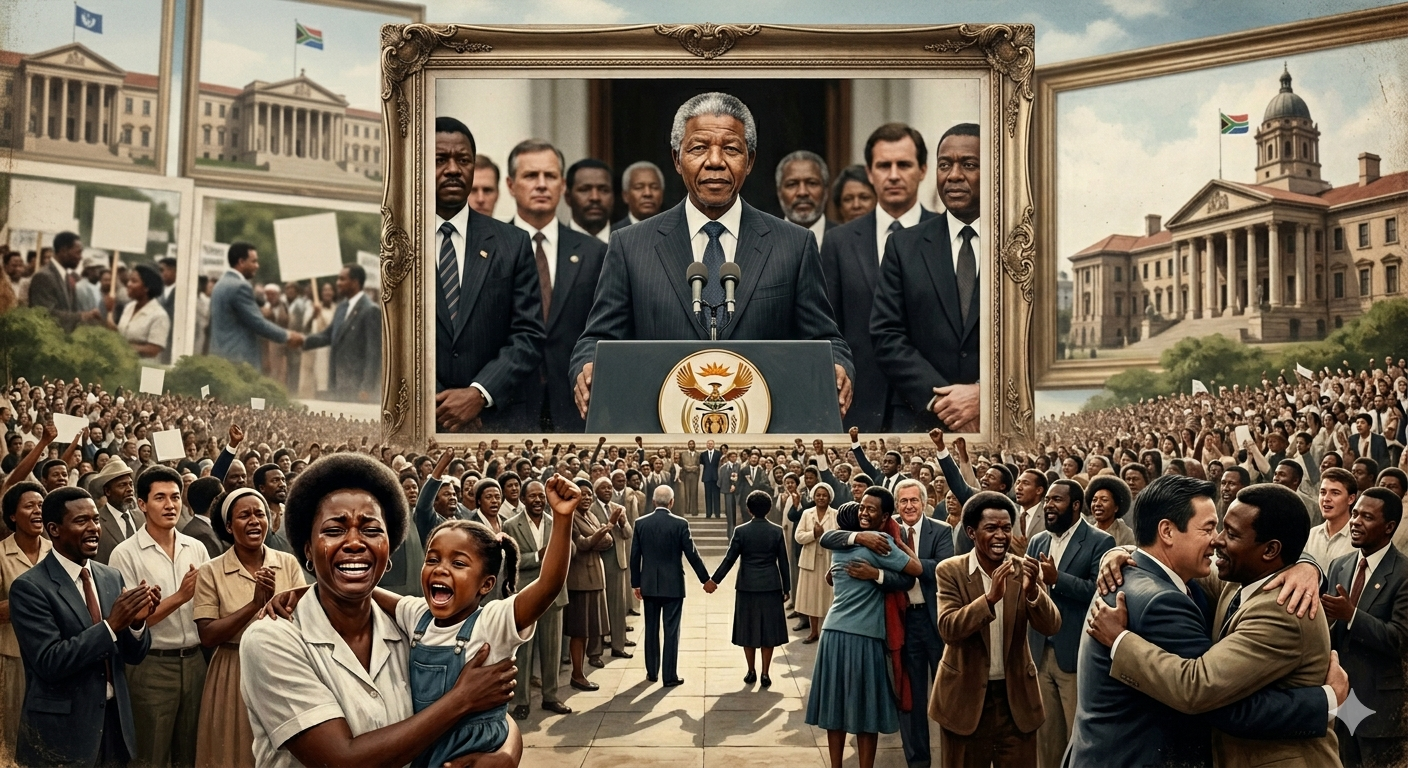
On February 2, 1990, South African State President Frederik Willem de Klerk stood before a packed parliament in Cape Town and delivered one of the most unexpected speeches in the history of the twentieth century.
He announced the unbanning of the African National Congress and dozens of other anti-apartheid organizations. He declared the release of political prisoners, including Nelson Mandela, who had been incarcerated for 27 years. He announced an end to the state of emergency and a moratorium on the death penalty.
In a matter of minutes, the man who had spent his entire political career upholding apartheid announced that it was over. South Africa would never be the same again.
What Was Apartheid? Understanding the System That De Klerk Dismantled
To understand the weight of what happened on February 2, 1990, it is essential to understand what apartheid was and how deeply it had entrenched itself in South African life.
The word “apartheid” comes from Afrikaans, meaning simply “apartness.” It became the official policy of South Africa in May 1948 when the National Party, representing the interests of the white Afrikaner-speaking population, won a narrow general election under the leadership of Daniel François Malan.
The system that followed was one of the most institutionalized forms of racial segregation in modern history. Under the Population Registration Act of 1950, all South Africans were classified by the government into racial categories — Black, White, Coloured (mixed race), or Indian. Every aspect of daily life was then organized around those classifications.
Hendrik Verwoerd, who became prime minister in 1958, refined the system further into a program he called “separate development.” He is widely regarded as the “Architect of Grand Apartheid.” Under his direction, Black South Africans were stripped of their citizenship and designated as citizens of one of ten “Bantustans” — nominally independent homelands carved out of the country’s least productive land. More than 80 percent of South Africa’s territory was reserved for the white minority.
Black people could not vote. They could not live in white areas. They could not use white hospitals, beaches, schools, or public facilities. Interracial marriage was illegal. Violation of these laws meant arrest, imprisonment, or worse. Opposition to apartheid was met with detention without trial, torture, and political assassination.
The ANC, Mandela, and the Long Resistance Against White Minority Rule
Resistance to apartheid did not begin in 1990. It began the moment the National Party took power in 1948.
The African National Congress, founded in 1912, became the primary vehicle of opposition to white minority rule. In the early 1950s, the ANC launched its Defiance Campaign of passive resistance, drawing inspiration from Mahatma Gandhi’s non-violent protest movement. But as apartheid tightened its grip and peaceful protest was met with brutal repression, the ANC shifted its approach.
Nelson Mandela, then a young lawyer from the Eastern Cape, co-founded the ANC’s armed wing — Umkhonto we Sizwe, or “Spear of the Nation” — in 1961. The organization conducted sabotage campaigns against government infrastructure, careful to avoid civilian casualties. In July 1963, Mandela and his colleagues were arrested. At the Rivonia Trial, Mandela delivered his famous “I am prepared to die” speech, articulating the ANC’s vision of a South Africa free of racial discrimination.
In June 1964, Mandela was sentenced to life imprisonment. He was sent to Robben Island, a prison in Table Bay off the coast of Cape Town, where he would remain for the next 18 years. Even from behind bars, Mandela remained the most powerful symbol of resistance to apartheid in the world.
A turning point in international awareness came in 1960, when South African police opened fire on unarmed Black protesters in Sharpeville, killing 69 people and wounding 186. The Sharpeville Massacre shocked the world, led the United Nations to call for sanctions against South Africa, and transformed the global conversation about apartheid.
The Forces That Made Change Inevitable: Sanctions, Violence, and Economic Collapse
By the 1980s, apartheid was not merely morally indefensible — it was financially collapsing. International pressure had been building for decades, but it intensified sharply during that decade.
In 1985, the United Kingdom and the United States imposed economic sanctions on South Africa. Major international corporations began withdrawing investment. Cultural boycotts isolated South African athletes, artists, and academics from the rest of the world. The apartheid economy buckled under the weight of sanctions, massive defense spending to maintain domestic repression, and a prolonged war of independence in neighboring Namibia.
Inside South Africa, violence was escalating to a level that threatened to tear the country apart. The United Democratic Front, formed in 1983, coordinated resistance across dozens of anti-apartheid organizations. Black townships across the country became battlegrounds between residents and security forces. The government had declared a state of emergency in 1985 — the first in 25 years — imposing sweeping restrictions on movement, speech, and the press.
P.W. Botha, who had been State President since 1984, made some minor concessions — abolishing the pass laws, ending the ban on interracial marriage, creating a limited Tricameral Parliament that included Coloured and Indian representatives while continuing to exclude Black South Africans entirely. But these half-measures satisfied no one and only intensified opposition. By 1989, Botha suffered a stroke and was effectively forced out of office by cabinet ministers who recognized the old approach was no longer viable.
The end of the Cold War also played a crucial role. South Africa’s value to Western governments as an anti-communist bulwark in Africa had been the justification for decades of quiet tolerance of apartheid. When the Soviet Union began to collapse and the Berlin Wall fell in 1989, that strategic argument evaporated. South Africa could no longer count on Cold War politics to shield it from full international condemnation.
De Klerk’s Unlikely Transformation: From Apartheid Enforcer to Architect of Change
Frederik Willem de Klerk was born on March 18, 1936, into one of the most prominent Afrikaner families in South Africa. His father, Jan de Klerk, was a senator who had served as a cabinet minister under Prime Minister J.S. Strijdom. His aunt was married to Strijdom himself. His entire world, from childhood through a career in law and politics, was shaped by the values of Afrikaner nationalism and the apartheid system.
When de Klerk became leader of the National Party in February 1989 and then State President in September 1989, nobody expected him to be different. His own brother, Wimpie, wrote that F.W. was “too strongly convinced that racial grouping is the only truth, way and life” to ever break from apartheid. Even liberal white South Africans saw him as a hardliner who would slow any meaningful change.
But de Klerk had been watching the same reality that everyone else could see: apartheid was leading South Africa toward economic collapse and civil war. He later said that when he realized the system was “morally indefensible” and was leading the country to political and economic bankruptcy, he committed himself to a radical change of course. On occasion, he invoked the divine. “God had instructed me to do so,” he told one reporter.
In the months before the February 2 speech, de Klerk moved carefully. He met secretly with Nelson Mandela to discuss the path forward. He quietly released several senior ANC leaders — including Walter Sisulu and Govan Mbeki — from prison to test the political waters. He allowed peaceful protest marches that would previously have been violently suppressed.
He swore his cabinet to secrecy two days before the speech. Even on the morning of February 2, he had not finalized his decision to announce Mandela’s release — he told his wife in the car on the way to parliament that he would. British Prime Minister Margaret Thatcher had urged him to do it, telling him it would have the greatest possible impact of any single action he could take.
February 2, 1990: The Speech That Changed South Africa Forever
The opening of parliament in Cape Town had always been a formal ceremony. On February 2, 1990, it became history.
De Klerk began with relatively conventional matters — comments on foreign relations, economic policy, and South Africa’s human rights situation. Then, without theatrical preamble, he began dismantling the structure of apartheid one announcement at a time.
He announced the unbanning of the African National Congress, the Pan Africanist Congress, the South African Communist Party, and dozens of associated organizations — bodies that had been illegal for 30 years. He announced a moratorium on the death penalty. He announced the end of the state of emergency. He announced that political prisoners would be released.
Then he announced the unconditional release of Nelson Mandela.
The reaction in the chamber was immediate and sharply divided. Conservative Party members of parliament walked out shouting “traitor” at de Klerk. The Conservative MP Koos van der Merwe declared that “de Klerk is a traitor to his own people, he’s trying to kill the Afrikaner nation.” Outside, crowds gathered on the streets of Cape Town waving ANC flags in celebration for the first time in three decades. In Johannesburg, police — still operating under emergency rules not yet lifted — used tear gas and batons on celebrating crowds.
The New York Times described the speech as announcing “the most profound changes to South Africa’s race relations in 350 years.” The world barely had time to absorb what it had heard before the next milestone arrived. Nine days later, on February 11, 1990, Nelson Mandela walked out of Victor Verster Prison near Cape Town, blinking in the sunlight as a free man after 27 years of imprisonment. He raised his fist in the ANC salute to a roaring crowd. Images of his release were broadcast around the world.
The Long Road to Democracy: CODESA, the 1992 Referendum, and the First Free Election
De Klerk’s speech did not end apartheid overnight. It began a four-year negotiation process that was tense, frequently violent, and repeatedly threatened to collapse.
Direct talks between the ANC and the National Party government began in earnest on May 2–4, 1990, at the Groote Schuur presidential residence in Cape Town. The meeting produced the Groote Schuur Minute, a framework for continuing negotiations. But in March 1990, just weeks after the speech, 11 protesters were killed by police in the Sebokeng massacre, and the ANC temporarily suspended talks. Progress was fragile and painful.
In December 1991, the Convention for a Democratic South Africa — known as CODESA — convened for the first time. It brought together 19 political parties and movements to negotiate a transition framework. The ANC and the National Party were the dominant forces, but the process was complicated by boycotts from right-wing white groups, the Inkatha Freedom Party, and other parties who felt excluded or threatened.
In March 1992, de Klerk put the negotiation process to a whites-only referendum — the last such vote in South African history. He asked white voters to approve the end of apartheid and the continuation of negotiations. The result was decisive: 68 percent voted yes. Even among the white population that had built and maintained apartheid, the majority had concluded that the system was finished.
The process came close to total collapse on April 10, 1993, when white right-wing extremist Janusz Walus assassinated Chris Hani — the immensely popular leader of the South African Communist Party and a figure of enormous influence among young Black South Africans. Hani’s murder threatened to ignite exactly the racial civil war that negotiations were trying to prevent. It was Mandela, not de Klerk, who appeared on national television to appeal for calm, in a moment that demonstrated how completely the moral authority of the transition had passed to the ANC.
A new interim constitution was ratified on November 18, 1993. In November 1993, as South Africa’s Transitional Executive Council was inaugurated, both Mandela and de Klerk flew to Oslo, where they were jointly awarded the Nobel Peace Prize for their roles in ending apartheid.
April 27, 1994: The First Free Election and the Birth of Democratic South Africa
On April 27, 1994, South Africa held its first-ever general election open to voters of all races. The date is now commemorated every year as Freedom Day. Millions of South Africans of every racial background stood in lines that stretched for hours, sometimes stretching for miles, to cast their first votes.
The African National Congress won 62 percent of the vote. The National Party won just over 20 percent. Nelson Mandela, aged 75, was inaugurated as South Africa’s first Black president on May 10, 1994. De Klerk became one of his two deputy presidents, serving in a Government of National Unity alongside Thabo Mbeki of the ANC.
The transition was accompanied by the Truth and Reconciliation Commission, established in 1995 and chaired by Archbishop Desmond Tutu. The commission investigated human rights abuses committed under apartheid and provided a forum for victims and perpetrators to speak publicly. It found that apartheid was a crime against humanity and that the apartheid government had been responsible for the majority of human rights violations between 1960 and 1994.
De Klerk remained a controversial figure for the rest of his life. He never fully acknowledged the extent of the suffering apartheid had caused, and he resisted characterizing the system as a crime against humanity. He died on November 11, 2021, at his home in Cape Town, aged 85, having recorded a final video message in which he apologized “without qualification” for the suffering his regime inflicted. Many felt the apology came far too late.
Why the Announcement of February 2, 1990 Matters in History
The speech F.W. de Klerk delivered on February 2, 1990, was not just a turning point for South Africa. It was a moment that demonstrated something that history rarely proves but that the world urgently needed to see: that even one of the most entrenched and brutal systems of racial oppression in the modern era could be dismantled without a full-scale civil war.
It showed that political leaders, even those who had built their careers on injustice, were capable of recognizing reality and choosing a different path. It showed that decades of resistance — by the ANC, by international campaigners, by ordinary South Africans who suffered under the system every day — could ultimately succeed.
The apartheid system had classified, separated, humiliated, and brutalized the majority of South Africa’s people for 46 years. The speech on February 2, 1990 began the process of its dismantling. The election of April 27, 1994 completed it. And the South Africa that emerged — imperfect, unequal, still working through the wounds of its history — stands as proof that the arc of history, however long and painful its bending, can indeed bend toward justice.