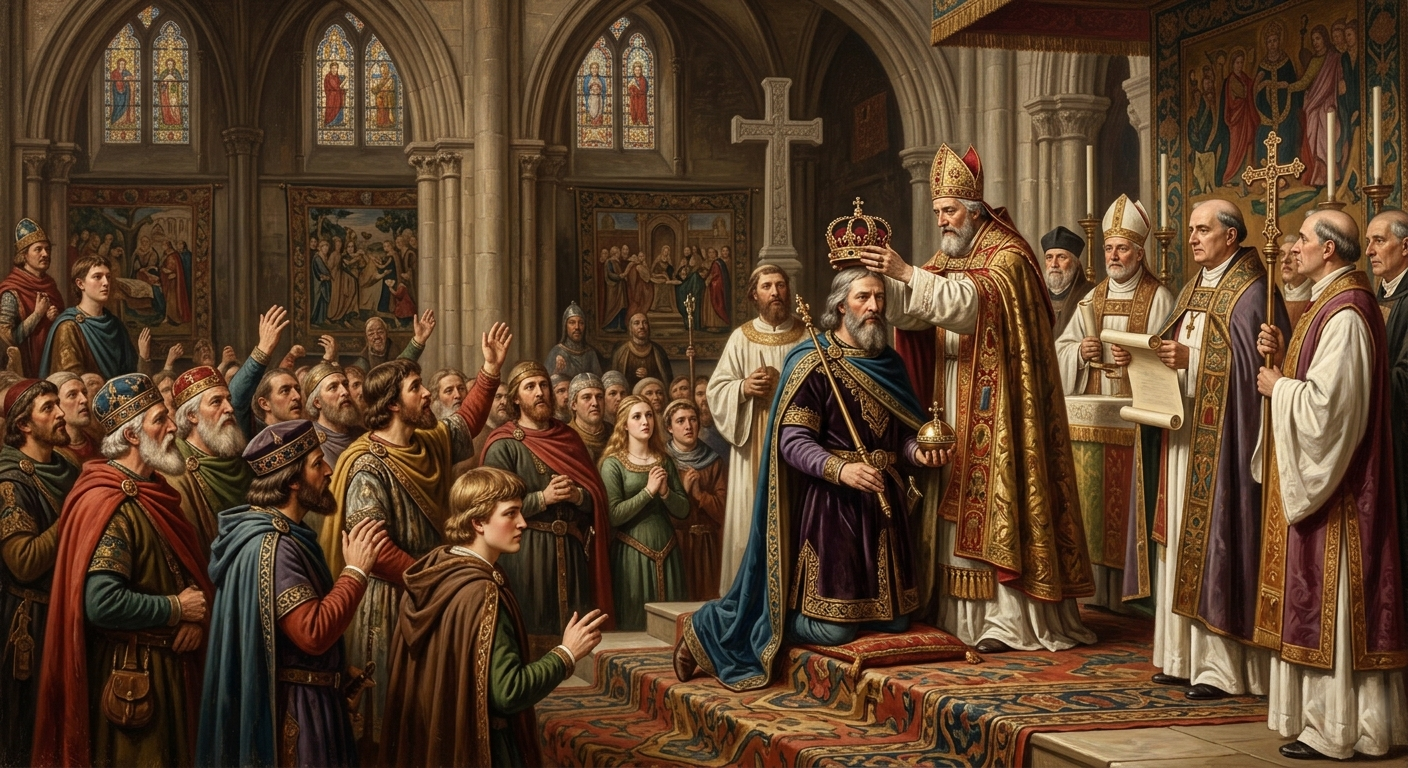
On Easter Sunday, April 3, 1043, a man who had spent most of his life as an exile in Normandy was crowned King of England at Winchester Cathedral in a ceremony of deep religious and political symbolism. Edward — the son of Aethelred the Unready and Emma of Normandy, born around 1003 in Islip, Oxfordshire — was finally assuming the throne of a kingdom that had been ruled by Danish kings for the better part of three decades. The choice of Easter Sunday for the coronation was deliberate and theologically freighted: the day of Christ’s resurrection signaled a new beginning, a divine blessing on the restored English royal line, a king consecrated as a sacred conduit through whom God might act for his people. Winchester Cathedral, the ancient royal seat of the West Saxons and the place where Alfred the Great’s legacy still resonated through every stone, was chosen over London to signal continuity with the greatest traditions of English kingship.
Edward would reign for twenty-four years, from 1042 until his death on January 5, 1066 — one of the longest reigns of any Anglo-Saxon king. He would build Westminster Abbey, the great church that still stands as the beating heart of English and British royal ceremonial life. He would be canonized by Pope Alexander III in 1161, becoming Saint Edward the Confessor, and his name, his crown, and the legal concept of ‘the Laws of Edward the Confessor’ would echo through English history for centuries after his death. And yet his reign would end in a succession crisis of such catastrophic consequence that it transformed not just England but the entire political and cultural fabric of Western Europe. When Edward died without a direct heir in January 1066, the struggle for his throne produced the Battle of Hastings, the Norman Conquest, and a rupture in English history whose consequences are still with us today.
England Before Edward: Danish Rule, Political Turmoil, and the Long Years of Exile
The England into which Edward the Confessor was born around 1003 was a kingdom in the grip of a prolonged national emergency. His father, King Aethelred II — known to history as Aethelred the Unready, a nickname that translates more accurately from Old English as ‘ill-counselled’ or ‘poorly-advised’ — had reigned since 978 in a style defined by indecision, administrative weakness, and an inability to organize effective resistance to the Viking raids that had been terrorizing the English coastline and increasingly penetrating deep inland for decades. The raids conducted by the formidable Danish king Sweyn Forkbeard escalated in the 1000s from plundering expeditions to outright conquest. In 1013, Sweyn Forkbeard launched a full-scale invasion that drove Aethelred himself off the throne. The king, his queen Emma of Normandy, and their sons fled to the court of Emma’s brother, Duke Richard II of Normandy.
Edward was thus displaced from England as a child of perhaps nine or ten years old, and he would not return to live in his own kingdom for nearly thirty years. His father Aethelred returned to England briefly when Sweyn Forkbeard died suddenly in February 1014, reclaiming the throne on terms negotiated with the English nobility — including a promise to govern more justly than he had done before, one of the earliest examples in English history of a king committing to constitutional limitations on his power. But Aethelred died in April 1016, and England immediately descended into war between his son Edmund Ironside and the new Danish claimant, Sweyn’s son Cnut the Great. After Edmund’s death in November 1016, Cnut became undisputed king of all England. He would rule until 1035, and under his firm but generally effective governance, England became the center of a North Sea empire that also encompassed Denmark and Norway.
For Edward, this meant decades of exile in the ducal court of Normandy — a court that was in many ways more home to him than England had ever been. He grew up speaking Norman French, educated in the Norman ecclesiastical and aristocratic traditions, surrounded by Norman clerics, knights, and administrators. He was a foreigner to his own kingdom in all but blood. His mother Emma, meanwhile, made a political calculation that must have stung deeply: after Aethelred’s death, she married Cnut himself in 1017, becoming the Danish king’s queen and the mother of his son Harthacnut. Emma’s shift of allegiance meant that she now actively promoted Harthacnut’s claim to the English throne rather than Edward’s. She would remain an ambivalent and at times actively hostile presence throughout the early part of her eldest son’s adult life.
The Murder of Alfred and the Trauma That Defined Edward’s Kingship
The event that most profoundly shaped Edward’s emotional landscape and political instincts occurred in 1036, when he and his brother Alfred separately attempted to return to England, apparently in response to an invitation from their mother Emma, who may have been trying to use her sons to counter the growing power of Harold Harefoot — Cnut’s son by his first wife Aelfgifu of Northampton, who was acting as regent in England while Harthacnut was occupied with affairs in Denmark. Edward landed near Southampton with a small force, engaged in what the Anglo-Saxon Chronicle describes as a successful skirmish, and then retreated back to Normandy. His brother Alfred was less fortunate.
Alfred landed in the south of England and was captured — precisely how and by whose agency remains disputed — but the dominant account attributes his seizure to Godwin, the Earl of Wessex, who had been one of the most trusted English nobles under Cnut and who now delivered Alfred to Harold Harefoot. What happened next was one of the most barbaric acts in the violent annals of Anglo-Saxon political life. Alfred was blinded by having red-hot pokers forced into his eyes — a technique used specifically to render him permanently unsuitable for kingship, since an unblemished body was a requirement for a legitimate king. Alfred died shortly afterward from the effects of this mutilation. He was Edward’s younger brother, and his killing at the hands of agents directly connected to Harold Harefoot — and, in the most damning accounts, to Godwin himself — burned itself into Edward’s memory as an injustice that demanded eventual reckoning. When Edward later became king and banished Godwin in 1051, historians have identified Alfred’s murder as one of the primary grievances Edward harbored against the most powerful man in England.
The Path to the Throne: Harthacnut’s Invitation and the Death of the Danish Kings
The sequence of events that eventually brought Edward to the English throne was driven more by the convenient deaths of his rivals than by any political campaign he was able to orchestrate from his Norman exile. Harold Harefoot died in March 1040, and Harthacnut — Edward’s half-brother and Emma’s son by Cnut — came from Denmark to claim the English throne, which he had always regarded as rightfully his. Harthacnut proved a brutal and financially oppressive ruler who imposed heavy taxes to fund his fleet. But he made one decision that changed everything: he invited Edward, his half-brother from England’s exiled royal line, to come to England and join his household. The Anglo-Saxon Chronicle records that Edward was sworn in as king alongside Harthacnut, suggesting that Harthacnut was already contemplating or acknowledging Edward as his heir.
Harthacnut died suddenly on June 8, 1042, collapsing at a wedding celebration — perhaps from a stroke or heart failure, perhaps from excessive drinking — and dying without having produced an heir. The succession was immediately resolved by popular acclamation: ‘before Harthacnut was buried, all the people chose Edward as king in London,’ records the Anglo-Saxon Chronicle, a passage that captures the relief with which the English nobility and people greeted the prospect of a return to the native royal line. The man most responsible for engineering Edward’s succession was Godwin, the Earl of Wessex — the same Godwin who had delivered Alfred to his terrible fate six years earlier. Godwin, the most powerful magnate in England, recognized that Edward was the legitimate candidate and that supporting him would both secure his own position and give him enormous leverage over a king who was essentially a stranger to his own country.
Edward met ‘the thegns of all England’ at Hursteshever, probably the modern Hurst Spit off the coast of Hampshire opposite the Isle of Wight, where he was received as king in exchange for his oath that he would uphold the laws of Cnut. It was a telling moment: the returning king of the ancient House of Wessex was required to swear to continue the legal and administrative arrangements of the Danish kings who had displaced his family. This was the political reality of the England Edward was inheriting — a kingdom shaped by a quarter-century of Scandinavian rule, with an entrenched Anglo-Danish aristocracy whose loyalty to the Wessex royal line was pragmatic rather than heartfelt, and whose primary allegiance was to their own regional power.
The Coronation at Winchester: Easter Sunday, April 3, 1043
The coronation of Edward the Confessor at Winchester Cathedral on Easter Sunday, April 3, 1043 was one of the most deliberately symbolic acts of the entire Anglo-Saxon era. Every element of the ceremony — the date, the location, the ritual form, and the officiating clergy — was chosen to convey specific and carefully calibrated messages about legitimacy, continuity, and divine favor. Winchester had been the ancient capital of Wessex, the kingdom from which English unity had been forged by Alfred the Great in the ninth century and consolidated by his successors in the tenth. By choosing Winchester over London — the great commercial city where kings were increasingly acclaimed — Edward was making an explicit statement about his rootedness in the oldest traditions of English royal authority.
The coronation was performed by Eadsige, the Archbishop of Canterbury, who had served as a royal priest under King Cnut before becoming Archbishop in 1038, and by Aelfric Puttoc, the Archbishop of York. The service itself was a version of the ‘Second Ordo’ — the liturgical form for royal consecration that had been developed in the tenth century based on the coronation rites of the Frankish kings and on the ceremonies used for the ordination of bishops. Its central elements could be traced back to the coronation ceremony devised by Saint Dunstan for King Edgar’s coronation at Bath Abbey in 973 — a service that had established the template for all subsequent Anglo-Saxon and early Norman coronation ceremonies. The coronation transformed Edward from a prince and king-designate into what a contemporary Winchester document described as ‘a consecrated king who became a sacred conduit through whom God might act for His people.’ Through the coronation liturgy, the king was identified with the great figures of Hebrew scripture — Abraham, Moses, David, and Solomon — as well as with Christ himself, whose resurrection was being celebrated that very Easter morning.
The choice of Easter Sunday amplified this already-charged symbolism to an extraordinary degree. In the Anglo-Saxon Christian world, Easter — the celebration of Christ’s triumph over death and his resurrection into new life — was the greatest feast of the liturgical year, the day of ultimate renewal and hope. For Edward, whose accession represented the restoration of the English royal line after nearly thirty years of Danish rule, the resonance could hardly have been more precise: as Christ had risen on Easter morning, so the House of Wessex was rising again. The ‘jubilant atmosphere’ described in the sources that surrounded the newly crowned king’s return to his kingdom reflected both genuine popular enthusiasm for the restoration of the native dynasty and the carefully orchestrated political theatre of a coronation that had been designed to maximize its symbolic impact on everyone who witnessed it.
The Key Stakeholders: Godwin, the Earls, and the Power Behind the Throne
The political landscape of Edward’s England was defined above all by the existence of an entrenched class of powerful regional earls whose accumulated wealth, military resources, and popular influence made them, in practical terms, the co-governors of the kingdom. Chief among these was Godwin, the Earl of Wessex, whose power base encompassed the richest and most densely populated region of England and whose influence over the English nobility was unmatched. Godwin had risen from relatively obscure origins to become the dominant English magnate under Cnut, and his support had been essential to Edward’s succession. He was not a man Edward could easily ignore, override, or displace — as Edward would discover in 1051 when he tried and found the attempt both initially successful and ultimately reversible.
Godwin (died April 15, 1053) was a figure of commanding political intelligence and flexible moral commitments. He had navigated the transition from Cnut’s Danish regime to the restored English monarchy with the skill of a natural political survivor, and he moved immediately to cement his family’s position under the new king by arranging the marriage of his daughter Edith to Edward. The wedding took place on January 23, 1045, and it was a union that encapsulated all the tensions of Edward’s reign: a king of deep Norman sympathies and pious personal temperament, married to the daughter of the man whom he held at least partially responsible for his brother’s murder, in a political match engineered by Godwin to bind the royal family to his own dynastic interests. Edward’s older brother Sweyn had already been given an earldom in the southwest midlands in 1043, Harold Godwinson was given the earldom of East Anglia, and Beorn Estrithson, a Danish cousin of the Godwins, received another earldom in southern England. By 1045, Godwin and his family subordinately controlled all of Southern England.
The other great earls of Edward’s reign included Leofric, Earl of Mercia — a man of comparable power and similar political longevity to Godwin, whose wife Lady Godgifu (the Godiva of later legend) is said by a twelfth-century source to have ridden naked through the streets of Coventry to secure tax relief for her husband’s tenants — and Siward, the formidable Earl of Northumbria, a warrior of Danish origin who had secured control of the north of England through military prowess and political astuteness. These three great earls — Godwin, Leofric, and Siward — dominated the political landscape of Edward’s reign, and the complex interplay of their rivalries, alliances, and ambitions shaped almost every major political development of his twenty-four years on the throne.
Edward’s Norman Sympathies and the Crisis of 1051: Godwin’s Exile and Return
Having spent approximately twenty-eight of his approximately forty years in Normandy when he came to the English throne, Edward the Confessor was culturally far more Norman than English. He surrounded himself with Norman ecclesiastics, administrators, and military companions, appointing them to positions of influence at court, in the church, and in local administration. He appointed Normans as sheriffs in English counties, filling the administrative infrastructure of the kingdom with men whose loyalties lay with the Norman Duke rather than with the English earls. Most controversially, in 1051 he appointed Robert of Jumieges — a Norman monk who had become a close royal advisor — as Archbishop of Canterbury, the most senior ecclesiastical position in England, passing over English candidates and inserting a trusted Norman intimate into the very center of the English Church’s authority.
The appointment of Robert of Jumieges as Archbishop crystallized the growing resentment of the English earls against what they saw as the Norman colonization of their king’s court. The crisis erupted in September 1051 when Eustace II of Boulogne — Edward’s own brother-in-law, whose sister Godgifu had been Edward’s sister — visited England and a violent altercation broke out between his armed Norman entourage and the townspeople of Dover. The details are disputed, but people were killed on both sides. Edward ordered Godwin, in whose earldom of Wessex Dover lay, to punish the people of Dover. Godwin refused. This was an extraordinary act of defiance — an earl refusing a direct royal order — and it forced a political confrontation that had been building since the beginning of the reign. The earls Leofric of Mercia and Siward of Northumbria supported the king rather than Godwin, and Edward was able to force Godwin and his entire family — including his sons and his daughter, Queen Edith — into exile. Queen Edith was sent to a nunnery at Wherwell. It was the most complete assertion of royal authority in Edward’s reign.
The triumph proved short-lived. Within a year, in September 1052, Godwin returned to England with an armed following, rallying support from the English population who resented the increased Norman influence at court. Edward, unable to mount effective military resistance and faced with defections from the forces he had assembled, was compelled to come to terms. Godwin’s titles and lands were restored. Queen Edith was retrieved from her nunnery. The Norman advisors and officials that Edward had placed in positions of power were expelled or fled. Archbishop Robert of Jumieges fled the country and was replaced by Stigand, an English bishop who took the archbishopric without proper papal authorization — a situation that would have significant consequences for the English Church’s standing with Rome. The Godwin family’s return marked a watershed in Edward’s reign: from this point forward, his power to shape English politics independently of the Godwins was severely constrained. Godwin himself died in April 1053 — tradition says he collapsed at the king’s table and died after three days — and his son Harold Godwinson succeeded to the earldom of Wessex.
Westminster Abbey: Edward’s Most Enduring Achievement and Legacy
If Edward the Confessor left one physical monument that transcended his reign and transformed the landscape of English history, it was Westminster Abbey. Edward began rebuilding the ancient monastery of St Peter at Westminster — which stood on a low-lying island called Thorney Island in the Thames, a short distance upstream from the city of London — sometime in the late 1040s, and the construction continued through the 1050s and into the 1060s. The abbey Edward built was constructed in the Norman Romanesque style that was reshaping ecclesiastical architecture across Western Europe, with massive round arches, solid stone walls, and a cruciform plan that expressed the ideals of Benedictine monasticism through architectural form. It was the largest church in England and one of the finest in Europe — a building that announced, in stone and glass, Edward’s profound personal piety and his desire to create a worthy house for the saints and for God.
Westminster Abbey was formally consecrated on December 28, 1065. Edward the Confessor was too ill to attend the ceremony — a devastating irony for the man who had dedicated a significant portion of his reign and resources to its construction. Within eight days of the consecration, on January 5, 1066, Edward was dead, and he was buried in the abbey he had built, before its altar. Harold Godwinson was crowned the following day, January 6, 1066 — and it was Harold’s coronation in Westminster Abbey that established the tradition of English royal coronations taking place there, a tradition that has continued without interruption for nearly a thousand years. Every British monarch since William the Conqueror (with one notable exception) has been crowned in the building that Edward the Confessor created. The abbey thus stands as the most tangible expression of Edward’s enduring impact on the physical and ceremonial fabric of the English state.
The choice of Westminster as the location for the abbey was itself historically significant. By building a great royal church at Westminster, Edward was effectively creating a new royal center distinct from the ancient capitals of Winchester and London proper, and positioning it as the site of royal devotion and burial. Henry III of England (r. 1216-1272), who admired Edward with an almost reverent intensity, substantially rebuilt Westminster Abbey in the Gothic style in the thirteenth century, created an elaborate shrine to Saint Edward at the heart of the building, and incorporated relics believed to be Edward’s into the new shrine. The result was the building that still stands today, its inner core defined by Henry III’s devotion to his predecessor. The shrine of Saint Edward remains at the center of Westminster Abbey, and the high altar under which Edward was originally buried stands near the location that every subsequent English and British monarch has occupied at their coronation.
Edward’s Reign: Military Campaigns, Administration, and Relative Peace
Despite the dramatic internal political conflicts of his reign — the Godwin crisis of 1051-52, the factional struggles over earldoms, the persistent tension between Norman and English interests at court — Edward’s twenty-four-year reign was, by the standards of his era, a period of relative peace and modest prosperity. Viking raids, which had been the defining military emergency of the previous century of English history, diminished dramatically during his reign, in part because the Scandinavian powers were preoccupied with their own internal conflicts and succession disputes. Taxation was comparatively light; Edward was not an extravagant king and lived principally off the revenues of his own substantial royal estates, estimated at around £5,500 per year. He did not engage in costly foreign military campaigns.
The major military challenges of his reign came from the Celtic periphery rather than from Scandinavia. The Welsh kingdoms remained a persistent source of border conflict. In 1053, Edward ordered the assassination of the southern Welsh prince Rhys ap Rhydderch, who had been raiding into England. In 1055, Gruffydd ap Llywelyn — who had succeeded in unifying Welsh resistance to English power to a degree unprecedented in Welsh history — allied with the exiled Aelfgar, son of Leofric of Mercia, and launched a devastating raid that burned the city of Hereford. It fell to Harold Godwinson to respond militarily, and Harold’s campaigns against Gruffydd in 1062-1063, conducted with his brother Tostig, resulted in the complete subjugation of Wales: Gruffydd was killed by his own men in August 1063, his head sent to Harold as proof of the campaign’s success. Gruffydd’s oath of loyalty to the English king, which Edward had sought for years, was finally delivered — to Harold rather than to Edward himself, in a military success that burnished Harold’s reputation at the expense of the king’s.
In Scotland, Edward conducted the most significant campaign of his reign in 1054, when he sent Siward, the Earl of Northumbria, with an English army into Scotland to depose the Scottish king Macbeth and restore the Anglophile candidate Malcolm Canmore (later Malcolm III) to power. Siward’s campaign was successful — Macbeth was defeated and forced to withdraw north — though it cost Siward his own son Osbeorn in the fighting. The campaign demonstrated that England under Edward retained the capacity for effective military projection when the political will existed, though the king himself played no personal role in it.
The Succession Question: William of Normandy, Harold Godwinson, and the Crisis That Changed History
The most consequential and most debated aspect of Edward the Confessor’s entire reign is the question of who he intended to succeed him — a question made urgently pressing by his apparent childlessness. Edward and Queen Edith of Wessex had no children, a fact that historians have interpreted in various ways. Norman sources, written after the Conquest to justify William’s claim, assert that Edward had taken a vow of celibacy before marriage, making the lack of an heir a deliberate spiritual choice. Most modern historians reject this interpretation as post-hoc Norman propaganda, arguing instead that Edward hoped to produce an heir with Edith at least until his quarrel with Godwin in 1051 raised the possibility that he might repudiate her entirely. Whatever the personal reality, the result was the same: Edward would die without a direct male heir, and the succession would be contested.
The Norman claim rested on a set of events that Norman sources depicted as a clear and deliberate promise of the throne to William, Duke of Normandy. William was Edward’s first cousin once removed — Edward’s mother Emma of Normandy was the daughter of Duke Richard I, making Edward’s distant kinship with the Norman ducal house a genuine if not particularly strong hereditary connection. Norman chroniclers claimed that Edward had promised William the succession during the period of Godwin’s exile in 1051-52, when William allegedly visited England and was received by the king. Whether such a promise was made, how seriously Edward meant it, and whether a medieval king’s personal promise could bind a kingdom whose nobility had the right to choose its ruler were all questions that contemporaries debated and that historians have debated ever since.
The most dramatic episode in the succession controversy was Harold Godwinson’s visit to Normandy — probably in 1064, though some sources suggest earlier — an event that is depicted in the Bayeux Tapestry and that lies at the heart of the Norman claim that Harold had pledged his support for William’s succession. The Norman account holds that Harold was sent by Edward as his ambassador to formally confirm the promise of the throne to William, and that Harold swore a solemn oath — possibly on sacred relics, making it binding under the terms of medieval Christian morality — to support William’s succession. Harold’s own position was that the oath had been extracted under duress and was therefore invalid. Whatever the truth, the episode provided William with the moral and legal framework he needed to portray his 1066 invasion not as conquest but as the legitimate enforcement of a broken promise.
Edward also made a late attempt to resolve the succession by inviting back the surviving member of the direct male line of the House of Wessex. Edward the Exile — the son of Edmund Ironside, Edward the Confessor’s older half-brother, who had been sent to the court of the Holy Roman Emperor in Hungary as a child to prevent him from serving as a focus for rebellion against Cnut — returned to England in 1057, bringing with him his young son Edgar, who bore the title Aetheling (meaning ‘throne-worthy’). But Edward the Exile died almost immediately upon his return to England, in circumstances that were suspicious enough to generate accusations of murder — possibly directed against Harold Godwinson, who had the most to gain from removing a rival claimant. His son Edgar, aged about six at the time, remained at the English court without becoming a genuine political force.
The Death of Edward the Confessor: January 5, 1066 and the Beginning of the Crisis
Edward the Confessor’s health had been declining for some time before his death. He appears to have suffered strokes in the preceding year, which weakened him progressively. By Christmas 1065 he was mortally ill, too sick even to attend the consecration of his beloved Westminster Abbey on December 28 — a cruel deprivation at the end of a life in which the abbey had been his most personal and sustained act of devotion. The court gathered at Westminster in a state of anxious uncertainty. Harold Godwinson was at the king’s side throughout the final days.
Edward died on the morning of January 5, 1066, at the royal palace of Westminster. Various sources record that before his death he briefly regained consciousness and commended his widow Edith and the kingdom to Harold’s ‘protection’ — a phrase whose ambiguity has been debated ever since, since ‘protection’ could mean either that Harold was to be the king’s guardian and successor or that he was merely to look after the queen as a trustee without claiming the throne. Edward was buried in Westminster Abbey on January 6, 1066 — the feast of the Epiphany — in the nave before the high altar of the church he had built. His body was later translated to the elaborate shrine created by Henry III, where his remains are believed to rest to this day.
Harold Godwinson was crowned Harold II of England on the same day Edward was buried, January 6, 1066 — in all likelihood in Westminster Abbey itself, making Harold probably the first king to be crowned in a building that would thereafter become the permanent home of the English and British coronation ceremony. The speed of Harold’s coronation was a measure of the urgency he felt: he knew that William of Normandy would regard the coronation of anyone other than himself as a usurpation, and he knew that Harald Hardrada, the fearsome King of Norway, also had a claim to the English throne. The confrontation was inevitable, and Harold had no time to lose.
The Norman Conquest: How Edward’s Ambiguous Succession Reshaped England
The catastrophic consequences of Edward the Confessor’s failure to secure an unambiguous succession played out with horrifying speed in 1066. William of Normandy assembled a fleet and an army — he had papal backing for his invasion, secured partly on the grounds that he was enforcing Harold’s broken oath — and crossed the Channel in September 1066. Harold, who had just defeated and killed Harald Hardrada of Norway at the Battle of Stamford Bridge in Yorkshire on September 25, was forced to march his exhausted army south at breakneck speed to confront the Norman landing. On October 14, 1066, at the Battle of Hastings, Harold Godwinson was defeated and killed — struck, in the most famous image of the Bayeux Tapestry, by an arrow in the eye, though the accuracy of this detail has been disputed. England’s last Anglo-Saxon king was dead, and William of Normandy was on his way to the throne.
After Hastings, the English nobility briefly proclaimed Edgar Aetheling — the great-nephew of Edward the Confessor and the last representative of the male line of the House of Wessex — as king. Edgar was perhaps thirteen or fourteen years old, and he had neither the military capacity nor the political support to resist William’s advance. He submitted to William at Berkhamsted in Hertfordshire, and William was crowned King of England at Westminster Abbey on Christmas Day, December 25, 1066. The Norman Conquest was complete. It transformed England in ways that are still visible in the English language, in English law, in English architecture, and in the class structure of English society. Latin, Norman French, and Anglo-Saxon merged over the following centuries into the English language as we know it. The feudal system of land tenure that the Normans imposed reshaped the social and economic organization of England for centuries. Westminster Abbey itself was rebuilt by the Normans in the generations after 1066, preserving Edward’s foundational act while transforming its architectural expression.
Canonization and Sainthood: How Edward the Confessor Became a Royal Saint
The making of Edward the Confessor into a saint was both a genuinely religious phenomenon rooted in popular piety and a carefully orchestrated political act by the medieval English monarchy. His reputation for personal holiness — his deep piety, his generosity to the poor, his patronage of the Church, and the miracles attributed to his intercession — had been building since his death. Aelred of Rievaulx, a twelfth-century English monk and theologian, wrote a detailed Life of Edward that emphasized his sanctity and his virtue as a Christian king, providing the theological foundation for the case for canonization. The campaign for Edward’s canonization was conducted on behalf of the English monarchy, which saw in the cult of Edward a powerful source of royal legitimacy and a way of distinguishing the English crown as having a native royal saint of the highest prestige.
Pope Alexander III formally canonized Edward the Confessor in 1161, during the reign of King Henry II. The title ‘Confessor’ — which distinguished him from saints who had suffered martyrdom, such as his uncle Edward the Martyr — reflected the tradition of a holy person who had witnessed to the Christian faith through an exemplary life rather than through death. The timing of the canonization had political dimensions: it was pursued under Henry II partly to strengthen the prestige of the English crown in its ongoing tensions with the papacy, and partly to provide the Angevin dynasty — which had French rather than Anglo-Saxon roots — with a link to the ancient English royal tradition through the veneration of its most celebrated representative.
The cult of Edward the Confessor reached its zenith under Henry III of England, who was personally devoted to the saint with an intensity that shaped much of his reign. Henry III largely rebuilt Westminster Abbey in the Gothic style, creating a magnificent new shrine for Edward at the heart of the church, and incorporated the relics believed to be Edward’s — which had been venerated since the king’s burial — into a new golden shrine that became one of the great pilgrimage destinations of medieval England. Henry III chose to be buried at Westminster near Edward’s shrine, and he named his eldest son Edward — breaking with the Plantagenet tradition of naming sons Henry — in tribute to his predecessor. Edward the Confessor was for a time one of England’s national saints, standing alongside Saint George, and his feast day on October 13 was celebrated throughout the medieval English Church.
Edward the Confessor’s Legacy: The Laws, the Crown, and the Long Shadow Over English History
Edward the Confessor’s most enduring historical legacy is not a particular conquest or a decisive battle or a sweeping political reform, but rather the idea of himself: the image of a just, pious, and peaceful king whose reign represented a golden age of good governance to which later generations perpetually looked back with nostalgia. The ‘Laws of Edward the Confessor’ — a body of legal customs and administrative practices associated with his reign, codified in the twelfth century — became a touchstone for reformers throughout the medieval period who wished to constrain royal power and restore what they saw as the just governance that Edward had represented. When the barons forced King John to agree to Magna Carta in 1215, they demanded a return to the laws of Edward the Confessor. When later generations of English reformers argued for constitutional limits on royal power, they invoked Edward’s name as their precedent.
Every English and British monarch since William the Conqueror has sworn at their coronation to uphold the laws of Saint Edward — a formula that has been part of the coronation oath for nearly a thousand years and that was still included, in updated form, in the coronation of King Charles III in May 2023. The St Edward’s Crown — the solid gold crown made for the coronation of Charles II in 1661 following the destruction of the original crown jewels during the Commonwealth period — is named after Edward, possibly incorporating pieces of his original crown, and it is the crown placed on the monarch’s head at the moment of coronation. St Edward’s Sapphire, an octagonal rose-cut stone said to have been taken from Edward’s coronation ring, is among the oldest items in the Crown Jewels. The Coronation Chair, made for Edward I in the 1290s and used at every coronation since, is named after Edward the Confessor.
The paradox of Edward the Confessor’s historical reputation lies in the gap between the reverential image projected by medieval hagiography and the more complex and often troubling reality revealed by careful historical analysis. The man venerated as a saint of extraordinary piety was also a king who struggled with fits of rage, who harbored vindictive grudges, who was fascinated by hunting and other worldly pleasures to a degree that the sources find slightly incongruous in so supposedly unworldly a figure, and whose indecisiveness and failure to resolve the succession question bequeathed England a catastrophic crisis. His canonization has been described by most historians as primarily political — serving the interests of successive English monarchies in need of a royal saint — though some scholars argue that his cult’s early emergence must reflect something genuine in contemporary perceptions of his personal holiness.
Conclusion: The Coronation That Launched a Century of Transformation
When Archbishop Eadsige placed the crown upon Edward’s head at Winchester Cathedral on Easter Sunday, April 3, 1043, he was performing an act loaded with the weight of centuries of English royal tradition and the hope of a people relieved to see the return of their native dynasty after the long years of Danish rule. The ceremony was a moment of genuine national renewal — an assertion that the House of Wessex, which had unified England and defended it against the Vikings, had survived, and that its king was now ready to take up his inheritance.
Edward the Confessor’s twenty-four-year reign was defined by the tensions between that hope and the complex realities of eleventh-century English politics. He was a man more comfortable with piety than with power, more at home in the Norman world where he had been educated than in the Anglo-Danish England he now ruled. His greatest achievement — Westminster Abbey — stands to this day as one of the most significant buildings in British history. His greatest failure — the succession crisis that his childlessness and ambiguous promises created — produced the Norman Conquest of 1066, the most transformative event in English history since the Roman invasion. The coronation of April 3, 1043 began a reign that ended in the upheaval of 1066, and in that paradox — a peaceful king whose peaceful reign ended in total war — lies the essential story of Edward the Confessor and his complex, consequential place in the history of England.