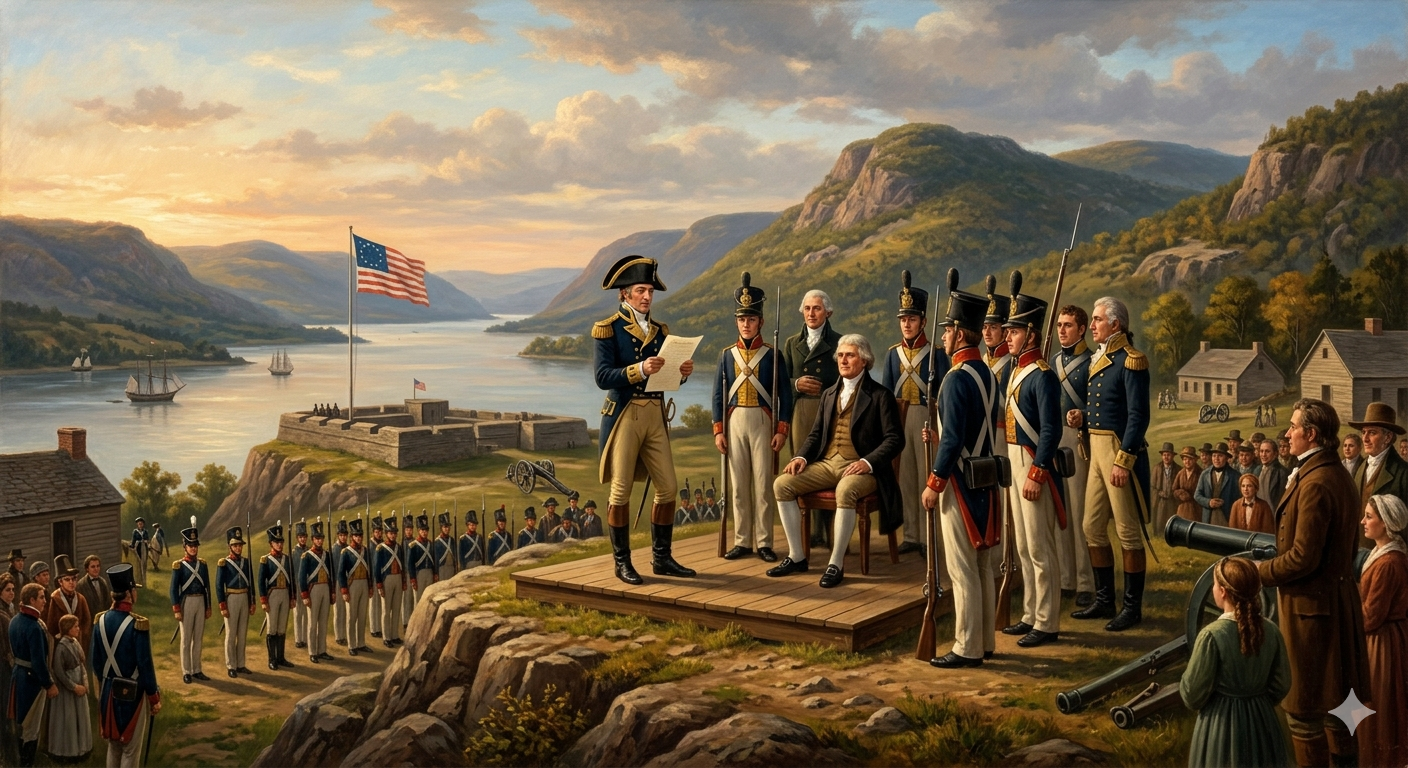
On the morning of July 4, 1802, at a plateau of rock and forest above the great bend in the Hudson River fifty miles north of New York City, the United States Military Academy formally opened its doors for instruction. The date was not chosen casually. July 4 was already the most sacred day in the American calendar, the anniversary of the Declaration of Independence, and the founders of the new academy understood that in opening on Independence Day they were making a statement about what the institution was meant to be and to do: a school of men and science dedicated to the defense of the republic that had been born twenty-six years earlier and that remained, in 1802, a young and fragile experiment in self-governance surrounded by powerful European empires that had not abandoned their ambitions in the Western Hemisphere.
The opening of the United States Military Academy at West Point was the culmination of nearly three decades of argument, advocacy, and legislative struggle over whether the new American republic needed and could afford a permanent professional military establishment trained in the science of warfare. It was an idea that George Washington had championed from the earliest days of the Revolutionary War and had never stopped urging upon Congress. It was an idea that Alexander Hamilton had pushed repeatedly, that Secretary of War Henry Knox had formally recommended, and that a succession of presidents and military officers had supported against the resistance of those who believed that a standing professional officer corps was incompatible with democratic values and dangerous to republican government. The man who finally signed the legislation and made it law — Thomas Jefferson — had ironically been among the institution’s most skeptical opponents before his own experience in the presidency convinced him that the republic could not defend itself without a school for soldiers.
West Point’s Strategic Importance During the American Revolution: The Fortress That Held the Nation Together
The story of West Point as a military institution begins long before the founding of the academy. The plateau on the west bank of the Hudson River that the Continental Army first occupied on January 27, 1778, was one of the most strategically vital pieces of ground in North America. The Hudson River was the primary transportation and communication artery connecting the northern and southern colonies, and whoever controlled its flow controlled the ability of the British to divide the American states and deal with them piecemeal. West Point sat at a distinctive S-curve in the river’s course where the channel narrowed and bent sharply, forcing sailing ships to slow nearly to a standstill to navigate the turn — a perfect location for a fortress designed to block naval passage.
George Washington understood West Point’s importance with unusual clarity. In 1779, he relocated his headquarters to the highlands near West Point, and in 1781 he called it the most important Post in America. Under the direction of Thaddeus Kościuszko — the Polish military engineer born in 1746 who had come to America to offer his skills to the cause of independence, and who would later become a hero of the Polish struggle for freedom as well — the Continental Army constructed one of the most elaborate defensive systems in North America. Fort Clinton stood nearest the river. Fort Putnam occupied the high ground several hundred feet above, covering the approaches from the western interior. A network of smaller redoubts, gun batteries, and defensive works extended across the surrounding terrain. And spanning the river at its narrowest crossing point was the Great Chain: sixty-five tons of hand-forged iron links, approximately five hundred yards long, each link weighing approximately one hundred pounds, suspended across the Hudson by log floats to prevent British ships from sailing upriver. The chain was never tested in battle, but its presence was sufficient to deter the British from attempting the passage throughout the Revolutionary War.
Fortress West Point was never captured by the British, and this fact — remarkable given the ambitions of British commanders to divide and isolate the colonies — owes in part to one of the most dramatic episodes of treachery in American history. In the summer of 1780, Major General Benedict Arnold was appointed commander of the fortifications at West Point. Arnold had been one of the most gifted combat commanders in the Continental Army, the hero of the crucial American victory at Saratoga in 1777, which had turned the course of the war by bringing France into the conflict on the American side. But Arnold had grown embittered by what he perceived as inadequate recognition of his contributions and unjust treatment by the Continental Congress. Beginning in 1779, he entered into secret negotiations with British Major John André, offering to betray the West Point garrison in exchange for a commission in the British Army and a payment of ten thousand pounds sterling. His plot, had it succeeded, would have handed the British the most important strategic position in America and might well have determined the outcome of the war.
The plot was uncovered in September 1780 when André was captured near Tarrytown, New York, carrying incriminating papers in his boot. André was tried by a board of senior American officers, convicted as a spy, and executed by hanging on October 2, 1780. Arnold, warned by a messenger that the plot had been discovered, fled by boat to the British frigate HMS Vulture and spent the remainder of the war in British service. He spent the rest of his life in exile, dying in London in 1801, having become the most reviled name in American history — a synonym for treason as enduring as his one-time reputation for battlefield courage had been. The fort at West Point, previously named Fort Arnold in honor of his Saratoga victory, was immediately renamed Fort Clinton. West Point thus entered the national memory not only as the strategic key to the Revolution but as the stage for its most infamous act of betrayal, a history that gave the site a particular weight of meaning when it became the location of the academy charged with training America’s future officers in the values of duty and honor.
The Long Debate Over a Military Academy: Washington, Hamilton, Knox, and the Question of a Professional Officer Corps
George Washington’s conviction that the United States needed a permanent institution for the training of military officers developed during the Revolutionary War itself, forged by bitter direct experience of the consequences of relying on improvisation, foreign experts, and amateur enthusiasm in place of professional military education. Throughout the war, the Continental Army had been dependent on foreign officers for skills in military engineering, artillery, and tactical training that American officers simply did not possess. Baron Friedrich von Steuben, the Prussian drill master who arrived at Valley Forge in February 1778 and transformed the Continental Army’s discipline and tactical competence, was the most prominent of these foreign helpers. Tadeusz Kościuszko, the Polish engineer who designed West Point’s fortifications, was another. The Marquis de Lafayette, the French aristocrat whose military knowledge and access to French royal support proved invaluable, was a third.
Washington found this dependence on foreign expertise both strategically dangerous and nationally embarrassing. In 1783, at the war’s conclusion, he proposed the creation of a military academy to train American officers, arguing in his Sentiments on a Peace Establishment that the art of war is at once comprehensive and complicated; that it demands much previous study; and that the possession of it in its most improved and perfect state is always of great moment to the security of a nation. Henry Knox, Washington’s artillery commander who became the first Secretary of War under the new Constitution, shared and amplified this conviction. In 1790, Knox and Alexander Hamilton jointly recommended to Congress the creation of a military academy, favoring West Point as the site precisely because its existing fortifications made it a natural location for training artillerists and engineers.
The proposal met resistance that reflected deep ideological currents in American political thought. Many members of Congress — and many ordinary citizens — harbored a profound suspicion of permanent professional armies as instruments of tyranny. The English constitutional tradition, which shaped American political culture deeply, treated standing armies as threats to civil liberty: armies that answered to a professional officer class rather than to the people’s elected representatives were the instruments by which kings and tyrants had historically suppressed the freedoms of ordinary subjects. The American experience of British military occupation in the years before the Revolution had reinforced these fears viscerally. And the Jeffersonian wing of American politics, which believed that a citizen militia was both sufficient for national defense and more compatible with republican values than a professional army, provided principled opposition to any institution that would train and perpetuate a hereditary military caste.
Congress rejected Knox and Hamilton’s proposal. It rejected subsequent proposals. Throughout Washington’s presidency and into the administration of John Adams, the idea of a permanent military academy at West Point was debated, reduced in ambition, and repeatedly denied the formal statutory authorization that would have given it stability and resources. In 1794, Congress did authorize the establishment of a Corps of Artillerists and Engineers at West Point, and some cadets began receiving informal instruction in artillery and engineering from that year. But this fell far short of a genuine academy with a fixed curriculum, defined standards of admission, and a faculty organized to provide systematic military education. By the time Adams left office in 1801, the corps at West Point consisted of only twelve cadets and one instructor, a thin and struggling institution operating without clear purpose, mission, or future. The breakthrough required a president willing to sign legislation that he had once opposed, for reasons that his own experience in office had persuaded him he could no longer sustain.
Thomas Jefferson and the Military Peace Establishment Act of March 16, 1802
Thomas Jefferson’s transformation from skeptic to founder of the United States Military Academy is one of the more illuminating examples of how the responsibilities of executive power can modify the ideological certainties of opposition. As a private citizen and as Secretary of State under Washington, Jefferson had opposed the creation of a professional military academy, fearing the creation of an aristocratic officer class of the European kind and believing that a citizen militia was sufficient for American defense. The standing army, in Jefferson’s Enlightenment republican framework, was the instrument of tyranny rather than liberty, and an institution that trained and perpetuated a professional officer corps threatened the civic republican values he held most deeply.
As president, however, Jefferson confronted a different reality. The young American republic in 1801 faced genuine threats: the possibility of renewed conflict with either Britain or France, both of whom had interests in North America that did not coincide with American sovereignty; the ongoing challenges of frontier defense and the need to project military force across an expanding continental domain; and the embarrassing inadequacy of American military capability that had been demonstrated repeatedly in conflicts from the Battle of the Wabash in 1791 to the Quasi-War with France. Jefferson also had a practical political interest in the new academy: the officer corps of the existing army was dominated by Federalist appointments, and Jefferson saw in the creation of a new military school an opportunity to build an officer corps drawn from the Republican Party’s constituency — from the farming and working-class families of the South and West who formed his political base, rather than from the Northeastern commercial elite that had supplied the Federalist officer corps.
On March 16, 1802, Jefferson signed the Military Peace Establishment Act, a comprehensive piece of legislation that reorganized the structure of the United States Army following the reduction of the Quasi-War establishment. Section 27 of the act directed that a corps of engineers be established and stationed at West Point in the state of New York, and shall constitute a Military Academy. The phrasing was characteristically modest: not a great national university of military science, but a corps of engineers that would also function as an academy. The legislation authorized the appointment of a superintendent, professors, and cadets, and specified that the academy would be organized under the direction of the Secretary of War. Jefferson signed the act, as he signed the Declaration of Independence, on a date of symbolic significance: March 16, 1802, the year Jefferson intended to begin something both practically necessary and ideologically important for the republic he had spent his life helping to build.
Jefferson selected Jonathan Williams as the first superintendent of the United States Military Academy. Williams was a grandnephew of Benjamin Franklin and had served as a military officer and scientific administrator. He was not a professional soldier in the European sense but a gentleman-scientist of the Enlightenment type that Jefferson admired and trusted: a man who believed that the mastery of military science was fundamentally a matter of applied mathematics, engineering, and systematic rational inquiry. Williams’s statement of mission for the new academy captured the character Jefferson intended for it: Our leading star is not a little mathematical school, but a great national establishment. We must always bear it in mind that our officers are to be men of science, and such as will by their acquirements be entitled to the notice of learned societies. It was an ambitious vision, and one that would take decades to fully realize.
July 4, 1802: The Academy Opens and the First Cadets Begin Their Studies
The United States Military Academy officially commenced operations on July 4, 1802, in facilities that bore no resemblance to the imposing Gothic stone buildings that today dominate the West Point landscape. The physical academy of 1802 was small, poorly equipped, and barely organized: a few modest structures at the plateau above the Hudson River, largely unchanged from the utilitarian military installations of the Revolutionary era, supplemented by whatever furniture, books, and equipment the superintendent could obtain from a Congress that had authorized the institution without providing generous resources for its establishment. The early corps of cadets was similarly unpretentious: a small number of young men ranging widely in age and background, receiving instruction in mathematics, artillery, and engineering from a faculty that was itself still being assembled.
The first graduating class produced two graduates: Joseph Gardner Swift and Simeon Magruder Levy, who received their diplomas in October 1802. Swift was born February 17, 1783, in Tiverton, Rhode Island, and would become the academy’s first officially numbered graduate — Cullum Number 1, assigned by the Biographical Register system later established by Major General George W. Cullum. Swift returned to West Point years later to serve as Superintendent from 1812 to 1814, one of only a handful of men in the academy’s history to both graduate from and lead the institution. His fellow graduate Levy became one of the first Jewish officers to serve as a commissioned officer in the United States Army. These two men — the academy’s entire first graduating class — embodied both the modest scale of the institution’s beginnings and the genuine diversity of the young republic from whose population it drew.
The early years of the academy were characterized by chronic organizational difficulties that would eventually lead to serious questions about whether the institution could survive. Admission standards were essentially nonexistent in the initial years: cadets ranged in age from ten to thirty-seven, some arriving barely literate and others as mature men with significant prior education. The length of study was unspecified and wildly variable, with some cadets departing after six months and others remaining for six years without completing a defined course. The faculty was inadequate for the educational mission Williams had articulated. Discipline was poor. The political nature of appointments — Jefferson’s use of the academy as a vehicle for Republican Party patronage had been followed by subsequent administrations using it for their own purposes — meant that the cadet corps reflected the political preferences of whoever held the presidency rather than any systematic assessment of the candidates’ aptitude for military education and service.
The War of 1812 and the Crisis That Nearly Ended West Point
By the time the United States found itself at war with Britain again in 1812, the Military Academy at West Point had been operating for a decade without producing the professional officer corps that its founders had envisioned. Only eighty-nine officers had graduated from the academy in its first decade of operation, a number wholly inadequate to officer an army suddenly expanded for major war. Morale at the institution was low, the curriculum was unsettled, and the quality of both instruction and the student body was inconsistent. Congress, confronting the military disasters of the early stages of the War of 1812, was forced to recognize that something was deeply wrong with the army’s officer corps, and some members concluded that the academy was a failure that should be abolished rather than reformed.
The Act of April 29, 1812, reorganized the academy in an attempt to address its most obvious deficiencies: it increased the authorized strength of the corps of cadets to 250, expanded the teaching faculty, and established a more formal four-year curriculum in place of the indeterminate studies that had characterized the first decade. The reorganization helped stabilize the institution, but the real test of whether the academy had produced anything of value came on the battlefields of the War of 1812 itself. The results were mixed but contained enough evidence of success to save the institution from abolition. In at least one notable instance, the value of a West Point engineering education was demonstrated dramatically: every fortification designed by a West Point graduate proved impregnable to British assault, while works designed by officers without formal military engineering training repeatedly fell. It was not a comprehensive vindication, but it was evidence enough to justify the continuation of the experiment.
The most significant problem of the War of 1812 era was the quality of institutional leadership at the academy itself. Jonathan Williams served as superintendent from 1802 to 1803 and again from 1805 to 1812, his tenure marked by the genuine ambitions he had articulated but limited by the resources and organization available to realize them. His successors, most notably Alden Partridge, who served as Acting Superintendent and then Superintendent between 1813 and 1817, were less successful in maintaining even the modest standards Williams had established. Partridge, an 1806 graduate of the academy who served as a professor of mathematics and engineering, was accused of lax management, erratic standards, and favoritism toward cadets whom he liked personally. The institution under Partridge’s leadership was in serious danger of losing whatever academic and military coherence it had managed to develop, and when the Monroe administration decided in 1817 to replace him with a young officer who had spent the previous two years studying military education in France, the transformation that followed was among the most consequential in the history of American higher education.
Sylvanus Thayer: The Father of the Military Academy and the Transformation of West Point
Sylvanus Thayer was born on June 9, 1785, in Braintree, Massachusetts, into a farming family of moderate circumstances and extraordinary intellectual gifts. He attended Dartmouth College, where he graduated in 1807 as class valedictorian, and then immediately proceeded to West Point — declining to attend his own graduation ceremony at Dartmouth because his appointment to the Military Academy had already been granted and he was eager to begin. He graduated from West Point the following year, in 1808, and served in various engineering capacities through the War of 1812 before Secretary of War William Crawford and President James Monroe selected him in 1815 for a special mission: two years of intensive study at France’s École Polytechnique in Paris, then the finest technical and military engineering school in the world, to learn what France had developed in military education that America might adapt.
Thayer returned to the United States in 1817 with notebooks full of French educational methods, a thorough knowledge of the most advanced engineering curriculum in the world, and a clear vision of what the United States Military Academy needed to become. On July 17, 1817, President Monroe ordered him to West Point to assume the superintendency. The transition was not smooth: Alden Partridge, the incumbent, refused to relinquish command to a former subordinate and had to be removed by force. Partridge was court-martialed for insubordination and neglect of duty; though acquitted, he resigned his commission and eventually founded Norwich University in Vermont, which he intended as an alternative model of military education. Thayer took command in August 1817 and began one of the most transformative periods in the history of American higher education.
The reforms Thayer implemented over his sixteen-year tenure as superintendent were systematic, comprehensive, and enduring. He established for the first time definitive standards for admission, requiring candidates to demonstrate basic academic competence before enrollment. He created a standard four-year curriculum organized into four classes, replacing the haphazard variable-length studies of the early academy. He introduced a rigorous system of continuous evaluation, with cadets ranked by academic performance across all subjects and organized into recitation sections by ability. The Thayer Method, as this pedagogical approach came to be known, placed small classes of cadets before instructors daily, with each cadet required to demonstrate preparation at every class meeting — an approach that made passive listening impossible and demanded active intellectual engagement as the price of academic standing.
Mathematics was at the foundation of Thayer’s curriculum, reflecting both the French engineering tradition he had studied at the École Polytechnique and his conviction that the mastery of military science required the same rigorous analytical training as any other branch of applied mathematics. Civil and military engineering was the capstone of the program, with the top students in each graduating class commissioned into the Corps of Engineers rather than into the infantry, cavalry, or artillery that received graduates of lower academic standing. By 1831, the military engineering course had been redesignated as civil engineering and had expanded to encompass the construction of bridges, canals, roads, harbors, and public buildings — making West Point the first engineering school in the United States and the primary source of trained engineers for the vast infrastructure projects of the nineteenth century. Under Thayer’s leadership, West Point graduates designed and built a significant portion of early America’s railroads, canals, harbor improvements, coastal fortifications, and public buildings, including the Washington Monument.
Beyond the academic curriculum, Thayer transformed the culture and character of the institution. He introduced the demerit system for recording and punishing violations of academic and military standards. He established the tradition of summer encampment, in which cadets lived under field conditions to develop the practical military skills that classroom instruction alone could not provide. He created the Honor System — the foundational principle that a cadet will not lie, cheat, steal, or tolerate those who do — that would become one of the most distinctive and lasting elements of the West Point experience and that spread through American military and civic culture as academy graduates took positions of leadership across the country. He made regular physical exercise and the maintenance of military bearing and appearance mandatory elements of cadet life. And he established the motto that would define the academy’s aspirations for more than two centuries: Duty, Honor, Country.
West Point and the Civil War: Brothers Against Brothers Who Learned Together
The most severe test of what the United States Military Academy had built, and the most revealing examination of both its strengths and its contradictions, came with the American Civil War. The war produced a paradox that has fascinated historians ever since: the same institution that had forged the national officer corps through shared years of training, shared values, shared traditions, and shared bonds of personal friendship was simultaneously responsible for the extraordinary military competence of both the Union and Confederate armies. West Point graduates commanded one or both sides in every major battle of the Civil War — sixty decisive engagements in which the outcome was determined in large part by the quality of professional military leadership that the academy had produced on both sides of the Mason-Dixon Line.
The roll call of West Point graduates who led the Civil War’s great armies is one of the most remarkable in military history. On the Union side stood Ulysses S. Grant, class of 1843, who graduated twenty-first in his class and who would become the commanding general of all Union armies and subsequently the eighteenth president of the United States. William Tecumseh Sherman, class of 1840, whose March to the Sea through Georgia would establish the modern doctrine of total war. George B. McClellan, class of 1846, who organized and trained the Army of the Potomac but proved too cautious in its employment. George Gordon Meade, class of 1835, who commanded the Army of the Potomac at Gettysburg and held the decisive ground through three days of battle against his fellow graduates on the Confederate side. Philip Henry Sheridan, class of 1853, whose cavalry operations in the Shenandoah Valley and at Five Forks helped seal the Confederacy’s defeat.
On the Confederate side stood officers whose abilities equaled and in some respects exceeded their Union counterparts. Robert Edward Lee, class of 1829, who graduated second in his class without a single demerit and who later served as West Point’s superintendent from 1852 to 1857, became the Confederate army’s most brilliant commander and remains one of the most revered figures in American military history despite the cause he served. Thomas Jonathan Jackson, class of 1846, who earned the nickname Stonewall at First Manassas and became the Confederacy’s master of swift maneuver before his death from friendly fire at Chancellorsville in May 1863. James Longstreet, class of 1842, Lee’s Old War Horse and his most capable corps commander. J.E.B. Stuart, class of 1854, the Confederate cavalry chief whose personal style and operational brilliance shaped the mounted operations of the Army of Northern Virginia. The Confederate President himself, Jefferson Davis, was a West Point graduate, class of 1828.
The Civil War demonstrated something that West Point’s founders had intended but could not have fully anticipated: that a shared educational institution, even one that had trained men who would fight against each other, transmitted a professional culture and a common body of military knowledge that shaped the conflict in ways that made it, among other things, one of the most expertly managed military contests of the nineteenth century at its command level. The mutual recognition between opposing commanders who had trained at the same institution, who knew each other personally, and who shared a common professional vocabulary and tactical framework gave the Civil War a character different from conflicts in which the opposing forces had no shared institutional background. The tragedy of brother against brother was compounded by the fact that these brothers had learned together what it meant to lead men in war.
African American Cadets, Women at West Point, and the Long March Toward Inclusion
For most of its first century and a half, the United States Military Academy was an institution exclusively for white men, its demographic composition reflecting the racial and gender assumptions of the society that had created it. The admission of the academy’s first African American cadet, Henry Ossian Flipper of Thomasville, Georgia, came in 1873, seven years after the end of the Civil War and the abolition of slavery, and his experience at West Point was an ordeal of isolation and hostility that the institution made little effort to mitigate. His white classmates refused to speak to him or associate with him, a practice of social exclusion known as silencing that was applied to cadets deemed unacceptable to the corps. Flipper endured four years of this treatment and graduated in June 1877 as the first African American graduate of West Point, assigned to the Buffalo Soldiers — the all-Black cavalry regiments of the post-Civil War western frontier army. His graduation was a milestone, though the institutional culture of the academy remained hostile to Black cadets for decades afterward, and the pattern of silencing and social exclusion continued to be applied to subsequent African American students.
The integration of women into the United States Military Academy came nearly a century after Flipper’s graduation. For most of its history, the academy’s exclusion of women had been treated as so obvious and natural as to require no formal justification. The debates that led to the admission of women in 1976 were contentious and revealed deep divisions both within the military establishment and in American society about the proper role of women in national defense. Congress, as part of a broader legislative movement to open the service academies to women, included the Military Academy in the prohibition of sex discrimination in federal education programs, and President Gerald Ford signed the legislation that opened the doors. On July 7, 1976, the first class of women — 119 cadets — arrived at West Point to begin plebe year. Many of their male classmates and some of the institutional leadership were hostile to their presence, and the integration process was neither smooth nor swift. But the women of the class of 1980 — the first to graduate — proved that the demanding West Point curriculum and military experience were fully compatible with female participation, and the integration of women has continued in the decades since, with women now comprising approximately a quarter of each entering class.
West Point’s Academic Legacy: Engineering America and Building the Nation’s Infrastructure
Among the most consequential and least-celebrated contributions of the United States Military Academy to American history is its role in the physical construction of the nation’s infrastructure during the nineteenth century. Before West Point, the United States had essentially no professionally trained engineers. The great public works projects that linked the expanding nation together — canals, roads, harbor improvements, railroads, bridges — required a technical expertise in surveying, design, and construction that the country’s colleges, none of which offered engineering education until well into the nineteenth century, were not producing. West Point, under Thayer’s engineering-centered curriculum, became the primary source of this expertise, and its graduates dispersed across the continent to apply their training to projects of enormous national significance.
The Erie Canal, which opened in 1825 and connected the Great Lakes to New York Harbor, transforming the economics of the entire interior of the continent, was built under the direction of engineers many of whom had been trained at West Point or had worked closely with West Point graduates. The early American railroads depended heavily on West Point-trained engineers for their surveys, design, and construction. The fortifications of the Atlantic and Gulf coasts, built by the Corps of Engineers in the decades before the Civil War to defend American ports from naval attack, were designed by West Point graduates working in their capacity as Army engineers. The Washington Monument, begun in the 1840s and completed in 1884, was an Army engineering project. And in the twentieth century, the Panama Canal — which Colonel George W. Goethals of the class of 1880 completed in 1914 after engineering challenges that had defeated a French company and were widely described as the greatest engineering feat in world history — demonstrated the continuing relevance of the tradition of military engineering that Sylvanus Thayer had established at West Point more than a century before.
West Point’s influence on American engineering education extended beyond the direct contributions of its graduates. The model of engineering education that Thayer established — rigorous mathematics as foundation, systematic scientific instruction in applied subjects, continuous evaluation of student performance, and explicit connection between theoretical knowledge and practical application — became the template for civilian engineering schools as they were established throughout the nineteenth century. When the Massachusetts Institute of Technology was founded in 1861, when Rensselaer Polytechnic Institute was reorganized and expanded, when Cornell University and other land-grant institutions established engineering programs under the Morrill Act of 1862, they drew explicitly on the West Point model of what engineering education should look like. The academy that Jefferson founded as a corps of engineers had, within a generation, become the paradigm for engineering higher education in the United States.
The Long Gray Line: West Point’s Most Famous Graduates and Their Impact on American History
Over more than two centuries and approximately 80,000 graduates, the United States Military Academy has produced a roster of American leaders whose influence on the nation’s history extends far beyond military affairs. The class of 1843 alone — a single year’s graduating class — included Ulysses S. Grant, who would command the Union armies to victory in the Civil War and then serve two terms as president, and John Pemberton, who as a Confederate general would surrender Vicksburg to Grant on July 4, 1863, in one of the most ironic juxtapositions of command and submission in military history. The class of 1840 included William Tecumseh Sherman, whose strategic genius and ruthless execution of total war doctrine shortened the Civil War at an immense human cost but also established doctrines of modern warfare that are studied in military academies around the world to this day.
The twentieth century saw West Point graduates at the center of the great conflicts that shaped the modern world. John Joseph Pershing, class of 1886, commanded the American Expeditionary Forces in France during the First World War, introducing American military power to European continental warfare at a scale that permanently altered the global balance of power. Douglas MacArthur, class of 1903, who graduated first in his class and who served as West Point’s superintendent from 1919 to 1922, commanded Allied forces in the Pacific during the Second World War, accepted the Japanese surrender on the deck of the USS Missouri in Tokyo Bay on September 2, 1945, and then commanded United Nations forces in the Korean War before his famous dismissal by President Harry Truman in April 1951. Dwight David Eisenhower, class of 1915, served as Supreme Commander of Allied Forces in Europe, directed the D-Day invasion of Normandy on June 6, 1944, accepted Germany’s unconditional surrender, and then served two terms as the thirty-fourth president of the United States. Omar Nelson Bradley, class of 1915 — the same class as Eisenhower — commanded the First United States Army in the Normandy invasion and subsequently served as Chairman of the Joint Chiefs of Staff.
George Smith Patton, class of 1909, became one of the most celebrated and controversial combat commanders of the Second World War, whose armored operations in North Africa, Sicily, and France combined audacity with meticulous preparation in ways that embodied the West Point tradition of combining military science with personal leadership. Norman Schwarzkopf Jr., class of 1956, commanded the coalition forces that expelled Iraq from Kuwait in the Gulf War of 1991 in a campaign whose operational brevity and decisive success demonstrated that the professional military education tradition that began at West Point in 1802 had produced results that remained fully relevant in the complex conflicts of the late twentieth century. Edgar Allan Poe, though known to history as a poet and fiction writer rather than a soldier, briefly attended West Point in 1830-1831, providing the unlikely link between the military academy on the Hudson and the American literary tradition. The list of West Point graduates who have led corporations, governed states, constructed great works of engineering, and shaped American life in ways that have nothing to do with military command is itself enormous, reflecting the breadth of leadership capacity that the institution has tried to develop in its graduates across more than two centuries.
Conclusion: July 4, 1802 and the Enduring Mission of Duty, Honor, Country
When the United States Military Academy opened on July 4, 1802, it was a modest institution of uncertain future, occupying a few modest buildings on a strategic promontory above the Hudson River that was already sacred to American national memory as a fortress of the Revolution and the scene of its most infamous treason. The dozen or so young men who arrived for instruction that Independence Day could not have imagined the institution that their successors would create, or the graduates that institution would produce, or the history that those graduates would make across the following two hundred years and beyond.
The road from that July 4, 1802 opening to the academy that exists today ran through Sylvanus Thayer’s transformative reforms, through the fraternal tragedy of the Civil War, through the great engineering projects that built a continent, through two world wars and Korea and Vietnam and the Gulf and Iraq and Afghanistan, through the slow and contested opening of its doors to African Americans and women, and through more than two centuries of continuous effort to answer a question that George Washington first posed during the darkest days of the Revolutionary War: what kind of education produces the officer who can lead soldiers in war while remaining the citizen who serves the republic in peace? The answer that West Point has developed over more than two centuries — rigorous academic preparation, demanding physical training, systematic development of character and integrity through the Honor Code and the culture of military service, and the binding of all these elements together by the motto Duty, Honor, Country — represents one of the most sustained and consequential experiments in education that the United States has ever conducted.
The physical academy that occupies the 16,000-acre reservation above the Hudson River today, with its Gothic stone buildings, its parade ground called the Plain, its cannons and monuments and memorials to its graduates, its museum of more than 60,000 artifacts, and its corps of more than 4,000 cadets in gray uniforms, bears little resemblance to the small military installation where Jonathan Williams opened the doors on a July 4th morning in 1802. But the mission is the same. The academy that Jefferson founded to train engineers for a republic that needed soldiers who were also men of science has become the oldest and most distinguished military academy in the United States, the model for four subsequent service academies, and the institution that more than 80,000 graduates call the source of whatever they have become. On the day it opened — the twenty-sixth anniversary of the Declaration of Independence — the founders hoped it would be a great national establishment. It has been that, and more.