On the morning of July 4, 1826, the United States of America was celebrating the fiftieth anniversary of its independence — the Jubilee, as newspapers and citizens had taken to calling it — with a fervor that reflected both the pride of a young nation that had survived and grown beyond all expectation, and the sobering awareness that the men who had made that independence possible were nearly all gone. The heroes of 1776 were old men now, their numbers dwindling year by year, and the country was conscious as it celebrated the golden anniversary of the Declaration of Independence that it was watching the last of an extraordinary generation pass from history into memory.
By the afternoon of that same July 4, 1826, the United States had lost two of the most important men who had ever shaped its destiny. Thomas Jefferson, the author of the Declaration of Independence, the third president of the United States, the architect of Monticello and the University of Virginia, died at his home on the mountain in Virginia shortly after twelve-thirty in the afternoon, at the age of eighty-three. John Adams, the fiery Massachusetts lawyer who had seconded Richard Henry Lee’s motion for independence, served as the nation’s second president, and spent sixty years in public service and private reflection on what it meant to be an American, died at his home in Quincy, Massachusetts, at approximately six in the evening, at the age of ninety. Jefferson had been dead for five hours when Adams drew his last breath. Adams’s last words, spoken near midday before he lost consciousness, were, in most accounts, some version of: Thomas Jefferson still survives. He was wrong. The friend of his youth, the rival of his middle years, and the correspondent of his old age had already departed the world on the very day both men had helped to create fifty years before.
The coincidence of their deaths — on the same day, at the same moment in the nation’s history, the fiftieth anniversary of the Declaration of Independence that both had helped to write — struck their contemporaries with an almost physical force. It seemed too perfectly arranged by Providence to be mere chance. Daniel Webster, the great orator and statesman, captured the national feeling in a eulogy that asked how the heavens could receive two such men on the same day, the very day on which their own fame was most inextricably linked with their country’s glory. The deaths of Adams and Jefferson on July 4, 1826, represent one of the most remarkable coincidences in the history of any nation — a moment when the symmetry of history seemed to confirm that something more than accident had been at work.
The Two Men Who Created the Declaration: How Adams and Jefferson First Met and What They Built Together
John Adams was born on October 30, 1735, in Braintree, Massachusetts, into a family of modest farmers and craftsmen who had been in New England since the mid-seventeenth century. He attended Harvard College, graduated in 1755, studied law, and became one of the most successful and respected attorneys in Massachusetts, known for his brilliant legal mind, his principled willingness to defend the unpopular — he famously and successfully defended the British soldiers accused in the Boston Massacre in 1770 — and his irascible, intense, often self-doubting personality that contrasted strikingly with his genuine intellectual gifts. He was short, stout, and deeply emotional; prone to periods of black depression that he called the glooms and to bursts of passionate advocacy that made him one of the most effective voices in any room he entered. His wife Abigail, whom he married in 1764, was in many respects his intellectual and moral equal, and their correspondence forms one of the great epistolary relationships in American history.
Thomas Jefferson was born on April 13, 1743, at Shadwell plantation in Goochland County, Virginia, the son of a successful planter and surveyor and a mother from the distinguished Randolph family. He was tall, red-haired, and elegant in manner; a polymath whose interests encompassed law, architecture, natural science, music, philosophy, and agriculture; a man whose public commitments to liberty and equality existed in painful and apparently unresolvable tension with his private life as the owner of more than six hundred enslaved people over the course of his lifetime. He had attended the College of William and Mary, studied law under the brilliant jurist George Wythe, and built at Monticello one of the most extraordinary private houses in America, designed by himself and rebuilt repeatedly over decades as his architectural ideas evolved. Where Adams was a self-made man who had clawed his way to prominence from modest origins, Jefferson inherited wealth, land, and social standing, and built his public reputation on top of a foundation of private privilege.
The two men first met at the Continental Congress in Philadelphia in 1775, brought together by the shared conviction that the British Parliament had no constitutional right to tax and legislate for the American colonies. Despite their obvious differences in temperament, background, and personality, they recognized in each other kindred spirits: men of exceptional intelligence and genuine principle who were committed to the American cause beyond the point of comfortable prudence. Their early friendship was forged in the crucible of the most important political work either would ever do. When the Congress appointed a Committee of Five in June 1776 to draft a declaration of independence — the committee comprising Jefferson, Adams, Benjamin Franklin, Robert R. Livingston, and Roger Sherman — and the committee needed to choose its primary author, Adams’s advocacy for Jefferson was decisive. He told Jefferson, as he later recalled: Reason first, you are a Virginian, and a Virginian ought to appear at the head of this business. Reason second, I am obnoxious, suspected, and unpopular. You are very much otherwise. Reason third, you can write ten times better than I can. Jefferson drafted the Declaration; Adams argued for its adoption on the floor of the Congress with a passion and force that contemporaries described as incomparable; and between them, with Franklin’s editorial revisions and the Congress’s debates, they produced the document that created the United States.
Partnership in Diplomacy: Europe, Abigail Adams, and the Years of Friendship Abroad
After the Declaration of Independence was adopted and the Revolutionary War entered its long middle years, both Adams and Jefferson served the new nation’s diplomatic needs in Europe. Adams was sent to France in 1778 to join the American diplomatic mission, then to the Netherlands in 1780 where he secured a critical loan that helped finance the Revolutionary War, and then to London in 1785 as the first American minister to the Court of St. James’s — the awkward and ironic assignment of presenting his credentials to the court of the king against whom his country had just fought a successful war of independence. In 1784, Jefferson arrived in Paris to join Adams on a diplomatic mission, and the two men’s friendship deepened into something that was more than collegial and less than familial but carried elements of both.
The Paris years cemented a friendship that was shared by Abigail Adams as fully as by her husband. Abigail wrote of Jefferson that he was the only person with whom her companion could associate with perfect freedom and reserve — a remarkable testimony given John Adams’s famously difficult personality and his limited patience for superficiality of any kind. Jefferson wrote Abigail that he considered her as my neighbor even when she was in London with her husband. When Jefferson’s wife Martha died in 1782, leaving him a widower with young children, he frequently sought the company of the Adams household, and Abigail’s warm and practical intelligence became a source of genuine comfort. In 1786, Jefferson traveled to England on diplomatic business and the two men spent several weeks together touring English gardens and visiting places of cultural significance, including William Shakespeare’s birthplace at Stratford-upon-Avon, where both men chipped off a small piece of wood from Shakespeare’s chair as a souvenir — a moment of almost endearing personal vanity that belies the image of the Founding Fathers as uniformly solemn and high-minded.
The European years gave Adams and Jefferson the opportunity to observe from a distance the political developments in the young United States and to discuss, in the relative freedom of private conversation and correspondence, their emerging differences about the character and direction of the American government they were helping to build. Jefferson absorbed the Enlightenment culture of Paris, developed his admiration for the French philosophical tradition, and became increasingly sympathetic to the French Revolutionary spirit. Adams, in London, observed the instability and violence that accompanied the early stages of the French Revolution and developed a skepticism about the capacity of popular government to maintain order and protect individual rights that deepened into a genuine philosophical conservatism. The seeds of their later political estrangement were already present in these European conversations, though they were not yet strong enough to override the personal warmth and mutual respect that had developed between the two men and their families.
Political Estrangement: The Federalists Against the Republicans and the Bitterest Election in American History
The return of both men to the United States in the late 1780s and their entry into the politics of the new republic under the Constitution produced a gradual but accelerating deterioration in their relationship. The fundamental political division of the 1790s — between Alexander Hamilton’s Federalists, who believed in a strong central government, an energetic executive, a national bank, and a foreign policy aligned with Britain rather than France, and Thomas Jefferson’s Democratic-Republicans, who championed states’ rights, limited federal power, agrarian democracy, and sympathy for the French Republic — exposed a genuine philosophical divide between Adams and Jefferson that their earlier friendship had managed to contain.
Adams was a Federalist, though an independent-minded and sometimes idiosyncratic one who never fully trusted Hamilton and whose stubbornness and integrity frequently put him at odds with the most partisan elements of his own party. He served as George Washington’s vice president for two terms and was elected as Washington’s successor in 1796, defeating Jefferson in a bitterly contested election in which Adams received seventy-one electoral votes to Jefferson’s sixty-eight. Under the original Constitutional electoral system, the runner-up in the presidential election became vice president, which produced the grotesque political anomaly of Jefferson serving as Adams’s vice president while simultaneously leading the opposition party that was dedicated to undermining the Adams administration’s policies. For four years, the second and third presidents of the United States sat in official proximity while working to frustrate each other’s political goals, a situation that would have strained any friendship.
The relationship reached its nadir in the presidential campaign of 1800, one of the most vicious and personal in American political history. Federalist newspapers and pamphlets attacked Jefferson as an atheist, a coward who had fled the British when he was governor of Virginia, a man who had fathered children with an enslaved woman named Sally Hemings — a charge that Jefferson never confirmed or denied and that has since been supported by extensive DNA and historical evidence — and a dangerous radical whose election would bring the chaos of the French Revolution to American shores. Republican newspapers and pamphlets attacked Adams as a monarchist who wanted to establish a hereditary dynasty, a hypocrite, and a man whose Alien and Sedition Acts of 1798 — which criminalized criticism of the government — had demonstrated his contempt for the very liberties the Revolution had won. The vitriol on both sides was extraordinary, and both men knew exactly what was being said in their names, even when they had not personally authorized the specific attacks.
Jefferson defeated Adams, receiving seventy-three electoral votes to Adams’s sixty-five. The defeat was devastating for Adams, who left Washington for Quincy before Jefferson’s inauguration on March 4, 1801 — not attending the ceremony in an act that was seen as a personal slight by Jefferson and his supporters. Adams had spent his final hours as president signing judicial appointments, the so-called midnight judges, to fill positions with Federalist loyalists before Jefferson could control them. Jefferson referred to these appointments as from among my most ardent political enemies and admitted to brooding over the matter for some time. The letters between the two men stopped completely. For eleven years, two of the most important figures in the history of the United States did not exchange a single written word.
Dr. Benjamin Rush and the Letter of January 1, 1812: Rekindling the Greatest Friendship in American History
The person most responsible for the reconciliation of Adams and Jefferson was Dr. Benjamin Rush, the Philadelphia physician and fellow signer of the Declaration of Independence who had maintained his friendship with both men through the years of their estrangement and who grieved at the loss of what he regarded as one of the great intellectual partnerships of the age. Rush was deeply concerned that the two men would die without having resolved their estrangement, and he undertook what can only be described as a sustained and ingenious diplomatic campaign to bring them back into correspondence. He wrote separately to each man, suggesting that the other had expressed a desire to renew the friendship, creating a gentle mutual pressure that left both with a graceful path toward reconciliation.
On New Year’s Day, 1812, John Adams sat down at his desk in Quincy and wrote a brief, carefully calibrated note to Thomas Jefferson. The note was ostensibly about some books and a gift of homespun cloth, but its real meaning was unmistakable: the eleven years of silence were over. Jefferson responded with warmth and what can only be described as relief, writing that he had compared notes with Adams on the score of progeny and found that he was ahead in the count of grandchildren — a lightness of tone that would have been impossible in the tense years of their political rivalry but that now signaled that the two old men were willing to approach each other not as partisan adversaries but as human beings who had lived through extraordinary times together and who valued that shared history more than the political battles that had divided them.
What followed was one of the most remarkable intellectual correspondences in American history. From January 1812 until July 4, 1826, Adams and Jefferson exchanged 158 letters — 109 from Adams and 49 from Jefferson, a disparity that reflected both Adams’s greater verbal energy and Jefferson’s declining health and eyesight in his final years. The letters ranged across the full compass of their shared experience and intellectual interests: reminiscences about the Revolution and the people who had made it; philosophical discussions about religion, immortality, and the nature of the soul; reflections on the proper organization of government and the dangers of both tyranny and democracy; opinions on the political events of the day; exchanges about aging, illness, and the approach of death; and, woven throughout, a growing tenderness between two old men who had quarreled, been reconciled, and found in each other the only other living person who fully understood what they had been through together.
Adams wrote to Jefferson on July 15, 1813: You and I ought not to die before we have explained ourselves to each other. It was a statement that cut to the heart of what the correspondence was about: not merely intellectual exchange or historical record-keeping, but a genuine attempt by two very old men to understand each other’s lives and choices and to achieve, before the end, the clarity and honesty that their political rivalry had prevented during the years of active contention. Jefferson’s letters in return showed a warmth toward Adams that he rarely displayed in correspondence with anyone else. Benjamin Rush, writing after the reconciliation began, described Adams and Jefferson as the North and South Poles of the American Revolution, adding that while some talked, some wrote, and some fought to promote and establish it, you and Mr. Jefferson thought for us all. It was, in Rush’s judgment, the most important intellectual partnership in American history, and its resumption after eleven years of silence was one of the great gifts the surviving generation of founders gave to posterity.
The Last Days at Monticello: Jefferson’s Final Hours on July 4, 1826
By the spring of 1826, Thomas Jefferson was gravely ill. He had been suffering for years from a combination of conditions including rheumatism, problems with his urinary tract, and the general decline of a body that had been subjected to decades of physical and intellectual work. His finances were in ruins: despite the enormous wealth he had inherited and generated, Jefferson’s lifelong inability to live within his means — the constant building and rebuilding at Monticello, the extraordinary wine cellar, the books, the scientific instruments, the hospitality to the stream of visitors who descended on his mountain — had left him deeply in debt, a situation he struggled to conceal but which he knew would devastate his estate after his death. His beloved granddaughter Ellen Randolph Coolidge, who was living in Boston, had received his last substantial bequest of furniture as a wedding gift. His remaining family at Monticello consisted of his daughter Martha Jefferson Randolph and her children, who cared for him with great devotion as he declined.
An invitation arrived at Monticello for Jefferson to attend the great Jubilee celebration of Independence Day in Washington. Jefferson declined, as he had been declining public engagements for years. His letter of declining, written in June 1826, was among his last public communications, and it contained a passage of characteristic eloquence and hopefulness about the future of the republic he had helped to found: he expressed his hope that the Declaration of Independence would be the signal to arouse men to burst the chains under which monkish ignorance and superstition had persuaded them to bind themselves and to assume the blessings and security of self-government. It was Jefferson at his most Jeffersonian: expansive, philosophical, optimistic, and eloquent even as death approached. He was, by some accounts, determined to survive until July 4 — the fiftieth anniversary of the Declaration. He had expressed more than once, according to those who knew him, a desire to live until that date if he could.
By July 2, Jefferson was barely conscious, rousing occasionally to ask whether it was yet the Fourth. He refused his usual dosage of laudanum on the night of July 3, a decision that his physician and biographers have interpreted in various ways: some as evidence of a desire to remain mentally present for the anniversary he so desperately wanted to witness; others as a decision that simply reflected his declining capacity to consume medication. On the morning of July 4, his family and physician gathered around him at Monticello. He appears to have regained consciousness briefly, aware that it was the Fourth. He died at approximately 12:50 in the afternoon, or by some accounts shortly after noon, on the fiftieth anniversary of the Declaration of Independence, at his beloved mountain home in Virginia, surrounded by his family. He was eighty-three years old. He had outlived his wife Martha by forty-four years, his friend Benjamin Franklin by thirty-six years, and his friend and correspondent John Adams by approximately five hours.
The Last Day in Quincy: John Adams at Peacefield on July 4, 1826
John Adams spent the final months of his life at his home in Quincy, Massachusetts, the farm he called Peacefield that had been the center of his domestic life since his return from Europe in 1788. Unlike Jefferson, whose final years were shadowed by financial catastrophe and the looming dissolution of his estate, Adams was in relatively comfortable circumstances: his son John Quincy Adams had in 1824 been elected the sixth president of the United States, making Adams the first president to see a child succeed him in that office, a source of enormous pride to the old man in his final years. He had been fortunate enough to watch the republic he had helped create survive a generation and produce leaders who carried the founding tradition forward. His physical decline was real but less catastrophic than Jefferson’s, and he retained his characteristic sharpness and humor until near the end.
Adams also declined the invitation to the Jubilee celebrations in Boston on July 4, citing his health. His family gathered around him at Peacefield as the country celebrated. He had been ill for some weeks, and those around him had been uncertain whether he would survive to see Independence Day. In the early hours of July 4, he lost consciousness. He recovered somewhat near midday — some accounts say he roused himself at the sound of a cannon being fired in celebration nearby — and it was at approximately this point that he spoke the words that would become among the most quoted in the history of American political culture: Thomas Jefferson still survives, or Jefferson still lives, or Jefferson survives. The precise phrasing is uncertain, as different family members and witnesses recalled it somewhat differently. What is beyond question is the substance: Adams’s last conscious thought was of Jefferson. He died at approximately six in the evening. He was ninety years old. He did not know that Jefferson had been gone for five hours.
The irony of Adams’s last words has fascinated historians and writers for two centuries. In one reading, it was simply wrong: Jefferson had already died, and Adams’s last known utterance was factually inaccurate. In another and more resonant reading, it was profoundly and permanently right: Jefferson did still survive, and survives to this day, in the Declaration of Independence and in the ideals and institutions that both men had spent their lives building. The words Thomas Jefferson still survives are as true in the twenty-first century as they were when Adams spoke them, and in that sense Adams’s last utterance, whatever its literal inaccuracy, captured something essential about the relationship between the two men and the legacy they shared. Jefferson survived in the republic; Adams survived in the republic; and the republic survived in ways that neither man could have confidently predicted when they signed the Declaration fifty years before.
The Nation’s Reaction: Jubilee Turns to Mourning and the Question of Providence
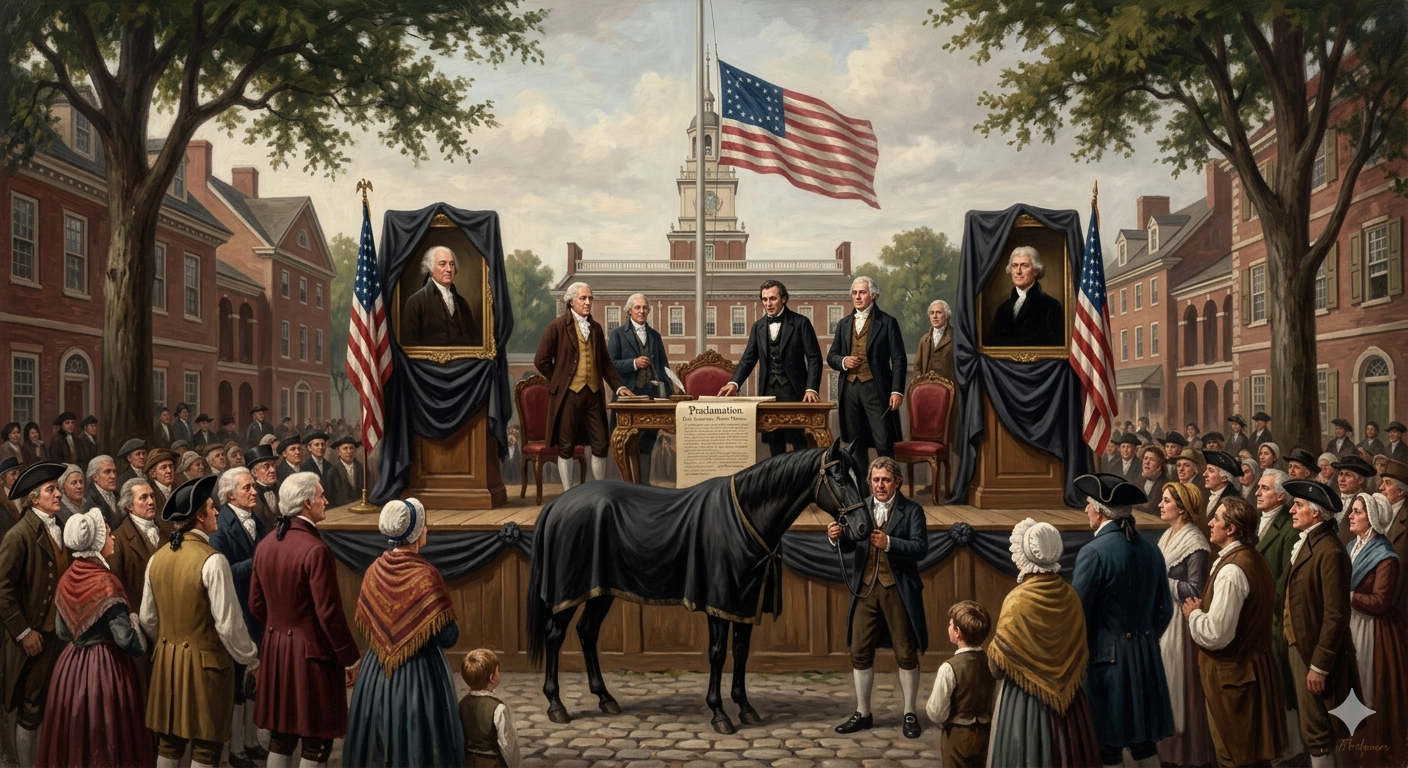
The news of Jefferson’s death reached the surrounding counties of Virginia quickly, carried by riders and word of mouth. The news of Adams’s death reached Boston by the end of July 4, and the Columbian Centinel, the Boston newspaper aligned with the Federalist tradition that had been Adams’s political home, printed the announcement in its July 8 edition with mourning bars — the heavy black lines that newspapers traditionally used to announce the death of a distinguished person. When the news from Virginia arrived days later with the confirmation that Jefferson had also died on July 4, the reaction across the country was one of stupefied astonishment combined with something approaching spiritual awe. Two deaths on the same day would have been remarkable; two deaths on July 4 would have been extraordinary; two deaths on July 4 on the fiftieth anniversary of the Declaration of Independence, by the two surviving members of the Committee of Five who had drafted that document, was something that defied ordinary explanation.
The eulogies that poured forth in the weeks and months following July 4, 1826, repeatedly returned to the question of what the coincidence meant. Daniel Webster, the most celebrated orator in America, delivered a eulogy in Boston that addressed the question directly and with characteristic eloquence: The concurrence of their death on the anniversary of Independence has naturally awakened stronger emotions. It cannot but seem striking and extraordinary, that these two should live to see the fiftieth year from the date of that act, that they should complete that year, and that then, on the day which had fast linked forever their own fame with their country’s glory, the heavens should open to receive them both at once. Webster asked whether those who believed that human lives and human history were subject to divine Providence could resist seeing the hands of that Providence in a coincidence so perfect and so suited to the significance of the two lives it concluded.
John Tyler, who would later become the tenth president of the United States, delivered another notable eulogy in which he described Jefferson’s often-expressed desire to die on the Fourth of July as adding credence to the theory that their deaths might not have been entirely coincidental, or at least that one of the two men had willed himself to survive until the symbolic date. This interpretation — that Adams and Jefferson had both in some sense chosen to live until the fiftieth anniversary, or had been kept alive past the point of natural survival by a will determined to reach that date — has become one of the recurring themes in the historical literature about their deaths. Modern scholars have noted that the phenomenon of holding on for a significant date or event is well documented in medical literature, and that the hypothesis that both old and very ill men might have been sustained past the ordinary limits of their condition by a shared determination to witness the Jubilee is not as mystical as it might initially appear.
The theory received additional fuel from Adams’s granddaughter’s account of the final days at Quincy, in which she reported that the family physician had given Adams an experimental medication in his final days with the warning that it would either prolong his life by as much as two weeks or bring it to a close within twenty-four hours. The account suggests that something active and intentional was happening in the management of Adams’s final days, even if the intentions were benevolent. Jefferson’s refusal of his usual laudanum on the night before he died suggested a similar desire to remain present and conscious for the great day. The possibility that attending physicians and family members on both sides, knowing how significant the coincidence of dying on the Jubilee would be, had taken actions to either extend or accelerate the arrival of death has been explored in historical literature and remains an intriguing dimension of the story.
The Letters That Survived: The Adams-Jefferson Correspondence as a Window Into the Founding Generation
Among the most enduring legacies of the friendship and rivalry of Adams and Jefferson is the body of written correspondence that they exchanged over the course of their relationship: more than 380 letters in total across the full arc of their friendship, estrangement, and reconciliation, constituting one of the great epistolary records in American history. The letters written before their estrangement are interesting for what they reveal about the Revolutionary generation at the height of its creative energy — men who were simultaneously making history and trying to understand what they were making, writing to each other from Philadelphia and Paris and London about the momentous events in which they were participants. But it is the 158 letters exchanged between 1812 and 1826, in the fourteen years of their restored friendship, that are most remarkable as documents of the human experience.
These late letters — written by two very old men who knew they were approaching death and who had earned the right to honesty that only extreme age can fully confer — range across an astonishing breadth of subjects with a candor and intellectual range that makes them among the most readable and revealing documents of the period. Adams, who was by nature more voluble and less self-conscious, initiated most of the exchanges and wrote more than twice as many letters. He was funny, opinionated, sometimes cantankerous, and always honest about his uncertainties and his vanities. Jefferson’s responses were typically more carefully composed, more graceful in expression, and occasionally — particularly when Adams raised questions about religion and metaphysics that Jefferson preferred not to engage directly — more evasive. Both men used the correspondence as an opportunity to interpret and justify to posterity their roles in the founding of the country, knowing that the letters would eventually be read by people they would never meet.
The most famous of their late exchanges concerned religion, immortality, and what might await them after death. Adams, who had been raised as a Congregationalist but who had evolved toward a Unitarian skepticism about orthodox Christianity, wrote to Jefferson with characteristic directness about the prospect of death: You and I ought not to die before we have explained ourselves to each other. Jefferson, who was even more heterodox in his religious views — he had literally cut and pasted together his own version of the New Testament, removing all the supernatural elements and retaining only the moral teachings of Jesus — responded with his characteristic blend of optimism and philosophical caution. Jefferson wrote to Adams: I think with you that it is a good world on the whole, that it has been framed on a principle of benevolence. These exchanges between two very old men, friends across decades and rivals across years, confronting the questions of what they had done and where they were going, have a quality of intellectual honesty and human warmth that transcends the period in which they were written and remains moving to anyone who reads them today.
James Monroe’s Death on July 4, 1831: The Third Founder Who Died on Independence Day
The remarkable coincidence of Adams and Jefferson dying on the same July 4th was made even stranger by events five years later. On July 4, 1831, James Monroe, the fifth president of the United States and the last of the major Founding Fathers, died at his son-in-law’s home in New York City at the age of seventy-three. Monroe had been in declining health for some time, and newspapers had reported on his illness in the days before his death. When the news arrived that Monroe too had died on Independence Day, five years to the day after Adams and Jefferson, the reaction was one of renewed astonishment. Three of the first five presidents of the United States had died on July 4th. Three of the major figures of the Revolutionary generation had chosen — or had been chosen by whatever forces govern such things — to depart the world on the anniversary of the nation’s birth.
The third July 4th death prompted newspapers across the country to revisit the debate about what these extraordinary coincidences meant. Were they evidence of divine design, as many Americans of the period readily believed? Were they the product of deliberate human effort — men of great will determining to live until the most symbolically appropriate date they could reach? Were they statistical flukes that seemed improbable but were not actually outside the range of chance events in a universe governed by probability? Each of these explanations found adherents then, as each finds them now. What they share is the recognition that the concentration of deaths on July 4th among the founding generation — men whose entire identity was defined by their role in the events of that date — is at minimum a striking pattern that resists ordinary dismissal as mere coincidence and that continues to generate productive historical and philosophical reflection.
The Contrasting Lives That Ended Together: What the Deaths of Adams and Jefferson Tell Us About the Founding Generation
The joint death of Adams and Jefferson on July 4, 1826, is made more resonant by the contrasts between the two men that it simultaneously ended and transcended. They had been in almost every way each other’s opposite: in temperament, in background, in philosophy, in political affiliation, in their legacies. Adams was a New Englander; Jefferson a Virginian. Adams was self-made; Jefferson was born to privilege. Adams was passionate, direct, and sometimes painfully honest; Jefferson was graceful, indirect, and capable of a certain strategic evasiveness about matters he preferred not to confront directly. Adams was a Federalist who believed in energetic government; Jefferson was a Republican who believed in limited government and individual liberty. Adams never owned enslaved people; Jefferson owned hundreds of them while writing the most famous statement of human equality in world history.
And yet these two men who were in so many respects each other’s opposites had created together something that neither could have created alone. The Declaration of Independence is in a genuine sense the product of both their minds: Jefferson wrote it with the philosophical depth and rhetorical magnificence that Adams had recognized and deferred to; Adams argued for its adoption with the passionate intensity and floor leadership that Jefferson’s more reserved temperament could never have supplied. Their joint contribution to the founding was not accidental or merely complementary — it was constitutive. The document that declared all men to be created equal and endowed with unalienable rights was born from the collaboration of a Virginia aristocrat who owned hundreds of people and a Massachusetts lawyer who had argued for the equality of all persons before the law since the early days of his legal career.
Jefferson’s legacy — vast, beautiful, contradictory, and deeply American — includes the Declaration of Independence, the Louisiana Purchase that doubled the size of the nation, the founding of the University of Virginia, the extraordinary monument of Monticello, the Notes on the State of Virginia, and the vision of an agrarian republic of small farmers and free citizens that animated the Democratic-Republican tradition for a generation and beyond. It also includes the enslaved people whose labor built Monticello and whose freedom Jefferson never secured, the Sally Hemings relationship that he never acknowledged, and the financial recklessness that left his estate in ruins and forced the sale of much of what he had built. Adams’s legacy — more modest in its public monuments but in some ways more morally coherent — includes his magnificent service in the Continental Congress, the Treaty of Paris that formally ended the Revolutionary War, the peaceful transition of presidential power to Jefferson in 1801, his lifelong opposition to slavery at a time when few politicians were willing to make it an issue, and the letters to Abigail that remain the finest epistolary expression of a marriage in American history.
Thomas Jefferson Still Survives: The Enduring Legacy of the Jubilee Deaths
The phrase that Adams spoke as his last audible words — Thomas Jefferson still survives — has become, in the fullness of time, a statement of historical truth rather than a dying man’s factual error. Jefferson survived in the ideals of the Declaration of Independence, whose language of human equality, unalienable rights, and government by consent has been invoked by every generation of Americans seeking to extend the promise of 1776 to those it initially excluded. Jefferson survived in the university he founded at Charlottesville, which has produced generations of leaders and thinkers whose work continues to shape American intellectual and public life. Jefferson survived in the democratic tradition that bears his political lineage, whatever its distortions and corruptions across the centuries. And Adams survived too, in the constitutional framework of balanced government and the rule of law that he championed against the romantic excesses of pure democracy, in the tradition of executive independence that he maintained against political pressure from his own party, and in the letters to Abigail and to Jefferson that remain among the most humanly rich documents in American literary history.
The fifty years between the signing of the Declaration of Independence on July 4, 1776, and the deaths of its two principal authors on July 4, 1826, represent a period of world-historical transformation that neither man had fully anticipated when he put his name to the parchment in 1776. The republic they had helped to create had survived a second war with Britain, expanded its territory across a continent, established constitutional precedents for the peaceful transfer of power, and begun — haltingly, incompletely, and with immense violence yet to come — the process of confronting the contradiction between its proclaimed values of equality and liberty and the institution of slavery that it had built into its economic and social foundations. Both men knew, in their final years, that this contradiction would eventually produce a crisis they would not live to see. Jefferson wrote near the end of his life that the question of slavery was like a firebell in the night that had awakened and filled him with terror. Adams had been saying as much for decades.
Conclusion: The Most Remarkable Coincidence in American History and What It Means
On July 4, 1826, two men who had written the sentence We hold these truths to be self-evident, that all men are created equal — one who had composed it and one who had argued for it before the Continental Congress — left the world on the anniversary of the day that sentence had become the founding declaration of a new nation. The coincidence has been debated, analyzed, mythologized, and explained across the nearly two centuries since it occurred, and none of the explanations fully accounts for the mathematical improbability of two men dying on the same day, the fifty-year anniversary of the most important act of both their lives, within five hours of each other, with one man’s last words being the name of the other.
What the deaths of Adams and Jefferson on July 4, 1826, have meant to American history is perhaps more important than any explanation of how they happened. They gave the founding generation a perfect and poignant ending — a closure so symbolically appropriate that it seemed to confirm retrospectively that the revolution these men had led had been not merely historically contingent but somehow preordained, written into the nature of things as surely as the self-evident truths they had proclaimed. They bound Adams and Jefferson together in death as completely as they had been bound together in life, and they ensured that the story of their friendship, rivalry, and reconciliation would be told and retold as long as the republic they founded endures. John Adams was wrong that Thomas Jefferson still survived at six o’clock on the evening of July 4, 1826. But he was more right than he could have known. Jefferson survived. Adams survived. Both men survived in the republic, the letters, the ideals, and the continuing American argument about what it means to hold these truths to be self-evident.