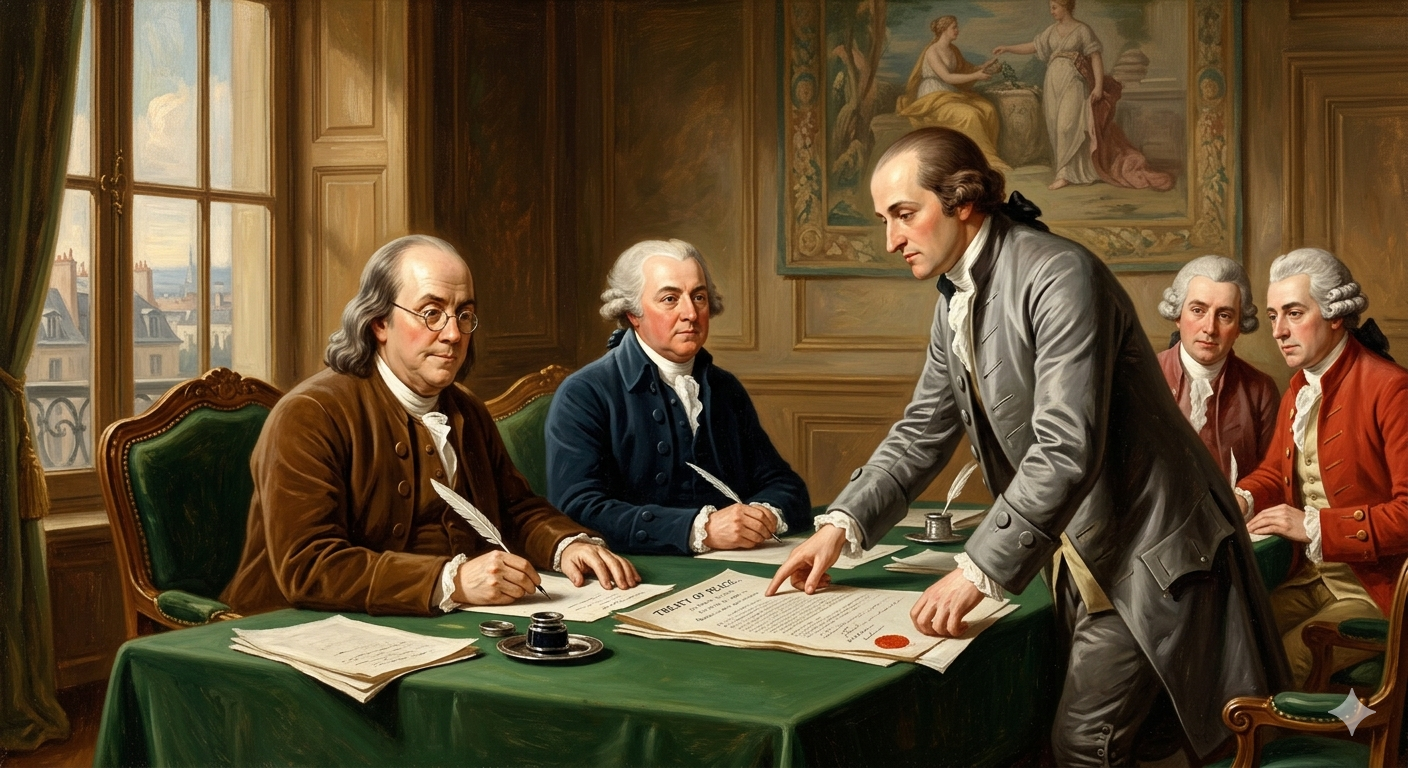
On the morning of September 3, 1783, in a room at the Hôtel d’York on what is now 56 Rue Jacob in Paris, four men sat down to sign a document that would formally end the most consequential war of the eighteenth century and announce to the watching world that a new nation had been born. Three of them — Benjamin Franklin, John Adams, and John Jay — represented the United States of America, a republic that had declared its independence from the British Crown just over seven years earlier and had spent those years fighting to make that declaration stick against the military power of the greatest empire on earth. The fourth man, David Hartley, was a Member of the British Parliament and a personal friend of Benjamin Franklin, representing King George III of Great Britain in his capacity as the sovereign who had just acknowledged that his former colonies were lost forever. When the sealing wax dried on those signatures and that document was rolled and secured, the American Revolutionary War was officially over.
The Treaty of Paris of 1783 is one of the most consequential diplomatic documents ever signed. Its first article formally recognized the United States of America as a free, sovereign, and independent nation — words that, in the language of eighteenth-century international law, meant that the most powerful monarchy in the world had acknowledged the legitimacy of a revolution against itself. Its second article granted the new republic a territorial domain that more than doubled the land area of the original thirteen colonies, stretching from the Atlantic coast west to the Mississippi River and from the Canadian border south to Florida — a vast territory whose acquisition made possible the entire subsequent history of American westward expansion. Together, the treaty’s provisions transformed thirteen coastal colonies into a continental republic with room to grow, and established the diplomatic precedents and procedures of the fledgling American state on the world stage for the first time.
The Road to Peace: Yorktown, Lord North, and Britain’s Decision to Negotiate
The path to the Treaty of Paris began on October 19, 1781, in a field outside Yorktown, Virginia, where British General Lord Charles Cornwallis surrendered approximately 7,000 British soldiers to the combined American and French forces commanded by General George Washington and French General Comte de Rochambeau. The Battle of Yorktown was not technically the last engagement of the American Revolutionary War — fighting continued in the southern states and elsewhere for months afterward — but it was the last major offensive operation of the conflict, and when news of Cornwallis’s surrender reached London, it effectively broke Britain’s political will to continue the war. Prime Minister Lord Frederick North, the 2nd Earl of Guilford, who had managed the British war effort throughout the conflict, reportedly received the news as he would have taken a ball in the breast, exclaiming ‘Oh, God! It is all over!’
North’s government fell in March 1782, swept away by a parliamentary vote against continuing offensive military operations in America. The new government, headed by the Marquess of Rockingham, came to power on a platform of acknowledging American independence and pursuing peace. When Rockingham died unexpectedly in July 1782, he was succeeded by the Earl of Shelburne — William Petty, 2nd Earl of Shelburne — who became Prime Minister and took personal supervision of the peace negotiations. Shelburne was a figure of considerable political intelligence whose approach to the American question was shaped by an economic vision rather than a wounded imperial pride. He understood that the thirteen former colonies represented one of the most valuable potential trading partners on earth, that an America treated generously in the peace settlement would become a major buyer of British manufactured goods, and that the economic benefits of a friendly United States could compensate for the political loss of the colonial relationship. This calculation would drive Britain’s remarkable generosity in the territorial terms of the eventual treaty.
The British sent Richard Oswald to Paris to begin negotiations — a sixty-seven-year-old Scottish merchant who had made his fortune partly through the slave trade, who had extensive connections in North America, and who had the personal qualities of patience and flexibility that difficult negotiations required. Oswald was eventually replaced for the formal signing by David Hartley, but his role in the preliminary discussions was substantial. On the American side, the Continental Congress had appointed a five-man negotiating team: Benjamin Franklin, John Adams, John Jay, Thomas Jefferson, and Henry Laurens. Jefferson, however, was unable to leave the United States for the negotiations, and Laurens had been captured at sea by a British warship while traveling to the Netherlands and had been imprisoned in the Tower of London — he was only released after the preliminary peace terms were agreed and would join the American delegation in Paris too late to participate meaningfully in the core negotiations. The practical work of securing American interests at the peace table thus fell to three men: Franklin, Adams, and Jay.
Benjamin Franklin: America’s Master Diplomat in the City of Peace
Benjamin Franklin was the towering figure of the American delegation and arguably the most important single individual in the entire Treaty of Paris negotiation. He was seventy-six years old when the serious peace talks began in 1782 — elderly by the standards of any era, ancient by the standards of the eighteenth century — and afflicted by gout and kidney stones that caused him considerable physical suffering throughout the negotiations. Yet his mental faculties were undiminished, his reputation in European diplomatic circles was unequaled among the Americans, and his judgment about both the practical possibilities of the negotiation and the long-term interests of the United States was consistently sound.
Franklin had been serving as the American minister to France since 1778, the year in which his brilliant diplomatic work had secured the Franco-American alliance that brought France openly into the war on the American side. His relationship with French Foreign Minister Charles Gravier, Comte de Vergennes, was central to the American position in Paris: France was the Americans’ most important ally, the power whose military and financial support had made American independence militarily achievable, and Vergennes had good reasons to expect that the American delegation would work with rather than around French interests at the peace table. The instructions that the Continental Congress had sent to the American negotiators explicitly required them to follow French advice and to avoid taking any steps in the peace negotiations without French knowledge and concurrence.
Franklin understood these instructions — and he also understood, with the political realism that was one of his defining qualities, that following them slavishly would produce a worse outcome for the United States than ignoring them strategically. French interests at the peace table were not identical with American interests: France wanted a settlement that would leave the United States dependent on French patronage, that would prevent the Americans from acquiring territory that might make them genuinely self-sufficient and independent of European alliances, and that would accommodate the interests of Spain, France’s ally in the war, whose own territorial ambitions in North America conflicted with American expansion westward. When the moment came to choose between the letter of their congressional instructions and the maximum achievable benefit for the United States, Franklin and his colleagues chose the latter.
John Jay, John Adams, and the Decision to Negotiate Separately With Britain
The decision that most shaped the ultimate outcome of the Treaty of Paris was made not by Franklin but by John Jay — the American minister to Spain who arrived in Paris in the summer of 1782 and quickly formed his own assessment of the diplomatic situation. Jay was forty-six years old, a New York lawyer of exceptional intelligence and strong anti-British feeling who had spent years in Madrid trying unsuccessfully to get Spain to recognize American independence and to provide effective military support for the American cause. His experience in Madrid had left him deeply suspicious of European diplomacy in general and of French and Spanish intentions toward the United States in particular. He arrived in Paris already predisposed to believe that France and Spain were using America as a pawn in their own power games rather than genuinely supporting American independence.
Jay’s suspicions were confirmed, from his perspective, by a series of developments in the summer and fall of 1782. Most damaging was the discovery that French Foreign Minister Vergennes had been conducting back-channel communications with the British in which he had hinted that France did not support all of the Americans’ demands and would be willing to consider a settlement that confined the United States to the territory east of the Appalachian Mountains — cutting off American access to the vast trans-Appalachian west that would later become the states of Ohio, Indiana, Illinois, Michigan, Wisconsin, and beyond. This intelligence reached Jay through various sources and convinced him that Vergennes was prepared to sacrifice American territorial interests to accommodate Spanish concerns about limiting the westward expansion of a potentially rival power in North America.
Jay made a decision that was technically in violation of the congressional instructions but that the subsequent outcome entirely vindicated: he approached the British directly, without French knowledge or concurrence, and told them that the American delegation was willing to negotiate a separate bilateral peace. British Prime Minister Shelburne, who had his own reasons to welcome a split between France and its American ally, agreed. The bilateral negotiations that followed produced terms far more favorable to the United States than anything that would have emerged from a multilateral settlement in which French and Spanish interests shaped the outcome. When John Adams arrived from the Netherlands in late October 1782 — he had been successfully completing a loan agreement with Dutch bankers — he quickly endorsed Jay’s approach. Franklin, who initially had reservations about the abandonment of French diplomatic support, was persuaded by the logic of the position and threw his full weight behind the bilateral strategy.
Lord Shelburne and the Generous British Terms: Buying a Trading Partner
The generosity of the territorial terms that Britain offered the United States in the Treaty of Paris has surprised historians ever since. By the standards of what Britain might have insisted on — confining the Americans to the territory that the thirteen colonies had actually controlled during the war, retaining the trans-Appalachian west that British officials and their Indian allies had militarily contested throughout the conflict, insisting on robust protections for Loyalists who had supported the Crown — the treaty was remarkably favorable to the new republic. Understanding why requires understanding the economic and political vision of Lord Shelburne, who directed the British negotiating position from London.
Shelburne’s analysis of Britain’s long-term interests led him to a conclusion that many of his contemporaries found shocking: that the economic relationship with an independent America was more valuable than the political relationship with a colonial America had been. Under the colonial system, the Americans were bound by the Navigation Acts to trade primarily with Britain, but they were also subjects with rights and claims on imperial protection and governance that cost the British government money and created the political friction that had ultimately produced the revolution. An independent America, by contrast, could be a free trading partner — a rapidly growing market for British manufactured goods, a supplier of raw materials and agricultural produce, and a connection to the vast American interior that British merchants could access through commercial rather than colonial relationships. Vergennes himself, watching the extraordinary territorial concessions that Shelburne was prepared to make, observed with a mixture of admiration and rueful acknowledgment: The English buy peace rather than make it.
The key British concession was the cession of all territory east of the Mississippi River, north of Florida, and south of Canada — an enormous tract of land that the British had acquired from France in the Treaty of Paris of 1763 and that, under the Proclamation of 1763, they had reserved for Indian use and closed to colonial settlement. By ceding this territory to the United States, Britain was in effect handing over land that it had promised to protect for its Indian allies, that it had never successfully settled or controlled, and whose transfer would be enormously profitable to American land speculators and settlers who were already pressing against the Appalachian frontier. The British Indian allies whose interests were being sacrificed in this territorial cession received no consideration or consultation in the negotiations — a fact of profound and tragic consequence for the indigenous peoples of the trans-Appalachian region.
The Preliminary Articles of November 30, 1782: The Deal That Was Struck
After months of negotiation that ranged across the summer and fall of 1782, the American and British negotiators reached agreement on the Preliminary Articles of Peace on November 30, 1782, at Paris. The document was signed by Franklin, Jay, and Adams on the American side and by Richard Oswald on the British side. The preliminary articles were not yet the final treaty — they were explicitly conditional on the conclusion of a peace agreement between Britain and France — but they established the framework of all the essential terms that would be incorporated into the final Treaty of Paris signed on September 3, 1783.
When Vergennes learned that the Americans had concluded a preliminary agreement without informing him, his anger was substantial. The American negotiators had violated their congressional instructions, bypassed their most important ally, and negotiated a settlement that left France with considerably less leverage in its own negotiations with Britain. Franklin, who had the social grace and diplomatic skill to deliver difficult messages without generating permanent enmity, was tasked with managing Vergennes’s fury. He did so by acknowledging the procedural breach while defending the substance of the outcome, pointing out that the preliminary articles had not yet been finalized and were conditional on the Anglo-French settlement. Vergennes, who was a realist at heart and who was also under urgent pressure from France’s deteriorating financial situation to conclude peace, swallowed his displeasure and negotiated his own preliminary settlement with Britain in January 1783. Franklin also managed to secure a substantial additional loan from France even while apologizing for the diplomatic slight — a combination of audacity and charm that was quintessentially Franklinian.
The Ten Articles of the Treaty: What Each Provision Meant for the New Nation
The final Treaty of Paris, signed on September 3, 1783, at the Hôtel d’York in Paris, contained ten articles that addressed every significant aspect of the resolution of the American Revolutionary War. The treaty’s preamble invoked Divine Providence in language that reflected both the sincere religiosity of the eighteenth century and the desire of both parties to frame the settlement as a return to peace and friendship rather than a dictated submission: It having pleased the Divine Providence to dispose the Hearts of the most Serene and most Potent Prince George the Third, by the Grace of God, King of Great Britain, France, and Ireland, Defender of the Faith… and of the United States of America, to forget all past Misunderstandings and Differences.
Article I was the treaty’s most fundamental provision and remains in force today: a simple, unequivocal declaration that His Britannic Majesty acknowledges the said United States to be free, sovereign and independent States. This article represented the formal, legal conclusion of the argument that the Americans had been making since July 4, 1776, in the Declaration of Independence. Britain’s acknowledgment of American sovereignty was not merely diplomatic courtesy; it was the act that transformed the United States from a collection of rebellious colonies into a recognized member of the international community of sovereign states, entitled to enter into treaties, send and receive ambassadors, and conduct the full range of international relations that only sovereign nations could undertake.
Article II defined the boundaries of the United States in the language of eighteenth-century cartography, establishing the new nation’s territory as extending from the Great Lakes and the St. Lawrence watershed in the north to the thirty-first degree of north latitude in the south, from the Atlantic Ocean in the east to the Mississippi River in the west. The northern boundary — essentially the same as the US-Canada border today — was traced through the Great Lakes chain with a geographic specificity that reflected both the importance of the boundary and the imperfect knowledge of the actual geography of the interior that both negotiating parties possessed. The southern boundary with Spanish Florida was a point of subsequent controversy, since the concurrent Anglo-Spanish treaty at Versailles did not specify a northern boundary for Florida that was consistent with the boundary the US-British treaty established.
Article III addressed fishing rights — a provision of particular importance to the New England states whose economies depended heavily on the Atlantic fisheries. The article granted American fishermen the right to fish in the Grand Banks off Newfoundland and in the Gulf of St. Lawrence, and to dry and cure fish on the shores of specified uninhabited parts of Nova Scotia, the Magdalen Islands, and Labrador. These rights were economically significant for New England’s fishing communities and were vigorously defended by John Adams, whose Massachusetts constituency was heavily invested in the Atlantic fishing trade. Articles IV and V addressed the financial and property dimensions of the settlement. Article IV guaranteed that creditors on either side should meet with no lawful impediment to the recovery of debts contracted before the war. Article V dealt with the politically sensitive question of Loyalists — Americans who had remained loyal to the Crown during the war and who had in many cases suffered the confiscation of their property by revolutionary authorities.
The Loyalist provisions were among the most contentious elements of the entire negotiation. There were approximately 100,000 Loyalists in America, and their mistreatment at the hands of revolutionary state governments had been a persistent British concern throughout the war. Britain sought robust guarantees that Loyalists would have their property restored and that they would not face prosecution or persecution for their wartime conduct. The American negotiators were sympathetic to the principle but constrained by the practical reality that the Continental Congress had no power to compel the individual state governments to restore Loyalist property or to grant amnesty — that was a matter for each state’s own legislature. Article V therefore contained the carefully hedged formula that Congress would earnestly recommend to state legislatures the recognition of Loyalists’ property rights, while Article VI prohibited future confiscations. Both provisions were largely honored in their breach: most states ignored the federal recommendation, and Loyalists recovered little of their confiscated property through the legal mechanisms the treaty contemplated.
Articles VII and VIII addressed the practical mechanics of ending the war. Article VII promised a firm and perpetual Peace and required all prisoners on both sides to be set at liberty. It specified that Britain would withdraw all its armies, garrisons, and fleets from the United States with all convenient speed and without causing any destruction or carrying away any Negroes or other property of American inhabitants — a provision that specifically prohibited the British military from taking enslaved people out of the country, which had practical implications for the tens of thousands of enslaved people who had sought freedom by responding to British offers of liberation during the war. Article VIII guaranteed that both Americans and British subjects would always be allowed to navigate the full length of the Mississippi River, from its source to the ocean. This provision reflected both the economic importance of the river as a transport artery and the mutual interest of Britain and the United States in maintaining commercial access to the continental interior.
Henry Laurens: The American Prisoner in the Tower of London
Henry Laurens occupies a unique and poignant place in the history of the Treaty of Paris negotiations. Born in Charleston, South Carolina in 1724 to a family of French Huguenot origin, Laurens had been one of the wealthiest merchants in the American colonies before the revolution, his fortune built substantially on the slave trade. He served as president of the Continental Congress from 1777 to 1778 and was appointed by Congress as one of the American peace commissioners. In August 1780, while traveling across the Atlantic to the Netherlands to negotiate a loan and alliance, his ship was intercepted by a British warship. His papers were thrown overboard to prevent their capture, but were recovered and revealed his diplomatic mission. Laurens was arrested, brought to England, and imprisoned in the Tower of London — the only American to be held in the Tower during the Revolutionary War — where he remained for fifteen months under conditions that damaged his already fragile health.
Laurens was released in December 1781 on bail, partly through the efforts of Richard Oswald — who happened to be a business acquaintance from his pre-war slave trading days — and his health never fully recovered. He arrived in Paris too late to participate in the core of the peace negotiations but joined the other American commissioners in time to sign the preliminary articles of November 30, 1782. Strikingly, however, he did not sign the final Treaty of Paris itself on September 3, 1783 — only Franklin, Adams, and Jay appear with their seals on the final document. Laurens’s contribution to the treaty’s terms was limited but notable: it was at his insistence that Article VII included the specific prohibition against British forces carrying away enslaved people when evacuating American territory — a provision reflecting the interests of southern slave owners like Laurens himself, who were concerned about the loss of their human property to the British offers of freedom that had attracted tens of thousands of enslaved people to the British lines during the war.
David Hartley: The British Signatory and His Friendship With Franklin
The British signatory of the final Treaty of Paris, David Hartley, was in several respects an unusual choice as the representative of King George III. Hartley was a Whig Member of Parliament who had opposed the war with America throughout the conflict, who had maintained a warm personal friendship with Benjamin Franklin across the ideological divide of the revolution, and who genuinely believed in the importance of a reconciliation between Britain and its former colonies on terms that would create a durable and mutually beneficial relationship. His appointment to replace Richard Oswald as the British negotiator for the final treaty was made by the new government of the Duke of Portland, which had replaced Shelburne’s administration in April 1783, and it reflected the new government’s desire to signal goodwill toward the American side through the choice of a known friend of the American cause.
The personal friendship between Hartley and Franklin gave the final months of negotiation a warmth that the earlier phases had often lacked. The two men had corresponded throughout the war, and Franklin had maintained a genuine affection for Hartley that coexisted with his unsentimental pursuit of American national interests at the negotiating table. Hartley arrived in Paris harboring hopes for a broader commercial treaty that would establish a formal free-trade relationship between Britain and the United States — hopes that were not fulfilled in 1783 but that reflected a vision of Anglo-American economic integration that would eventually, in the twentieth century, become a reality. His failure to secure the commercial treaty he wanted was not for lack of effort but for lack of time and political will on both sides: the final Treaty of Paris that Hartley signed on September 3, 1783 was the minimum that could be agreed upon quickly, and the broader commercial relationship that both he and Franklin envisioned would have to wait for another generation to achieve.
Vergennes, France, and Spain: The Wider Peace of Paris
The Treaty of Paris signed between Britain and the United States at the Hôtel d’York on September 3, 1783 was the most important but not the only treaty signed that day. On the same date, at Versailles, Britain signed separate treaties with France and Spain that, together with the Anglo-American document, constituted what historians call the Peace of Paris — the comprehensive settlement that ended not only the American Revolutionary War but the broader global conflict that had grown up around it. France had entered the war in 1778 following the American victories at Saratoga, which had demonstrated that the American cause was militarily viable, and had contributed substantially to the eventual American victory through naval operations, ground forces at Yorktown, and financial subsidies that had kept the Continental Army in the field.
Charles Gravier, Comte de Vergennes, was the French Foreign Minister who had managed French participation in the war from the beginning and who now presided over the French negotiations at Versailles. Vergennes was a realist of the first order — a man who had supported the American cause not from ideological sympathy with republican principles but from cold-eyed calculation that weakening Britain by supporting American independence served French national interests. He had hoped to manage the peace settlement in a way that would leave France as the dominant patron of a dependent American republic, but the American negotiators’ end-run around French diplomacy had produced a settlement in which the United States had secured its interests independently. Vergennes was rankled but pragmatic: he admitted privately that the terms the Americans had secured were better than anything he had hoped for, and he understood that a rapidly independent America would eventually become a significant power in its own right.
France’s own terms in the Treaty of Versailles were less spectacular than those of the Americans. France recovered several Caribbean islands, including Tobago and Saint Lucia, regained its trading post at Gorée on the West African coast, and retained certain fishing rights off Newfoundland. The war had been enormously costly for France — the financial strain of fighting a global war would contribute significantly to the fiscal crisis that, within six years, would bring France to revolution — and the territorial gains it secured in the peace settlement were modest compensation for that cost. Spain, which had entered the war in 1779 and had been Britain’s most aggressive opponent in the Gulf Coast and Caribbean theaters, recovered Florida from Britain and gained Minorca in the Mediterranean, but failed in its primary goal of retaking Gibraltar, the British fortress at the entrance to the Mediterranean that had withstood a four-year siege. The Dutch Republic, which had been drawn into the war through its commercial support for the Americans, signed a preliminary peace with Britain on September 2, 1783, and a final peace on May 20, 1784.
The Unfinished Painting: Benjamin West and the Portrait That Was Never Completed
One of the most evocative artifacts of the Treaty of Paris negotiations is not the treaty document itself but an unfinished painting. Benjamin West, the American-born artist who had established himself as one of the leading painters in London and served as Historical Painter to King George III, planned to create a grand celebratory scene depicting the signing of the peace treaty, showing the American and British delegates together in the manner that was standard for portraits of important diplomatic occasions. He completed the faces and figures of the American delegation — John Jay, John Adams, Benjamin Franklin, Henry Laurens, and Franklin’s grandson and the delegation’s secretary, William Temple Franklin — and then attempted to complete the British side of the picture.
The British representatives reportedly refused to sit for West’s portrait. Their reasons are not entirely clear from the historical record, but the likely explanation is the political sensitivity of being depicted as the men who had signed away the American colonies — a transaction that was deeply unpopular with significant segments of British political opinion and that the British signatories may not have wished to memorialize in a permanent work of art. The result is that West’s painting remains unfinished to this day, showing only the American delegates on one half of the canvas while the other half is blank, an incomplete image that has become one of the most symbolically loaded artifacts of the Revolutionary era. The painting, which is held in the collection of the Winterthur Museum in Delaware, serves as a powerful visual metaphor for the asymmetry of the peace settlement: for the Americans, it was a triumph worth commemorating; for the British, it was a defeat they preferred to forget.
The Ratification and Its Aftermath: What the Treaty Actually Achieved
The Treaty of Paris was ratified by the Continental Congress on January 14, 1784, at the Maryland State House in Annapolis — the Congress being the governing body of the United States at the time, since the Constitution and the federal government it established were still four years in the future. The ratification took place in a building that can still be visited in Annapolis today, and the occasion was marked by the ceremony that the moment deserved. With ratification, the war was legally over and the new nation’s existence was internationally confirmed. Britain ratified the treaty on April 9, 1784, and the ratifications were exchanged on May 12, 1784.
The practical implementation of the treaty’s terms was, however, considerably messier than the clean language of the document suggested. The British military’s withdrawal from American territory was slow and incomplete: eight forts in the Great Lakes region and at the northern end of Lake Champlain remained in British hands for over a decade after the treaty’s ratification, with the British justifying their continued occupation by citing American failure to honor the treaty’s provisions regarding Loyalist property and British debts. The American states were equally reluctant to honor the treaty’s terms on their side: most states ignored the congressional recommendation to restore Loyalist property, continuing to enforce legislation that disenfranchised or expelled Loyalists. Virginia openly defied the treaty provision on pre-war British debts, maintaining state laws against their repayment.
The fate of the Loyalists was one of the treaty’s most tragic human outcomes. Approximately 60,000 to 80,000 Loyalists eventually left the United States following the revolution, emigrating to Britain, the Caribbean, or — in the largest movement — to Canada, where they helped populate and establish what are now the provinces of Nova Scotia, New Brunswick, and Ontario. These were people who had bet on the wrong side in the revolutionary conflict and who paid for their loyalty to the British Crown with the loss of their communities, their property, and in many cases their livelihoods. The treaty’s soft language about Loyalist property restitution, driven by the American negotiators’ awareness that they could not compel the states to act, left these people largely without recourse.
The indigenous peoples of the trans-Appalachian region suffered the most complete exclusion from the treaty’s consideration. The Native American nations — the Iroquois Confederacy, the Shawnee, the Delaware, the Cherokee, and dozens of other peoples who had fought alongside the British and who had been promised that their territorial rights would be respected — received no mention in the Treaty of Paris and no consultation in its negotiation. Britain’s cession of the trans-Appalachian west to the United States disposed of territory over which it had made commitments to its Indian allies without any consultation with those allies. The result was the dispossession and destruction of the indigenous nations of the American interior over the following decades, as the American westward expansion enabled by the treaty proceeded with the full force of a rapidly growing republic behind it.
The Significance of the Treaty: How It Created a Continental Republic
The Treaty of Paris of 1783 had consequences that its signatories could not fully anticipate. The most immediately visible was the territorial transformation it wrought in the United States. At the moment of independence in 1776, the thirteen colonies occupied a relatively narrow coastal strip east of the Appalachian Mountains, with contested claims to some western territory but no clear sovereignty over the interior of the continent. The treaty’s boundary settlement gave the United States sovereignty over an area extending to the Mississippi River — territory that would within decades become the states of the Old Northwest (Ohio, Indiana, Illinois, Michigan, Wisconsin, and part of Minnesota) and the states of the Old Southwest (Tennessee, Kentucky, Alabama, and Mississippi). The acquisition of this vast interior was, as French Foreign Minister Vergennes recognized in his rueful comment about the English buying peace, an extraordinary gift that laid the foundation for American continental expansion.
The diplomatic precedents established by the American negotiators in Paris were no less important than the territorial gains they secured. Franklin, Adams, and Jay had demonstrated that the United States was capable of sophisticated, independent, and effective diplomacy on the world stage — that the new republic could hold its own against the most experienced diplomatists of the most powerful nations on earth, could secure its interests through a combination of strategic intelligence and tactical flexibility, and could recognize when its allies’ interests diverged from its own and act accordingly. The decision to negotiate directly with Britain over French objections was a moment of diplomatic maturity that established the principle of American diplomatic independence — the refusal to be permanently tied to any European alliance system — that would characterize American foreign policy for much of the subsequent century.
The treaty also established the United States as a legal member of the international community in a way that the Declaration of Independence alone could never have done. The Declaration of 1776 was a political claim; the Treaty of Paris was its legal recognition by the most powerful state in the world. When George III’s representative signed Article I acknowledging the United States to be free, sovereign and independent States, he was doing something that transformed the Americans’ self-proclaimed independence into an internationally recognized fact. No subsequent British government could contest the legitimacy of American independence on legal grounds, and other nations could now enter into formal diplomatic and commercial relations with the United States without risking British objection that they were dealing with a rebel colony rather than a recognized sovereign state.
The Treaty’s Legacy: From Jay’s Treaty to the War of 1812 and Beyond
The Treaty of Paris of 1783 did not resolve all the tensions between Britain and the United States — it could not have, given the depth of the grievances and the complexity of the interests at stake — and the incomplete implementation of its terms on both sides contributed to a period of Anglo-American friction that would eventually produce another war. The most persistent British violation of the treaty was the continued occupation of the Great Lakes forts, which became a persistent source of American grievance through the 1780s and into the 1790s. The forts were strategically significant not only in themselves but as symbols of British willingness to continue interfering in American territory and to maintain relationships with the Native American nations of the interior that potentially threatened American westward expansion.
The tensions produced by the treaty’s incomplete implementation, combined with new disputes arising from the French Revolutionary Wars and the British practice of impressing American sailors into the Royal Navy, eventually required a new diplomatic initiative to prevent war. John Jay — who had been one of the three American negotiators of the Treaty of Paris — returned to Britain in 1794 as the first Chief Justice of the United States to negotiate the Jay Treaty, a commercial agreement that resolved the immediate disputes over the forts and established a framework for Anglo-American trade. The Jay Treaty was deeply controversial in the United States, widely seen as too favorable to Britain and too damaging to France, and it contributed to the first stirrings of American partisan politics. But it accomplished its primary objective of deferring another Anglo-American war for nearly two decades — until the War of 1812, which in retrospect can be seen as the final military expression of the tensions that the Treaty of Paris had left unresolved.
Conclusion: September 3, 1783 and the Document That Made a Nation
The Treaty of Paris signed on September 3, 1783, at the Hôtel d’York in Paris was the legal act that completed what the Declaration of Independence had declared and the Revolutionary War had fought to establish. It transformed the United States from a self-proclaimed republic into an internationally recognized sovereign state; it gave the new nation territorial boundaries that provided room for the continental expansion that would define the next century of American history; and it established the diplomatic procedures and precedents of the nascent American republic on the world stage for the first time. The three Americans whose signatures appear on the final document — Benjamin Franklin, John Adams, and John Jay — were among the most capable diplomats their country has ever produced, and the terms they secured from Britain in the negotiations of 1782 and 1783 represented one of the most successful diplomatic achievements in American history.
The treaty’s limitations and failures were real and in some cases produced suffering for those who received no consideration in its provisions — most notably the Native American nations of the trans-Appalachian region, whose territorial rights were disposed of without consultation or compensation, and the Loyalist Americans whose expectations of property restitution were largely disappointed by the states’ refusal to honor their government’s treaty commitments. These shadows over the treaty’s achievement are part of its history as much as its celebrated diplomatic triumphs, and they remind us that the founding of the United States, like the founding of any state, involved the displacement and dispossession of those who stood in the way of the new order alongside the liberation of those it was designed to serve.
When Benjamin Franklin, the seventy-seven-year-old polymath from Boston who had lived to see the world transformed by the revolution he had helped to make, pressed his seal into the wax beside his signature at the Hôtel d’York on September 3, 1783, he was completing a journey that had begun in the smoke of Lexington and Concord eight years earlier and that ended in the diplomatic triumph of Paris. The document that bore his seal, and those of John Adams, John Jay, and David Hartley, would eventually be housed in the National Archives in Washington, D.C., where it remains today — fragile, handwritten, sealed with red wax, seven paragraphs of text that changed the world. Article I, which declares the United States to be free, sovereign and independent States, remains in force to this day — the oldest continuously operative provision of American international law, the foundation stone on which everything that the United States has subsequently done and been was built.