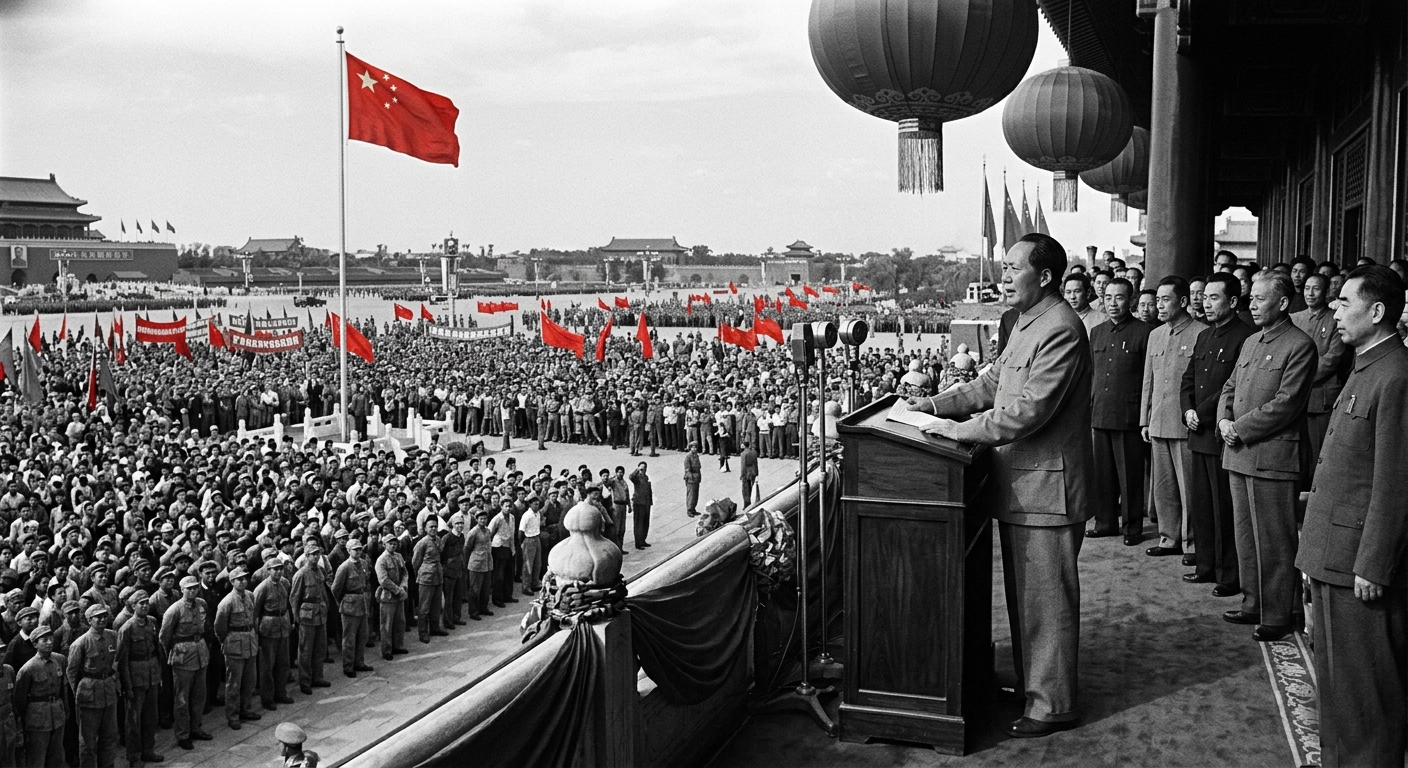
At exactly 3:00 in the afternoon on October 1, 1949, Mao Zedong stood atop the Tiananmen Gate in Beijing and addressed a vast crowd gathered in the square below. He wore a plain grey uniform. Behind him stood the senior leaders of the Chinese Communist Party. Below him stretched Tiananmen Square, packed with hundreds of thousands of cheering citizens, soldiers, students, and workers. At that moment, in a voice broadcast across China by radio, Mao made the announcement that ended more than a century of national humiliation, foreign invasion, and civil conflict: “Tongbao men, Zhonghua Renmin Gongheguo Zhongyang Renmin Zhengfu jintian chengli le!” Fellow countrymen, the Central People’s Government of the People’s Republic of China has been established today.
Earlier in his speech he had declared the words that would define the moment in Chinese historical memory: “The Chinese people have stood up!” The crowd’s response was enormous. The national flag of the new republic, a large red flag with five gold stars designed by Zeng Liansong, was raised over Tiananmen Gate. A 54-gun salute thundered across Beijing, one shot for each of the 54 ethnic groups of China. The People’s Liberation Army paraded through the square for hours. By nightfall, the People’s Republic of China existed as a political reality, and the century of chaos, foreign domination, and civil war that the Chinese called the “century of humiliation” was declared over.
The Century of Humiliation: China Before the Communist Revolution
The founding of the People’s Republic of China in 1949 cannot be understood without understanding the catastrophic century that preceded it. China had been one of the largest and most sophisticated civilizations in the world for thousands of years. The Qing Dynasty that ruled China in the nineteenth century commanded enormous territory and population. But the Qing state was increasingly unable to defend China against the modernizing industrial powers of Europe and later Japan, and the nineteenth and early twentieth centuries subjected China to a series of defeats and humiliations that eroded both the dynasty and the Chinese sense of national confidence.
The First Opium War of 1839 to 1842 forced China to open its ports to British trade on humiliating terms, including the cession of Hong Kong to Britain. The Second Opium War of 1856 to 1860 brought further concessions. The First Sino-Japanese War of 1894 to 1895 cost China Korea and Taiwan and demonstrated that even the smaller island nation of Japan had industrialized faster and more successfully than the Qing state. The Boxer Rebellion of 1900, in which Chinese nationalists attempted to expel foreigners, was crushed by an international military coalition of eight nations, and the resulting Boxer Protocol imposed massive indemnities on China and established foreign military presences in the Chinese capital.
The Qing Dynasty finally collapsed in 1911, replaced by the Republic of China under Sun Yat-sen. But the Republic proved fragile. It fragmented into warlordism, with regional military commanders exercising autonomous power. Japan’s invasion of Manchuria in 1931 and then of China proper in 1937 brought fourteen years of brutal occupation and extraordinary suffering. Estimates of Chinese deaths in the Second Sino-Japanese War range between eight and twenty million. The fall of Nanjing in December 1937 produced what became known as the Nanjing Massacre, in which Japanese forces killed hundreds of thousands of civilians in six weeks. Through all this, the Nationalist government under Chiang Kai-shek and the Chinese Communists under Mao Zedong alternated between cooperating against the Japanese and fighting each other for the future of China.
Mao Zedong: Revolutionary, Theorist, and the Making of a Communist State
Mao Zedong was born on December 26, 1893, in Shaoshan, a rural village in Hunan Province. His father was a moderately prosperous farmer who sold grain, and Mao grew up with a classical Chinese education before moving to the provincial capital Changsha for further schooling. The 1911 Revolution that overthrew the Qing Dynasty made a profound impression on the seventeen-year-old Mao. He served briefly as a soldier in the revolutionary army before returning to his studies, and in the years that followed he worked as a librarian at Peking University, where exposure to Marxist thought and the intellectual excitement of the May Fourth Movement of 1919 shaped his political vision permanently.
In 1921, Mao attended the founding congress of the Chinese Communist Party in Shanghai, becoming one of its earliest members. Over the following two decades, he would survive warlord attacks, Nationalist attempts to exterminate the Communist Party, the extraordinary privations of the Long March of 1934 to 1935, and the complex politics of leading an increasingly powerful revolutionary movement in a country under foreign occupation.
The Long March itself was one of the defining events of the Chinese Communist movement. When Nationalist forces encircled the Communist base areas in Jiangxi Province in 1934, the Red Army broke out and marched approximately 9,000 kilometers over a year through some of the most difficult terrain in China, losing the majority of the soldiers who began the march but arriving in Yan’an in northwestern China with a core of survivors whose shared experience forged an extraordinary bond of loyalty and ideological commitment. Mao emerged from the Long March as the dominant leader of the Chinese Communist Party, a position he consolidated at the Zunyi Conference of January 1935.
The Wikipedia article on Mao Zedong covers the full arc of his revolutionary career from his early years in Hunan through the civil war victory and his leadership of the People’s Republic until his death in 1976.
The Chinese Civil War: From Japanese Surrender to Communist Victory
The Japanese surrender in August 1945 ended one crisis and immediately began another. The civil war between the Chinese Nationalist Party, the Kuomintang or KMT, and the Chinese Communist Party, which had been simmering and occasionally erupting throughout the 1920s and 1930s, resumed with full force.
At American urging and under General George Marshall’s mediation, Chiang Kai-shek and Mao Zedong met in the city of Chongqing in late 1945 for a series of talks aimed at forming a coalition government. Both sides agreed on democratic principles in their public statements. Neither trusted the other in practice. By 1946, the talks had collapsed and full-scale civil war had resumed.
The Nationalist government commanded larger forces and received substantial American military and financial support. American military assistance to Chiang’s government exceeded one billion dollars in the immediate postwar years. But the Nationalist government was undermined by corruption, military incompetence at the leadership level, and economic mismanagement so severe that it produced hyperinflation that destroyed the savings of the Chinese middle class and alienated the urban population that should have been Nationalism’s natural base.
The Communist forces, by contrast, fought with organizational discipline and maintained a carefully cultivated relationship with the rural peasantry. Mao’s strategic writings, particularly his development of protracted people’s war, had emphasized that revolutionary military forces must swim among the people as fish swim in water. Communist cadres were explicitly instructed not to steal from peasants, to pay for what they took, and to treat civilians with respect. This discipline stood in sharp contrast to the behavior of many Nationalist military units and generated the popular support that gave Communist forces their decisive advantages in the countryside.
The military tide turned decisively in 1948. In the autumn of that year, a series of massive engagements known as the Three Great Campaigns annihilated the core of the Nationalist military strength. The Liaoshen Campaign secured Manchuria for the Communists. The Huaihai Campaign destroyed fifty-five Nationalist divisions in central China in a battle involving 1.5 million troops on both sides. The Pingjin Campaign gave the Communists Beijing without a full siege after negotiating with the local Nationalist commander. By January 1949, Nationalist military power had been broken. On January 21, Chiang Kai-shek resigned the presidency of the Republic of China and handed power to the Vice President Li Zongren, attempting to negotiate a peace. Mao refused terms.
Communist forces crossed the Yangtze River in April 1949, taking Nanjing, the Nationalist capital, on April 23. Chiang Kai-shek and the remnants of the Nationalist government began transferring to the island of Taiwan, taking with them China’s gold reserves, major museum collections, and approximately 1.2 million soldiers and civilians. By December 1949, the last Nationalist holdouts on the mainland had been driven out.
The US State Department Office of the Historian’s account of the Chinese Revolution of 1949 covers the international dimensions of the civil war, American policy toward the competing Chinese factions, and the diplomatic consequences of the Communist victory for United States foreign policy in Asia.
September 21 to October 1, 1949: The Political Consultative Conference and the Founding Ceremony
The formal political process that established the People’s Republic of China began ten days before the Tiananmen ceremony. On September 21, 1949, the Chinese People’s Political Consultative Conference convened in Beijing, the former Nationalist capital that was now renamed from Beiping back to Beijing, meaning Northern Capital. The CPPCC was a body that included not only the Chinese Communist Party but also several smaller allied parties and organizations, designed to present the new state as a broad coalition rather than a pure one-party communist dictatorship.
At the first plenary session on September 21, Mao Zedong delivered his founding speech to the assembled delegates. It was in this speech that he made the declaration “The Chinese people have stood up,” though some historians note the exact wording appears in his address to the conference rather than in the October 1 proclamation itself. The conference adopted the Common Program of the CPPCC as the provisional constitution of the new state, and elected the Central People’s Government Council. Mao Zedong was elected Chairman of the Central People’s Government. Zhu De, Liu Shaoqi, Song Qingling, Li Jishen, Zhang Lan, and Gao Gang were elected as Vice Chairmen.
The appointments announced at the government’s formation were a comprehensive distribution of the new state’s senior positions. Zhou Enlai became Premier of the Government Administration Council and simultaneously Minister of Foreign Affairs, combining executive and diplomatic leadership in one of the most capable figures in the Communist Party. Zhu De became Commander-in-Chief of the People’s Liberation Army. Shen Junru became President of the Supreme People’s Court. Luo Ronghuan became Procurator General of the Supreme People’s Procuratorate. Lin Boqu became Secretary General of the Central People’s Government Council.
The October 1 ceremony was organized with enormous care for its symbolic content. The choice of Tiananmen Gate was deliberate: this was the ceremonial entrance to the old Imperial City, the gate through which Chinese emperors had passed and from which imperial proclamations had been issued for centuries. By choosing Tiananmen as the site of the new republic’s founding proclamation, the Communist leadership was claiming both the physical location and the symbolic authority of China’s imperial past for the new revolutionary state.
October 1, 1949: The Ceremony, the Proclamation, and the World’s Response
The ceremony of October 1, 1949, began with the raising of the national flag. Mao Zedong himself pressed the button that raised the five-star red flag to the top of the flagpole in Tiananmen Square for the first time. The flag design by Zeng Liansong featured one large star representing the Communist Party and four smaller stars representing the four social classes that the party claimed to lead: the working class, the peasantry, the urban petty bourgeoisie, and the national bourgeoisie. The flag rising was accompanied by the playing of the March of the Volunteers, composed in 1935 during the war against Japan, which became the national anthem of the new state.
Mao then read the Proclamation of the Central People’s Government from atop Tiananmen Gate. The document was precise and formal in its language, announcing the establishment of the Central People’s Government, declaring that the government was the sole legal government representing all the people of China, and expressing willingness to establish diplomatic relations with any foreign government that would treat the new state on the basis of equality, mutual benefit, and mutual respect of territorial integrity and sovereignty.
The People’s Liberation Army parade that followed the proclamation lasted three hours. Infantry, artillery, cavalry, and the modest air force of the new People’s Republic marched and flew past the reviewing stand. Soviet-made aircraft flew overhead. The parade was both a demonstration of military power and a display of national capability at a moment when the new state needed to project both strength and order to its own people and to the watching world.
International reactions divided sharply along Cold War lines. On October 2, 1949, just one day after the proclamation, the Soviet Union under Joseph Stalin became the first nation to recognize the People’s Republic of China. Bulgaria, Romania, Hungary, North Korea, Czechoslovakia, Poland, Mongolia, East Germany, Albania, and North Vietnam quickly followed. The United States, however, refused to recognize the new government, continuing to treat Chiang Kai-shek’s Republic of China on Taiwan as the legitimate government of all China. This American refusal to recognize the PRC would persist for more than two decades, until President Richard Nixon’s historic visit to China in February 1972 and the formal extension of diplomatic recognition by the Carter administration in 1979.
The Britannica article on the People’s Republic of China’s founding and early history covers the establishment of the new government, the implementation of Communist Party policies in the early years of the republic, and the rapid transformation of Chinese society under Mao’s leadership from 1949 onward.
Building the New China: Early Policies and the First Decade
The People’s Republic inherited a country devastated by more than a decade of war, occupation, and civil conflict. China’s industrial base had been severely damaged. The economy was experiencing massive inflation. Millions of people were displaced. The population of approximately 540 million was predominantly rural, mostly illiterate, and accustomed to exploitation by landlords and local officials.
The new government moved rapidly on its central economic commitments. Land reform was the most immediate and transformative policy: the system of gentry landlord ownership of farmland and tenant peasants was abolished, and land was redistributed to poor and landless peasants. The land reform campaign, carried out between 1950 and 1953, redistributed approximately 43 million hectares of land to approximately 300 million peasants. It was also accompanied by violence: estimates suggest that between one and two million landlords were executed or died in the process, and local communities held “struggle sessions” in which landlords were publicly accused before crowds.
The Korean War, which began in June 1950, pulled the new republic almost immediately into the international arena in ways that set the Cold War pattern of US-China relations for decades. When United Nations forces under American command approached the Yalu River border with China in October 1950, China entered the war with massive force. The Chinese People’s Volunteer Army, in reality regular PLA units, fought the UN coalition to a standstill that eventually produced the armistice of 1953. The war confirmed American hostility to the PRC, reinforced China’s exclusion from the United Nations, and deepened the Sino-Soviet alliance that Mao had formalized with Stalin in the Treaty of Friendship, Alliance, and Mutual Assistance signed in February 1950.
The First Five-Year Plan of 1953 to 1957 followed the Soviet model of rapid industrialization, emphasizing heavy industry, collectivization of agriculture, and central state planning. Soviet technical advisers poured into China by the thousands. Industrial output grew substantially. Literacy campaigns reduced illiteracy dramatically from the roughly 80 percent rate at the time of the republic’s founding.
But the decade after 1949 also contained the seeds of the catastrophes that would follow. The Hundred Flowers Campaign of 1956 to 1957, which briefly encouraged open criticism of the Party, was followed by the Anti-Rightist Campaign in which some 550,000 people identified as critics of the Party were persecuted. The Great Leap Forward of 1958 to 1962 attempted to accelerate industrialization and agricultural collectivization simultaneously, producing a famine that killed between 15 and 55 million people in the greatest human-caused famine in recorded history. The Cultural Revolution of 1966 to 1976 persecuted tens of millions more.
The History.com account of Mao Zedong’s proclamation of the People’s Republic of China covers the October 1, 1949 ceremony, Mao’s proclamation, the immediate international response, and the Cold War context of America’s refusal to recognize the new government.
The Legacy of October 1, 1949: A Nation Transformed and a Century of Consequences
October 1 became National Day, celebrated annually in the People’s Republic of China as the anniversary of the founding. The ceremonies held in Tiananmen Square on major National Days have themselves become historical events, with the anniversaries of 1959, 1969, 1979, 1984, 1999, 2009, and 2019 each marking major milestones with enormous parades and public celebrations that have demonstrated both continuity of Communist Party rule and the extraordinary transformation of China’s national power and economic capacity.
The People’s Republic of China that Mao proclaimed in 1949 has undergone transformations that he himself did not anticipate and would not have approved. After Mao’s death in September 1976 and the arrest of the Gang of Four later that year, Deng Xiaoping emerged as China’s paramount leader and launched the Reform and Opening-Up policies that created the world’s second-largest economy by redirecting China toward market economics while maintaining Communist Party political control. The formula Deng arrived at for assessing Mao’s legacy, “seventy percent correct, thirty percent wrong,” preserved Mao’s founding status while acknowledging the disasters of the Great Leap Forward and the Cultural Revolution.
What Mao achieved on October 1, 1949, was by any measure extraordinary. He had taken a country in ruins after a century of humiliation, foreign invasion, and civil war, and established a unified central government exercising effective sovereignty over the vast majority of Chinese territory for the first time in decades. He had mobilized the peasantry, the majority of China’s population, as the social base for a revolutionary transformation that redistributed land and restructured the fundamental social relationships of Chinese rural life. And he had done all of this without the foreign assistance that previous Chinese revolutionary movements had depended on, a fact he emphasized when he proclaimed from Tiananmen Gate that the Chinese people had stood up.
The People’s Republic of China today is home to 1.4 billion people, is the world’s second-largest economy by nominal GDP, and is a permanent member of the United Nations Security Council with nuclear weapons and the world’s largest conventional military force. None of this was visible on the afternoon of October 1, 1949, when a man in a plain grey uniform stood atop an ancient imperial gate and announced that something new had begun.