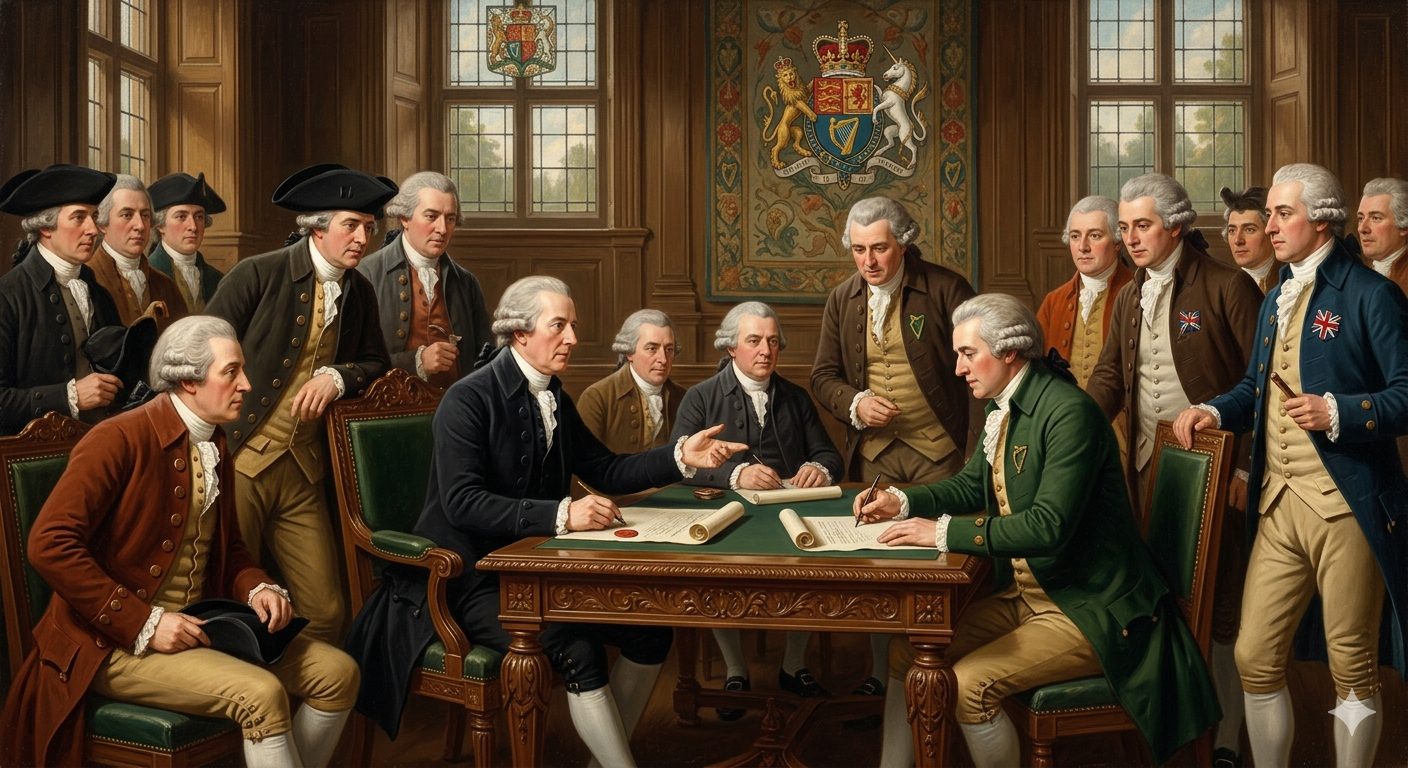
On January 1, 1801, one of the most significant constitutional transformations in British and Irish history took effect when the Act of Union 1800 officially merged the Kingdom of Great Britain and the Kingdom of Ireland into a single sovereign state known as the United Kingdom of Great Britain and Ireland. This momentous legislative achievement represented the culmination of decades of political maneuvering, strategic calculation, and constitutional negotiation that forever altered the political landscape of the British Isles and established the constitutional framework that would govern British-Irish relations for over a century. The Act, which required passage through both the Parliament of Great Britain and the Parliament of Ireland, created a unified parliamentary system, consolidated imperial resources, and established new administrative structures that would define the character of British governance well into the 19th and 20th centuries. This historic union emerged from complex political circumstances including the threat of French revolutionary influence, the aftermath of the 1798 Irish Rebellion, and strategic concerns about imperial security that convinced British political leaders that formal constitutional union was essential for maintaining stability and defending against foreign threats. The legislation’s passage marked the end of the Kingdom of Ireland as an independent political entity and the beginning of a new era of direct British rule that would shape Irish politics, society, and culture for generations while creating the constitutional foundation for the modern United Kingdom that continues to influence British governance to this day.
The Historical Context: Ireland’s Strategic Importance and Growing British Concerns
The movement toward union between Great Britain and Ireland emerged from a complex web of strategic, political, and security considerations that had been developing throughout the 18th century as Britain’s global empire expanded and international threats to British power intensified. Ireland’s geographic position as Britain’s western neighbor made it strategically crucial for British defense, particularly during periods of conflict with continental European powers who might seek to use Ireland as a base for attacking Britain or disrupting British naval operations in the Atlantic Ocean. The island’s extensive coastline, numerous harbors, and proximity to major British naval bases made it an attractive target for enemy forces seeking to establish a foothold in the British Isles.
The threat posed by revolutionary France during the 1790s crystallized British concerns about Irish loyalty and the security risks posed by an autonomous Irish parliament that might prove unreliable in times of international crisis. French revolutionary ideology had found receptive audiences among certain segments of Irish society, particularly among those who chafed under the restrictions of the Penal Laws and the political dominance of the Protestant Ascendancy. The possibility that a future Irish parliament might align with France against Britain represented an existential threat to British security that British political leaders felt could only be addressed through direct political control over Irish decision-making.
Economic considerations also played a significant role in British calculations about union, as Ireland’s separate parliament and customs system created barriers to trade integration and limited Britain’s ability to coordinate imperial economic policy across both kingdoms. The Irish Parliament had demonstrated increasing independence in commercial matters during the late 18th century, sometimes pursuing policies that British officials believed conflicted with broader imperial interests. Union would eliminate these complications by creating a single parliamentary system with unified control over trade policy, taxation, and economic regulation throughout the British Isles.
The constitutional relationship between Britain and Ireland under the existing system had become increasingly problematic as Irish parliamentary independence grew during the late 18th century, creating situations where the two kingdoms might pursue conflicting policies or fail to coordinate effectively during international crises. The 1782 Constitution of Ireland had granted the Irish Parliament legislative independence while maintaining the connection to the British Crown, but this arrangement had proven unstable in practice as it created opportunities for constitutional conflicts and policy disagreements that complicated imperial governance.
Religious tensions within Ireland also contributed to British concerns about the stability and reliability of the existing constitutional arrangement, as the Catholic majority population remained largely excluded from political participation while Protestant minorities exercised disproportionate political power through the Irish Parliament. British leaders recognized that this system was potentially unstable and might lead to internal conflicts that could weaken Ireland’s ability to contribute to imperial defense or create opportunities for foreign interference in Irish affairs.
The Irish Rebellion of 1798: The Catalyst for Constitutional Change
The Irish Rebellion of 1798 served as the immediate catalyst that transformed British concerns about Irish loyalty from theoretical possibilities into urgent practical necessities, demonstrating the very real dangers that an autonomous Irish political system posed to British security during periods of international conflict. The rebellion, which was inspired by French revolutionary ideology and supported by French military assistance, revealed the extent to which revolutionary ideas had penetrated Irish society and the potential for coordinated resistance to British authority that could destabilize the entire British defense system.
The rebellion began with coordinated uprisings across multiple counties in Ireland, with rebels seeking to establish an independent Irish republic modeled on the French revolutionary system and allied with France against Britain. The involvement of the United Irishmen, a revolutionary organization that had been developing since the early 1790s, demonstrated the existence of sophisticated networks capable of organizing resistance to British rule and potentially facilitating foreign invasion. Leaders like Theobald Wolfe Tone, who had traveled to France seeking military support for Irish independence, represented the concrete realization of British fears about Irish-French collaboration against British interests.
French military involvement in the rebellion confirmed British suspicions about foreign threats to imperial security, as French naval forces attempted to land troops and supplies to support Irish rebels despite British naval superiority. The unsuccessful French expedition to Bantry Bay in 1796 and subsequent French landing at Killala in 1798 demonstrated that France was actively seeking to exploit Irish discontent as part of its broader strategy against Britain. These events proved that Ireland could serve as a backdoor for French attacks on British power and that autonomous Irish institutions might prove unreliable or actively hostile during periods of international conflict.
The rebellion’s sectarian dimensions also highlighted the internal instabilities within Irish society that created vulnerabilities for British security, as religious and ethnic tensions between Protestant and Catholic communities created divisions that foreign enemies might exploit. The brutal suppression of the rebellion by British and loyalist forces further deepened these divisions while demonstrating the lengths to which the British government was prepared to go to maintain control over Ireland. The extensive use of military force, including the deployment of regular British army units and militia forces, revealed the substantial military resources required to maintain British authority in Ireland under the existing constitutional system.
The failure of the rebellion ultimately strengthened British resolve to pursue constitutional union as the only reliable solution to the Irish problem, as military suppression alone had proven insufficient to eliminate the threat of future rebellions or prevent foreign interference in Irish affairs. British leaders concluded that only direct parliamentary control over Ireland could ensure reliable coordination of defense policy and prevent the emergence of future challenges to British authority. The rebellion’s aftermath created a political environment in which union could be presented as a necessary security measure rather than merely an administrative convenience.
William Pitt the Younger: Architect of the Union Strategy
William Pitt the Younger, who served as Prime Minister of Great Britain from 1783 to 1801 and again from 1804 to 1806, emerged as the principal architect of the union strategy and the driving force behind the complex political campaign that eventually secured passage of the Act of Union through both the British and Irish parliaments. Pitt’s vision of union reflected both his strategic understanding of imperial security requirements and his appreciation for the constitutional and administrative challenges that had made the existing dual-parliament system increasingly problematic for effective governance of the British Isles.
Pitt’s approach to achieving union demonstrated sophisticated political strategy that combined constitutional arguments about imperial unity with practical incentives designed to overcome Irish parliamentary resistance to the proposal. He recognized that the Irish Parliament, composed primarily of Protestant landowners who had benefited from the existing system of Irish parliamentary independence, would be naturally reluctant to vote for their own abolition unless provided with compelling reasons or adequate compensation for their loss of political influence. Pitt’s strategy therefore involved both positive inducements to support union and subtle threats about the consequences of continued resistance to British authority.
The Prime Minister’s constitutional arguments for union emphasized the natural affinity between Britain and Ireland as neighboring kingdoms sharing common interests in imperial defense, commercial prosperity, and constitutional government under the British Crown. Pitt argued that formal union would eliminate the artificial barriers that had prevented the two kingdoms from coordinating effectively while preserving the essential constitutional principles that protected property rights, religious liberty, and parliamentary governance in both countries. This constitutional framework was designed to appeal to Irish Protestant elites who valued their connection to British constitutional traditions while addressing their concerns about maintaining their social and economic privileges under a unified system.
Pitt’s recognition of the need for Catholic concessions as part of the union package reflected his understanding that long-term stability in Ireland would require addressing the grievances of the Catholic majority population that had been largely excluded from political participation under the Penal Laws. The Prime Minister privately indicated his support for Catholic emancipation as a natural consequence of union, arguing that a unified parliament would be better positioned to address religious disabilities that had become politically and morally indefensible in the context of late 18th-century political developments.
The implementation of Pitt’s union strategy required careful coordination with Irish officials and supporters who could navigate the complex politics of the Irish Parliament while maintaining sufficient support among Protestant constituencies to ensure passage of the necessary legislation. Pitt worked closely with Lord Lieutenant Charles Cornwallis and Chief Secretary Lord Castlereagh to develop tactical approaches that could overcome parliamentary opposition while maintaining the appearance of constitutional propriety in the passage of such fundamental constitutional legislation.
Lord Castlereagh and the Parliamentary Campaign in Ireland
Robert Stewart, Viscount Castlereagh, who served as Chief Secretary for Ireland from 1798 to 1801, played a crucial role in implementing the union strategy within Ireland itself, conducting the detailed parliamentary campaign that ultimately secured passage of the Act of Union through the Irish Parliament despite significant initial opposition from members who were reluctant to vote for the abolition of their own institution. Castlereagh’s political skills, administrative expertise, and understanding of Irish parliamentary politics made him indispensable to the success of the union campaign and the navigation of the complex political challenges that arose during the lengthy legislative process.
Castlereagh’s approach to securing parliamentary support for union combined constitutional arguments about the benefits of imperial integration with practical incentives designed to address the specific concerns and interests of individual members of the Irish Parliament. He developed detailed knowledge of the political positions, financial circumstances, and personal motivations of Irish parliamentarians, enabling him to craft targeted appeals that could overcome initial resistance to the union proposal. This individualized approach was essential given the diversity of interests and opinions within the Irish Parliament and the absence of strong party discipline that might have simplified the persuasion process.
The Chief Secretary’s use of patronage and honors to secure parliamentary support for union became one of the most controversial aspects of the entire campaign, as critics both at the time and in subsequent historical analysis have argued that the passage of such fundamental constitutional legislation through bribery and corruption undermined the legitimacy of the union itself. Castlereagh distributed peerages, government positions, and financial compensation to members of the Irish Parliament who agreed to support union, while also creating new constituencies and modifying electoral arrangements to favor pro-union candidates in future elections.
Castlereagh’s management of the constitutional and legal aspects of the union legislation required careful attention to technical details that would ensure the smooth integration of Irish institutions into the broader British governmental system while preserving essential protections for Irish interests and maintaining constitutional continuity. He worked with legal experts to draft provisions that would address potential complications arising from the merger of different legal systems, parliamentary procedures, and administrative structures, ensuring that the transition to unified government could proceed without major disruptions to existing institutional arrangements.
The Chief Secretary’s coordination with British officials throughout the union campaign demonstrated the extent to which the success of the project depended on close cooperation between London and Dublin administrations and the alignment of policy across both kingdoms. Castlereagh maintained regular correspondence with Pitt and other British ministers to ensure that the Irish parliamentary campaign remained consistent with broader British strategic objectives while addressing specifically Irish concerns that might otherwise have derailed the union project.
The Parliamentary Battles: Opposition, Persuasion, and Political Maneuvering
The passage of the Act of Union through both the British and Irish parliaments required extensive political maneuvering and constitutional debate that extended over several years as supporters and opponents of union presented competing visions of the future relationship between Britain and Ireland. The parliamentary battles revealed deep divisions within both kingdoms about the desirability and feasibility of constitutional union while highlighting the complex interplay between principle and interest that shaped political decision-making during this crucial period in British and Irish history.
Opposition to union in the Irish Parliament was led by prominent figures like Henry Grattan, who had been instrumental in securing Irish legislative independence in 1782 and who viewed union as a betrayal of Irish constitutional rights and parliamentary sovereignty. Grattan and his allies argued that union would reduce Ireland to the status of a British province while eliminating the political representation and constitutional protections that the Irish Parliament provided for Irish interests. These opponents contended that the existing system of legislative independence under the Crown provided adequate coordination between the two kingdoms while preserving essential Irish autonomy in domestic affairs.
The constitutional arguments presented by union opponents focused on the principle of parliamentary sovereignty and the illegitimacy of any parliament voting to abolish itself without explicit popular consent or clear constitutional authority. Critics argued that the Irish Parliament lacked the constitutional power to surrender Irish legislative independence and that such fundamental constitutional changes required broader consultation with the Irish people rather than simply the agreement of parliamentary majorities that might be influenced by patronage or corruption.
Supporters of union in both parliaments presented their case in terms of imperial necessity, economic advantage, and constitutional rationalization that would eliminate the sources of conflict and inefficiency that had characterized the dual-parliament system. They argued that union would provide Ireland with better representation in imperial decision-making while ensuring that British and Irish interests could be properly coordinated during periods of international crisis. Pro-union speakers emphasized the commercial benefits that would flow from the elimination of trade barriers between the two kingdoms and the enhanced security that would result from unified military and naval coordination.
The debates over representation in the unified parliament revealed the complex negotiations required to balance British and Irish interests while maintaining the essential character of parliamentary government in both kingdoms. The final settlement provided Ireland with 100 members in the House of Commons and 28 peers in the House of Lords, representation that was proportionally smaller than Ireland’s population would have justified but which reflected British concerns about maintaining effective control over the unified parliament while providing adequate representation for Irish interests.
The Terms of Union: Constitutional, Economic, and Religious Provisions
The Act of Union 1800 established comprehensive constitutional, economic, and religious frameworks that governed the relationship between Britain and Ireland within the new United Kingdom while attempting to address the diverse interests and concerns that had emerged during the lengthy parliamentary debates over union. These provisions reflected careful negotiation between competing demands and the need to create a stable constitutional system that could accommodate both British imperial interests and Irish domestic concerns.
The constitutional provisions of the Act created a unified Parliament of the United Kingdom of Great Britain and Ireland with carefully defined representation for both former kingdoms that attempted to balance population-based representation with recognition of Ireland’s distinct political identity. Ireland received 100 seats in the House of Commons out of a total of 658, providing substantial Irish representation while ensuring that British members would retain a clear majority. The Irish peerage was integrated into the British system through the allocation of 28 Irish representative peers who would sit in the House of Lords for life, while the remaining Irish peers would lose their automatic right to parliamentary seats but could be elected to the House of Commons.
The economic clauses of the Act eliminated trade barriers between Britain and Ireland while establishing provisions for coordinated taxation and fiscal policy that reflected the different economic conditions and revenue systems that had developed in the two kingdoms. The Act provided for the gradual harmonization of taxation systems while recognizing that immediate equalization would create excessive burdens for Ireland given its lower levels of economic development. Special provisions protected certain Irish economic interests, including the Irish linen industry, while opening British markets to Irish agricultural products and eliminating the customs duties that had previously restricted trade between the kingdoms.
Religious provisions within the Act maintained the established status of both the Church of England and the Church of Ireland while preserving the existing legal disabilities that applied to Catholics and Protestant dissenters in both kingdoms. However, the Act included language that was interpreted by many as providing a foundation for future Catholic emancipation, with supporters of union arguing that the unified parliament would be better positioned to address religious inequalities than the Protestant-dominated Irish Parliament had been. These religious provisions reflected the delicate balance required to maintain Protestant support for union while creating possibilities for future reforms that might address Catholic grievances.
The judicial and administrative provisions of the Act preserved the separate legal systems and court structures of England, Scotland, and Ireland while establishing mechanisms for appeals and coordination that would ensure consistency in the application of imperial law. The Act maintained the distinct character of Irish legal institutions while providing for ultimate judicial review by British courts in cases involving imperial interests or constitutional questions. These provisions reflected recognition that complete legal integration would be impractical given the different legal traditions and procedures that had developed in each kingdom.
Commercial and trading arrangements established by the Act created a unified internal market within the United Kingdom while maintaining separate arrangements for colonial and foreign trade that reflected the different roles that Britain and Ireland played in the broader imperial economy. The elimination of internal trade barriers was expected to stimulate economic development in Ireland by providing access to British markets and capital while allowing British merchants and manufacturers to expand their operations into Irish markets that had previously been protected by tariff barriers.
The Role of Bribery and Corruption in Securing Parliamentary Approval
The passage of the Act of Union through the Irish Parliament involved extensive use of patronage, honors, and financial inducements that contemporary critics and subsequent historians have characterized as systematic corruption that undermined the legitimacy of such fundamental constitutional legislation. The scale and systematic nature of these inducements reflected both the strength of initial opposition to union and the determination of British officials to secure parliamentary approval regardless of the methods required to overcome resistance from Irish parliamentarians.
Lord Castlereagh’s distribution of peerages to members of the Irish Parliament who supported union represented one of the most visible forms of inducement used to secure parliamentary approval, with numerous Irish commoners receiving elevation to the peerage in exchange for their votes on the union question. These new peerages provided recipients with enhanced social status, potential seats in the House of Lords of the unified parliament, and improved prospects for their families’ long-term political and social advancement. The systematic nature of these honors distributions made clear that they were directly connected to political support for union rather than recognition of merit or service.
Financial compensation for members of parliament who would lose their seats as a result of the reduction in Irish representation provided another major category of inducement that helped overcome resistance from parliamentarians whose opposition to union was based partly on concerns about their personal political and economic prospects. The British government provided compensation payments to borough owners whose constituencies would be eliminated by the union settlement, while also offering government positions and sinecures to former members who would otherwise have lost their political careers as a result of the constitutional changes.
The creation of new Irish peerages and the promise of future honors for supporters of union extended the patronage system beyond immediate parliamentary needs to create ongoing incentives for political loyalty among Irish elites who might otherwise have been tempted to oppose British policies in the post-union period. These arrangements helped ensure that the Irish Protestant establishment would have reasons to support the new constitutional system rather than working to undermine it through political opposition or appeals to Irish national sentiment.
Government positions and administrative appointments provided additional forms of inducement that were particularly attractive to younger members of the Irish Parliament who were seeking to establish political careers and who might view union as an opportunity to access the broader range of positions available within the imperial government system. The promise of future appointments to lucrative government offices helped convince ambitious politicians that union would enhance rather than limit their career prospects.
The scale of these inducements led contemporary critics to argue that the Irish Parliament had been “bought” rather than persuaded, undermining claims that the union represented the legitimate will of the Irish political nation. Opposition members documented the various forms of corruption employed by the government while arguing that such fundamental constitutional changes required genuine parliamentary consent rather than manufactured majorities created through patronage and bribery. These criticisms would continue to influence Irish attitudes toward the union throughout the 19th century and contribute to arguments for Irish home rule and eventual independence.
January 1, 1801: The Birth of the United Kingdom of Great Britain and Ireland
The formal implementation of the Act of Union on January 1, 1801, marked a pivotal moment in the constitutional history of the British Isles as the separate kingdoms of Great Britain and Ireland ceased to exist as independent political entities and were replaced by the single sovereign state known as the United Kingdom of Great Britain and Ireland. This constitutional transformation represented the culmination of several years of political negotiation, parliamentary debate, and administrative preparation that had been required to merge the different governmental systems, legal frameworks, and institutional structures that had developed independently in the two kingdoms.
The ceremonial aspects of the union’s implementation were carefully designed to emphasize the continuity of constitutional monarchy and the preservation of existing rights and privileges under the new unified system, while also celebrating the enhanced strength and unity that formal union was expected to provide for the British imperial system. Royal proclamations announced the creation of the new kingdom while confirming the continuation of existing laws, institutions, and administrative arrangements except where specifically modified by the union legislation. These proclamations were intended to reassure both British and Irish populations that union would not disrupt established social and economic relationships or threaten existing property rights and legal protections.
The first session of the unified Parliament of the United Kingdom convened with elaborate ceremony that highlighted both the historic significance of the constitutional change and the integration of Irish representatives into the broader British parliamentary system. Irish members took their seats in both houses of the new parliament, with the 100 Irish members of the House of Commons representing a significant addition to the parliamentary constituency while the 28 Irish representative peers brought Irish aristocratic voice into the House of Lords. The opening session included speeches that emphasized the benefits that union was expected to provide for both kingdoms while acknowledging the historic nature of the constitutional transformation that had just been completed.
Administrative integration proceeded gradually during the months following formal union as British and Irish governmental departments worked to coordinate their operations and establish consistent procedures for managing affairs that now fell under unified parliamentary authority. The Lord Lieutenant of Ireland continued to serve as the chief executive authority in Ireland while reporting to British ministers who were now responsible for Irish as well as British affairs. This administrative arrangement preserved the practical machinery of Irish government while ensuring that policy decisions would be coordinated with broader imperial interests and objectives.
Economic integration began immediately with the elimination of customs barriers and trade restrictions between Britain and Ireland, creating new opportunities for commercial exchange and economic development that had been hindered by the separate commercial policies pursued by the two kingdoms. Irish agricultural products gained improved access to British markets while British manufactured goods could be sold in Ireland without the tariff barriers that had previously protected Irish producers. These changes created both opportunities and challenges as producers in both kingdoms adjusted to increased competition and expanded market opportunities.
The symbolic importance of the union’s implementation extended beyond the immediate constitutional and administrative changes to represent a fundamental transformation in the relationship between England, Scotland, Wales, and Ireland within the broader British imperial system. The creation of the United Kingdom established the constitutional framework that would govern British politics for more than a century while providing the institutional foundation for the expansion and management of the British Empire during its period of greatest global influence and territorial extent.
The Catholic Question: Broken Promises and Religious Tensions
The relationship between the Act of Union and Catholic emancipation became one of the most controversial and politically divisive aspects of the union settlement, as many Irish Catholics had been led to believe that union would be accompanied by the removal of legal disabilities that prevented Catholic participation in parliament and other aspects of political life. The failure to deliver on these apparent promises created lasting resentment among Irish Catholics while contributing to the political tensions that would eventually lead to the campaign for Irish home rule and independence.
William Pitt the Younger had privately indicated his support for Catholic emancipation as a natural consequence of union, arguing that the unified parliament would be better positioned to address religious inequalities that had proven politically impossible for the Protestant-dominated Irish Parliament to reform. Pitt’s approach reflected both moral arguments about religious liberty and practical considerations about the long-term stability of British rule in Ireland, as he recognized that the systematic exclusion of the Catholic majority from political participation created ongoing sources of discontent that might be exploited by British enemies.
King George III’s adamant opposition to Catholic emancipation created a constitutional crisis that ultimately forced Pitt’s resignation from the prime ministership in March 1801, just months after the union had taken effect. The King argued that granting political rights to Catholics would violate his coronation oath to defend the Protestant religion and would undermine the constitutional foundations of British Protestant monarchy. This royal opposition made it politically impossible for Pitt to fulfill the expectations about Catholic emancipation that had been created during the union campaign, leading to accusations of betrayal and deception from Irish Catholic leaders.
The postponement of Catholic emancipation created immediate political difficulties for the new union as Irish Catholics realized that their support for union had not been rewarded with the political equality they had been encouraged to expect. Catholic leaders like Daniel O’Connell began organizing political campaigns for emancipation that challenged the legitimacy of a political system that excluded the majority of the Irish population from parliamentary representation while claiming to represent their interests through Protestant representatives who might not share their religious, social, or economic concerns.
The continued enforcement of Penal Laws and religious disabilities after union contradicted the arguments that union supporters had made about the benefits of integration into the broader British political system, as Irish Catholics found themselves subject to the same legal restrictions that had applied under the separate Irish Parliament. This situation created ongoing tensions between the promise of equal treatment within the United Kingdom and the reality of continued religious discrimination that applied specifically to Irish Catholics while similar restrictions had been largely abandoned in Britain itself.
The eventual passage of Catholic Emancipation in 1829, nearly three decades after union, demonstrated both the persistent political pressure created by the unfulfilled promises of 1800 and the difficulty of addressing religious questions within the constitutional framework established by the union. Daniel O’Connell’s successful campaign for emancipation required the threat of civil unrest and the creation of mass political organization that challenged the stability of the union settlement itself, suggesting that the failure to address the Catholic question at the time of union had created ongoing sources of political instability that would continue to complicate British rule in Ireland throughout the 19th century.
Economic Consequences: Integration, Development, and Unintended Effects
The economic impact of the Act of Union on both Ireland and Britain was complex and multifaceted, creating new opportunities for trade and investment while also generating competitive pressures and structural changes that had significant effects on different sectors of the Irish and British economies. The elimination of trade barriers between the two kingdoms represented the most immediate economic consequence of union, fundamentally altering commercial relationships that had been shaped by protective tariffs and separate commercial policies for more than a century.
Irish agricultural producers, particularly those involved in cattle, grain, and other food exports, benefited significantly from improved access to British markets that had previously been restricted by tariffs and trade regulations designed to protect British agricultural interests. The integration of Irish agriculture into the broader British food supply system contributed to increased specialization in Irish farming while providing British consumers with access to Irish agricultural products at lower prices than had been available under the previous system of separate commercial policies.
The impact on Irish manufacturing was more complex and generally negative, as Irish producers faced increased competition from more advanced British manufacturers who could now sell their products in Irish markets without tariff protection. The Irish textile industry, which had developed under the protection of separate Irish commercial policy, faced particular challenges as British manufacturers gained unrestricted access to Irish markets while possessing superior technology, capital resources, and production capacity that allowed them to undersell Irish competitors.
The gradual deindustrialization of Ireland during the early 19th century was partly attributed to the competitive pressures created by economic union, as Irish manufacturing enterprises that had been viable under tariff protection proved unable to compete effectively with British producers once trade barriers were eliminated. This process contributed to Ireland’s increasing economic dependence on agriculture while limiting the development of the diverse economic base that might have supported higher levels of employment and economic growth.
The fiscal arrangements established by the union created additional economic pressures for Ireland as the country was required to contribute to imperial expenses and debt service that had been accumulated primarily for British rather than Irish purposes. The Irish contribution to imperial finances increased substantially after union while the country received a proportionally smaller share of imperial expenditure on infrastructure, military facilities, and other public investments that might have stimulated Irish economic development.
Financial integration also created new opportunities for Irish access to British capital markets and investment resources that had previously been limited by the separate monetary and banking systems maintained by the two kingdoms. Irish landowners and entrepreneurs gained improved access to British credit and investment capital while British investors found new opportunities in Irish agricultural improvement and limited industrial development. These financial linkages contributed to closer economic integration between the two countries while also increasing Ireland’s dependence on British financial institutions and economic policy decisions.
Long-term Political Consequences and the Path to Irish Independence
The Act of Union of 1800 established the constitutional framework that governed British-Irish relations for more than a century, but it also created political tensions and contradictions that would eventually contribute to the growing demand for Irish home rule and ultimately Irish independence in the 20th century. The union’s failure to deliver on early promises of Catholic emancipation and equal treatment for Irish interests within the United Kingdom created lasting grievances that would be exploited by successive generations of Irish political leaders seeking to restore Irish autonomy or independence.
The development of Irish nationalism during the 19th century was significantly influenced by the perceived failures and broken promises associated with the union settlement, as Irish political leaders argued that the country’s interests had been subordinated to British priorities within the supposedly unified political system. The systematic underrepresentation of Irish interests in imperial policy-making and the continued application of discriminatory policies toward Irish Catholics provided concrete evidence for nationalist arguments that union had failed to deliver the equality and fair treatment that had been promised during the original union campaign.
Daniel O’Connell’s successful campaign for Catholic emancipation during the 1820s demonstrated both the potential for mass political organization to challenge British authority in Ireland and the ongoing relevance of the religious grievances that had been left unresolved by the union settlement. O’Connell’s later campaign for the repeal of the union itself showed how the constitutional questions raised by the union could be mobilized to challenge the legitimacy of British rule in Ireland while appealing to broader principles of national self-determination and democratic governance.
The Home Rule movement that emerged during the late 19th century represented a direct challenge to the constitutional settlement established by the Act of Union, as Irish political leaders argued for the restoration of an Irish parliament with substantial autonomy over domestic affairs while maintaining the connection to the British Empire for imperial and foreign policy purposes. The success of the Irish Parliamentary Party in winning a majority of Irish seats in successive British general elections demonstrated the extent to which Irish public opinion had turned against the union settlement and favored some form of restored Irish self-governance.
The Ulster Unionist response to Home Rule proposals revealed the sectarian and regional divisions that the Act of Union had both created and failed to resolve, as Protestant communities in northeastern Ireland organized to resist any restoration of Irish parliamentary autonomy that might subject them to rule by the Catholic majority. The development of these sectarian political divisions during the Home Rule crisis demonstrated how the union settlement had failed to create a stable foundation for Irish political development while creating new sources of division and conflict that would complicate efforts to resolve the Irish question.
The eventual partition of Ireland and the creation of Northern Ireland in 1921 represented the final failure of the unionist project established by the Act of Union 1800, as the British government acknowledged that the union could not be maintained over the entire territory of Ireland in the face of sustained Irish resistance and the changed international circumstances following World War I. The retention of six northeastern counties within the United Kingdom while granting independence to the remainder of Ireland demonstrated the regional and sectarian divisions that had been exacerbated by more than a century of union while creating new constitutional arrangements that would generate their own problems and tensions throughout the remainder of the 20th century and beyond.