On October 1, 331 BC, the fate of two empires was decided on a dusty plain in northern Mesopotamia, where Alexander III of Macedon faced Darius III of Persia in what would become one of history’s most decisive battles. The Battle of Gaugamela, fought near the village of Gaugamela on the banks of the Bumodus River, marked the final confrontation between the young Macedonian king and the mighty Achaemenid Empire that had dominated the ancient world for over two centuries. Despite being vastly outnumbered by Persian forces that may have exceeded 250,000 men, Alexander’s army of approximately 47,000 troops achieved a crushing victory that would forever change the balance of power in the ancient world. This monumental clash represented the culmination of Alexander’s eastern campaign and would establish him as the undisputed master of the largest empire the world had ever known, stretching from Greece to India and encompassing the accumulated wealth and knowledge of multiple civilizations.
The Strategic Context: Alexander’s Relentless March Toward Empire
The Battle of Gaugamela did not occur in isolation but represented the climax of Alexander’s systematic conquest of the Persian Empire that had begun with his crossing of the Hellespont in 334 BC. Following his decisive victory at the Battle of Issus in November 333 BC, where he had defeated Darius III and captured the Persian king’s family, Alexander had methodically secured his strategic position by conquering the eastern Mediterranean coastline. His grueling siege of Tyre, lasting from January to July 332 BC, and his subsequent capture of Gaza had eliminated Persian naval power in the Mediterranean and secured his supply lines from potential Persian counterattacks.
The conquest of Egypt in 332-331 BC had been remarkably swift, as the Persian satrap Mazaces surrendered without resistance, recognizing the futility of opposing Alexander’s seasoned army. During his stay in Egypt, Alexander founded the city of Alexandria and visited the Oracle of Amun at Siwa Oasis, where he was proclaimed the son of Zeus-Ammon, adding divine legitimacy to his conquests. These achievements not only provided Alexander with enormous wealth from Egyptian treasuries but also demonstrated his growing skill at integrating conquered peoples into his expanding empire through a combination of tolerance for local customs and strategic appointments of local administrators.
By the spring of 331 BC, Alexander had achieved complete control of the Mediterranean coastline, effectively cutting off Persian maritime power and ensuring that Darius could not outflank him through naval operations. This strategic accomplishment freed Alexander to strike directly into the heartland of the Persian Empire, where he would face Darius in a final confrontation that would determine the fate of both empires. The systematic nature of Alexander’s campaign demonstrated his sophisticated understanding of grand strategy and his ability to coordinate military, political, and economic objectives in pursuit of his ultimate goal of conquering the known world.
The psychological impact of Alexander’s victories had been equally important in setting the stage for Gaugamela. His string of successes against Persian forces had enhanced his reputation for invincibility while simultaneously undermining confidence in Darius’s leadership among Persian nobles and subject peoples. Many satrapies had begun to calculate whether their interests lay with the apparently unstoppable Macedonian conqueror or with a Persian king who had twice fled from battlefield defeats. This erosion of loyalty would prove crucial during and after the battle, as Persian resistance collapsed more quickly than purely military considerations would suggest.
Darius III’s Desperate Preparations: Building the Ultimate Persian Army
King Darius III, whose full name was Darius Codomannus, understood that the Battle of Gaugamela represented his final opportunity to preserve the Achaemenid Empire and his own throne. Following his humiliating defeat at Issus, where he had abandoned his family to save himself, Darius had retreated to Babylon and devoted nearly two years to assembling the largest and most diverse army in Persian history. Drawing upon the vast resources of his empire, he summoned troops from across the known world, creating a multinational force that included Persians, Medes, Assyrians, Armenians, Cappadocians, Arabs, Indians, Scythians, and many other peoples from the far reaches of his domain.
The Persian king’s military preparations reflected both the empire’s immense resources and the desperate nature of his situation. Darius understood that this would likely be his last chance to defeat Alexander, and he spared no expense in equipping and positioning his forces for maximum effectiveness. The army that assembled at Babylon included the elite Persian Immortals, experienced Greek mercenary infantry who provided heavy infantry capabilities comparable to Alexander’s phalanx, and massive cavalry formations from the steppes of Central Asia. Additionally, Darius had gathered war elephants from India, scythed chariots designed to break enemy formations, and specialized troops trained in the use of various exotic weapons.
The choice of Gaugamela as the battlefield demonstrated Darius’s strategic thinking and his determination to maximize his advantages. The flat plains near this small village provided ideal terrain for cavalry operations and chariot charges, allowing Darius to fully utilize his numerical superiority and his army’s diverse capabilities. Persian engineers worked for weeks to level the battlefield further, removing rocks, bushes, and any terrain features that might impede the movement of chariots or cavalry. This extensive preparation showed that Darius had learned from his previous defeats and was determined to create conditions that would favor his larger army while negating Alexander’s tactical advantages.
Darius’s strategic position was also strengthened by his use of scorched earth tactics throughout Mesopotamia, which he hoped would force Alexander to accept battle on Persian terms rather than risk his army’s starvation through prolonged maneuvering. The Persian king correctly calculated that Alexander’s army, operating far from its Macedonian base and dependent on local resources for supplies, could not afford to avoid battle indefinitely. This strategic pressure placed Alexander in the position of having to attack a prepared enemy position, seemingly giving Darius the defensive advantage that had been absent from his previous encounters with the Macedonian forces.
Failed Diplomacy: The Final Peace Negotiations Between East and West
Before committing to the ultimate trial by battle, Darius made several attempts to negotiate a peaceful resolution to the conflict that would preserve at least part of his empire while acknowledging Alexander’s conquests. These diplomatic overtures, conducted through written correspondence and envoys, revealed the desperate situation facing the Persian king while also demonstrating the growing confidence and ambitions of his Macedonian opponent. The progression of these negotiations provides fascinating insight into the mindset of both rulers as they prepared for their final confrontation.
Darius’s initial diplomatic offer, made after his defeat at Issus, had been relatively modest, proposing to pay a ransom of 10,000 talents for the return of his captured family and requesting Alexander’s withdrawal from Asia Minor. When this offer was rejected, Darius increased his terms substantially, offering to cede all Persian territories west of the Halys River and providing a much larger ransom for his family. The escalation in Darius’s offers reflected his growing understanding of Alexander’s military capabilities and his willingness to make significant territorial concessions to preserve the core of his empire.
The final diplomatic exchange, which took place after Alexander’s conquest of Egypt, represented Darius’s most generous terms and revealed the extent of his desperation. The Persian king offered Alexander all territories west of the Euphrates River, co-rulership of the Achaemenid Empire, marriage to one of his daughters, and a massive payment of 30,000 talents of silver. This offer would have made Alexander one of the most powerful rulers in the known world while preserving Darius’s control over the Persian heartland and maintaining the formal structure of the Achaemenid Empire.
Alexander’s response to these increasingly generous offers demonstrated his unlimited ambitions and his confidence in his ability to conquer the entire Persian Empire through military force. When his general Parmenion reportedly advised him to accept Darius’s final offer, saying “If I were Alexander, I should accept what was offered,” the king allegedly replied, “So should I, if I were Parmenion.” This exchange, whether historically accurate or legendary, perfectly captures Alexander’s refusal to accept anything less than complete victory and his determination to become the sole ruler of both East and West.
The failure of these negotiations made military confrontation inevitable and set the stage for a battle that would determine not just the fate of two armies but the future direction of world civilization. Darius’s willingness to offer such generous terms revealed his recognition of Alexander’s military superiority, while Alexander’s rejection of these offers demonstrated his absolute commitment to total conquest. The breakdown of diplomacy ensured that the upcoming battle would be fought for the highest possible stakes, with the winner taking control of the largest empire in human history.
Alexander’s Strategic March: The Approach to Destiny
Alexander’s march from Egypt through Syria and Mesopotamia toward his confrontation with Darius represented a masterpiece of strategic planning and logistical coordination. After consolidating his control over Egypt in early 331 BC, Alexander led his army northeast through Syria, carefully choosing a route that would provide adequate supplies for his forces while positioning them for maximum strategic advantage against the Persian army. The Macedonian king’s decision to head for the Tigris River rather than advancing directly toward Babylon reflected his sophisticated understanding of the strategic situation and his determination to force Darius to fight on terms favorable to Macedonian tactical capabilities.
The crossing of the Euphrates River near Thapsacus in July 331 BC marked a crucial milestone in Alexander’s advance, as it represented his passage into the heartland of the Persian Empire. The Persian commander Mazaeus had been stationed at the crossing with 3,000 cavalry to oppose Alexander’s advance, but the reputation of the Macedonian army was such that these forces retreated without offering serious resistance. This unopposed crossing demonstrated the psychological impact of Alexander’s previous victories and suggested that Persian morale was already beginning to crumble before the armies had even engaged in battle.
Alexander’s choice to follow a northern route through Mesopotamia rather than advancing directly southeast toward Babylon reflected both tactical and logistical considerations. The northern route provided better access to supplies and water while avoiding the extreme heat that would have sapped his soldiers’ strength during the summer months. Additionally, this approach allowed Alexander to maintain contact with his lines of communication while forcing Darius to respond to Macedonian movements rather than implementing his own strategic plans. The psychological effect of this strategic initiative was significant, as it demonstrated Alexander’s confidence and placed the Persian king in a reactive position from the outset.
When Alexander reached the Tigris River in late September 331 BC, he found the crossing undefended, allowing his army to ford this major obstacle without facing organized Persian resistance. The ease of this crossing revealed the extent to which Persian defensive strategy had collapsed under the pressure of Alexander’s advance and suggested that many Persian commanders were already beginning to doubt their chances of success. The timing of this crossing was particularly significant, as it occurred during a lunar eclipse on September 20-21, which some of Alexander’s troops interpreted as a favorable omen for their upcoming battle.
The final approach to Gaugamela demonstrated Alexander’s skill at maintaining his army’s fighting effectiveness while gathering crucial intelligence about enemy positions and intentions. When Macedonian scouts captured Persian cavalry patrols and learned that Darius’s army was encamped near Gaugamela, Alexander made the crucial decision to rest his troops for four days before engaging in battle. This decision reflected his understanding that well-rested soldiers would fight more effectively than tired ones, even if it meant giving Darius additional time to complete his battlefield preparations. The strategic confidence implicit in this decision revealed Alexander’s certainty that he could defeat the Persian army regardless of their numerical advantage or defensive preparations.
The Armies Assemble: Macedonian Excellence Versus Persian Multitude
The contrast between the two armies that faced each other at Gaugamela could hardly have been more dramatic, representing fundamentally different approaches to military organization, training, and tactical doctrine. Alexander’s army of approximately 47,000 men was the product of decades of military reform and innovation initiated by his father Philip II and perfected through years of constant campaigning. The core of this force consisted of about 31,000 infantry, including the elite Macedonian phalanx armed with the fearsome sarissa (18-foot spear), and approximately 7,000 cavalry, including the legendary Companion Cavalry that formed Alexander’s primary striking force.
The Macedonian phalanx represented the pinnacle of heavy infantry development, with soldiers trained from youth in complex formations and maneuvers that required exceptional discipline and coordination. The hypaspists, elite infantry units serving as the link between the phalanx and the cavalry, provided tactical flexibility that allowed Alexander to adapt his formations to meet changing battlefield conditions. The army’s supporting elements included Agrianian javelin throwers, Cretan archers, and Thracian light infantry, all of whom had been integrated into a cohesive tactical system through years of joint training and combat experience.
Darius’s army, by contrast, represented the accumulated military power of the vast Persian Empire but lacked the tactical cohesion and training standards that characterized Alexander’s forces. Ancient sources provide varying estimates of Persian strength, with some accounts suggesting forces exceeding 250,000 men, though modern historians generally estimate the actual Persian army at between 100,000 and 150,000 troops. The Persian force included the elite Immortals, Greek mercenary infantry, various national contingents from across the empire, substantial cavalry forces from Central Asia and Armenia, war elephants from India, and the famous scythed chariots that Darius hoped would break the Macedonian phalanx.
The diversity of Darius’s army, while impressive in terms of sheer numbers and exotic weaponry, created significant challenges for command and control that would prove crucial during the battle. The various national contingents spoke different languages, followed different tactical doctrines, and had varying levels of loyalty to the Persian crown. Communication across such a diverse force was extremely difficult, particularly during the confusion of battle, and the different units had little experience fighting together as a coordinated whole. These organizational weaknesses would be systematically exploited by Alexander’s tactical innovations during the coming battle.
The quality of equipment and training also favored the Macedonian forces, despite their numerical disadvantage. Alexander’s soldiers were equipped with standardized weapons and armor, trained in uniform tactics, and led by experienced officers who had proven their competence in numerous previous engagements. The Persian army, while containing some excellent individual units, lacked this overall standardization and suffered from inconsistent leadership quality among its various contingents. The morale advantage also lay with the Macedonians, who had never suffered a significant defeat under Alexander’s leadership, while many of the Persian troops were facing the legendary Macedonian army for the first time and were already psychologically intimidated by its reputation for invincibility.
The Night Before Battle: Psychological Warfare and Final Preparations
The final night before the Battle of Gaugamela revealed the psychological state and leadership philosophy of both commanders as they prepared their armies for what both understood would be a decisive confrontation. Alexander’s decision to allow his troops to rest during the night before battle, while personally remaining awake to study reconnaissance reports and finalize his tactical plans, demonstrated his confidence in both his strategic preparation and his soldiers’ combat readiness. This approach reflected his understanding that well-rested troops would fight more effectively than exhausted ones, even if it meant missing an opportunity for a surprise night attack that some of his officers had suggested.
Darius, by contrast, kept his entire army standing in battle formation throughout the night, fearing that Alexander might attempt a nocturnal assault. This decision, while tactically defensible given Alexander’s reputation for innovative tactics, had the unintended consequence of exhausting Persian troops before the battle even began. Soldiers who had spent the entire night in armor, holding weapons and maintaining alert positions, would inevitably be less effective fighters than opponents who had enjoyed a full night’s sleep. The psychological impact of this sleepless vigil also worked against Persian morale, as soldiers contemplated the approaching battle while suffering from fatigue and anxiety.
Alexander’s use of this final preparation time to conduct personal reconnaissance and refine his battle plans illustrated his hands-on leadership style and his attention to tactical details that would prove crucial during the fighting. The Macedonian king spent the night studying the Persian dispositions, identifying potential weak points in their line, and coordinating with his commanders to ensure that every unit understood its role in the complex tactical scheme he had devised. This meticulous preparation allowed Alexander to implement sophisticated maneuvers during the battle that required precise timing and coordination between different parts of his army.
The contrast in the two leaders’ approaches to the night before battle also reflected their different strategic situations and psychological states. Alexander approached the confrontation with supreme confidence, born from years of unbroken military success and absolute faith in his soldiers’ capabilities. His relaxed demeanor and careful preparation suggested a commander who viewed the upcoming battle as another opportunity to demonstrate Macedonian superiority rather than as a desperate struggle for survival. Darius, facing the prospect of losing his empire and possibly his life, displayed the nervousness and defensive mentality of a ruler who understood that defeat would mean the end of everything he sought to protect.
The morning of October 1, 331 BC, dawned clear and bright, providing perfect visibility for the massive armies that would soon clash on the plains of Gaugamela. As Alexander’s soldiers emerged from their camps, they could see for the first time the enormous Persian army arrayed against them, a sight that might have intimidated lesser troops but apparently only increased the Macedonians’ eagerness for battle. The sight of their confident king, calmly reviewing his battle plans and displaying absolute certainty of victory, reinforced their own morale and prepared them psychologically for the greatest battle of their careers.
The Battle Begins: Alexander’s Revolutionary Opening Moves
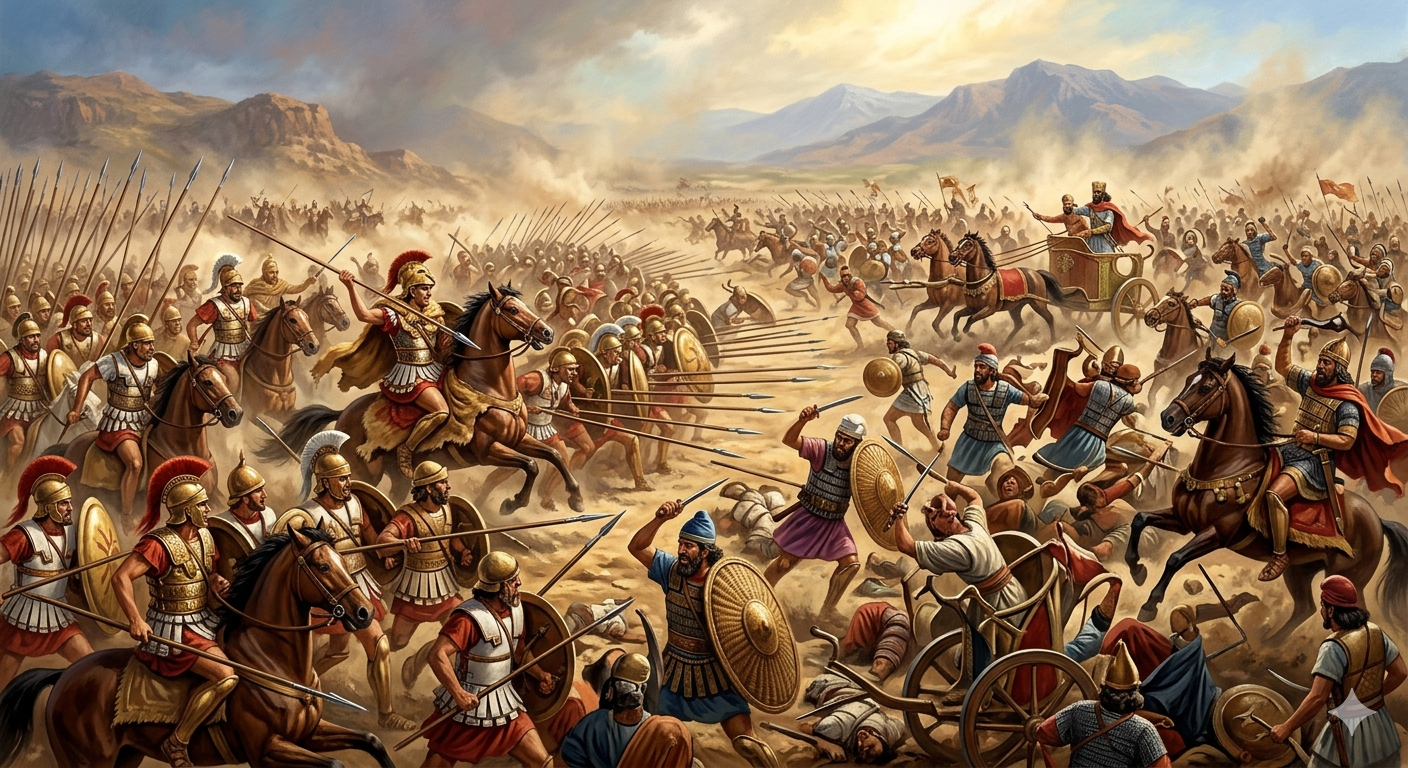
The Battle of Gaugamela opened with Alexander executing one of the most innovative tactical maneuvers in military history, immediately seizing the initiative and forcing Darius to react to Macedonian movements rather than implementing his own battle plan. Instead of advancing directly toward the Persian center as conventional wisdom would suggest, Alexander ordered his entire army to march obliquely to the right, parallel to the Persian battle line. This unexpected movement achieved multiple strategic objectives simultaneously: it drew the Macedonian forces away from the carefully prepared terrain that favored Persian chariots and cavalry, forced Persian units to extend their line to match Macedonian movements, and created the gaps in Persian formations that Alexander intended to exploit.
The psychological impact of this opening maneuver was as important as its tactical effects, as it immediately demonstrated Alexander’s supreme confidence and his refusal to fight the battle on Persian terms. By taking the tactical initiative from the moment fighting began, Alexander forced Darius into a reactive mode that would characterize Persian responses throughout the entire engagement. The complexity of coordinating such a maneuver while under enemy observation required exceptional discipline and training, capabilities that the Macedonian army possessed in abundance but that would have been impossible for the diverse and less experienced Persian forces to replicate.
As the Macedonian line moved steadily to the right, Persian cavalry units began to respond by extending their own formations to prevent Alexander from outflanking their position. This response, while tactically necessary, had the effect of thinning the Persian line and creating the gaps between units that Alexander’s tactical plan depended upon. The Persian left wing, commanded by Bessus, the satrap of Bactria, was gradually drawn away from the center of their formation as Bactrian and Scythian cavalry attempted to maintain contact with the moving Macedonian right wing.
The opening phase of the battle also featured the first use of Persian scythed chariots, as Darius attempted to disrupt the Macedonian formations while they were in motion. These fearsome weapons, equipped with sharp blades extending from their wheels and designed to cut down infantry formations, had been one of Darius’s primary innovations for dealing with the Macedonian phalanx. However, Alexander had prepared specific countermeasures for this threat, positioning Agrianian javelin throwers and archers in front of his main battle line with orders to target the chariot horses and drivers before they could reach his infantry formations.
The failure of the chariot attack marked an early psychological victory for Alexander’s forces and demonstrated the effectiveness of his tactical preparations. Most of the chariots were stopped by missile fire before reaching the Macedonian lines, while those that did break through found that the disciplined phalanx formations opened ranks to allow them to pass harmlessly through, then closed ranks behind them while light infantry eliminated the isolated charioteers. This innovative defensive technique, which required exceptional training and nerve from the soldiers involved, neutralized one of Darius’s most important tactical advantages and further increased Macedonian confidence while demoralizing Persian forces.
The Decisive Cavalry Charge: Alexander’s Moment of Glory
The climax of the Battle of Gaugamela came when Alexander personally led his Companion Cavalry in a devastating charge that shattered the Persian center and decided the fate of the Achaemenid Empire. This charge, which has become legendary in military history, represented the perfect execution of Alexander’s tactical philosophy and demonstrated his genius for identifying and exploiting enemy weaknesses at the crucial moment. The timing of this attack was critical, as it occurred precisely when the Persian formations had been stretched and weakened by their responses to Alexander’s earlier maneuvers.
Alexander’s charge was organized in the distinctive wedge formation that had become the trademark of Macedonian cavalry tactics, with the king himself at the point of the wedge leading his men directly toward Darius’s position in the Persian center. This formation allowed the Companions to concentrate their impact at a specific point while providing mutual support and protection as they drove deep into enemy territory. The psychological effect of seeing their king leading from the front, sharing the same dangers as his soldiers, inspired the Companions to extraordinary efforts and created the momentum that would prove irresistible to Persian resistance.
The target of Alexander’s charge was not randomly chosen but represented the culmination of careful tactical planning and battlefield observation. The king had identified a gap in the Persian line where cavalry units had been drawn away to respond to threats on the flanks, leaving the center temporarily weakened and vulnerable. By striking at this precise point with his elite cavalry, Alexander aimed to break through to Darius himself, recognizing that the capture or flight of the Persian king would lead to the immediate collapse of enemy resistance across the entire battlefield.
The charge itself was a masterpiece of shock action, as the heavily armored Companions struck the Persian line with devastating force, their long cavalry spears outreaching Persian weapons and their disciplined formation maintaining cohesion even in the midst of desperate hand-to-hand combat. Alexander himself was in the thick of the fighting, his distinctive armor and helmet making him a clear target for Persian attacks but also inspiring his men through his visible presence at the point of greatest danger. Ancient sources record that Alexander had at least one horse killed beneath him during this charge, demonstrating the intensity of the fighting and his personal commitment to victory.
The breakthrough achieved by Alexander’s cavalry was immediately exploited by supporting infantry, as hypaspists and phalanx battalions poured through the gap created by the Companions and began rolling up the Persian flanks from the center outward. This coordinated attack between cavalry and infantry represented the perfect execution of combined-arms tactics and demonstrated the superior training and coordination of Alexander’s forces. As Persian resistance in the center began to collapse, panic spread rapidly through their ranks, and what had been an organized battle line quickly degenerated into a chaotic rout.
Crisis on the Left: Parmenion’s Desperate Defense
While Alexander was achieving his spectacular breakthrough on the right wing of the Macedonian line, a potentially catastrophic crisis was developing on the left wing under the command of his veteran general Parmenion. Persian cavalry forces, led by Mazaeus and including some of the finest horsemen in the empire, had broken through the Macedonian left and were threatening to envelop Alexander’s entire army from behind. This development posed an existential threat to Macedonian victory, as even Alexander’s success in the center would be meaningless if his army was surrounded and destroyed by superior Persian numbers.
Parmenion’s situation became increasingly desperate as Persian cavalry poured through the gap in his lines and began attacking the Macedonian camp and baggage train. The psychological impact of this breakthrough was significant, as Macedonian soldiers could see enemy forces in their rear while they were still engaged with Persian infantry to their front. Some units began to waver, and there was a real possibility that panic might spread through the Macedonian ranks if the situation was not quickly resolved. The crisis demonstrated that even the best-laid tactical plans could go awry in the chaos of battle and that victory often depended on the ability to adapt quickly to changing circumstances.
The veteran general’s urgent appeals for assistance reached Alexander just as the Macedonian king was pursuing his breakthrough in the center and seemed on the verge of capturing Darius himself. This moment presented Alexander with one of the most difficult decisions of his military career: should he continue his pursuit of the Persian king and risk losing his entire army, or should he abandon his chance to end the war immediately and instead rescue his endangered left wing? The decision revealed both Alexander’s tactical genius and his understanding of the broader strategic situation.
Alexander’s choice to abandon his pursuit of Darius and instead turn his cavalry to assist Parmenion demonstrated his recognition that no individual achievement, however spectacular, was worth risking the destruction of his army. Leading a select force of his Companions, Alexander executed a dramatic about-face and charged into the Persian cavalry that was threatening his left wing. This intervention required exceptional leadership and personal courage, as Alexander had to rally his men for a second major cavalry charge after they had already been exhausted by their initial breakthrough against the Persian center.
The relief of Parmenion’s forces marked some of the heaviest fighting of the entire battle, as Persian cavalry, infantry, and war elephants launched desperate attacks against the Macedonian formations. Alexander himself was in the thick of this fighting, and ancient sources record the loss of sixty Companions during this phase of the battle, representing some of the highest casualties suffered by Alexander’s elite cavalry units. The successful resolution of this crisis demonstrated the flexibility and resilience of Alexander’s tactical system and the exceptional quality of his military leadership under pressure.
The Collapse of Persian Power: Darius Flees the Field
The sight of Alexander’s cavalry breakthrough and the king’s personal approach toward his position in the Persian center finally broke Darius III’s nerve, leading to the Persian king’s second ignominious flight from a battlefield confrontation with his Macedonian rival. Ancient sources describe Darius as having been in a state of increasing anxiety throughout the battle, and the approach of Alexander’s wedge formation, bristling with cavalry spears and cutting through his supposedly impenetrable defenses, proved too much for the Persian monarch’s psychological endurance. The king’s flight marked the effective end of organized Persian resistance and triggered a general collapse of morale that spread rapidly through the remaining Persian forces.
Darius’s decision to flee the battlefield at this critical moment represented more than personal cowardice; it reflected his fundamental misunderstanding of the nature of leadership in ancient warfare. Unlike Alexander, who led from the front and shared the dangers of his soldiers, Darius had positioned himself in the relative safety of the rear center, surrounded by his personal guard and separated from the actual fighting. When the battle reached his position, he lacked both the personal combat experience and the psychological preparation necessary to stand and fight, instead choosing preservation of his own life over the defense of his empire and the safety of his soldiers.
The immediate impact of the Persian king’s flight was catastrophic for the remaining Persian forces, as word of Darius’s abandonment of the battlefield spread rapidly through their ranks. In ancient warfare, the presence or absence of the commanding monarch was often the decisive factor in determining whether troops would continue fighting or begin to retreat. Once Persian soldiers realized that their king had abandoned them, their own motivation to continue fighting evaporated, and what had been an organized army quickly degenerated into a collection of individuals seeking only to escape with their lives.
The Persian center, already weakened by Alexander’s cavalry charge, completely disintegrated once Darius’s flight became known. The elite Immortals, who had been the backbone of Persian military power for centuries, found themselves isolated and surrounded by victorious Macedonian forces. Many chose to surrender rather than die uselessly for a king who had abandoned them, while others joined the general flight that was spreading across the battlefield. The psychological shock of seeing their supposedly invincible monarch flee from combat had a devastating effect on Persian morale and marked the symbolic end of Achaemenid military prestige.
The collapse of the Persian center also doomed the wings of Darius’s army, as units that might have continued fighting if they had maintained contact with the main body now found themselves isolated and facing inevitable defeat. Bessus’s forces on the Persian left began an organized withdrawal rather than risk being surrounded, while Mazaeus’s cavalry on the Persian right, despite their earlier success against Parmenion, abandoned their positions and joined the general retreat. The speed and completeness of this collapse demonstrated that the Battle of Gaugamela had been decided as much by psychological factors as by tactical considerations.
The Pursuit and the Spoils: Victory’s Immediate Rewards
Following the collapse of Persian resistance, Alexander faced another crucial decision that would determine whether his tactical victory could be transformed into strategic success. The immediate pursuit of Darius offered the tantalizing possibility of capturing the Persian king and thereby ending the war immediately, but it also risked allowing scattered Persian forces to regroup and escape with much of the royal treasury and military equipment. Alexander’s decision to limit his pursuit and instead focus on securing the battlefield and capturing the Persian camp demonstrated his understanding of the broader strategic implications of his victory.
The Macedonian king’s pursuit of Darius was conducted by a select force of his fastest cavalry, while the main body of his army was directed toward securing the enormous Persian baggage train that contained the accumulated wealth of the empire. This division of effort reflected Alexander’s recognition that while capturing Darius would have immense symbolic value, controlling the Persian treasury was essential for financing his continued campaigns and maintaining the loyalty of his own forces. The decision proved strategically sound, as the wealth captured at Gaugamela provided the resources necessary for Alexander’s subsequent conquest of the eastern satrapies.
The Persian camp yielded spoils beyond even Alexander’s expectations, including 4,000 talents of gold and silver, the personal chariot and weapons of Darius, royal regalia and ceremonial items of immense value, and the complete administrative records of the Persian Empire. The capture of these administrative documents proved particularly valuable, as they provided Alexander with detailed information about Persian governmental structure, taxation systems, and the location of additional treasures throughout the empire. This intelligence would prove crucial for the administrative challenges of governing his vast new conquests.
Perhaps most significantly, the Macedonian victory at Gaugamela also yielded control of the Persian war elephants, exotic weapons that would later become important components of Hellenistic armies. These massive animals, trained for warfare and psychologically intimidating to troops who had never encountered them, represented both a practical military asset and a powerful symbol of Alexander’s dominance over the exotic resources of the East. The successful capture and integration of these elephants into his own forces demonstrated Alexander’s ability to adapt and incorporate the military innovations of his conquered enemies.
The distribution of captured wealth among Alexander’s soldiers served important military and political purposes beyond simply rewarding their battlefield performance. The generous sharing of Persian treasures reinforced the loyalty of troops who had already followed their king across thousands of miles and faced constant dangers in his service. Additionally, the visible wealth obtained from victory provided powerful motivation for continued campaigning and demonstrated the material benefits of supporting Alexander’s ambitions. This policy of sharing captured wealth would become a hallmark of Alexander’s leadership style and a crucial factor in maintaining military morale during the extended campaigns that lay ahead.
Strategic Consequences: The Fall of the Achaemenid Empire
The Battle of Gaugamela marked the effective end of the Achaemenid Empire as an independent political entity, though several more years would pass before Alexander completed his conquest of all Persian territories. The psychological impact of Darius III’s second flight from battle was devastating for Persian morale and authority throughout the empire, as subject peoples and provincial governors began to calculate whether their interests lay with a king who could not defend himself or with the seemingly invincible Macedonian conqueror. The speed with which Persian resistance collapsed after Gaugamela demonstrated that the empire’s apparent strength had been largely illusory, dependent more on the prestige of past victories than on current military capability.
The immediate aftermath of the battle saw a cascade of Persian surrenders as major cities and satrapies chose submission over resistance. Babylon, the greatest city of Mesopotamia and a symbol of Near Eastern power since ancient times, surrendered to Alexander without a siege through its satrap Bagophanes. This submission not only provided Alexander with enormous additional wealth but also demonstrated that Persian administrative officials were willing to transfer their allegiance to the new conqueror rather than face the destruction that resistance would bring. The peaceful transition of authority in Babylon became a model for Alexander’s subsequent conquests throughout the former Persian Empire.
The collapse of central Persian authority also triggered a series of power struggles among Persian nobles and provincial governors who sought to position themselves advantageously in the new political order. Some, like Mazaeus, chose early submission and were rewarded with continued authority under Macedonian oversight. Others, like Bessus, attempted to continue resistance by murdering Darius and claiming royal authority for themselves, a strategy that ultimately failed when Alexander’s relentless pursuit eliminated these pretenders one by one. These political maneuvers revealed the extent to which the Battle of Gaugamela had shattered not just Persian military power but also the political unity that had held the empire together.
The transformation of Alexander from Macedonian king to ruler of the world’s largest empire created unprecedented challenges of governance and administration that would define the remainder of his career. The territories now under his control stretched from Greece to India and encompassed dozens of different peoples with varying languages, religions, and cultural traditions. The wealth captured from the Persians provided the resources necessary for governing this vast domain, but it also raised questions about how a Macedonian king could effectively rule populations that far outnumbered his own people and possessed their own ancient traditions of government and law.
The cultural implications of Persian defeat were equally profound, as the victory at Gaugamela marked the beginning of the Hellenistic period in which Greek culture and ideas would spread throughout the ancient world. The interaction between Greek and Persian civilizations, facilitated by Alexander’s policy of cultural fusion and administrative pragmatism, would create new forms of art, architecture, philosophy, and government that would influence human development for centuries. The battle thus represented not just a military victory but a civilizational transformation that reshaped the intellectual and cultural landscape of the ancient world.
The Death of Darius: End of an Ancient Dynasty
The final chapter in the personal drama between Alexander and Darius III played out during the months following Gaugamela, as the Persian king’s flight eastward led eventually to his murder by his own satrap Bessus in 330 BC. Darius’s desperate attempt to rally resistance in the eastern satrapies of his empire was undermined by his damaged prestige and the reluctance of Persian nobles to commit themselves to what appeared to be a doomed cause. The king’s isolation and vulnerability during this period revealed the extent to which the Battle of Gaugamela had destroyed not just Persian military power but also the political authority and personal loyalty that had sustained the Achaemenid dynasty for over two centuries.
Bessus, the satrap of Bactria who had commanded the Persian left wing at Gaugamela, represents the complex loyalties and calculations that characterized the empire’s final collapse. His decision to murder Darius was motivated partly by his desire to claim royal authority for himself and partly by his belief that eliminating the failed king might provide a basis for more effective resistance to Alexander’s advance. However, this act of regicide backfired spectacularly, as it eliminated the last symbol of legitimate Persian authority while failing to create effective alternative leadership that could unite the remaining Persian forces.
Alexander’s reaction to the news of Darius’s murder revealed both his political sophistication and his understanding of the symbolic importance of treating his former enemy with appropriate dignity. Rather than celebrating the death of his rival, Alexander expressed genuine grief and anger at the manner of Darius’s end, giving the dead king a royal funeral at Persepolis and vowing to pursue his murderers with relentless determination. This response served important political purposes by demonstrating Alexander’s respect for legitimate authority and his condemnation of regicide, while also providing justification for his continued military campaigns against the remaining Persian rebels.
The pursuit and capture of Bessus became a personal obsession for