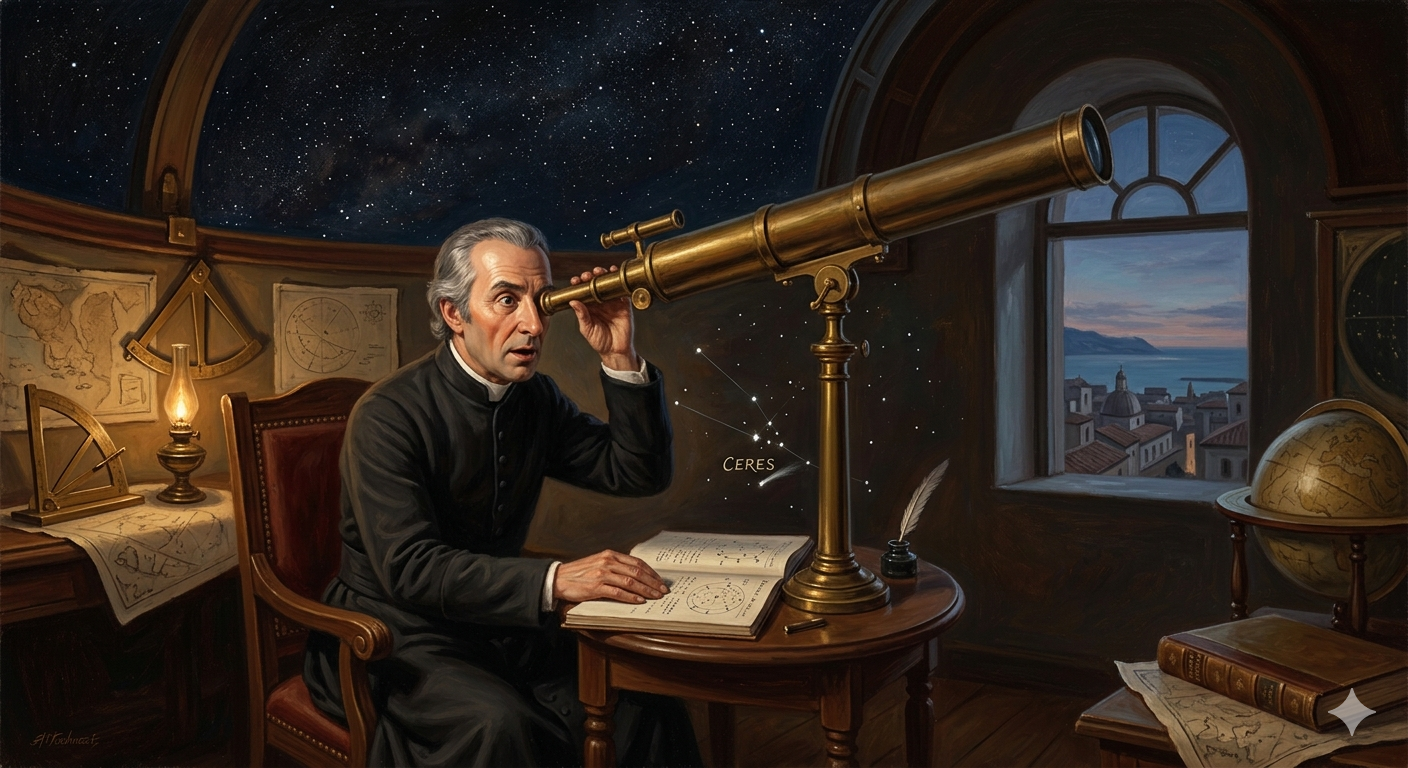
On January 1, 1801, as the world celebrated the dawn of the 19th century, Italian astronomer Giuseppe Piazzi made a discovery that would revolutionize our understanding of the solar system. While conducting routine observations from the Palermo Observatory in Sicily, Piazzi spotted what he initially thought was an uncharted star, but which would prove to be Ceres, the first asteroid ever discovered by humanity. This momentous discovery not only filled a puzzling gap in the solar system between Mars and Jupiter but also opened up an entirely new class of celestial objects that would expand our cosmic perspective. Piazzi’s meticulous observations and scientific dedication led to the identification of what was originally classified as the solar system’s eighth planet, though we now know Ceres as the largest object in the asteroid belt and a dwarf planet. This groundbreaking discovery marked the beginning of asteroid astronomy and demonstrated that our solar system contained far more complexity and wonder than previously imagined.
The Scientific Context: The Missing Planet Between Mars and Jupiter
The discovery of Ceres occurred against the backdrop of intense astronomical speculation about a missing planet in our solar system. For decades before Piazzi’s historic observation, astronomers had been puzzled by an apparent gap in the spacing of planetary orbits between Mars and Jupiter. This mystery was particularly compelling because of the Titius-Bode law, a mathematical formula that seemed to predict the distances of known planets from the Sun with remarkable accuracy, yet indicated that something should exist in the space between Mars and Jupiter.
The Titius-Bode law, published by German astronomer Johann Elert Bode in 1772 based on earlier work by Johann Daniel Titius, suggested that planetary distances followed a predictable mathematical pattern. This formula accurately predicted the orbits of all known planets, including the surprising confirmation when William Herschel discovered Uranus in 1781 at precisely the distance the law predicted for a planet beyond Saturn. However, the law also predicted that another planet should orbit the Sun at approximately 2.8 astronomical units, right in the empty space between Mars and Jupiter.
Theoretical astronomers had long pondered this apparent gap in planetary spacing. As early as 1596, Johannes Kepler had suggested that divine design required additional planets, including one between Mars and Jupiter. Later thinkers like Immanuel Kant wondered whether Jupiter’s powerful gravity might have disrupted the formation of a planet in this region, while Johann Heinrich Lambert in 1761 speculated whether missing planets might have been destroyed or displaced by the gravitational influence of the giant planets Jupiter and Saturn.
The astronomical community’s interest in finding this missing planet intensified throughout the late 18th century. The success of the Titius-Bode law in predicting Uranus’s location gave credibility to the idea that mathematical laws could reveal hidden aspects of cosmic architecture. This theoretical foundation provided strong motivation for systematic searches of the region between Mars and Jupiter, setting the stage for organized efforts that would ultimately lead to Piazzi’s historic discovery.
The search for the missing planet also reflected broader changes in astronomical practice during this period. Astronomy was becoming more systematic and collaborative, with astronomers sharing observations and coordinating efforts across national boundaries. The technological improvements in telescope design and observational techniques made it possible to detect much fainter objects than had been visible to earlier generations of astronomers, opening up new possibilities for discovery that would soon bear fruit in Piazzi’s observations.
The Celestial Police: Organized Search for the Missing Planet
In 1800, a group of German astronomers led by Franz Xaver von Zach organized what they called the “Celestial Police” (Himmelspolizei in German), a collaborative effort specifically designed to locate the predicted planet between Mars and Jupiter. This systematic approach to astronomical discovery represented an innovative model of scientific cooperation that brought together twenty-four of Europe’s most experienced astronomers to divide the sky and conduct methodical searches for the missing world.
Von Zach, who edited the influential astronomical journal Monthly Correspondence, coordinated this ambitious project by assigning specific regions of the zodiac to different astronomers. Each member of the Celestial Police was responsible for carefully mapping their assigned section of sky and watching for any moving objects that might represent the sought-after planet. This collaborative approach maximized the chances of discovery while ensuring that no promising regions would be overlooked due to individual limitations in observing time or geographic location.
The Celestial Police represented a significant evolution in astronomical methodology, moving beyond the individual efforts of isolated observers toward coordinated team research that would become increasingly common in modern science. The group’s systematic approach included detailed record-keeping, standardized observation protocols, and regular communication between members to share findings and coordinate efforts. This organizational structure provided a model for future collaborative astronomical projects and demonstrated the power of scientific cooperation in tackling complex observational challenges.
Giuseppe Piazzi was selected as one of the twenty-four members of the Celestial Police, a testament to his reputation as a skilled observer and the quality of the Palermo Observatory’s facilities. However, in one of history’s great ironies, Piazzi made his historic discovery of Ceres before he even received his formal invitation to join the group. This serendipitous timing meant that the first asteroid was discovered not through the organized efforts of the Celestial Police, but through the routine observational work of an astronomer who was about to become part of their systematic search.
While the Celestial Police did not directly contribute to the discovery of Ceres, the group went on to play important roles in confirming Piazzi’s discovery and locating additional asteroids. Members of the organization, including Heinrich Olbers, would later discover the second, third, and fourth asteroids: Pallas, Juno, and Vesta. The collaborative framework established by von Zach proved invaluable for the rapid follow-up observations needed to confirm and track these new celestial objects, demonstrating the value of organized scientific cooperation even when individual serendipity led to the initial breakthrough.
Giuseppe Piazzi: The Astronomer Behind the Discovery
Giuseppe Piazzi, born Gioacchino Giuseppe Maria Ubaldo Nicolò Piazzi on July 16, 1746, in Ponte in Valtellina, Italy, was a Catholic priest, mathematician, and astronomer whose diverse intellectual interests and meticulous observational skills prepared him perfectly for his role in astronomical history. Educated in mathematics and theology, Piazzi combined scientific rigor with religious devotion throughout his career, serving as both a professor of mathematics and theology at various Italian institutions while pursuing cutting-edge astronomical research.
Piazzi’s appointment as the first director of the Palermo Observatory in Sicily in 1787 positioned him at one of Europe’s most advanced astronomical facilities. The observatory, established under the patronage of the Viceroy of Sicily, was equipped with state-of-the-art instruments, including a precision meridian circle manufactured by the renowned English instrument maker Jesse Ramsden. This sophisticated equipment allowed Piazzi to conduct the precise positional measurements that would prove crucial for his discovery and study of Ceres.
The astronomer’s primary research focus involved creating an accurate star catalog, a painstaking project that required systematic observation of stellar positions throughout the zodiac. This work, while routine, demanded exceptional attention to detail and consistent observation over many months or years. Piazzi’s dedication to this cataloging project meant that he was intimately familiar with the star patterns in his assigned regions of sky, making him uniquely qualified to notice when something appeared that didn’t belong among the familiar stellar configurations.
Piazzi’s scientific approach combined careful observation with mathematical analysis, reflecting the best practices of late 18th-century astronomy. He understood the importance of repeated observations to confirm the reality of phenomena and was skilled in the mathematical techniques needed to analyze orbital motion and planetary positions. These skills would prove essential not only for his discovery of Ceres but also for his subsequent efforts to determine its orbital characteristics and establish its true nature as a new type of celestial object.
The astronomer’s international connections within the European scientific community ensured that his discovery would receive proper attention and follow-up study. Piazzi maintained correspondence with leading astronomers throughout Europe, including Barnaba Oriani in Milan and Johann Bode in Berlin, providing channels for sharing his observations and obtaining the collaborative support needed to confirm and study his remarkable discovery. This scientific networking would prove crucial during the challenging months when Ceres was lost to observation and required sophisticated mathematical analysis to relocate.
The Night of Discovery: January 1, 1801
On the evening of January 1, 1801, Giuseppe Piazzi began what he expected to be a routine night of stellar observation at the Palermo Observatory. He was working on verifying and extending the catalog of zodiacal stars compiled by the French astronomer Nicolas-Louis de Lacaille, systematically checking the positions of known stars and searching for any that might have been missed in previous surveys. This meticulous work required examining each region of sky carefully and comparing what he saw through his telescope with existing star maps and catalogs.
As Piazzi focused his meridian circle telescope on a region near the constellation Taurus, he noticed what appeared to be a faint star that was not marked on his charts. Initially, this observation seemed routine, as astronomers frequently discovered previously uncatalogued stars during systematic surveys. However, something about this particular object caught Piazzi’s attention. Its light appeared “a little faint and colored as Jupiter,” suggesting unusual characteristics that set it apart from typical stellar observations.
The astronomer’s scientific training prompted him to make careful note of the object’s exact position and characteristics before concluding his observations for the night. This systematic approach to record-keeping, which was standard practice for serious astronomical research, would prove crucial for establishing the object’s true nature. Piazzi recorded the coordinates, brightness, and appearance of the mysterious object, creating the first documented observation of what would become known as Ceres.
On the following night, January 2, Piazzi returned to the same region of sky to continue his stellar catalog work. When he again located the unusual object he had noted the previous evening, he made a discovery that changed astronomical history: the object had moved. Stars, being so distant that their motion is imperceptible over short periods, maintain fixed positions relative to each other night after night. The fact that this object had changed its position indicated that it was not a star but something much closer, something within our own solar system.
This moment of realization marked a turning point in Piazzi’s observations and in astronomical history. The astronomer understood immediately that he had discovered either a comet or, more intriguingly, the long-sought planet between Mars and Jupiter. The movement was slight but definite, confirming that the object was orbiting the Sun and was therefore a member of our solar system rather than a distant star. This discovery launched a period of intensive observation and analysis that would ultimately reveal the existence of an entirely new class of celestial objects.
Tracking the Moving Object: Early Observations and Analysis
Following his recognition that the mysterious object was moving against the stellar background, Piazzi embarked on an intensive observational campaign to track its motion and determine its characteristics. Each clear night provided an opportunity to measure the object’s position precisely and build up a database of observations that could reveal its orbital motion around the Sun. This systematic tracking required exceptional dedication, as the object was quite faint and required careful observation with the best available instruments.
Over the course of several weeks, Piazzi accumulated twenty-four separate observations of the moving object, carefully recording its position, brightness, and any changes in appearance. These observations revealed that the object was moving in a slow, steady manner that suggested a nearly circular orbit at a considerable distance from the Sun. The character of its motion was unlike that of known comets, which typically follow more elliptical paths and often show changes in brightness and appearance as they approach or recede from the Sun.
The astronomer’s initial hypothesis was that he had discovered a comet, as this seemed the most likely explanation for a previously unknown object moving through the solar system. However, the object’s steady motion, consistent brightness, and lack of any visible tail or coma that typically characterized comets made this identification increasingly doubtful. In his correspondence with fellow astronomers, Piazzi expressed uncertainty about the object’s nature, noting that “its movement is so slow and rather uniform, it has occurred to me several times that it might be something better than a comet.”
Piazzi’s observations were complicated by several factors that would ultimately lead to the object’s temporary loss. Illness interrupted his observation schedule in February 1801, preventing him from continuing his systematic tracking of the object’s motion. Additionally, the object’s orbital position was gradually carrying it closer to the Sun’s position in the sky, making it increasingly difficult to observe as it became lost in the solar glare during morning twilight.
The astronomer’s final clear observation of his discovery occurred on February 11, 1801, after which a combination of poor weather, his personal illness, and the object’s position relative to the Sun made further observations impossible. By this time, Piazzi had accumulated sufficient data to recognize that the object was something extraordinary, but he had not yet determined its exact nature or orbital characteristics. The challenge of relocating the object after months of invisibility would soon require the mathematical genius of Carl Friedrich Gauss to solve.
The Great Loss: Ceres Disappears into Solar Glare
The period following Piazzi’s last observation of Ceres on February 11, 1801, marked one of the most challenging phases in early asteroid astronomy. As the object moved in its orbit, it gradually approached the region of sky near the Sun, making observation increasingly difficult and eventually impossible as it became lost in the brilliant solar glare. This disappearance created a race against time, as astronomers would need to predict where Ceres would reappear months later after it had moved far enough from the Sun to become visible again.
The loss of Ceres in the solar glare was particularly frustrating because Piazzi had not yet published his complete observations, leaving the astronomical community with insufficient data to confirm the discovery or predict the object’s future position. Some of Piazzi’s colleagues grew impatient with his secretiveness, as the astronomer continued to refine his measurements and analysis rather than immediately sharing all his data. This cautious approach, while scientifically responsible, created tensions within the community of astronomers eager to confirm and study the remarkable discovery.
Piazzi’s initial announcement of his discovery came in letters to fellow astronomers Barnaba Oriani in Milan and Johann Bode in Berlin on January 24, 1801, but he described the object as a possible comet rather than definitively identifying its nature. This conservative approach reflected both scientific caution and Piazzi’s own uncertainty about what he had discovered. The astronomer understood the importance of thorough analysis before making bold claims about new celestial phenomena.
The challenge of predicting Ceres’s future position was complicated by the limited understanding of orbital mechanics available at the time. Traditional methods for calculating comet orbits were inadequate for determining the path of an object that appeared to follow a nearly circular orbit around the Sun. The mathematical techniques needed to solve this problem required innovative approaches that could extract maximum information from the limited set of observations Piazzi had collected.
By the summer of 1801, it became clear that relocating Ceres would require exceptional mathematical skill and new computational methods. The object had been invisible for months, and even when it emerged from the solar glare later in the year, astronomers would need precise predictions of its position to distinguish it from the countless faint stars visible in telescopes. The stage was set for one of the most brilliant applications of mathematical analysis in astronomical history, as a young German mathematician would soon provide the key to recovering the lost world.
Carl Friedrich Gauss: Mathematical Genius Saves the Discovery
The recovery of Ceres from its months-long disappearance in solar glare required the intervention of one of history’s greatest mathematical minds. Carl Friedrich Gauss, then only twenty-four years old, applied his innovative mathematical techniques to the problem of determining Ceres’s orbit from Piazzi’s limited observations. Gauss had been developing new methods for orbit determination that could extract maximum information from minimal observational data, and the challenge of relocating Ceres provided the perfect test case for his revolutionary approaches.
Gauss’s method, which would later be refined and published as his theory of orbit determination, represented a fundamental advance in astronomical mathematics. Traditional techniques for calculating celestial orbits required extensive observational data collected over long periods, but Gauss developed methods that could determine an object’s complete orbital characteristics from just a few well-timed observations. This breakthrough made it possible to predict planetary and cometary positions with unprecedented accuracy from limited data sets.
The young mathematician’s analysis of Piazzi’s twenty-four observations of Ceres revealed that the object was indeed orbiting the Sun at approximately 2.8 astronomical units, precisely the distance predicted by the Titius-Bode law for the missing planet between Mars and Jupiter. This remarkable confirmation of theoretical predictions added weight to the growing conviction that Ceres represented the long-sought missing world rather than merely another comet passing through the solar system.
Gauss’s calculations predicted that Ceres would become visible again in the constellation of Virgo during late 1801, providing specific coordinates where astronomers should search for the lost object. These predictions were met with some skepticism from the astronomical community, as the young mathematician was not yet widely known and his methods were untested. However, the urgency of confirming Piazzi’s discovery motivated several astronomers to search the predicted region despite their doubts about the accuracy of Gauss’s calculations.
The mathematical triumph came on December 31, 1801, when Franz Xaver von Zach, using Gauss’s predictions, successfully relocated Ceres almost exactly where the young mathematician had calculated it should be. This spectacular confirmation of Gauss’s orbital calculations established both his reputation as a mathematical genius and the validity of his new methods for astronomical computation. The recovery of Ceres demonstrated that mathematical analysis could overcome observational limitations and provided powerful tools for future astronomical discoveries.
The Recovery of Ceres: December 31, 1801
The successful relocation of Ceres on December 31, 1801, represented one of the most dramatic confirmations of mathematical prediction in astronomical history. Franz Xaver von Zach, the coordinator of the Celestial Police, directed his telescope to the region of sky where Gauss’s calculations predicted the lost object should reappear. After months of uncertainty about whether Piazzi’s discovery could ever be confirmed, von Zach’s observation validated both the reality of the new celestial object and the power of advanced mathematical analysis.
Von Zach’s success in finding Ceres was quickly followed by confirmatory observations from other prominent astronomers, including Heinrich Olbers, who had been actively searching for the object based on Gauss’s predictions. These multiple independent confirmations removed any remaining doubt about the existence of Ceres and established its orbital characteristics with high precision. The object was indeed moving in a nearly circular orbit between Mars and Jupiter at the distance predicted by the Titius-Bode law.
The recovery of Ceres also allowed astronomers to determine its physical characteristics more accurately. Observations revealed that despite its planetary orbit, Ceres was much smaller than any known planet, appearing as little more than a point of light even in the best telescopes of the time. This small size, combined with its orbital location, suggested that Ceres might represent a new type of celestial object, neither a traditional planet nor a comet but something previously unknown to astronomy.
Giuseppe Piazzi himself was able to observe his discovered object again on February 23, 1802, more than a year after his original discovery. This reunion with his celestial find provided satisfying confirmation of his historic observations and allowed him to contribute additional data to the growing database of information about Ceres. Piazzi’s continued involvement in studying the object he had discovered demonstrated the collaborative nature of astronomical research and the importance of multiple observers in confirming and characterizing new phenomena.
The successful recovery of Ceres established important precedents for asteroid astronomy and demonstrated the crucial role of mathematical analysis in modern observational science. The combination of careful observation, mathematical prediction, and collaborative confirmation that characterized the Ceres recovery became the standard approach for dealing with newly discovered small bodies in the solar system. This methodology would prove essential as astronomers began discovering additional asteroids and needed reliable methods for tracking and studying these elusive objects.
Classification Controversies: Planet or Asteroid?
The discovery of Ceres immediately raised fundamental questions about how to classify this new type of celestial object within the existing framework of astronomical knowledge. Initial excitement focused on the apparent confirmation of the Titius-Bode law’s prediction of a missing planet between Mars and Jupiter. For the first few years after its discovery, Ceres was indeed classified as the solar system’s eighth planet, fitting neatly into theoretical expectations about planetary spacing and orbital characteristics.
However, as more detailed observations accumulated, astronomers began to recognize that Ceres possessed unusual characteristics that set it apart from other known planets. Most significantly, despite orbiting at the predicted distance for a planet between Mars and Jupiter, Ceres appeared to be much smaller than any other known world. Even the best telescopes of the early 19th century showed Ceres as nothing more than a star-like point of light, suggesting a size dramatically smaller than traditional planets.
The classification question became more complicated with the discovery of additional objects in similar orbits. In 1802, Heinrich Olbers discovered Pallas, followed by his discovery of Vesta in 1807, while Karl Harding found Juno in 1804. These discoveries revealed that Ceres was not unique but rather the first member of an entirely new class of solar system objects orbiting between Mars and Jupiter. The existence of multiple small bodies in this region suggested that the Titius-Bode law’s prediction had been fulfilled not by a single large planet but by a collection of smaller worlds.
William Herschel, the discoverer of Uranus, played a crucial role in developing new terminology for these unusual objects. Recognizing that traditional planetary classifications were inadequate for describing Ceres and its companions, Herschel introduced the term “asteroid” (meaning “star-like”) to describe their appearance in telescopes. This nomenclature emphasized their stellar appearance while distinguishing them from true planets, which showed measurable disks when observed through sufficiently powerful instruments.
The reclassification of Ceres from planet to asteroid reflected the evolving understanding of solar system architecture and demonstrated astronomy’s ability to revise theoretical frameworks when confronted with new observational evidence. By the 1850s, the asteroid designation for Ceres and its companions had become widely accepted, though the discovery would later prompt additional reclassifications as our understanding of these objects continued to develop. The modern classification of Ceres as a dwarf planet reflects continued evolution in how we categorize celestial objects based on their physical and orbital characteristics.
The Birth of Asteroid Astronomy
Piazzi’s discovery of Ceres marked the beginning of an entirely new branch of astronomy focused on the study of small rocky bodies orbiting between Mars and Jupiter. This field of asteroid astronomy would reveal that our solar system contained far more complexity and diversity than previously imagined, with thousands of individual objects following independent paths around the Sun in what became known as the asteroid belt. The systematic study of these objects would provide crucial insights into solar system formation and evolution.
The early years of asteroid astronomy were characterized by slow but steady discovery of new objects. After the initial discoveries of Ceres, Pallas, Juno, and Vesta between 1801 and 1807, there was a lengthy gap before the next asteroid discoveries in the 1840s. This pause reflected both the difficulty of detecting these faint objects with 19th-century telescopes and the limited number of astronomers actively searching for them. However, improvements in telescopic technology and observational techniques gradually made asteroid detection more routine.
The development of photography in the late 19th century revolutionized asteroid discovery by allowing astronomers to systematically survey large regions of sky and identify moving objects through comparison of photographs taken on different nights. This technological advance led to an explosion in asteroid discoveries, with hundreds of new objects cataloged by the end of the 19th century. The photographic method also enabled more precise measurements of asteroid positions and motions, improving orbital calculations and physical characterization.
The study of asteroids provided important insights into solar system history and planetary formation processes. The chemical composition and physical characteristics of asteroids preserved information about conditions in the early solar system, making them natural laboratories for understanding how planets formed and evolved. Spectroscopic analysis of asteroid surfaces revealed diverse compositions ranging from carbonaceous materials to metallic iron-nickel alloys, suggesting complex formation and evolution histories.
Modern asteroid astronomy has revealed that these objects are far more diverse and scientifically interesting than early observers could have imagined. Space missions to asteroids have provided detailed images and analysis of their surfaces, compositions, and internal structures. The recognition of asteroids as important sources of scientific information about solar system history has elevated them from curiosities to major subjects of planetary science research, validating the significance of Piazzi’s pioneering discovery more than two centuries ago.
Ceres Today: From Asteroid to Dwarf Planet
The scientific understanding and classification of Ceres have continued to evolve throughout the centuries since Piazzi’s discovery, reflecting both technological advances and evolving theoretical frameworks for understanding solar system objects. In 2006, the International Astronomical Union reclassified Ceres once again, this time promoting it from asteroid to dwarf planet status. This reclassification recognized Ceres as a unique object that, while sharing orbital space with other asteroids, possesses characteristics that set it apart from typical small bodies.
The dwarf planet classification reflects Ceres’s status as the largest object in the asteroid belt, containing approximately one-third of the belt’s total mass. Unlike typical asteroids, Ceres is large enough that its gravity has pulled it into a roughly spherical shape, one of the criteria for dwarf planet status. Additionally, recent observations have revealed that Ceres may harbor a subsurface ocean and shows evidence of ongoing geological activity, characteristics more typical of larger worlds than small rocky fragments.
NASA’s Dawn spacecraft, which orbited Ceres from 2015 to 2018, revolutionized our understanding of this historically significant world. The mission revealed a complex surface featuring bright spots now known to be salt deposits, evidence of past water activity, and geological features suggesting ongoing processes within the dwarf planet. These discoveries have elevated Ceres from a simple rocky body to a potentially active world that may harbor conditions suitable for life.
The modern study of Ceres has also provided insights into the early history of our solar system, as this object appears to be a surviving remnant from the era of planetary formation. Unlike the terrestrial planets, which were heavily modified by subsequent geological processes, Ceres preserves information about conditions and materials present during the solar system’s formation 4.6 billion years ago. This makes it a valuable target for understanding how planets formed and evolved in our cosmic neighborhood.
The transformation of Ceres from Piazzi’s mysterious moving star to a recognized dwarf planet and potential astrobiological target demonstrates the continuous evolution of scientific understanding. Each new technological capability and theoretical framework has revealed additional layers of complexity and scientific interest in this remarkable object. The fact that Ceres continues to surprise and inform scientists more than two centuries after its discovery testifies to the enduring significance of Piazzi’s historic observation on that New Year’s Day in 1801.
The Enduring Legacy of Piazzi’s Discovery
Giuseppe Piazzi’s discovery of Ceres on January 1, 1801, represents far more than the identification of a single celestial object; it marked a fundamental expansion in humanity’s understanding of our place in the cosmos. The discovery revealed that our solar system contained unexpected diversity and complexity, with entire populations of objects waiting to be discovered and studied. This expansion of cosmic perspective has continued to influence astronomical research and public understanding of space exploration throughout the subsequent centuries.
The methodological approaches pioneered during the discovery and recovery of Ceres established important precedents for modern astronomical research. The combination of systematic observation, mathematical analysis, and international collaboration that characterized the Ceres discovery became the standard model for studying newly discovered celestial phenomena. These methods proved essential as astronomy evolved from individual observations to large-scale collaborative research programs involving multiple institutions and countries.
The discovery of asteroids also had profound implications for understanding planetary formation and solar system evolution. The asteroid belt between Mars and Jupiter preserves information about the conditions and materials present during the early stages of solar system formation, providing a natural laboratory for studying planetary science. Modern theories of planetary formation rely heavily on observations and analysis of asteroidal materials, making Piazzi’s discovery foundational to contemporary understanding of how planetary systems develop.
The technological innovations required to study asteroids have driven advances in observational techniques, mathematical methods, and space exploration capabilities. From Gauss’s revolutionary orbital calculations to modern spacecraft missions, the study of asteroids has consistently pushed the boundaries of what is technically possible in astronomy and space science. These technological developments have had applications far beyond asteroid research, contributing to advances in navigation, communication, and exploration technologies.
Perhaps most significantly, the discovery of Ceres demonstrated that the universe contains far more wonders and surprises than human imagination had previously conceived. The recognition that our solar system included thousands of previously unknown worlds expanded the scope of astronomical research and inspired generations of scientists to continue exploring and discovering. This legacy of discovery and exploration, beginning with Piazzi’s careful observations more than two centuries ago, continues to drive modern space exploration and the search for understanding our cosmic environment.
The story of Ceres, from Piazzi’s initial observation through its modern classification as a dwarf planet and target for space exploration, illustrates how scientific discovery is an ongoing process of observation, analysis, and reinterpretation. Each generation of astronomers has found new significance and meaning in this remarkable object, ensuring that Piazzi’s New Year’s Day discovery continues to contribute to human knowledge and cosmic perspective. As we continue to explore asteroids and small bodies throughout the solar system, we build upon the foundation established by Giuseppe Piazzi’s historic observation and the collaborative scientific effort that followed, demonstrating the enduring value of careful observation, mathematical analysis, and international cooperation in advancing human understanding of the universe.