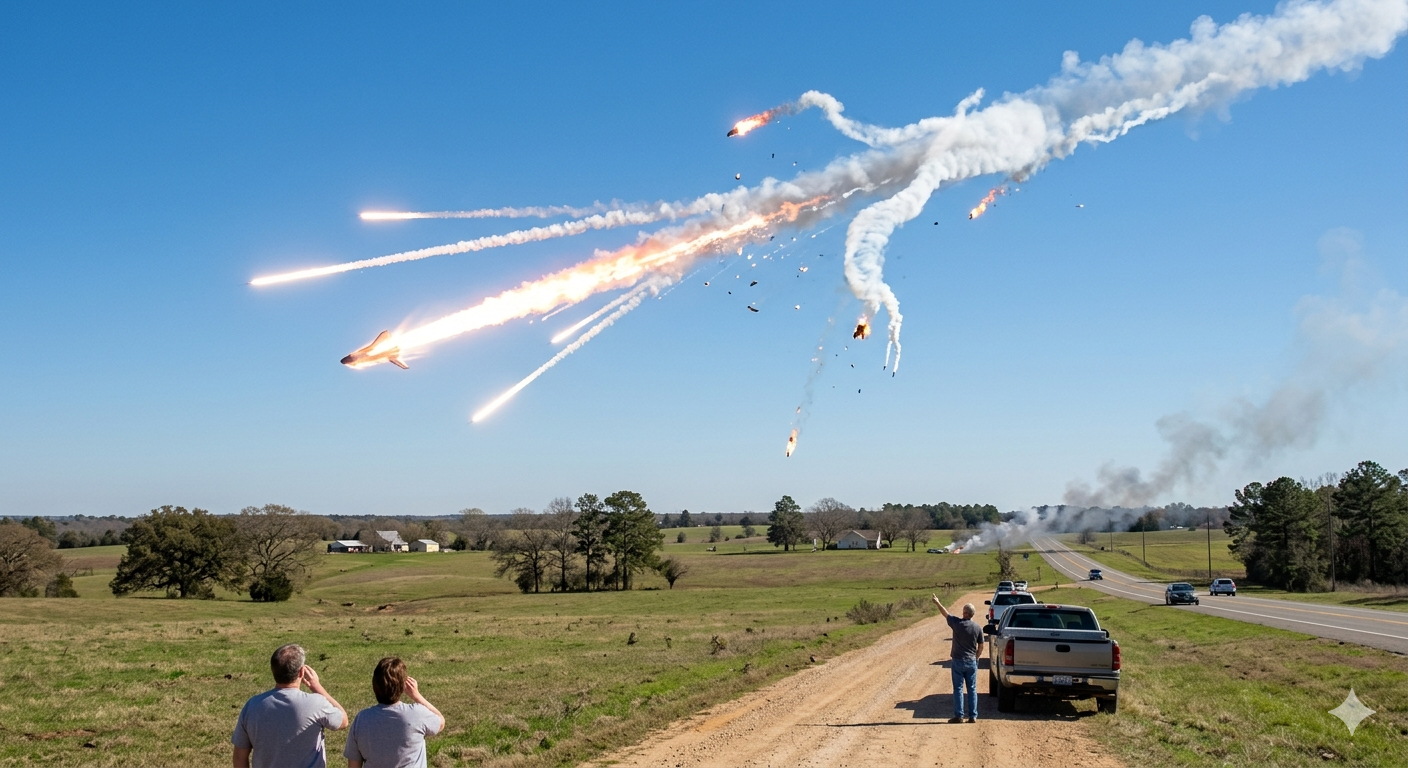
On the morning of February 1, 2003, hundreds of people had gathered at Kennedy Space Center in Florida in quiet anticipation of what everyone expected to be a routine landing. The seven astronauts aboard Space Shuttle Columbia had spent nearly sixteen days in orbit conducting scientific experiments, and they were minutes away from home. At Mission Control in Houston, flight controllers watched their consoles. Families of the crew waited. And then, at approximately 9:00 a.m. Eastern Standard Time, the data streams from Columbia went silent. Across the skies of Texas and Louisiana, witnesses on the ground looked up to see streaks of fire and cascading debris falling from a clear blue morning sky. Space Shuttle Columbia had disintegrated at an altitude of roughly 60 kilometers, traveling at eighteen times the speed of sound. All seven astronauts aboard were killed. It was the second catastrophic loss in the history of the space shuttle program, and it would change NASA—and the future of human spaceflight—forever.
The History of Space Shuttle Columbia: America’s Pioneer Orbiter
To understand what was lost on February 1, 2003, it is important to understand what Columbia meant to American space history. Columbia was the first space-rated orbiter of NASA’s Space Shuttle program and had carried astronauts into orbit for the very first time on April 12, 1981, when commander John Young and pilot Robert Crippen launched aboard the vehicle in the program’s debut mission, designated STS-1. Over the following two decades, Columbia had flown twenty-seven missions, accumulating a record that made it a symbol of American scientific ambition and the promise of reusable spaceflight.
By the time of its final mission in January 2003, Columbia was the oldest and heaviest of the operational orbiters in the shuttle fleet. The other orbiters — Discovery, Atlantis, and Endeavour, the last of which had been built to replace Challenger after the 1986 disaster — were primarily devoted to construction and resupply runs to the International Space Station. Columbia, with its different internal configuration, was used for research missions that required the SpaceHab laboratory module. The mission that would become its last, designated STS-107, had originally been scheduled for launch as early as January 2001, but had been delayed nearly two years due to payload conflicts, technical issues, and scheduling adjustments. Columbia finally launched on January 16, 2003, at 10:39 a.m. Eastern Standard Time from Launch Complex 39A at Kennedy Space Center.
The Seven Astronauts of STS-107: A Crew of Remarkable Diversity and Expertise
The crew selected for STS-107 was one of the most internationally diverse and scientifically accomplished groups in shuttle history. The mission was commanded by Rick D. Husband, a 45-year-old colonel in the United States Air Force and a test pilot who had previously flown on STS-96 in 1999, the first mission to dock with the International Space Station. Husband, who was originally from Amarillo, Texas, was known among his colleagues as a deeply principled leader who worked hard to foster unity among his crew. His daughter Laura later recalled that he had organized a team-building outdoor trip in Wyoming before the mission to help the crew bond before launch.
The pilot was William C. “Willie” McCool, 41, a commander in the United States Navy who was making his first spaceflight. The mission’s payload commander was Lieutenant Colonel Michael P. Anderson of the United States Air Force, 43, who had previously flown on STS-89 in 1998. Anderson was the most senior science officer on the mission and oversaw the research program.
Mission specialists David M. Brown, 46, and Laurel B. Clark, 41 — both Navy captains and both flying in space for the first time — were responsible for managing and conducting many of the scientific experiments carried in the SpaceHab module. Laurel Clark, who had lived in Scotland during a posting and was a fan of the Scottish Celtic-rock band Runrig, had arranged for one of their songs to serve as her wake-up call during the mission. Mission specialist Kalpana Chawla, 41, was an aerospace engineer born in Karnal, India, who held a doctorate in aerospace engineering from the University of Colorado-Boulder. She had previously flown on STS-87 in 1997 and served as the flight engineer for STS-107, working alongside Commander Husband on several of the payload bay experiments.
The seventh crew member was Ilan Ramon, 48, a colonel in the Israeli Air Force who was making his first spaceflight and who became the first Israeli astronaut to fly in space. Ramon’s presence on the mission had grown out of a 1995 agreement between United States President Bill Clinton and Israeli Prime Minister Shimon Peres on space cooperation between the two nations. Ramon had been selected as a payload specialist by the Israeli Air Force in 1997 and approved by NASA in 1998. He carried into orbit a small copy of a drawing by Petr Ginz, a fourteen-year-old Jewish boy who had been imprisoned at the Terezín concentration camp during the Holocaust and had sketched what he imagined the Earth looked like from the Moon. That drawing was lost when Columbia broke apart.
Eighty-Two Seconds After Launch: The Foam Strike That Sealed Columbia’s Fate
The chain of events that destroyed Columbia began not on February 1, but on January 16, 2003 — the very day the shuttle lifted off. At 81.7 seconds after launch, when Columbia was at approximately 65,600 feet and traveling at 1,650 miles per hour, a piece of insulating foam roughly 21 to 27 inches long and 12 to 18 inches wide broke off from the left bipod ramp area of the shuttle’s external fuel tank. The chunk of foam, which had been hand-crafted and applied to the tank, struck the leading edge of Columbia’s left wing, specifically impacting the reinforced carbon-carbon panels that formed the critical heat-shielding surface of the wing’s leading edge.
The strike was captured on camera by launch monitoring equipment, but the resolution was insufficient to clearly show the location and extent of the damage. Engineering teams and program managers were aware of the foam impact almost immediately. The Debris Assessment Team was convened to analyze the risk. However, a pattern of complacency that had built up over years of shuttle operations had normalized the occurrence of foam shedding—similar strikes had occurred on dozens of previous shuttle missions without causing catastrophic failure, and this gradual acceptance of risk had embedded itself deeply in NASA’s institutional culture. The Mission Management Team, led by manager Linda Ham, concluded that the foam impact posed no safety-of-flight concern. No external imaging of the damaged wing was requested from the Department of Defense, which had offered its high-resolution reconnaissance assets to photograph Columbia in orbit. No contingency plans were made.
The Columbia Accident Investigation Board later established that the foam impact created a hole approximately 6 to 10 inches wide in the reinforced carbon-carbon panels on the left wing’s leading edge. This breach meant that when Columbia re-entered the atmosphere, the superheated plasma generated by atmospheric friction — reaching temperatures of 2,400 degrees Fahrenheit and above — would have a direct pathway into the interior of the wing.
The Final Mission: Sixteen Days of Science Above the Earth
While the damage to the wing remained unaddressed and unacknowledged, the seven astronauts of STS-107 conducted what was by all scientific measures an extraordinarily productive mission. The crew worked in two alternating shifts — a Red Team consisting of Husband, Chawla, Clark, and Ramon, and a Blue Team consisting of McCool, Anderson, and Brown — allowing research to continue around the clock for the duration of the mission. Together, they performed approximately eighty experiments across disciplines including life sciences, materials science, fluid physics, atmospheric research, and combustion science.
The SpaceHab Research Double Module carried in Columbia’s payload bay hosted fifty-nine investigations, including work for the European Space Agency, nine commercial payloads, and numerous NASA-sponsored experiments. Ilan Ramon operated the Mediterranean Israeli Dust Experiment, a multispectral camera that measured dust aerosols in the atmosphere over the Mediterranean and the Saharan coast of the Atlantic. Kalpana Chawla worked on osteoporosis research in microgravity, while David Brown conducted combustion experiments examining how fire behaves in the absence of gravity. On January 28, Commander Husband gathered the crew for a moment of reflection, honoring the memory of the astronauts lost in the Challenger disaster seventeen years earlier and in the Apollo 1 fire on January 27, 1967. “It is today that we remember and honor the crews of Apollo 1 and Challenger,” Husband said.
Re-entry and Disintegration: What Happened on February 1, 2003
Columbia was scheduled to begin re-entry on the morning of February 1, 2003, with a planned touchdown at Kennedy Space Center at approximately 9:16 a.m. Eastern Standard Time. As the orbiter descended into the upper atmosphere over the Pacific Ocean and then began its approach over the American Southwest, the damage to the left wing’s leading edge began to exact its terrible consequence. At 8:52 a.m., sensors inside the left wing began recording rising temperatures — data that was transmitted to the ground but not fully understood by Mission Control in real time.
As Columbia flew over California and Nevada, observers on the ground reported seeing unusual debris separating from the vehicle and plasma trails that appeared abnormal. Ground radar operated by the United States Air Force at Kirtland Air Force Base in New Mexico captured imagery of Columbia at approximately 7:57 a.m. Central Standard Time showing the orbiter already exhibiting signs of structural distress. By the time Columbia was over Texas, traveling at 18 times the speed of sound and still 200,700 feet above the ground, the hot gases that had been entering the breach in the left wing had melted through the hydraulic lines and internal structural elements of the wing. The left wing failed catastrophically. The aerodynamic forces tearing at the asymmetrical vehicle were instantly uncontrollable.
At 8:59:32 a.m., Commander Rick Husband responded to a call from the capsule communicator at Mission Control with a single word — “Roger” — followed by part of another word that was cut off as communication was permanently lost. Columbia broke apart over northeastern Texas and southwestern Louisiana, scattering debris across an area of more than 2,000 square miles. Witnesses across eastern Texas reported hearing sonic booms and seeing flaming debris streak across the morning sky. At Mission Control in Houston, flight director Leroy E. Cain called for the doors to be locked and for all data to be preserved. “This is indeed a tragic day for the NASA family, for the families of the astronauts who flew on STS-107, and likewise is tragic for the nation,” said NASA Administrator Sean O’Keefe.
A NASA crew survival report released in 2008 revealed that the seven astronauts had likely survived the initial breakup of the vehicle but lost consciousness within seconds as the crew cabin depressurized rapidly. The crewmembers had not had time to close their helmet visors. Some were not wearing helmets or gloves. They were subjected to severe rotational forces as the shuttle rolled after the loss of the wing. The report listed the cause of death as blunt trauma and loss of oxygen.
The Search for Debris and the Reconstruction of What Was Lost
In the days and weeks following the disaster, a massive search and recovery effort unfolded across eastern Texas, western Louisiana, and neighboring states. The search was headquartered at Barksdale Air Force Base in Shreveport, Louisiana, and involved thousands of workers including NASA personnel, law enforcement officers, military units, and volunteers. The recovery effort was not without its own tragedy. On March 27, 2003, a helicopter supporting the search crashed in the Angelina National Forest in Texas, killing pilot Jules F. Mier Jr. and a Texas Forest Service aviation specialist, Charles Krenek, and injuring three other crew members.
In total, NASA recovered approximately 84,000 pieces of Columbia debris, representing roughly 38 percent of the orbiter’s total dry weight — far more than the 5 percent originally anticipated. The debris was transported to Kennedy Space Center, where NASA Launch Director Michael Leinbach led a reconstruction team that laid the recovered pieces out on the floor of the Reusable Launch Vehicle hangar in the shape of the orbiter, allowing investigators to study the pattern of damage for clues about the sequence of the disaster. Among the remarkably resilient survivors of re-entry was a collection of Caenorhabditis elegans roundworms, enclosed in aluminum canisters as part of a microgravity growth experiment, which were found alive on April 28, 2003. The remains of all seven crew members were recovered from the debris field and identified using DNA.
The Columbia Accident Investigation Board: Exposing the Technical and Cultural Failures
Within days of the disaster, NASA convened the Columbia Accident Investigation Board, known as the CAIB, to conduct a thorough independent investigation. The board was led by retired Admiral Harold W. Gehman Jr., former commander-in-chief of the United States Joint Forces Command, and included thirteen members drawn from government, academia, and the aerospace industry. The CAIB conducted public hearings from March through June 2003 and released its comprehensive final report in August 2003.
The report confirmed that the physical cause of the disaster was the foam strike at launch and the resulting breach in the left wing’s reinforced carbon-carbon panels. But the CAIB’s findings went far beyond identifying the technical failure. The board issued a sweeping indictment of NASA’s organizational culture, concluding that the agency had allowed a pattern of normalization of risk to develop over years of shuttle operations. The report stated that “cultural traits and organizational practices detrimental to safety were allowed to develop,” including “reliance on past success as a substitute for sound engineering practices.” The board was particularly critical of the Mission Management Team’s decision to classify the foam strike as a non-issue without obtaining external imaging of the wing, and of the institutional pressures that had made it difficult for engineers who held concerns about the damage to raise those concerns effectively through official channels.
The CAIB also made a finding that would haunt NASA’s leadership: it concluded that a rescue mission had been technically feasible. Space Shuttle Atlantis, which was already being prepared for the STS-114 mission, could potentially have been launched as early as February 10, giving a narrow window either for the STS-107 crew to transfer to Atlantis or for the Columbia crew to conduct a spacewalk repair of the damaged wing. Columbia could have remained in orbit until February 15, 2003. That option was never considered because NASA management never confirmed that the damage was serious. The board also investigated on-orbit repair options, though it concluded that no materials or adhesives available to the crew aboard Columbia could have survived the temperatures of re-entry.
Legacy and Lasting Impact: How the Columbia Disaster Changed NASA and Human Spaceflight
In the immediate aftermath of the Columbia disaster, the Space Shuttle program was grounded. Discovery, Atlantis, and Endeavour were stood down while NASA and its contractors developed new inspection procedures, repair techniques, and safety protocols to prevent a similar tragedy. The shuttle program did not return to flight until July 26, 2005, when Discovery launched on mission STS-114. Assembly of the International Space Station, which had been suspended following the disaster, was resumed using Russian Soyuz spacecraft for crew transport and Russian Progress vehicles for resupply during the two-and-a-half-year gap.
The shuttle program ultimately flew its final mission — STS-135, aboard Atlantis — in July 2011, completing 135 total flights over thirty years. Two of those 135 missions, Challenger and Columbia, had ended in catastrophe, claiming the lives of fourteen astronauts. On February 2, 2004, NASA Administrator Sean O’Keefe unveiled a memorial for the STS-107 crew at Arlington National Cemetery, located near the existing Challenger memorial. President George W. Bush posthumously awarded the Congressional Space Medal of Honor to all fourteen astronauts who had perished in the Challenger and Columbia disasters.
The crew of STS-107 was honored in numerous enduring ways. Seven asteroids discovered in July 2001 were named after the astronauts: 51823 Rickhusband, 51824 Mikeanderson, 51825 Davidbrown, 51826 Kalpanachawla, 51827 Laurelclark, 51828 Ilanramon, and 51829 Williemccool. India’s first dedicated meteorological satellite was renamed Kalpana-1 on February 5, 2003, in honor of Kalpana Chawla. The airport in Amarillo, Texas — Rick Husband’s hometown — was renamed the Rick Husband Amarillo International Airport. A mountain peak in Colorado’s Sangre de Cristo Range was renamed Columbia Point. The exhibit Forever Remembered at the Kennedy Space Center Visitor Complex preserves the cockpit window frames recovered from Columbia, offering visitors a tangible connection to the seven people who flew their final mission aboard her.
Columbia and its crew are remembered not only as a tragedy but as a warning. The disaster demonstrated with devastating clarity that even mature, proven technological systems can fail catastrophically when institutional culture values schedule and success over rigorous safety analysis, and when the voices of engineers who harbor doubts are not given adequate hearing. That lesson — perhaps more than any technical fix — is the enduring legacy of February 1, 2003.