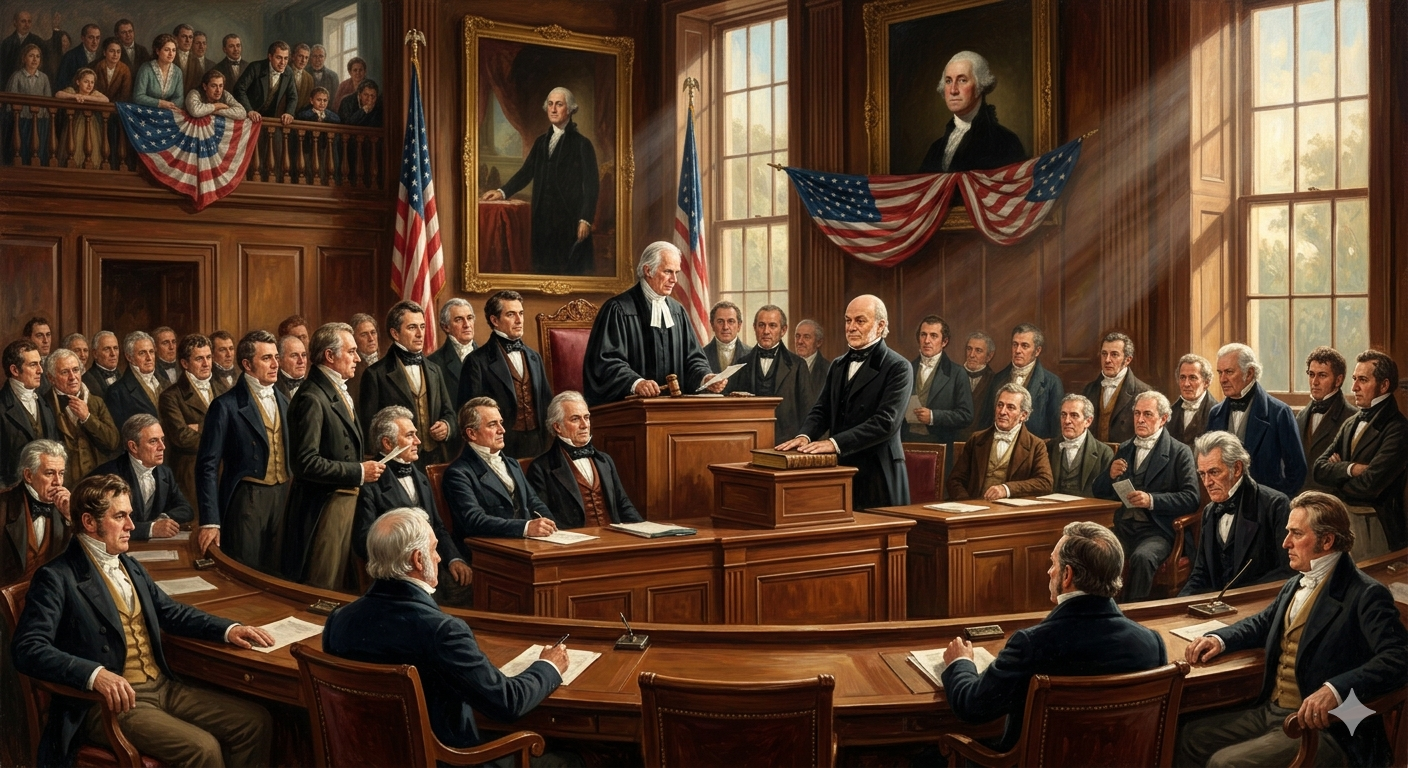
In the complex tapestry of American democracy, few events are as dramatic and constitutionally significant as when a presidential election fails to produce a clear winner through the Electoral College, forcing the decision into the halls of Congress for what is known as a “contingent election.” This extraordinary constitutional mechanism, embedded in the Twelfth Amendment to the United States Constitution, has been invoked only twice in American history to determine the presidency, creating some of the most politically charged and historically consequential moments in the nation’s development. The contingent election process represents a fascinating intersection of constitutional law, political strategy, and democratic theory, where the normal rules of presidential campaigns give way to an entirely different game of state delegation politics and congressional maneuvering. These rare occurrences in 1800 and 1824 not only determined the occupants of the highest office in the land but also shaped the evolution of American political parties, electoral procedures, and constitutional interpretation for generations to come. Understanding these pivotal moments provides crucial insight into the unique nature of American democracy and the complex safeguards the Founding Fathers built into the system to ensure legitimate governance even when the electoral process fails to produce a decisive outcome.
The Constitutional Framework: How the Twelfth Amendment Governs Contingent Elections
The constitutional mechanism that governs presidential elections decided by Congress is primarily outlined in the Twelfth Amendment, ratified on June 15, 1804, which refined and clarified the original Electoral College provisions established in Article II of the Constitution following the chaotic election of 1800. This amendment fundamentally transformed how contingent elections operate by establishing distinct procedures for selecting the president and vice president when no candidate receives a majority of electoral votes, creating a system that balances federalism, state representation, and democratic principles in ways that continue to shape American politics today.
When no presidential candidate secures an absolute majority of electoral votes (currently 270 out of 538), the Twelfth Amendment mandates that the House of Representatives immediately assumes responsibility for electing the president from among the three candidates who received the most electoral votes. This process, known as a contingent election, operates under rules that are dramatically different from normal legislative procedures, with each state delegation casting a single vote regardless of the state’s population or the number of representatives it has in Congress. This provision means that Wyoming, with its single representative, has the same voting power as California, which has 52 representatives, creating a system where geographic distribution of political support becomes more important than raw population numbers.
The amendment requires that a candidate receive support from an absolute majority of state delegations, currently 26 states, to be declared president, and voting continues on successive ballots until this threshold is achieved. This process can theoretically continue indefinitely, creating the potential for prolonged political deadlock if state delegations cannot reach consensus or if political maneuvering prevents the formation of a winning coalition. The constitutional framers included this safeguard to ensure that the eventual president would have geographically diverse support across the nation rather than being concentrated in heavily populated urban centers or specific regions.
Simultaneously, the Senate conducts its own election for vice president, choosing between the two candidates who received the most electoral votes for that office, with each individual senator casting one vote and a simple majority of 51 votes required for selection. This dual process can theoretically result in a president and vice president from different political parties, a scenario that would create unprecedented challenges for executive branch governance and party unity. The separate election of these offices reflects the Founding Fathers’ original conception of the vice presidency as an independent office rather than merely an extension of the presidential campaign.
The Twelfth Amendment also establishes important procedural safeguards and timelines for contingent elections, requiring that the process be completed before the constitutionally mandated inauguration date, currently January 20. If the House fails to elect a president by this deadline, the newly elected vice president would serve as acting president until the congressional deadlock is resolved, creating additional pressure for representatives to reach agreement and avoid a constitutional crisis that could undermine the legitimacy of the federal government.
The Election of 1800: Jefferson, Burr, and the First Constitutional Crisis
The presidential election of 1800 represents one of the most dramatic and consequential political events in early American history, marking the first peaceful transfer of power between opposing political parties while simultaneously exposing fundamental flaws in the original Electoral College system that necessitated constitutional amendment. The election pitted incumbent Federalist President John Adams against Democratic-Republican challenger Thomas Jefferson, but constitutional complications arising from the original electoral process created an unexpected crisis that threatened to undermine the stability of the young republic and establish dangerous precedents for future electoral disputes.
Under the original constitutional system, electors cast two votes for president without distinguishing between presidential and vice-presidential preferences, with the candidate receiving the most votes becoming president and the runner-up becoming vice president. This system worked adequately when George Washington was the unanimous choice for president, but the emergence of organized political parties in the 1790s created new complications that the Founding Fathers had not anticipated. The Democratic-Republicans nominated Thomas Jefferson for president and Aaron Burr for vice president, intending that Jefferson would receive the higher number of electoral votes, but careful party coordination resulted in both candidates receiving exactly 73 electoral votes, creating a constitutional deadlock.
The tie between Jefferson and Burr meant that the election was thrown into the House of Representatives, where Federalists, despite losing the popular election, retained control during the lame-duck session and found themselves in the unprecedented position of choosing between two Democratic-Republican candidates, neither of whom represented their political preferences. This situation created intense political maneuvering as Federalist representatives debated whether to support Jefferson, whom they viewed as a dangerous radical but a known quantity, or Burr, whom they considered more moderate but potentially unreliable and opportunistic in his political allegiances.
Alexander Hamilton, despite his personal animosity toward Jefferson stemming from their disagreements over federal economic policy, played a crucial role in the eventual outcome by urging Federalist representatives to support Jefferson rather than Burr, whom Hamilton regarded as fundamentally untrustworthy and lacking in the principled convictions necessary for effective presidential leadership. Hamilton’s extensive correspondence during the crisis reveals his belief that Jefferson, despite their political differences, possessed the character and intelligence necessary for the presidency, while Burr’s apparent willingness to accept Federalist support in exchange for policy concessions demonstrated a dangerous opportunism that could undermine republican government.
The House voting process extended through 36 ballots over six days of intensive deliberation from February 11 to February 17, 1801, with Jefferson initially receiving support from eight state delegations, Burr from six, and two delegations divided and therefore unable to cast votes. The eventual resolution came when key Federalist representatives from Vermont and Maryland abstained rather than supporting Burr, allowing Jefferson to secure the necessary majority of state delegations on the 36th ballot. This prolonged deadlock demonstrated the potential for constitutional crisis when electoral procedures failed to produce clear outcomes and highlighted the need for constitutional reforms that would prevent similar situations in future elections.
The Corrupt Bargain: The Election of 1824 and the Triumph of John Quincy Adams
The presidential election of 1824 produced the second and most recent contingent election in American history, creating a political controversy that would reshape party alignments and contribute to the emergence of modern democratic politics in the United States. This election occurred during the “Era of Good Feelings,” when the collapse of the Federalist Party had temporarily eliminated organized party competition, allowing multiple regional candidates to seek the presidency without clear party labels or unified national campaigns that might have consolidated support behind fewer contenders.
Four major candidates emerged from the Democratic-Republican Party to contest the 1824 election: Andrew Jackson of Tennessee, a military hero from the War of 1812; John Quincy Adams of Massachusetts, son of former President John Adams and serving as Secretary of State; Henry Clay of Kentucky, Speaker of the House and architect of the American System of internal improvements; and William Crawford of Georgia, Secretary of the Treasury who suffered a debilitating stroke during the campaign but remained in the race. This fragmentation of political leadership reflected the absence of strong party organization and the regional nature of early 19th-century American politics, where sectional interests often trumped national party loyalty.
The electoral results reflected the candidates’ regional appeal and the absence of a truly national political organization capable of building geographically diverse coalitions. Jackson received 99 electoral votes and 153,544 popular votes, carrying much of the South and West; Adams received 84 electoral votes and 108,740 popular votes, dominating New England; Crawford received 41 electoral votes and 46,618 popular votes from his Georgia base and scattered Southern support; and Clay received 37 electoral votes and 47,136 popular votes from Kentucky and Ohio. Jackson’s plurality in both electoral and popular votes made him the apparent front-runner, but his failure to achieve the necessary majority of 131 electoral votes threw the election into the House of Representatives.
The House election was complicated by Henry Clay’s elimination from consideration, as the Twelfth Amendment limited the congressional choice to the top three electoral vote recipients, leaving only Jackson, Adams, and Crawford as potential presidents despite Clay’s significant political influence as Speaker of the House. Clay’s position became crucial because his supporters in the Western states held the balance of power in determining the outcome, and his decision to throw his support behind Adams rather than Jackson would prove decisive in the eventual vote. Clay’s choice reflected both his policy preferences, as he shared Adams’s support for federal internal improvements and protective tariffs, and his personal animosity toward Jackson, whom he viewed as unqualified for the presidency despite his military achievements.
The House voting took place on February 9, 1825, with Adams receiving support from 13 state delegations (New York, New England states, Maryland, Louisiana, Missouri, Ohio, Kentucky, and Illinois), Jackson receiving 7 delegations (Pennsylvania, South Carolina, Alabama, Mississippi, Tennessee, Indiana, and New Jersey), and Crawford receiving 4 delegations (North Carolina, Georgia, Virginia, and Delaware). Adams’s victory was secured by Clay’s influence in convincing the Kentucky delegation to support the Massachusetts candidate despite Jackson’s stronger showing in the general election, a decision that would have profound political consequences for both men.
The aftermath of Adams’s election created the “corrupt bargain” controversy when the new president nominated Henry Clay as Secretary of State, the traditional stepping stone to the presidency. Jackson and his supporters denounced this appointment as evidence of a corrupt deal between Adams and Clay to deny the presidency to the candidate who had received the most popular and electoral votes, creating a political narrative that would fuel Jackson’s successful 1828 presidential campaign and contribute to the formation of the Democratic Party as a vehicle for Jackson’s political ambitions.
The “Corrupt Bargain” Controversy: Political Fallout and Party Realignment
The appointment of Henry Clay as Secretary of State by President John Quincy Adams following the contingent election of 1825 created one of the most enduring political controversies in American history, generating accusations of corruption and manipulation that fundamentally altered the trajectory of American politics and contributed to the formation of the modern Democratic Party. The “corrupt bargain” allegation, though never proven and vigorously denied by both Adams and Clay, provided Andrew Jackson and his supporters with a powerful narrative of political victimization that resonated with American voters who increasingly valued democratic legitimacy and popular sovereignty over elite political maneuvering.
The timing and nature of Clay’s appointment made the corruption charges particularly damaging because the Secretary of State position had traditionally served as a stepping stone to the presidency, with both Jefferson and Madison having held the office before their presidential elections. Jackson’s supporters argued that Clay had effectively sold his influence in the House election in exchange for the promise of succession to the presidency, creating a scenario where the will of the people, as expressed through Jackson’s popular vote plurality, had been subverted by elite political deal-making that undermined the democratic principles underlying the American constitutional system.
The political consequences of the corrupt bargain controversy extended far beyond the immediate participants to reshape the entire American party system and establish new standards for political legitimacy that emphasized popular democracy over elite governance. Jackson’s supporters began organizing immediately after Adams’s inauguration to build a political movement that would restore Jackson to his rightful position as president while preventing future subversion of popular will through congressional manipulation of contingent elections. This organizational effort drew on Democratic-Republican political networks throughout the country while appealing to broader democratic sentiments that viewed the 1825 House election as fundamentally illegitimate.
The controversy also revealed important tensions within American democratic theory between different conceptions of legitimate political authority, with Adams and Clay arguing that the constitutional system had operated as intended while Jackson’s supporters contended that popular sovereignty should take precedence over constitutional technicalities when the two came into conflict. This debate reflected broader questions about the nature of American democracy and the appropriate role of political elites in mediating between popular preferences and constitutional requirements, issues that would continue to influence American politics throughout the 19th and 20th centuries.
The formation of the Democratic Party as a vehicle for Jackson’s 1828 presidential campaign represented the most significant long-term consequence of the corrupt bargain controversy, as it created a new political organization that emphasized popular democracy, limited government, and suspicion of elite political manipulation. This new party drew on existing Democratic-Republican networks while expanding political participation to include groups that had previously been excluded from active political engagement, including small farmers, urban workers, and western settlers who identified with Jackson’s populist political message and his image as a champion of common people against corrupt political elites.
Constitutional Implications and Modern Relevance
The historical experiences of contingent elections in 1800 and 1824 provide important insights into the strengths and weaknesses of the American constitutional system while highlighting potential challenges that could arise if future presidential elections fail to produce Electoral College majorities. These historical precedents demonstrate both the constitutional system’s capacity to resolve electoral deadlocks peacefully and the potential for such situations to create political crises that test the legitimacy of democratic institutions and the stability of American governance.
The possibility of future contingent elections has become increasingly relevant in recent decades as American politics has become more polarized and geographically concentrated, creating scenarios where third-party candidates or regional political movements could potentially deny major party candidates the electoral majorities necessary to avoid House elections. The growth of third-party movements, the increasing competitiveness of presidential elections, and the geographic clustering of partisan voters all contribute to conditions that could theoretically produce future contingent elections, particularly in scenarios where no candidate achieves clear geographic and demographic dominance.
Modern constitutional scholars and political scientists have identified several potential problems with the contingent election process that could create serious challenges if future presidential elections require House resolution. The principle of state equality in House elections, where Wyoming’s single representative has the same voting power as California’s 52-member delegation, contradicts democratic principles of proportional representation while potentially allowing candidates with limited popular support to achieve the presidency through strategic appeals to small-state delegations. This system could theoretically allow a candidate who finished third in both popular and electoral votes to win the presidency by building a coalition of small-state delegations, creating a legitimacy crisis that could undermine public confidence in democratic institutions.
The potential for deadlock in contingent elections also poses serious risks to governmental stability and constitutional governance, as the requirement for absolute majorities in state delegations could create situations where political polarization prevents the formation of winning coalitions. If state delegations are evenly divided between parties or if strategic considerations prevent representatives from supporting any of the available candidates, the House could theoretically remain deadlocked past the constitutional inauguration deadline, creating unprecedented constitutional and political crises that would test the resilience of American democratic institutions.
Contemporary discussions of Electoral College reform often focus on these potential complications while proposing alternative systems that would eliminate the possibility of contingent elections through direct popular vote mechanisms or proportional electoral vote allocation systems. However, defenders of the current system argue that the contingent election mechanism provides important safeguards against regional candidates or extremist movements while ensuring that presidential candidates must build geographically diverse coalitions rather than simply maximizing vote totals in heavily populated urban areas. These debates reflect ongoing tensions between different conceptions of democratic legitimacy and federal representation that have shaped American politics since the founding era and continue to influence contemporary electoral reform discussions.
State Delegation Dynamics and Modern Political Considerations
Understanding the dynamics of state delegations in potential future contingent elections requires careful analysis of contemporary political geography and party representation patterns that differ significantly from the historical contexts of 1800 and 1824. Modern state delegations reflect complex interactions between partisan gerrymandering, geographic sorting of political preferences, and demographic changes that create delegation compositions that may not accurately represent statewide political preferences or presidential election outcomes within individual states.
The current composition of House state delegations shows significant variation in partisan control, with some states having clear Republican or Democratic majorities while others have closely divided delegations that could become deadlocked in contingent election scenarios. As of recent congressional elections, Republicans control majorities in approximately 26 state delegations while Democrats control fewer delegations, creating a situation where Republican presidential candidates might have advantages in potential contingent elections regardless of their performance in the Electoral College or popular vote. This partisan imbalance reflects both geographic concentration of Democratic voters in urban areas and the effects of gerrymandering that can create artificial majorities within state delegations.
The potential for deadlocked state delegations poses particular challenges in closely divided states where neither party controls a clear majority of House seats, as these delegations would be unable to cast votes in contingent elections unless internal agreements could be reached to break ties. States with even numbers of representatives and equal partisan representation would face particular difficulties in reaching consensus, potentially requiring elaborate negotiations or strategic abstentions to enable voting. Such deadlocks could effectively reduce the number of votes available in contingent elections while creating additional pressure on representatives from swing delegations to determine the presidency.
Strategic considerations in potential contingent elections would likely focus heavily on the persuadability of individual representatives and the internal dynamics of closely divided state delegations, creating scenarios where national presidential campaigns might need to pivot to intensive lobbying of specific House members rather than broad public appeal. This dynamic could fundamentally alter the nature of presidential politics by shifting focus from mass democratic appeal to elite persuasion while potentially creating opportunities for corruption or inappropriate influence that could undermine public confidence in the electoral process.
The role of third parties and independent candidates in potential future contingent elections adds another layer of complexity, as these candidates could potentially influence the selection of the three finalists eligible for House consideration while building strategic alliances with major party candidates seeking to secure necessary state delegation majorities. The presence of regionally strong third-party candidates could create kingmaker scenarios where minor candidates exercise disproportionate influence over presidential selection, potentially allowing ideological extremists or single-issue movements to extract policy concessions in exchange for their support in contingent elections.
Lessons from History: Preventing Future Electoral Crises
The historical experiences of 1800 and 1824 provide valuable lessons for understanding how contingent elections operate in practice while highlighting potential reforms that could prevent future electoral crises or minimize their disruptive effects on American democratic governance. These historical precedents demonstrate both the constitutional system’s ultimate capacity to resolve electoral deadlocks peacefully and the political costs associated with elections that appear to contradict popular will or democratic legitimacy, suggesting the importance of electoral mechanisms that maintain public confidence in democratic institutions.
The rapid adoption of the Twelfth Amendment following the 1800 election crisis demonstrates the constitutional system’s capacity for adaptation and reform when electoral mechanisms prove inadequate or create unintended consequences that threaten democratic governance. This constitutional change eliminated the possibility of ties between presidential and vice presidential candidates while clarifying the procedures for contingent elections, showing how democratic systems can learn from experience and implement structural reforms that prevent the recurrence of specific problems. The speed and consensus behind the Twelfth Amendment’s adoption reflected broad recognition that the original electoral system was incompatible with the reality of organized party competition that had emerged in American politics.
Modern proposals for Electoral College reform often draw on these historical experiences while addressing contemporary concerns about democratic legitimacy and effective governance that have become more prominent as American society has become more diverse and politically polarized. Some reform proposals focus on eliminating the possibility of contingent elections entirely through direct popular vote systems that would ensure the candidate with the most votes nationwide becomes president, while others propose proportional allocation of electoral votes within states that would make Electoral College deadlocks less likely while preserving federalist principles.
Alternative reform approaches focus on modifying the contingent election process itself rather than eliminating the Electoral College, proposing changes such as allowing House members to vote individually rather than by state delegation, expanding the number of candidates eligible for House consideration beyond three, or establishing different procedures for breaking deadlocks that might arise during contingent elections. These proposals attempt to address democratic legitimacy concerns while preserving the essential structure of the Electoral College system and its emphasis on federalist representation and geographic coalition-building.
The political lessons from historical contingent elections also suggest the importance of clear constitutional procedures and established precedents that can guide political actors during electoral crises while minimizing opportunities for manipulation or abuse that could undermine public confidence in democratic institutions. The detailed procedural framework established by the Twelfth Amendment has provided stability and predictability for more than two centuries, demonstrating how constitutional clarity can prevent the kind of improvisation and uncertainty that characterized the 1800 election crisis before formal amendment of the constitutional text.