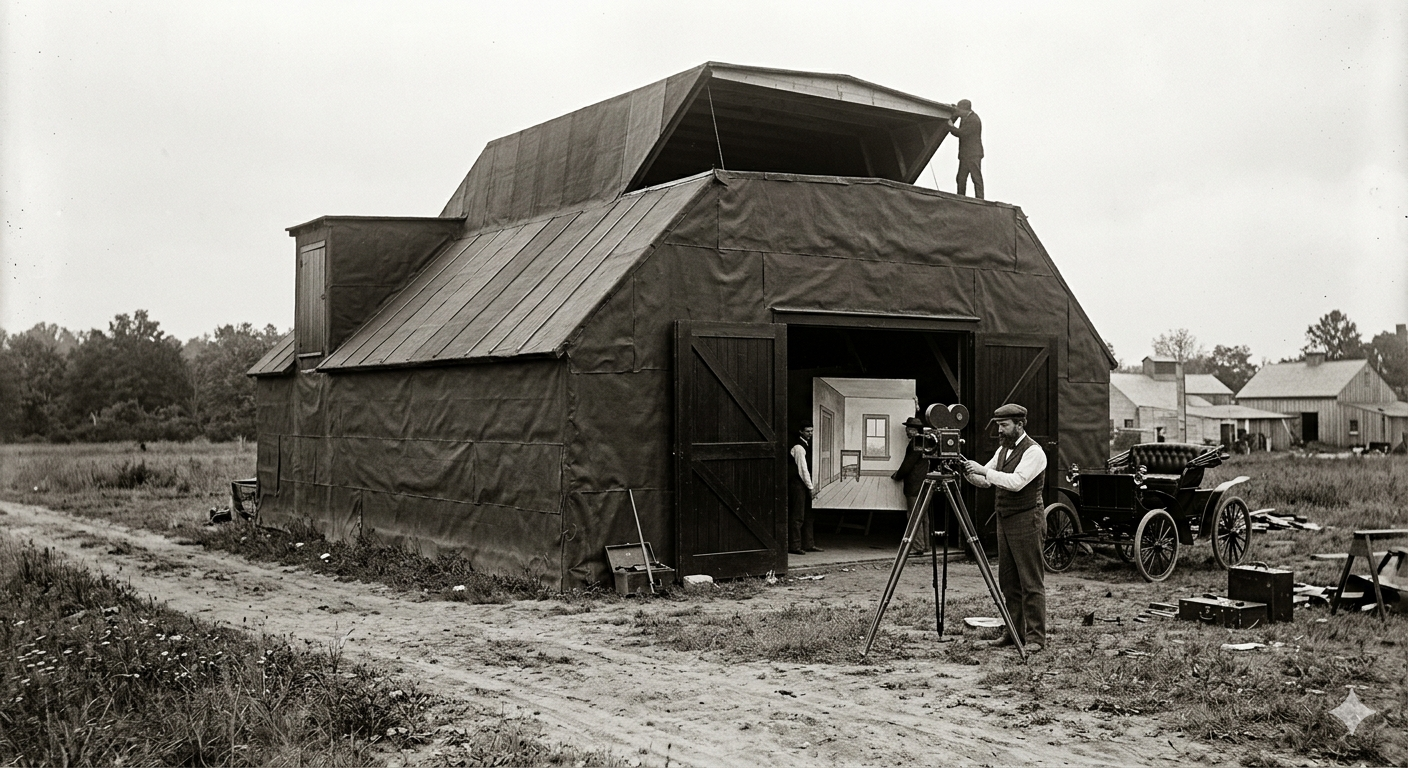
In February 1893, Thomas Alva Edison forever changed the course of entertainment history when he completed construction of the world’s first dedicated motion picture studio, known as the Black Maria, on the grounds of his West Orange Laboratories in New Jersey, marking the beginning of an industry that would eventually become one of America’s most influential cultural and economic forces. This revolutionary facility, costing a modest $637.67 to construct (equivalent to approximately $22,316 in today’s currency), represented the culmination of Edison’s years of experimentation with motion pictures and his collaboration with talented inventor William Kennedy Laurie Dickson, who had been working tirelessly since 1889 to perfect the technology that would make commercial film production possible. The Black Maria, nicknamed by Edison’s staff after the black prison wagons of the era due to its distinctive tar-paper-covered exterior and windowless design, was specifically engineered to address the technical challenges of early cinematography, featuring innovative design elements including a retractable roof for natural lighting control and a revolutionary pivot system that allowed the entire building to rotate on a circular track to follow the sun’s path throughout the day. This remarkable facility would serve as the birthplace of American cinema, producing between 200 and 300 films over its decade of operation and establishing the fundamental principles of studio-based film production that would eventually spread across the globe and transform entertainment from a live, localized experience into a mass medium capable of reaching millions of viewers simultaneously. The studio’s completion represented not just a technological achievement but a cultural milestone that would democratize entertainment, preserve performances for posterity, and create entirely new forms of artistic expression that continue to evolve and influence global culture more than a century after the first cameras began rolling in Edison’s pioneering facility.
The Scientific Foundation: Edison’s Path to Motion Picture Innovation
Thomas Edison’s journey toward creating the world’s first motion picture studio began in the 1880s when the renowned inventor became fascinated with the possibility of creating moving images to complement his already successful phonograph technology, leading him to envision a complete entertainment system that would capture and reproduce both sound and vision for commercial exploitation. Edison’s initial concept, which he described in a caveat filed with the United States Patent Office in October 1888, outlined his vision for what he called a “kinetoscope” that would “do for the eye what the phonograph does for the ear,” demonstrating his understanding that successful innovation required not just technical achievement but also practical application that could reach mass audiences and generate sustainable revenue streams.
The development of Edison’s motion picture technology accelerated dramatically when he hired William Kennedy Laurie Dickson, a talented young inventor and photographer who possessed both the technical expertise and creative vision necessary to transform Edison’s theoretical concepts into a working apparatus that could reliably capture, process, and display moving images. Dickson’s background in photography and his understanding of the chemical processes involved in image capture proved invaluable as he worked to solve the complex technical challenges involved in creating a practical motion picture system, including the development of flexible film stock, precise mechanical timing mechanisms, and optical systems capable of creating the illusion of motion from rapidly displayed still images.
The collaboration between Edison and Dickson represented a perfect combination of visionary leadership and technical expertise, as Edison provided the financial resources, laboratory facilities, and business acumen necessary for large-scale innovation while Dickson contributed the hands-on engineering skills and creative problem-solving abilities required to overcome the numerous technical obstacles that stood between concept and commercial reality. Their partnership would establish a model for industrial research and development that would influence American innovation for decades to come, demonstrating how successful technological advancement required not just individual genius but also collaborative effort, substantial financial investment, and systematic experimentation over extended periods.
The international context of Edison’s motion picture development efforts was shaped by simultaneous research being conducted by inventors in Europe, particularly Eadweard Muybridge’s motion studies and Étienne-Jules Marey’s chronophotographic experiments, creating a competitive environment that encouraged rapid innovation while also providing opportunities for cross-pollination of ideas and techniques that would accelerate the overall development of motion picture technology. Edison’s awareness of these international developments influenced his decision to focus on creating a complete commercial system rather than simply developing individual components, recognizing that lasting success would require not just technical innovation but also comprehensive business infrastructure capable of supporting sustained commercial exploitation of the new medium.
William Kennedy Laurie Dickson: The Unsung Pioneer of Cinema
William Kennedy Laurie Dickson’s contributions to the development of motion pictures and the creation of the first movie studio have often been overshadowed by Thomas Edison’s fame and business acumen, yet Dickson’s technical innovations and creative vision were absolutely essential to the success of Edison’s motion picture ventures and the establishment of fundamental principles that would guide the film industry for generations to come. Born in France to British parents and educated in England before immigrating to the United States, Dickson brought a sophisticated understanding of European scientific and artistic traditions to his work at Edison’s laboratory, helping to ensure that American motion picture technology would incorporate the best international practices while also developing distinctly American approaches to commercial entertainment production.
Dickson’s primary responsibility involved solving the complex technical challenges associated with creating a practical motion picture camera and viewing apparatus, requiring him to develop innovations in mechanical engineering, optics, chemistry, and precision manufacturing that pushed the boundaries of contemporary technology and established new standards for industrial precision and reliability. His development of the Kinetograph camera involved creating mechanisms capable of advancing photographic film at precise intervals while maintaining proper registration and exposure, requiring innovations in gear ratios, timing mechanisms, and film transport systems that would influence camera design for decades after the Edison studio’s establishment.
The Kinetoscope viewing apparatus developed by Dickson represented an equally impressive technical achievement, requiring the creation of optical systems capable of creating smooth motion illusion from rapidly displayed still images while also incorporating electrical lighting systems that would provide consistent illumination for viewing experiences. Dickson’s understanding of human perception and the physiological basis of motion illusion helped him optimize the Kinetoscope’s viewing experience, ensuring that audiences would perceive smooth, natural motion rather than the jerky, fragmented images that characterized many early attempts at motion picture display.
Dickson’s artistic sensibilities and understanding of theatrical conventions proved equally important to the success of Edison’s motion picture venture, as he helped develop filming techniques, staging approaches, and performance styles that would translate effectively from live theater and vaudeville to the new medium of film. His background in photography provided him with essential knowledge about composition, lighting, and visual storytelling that would prove crucial as the Edison studio began producing films for commercial distribution, establishing aesthetic principles that would influence filmmaking long after the Black Maria’s closure.
The working relationship between Dickson and Edison illustrated both the possibilities and the tensions inherent in collaborative innovation, as Dickson’s technical expertise and creative vision sometimes conflicted with Edison’s business priorities and desire for rapid commercial exploitation of new technologies. These tensions would eventually contribute to Dickson’s departure from Edison’s organization in 1895, but his foundational contributions to motion picture technology and studio-based film production would continue to influence the industry throughout its subsequent development and expansion.
Architectural Innovation: Designing the Perfect Motion Picture Facility
The design and construction of the Black Maria represented a revolutionary approach to building design that prioritized the specific technical requirements of motion picture production over conventional architectural concerns, creating the world’s first purpose-built film studio and establishing design principles that would influence movie studio construction throughout the industry’s subsequent development. The facility’s most distinctive feature was its tar-paper-covered exterior, which earned it the nickname “Black Maria” due to its resemblance to the horse-drawn police wagons commonly used for prisoner transport during the 1890s, but this unusual appearance resulted from practical considerations about light control and weather protection rather than aesthetic preferences or cost savings.
The studio’s interior dimensions of approximately 50 feet in length and 14 feet in width were carefully calculated to accommodate the staging requirements of typical vaudeville and theatrical performances while also providing adequate space for camera placement and crew movement, demonstrating Edison and Dickson’s understanding that successful film production required not just technical equipment but also appropriate spatial arrangements that could support complex collaborative work processes. The building’s interior was painted entirely black to minimize unwanted light reflections and provide maximum control over illumination conditions, establishing a practice that would become standard in professional film studios throughout the world.
Perhaps the most innovative aspect of the Black Maria’s design was its retractable roof system, which consisted of hinged panels that could be opened to provide natural sunlight for filming while also allowing for rapid closure when weather conditions threatened equipment or when artificial lighting was preferred for specific artistic effects. This roof system represented a sophisticated understanding of the lighting requirements for early film stock, which was far less sensitive than modern materials and required intense illumination to produce acceptable image quality, making natural sunlight the most practical and economical lighting source for sustained commercial production.
The building’s most remarkable engineering feature was its pivot system, which allowed the entire structure to rotate on a circular track to follow the sun’s movement throughout the day, ensuring optimal lighting conditions for filming regardless of the time of day or season of the year. This rotating mechanism required precise engineering and substantial structural modifications to support the building’s weight while maintaining smooth operation, demonstrating the level of technical sophistication that Edison was willing to invest in creating the ideal environment for motion picture production.
The Black Maria’s location on the grounds of Edison’s West Orange laboratory complex provided numerous practical advantages for film production, including access to the inventor’s machine shops for equipment maintenance and modification, proximity to electrical power generation facilities, and availability of skilled technicians who could assist with the complex technical requirements of early cinematography. This integration of film production with Edison’s broader research and development activities created synergies that accelerated innovation while also ensuring that motion picture technology development could benefit from advances in other areas of Edison’s scientific and commercial activities.
Early Productions: The Birth of American Cinema
The first films produced in the Black Maria during 1893 and 1894 established fundamental conventions of cinematic storytelling while also serving as important technical experiments that helped Edison and Dickson refine their equipment and production processes for commercial exploitation. These early productions featured a diverse range of performers and subjects, including circus acts, vaudeville performers, dancers, boxers, and everyday activities, reflecting Edison’s understanding that successful commercial cinema would need to appeal to broad audiences with varied interests and entertainment preferences while also demonstrating the medium’s capability to capture and preserve different types of human activity and artistic expression.
One of the most famous early Edison films, “Fred Ott’s Sneeze,” produced in January 1894, featured Edison laboratory employee Fred Ott performing an exaggerated sneeze for the camera, becoming the first motion picture to receive copyright protection in the United States and establishing important legal precedents for the commercial exploitation of filmed entertainment. This seemingly simple film actually represented a sophisticated technical achievement, requiring precise timing, proper lighting, and careful camera operation to capture a brief, spontaneous human action in sufficient detail to create an entertaining viewing experience for Kinetoscope audiences.
The Edison studio’s production of boxing films represented a particularly important development in early cinema, as these subjects required the camera to capture rapid, complex physical movements while also maintaining visual clarity and dramatic interest throughout extended sequences. Films featuring professional boxers like James J. Corbett and Michael Leonard demonstrated the medium’s ability to preserve athletic performances and provide audiences with access to sporting events they might not otherwise be able to witness, establishing sports entertainment as a crucial component of commercial cinema that continues to generate substantial revenue for the film and television industry.
Dance and musical performances filmed in the Black Maria showcased the studio’s ability to capture artistic expression and cultural performances, with subjects ranging from classical ballet to popular social dances and ethnic folk traditions that reflected the diversity of American entertainment culture during the 1890s. These films served not only as entertainment but also as important cultural documents that preserved performance traditions and artistic styles that might otherwise have been lost to history, demonstrating cinema’s potential as both commercial entertainment and cultural preservation medium.
The Edison studio’s experiments with narrative filmmaking, though limited by the brief duration possible with early Kinetoscope technology, began to explore the medium’s potential for storytelling and dramatic presentation that would eventually evolve into the complex narrative structures characteristic of modern cinema. These early narrative experiments, including simple dramatic scenes and comic vignettes, established basic principles of film editing, performance for camera, and visual storytelling that would influence filmmaking throughout its subsequent development and provide the foundation for cinema’s evolution into a sophisticated art form capable of complex emotional and intellectual expression.
The Kinetoscope Revolution: Commercializing Motion Pictures
The commercial success of Edison’s motion picture venture depended not only on the ability to produce films in the Black Maria but also on the development of effective distribution and exhibition systems that could bring the new entertainment medium to paying audiences throughout the United States and eventually around the world. The Kinetoscope viewing apparatus, developed by Dickson to display films produced in the Edison studio, represented a revolutionary approach to entertainment distribution that made individual viewing experiences possible while also creating sustainable revenue streams for content producers and exhibition operators.
The first commercial Kinetoscope installation opened on April 14, 1894, when brothers Andrew M. Holland and George C. Holland established a Kinetoscope Parlor at 1155 Broadway in New York City, creating the world’s first commercial movie theater and demonstrating that audiences were willing to pay for the novel experience of viewing moving pictures. This facility featured multiple Kinetoscope machines, each displaying different films and allowing customers to view several short subjects for a single admission price, establishing the basic economic model that would eventually evolve into the modern cinema exhibition industry.
The rapid expansion of Kinetoscope parlors throughout the United States during 1894 and 1895 demonstrated the substantial public demand for motion picture entertainment while also creating a distribution network that could support sustained film production at the Black Maria and provide economic incentives for continued technological development and artistic innovation. The success of these early exhibitions validated Edison’s belief that motion pictures could become a profitable commercial enterprise rather than merely a scientific curiosity or technological demonstration.
The international expansion of Kinetoscope distribution brought Edison’s motion pictures to audiences in Europe, Asia, and other international markets, establishing American cinema as a global entertainment medium and creating cultural exchange opportunities that would influence artistic and technological development in multiple countries. This early internationalization of American motion pictures established precedents for the global distribution of entertainment content that would eventually make Hollywood productions dominant in international markets throughout the twentieth century.
The economic success of the Kinetoscope also attracted competitors and imitators who sought to develop alternative motion picture technologies that could challenge Edison’s patents and create additional opportunities for commercial exploitation of the growing public interest in moving pictures. This competitive environment accelerated technological innovation while also creating legal disputes over patent rights that would influence the structure and development of the American film industry for decades to come, ultimately leading to the establishment of the Motion Picture Patents Company and subsequent antitrust actions that would reshape the industry’s competitive landscape.
Technological Challenges and Innovations: Perfecting Early Cinema
The operation of the world’s first motion picture studio required Edison and his team to overcome numerous technical challenges that had never been encountered before, ranging from the development of suitable photographic film stock to the creation of mechanical systems capable of precise timing and reliable operation under the demanding conditions of commercial film production. The photographic film used in early Edison productions required careful chemical processing and precise handling to achieve acceptable image quality, with Dickson and his assistants developing specialized techniques for film developing, printing, and preservation that would establish standards for professional film processing that continued to influence the industry long after the introduction of more advanced materials and equipment.
The mechanical complexity of the Kinetograph camera required constant maintenance and adjustment to ensure reliable operation, with Edison’s machine shop personnel developing specialized tools and techniques for repairing and calibrating the precision mechanisms that were essential for successful cinematography. The camera’s intermittent movement mechanism, which advanced the film frame by frame while providing precise registration for each exposure, represented a particular engineering challenge that required innovations in gear design, timing mechanisms, and mechanical precision that pushed the boundaries of contemporary manufacturing capabilities.
Lighting control represented another significant technical challenge for Black Maria productions, as the early photographic emulsions required intense illumination to achieve acceptable exposure while the studio’s design had to balance natural lighting with weather protection and the need for consistent illumination quality throughout extended filming sessions. Dickson experimented with various artificial lighting techniques, including electric arc lights and improved gas lighting systems, while also developing techniques for manipulating natural sunlight through the use of reflectors and diffusion materials that would maximize the effectiveness of available illumination.
The storage and preservation of completed films presented additional technical challenges, as the nitrate-based film stock used in early productions was highly flammable and chemically unstable, requiring specialized storage conditions and handling procedures to prevent deterioration and ensure that valuable film content could be preserved for future distribution and exhibition. Edison’s laboratory developed some of the first systematic approaches to film archival and preservation, establishing practices that would influence professional film storage throughout the industry’s subsequent development.
The synchronization of sound and picture, which Edison attempted through the development of his Kinetophone system, represented perhaps the most ambitious technical challenge faced by the Black Maria production team, requiring precise mechanical coordination between phonograph and Kinetoscope equipment while also demanding new approaches to performance and recording that could accommodate the requirements of both audio and visual recording systems simultaneously. Although these early experiments with synchronized sound were not commercially successful, they established important precedents for the development of sound motion pictures that would eventually revolutionize the industry during the late 1920s.
Competition and Patent Wars: The Business of Early Cinema
The commercial success of Edison’s motion picture venture inevitably attracted competitors who sought to develop alternative technologies and business models that could challenge Edison’s dominance in the emerging entertainment industry, leading to a series of patent disputes and legal battles that would influence the structure and development of American cinema throughout the industry’s formative years. Edison’s aggressive defense of his motion picture patents reflected his understanding that technological innovation required substantial investment and legal protection to ensure that inventors could recover their development costs and profit from their creative work, but his patent enforcement efforts also created tensions with other inventors and entrepreneurs who believed that overly broad patent claims could stifle innovation and limit competitive opportunities.
The development of alternative motion picture technologies by inventors like the Lumière Brothers in France and other international competitors demonstrated that Edison’s approach to cinematography was not the only viable solution to the technical challenges of motion picture production, creating pressure for continued innovation and improvement while also establishing international competition that would influence American film industry development throughout its subsequent history. These alternative technologies often emphasized different aspects of motion picture production and exhibition, with some focusing on projection systems for large audiences rather than individual viewing devices, creating diverse approaches to commercializing the new medium.
The emergence of domestic competitors like the American Mutoscope Company, founded by former Edison employee W.K.L. Dickson after his departure from the Edison organization, illustrated how the motion picture industry’s rapid growth created opportunities for experienced technicians and creative personnel to establish independent ventures that could challenge established companies while also contributing to overall industry expansion and innovation. Dickson’s decision to leave Edison and establish a competing company reflected both personal ambitions and disagreements over creative control and business strategy that would become common themes in the entertainment industry’s subsequent development.
The formation of the Motion Picture Patents Company in 1908, which attempted to create a monopolistic trust controlling all aspects of American motion picture production and distribution, represented Edison’s most ambitious effort to maintain control over the industry he had helped create, but the trust’s ultimate failure demonstrated that technological innovation and creative expression could not be successfully monopolized in a dynamic, rapidly evolving entertainment market. The trust’s legal challenges and eventual dissolution under antitrust pressure established important precedents for competition policy in creative industries while also contributing to the geographic shift of film production from the East Coast to Hollywood.
The patent wars of the early motion picture industry established important principles about intellectual property protection and commercial competition that would influence not only the film business but also other technology-intensive industries throughout the twentieth century, demonstrating both the importance of patent protection for encouraging innovation and the dangers of using intellectual property rights to suppress competition and limit market development. These early experiences would inform later approaches to intellectual property policy in the entertainment and technology industries, helping to establish more balanced frameworks for protecting innovation while also encouraging competitive market development.
Cultural Impact and Artistic Development: Cinema as Art Form
The establishment of the Black Maria and the beginning of commercial motion picture production marked not only a technological achievement but also the birth of an entirely new art form that would profoundly influence global culture, artistic expression, and social communication throughout the twentieth century and beyond. The early films produced in Edison’s studio began to explore the unique aesthetic possibilities of the motion picture medium, developing visual languages and storytelling techniques that were distinct from theater, literature, and other established art forms while also drawing upon existing cultural traditions and performance styles to create entertainment that could appeal to diverse audiences.
The democratizing potential of motion pictures became evident even in the earliest Edison productions, as the medium’s ability to preserve and distribute performances made it possible for audiences throughout the country to experience entertainment and artistic expressions that had previously been available only to urban residents with access to major theaters and cultural institutions. This democratization of entertainment access would eventually contribute to the development of shared national cultural experiences and the establishment of common cultural references that could unite diverse American communities around shared entertainment experiences.
The documentary potential of motion pictures was also evident in early Edison films that captured everyday activities, industrial processes, and social customs, creating visual records of American life during the 1890s that provide invaluable historical insights into the social, economic, and cultural conditions of the period. These early documentaries established precedents for using motion pictures as tools for education, social commentary, and historical preservation that would eventually evolve into sophisticated approaches to non-fiction filmmaking and multimedia journalism.
The international influence of American motion pictures, which began with the global distribution of Edison Kinetoscope films during the 1890s, would eventually contribute to the establishment of Hollywood as a dominant force in global entertainment and the spread of American cultural values and perspectives throughout the world. This cultural influence would become one of the most significant aspects of America’s international relations and soft power projection throughout the twentieth century, with American films serving as ambassadors for American values, lifestyles, and political perspectives in countries around the world.
The artistic legitimacy of motion pictures as a serious creative medium would take decades to establish fully, but the foundation for cinema’s eventual recognition as a major art form was laid in the experimental productions of the Edison studio and other early film facilities that demonstrated the medium’s capacity for visual beauty, emotional expression, and intellectual sophistication that could rival other established art forms while also offering unique capabilities for storytelling and artistic communication that were impossible in other media.
The End of an Era: Black Maria’s Legacy and Transformation
The Black Maria’s operational period came to an end in 1903 when Edison’s company dismantled the building and shifted film production to newer facilities in New York that offered better access to theatrical talent, improved technical capabilities, and closer proximity to the growing motion picture distribution networks that were transforming the industry from a novelty entertainment into a major commercial enterprise. This transition reflected broader changes in the motion picture industry, including the shift from individual viewing devices to projection systems for large audiences, the development of longer narrative films that required more sophisticated production techniques, and the increasing importance of urban markets and theatrical distribution systems for commercial success.
The decision to close the Black Maria also reflected Edison’s changing priorities as he focused greater attention on other inventions and business ventures, including the development of improved phonograph technology, electric power systems, and industrial applications that offered more immediate commercial returns than the increasingly competitive motion picture industry. Edison’s reduced involvement in film production allowed other companies and entrepreneurs to assume leadership roles in the industry’s continued development, contributing to the diversification and geographic expansion that would eventually establish Hollywood as the center of American film production.
The demolition of the original Black Maria represented the end of an era in motion picture history, but the facility’s influence on film industry development continued through the techniques, technologies, and business practices that had been developed during its decade of operation. Many of the fundamental principles of studio-based film production that were pioneered at the Black Maria would continue to influence moviemaking throughout the industry’s subsequent development, including systematic approaches to lighting, set design, performance direction, and post-production processing that established professional standards for commercial film production.
The preservation of the Black Maria’s legacy through the construction of a replica facility in 1954 by the Thomas Alva Edison Foundation demonstrated the continuing recognition of the original studio’s historical importance and its role in establishing the foundations of one of America’s most important cultural and economic industries. This replica, which has served as a museum and educational facility at the Thomas Edison National Historical Park, has provided generations of visitors with opportunities to understand the technical challenges and creative achievements of early motion picture pioneers while also preserving important artifacts and documents related to the development of American cinema.
The broader impact of Edison’s motion picture innovations extended far beyond the entertainment industry to influence scientific research, education, industrial training, and social communication in ways that continue to shape contemporary society. The principles of visual recording and mass distribution that were pioneered at the Black Maria would eventually contribute to the development of television, video recording, digital media, and internet-based content distribution systems that have fundamentally transformed how information and entertainment are created, distributed, and consumed in the twenty-first century.
Innovation Legacy: From Edison’s Studio to Modern Hollywood
The technological and business innovations pioneered at Edison’s Black Maria established foundational principles for the modern entertainment industry that continue to influence film production, distribution, and exhibition more than a century after the original studio’s closure. The concept of centralized production facilities designed specifically for content creation became the standard model for the film industry, evolving into the elaborate studio systems of Hollywood’s golden age and the modern production complexes that continue to serve as centers for contemporary film and television production. Edison’s emphasis on systematic production processes, quality control, and efficient workflow management established organizational principles that would be refined and expanded by later industry leaders but remained fundamentally consistent with the approaches developed during the Black Maria’s operational period.
The integration of technological innovation with artistic expression that characterized Edison’s motion picture venture established a creative culture that balanced commercial considerations with artistic ambitions, creating a model for entertainment industry development that would influence generations of filmmakers, producers, and industry executives who sought to combine profitable business operations with meaningful creative achievement. This balance between commerce and art would become one of the defining characteristics of American cinema and would contribute to the industry’s ability to achieve both commercial success and cultural influence on a global scale.
The global distribution networks that began with Edison’s international licensing of Kinetoscope technology established precedents for the worldwide marketing and distribution of entertainment content that would eventually make American motion pictures dominant in international markets and create one of the United States’ most successful export industries. The economic model of content creation followed by mass distribution that was pioneered by Edison’s organization would eventually evolve into the complex multimedia entertainment conglomerates that dominate contemporary global entertainment markets while maintaining the basic principle of creating content once and distributing it widely to maximize revenue and audience reach.
The Edison studio’s emphasis on capturing and preserving performance and cultural expression established motion pictures as a significant medium for historical documentation and cultural preservation, contributing to the development of film archives, historical documentation projects, and educational programming that continue to serve important social and cultural functions in contemporary society. The recognition that motion pictures could serve purposes beyond pure entertainment helped establish the medium’s legitimacy and cultural importance while also creating opportunities for public support and institutional investment in film production and preservation.
The legal and business precedents established during the Edison era, including patent protection strategies, licensing arrangements, and distribution agreements, created frameworks for intellectual property management and commercial exploitation that continue to influence entertainment industry business practices and legal structures. The lessons learned from Edison’s patent wars and competitive strategies helped establish more balanced approaches to intellectual property protection that encourage innovation while also maintaining competitive markets, contributing to the development of modern entertainment industry legal and business frameworks that support both creative expression and commercial success.