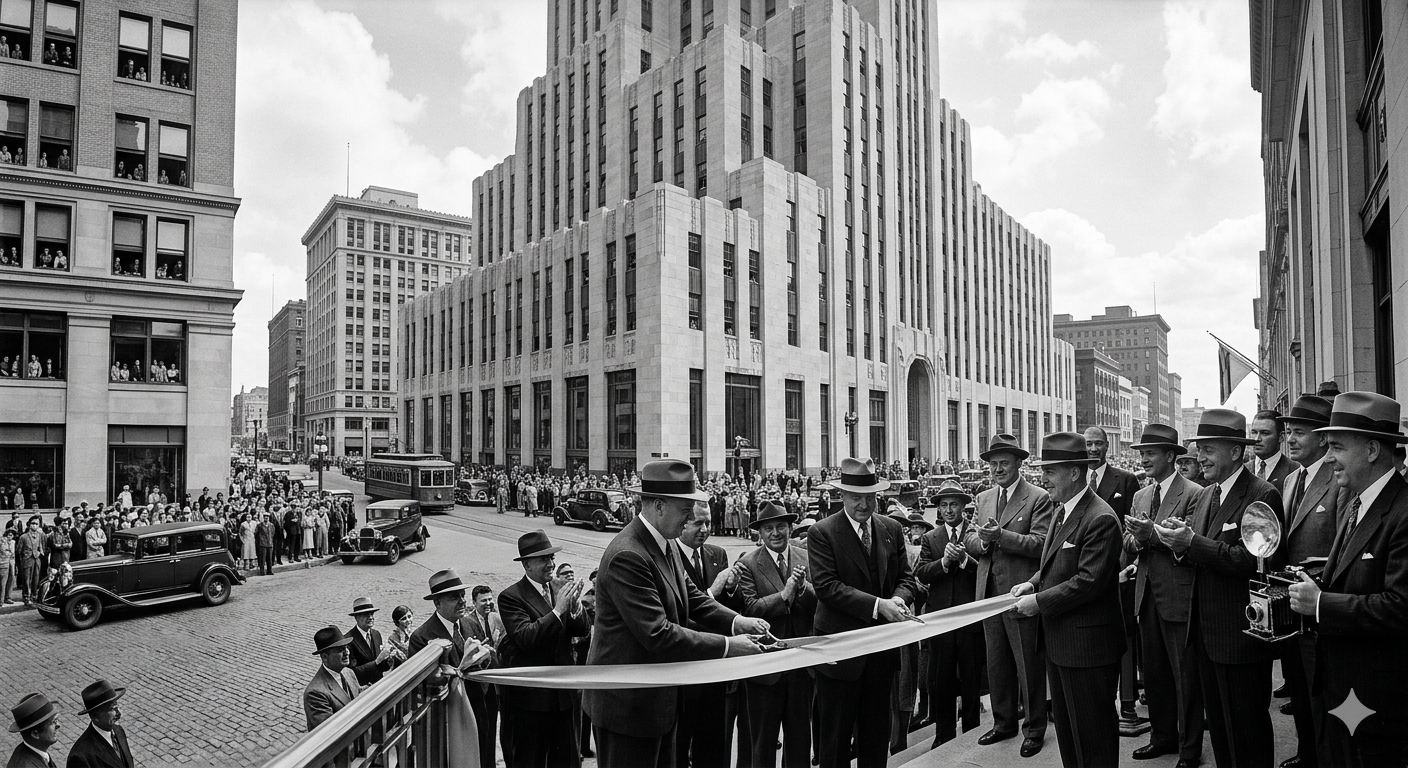
On May 1, 1931, a button was pressed in Washington, D.C., and the lights of the world’s tallest building flickered on for the first time above the Manhattan skyline. President Herbert Hoover never left the White House. He didn’t need to. The Empire State Building was so tall, so audacious, and so thoroughly impossible by any reasonable measure of what the moment demanded, that a symbolic gesture from 225 miles away felt entirely appropriate.
New York City had just built something the world had never seen. In 410 days, at a cost of approximately $41 million under budget, ahead of schedule, during the worst economic crisis in modern American history it had erected 102 stories of steel, limestone, and glass above Fifth Avenue and 34th Street. The building stood 1,250 feet to its roof and 1,454 feet to the tip of its antenna. It was the tallest structure on earth, and it would remain so for the next four decades.
Author F. Scott Fitzgerald captured the contradiction of the moment perfectly when he wrote: “From the ruins, lonely and inexplicable as the sphinx, rose the Empire State Building.”
The Site Before the Skyscraper: From Farmland to the Waldorf-Astoria
The story of the Empire State Building begins not with steel and concrete but with farmland and a hotel.
In 1799, New York City sold a tract of land on the west side of Fifth Avenue to a farmer named John Thompson for $2,600. The land passed through several owners over the following decades until the Astor family acquired it and, in the 1890s, built one of the grandest hotels in the world on the site the Waldorf-Astoria, which opened in stages in 1893 and 1897. For decades it was the social heart of New York high society, the place where presidents, industrialists, and celebrities came to see and be seen.
By the late 1920s, the hotel was aging and outpaced by newer establishments. Its owners decided to relocate to a new building on Park Avenue, which opened in 1931. That left the Fifth Avenue block between 33rd and 34th Streets empty and available a prime piece of Midtown Manhattan real estate sitting directly across from the newly completed Pennsylvania Station.
A development company called the Bethlehem Engineering Corporation initially purchased the site with plans to build a 25-story office building. They could not raise the necessary financing and sold the property to Empire State Inc., a group of investors led by two men whose partnership would define one of the great construction stories in American history.
John Raskob, Al Smith, and the Men Who Dared to Build It
The driving force behind the Empire State Building was John Jakob Raskob a self-made financial genius who had served as chief financial officer of both DuPont and General Motors, accumulating a fortune through his extraordinary ability to see value before others could.
Raskob was famously aggressive in his ambitions. He was the man who, in August 1929 just two months before the stock market crash published an article in Ladies’ Home Journal titled “Everybody Ought to Be Rich,” urging ordinary Americans to invest in stocks. His timing proved spectacularly wrong. But his vision for a skyscraper on Fifth Avenue proved spectacularly right.
He needed a public face for the project someone New Yorkers knew and trusted. He found that person in Alfred Emanuel Smith, the former four-term Governor of New York who had lost the 1928 presidential election to Herbert Hoover. Smith was a son of the Lower East Side, a self-educated Irish Catholic who had risen entirely on talent and charisma. He was beloved in the city. After losing the presidency, he found himself without a job and eager for purpose. Raskob offered him the presidency of Empire State Inc. and Smith accepted.
Together they made the announcement on August 29, 1929: they would build the world’s tallest skyscraper on Fifth Avenue. Forty days later, the stock market crashed, and the Great Depression began. They built it anyway.
The architectural firm of Shreve, Lamb & Harmon Associates was hired to design the building. The principal designer was William F. Lamb a quiet, precise architect who accepted a set of constraints that would have deterred most designers: a fixed budget, a May 1, 1931 completion deadline, no interior office space more than 28 feet from a window, and a requirement for the building to be the tallest in the world. The final design went through fifteen revisions before it was approved.
The construction contract went to Starrett Brothers and Eken, the building firm that had helped construct several of New York’s other major skyscrapers. Their job was to translate Lamb’s blueprints into steel and stone faster than any comparable structure had ever been built.
The Skyscraper Race: How the Chrysler Building Changed Everything
The Empire State Building was conceived in a city gripped by a mania for height that made the skyscraper race of the 1920s feel like something between a sporting event and a civic religion.
In the fall of 1929, the Bank of Manhattan building at 40 Wall Street, rising to 927 feet, briefly claimed the title of world’s tallest building, surpassing the 792-foot-tall Woolworth Building. But that record lasted only weeks. The Chrysler Building, designed by architect William Van Alen for Walter Chrysler of the Chrysler Corporation, was rising in midtown and approaching completion.
What happened next became one of the great architectural coups in history. Van Alen had secretly designed a gleaming stainless-steel spire inside the Chrysler Building’s fire shaft. In October 1929, once the competing building at 40 Wall Street had declared its final height, workers raised the Chrysler spire through the crown of the building the entire assembly took approximately 90 minutes. The Chrysler Building shot to 1,046 feet, surpassing the Eiffel Tower and claiming the title of world’s tallest structure. The city was electrified.
Raskob was not amused. He sent Shreve, Lamb & Harmon back to the drawing boards with instructions to build higher. The architects added a five-story penthouse above the original roofline, bringing the Empire State Building to 85 floors and 1,050 feet. That was still barely taller than the Chrysler Building. Then someone accounts differ on exactly who proposed an even more dramatic solution: a mooring mast for dirigibles at the very top.
The idea was that transatlantic airships which were seen in the late 1920s as a promising future of international travel could dock at the tower’s apex, allowing passengers to disembark directly into Midtown Manhattan. The mast would add 200 feet to the building’s total height, bringing it to 1,250 feet. The proposal was logistically borderline absurd. Airships attempting to dock in the updrafts swirling around the Manhattan skyline would face nearly impossible conditions. Critics said so immediately. The mast was built anyway, and the building’s final height became unassailable.
410 Days: The Construction That Defied Every Expectation
Ground was formally broken on March 17, 1930 St. Patrick’s Day, a date likely chosen deliberately given Al Smith’s proud Irish Catholic heritage. The old Waldorf-Astoria Hotel was demolished to make way for the excavation, and within weeks the site was one of the busiest construction operations in American history.
The numbers alone are staggering. At the peak of construction, between 3,400 and 3,500 workers were on the job site every single day. The structural steel framework rose at a rate of four and a half floors per week. Over the course of the project, 10 million bricks were laid, 200,000 cubic feet of Indiana limestone were cut and placed, and 6,400 windows were installed. More than 200 trucks delivered materials to the site every day at the project’s height.
William Lamb solved the logistical problem of moving materials vertically through an innovation that would become standard practice in modern construction: a temporary miniature railway system that ran to each floor, delivering tools, supplies, and materials on a precise schedule. Steel columns were prefabricated in Pennsylvania mills, numbered, and shipped to the site in the exact sequence they would be installed a kind of industrial choreography that kept the pace of construction from ever stalling.
Lewis Wickes Hine, a photographer who had previously used his camera to document child labor abuses and immigrant life, spent the entire construction period on the job site, capturing images of ironworkers balanced on beams hundreds of feet in the air. His photographs workers eating lunch on a girder with the skyline stretching below them, men guiding steel into position with their bare hands became some of the most iconic images of the twentieth century. Hine climbed out onto the steel alongside the ironworkers and once hung from a derrick cable far above the city to capture images no one had ever taken before.
The structural steelwork was completed on April 11, 1931 twelve days ahead of schedule. The entire building, including its interior fit-out, was ready by May 1, 1931 forty-five days ahead of the original projected opening date, and approximately five million dollars under the fixed budget that Lamb had been given.
May 1, 1931: The Opening Ceremony
The opening celebration on May 1, 1931, drew 350 guests to the building’s lobbies and observation floors, including New York Governor Franklin D. Roosevelt who would become President of the United States less than two years later and Mayor James “Jimmy” Walker of New York City.
Al Smith presided as master of ceremonies, beaming with the pride of a man who had staked his post-political reputation on the project. He showed dignitaries around the building with the proprietary enthusiasm of someone who genuinely felt it was his greatest achievement.
In Washington, D.C., President Herbert Hoover pressed a ceremonial button that sent a signal by radio to New York, symbolically illuminating the building’s lights. The gesture was theatrical the actual switching of the building’s lights was done manually in New York but its symbolism was genuine. The most powerful man in America was acknowledging that something remarkable had happened on Fifth Avenue.
One person notably absent from the ceremony was chief architect William F. Lamb. He had boarded an ocean liner bound for Europe on the very day of the opening. Three miles out to sea, past the Prohibition limit, he poured two martinis from a chrome shaker, pointed to the building visible on the Manhattan skyline behind him, and said to his wife: “Isn’t this marvelous?”
The 86th floor observation deck opened to the public the following day and drew 17,000 visitors in its first four days alone. Admission was one dollar. By the end of 1931, one million people had paid to ride the elevators to the top and look out over the city. The observation deck revenue would prove critical, because the office floors above it told a very different story.
The Empty State Building: Depression, Debt, and the Long Wait for Profit
Almost immediately after opening, the Empire State Building acquired an unwanted nickname: “The Empty State Building.” The Great Depression had devastated the New York commercial real estate market. Businesses were contracting or failing, not expanding into prestige office towers.
When the building opened, only a fraction of its office space had been rented. The floors between roughly the 26th and 80th stories were almost entirely vacant for months. The owners left the lights on in empty offices at night so that passers-by on Fifth Avenue would think the building was occupied. Express elevator service was established directly to the 80th floor observation deck, bypassing the vacant middle floors where there was simply nothing to see.
One early tenant recalled that when he moved in, there were approximately 20 tenants in the entire building, and that Al Smith’s offices near the top were the only occupied space above the seventh floor. The building was a financial catastrophe for its investors throughout the 1930s, costing far more to maintain than it earned in rent.
It was not until the early 1950s nearly two full decades after opening that the Empire State Building finally became profitable. When real estate investor Robert L. Stevens and a syndicate bought the building after John Raskob’s death in 1950, Stevens acknowledged that the purchase was made because the building “looked like a cheap piece of real estate,” not because of its prestige. By 1961, when another syndicate paid $65 million for it the most ever paid for a building at that time it had achieved a 99 percent occupancy rate and transformed from a symbol of Depression-era recklessness into one of the world’s most profitable buildings.
King Kong, the Movies, and a Cultural Icon That Outlived Its Age
The Empire State Building’s cultural life began almost immediately after its physical one. In 1933, just two years after opening, the building appeared as the dramatic climax of King Kong the giant ape scaling its exterior while biplanes circled overhead. The image became one of cinema’s most enduring, and the Empire State Building has since appeared in more than 250 films, television shows, and other media.
The building’s observation decks became inseparable from the idea of romance and aspiration in popular culture. Love Affairs in 1939, its remake An Affair to Remember in 1957, and Sleepless in Seattle in 1993 all used the observation deck as the ultimate meeting point for lovers separated by circumstance and reunited by fate.
The mooring mast, despite never successfully docking an airship on a regular basis only two blimps ever made contact with it, and the idea was soon abandoned became instead the television and radio broadcast antenna for New York City, a role it serves to this day.
In 1967, the Empire State Building was designated a New York City Landmark. In 1976, it was listed on the National Register of Historic Places and designated a National Historic Landmark. The American Society of Civil Engineers named it one of the Seven Wonders of the Modern World, placing it alongside the Hoover Dam and the Panama Canal. Today it attracts approximately four million visitors per year and consistently ranks as one of the most visited attractions in the United States.
The Empire State Building opened on May 1, 1931, as a monument to ambition and denial a refusal to accept that the worst economic crisis of the century could stop New York from reaching toward the sky. The Great Depression nearly broke the investors who built it. The Depression-era workers who constructed it in 410 days received wages that averaged between $5 and $15 per day. And the city that watched it rise from a vacant lot to the clouds in little more than a year understood, even in the depths of its suffering, that something had been built that would outlast all of it.