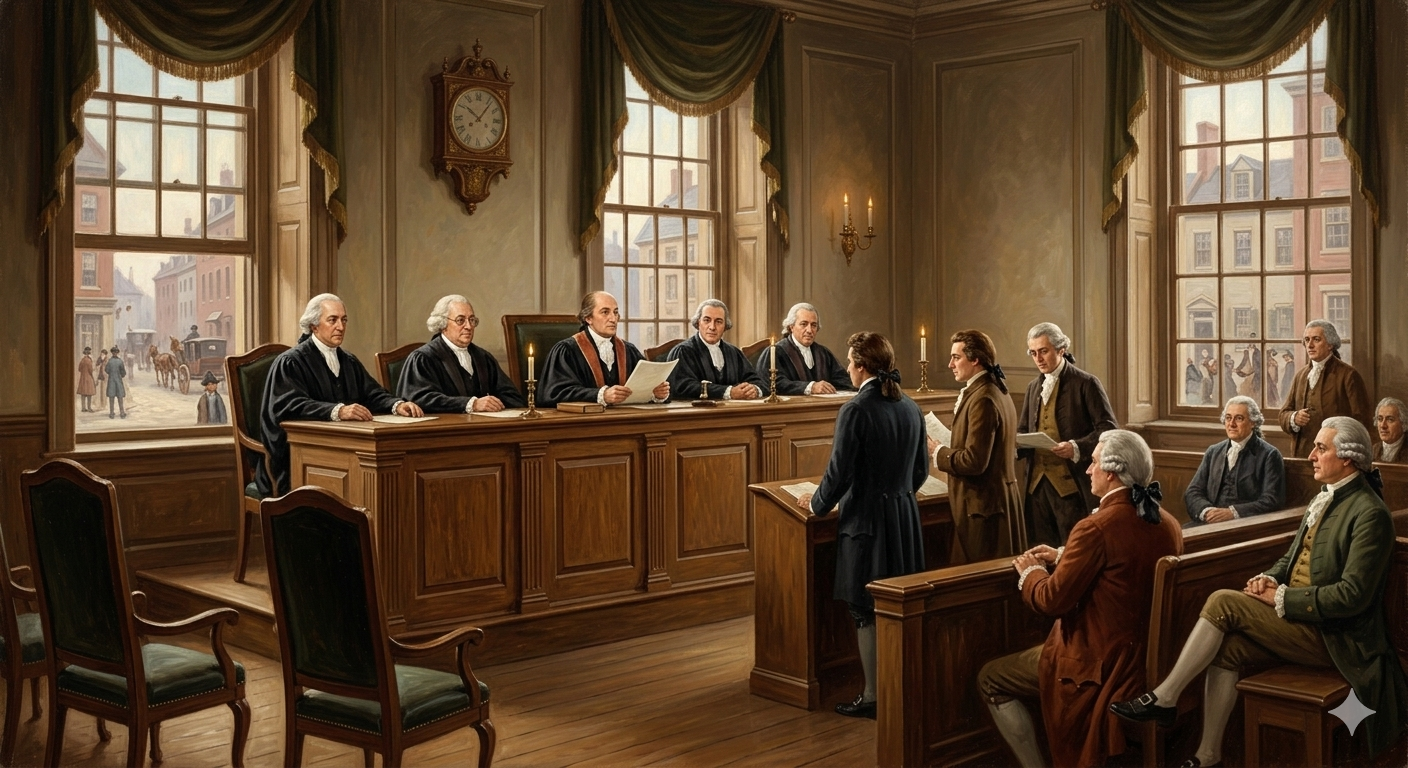
On February 2, 1790, a momentous event in American constitutional history took place when the United States Supreme Court convened for its inaugural session in the Royal Exchange Building on Broad Street in New York City, marking the formal beginning of the federal judiciary as envisioned by the Founding Fathers in the Constitution. This historic gathering of six justices represented the culmination of months of careful planning and preparation following the ratification of the Constitution and the establishment of the new federal government under President George Washington. The Court’s first session, which lasted eight days until February 10, 1790, was primarily devoted to organizational proceedings and the establishment of rules and procedures that would govern the highest court in the land for generations to come. Although no actual cases were decided during this inaugural session, the proceedings established crucial precedents for judicial conduct, court operations, and the relationship between the Supreme Court and the other branches of government. The significance of this first meeting extended far beyond the immediate administrative tasks at hand, as it represented the practical implementation of the judicial article of the Constitution and the creation of an independent judiciary that would serve as a co-equal branch of the federal government alongside the executive and legislative branches.
The Constitutional Foundation: Article III and the Judiciary Act of 1789
The establishment of the Supreme Court and its first session in 1790 was the direct result of careful constitutional planning and legislative action that began with the drafting of Article III of the Constitution at the Constitutional Convention in Philadelphia during the summer of 1787. Article III, Section 1 of the Constitution established that “the judicial Power of the United States, shall be vested in one supreme Court, and in such inferior Courts as the Congress may from time to time ordain and establish,” providing the constitutional foundation for a federal court system but leaving the specific details of organization and jurisdiction to be determined by Congress through subsequent legislation.
The Constitutional Convention’s debates over the federal judiciary revealed significant disagreements among the delegates about the proper scope and structure of federal courts, with some arguing for a strong national judicial system and others expressing concerns about federal interference with state court systems. The compromise language of Article III reflected these tensions by mandating the creation of a Supreme Court while giving Congress discretionary authority over the establishment of lower federal courts. This constitutional framework required subsequent legislative action to transform the abstract concept of federal judicial power into a functioning court system with defined jurisdiction, procedures, and personnel.
The Judiciary Act of 1789, passed by the First Congress and signed into law by President Washington on September 24, 1789, provided the essential legislative framework that made the Supreme Court’s first session possible by establishing the Court’s composition, jurisdiction, and relationship to other federal courts. The Act created a Supreme Court consisting of a Chief Justice and five Associate Justices, established federal district courts in each state, and created three federal circuit courts with appellate jurisdiction over the district courts. This legislation represented one of the most important early achievements of the new federal government, as it created the institutional structure necessary to enforce federal law and establish the supremacy of the Constitution throughout the United States.
The Judiciary Act also established the crucial principle that Supreme Court justices would “ride circuit” by serving as judges on the circuit courts during designated periods throughout the year, a requirement that would prove controversial and burdensome for the justices but which reflected the limited resources available to the new federal government and the practical need to provide federal judicial services throughout the country. This circuit-riding duty would consume much of the justices’ time and energy during the Court’s early years, limiting their availability for Supreme Court business and contributing to the relatively light caseload that characterized the Court’s first decade of operation.
President Washington’s Judicial Appointments: Selecting the First Supreme Court
President George Washington’s selection of the first Supreme Court justices represented one of his most important and lasting contributions to the new federal government, as these appointments would establish precedents for judicial independence, legal expertise, and geographic representation that would influence the Court’s development for decades to come. Washington understood that his choices for the first Court would be closely scrutinized and would help establish public confidence in the new federal judiciary, making it essential to select individuals of unquestioned integrity, legal competence, and national reputation who could command respect from both supporters and critics of the new constitutional system.
The appointment of John Jay as the first Chief Justice reflected Washington’s recognition of the need for exceptional leadership at the head of the new Court, as Jay brought impressive credentials as a prominent lawyer, diplomat, and political leader who had played crucial roles in the negotiation of the Treaty of Paris ending the Revolutionary War and the ratification campaign for the Constitution. Jay’s service as Secretary of Foreign Affairs under the Articles of Confederation had given him extensive experience in national affairs, while his authorship of several Federalist Papers demonstrated his deep understanding of constitutional principles and his commitment to the new federal system. Washington’s choice of Jay also reflected the President’s desire to appoint a Chief Justice from New York, the temporary capital of the United States, as a gesture of respect for the state that was hosting the new federal government.
The selection of Associate Justices demonstrated Washington’s careful attention to geographic balance and political considerations that would ensure broad national support for the Court while drawing on the legal talent available in different regions of the country. James Wilson of Pennsylvania brought distinguished credentials as a signer of the Declaration of Independence and a prominent member of the Constitutional Convention, where he had been one of the most influential advocates for a strong federal judiciary. Wilson’s appointment reflected his status as one of the nation’s leading legal scholars and his important contributions to the development of American constitutional law during the founding period.
William Cushing of Massachusetts represented the appointment of an experienced state court judge who could bring practical judicial experience to the new federal Court, having served as Chief Justice of the Massachusetts Supreme Judicial Court since 1777 and having established a reputation for fairness and legal competence during his tenure on the state bench. John Blair Jr. of Virginia provided regional balance from the South while bringing experience as a judge on the Virginia Court of Appeals and service as a delegate to the Constitutional Convention, where he had supported the creation of a strong federal judiciary.
The appointments of John Rutledge of South Carolina and James Iredell of North Carolina completed Washington’s original slate of justices, providing representation from the Deep South while adding individuals with strong legal backgrounds and experience in state government. Rutledge had served as Governor of South Carolina and as a delegate to the Constitutional Convention, while Iredell had been a prominent lawyer and political leader in North Carolina who had played an important role in that state’s ratification of the Constitution. These appointments reflected Washington’s successful effort to create a Court that represented the geographic diversity of the nation while maintaining high standards of legal competence and political experience.
The Royal Exchange Building: Setting and Symbolism of the First Session
The choice of the Royal Exchange Building as the venue for the Supreme Court’s first session reflected both practical considerations about available space in New York City and symbolic concerns about establishing the dignity and authority of the new federal judiciary in appropriate surroundings. Located on Broad Street in lower Manhattan, the Royal Exchange had served as a commercial center and meeting place for merchants and traders, making it a familiar and accessible location for important public gatherings while providing the physical space necessary to accommodate the Court and its proceedings.
The building’s history as a center of commercial activity carried important symbolic significance for the establishment of the federal judiciary, as it represented the connection between legal institutions and economic prosperity that the Founding Fathers viewed as essential for the success of the new constitutional system. The choice of a commercial building also reflected the practical realities facing the new federal government, which lacked dedicated judicial facilities and needed to adapt existing structures to serve the needs of the Court while maintaining appropriate dignity and formality for judicial proceedings.
City officials in New York demonstrated their understanding of the historic significance of the Court’s first session by taking special measures to ensure that the proceedings would be conducted in an atmosphere of dignity and respect befitting the nation’s highest court. The temporary relocation of the building’s usual market activities, including the removal of butchers and other vendors, showed the city’s commitment to providing an appropriate setting for the Court’s work while minimizing distractions and disruptions that might interfere with judicial deliberations.
The installation of chains across the street to prevent cart traffic during the Court’s session represented an early example of the special security and protocol arrangements that would become standard features of Supreme Court operations, reflecting recognition that the Court’s work required protection from outside interference and disruption. These arrangements also demonstrated the collaborative relationship between federal and local authorities that would be necessary for the successful operation of the federal government in its temporary capital while permanent arrangements were being developed in the new federal city being planned along the Potomac River.
The physical arrangement of the courtroom itself, though not extensively documented, likely followed traditional English legal conventions adapted to American republican principles, with the justices seated at an elevated bench facing the area designated for lawyers and spectators. This arrangement would have reinforced the dignity and authority of the Court while maintaining accessibility for members of the public who wished to observe the proceedings, reflecting the democratic principles underlying the new constitutional system while preserving the formality necessary for effective judicial administration.
February 2-10, 1790: The Proceedings of the Inaugural Session
The Supreme Court’s inaugural session formally began on February 2, 1790, after being delayed one day from its originally scheduled start date of February 1 due to the absence of sufficient justices to constitute a quorum, highlighting one of the practical challenges that would face the Court throughout its early years as justices struggled with transportation difficulties and the demands of their circuit-riding duties. Chief Justice John Jay presided over the opening proceedings, which were attended by Associate Justices James Wilson, William Cushing, and John Blair, while Associate Justices John Rutledge and James Iredell were absent due to travel delays and other commitments that prevented their timely arrival in New York.
The first day’s proceedings were devoted primarily to ceremonial and administrative matters that established the formal structure and procedures for the Court’s future operations. The justices took their judicial oaths of office in a public ceremony that symbolically marked the beginning of their service as the nation’s highest judicial officers, while also demonstrating their commitment to upholding the Constitution and faithfully executing their judicial duties. The administration of oaths represented a crucial step in the formal establishment of the Court as a functioning institution of government, providing legal legitimacy for the justices’ subsequent actions and decisions.
The admission of attorneys to practice before the Supreme Court represented one of the most practically important accomplishments of the first session, as it established the bar of practitioners who would be eligible to argue cases before the Court and participate in its proceedings. The Court admitted several prominent lawyers to its bar, including Attorney General Edmund Randolph, who would represent the federal government in cases before the Court, and other distinguished members of the legal profession who met the Court’s standards for admission based on their legal education, experience, and professional reputation.
The establishment of rules and procedures for the Court’s operations consumed much of the first session’s time and attention, as the justices worked to create the administrative framework that would govern everything from the filing of cases to the conduct of oral arguments and the issuance of decisions. These rules drew heavily on English legal precedent and the practices of state courts but were adapted to reflect the unique constitutional position of the Supreme Court as the highest federal judicial authority and the final interpreter of the Constitution and federal law.
The Court’s adoption of formal procedures for the conduct of its business reflected the justices’ understanding that their actions would establish precedents for future Courts and help define the role of the federal judiciary within the American constitutional system. The careful attention to procedural details during the first session demonstrated the justices’ commitment to establishing the Court as a respected and effective institution that could command public confidence and successfully fulfill its constitutional responsibilities as the guardian of the Constitution and federal law.
The Absent Justices: Early Challenges of Circuit Riding
The absence of Associate Justices John Rutledge and James Iredell from the Supreme Court’s first session highlighted one of the most significant challenges facing the early federal judiciary: the requirement that Supreme Court justices spend much of their time traveling throughout the country to hold circuit court sessions in distant locations with primitive transportation and communication systems. This circuit-riding duty, established by the Judiciary Act of 1789, required each justice to preside over circuit courts in designated geographic regions during specified periods throughout the year, creating enormous physical and logistical demands that often prevented justices from attending Supreme Court sessions or fulfilling their appellate responsibilities.
John Rutledge’s absence from the first session reflected the particular challenges facing justices assigned to the Southern Circuit, which required extensive travel through South Carolina and Georgia over difficult roads and waterways that could become impassable during certain seasons of the year. Rutledge’s appointment as the senior Associate Justice had made him responsible for the most demanding circuit assignment, requiring months of travel each year to hold court sessions in remote locations far from the temporary capital in New York. This geographic burden would prove so onerous that Rutledge would eventually resign from the Court in 1791 to accept appointment as Chief Justice of the South Carolina Court of Common Pleas, citing the excessive travel demands as a major factor in his decision.
James Iredell’s absence from the first session similarly reflected the challenges facing justices assigned to circuits covering large geographic areas with limited transportation infrastructure, as his Southern Circuit duties required extensive travel through North Carolina and other southeastern states. Iredell would later become one of the most vocal critics of the circuit-riding system, arguing in correspondence with fellow justices and government officials that the travel requirements were undermining the effectiveness of the Supreme Court by preventing regular attendance at sessions while creating excessive physical and financial burdens for the justices.
The practical impact of justice absences on the Court’s ability to function effectively became apparent during the first session and would continue to plague the Court throughout its early years, as the lack of a full complement of justices limited the Court’s ability to hear cases and issue authoritative decisions on important constitutional and legal questions. The problem was compounded by the requirement that a majority of justices be present to constitute a quorum for conducting business, meaning that the absence of even one or two justices could prevent the Court from functioning at all.
The justices’ growing frustration with the circuit-riding system would eventually lead to collective protests and appeals to Congress for relief, including a famous letter signed by all the justices in 1792 arguing that the system was unconstitutional and impractical. However, Congress would not provide meaningful relief from circuit-riding duties until the Judiciary Act of 1925, reflecting the tension between the practical needs of the Court and the political and economic constraints facing the federal government during its early years of operation.
Establishing Judicial Precedent: Rules and Procedures
The Supreme Court’s first session devoted considerable attention to establishing the rules and procedures that would govern the Court’s operations and define its institutional character, recognizing that these early decisions would create precedents that would influence the Court’s development for decades to come. The justices understood that their procedural choices would help establish public perceptions of the Court’s dignity, accessibility, and effectiveness while creating the administrative framework necessary for handling the complex legal questions that would eventually come before the Court for resolution.
The Court’s adoption of formal dress requirements for justices and attorneys reflected both practical considerations about maintaining appropriate courtroom decorum and symbolic concerns about establishing the authority and dignity of the federal judiciary in the eyes of the American public. The justices decided to wear black robes during Court sessions, following English tradition while adapting it to republican principles by avoiding the more elaborate ceremonial garments associated with British judicial practice. This dress code helped establish visual symbols of judicial authority while maintaining democratic accessibility that would be appropriate for the American constitutional system.
The establishment of procedures for oral arguments represented one of the most important accomplishments of the first session, as these rules would govern how cases would be presented to the Court and how attorneys would be permitted to advocate for their clients before the nation’s highest tribunal. The Court adopted relatively generous time limits for oral arguments, reflecting the limited number of cases expected during the early years and the justices’ desire to ensure thorough consideration of the complex legal issues that would likely come before the Court as federal law developed and constitutional questions arose.
The Court’s decisions about the filing and processing of cases created the administrative infrastructure that would be necessary for managing the Court’s docket as its caseload grew in subsequent years. The establishment of formal procedures for submitting petitions, filing briefs, and scheduling arguments reflected the justices’ understanding that systematic case management would be essential for maintaining the Court’s effectiveness and credibility as federal judicial business expanded with the growth of the federal government and the national economy.
The adoption of procedures for issuing opinions and decisions represented perhaps the most significant precedential action of the first session, as these rules would govern how the Court would communicate its reasoning to the public and establish its authority as the final interpreter of federal law and the Constitution. The Court’s decision to issue written opinions explaining the legal basis for its decisions would prove crucial for establishing the Court’s intellectual authority and its role in developing American legal principles through reasoned analysis and constitutional interpretation.
The Light Docket: Organizational Focus Over Case Decisions
The Supreme Court’s first session was characterized by the absence of actual cases to decide, reflecting the early stage of federal court system development and the limited time available for cases to work their way through the newly established lower federal courts to reach the Supreme Court on appeal. This situation allowed the justices to focus entirely on organizational and administrative matters that would establish the foundation for the Court’s future operations, while also highlighting the gradual nature of federal judicial development during the early years of the new constitutional system.
The lack of cases during the first session reflected the practical realities of court system development, as the federal district and circuit courts had only recently begun operations and had not yet generated the appellate cases that would eventually form the Supreme Court’s regular docket. The complex legal questions that would ultimately define the Court’s role in American government were still developing as federal law began to be implemented and constitutional issues arose from the practical operation of the new federal system.
This organizational focus during the first session proved to be of lasting importance, as the procedures and precedents established during these early meetings would influence the Court’s operations throughout its subsequent history. The careful attention to administrative details and institutional development during the first session demonstrated the justices’ understanding that their primary responsibility was not merely to decide individual cases but to establish the Supreme Court as an effective and respected institution capable of fulfilling its constitutional role as the guardian of federal law and the Constitution.
The absence of contentious legal disputes during the first session also allowed the justices to work together collaboratively on institutional development without the pressures and divisions that would later arise as the Court began deciding politically sensitive cases involving federal authority, individual rights, and interstate relations. This period of institutional harmony would prove valuable for establishing working relationships among the justices and creating a sense of shared institutional identity that would help the Court weather the political storms that would arise as it began to exercise its constitutional authority.
The gradual development of the Court’s caseload would prove to be beneficial for the institution’s long-term effectiveness, as it allowed the justices to gain experience with their new responsibilities and refine their procedures before facing the complex constitutional and legal questions that would eventually define the Court’s role in American government. The first session’s focus on organizational matters thus represented an essential foundation for the Court’s subsequent development into one of the most important and influential institutions in American government.
Geographic Challenges: The Reality of Early American Transportation
The difficulties faced by the Supreme Court justices in traveling to New York City for the first session illustrated the enormous geographic and transportation challenges that confronted the new federal government as it attempted to establish effective institutions across the vast territory of the United States during the late 18th century. The absence of modern transportation infrastructure meant that travel between distant cities often required weeks of difficult and dangerous journeys over primitive roads, uncertain river crossings, and limited accommodation facilities that made regular attendance at Court sessions extremely challenging for justices assigned to distant circuits.
The primitive state of American roads during this period created particular difficulties for justices traveling from southern states, as the road network was primarily designed to serve local and regional needs rather than long-distance travel between major cities. The lack of standardized road construction and maintenance meant that travel conditions could vary dramatically depending on weather, season, and local infrastructure investment, making it impossible to predict travel times accurately or ensure reliable transportation to Court sessions.
River transportation offered some advantages over overland travel for certain routes, but it was subject to seasonal variations, weather conditions, and the limited availability of suitable vessels for passenger transport. Justices traveling to New York from southern or western regions often had to combine multiple modes of transportation, including overland travel, river boats, and coastal shipping, creating complex logistical challenges that could easily result in delays or prevent timely arrival at Court sessions.
The financial burden of extensive travel represented another significant challenge for the early Supreme Court justices, who received relatively modest salaries and were expected to pay their own travel expenses while riding circuit and attending Court sessions. The combination of high travel costs and uncertain travel conditions made the judicial positions less attractive to qualified candidates and contributed to the difficulty of recruiting and retaining effective justices during the Court’s early years.
These transportation challenges would continue to plague the Supreme Court throughout its early decades and would contribute to ongoing political debates about the proper organization of the federal court system, the appropriate location of the national capital, and the wisdom of requiring Supreme Court justices to serve as circuit judges. The eventual resolution of these issues through improved transportation infrastructure and judicial system reforms would be essential for the Court’s development into an effective national institution capable of serving the entire United States.
The Move to Philadelphia: Following the Federal Government
The Supreme Court’s brief tenure in New York City came to an end in 1790 when the federal government relocated to Philadelphia as part of the political compromise that established the permanent national capital on the Potomac River, requiring the Court to adapt once again to new physical facilities and administrative arrangements while maintaining its institutional continuity and effectiveness. The move to Philadelphia represented both practical opportunities for improved Court operations and additional challenges related to establishing the Court’s authority and procedures in a new location with different local legal traditions and political environment.
The Court’s second session, held in August 1790 at the Royal Exchange Building in New York, served as a transition period that allowed the justices to complete their organizational work in familiar surroundings while preparing for the relocation to Philadelphia that would mark the beginning of a new phase in the Court’s development. This final New York session lasted only a few days and was devoted primarily to administrative matters and the admission of additional attorneys to the Supreme Court bar, reflecting the Court’s continued focus on institutional development during its early years.
The relocation to Philadelphia placed the Supreme Court in a city with a rich legal and political tradition, including the presence of experienced lawyers, established legal institutions, and facilities that had previously hosted important political gatherings including the Constitutional Convention and the Continental Congress. This environment provided advantages for the Court’s continued development, including access to a sophisticated legal community and facilities that were better adapted to the needs of a national institution.
The Court’s initial meetings in Philadelphia were held in Independence Hall, the same building where the Declaration of Independence and the Constitution had been signed, providing powerful symbolic continuity between the founding documents of the American republic and the institution responsible for interpreting and enforcing constitutional law. This symbolic connection helped reinforce the Court’s legitimacy and authority while demonstrating the institutional continuity between the revolutionary founding of the United States and the practical implementation of constitutional government.
The Court’s eventual establishment in Philadelphia’s Old City Hall from 1791 to 1800 provided more permanent and appropriate facilities for the Court’s growing responsibilities while allowing for the development of more sophisticated procedures and institutional practices. The Philadelphia period would see the Court begin to decide its first significant cases and establish important precedents for constitutional interpretation, building on the organizational foundation established during the first session in New York while adapting to the practical challenges of serving as the highest court in an expanding and increasingly complex nation.
Legacy of the First Session: Foundations of American Justice
The Supreme Court’s first session in February 1790 established institutional foundations and precedents that would influence the development of American judicial authority and constitutional interpretation for more than two centuries, demonstrating the lasting significance of the careful organizational work undertaken by the first justices during their brief meeting in New York City. The procedures and practices established during this inaugural session created the institutional framework that would enable the Court to evolve from a small and relatively powerless tribunal into one of the most influential judicial institutions in world history, while maintaining essential principles of judicial independence, constitutional authority, and democratic accountability.
The precedents established for judicial conduct and institutional dignity during the first session helped create public respect and confidence in the federal judiciary that would prove essential for the Court’s effectiveness as it began to exercise its constitutional authority to interpret federal law and resolve disputes between states, between citizens and government, and between different branches of the federal government. The careful attention to procedural formality and institutional respect during the first session demonstrated the justices’ understanding that the Court’s authority would ultimately depend on public acceptance of its legitimacy and competence rather than on enforcement mechanisms available to the executive and legislative branches.
The collaborative approach to institutional development demonstrated during the first session established important precedents for how the Court would address internal disagreements and procedural questions throughout its subsequent history, emphasizing consensus-building and institutional continuity over individual preferences or political considerations. This institutional solidarity would prove crucial for maintaining the Court’s effectiveness and public credibility as it faced increasingly controversial political and constitutional questions during subsequent decades.
The geographic and logistical challenges highlighted during the first session would eventually lead to important reforms in the federal court system, including the eventual elimination of circuit-riding duties, the establishment of intermediate appellate courts, and the creation of improved facilities and support systems for federal judicial operations. These reforms reflected lessons learned from the practical experience of the early justices and demonstrated the adaptive capacity of American judicial institutions to respond to changing needs and circumstances.
The first session’s emphasis on establishing the Court as an effective and respected institution rather than merely deciding individual cases reflected a sophisticated understanding of institutional development that would influence the Court’s approach to its responsibilities throughout its history. The recognition that the Court’s long-term effectiveness would depend on careful institutional development and public confidence would guide the justices’ approach to controversial questions and help maintain the Court’s authority and influence through changing political circumstances and evolving constitutional challenges. The foundations laid during this first session in New York City thus represent one of the most important achievements in the early history of American constitutional government, creating the institutional framework for an independent judiciary that continues to serve as a guardian of constitutional rights and the rule of law in the 21st century.