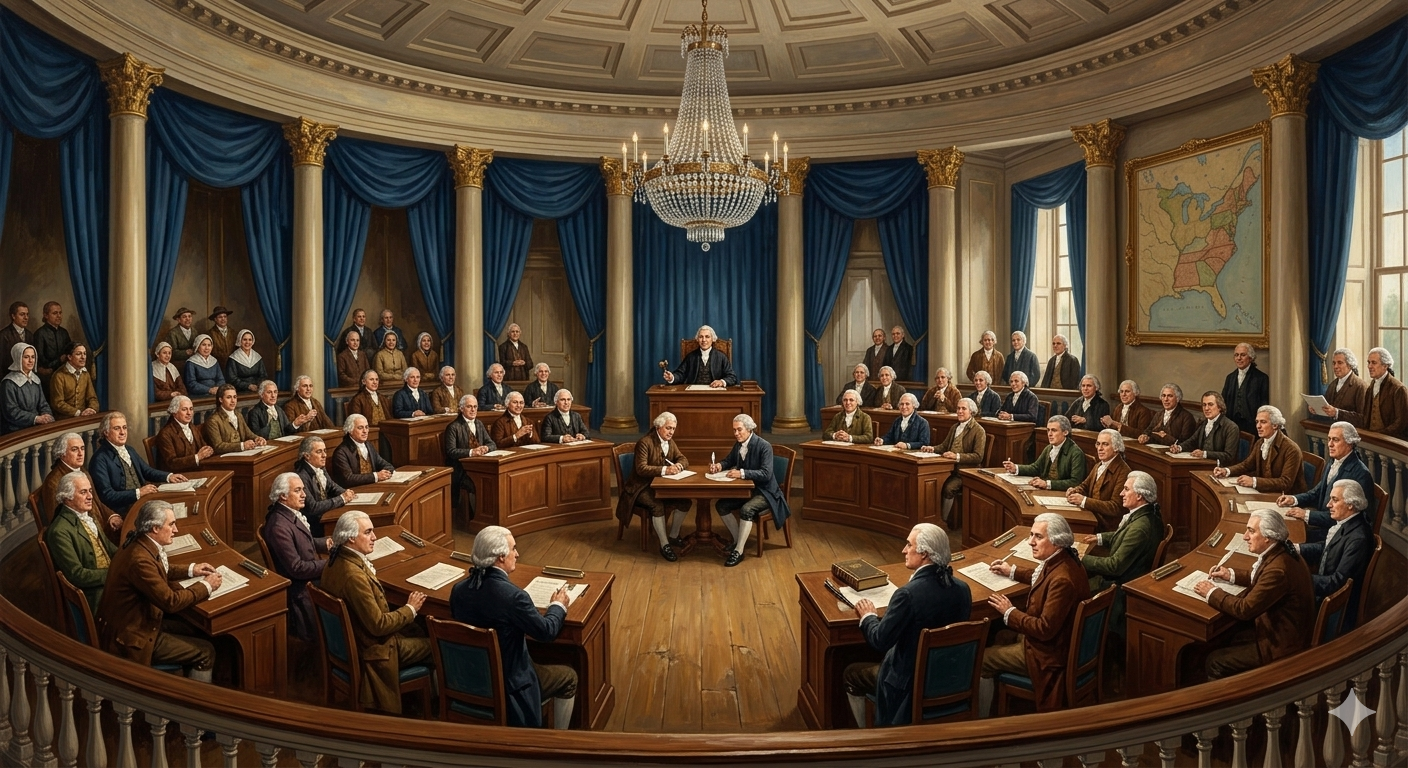
The first session of the United States House of Representatives stands as one of the most pivotal moments in American democratic history, marking the official beginning of the federal government under the Constitution. On April 1, 1789, after nearly a month of delays, the House of Representatives finally achieved its quorum at Federal Hall in New York City, setting in motion the machinery of American democracy that continues to function today.
The Constitutional Foundation and Legislative Framework
The establishment of the House of Representatives emerged from the Constitutional Convention of 1787, where the Founding Fathers crafted Article I of the Constitution, which outlined the structure and powers of the legislative branch. The House was designed as the lower chamber of Congress, with representation based on population as determined by the constitutional provision in Article I, Section 2, Clause 3. This proportional representation system distinguished the House from the Senate, where each state received equal representation regardless of size.
The new Constitution required specific procedures for the House to begin operations. According to the constitutional framework, the House needed a quorum of thirty members present to conduct official business, elect officers, and begin the work of governance. This quorum requirement reflected the Founders’ intention to ensure that legislative decisions represented a substantial portion of the elected representatives rather than just a small minority.
The Delayed Beginning and March 4th Disappointment
The Confederation Congress, operating under the Articles of Confederation, had designated March 4, 1789, as the official start date for the new Congress under the Constitution. This date carried enormous symbolic weight as it represented the transition from the weak federal system under the Articles to the stronger constitutional government that would define American governance.
However, the reality of eighteenth-century transportation and communication created significant challenges for the representatives. When March 4th arrived, only thirteen House members and eight Senators had assembled at Federal Hall in New York City. The harsh winter of 1788-1789 had made travel treacherous, with many representatives facing difficult journeys over muddy roads, swollen rivers, and unreliable transportation methods. Some representatives from distant states like Georgia and South Carolina faced weeks-long journeys to reach New York.
The absence of a quorum created a constitutional crisis of sorts. Without the required thirty House members present, no official business could be conducted. The representatives who had arrived could only meet informally, growing increasingly concerned about the delays and their potential impact on the new government’s credibility and George Washington’s pending inauguration.
Federal Hall: The Birthplace of American Legislative Democracy
Federal Hall, located on Wall Street in what is now Manhattan’s Financial District, served as the stage for this historic moment. Originally constructed in 1703, this three-story structure had previously housed the Confederation Congress under the Articles of Confederation. The building underwent extensive renovations in preparation for hosting the new federal government, with the larger ground floor chamber designated for the sixty-five-member House of Representatives, while the twenty-six-member Senate occupied smaller quarters on the second floor, literally making it the “upper house.”
The physical layout of Federal Hall reflected the democratic ideals of the new nation. The House chamber featured galleries where citizens could observe their representatives in action, embodying the principle of transparent governance that distinguished the American system from European monarchies. The building’s location in New York City, then the nation’s capital, placed the federal government at the heart of American commerce and culture.
The Crucial Quorum Achievement on April 1, 1789
After nearly a month of anxious waiting, April 1, 1789, became the true birthday of the American House of Representatives. The arrival of James Schureman from New Jersey and Thomas Scott from Pennsylvania provided the thirtieth and thirty-first members needed to achieve quorum. This moment transformed the informal gathering into an official legislative body with constitutional authority to conduct the nation’s business.
The achievement of quorum triggered a series of immediate actions that established the House’s operational framework. The first order of business involved electing the chamber’s officers, most notably the Speaker of the House, who would preside over debates and maintain order during legislative sessions. The representatives understood that their choices would set precedents for future Congresses and help define the role of legislative leadership in American democracy.
Frederick Muhlenberg: America’s First House Speaker
The election of Frederick Augustus Conrad Muhlenberg as the first Speaker of the House of Representatives represented a carefully considered choice that reflected the political dynamics of the early republic. Muhlenberg, a Pennsylvania representative born on January 1, 1750, brought unique qualifications to this historic role. As a Lutheran minister turned politician, he combined moral authority with practical political experience, having previously served in the Pennsylvania legislature.
Muhlenberg’s selection demonstrated the House’s commitment to experienced leadership during its formative period. His Pennsylvania origins reflected the state’s central role in the founding of the republic, while his religious background appealed to representatives who valued moral leadership. As Speaker, Muhlenberg would preside over crucial early debates about the structure of the federal government, the Bill of Rights, and the economic policies that would shape the young nation’s future.
The Speaker’s role, while not extensively defined in the Constitution, evolved during Muhlenberg’s tenure to include maintaining order during debates, recognizing members who wished to speak, and ensuring adherence to House rules. These precedents, established during those first sessions, continue to influence the Speaker’s role in modern American politics.
Establishing House Rules and Democratic Procedures
With quorum achieved and leadership elected, the House faced the crucial task of establishing its operating procedures. During the brief intervals between April 1st and the Senate’s achievement of quorum on April 6th, House members worked diligently to craft the rules that would govern their deliberations. Notable figures like James Madison, Richard Henry Lee, and Roger Sherman contributed to drafting these foundational procedures.
These early rules addressed fundamental questions about democratic governance: How would debates be conducted? What procedures would ensure fair representation of different viewpoints? How would the House maintain order while preserving the right of free speech and democratic deliberation? The answers to these questions helped establish parliamentary procedures that influenced legislative bodies throughout the world.
The House rules reflected Enlightenment principles about democratic governance, incorporating safeguards against both mob rule and tyrannical leadership. Time limits on speeches, procedures for recognizing members, and methods for calling votes all served to balance efficiency with democratic participation. These innovations in legislative procedure represented practical applications of democratic theory that had previously existed mainly in philosophical texts.
The Political Composition and Factional Dynamics
The First Congress reflected the emerging political divisions that would eventually crystallize into America’s first political parties. Representatives aligned themselves into two primary factions: the Pro-Administration faction, which generally supported the policies of the Washington administration and favored a strong federal government, and the Anti-Administration faction, which advocated for more limited federal power and greater state autonomy.
The Pro-Administration faction held a majority in the House, with thirty-one members compared to twenty-three Anti-Administration representatives at the session’s beginning. This composition would prove crucial for passing the early legislation that established the federal government’s basic operations, including the creation of executive departments, the federal court system, and the nation’s first revenue measures.
Key Pro-Administration leaders included James Madison of Virginia, who despite his later opposition to Hamilton’s policies, initially supported the strong federal government he had helped design. Fisher Ames of Massachusetts, George Clymer of Pennsylvania, and Egbert Benson of New York also played important roles in advancing the Pro-Administration agenda. The Anti-Administration faction included figures like Aedanus Burke of South Carolina, William Maclay of Pennsylvania, and Thomas Tudor Tucker of South Carolina, who advocated for more restrictive interpretations of federal power.
Early Legislative Achievements and Their Lasting Impact
The First Congress accomplished remarkable legislative work that established the foundation of the American government. The House’s early sessions produced crucial legislation that transformed constitutional theory into practical governance. The Judiciary Act of 1789 established the federal court system, creating the Supreme Court and lower federal courts that would interpret the Constitution and federal law.
The Revenue Act of 1789, passed on July 4th in a symbolic gesture, established the nation’s first tariff system and provided the federal government with essential income. This legislation demonstrated the House’s constitutional authority to raise revenue and marked a sharp departure from the impotent Confederation Congress, which had lacked the power to tax effectively.
Perhaps most significantly, the First Congress crafted and passed the first ten amendments to the Constitution, which became known as the Bill of Rights. These amendments addressed concerns raised during the ratification debates and helped secure the Constitution’s acceptance by skeptical citizens who feared federal overreach. The House’s role in drafting these fundamental protections of individual liberty established its position as the guardian of popular rights within the federal system.
The establishment of executive departments, including the Department of State, Department of War, and Department of Treasury, created the administrative framework that would allow the federal government to function effectively. These departments, proposed by the House and approved by both chambers, demonstrated Congress’s role in creating the bureaucratic machinery necessary for governing a large republic.
The Significance of Location and Symbolic Importance
The choice of New York City as the site for the First Congress carried important symbolic and practical implications. New York represented the commercial and cultural dynamism of the new republic, while Federal Hall itself embodied the continuity between the old Confederation and the new constitutional system. The building’s renovation specifically for the new Congress demonstrated the nation’s commitment to its democratic experiment.
The presence of galleries for public observation reflected the founders’ commitment to transparent governance, allowing citizens to witness their representatives’ deliberations. This transparency distinguished the American system from European models of governance, where policy decisions often occurred behind closed doors in royal courts or aristocratic councils.
The temporary nature of New York’s role as capital also reflected the political compromises necessary for effective governance. The decision to move the capital to Philadelphia and eventually to Washington, D.C., demonstrated the House’s role in addressing sectional tensions and maintaining national unity through careful political negotiation.
Long-term Constitutional and Political Consequences
The successful convening of the First House session established crucial precedents that continue to influence American governance today. The procedures for achieving quorum, electing leadership, and conducting legislative business became models for future Congresses and state legislatures throughout the nation. The House’s early assertion of its constitutional prerogatives helped establish the balance of power between the legislative and executive branches.
The factional divisions evident in the First Congress prefigured the development of America’s two-party system, with the Pro-Administration and Anti-Administration factions evolving into the Federalist and Democratic-Republican parties. These early political divisions reflected fundamental disagreements about the proper scope of federal power, the relationship between government and economy, and America’s position in international affairs.
The House’s role in crafting the Bill of Rights established its position as the primary guardian of individual liberty within the federal system. This responsibility continues to define the House’s role in American politics, as representatives regularly invoke their duty to protect constitutional rights when debating contemporary issues.
The Enduring Legacy of Democratic Innovation
The First House session represents more than just a procedural milestone in American history; it marked the beginning of the world’s first large-scale experiment in representative democracy. The successful establishment of legislative procedures, the peaceful election of leadership, and the orderly conduct of public business demonstrated that democratic governance could function effectively on a national scale.
The innovations in legislative procedure developed during these early sessions influenced democratic movements throughout the world. The combination of majority rule with minority rights, the balance between efficiency and deliberation, and the integration of public oversight with practical governance provided a model that inspired democratic reformers in Europe, Latin America, and beyond.
The House’s early emphasis on transparency, accountability, and responsive representation established principles that continue to define American democratic expectations. Citizens’ right to observe legislative proceedings, petition their representatives, and participate in electoral processes all trace their origins to the precedents established during those first crucial sessions at Federal Hall.
The First US House session thus represents not merely the beginning of one branch of government, but the commencement of America’s ongoing experiment in democratic self-governance. The decisions made and precedents established during those April days in 1789 continue to shape American political life more than two centuries later, demonstrating the enduring wisdom and foresight of the founding generation’s commitment to representative democracy.