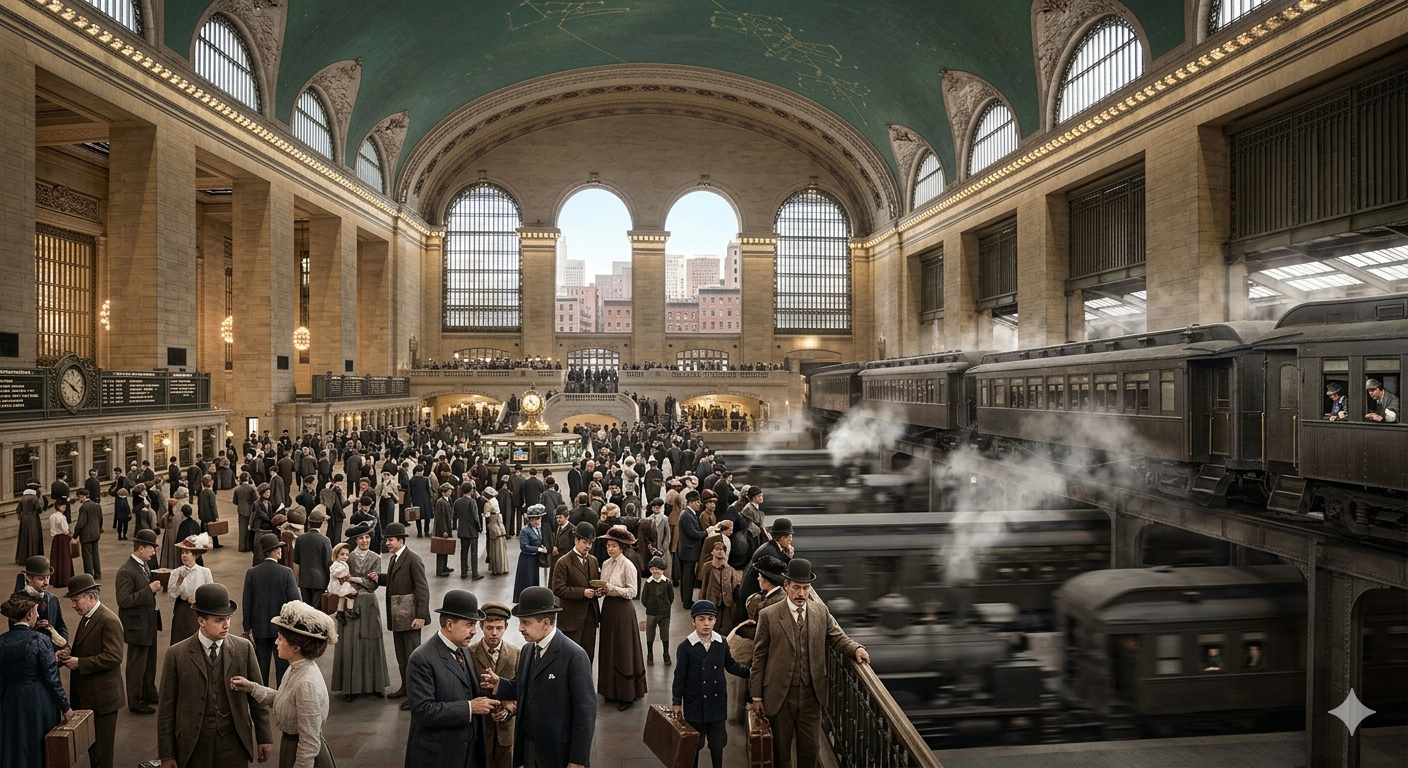
At exactly 12:01 a.m. on Sunday, February 2, 1913, the doors of Grand Central Terminal swung open in the heart of Midtown Manhattan. More than 150,000 people poured through those doors in the first day alone, marveling at soaring ceilings, marble floors, and a design unlike anything the world had seen in a railroad station.
The New York Times, which had once called the old station “a cruel disgrace,” changed its tune completely. The paper declared that the new terminal was “not only a station — it is a monument, a civic center, or, if one will, a city.” New York City had just given itself one of the greatest buildings in the history of the modern world.
What opened that February morning was the result of ten years of construction, more than $80 million in investment, the vision of a brilliant engineer, the boldness of two architecture firms, and the painful lesson of a deadly train crash that had made the old station impossible to keep.
The Old Grand Central and the Problem That Made Change Unavoidable
The story of Grand Central Terminal begins not in 1913, but decades earlier. Railroad tycoon Cornelius Vanderbilt purchased 23 acres of land on 42nd Street in 1869 and commissioned architect John B. Snook to design a major railroad depot on the site. Grand Central Depot opened in 1871, serving three rail lines — the New York and Harlem Railroad, the Hudson River Railroad, and the New York and New Haven Railroad — all unified under Vanderbilt’s New York Central Railroad.
As Manhattan grew northward and the city’s population exploded, the depot struggled to keep up. It was rebuilt and expanded into what became Grand Central Station by around 1900. But even the upgraded version could not manage the surging volume of trains and passengers flowing through its doors every day.
The real breaking point came on January 8, 1902. A southbound train crashed into another train stopped in the smoke-filled Park Avenue Tunnel beneath 56th Street, killing 15 people and injuring more than 30. The smoke from steam engines had blinded the driver of the oncoming train, leaving him unable to see the red signal ahead.
The disaster caused public outrage across the city. New Yorkers had long complained about the soot and smog choking the streets around the station. Now, people were dead. Within weeks of the crash, the president of New York Central announced that the approach tracks would be electrified. The New York State Assembly quickly followed by banning steam locomotives from operating south of the Harlem River after 1908. The old station’s days were numbered. A completely new Grand Central would have to be built.
William Wilgus: The Engineer Who Imagined Something Entirely New
The man who transformed disaster into opportunity was William J. Wilgus, the chief engineer and vice president of the New York Central Railroad. Wilgus had already been thinking about modernizing the station before the 1902 crash, but the tragedy gave his proposals urgency and political backing.
His plan was breathtakingly ambitious. He proposed tearing down the existing station entirely and building a brand-new terminal with two underground levels of electrified tracks — one for long-distance intercity trains and one for commuter rail. All the smoke and noise of the old steam engines would disappear underground, replaced by clean electric trains that could run in enclosed spaces without filling them with fumes.
Crucially, Wilgus also recognized a financial opportunity that had never been exploited before. By burying the tracks underground, the railroad would free up an enormous amount of valuable Midtown Manhattan real estate above the tracks. That air space — what Wilgus called “unreal estate” — could be leased to developers, generating revenue to help pay for the entire construction project. This was one of the first times in history that “air rights” were conceived as a commercial commodity.
The New York Central’s board of directors approved the project in June 1903 with a budget of $35 million, though costs ultimately exceeded $80 million. The railroad also launched an architectural design competition, which four firms entered: McKim, Mead & White; Samuel Huckel Jr.; Reed & Stem; and Daniel Burnham. Reed & Stem won.
Reed & Stem and Warren & Wetmore: The Architectural Partnership Behind the Terminal
The St. Paul, Minnesota firm of Reed & Stem was chosen in 1903 to handle the overall design of the new terminal. The firm brought genuine expertise in railroad station planning and introduced two innovations that would define Grand Central’s passenger experience forever.
The first was a system of internal pedestrian ramps — instead of stairs — allowing travelers to move smoothly between the terminal’s multiple levels without the jarring interruption of steps. The second was the Park Avenue Viaduct, an elevated roadway that would wrap around the outside of the building and allow Park Avenue traffic to continue north and south without being forced through the station’s immediate surroundings.
The New York Central was not entirely satisfied with Reed & Stem’s exterior design, however. They brought in a second firm — the New York architectural firm of Warren & Wetmore — as associated architects. Whitney Warren of Warren & Wetmore was reportedly selected in part because he was a cousin of William K. Vanderbilt. Warren’s firm proposed the monumental Beaux-Arts facade that would define the building’s famous appearance from 42nd Street.
The two firms collaborated — sometimes uneasily — throughout the project. When Reed & Stem’s founding partner Charles Reed died in 1911, Warren & Wetmore secretly met with New York Central and attempted to claim full credit for the station’s design. Reed & Stem later sued Warren & Wetmore and won. Despite the legal dispute, the combined work of both firms produced a building of extraordinary power and beauty.
Building the Impossible: Ten Years of Construction Beneath a Living City
Construction began on June 19, 1903, and proceeded in carefully planned phases so that railroad service could continue without interruption throughout the process. The scale of the excavation was extraordinary.
Workers removed approximately 3.2 million cubic yards of earth and rock — digging as deep as ten floors underground — to create the two-level track system. About 1,000 cubic yards of debris were removed from the site every single day. Over 10,000 workers were assigned to the project at various stages of the construction.
The design incorporated 44 platforms on two levels, accessed by 67 tracks in total. The upper level handled long-distance intercity trains; the lower level handled commuter services. The separation of these two categories of passengers was a major engineering achievement that dramatically improved the flow of people through the terminal.
The last train departed the old Grand Central Station at midnight on June 5, 1910. From that point, the team raced to complete the new building. The last of the old station’s tracks were decommissioned on June 21, 1912. On December 19, 1910, a gas explosion at a nearby electrical substation killed 10 workers and injured 117 — a grim reminder that even in the final stages, building Grand Central carried enormous risks.
The formal architectural design of the new station was not even fully finalized until 1910. In January 1911, the railroad filed 55 blueprints with the New York City Department of Buildings — among the most comprehensive sets of plans ever submitted to the department up to that time.
The Architecture: Beaux-Arts Grandeur Designed to Inspire Awe
When New Yorkers finally saw the finished building in February 1913, they were confronted with a structure designed not merely as a functional transit hub, but as a civic monument meant to express the greatness of the city it served.
The 42nd Street facade features three enormous arched windows, each 75 feet tall, rising above the main entrance. Above them, sculptor Jules-Félix Coutan’s massive sculptural group depicts three figures from Roman mythology — Mercury, god of travel and commerce; Minerva, goddess of wisdom; and Hercules, symbol of strength and labor. The sculptures were considered the largest sculptural group in the world at the time of the terminal’s construction.
At the center of the 42nd Street facade sits the world’s largest Tiffany glass clock, 13 feet in diameter, its face marked in opal — a symbol that became as iconic as the building itself. Acorns and oak leaves appear throughout the decorative details of the building, a reference to the Vanderbilt family motto: “Great oaks from little acorns grow.”
The heart of the terminal is the Main Concourse — a vast room 275 feet long, 120 feet wide, and 125 feet high, its dimensions roughly three-quarters the size of a football field. The vaulted ceiling overhead is painted a rich blue-green, covered with 2,500 gold-leaf stars depicting the astrological constellations of the Mediterranean winter sky. The celestial mural was designed by French artist Paul César Helleu, and the stars were originally illuminated by electric light bulbs — electricity being a novelty at the time — to create the impression of a glowing night sky indoors.
There is a famous quirk in the mural: the constellations are painted in mirror-image reverse, with east and west switched. Some historians believe this was intentional, based on medieval depictions of the sky as seen from outside the celestial sphere. Others think it was simply an error. Either way, the reversed sky has been a source of New York legend ever since.
The terminal was designed, in the words of one contemporary newspaper, to be “one of the smallest big stations in the world” — meaning that despite its enormous size, it was organized with such precision that it felt compact and navigable to any individual traveler passing through it.
Opening Day: The City Comes to See Its New Wonder
The evening before the official opening, New York officials and distinguished guests attended a private ceremony. Then, at precisely 12:01 a.m. on February 2, 1913, the first train departed — the Boston Express No. 2 — and the terminal was open to the public.
The crowds that flooded in were so large and so enthusiastic that railroad officials said they had never seen anything like it. By 4 o’clock that afternoon, the Main Concourse was so packed that people could barely move. By the end of the first day, the railroad estimated that more than 150,000 people had visited — not to catch trains, but simply to experience the building.
In its fiscal year ending June 30, 1913, Grand Central handled 22.4 million passengers. By 1920, that number had grown to 37 million. The terminal’s busiest year on record came in 1946, at the height of wartime and immediate postwar travel, when 65 million passengers passed through its doors.
The development of Park Avenue as a grand boulevard of luxury hotels and apartment towers followed directly from Grand Central’s opening. The air rights above the terminal’s tracks were leased to developers, generating the revenue Wilgus had envisioned and transforming 16 blocks of Midtown Manhattan into one of the most valuable real estate corridors in the world. The Waldorf-Astoria Hotel replaced the terminal’s original power plant in 1929. The MetLife Building and other glass towers rose in the years that followed, all clustered around Grand Central as their commercial heart.
The Fight to Save Grand Central: Jackie Kennedy, Philip Johnson, and the Supreme Court
By the mid-twentieth century, the rise of the automobile, the expansion of commercial aviation, and the decline of intercity rail travel had severely reduced Grand Central’s passenger numbers. The terminal fell into disrepair. Its famous celestial ceiling blackened with decades of cigarette smoke. The grand spaces grew dingy and neglected.
The most serious threat came in 1954 when Robert Young, chairman of New York Central Railroad, proposed demolishing the terminal and replacing it with an enormous office tower. That plan did not proceed, but the danger intensified after Penn Station — Grand Central’s great rival on the west side of Manhattan — was demolished between 1963 and 1966 to make way for the current Madison Square Garden. The destruction of Penn Station, once described by architectural critic Ada Louise Huxtable as “one of the great buildings of the world,” shocked the city and created the political will to fight for what remained.
Grand Central was designated a New York City Landmark in August 1967. But its owners were not finished trying to build a skyscraper above it. In February 1968, Penn Central — the railroad created by the merger of New York Central and the Pennsylvania Railroad — announced plans for a 55-story tower designed by architect Marcel Breuer to be constructed directly above the terminal. The proposal would have preserved the Main Concourse but demolished much of the rest of the building.
The battle that followed was one of the most important preservation fights in American history. Jacqueline Kennedy Onassis, the former First Lady, became the public face of the campaign to save Grand Central. She joined architect Philip Johnson and other prominent New Yorkers to form the Committee to Save Grand Central Station in 1975, taking the fight all the way to the United States Supreme Court.
In 1978, in the landmark case Penn Central Transportation Co. v. New York City, the Supreme Court upheld the constitutionality of New York’s landmarks preservation law. Grand Central’s landmark status was confirmed. The building could not be demolished. The case set a national precedent for historic preservation that still governs how American cities protect their architectural heritage today.
The $100 Million Restoration and Grand Central Today
With the legal battle won, the work of physically saving the building began. A massive restoration project launched in the 1980s and was completed in 1998 at a cost of approximately $100 million, overseen by the architecture firm Beyer Blinder Belle.
The celestial ceiling was cleaned to reveal its brilliant turquoise and gold splendor for the first time in generations. The vast commercial spaces were restored and revitalized with restaurants, shops, and a celebrated food market in the lower concourse. The restoration created more than 2,000 construction-related jobs across New York State and garnered international media attention.
Today, Grand Central Terminal serves over 67 million passengers a year through Metro-North Railroad’s commuter lines. During morning rush hour, a train arrives at the terminal every 58 seconds. It has 44 platforms connected to 67 tracks — more platforms than any other railroad station in the world. In January 2023, the opening of Grand Central Madison added Long Island Rail Road service to the station, the largest improvement to LIRR service in a century.
The terminal has been ranked the 13th-favorite work of architecture in the United States by the American Institute of Architects. It is a National Historic Civil Engineering Landmark, a National Register of Historic Places listing, and a New York City Landmark. Every year, millions of tourists visit not to catch trains but simply to stand in the Main Concourse and look up at the sky that Paul Helleu painted more than a century ago.
Grand Central Terminal opened on February 2, 1913, because a deadly train crash forced a city to demand something better. What it got was something far greater than a train station. It got a monument to ambition, beauty, and the belief that even the most ordinary daily act — catching a train to work — deserves to happen in a place worthy of the human spirit.