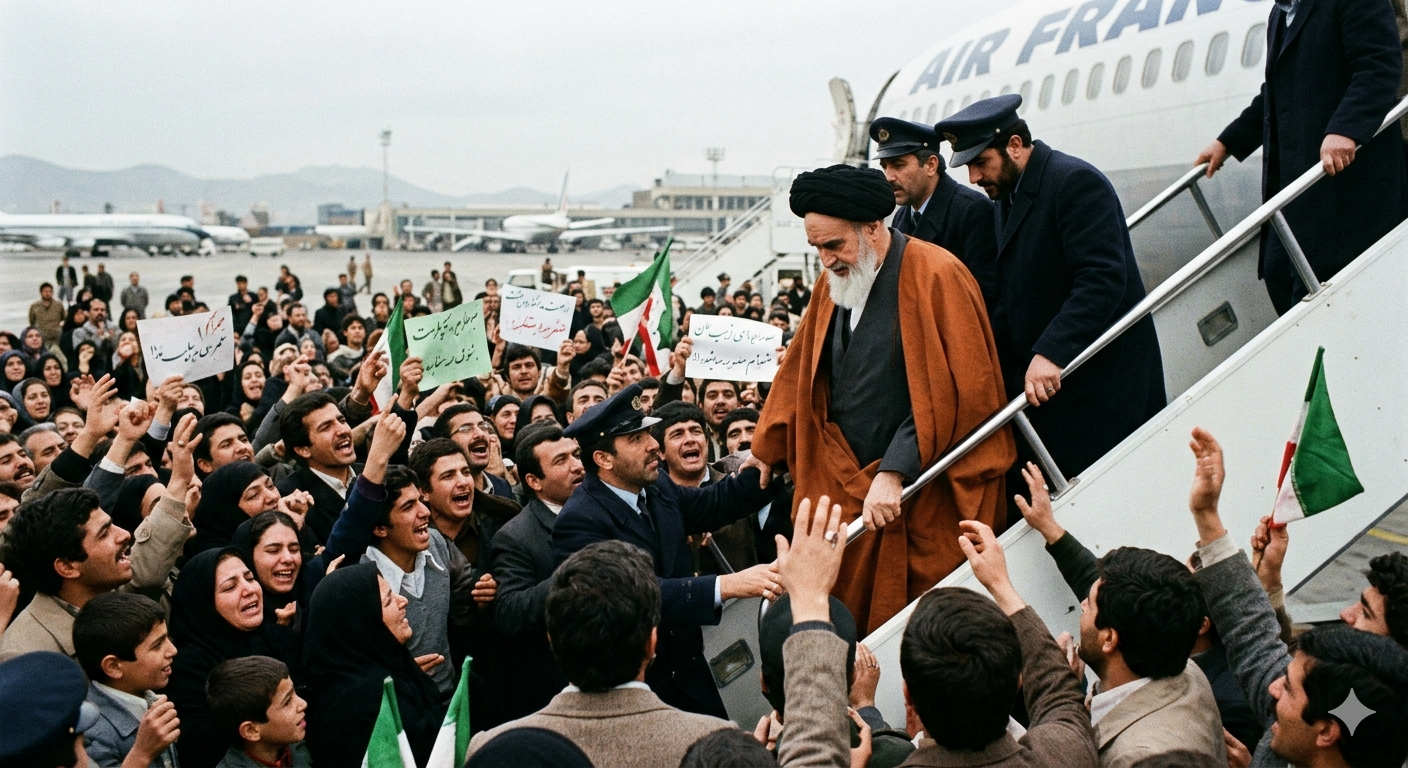
On the foggy morning of February 1, 1979, a chartered Air France Boeing 747 descended through the clouds over Tehran and touched down at Mehrabad International Airport. Aboard that plane was a 76-year-old cleric who had not stood on Iranian soil in more than fourteen years. When Ayatollah Ruhollah Khomeini stepped off the aircraft and onto the tarmac, he was greeted by one of the largest spontaneous gatherings of human beings in recorded history. Somewhere between five and ten million people flooded the streets of the Iranian capital, stretching from the airport to the city center, screaming his name, weeping, reaching out to touch the motorcade that could barely move through the crush of bodies. When an American journalist asked him how he felt returning to his homeland after so long in exile, Khomeini looked at the camera and said a single word: “Nothing.” That answer — inscrutable, unsettling, and endlessly debated ever since — captured something essential about the man who was about to dismantle a 2,500-year-old monarchy and replace it with the world’s first modern Islamic republic.
Who Was Ruhollah Khomeini Before the Revolution
Ruhollah Musavi Khomeini was born around 1902 in the small town of Khomein in central Iran. He was the son of an Islamic religious scholar and showed an early aptitude for religious study, memorizing the Quran in his youth and eventually devoting himself to the formal study of Shia Islam at the seminaries of Qom, one of the most sacred cities in the Shia world. He rose steadily through the clerical hierarchy over the following decades, attracting disciples and developing a reputation as a formidable scholar and theologian. Following the death of Grand Ayatollah Seyyed Husayn Borujerdi in 1961, Khomeini emerged as one of the leading religious authorities in Iran, achieving the rank of marja-e taqlid, meaning a model for imitation for hundreds of thousands of Shia Muslims.
His political engagement intensified in January 1963, when Shah Mohammad Reza Pahlavi announced a sweeping reform program known as the White Revolution. The six-point plan included land reform, the sale of state-owned enterprises to private interests, the enfranchisement of women, and the nationalization of forests and pastures. While the Shah promoted these changes as modernization, Khomeini viewed them as an assault on Islam and on the authority of the clerical class. He summoned senior religious scholars in Qom and persuaded them to decree a boycott of the referendum on the reforms. On January 22, 1963, Khomeini issued a strongly worded public declaration denouncing both the Shah and his reform plan, framing the entire project as a vehicle for Western imperialism and un-Islamic values.
The Arrest, the Uprising, and the Path to Exile
The confrontation between Khomeini and the Shah rapidly escalated. On June 3, 1963, Khomeini delivered an incendiary speech at the Feyziyeh Seminary in Qom, directly attacking the Shah’s legitimacy and drawing explicit parallels between the ruling monarchy and the historical enemies of Islam. Two days later, at three o’clock in the morning on June 5, 1963, agents of SAVAK — the Shah’s feared secret police — descended on Khomeini’s home and arrested him. When news of the arrest spread, massive protest demonstrations erupted in Qom, Tehran, Mashhad, Varamin, and Kashan. The Shah’s security forces killed and wounded numerous protesters in suppressing the uprising. That event entered history as the Movement of 15 Khordad, named for the date on the Iranian calendar when the crackdown occurred.
The Shah released Khomeini from prison on August 3 and placed him under house arrest, which was lifted on April 7, 1964. Rather than silencing him, the detention had elevated his status among religious conservatives and opponents of the regime. In October 1964, Khomeini delivered another charged public speech, this time denouncing a law the Shah had passed granting diplomatic immunity to all American military and civilian personnel stationed in Iran, effectively placing them beyond the reach of Iranian courts. He called it a capitulation to foreign powers and a humiliation of Iranian sovereignty. The regime’s patience ran out. At 5:30 in the afternoon on November 4, 1964, SAVAK agents arrested Khomeini and transported him directly to Mehrabad Airport in Tehran. He was put on a plane and sent into exile — a decision that the Shah almost certainly came to regret.
Fourteen Years in Exile: Turkey, Iraq, and the Road to Paris
The first stop on Khomeini’s long exile was Turkey, where he was placed under a form of supervised residency in the city of Bursa. He was hosted in the home of Colonel Ali Cetiner of the Turkish Military Intelligence. Khomeini spent less than a year in Turkey, using the time for study and for writing his second book, Tahrir al-Wasilah. In October 1965, after eleven months in Bursa, he was permitted to move to Najaf, a city in central Iraq that holds immense religious significance for Shia Muslims as the burial site of Imam Ali ibn Abi Talib. Khomeini would spend the next thirteen years in Najaf, teaching at the Sheikh Morteza Ansari Madrassah and attracting students from Iran, Iraq, India, Pakistan, Afghanistan, and across the Persian Gulf.
From Najaf, Khomeini did not retreat into scholarly silence. He continued to send home recordings of his sermons, which were copied and distributed throughout Iran by his followers despite attempts by SAVAK to intercept them. Between January 21 and February 8, 1970, he delivered a foundational series of lectures on the concept of Vilayat-e Faqih, or rule by an Islamic jurist, which became the ideological blueprint for the Islamic Republic he would eventually establish. He wrote letters to senior clerics urging them to work toward overthrowing the Shah, and he forbade any dealings with Israel. Meanwhile, the donations flowing in from Iranian supporters transformed him from a man who had arrived virtually penniless in Turkey into a figure of considerable material resources and enormous spiritual authority.
The situation changed dramatically in September 1978. Saddam Hussein, who was then the Vice President of Iraq and effectively the power behind the country’s Ba’ath government, met with representatives of the Shah at a meeting in New York. The two governments had been discussing the problem of Khomeini since at least 1975. Under renewed Iranian pressure and alarmed by the growing revolutionary unrest sweeping Iran, Saddam moved to expel Khomeini from Najaf on September 24, 1978. Khomeini attempted to find refuge in Kuwait but was turned back at the border because he had applied for his visa under the name Ruhollah Mustafavi. He considered Syria and Bahrain but was rebuffed. In a turn of events that the Shah had not anticipated, the only country Khomeini could travel to without a visa was France. He arrived in the small village of Neauphle-le-Château, located about forty kilometers west of Paris, on October 6, 1978, moving into a rented villa where he would spend the next 120 days.
Neauphle-le-Château: The French Village That Became a Revolutionary Headquarters
The Shah’s strategy in forcing Khomeini out of Najaf had been to cut him off from the mosque networks and student communities of the Shia holy cities and thereby reduce his influence over events in Iran. It backfired in spectacular fashion. France in 1978 was a country with a free press, open telephone lines, and international media organizations eager for access to the world’s most controversial cleric. Within days of Khomeini’s arrival in Neauphle-le-Château, journalists from around the world converged on the quiet Yvelines village, and Khomeini’s words and image began to appear in newspapers and on television screens globally. The BBC in particular put him in the spotlight, and he skillfully portrayed himself to Western audiences as a spiritually motivated figure seeking to free his people from the Shah’s oppression, presenting an image far more palatable to liberal Western sensibilities than his true political program.
One of his primary activities in the village was recording speeches and sermons on audio cassettes. These recordings were then smuggled into Iran through networks of sympathizers and played in mosques and private homes across the country, giving Khomeini a presence in every corner of Iran that the Shah could not suppress. Bernard Hourcade, a specialist on Iran at France’s National Centre for Scientific Research, later observed that Khomeini effectively organized the entire Iranian revolution from that small house in the French countryside. Among those who came to join him at Neauphle-le-Château was Abolhassan Banisadr, who would later become the first president of the Islamic Republic, and other aides who would shape the revolutionary government. On November 11, 1978, Khomeini assigned the formation of a Revolutionary Council, which was led by Ayatollah Beheshti and Ayatollah Mottahari, to begin coordinating the transition to a post-Shah government.
The Shah’s Departure and the Airport Confrontation
By late 1978, the revolution had engulfed Iran. Strikes and mass demonstrations paralyzed the country’s economy and government. High unemployment, rising inflation following the economic collapse of 1977, and deep resentment of the Shah’s autocratic rule and the brutality of SAVAK had fused into a broad revolutionary coalition that united Islamists, communists, socialists, nationalists, and ordinary citizens. Millions marched under Khomeini’s portrait. The Muharram protests of December 1978, timed to coincide with the holiest period of the Shia calendar, were among the most massive demonstrations the country had ever seen. By December of that year, protests had spread to nearly every major city and dozens of smaller towns throughout Iran.
On January 16, 1979, Shah Mohammad Reza Pahlavi, his wife Queen Farah Diba, and their family departed Iran aboard a royal aircraft, ostensibly for a vacation in Egypt. As he left, the Shah told his last Prime Minister, Shapour Bakhtiar — a long-time nationalist politician who had been confirmed by the Iranian parliament two weeks earlier — “I give Iran into your care, yours and God’s.” The Shah would never return. He eventually made his way to Panama and then to Cairo, where Egypt’s President Anwar Sadat granted him asylum. He died in Cairo on July 27, 1980, from lymphatic cancer.
Bakhtiar, now leading a government whose legitimacy was challenged by virtually everyone, made one last attempt to slow the revolutionary tide. He announced that Iran’s airports would be closed, initially preventing Khomeini’s planned return on January 26. Khomeini, speaking from France, declared that he would return as soon as the airports reopened and called on Iranians to maintain their pressure. In Tehran alone, twenty-eight people were killed in protests triggered by the airport closure. The strikes and demonstrations were unrelenting. On January 29, facing the collapse of his authority, Bakhtiar ordered the airports reopened.
The Return: February 1, 1979, and the Ten Days That Ended a Dynasty
At 9:30 in the morning on February 1, 1979, Ayatollah Khomeini arrived in Iran. The chartered Air France Boeing 747 circled the airport before landing, reportedly to confirm that no military tanks were blocking the runway. Aboard the plane with Khomeini were a group of opposition figures and aides who had supported him during exile. Crowds were so enormous that when Khomeini tried to travel from Mehrabad Airport by car, the vehicle was overwhelmed by supporters and he was forced to continue his journey by helicopter. Estimates of the total number of people who poured into the streets of Tehran that day range from five to ten million. Reporters described scenes of almost religious ecstasy, with crowds chanting “Khomeini, O Imam, we salute you, peace be upon you” and even “Khomeini for King.” Many in the crowd wept openly.
It was during this journey, in a brief exchange with journalist Peter Jennings of ABC News who asked how Khomeini felt about returning to Iran after fifteen years of exile, that Khomeini delivered his famous one-word reply. The word in Persian was “Hichi” — Nothing. The response attracted enormous attention and has been interpreted in many different ways. Some critics argued it revealed a fundamental detachment from the Iranian people and their suffering. Others, drawing on Shia mystical philosophy and the work of the twelfth-century Sufi thinker Ibn Arabi, interpreted it as a spiritually elevated response reflecting the concept of a “Perfect Man” who has transcended ordinary emotional attachment. Whatever its meaning, it crystallized the paradox of Khomeini himself — a man of vast popular devotion who seemed personally unmoved by it.
From the airport, Khomeini traveled to Behesht-e Zahra, Tehran’s largest cemetery, where many of those who had been killed during the revolution were buried. Standing before a vast crowd of mourners and celebrants, he delivered a speech in which he declared the Shah-appointed government of Shapour Bakhtiar to be entirely illegitimate. “I will appoint a government,” he announced. “I will slap this government on the mouth.” Four days later, on February 5, Khomeini selected Mehdi Bazargan as Prime Minister of a provisional government. On February 8, officers of the Iranian Air Force went to Khomeini’s residence and pledged their loyalty to the revolution. On February 11, the senior commanders of Iran’s armed forces formally declared neutrality and withdrew their troops from the streets. Bakhtiar resigned and fled to France. The revolution was complete. In just ten days — a period now commemorated in Iran as Dahe-ye Fajr, or the “Ten Days of Dawn” — a 2,500-year-old institution of Persian monarchy had ceased to exist.
Building the Islamic Republic: The Weeks and Months That Followed
The speed with which Khomeini consolidated power after his return was remarkable. In March 1979, Iranians voted in a referendum on whether to establish an Islamic Republic. More than 98 percent of eligible voters approved the change. Khomeini then oversaw the drafting of a new constitution that formalized the concept of Vilayat-e Faqih, the supreme authority of the Islamic jurist, which he had first articulated in his 1970 Najaf lectures. In December 1979, a second constitutional referendum was held, and Khomeini was officially named Iran’s Supreme Leader — a position he would hold until his death — with virtually unlimited authority over all branches of government. Among the figures in his inner circle, Sadegh Ghotbzadeh served as Foreign Minister between November 1979 and August 1980. Abolhassan Banisadr was elected as the Islamic Republic’s first president in February 1980, though he was later impeached and fled to France, where he lived until his death in Paris in 2021.
The new Iran was a dramatically different country from the one Khomeini had left in 1964. Women were required to wear the hijab in public. Western cultural products were banned. The American embassy was seized by revolutionary students on November 4, 1979, and more than fifty American diplomats were held hostage for 444 days, an event that permanently shattered the Iran-United States relationship. Iran’s Jewish community, which had numbered approximately 80,000 in 1979, found itself granted second-class citizenship under the new constitution, with much of their property confiscated. Within two years, roughly one-third of Iran’s Jews had emigrated, most to Israel or the United States. Iran’s relationship with Israel, which had maintained discreet diplomatic ties with the Pahlavi government since 1950, was severed entirely.
The Legacy of February 1, 1979: A Day That Reshaped the Middle East
The return of Ayatollah Khomeini on February 1, 1979 was not simply the conclusion of a personal journey from exile to power. It was a geopolitical earthquake whose aftershocks are still felt across the Middle East and the world today. The establishment of the Islamic Republic under Khomeini’s leadership introduced a new political model — theocratic governance fused with revolutionary ideology — that challenged both the secular authoritarian regimes of the Arab world and the Western-aligned order of the Cold War era. The revolution demonstrated that a popular uprising grounded in religious identity could overthrow a well-armed, oil-rich monarchy that had the explicit backing of the United States.
Iran’s regional foreign policy, its support for Hezbollah in Lebanon, its deep involvement in Iraq, Syria, and Yemen, and its confrontational posture toward Israel and the United States all trace their origins directly to the ideology Khomeini brought home with him on that Air France flight. The Iran-Iraq War, which began when Saddam Hussein invaded in September 1980 and lasted until 1988, killed hundreds of thousands and reshaped both countries. When Ayatollah Khomeini died on June 3, 1989, more than two million anguished mourners attended his funeral in Tehran in scenes that rivaled the welcome he had received a decade earlier. His successor as Supreme Leader, Ayatollah Ali Khamenei, has continued to govern Iran according to the constitutional framework and ideological principles Khomeini established.
In Neauphle-le-Château, the house where Khomeini recorded his revolutionary speeches was destroyed in an explosion in February 1980, just months after the revolution. In Tehran, the street on which the French Embassy stands was renamed after the quiet French village that had briefly served as the headquarters of a revolution. Every year, on February 1, Iranians mark the anniversary of Khomeini’s return as the beginning of the Ten Days of Dawn — a reminder that on a foggy morning in 1979, one man stepped off a plane and, with a single word, told the world exactly how much he cared about the power he was about to receive.