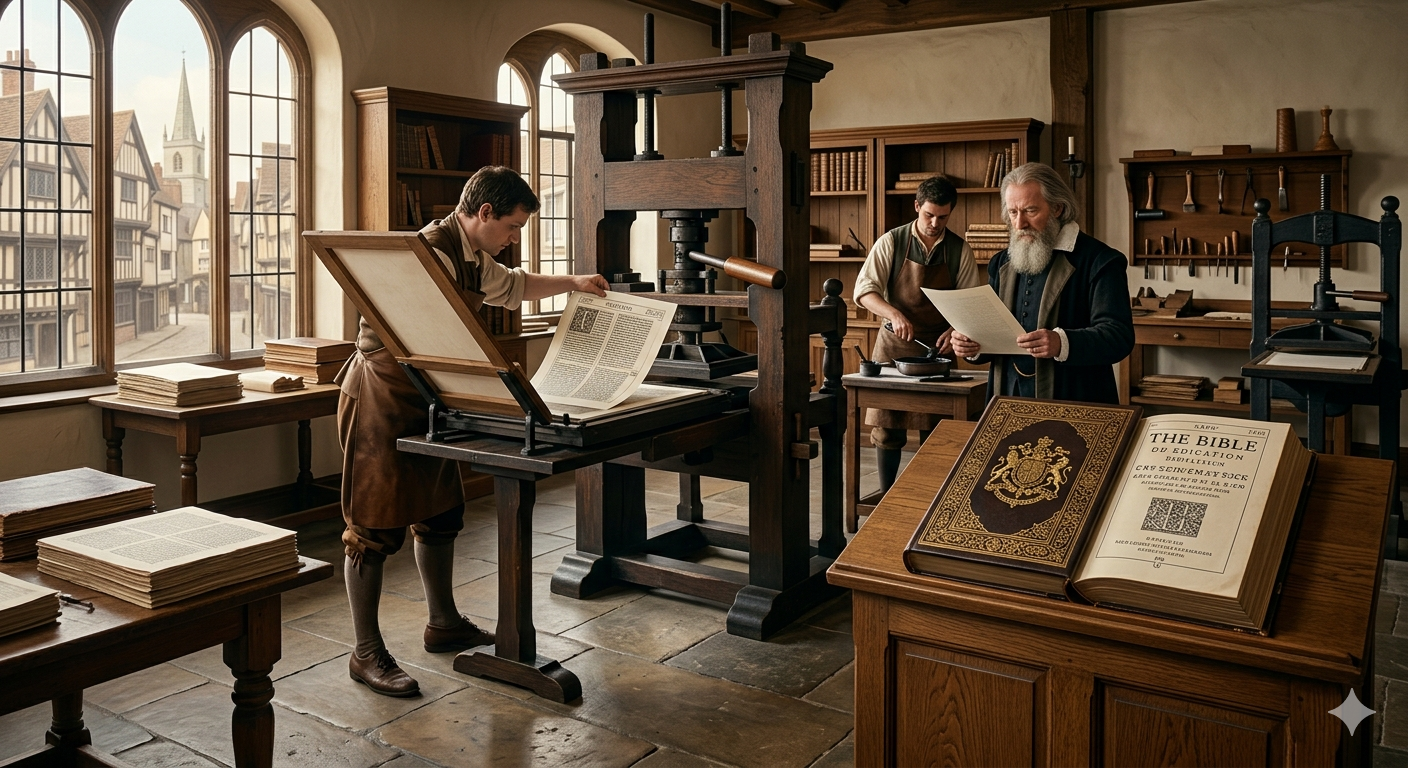
In 1611, the printing press of Robert Barker the King’s Printer released a folio Bible in London that would go on to become the most influential book in the history of the English language. It was known simply as the Authorized Version, or the King James Bible. Seven years of scholarship, 47 translators, six committees, three universities, and one deeply divided kingdom had produced a work whose phrases would flow into everyday English speech and remain there for centuries.
The Bible was dedicated “To the Most High and Mighty Prince James, by the Grace of God.” It was the right dedication. Without James I of England, the project would never have existed. But the story of why it was needed, who built it, and what it became is far larger than any single monarch.
England’s Bible Problem: A Kingdom Divided by Translation
When James VI of Scotland became James I of England in 1603, following the death of Queen Elizabeth I, he inherited a kingdom in which Christians were hearing one Bible at church and reading a different one at home and neither version was universally respected.
The Bishops’ Bible of 1568 was the official text of the Church of England, read aloud from church lecterns across the country. It had been commissioned by Archbishop Matthew Parker to replace the Great Bible of 1539 itself a revision of the earlier work of William Tyndale. The problem was that almost nobody liked it. The clergy tolerated it, but the translation was uneven, its scholarship inconsistent, and its language too stiff and archaic to resonate with ordinary readers.
The Bible that people actually loved was the Geneva Bible of 1560 a careful, scholarly translation produced by English Protestant exiles living in Calvin’s Geneva during the brutal reign of Mary I. It was the first English Bible to divide the text into numbered verses. It was small and affordable, designed to be held in the hand rather than set on a lectern. It was the Bible that William Shakespeare read, the Bible carried by the Pilgrim Fathers to America, and the Bible that sat in the homes of most literate English Protestants of the age.
But the Geneva Bible had one fatal problem, from James’s perspective: its margins. The Geneva Bible was filled with annotations explanatory notes that framed the text with a strongly Calvinist, anti-monarchist interpretation. One note, commenting on the book of Exodus, compared the defiance of Pharaoh’s midwives to legitimate resistance against tyrannical rulers. James, who believed passionately in the divine right of kings and had written a treatise on the subject, regarded these notes as directly threatening to his authority. He declared the Geneva Bible “the worst” translation he had encountered, condemning its notes as “partial, untrue, seditious.”
England needed a single Bible one that was scholarly enough to satisfy Puritan scholars, ecclesiastically sound enough for Anglican bishops, linguistically beautiful enough for ordinary readers, and completely free of politically dangerous commentary.
The Hampton Court Conference of 1604 and the Birth of a New Bible
In January 1604, just months after ascending the English throne, James I convened the Hampton Court Conference a formal meeting of church leaders designed to address Puritan grievances that had been building for years. About a thousand Puritan ministers had signed the Millenary Petition, calling for reform in the Church of England. James agreed to hear their complaints, though he had little sympathy for the Presbyterian system of church governance that the Puritans preferred, once warning them that if they did not conform he would “harry them out of the land.”
The Puritan delegation at Hampton Court was led by John Rainolds also spelled Reynolds the President of Corpus Christi College, Oxford, and one of the most distinguished biblical scholars in England. Near the end of the conference, Rainolds proposed that a new translation of the Bible be commissioned, arguing that the existing versions “were corrupt and not answerable to the truth of the original.” He hoped that James would turn against the Bishops’ Bible and create something more reformed. His plan partially backfired: James took up the idea with enthusiasm, but insisted the new translation would be based on the Bishops’ Bible, not the Geneva, and would contain no marginal notes of theological commentary whatsoever.
Richard Bancroft, the Bishop of London who initially opposed Rainolds’s proposal was appointed to oversee the project and identify suitable translators. He drew up fifteen rules of procedure to govern the entire enterprise. By June 30, 1604, James had approved a list of 54 scholars, of whom 47 are known to have actively participated.
The fifteen rules Bancroft established were precise and demanding. The Bishops’ Bible would serve as the base text. Where the original Hebrew or Greek required revision, translators could turn to Tyndale’s Bible, Coverdale’s Bible, Matthew’s Bible, the Great Bible, and the Geneva Bible in that order of preference. Old ecclesiastical words were to be retained. No marginal notes were to be added, except to explain difficult Hebrew or Greek words. And critically, each completed section would be reviewed not just by its own committee but by all the other committees as well a systematic process of peer review designed to produce a text that no group could fairly object to.
The 47 Scholars Who Built the King James Bible
The translators selected for the project were among the most extraordinarily learned men in England. They were divided into six groups, or “companies,” with two companies each working at Westminster, Oxford, and Cambridge. Each company was assigned a specific portion of Scripture.
The First Westminster Company translated the first books of the Old Testament, from Genesis through Kings. It was led by Lancelot Andrewes, then Dean of Westminster, who was widely considered the most learned man in England. Andrewes had command of fifteen languages, including Hebrew, Greek, Latin, Arabic, Aramaic, Syriac, French, Spanish, Italian, and more. He was also the royal chaplain to both Elizabeth I and James I the king reportedly slept with Andrewes’s sermons under his pillow. His linguistic mastery and spiritual authority gave the Westminster Company’s work its distinctive weight and gravity.
The First Oxford Company translated the major prophets Isaiah through Malachi and included John Rainolds himself, who had proposed the project in the first place. Rainolds died in 1607, before the work was complete, but not before contributing significantly to the prophetic books. Miles Smith, another Oxford scholar, would write the famous preface to the completed Bible “The Translators to the Reader” a masterwork of self-reflection and explanation that is, regrettably, no longer printed in most modern editions of the KJV.
The Second Oxford Company translated the Gospels, the Acts of the Apostles, and the Book of Revelation. It included Sir Henry Savile, the only layman among all the translators, who was the founding warden of Merton College and one of the greatest classical scholars of the age. The Cambridge companies handled the books from Chronicles through the Song of Solomon, the Apocrypha, and the Epistles.
All of these men were standing on the shoulders of one who had come before them: William Tyndale. In the early 16th century, Tyndale had translated the New Testament and portions of the Old directly from the original Greek and Hebrew, declaring his ambition that “a boy that driveth the plough should know more of the scriptures” than the learned clergymen of his day. He was arrested for heresy, strangled, and burned at the stake in 1536. But his words lived on scholars have estimated that between 70 and 80 percent of the King James New Testament derives directly from Tyndale’s translation. The men of 1604–1611 did not replace Tyndale. They refined, expanded, and completed what he had died trying to do.
Seven Years of Translation: From 1604 to 1611
The six companies began their work toward the end of 1604 and worked through a carefully staged process. First, each scholar within a given company independently translated the same passage. The translations were then compared and debated. When a company reached agreement on an entire book, that text was sent to the other five companies for review. Disagreements between companies were resolved at meetings of the leading scholars from each group.
The Apocrypha committee finished its work first. All six companies had completed their sections by 1608. From January 1609 onward, a General Committee of Review met at Stationers’ Hall in London to work through the entire Bible one final time. The members of this committee including John Bois, Andrew Downes, and John Harmar were paid by the Stationers’ Company for their attendance and labor.
By 1610, the text had gone to press. Richard Bancroft, by now elevated to Archbishop of Canterbury, insisted on making fourteen final changes to the manuscript among them inserting the word “bishopricke” at Acts 1:20, a subtle but characteristic assertion of episcopal authority. Miles Smith and Thomas Bilson supervised the actual printing process.
The records of the translation process were largely destroyed in the Great Fire of London in 1666, which is why so many details of the seven-year project remain uncertain. But the result of those years of labor was clear.
1611: Publication and the Frontispiece That Told the Story
The first edition of the King James Bible rolled off Robert Barker’s press in 1611. It was a massive folio volume approximately 16 inches tall designed primarily for church use. The title page bore the phrase “Appointed to be read in the churches.” It could be purchased unbound for ten shillings or bound for twelve. Two slightly different editions were printed in 1611, which scholars later distinguished as the “He Bible” and the “She Bible” based on a variation in the final clause of Ruth 3:15 one reading “he went into the city” and the other “she went into the city.”
The frontispiece of the 1611 edition, engraved by Cornelius Boel, was a masterpiece of symbolic design. Moses and Aaron flanked the sides. The Evangelists occupied the corners. At the center was the divine name in Hebrew, surrounded by heavenly light. Every element was deliberate this was not merely a book but a declaration of the union of learning, faith, and royal authority.
The Bible was 80 books in total: 39 books of the Old Testament, 14 books of the Apocrypha (later removed in most Protestant editions), and 27 books of the New Testament. You can explore the full text of the 1611 first edition, preserved in digitized form, at the Internet Archive’s 1611 Authorized King James Bible collection.
Reception and the Path to Dominance
The King James Bible did not instantly replace the Geneva Bible in popular affection. Editions of the Geneva continued to appear after 1611, and even Lancelot Andrewes one of the KJV’s own translators continued to use the Geneva Bible in his personal study for years afterward. In the first three decades, the KJV went through seventeen editions in its first three years alone but the Geneva was still being printed alongside it.
What finally secured the KJV’s dominance was politics as much as scholarship. After the English Civil War and the defeat of Puritanism, the Restoration of Charles II in 1660 made the Geneva Bible politically suspect too closely associated with the Puritan revolution that had executed his father. The Authorized Version, by contrast, carried royal imprimatur and no dangerous annotations. It swept the field. By the time the fifth edition of the Book of Common Prayer was produced in 1662, it quoted exclusively from the King James Version for its Gospel and Epistle readings. The Geneva Bible had effectively disappeared from English religious life.
There were small revisions in 1616, 1629, and 1638 to correct printer’s errors, and more substantial standardizations in 1762 and 1769. The 1769 Oxford Edition the work of Benjamin Blayney is actually the text that most readers today receive as “the 1611 King James Bible,” since it corrected many of the typographical irregularities that had accumulated over 150 years of reprinting.
One of the most famous misprints in publishing history came from a 1631 edition that accidentally omitted the word “not” from the Seventh Commandment, printing “Thou shalt commit adultery.” The printers were fined £300 and that edition became known as the “Wicked Bible.”
The King James Bible and the English Language: Phrases That Never Left
The cultural impact of the King James Bible on the English language is almost impossible to overstate. Scholars estimate that more than 250 phrases from the KJV have entered everyday English idiom expressions so thoroughly absorbed that most people who use them have no idea of their origin.
“Salt of the earth.” “Turn the other cheek.” “Fly in the ointment.” “Wolf in sheep’s clothing.” “The writing on the wall.” “Fell on stony ground.” “A drop in the bucket.” “Labour of love.” “Sour grapes.” “Fight the good fight.” “The skin of my teeth.” All of these come from the King James Bible. These were not just religious phrases they became the common property of every English speaker, regardless of faith.
Thomas Babington Macaulay, writing in 1828, called the King James Bible “a book which, if everything else in our language should perish, would alone suffice to show the whole extent of its beauty and power.” As recently as 2014, a major study on the Bible in American life found that 55 percent of American Bible readers still reached most often for the King James Version more than four centuries after its publication.
The Britannica describes the KJV as having “a marked influence on English literary style” and notes it was “generally accepted as the standard English Bible from the mid-17th to the early 20th century.” You can read more about this enduring influence at Britannica’s entry on the King James Version.
Why the King James Bible Remains One of History’s Most Important Books
The King James Bible was not simply a translation. It was an act of statecraft, a work of collective literary genius, and the product of a moment when the English language was at perhaps its most fertile and flexible spoken in the same generation as William Shakespeare, Francis Bacon, and John Donne.
James I wanted a Bible that would unify his divided kingdom. He got that, eventually. But he also got something he could not have fully anticipated: a document that would shape the consciousness of the English-speaking world for the next four hundred years, travel with settlers to the Americas, underpin the rhetoric of the English Civil War and the American Revolution, inspire the language of Abraham Lincoln and Martin Luther King Jr., and remain the most-printed book in human history.
The men who produced it Lancelot Andrewes, John Rainolds, Miles Smith, John Bois, and the forty-three others whose names most people have never heard were conscious of their duty to precision and beauty in equal measure. In the preface Miles Smith wrote, they aimed not to make a new translation, nor to make “a bad one a good one” but to make from “many good ones, one principal good one, not justly to be excepted against.”
In 1611, Robert Barker’s press delivered that principal good one to the world. It has been in print, continuously, ever since. The Bible Society’s resources on the King James Bible offer an excellent starting point for anyone who wants to explore its influence on faith, literature, and culture in greater depth.