On the morning of May 2, 1519, in a small château on the banks of the Loire River in Amboise, France, the most curious mind in human history fell silent forever. Leonardo da Vinci painter, sculptor, architect, engineer, anatomist, musician, and scientist died in his bedchamber at the Château du Clos Lucé at the age of 67.
He had spent his final three years in France, far from the Italy where he was born and where he had created most of his greatest works. He was surrounded by those he loved most: his devoted pupil Francesco Melzi, his faithful servant Battista de Villanis, and perhaps King Francis I of France himself though historians debate whether the king was truly present at the bedside.
The world had lost the man that Giorgio Vasari, his first great biographer, would call a person “marvellously endowed by heaven with beauty, grace and talent in such abundance that he leaves other men far behind.” Five centuries later, no one has seriously challenged that verdict.
Leonardo da Vinci: The Man Who Was Born to Question Everything
Leonardo di ser Piero da Vinci was born on April 15, 1452, in Anchiano, a small hamlet near the town of Vinci in the Tuscan hills of what is now Italy. He was born out of wedlock to Ser Piero da Vinci, a prosperous Florentine notary, and Caterina, a young peasant woman. His parents never married. His mother wed another man and started a separate family, and Leonardo was raised in his father’s household, first by grandparents and an uncle who shared his deep love of nature.
He received little formal schooling beyond basic reading, writing, and mathematics. But his natural curiosity, his ability to observe the world with surgical precision, and his extraordinary hand made it apparent from early childhood that he was exceptional. His father recognized the talent and, around 1466, apprenticed the fourteen-year-old Leonardo to Andrea del Verrocchio, one of the leading painters and sculptors in Florence.
Verrocchio’s bottega his workshop was one of the great intellectual centers of Renaissance Florence. There, Leonardo was trained not just in painting and sculpture but in chemistry, metallurgy, leather working, mechanical arts, carpentry, and drafting. He absorbed everything and surpassed his master with such speed that, according to Vasari’s account, when Verrocchio saw the angel Leonardo had painted in the Baptism of Christ (c. 1470–75), the older master was so overwhelmed by his pupil’s superiority that he resolved never to touch a paintbrush again.
By 1472, at just twenty years old, Leonardo had qualified as a master in the Guild of Saint Luke the Florentine guild of artists and physicians and established his own workshop.
Milan, the Mona Lisa, and a Lifetime of Unfinished Masterpieces
In 1482, Leonardo left Florence for Milan, entering the service of Ludovico Sforza, the Duke of Milan. He would spend nearly two decades there, working as painter, sculptor, military engineer, court entertainer, and designer of festivals and pageants. It was in Milan that he began the habit that would define his intellectual legacy: filling notebook after notebook with drawings, scientific observations, anatomical studies, and engineering designs written in his characteristic mirror script right to left, legible only when held up to a glass.
His greatest commission in Milan was The Last Supper, painted in tempera and oil directly onto the wall of the refectory of Santa Maria delle Grazie between approximately 1495 and 1498. It was a revolutionary work not only in its emotional depth and the individuality of its twelve apostles’ expressions, but in Leonardo’s belief, articulated throughout his notebooks, that every physical gesture of the body reflects the inner motion of the soul. The painting began to deteriorate almost immediately after completion due to his experimental technique, but it remains one of the most reproduced and analyzed images in the history of Western art.
When French forces invaded Milan in 1499 and the Sforza fell from power, Leonardo left the city and spent the next sixteen years moving restlessly across Italy Venice, Florence, Rome working for a succession of patrons including the infamous Cesare Borgia, the Florentine republic, and the papacy. It was during this period, around 1503, that he began the painting that would become the most famous in the world: the Mona Lisa, a portrait of Lisa del Giocondo, wife of Florentine merchant Francesco del Giocondo.
For Leonardo, the Mona Lisa was never finished. He carried it with him for the rest of his life, continuing to refine it, unable to declare it complete. It would travel with him to France and remain in his possession until his death.
The Notebooks: A Mind That Was Centuries Ahead of Its Time
If Leonardo’s paintings made him famous, his notebooks revealed the true scope of what he was. Between roughly 1490 and his death in 1519, he filled approximately 13,000 pages with drawings, diagrams, and observations spanning anatomy, geology, optics, hydraulics, botany, astronomy, cartography, and mechanical engineering. Around 7,000 of those pages survive today, organized into codices held by institutions including the Royal Library at Windsor, the Biblioteca Ambrosiana in Milan, the Institut de France in Paris, and the Biblioteca Nacional in Madrid.
He designed flying machines including a device that anticipates the modern helicopter decades before powered flight was conceivable. He sketched an armored vehicle that resembles a modern tank. He designed solar-powered concentrating lenses, a rudimentary calculator, a self-propelled cart, and a double-hulled ship. He performed anatomical dissections of human cadavers with a precision that would not be surpassed for over a century, producing drawings of the human skeletal system, musculature, cardiovascular system, brain, and fetus in utero that remained the most accurate representations of their kind until the 19th century.
None of these designs were published during his lifetime. His notebooks, written in mirror script and filled with observations that read as deeply personal thinking rather than polished science, circulated only among a small circle of admirers. Their influence on the scientific revolution, therefore, was indirect and delayed. But when scholars of later centuries finally studied them systematically, they understood that Leonardo had arrived alone, unassisted, and centuries early at conclusions that the rest of the world would take generations to reach.
The Codex Leicester, one of Leonardo’s most celebrated scientific journals, was purchased by Bill Gates in 1994 for $30 million a testament to how the world values what Leonardo left behind.
King Francis I and the Final Chapter: France Calls Leonardo Home
By 1516, Leonardo was 64 years old and in declining health. His primary patron in Rome, Giuliano de’ Medici, had died in March of that year. He had no permanent home, no secure income, and no clear prospect of completing the grand projects he had always envisioned.
Then came an invitation that changed everything.
King Francis I of France a young, energetic monarch who was genuinely passionate about art and ideas had encountered Leonardo through the cultural connections between France and northern Italy. The king was dazzled. He offered Leonardo the title of “Premier Painter, Engineer, and Architect to the King” and a stipend of 2,000 gold écus per year. He also offered Leonardo a residence: the Château du Clos Lucé, a late 15th-century manor house of pink brick and white stone located in Amboise, less than 500 meters from the royal Château d’Amboise itself. An underground passage reportedly connected the two residences, allowing the king to visit Leonardo without ceremony.
Leonardo accepted. In the late autumn of 1516, he crossed the Alps for the last time, traveling on mule back across the high passes in the company of Francesco Melzi, his devoted pupil and close companion of nearly two decades, and Battista de Villanis, his loyal Milanese servant. He brought with him his most cherished possessions: the Mona Lisa, The Virgin and Child with Saint Anne, Saint John the Baptist, and his vast collection of notebooks.
He would never return to Italy.
Life at Clos Lucé: Leonardo’s Final Three Years in Amboise
The years at Clos Lucé were productive and personally serene, though Leonardo’s physical strength was failing. A partial paralysis of his right hand likely the result of a stroke suffered around 1517 limited his ability to paint, but he continued to draw, design, and think with undiminished intensity.
He worked on projects for the king that ranged from the visionary to the practical. He designed a scheme for the ideal city of Romorantin, intended to become a new capital of France, with wide canals, rational street planning, and integrated waterways. He contributed ideas for the double-helix staircase of the Château de Chambord the Loire Valley’s grandest royal palace, then being designed for Francis I. He planned a network of canals linking the Loire Valley to Lyon, designed to ease trade with Italy.
He organized spectacular court entertainments elaborate theatrical pageants with mechanical automata and special effects that were unlike anything seen before in France. One celebrated the birth of the Dauphin François, heir to the French throne. Another commemorated Francis I’s victory at the Battle of Marignano. A mock battle staged in Amboise in April 1518 was so realistic that some participants were actually killed.
Cardinal Luigi d’Aragona, a distinguished Vatican diplomat, visited Leonardo at Clos Lucé on October 10, 1517. His secretary, Antonio de Beatis, recorded the visit in a diary that survives as one of the most valuable firsthand accounts of Leonardo in his last years. De Beatis described Leonardo as an old man whose right hand was paralyzed but who retained full mental clarity. He showed the Cardinal three extraordinary paintings: the Mona Lisa, The Virgin and Child with Saint Anne, and Saint John the Baptist. He also showed them his notebooks page after page of anatomical drawings, engineering designs, and scientific observations that de Beatis described with barely contained awe.
By early 1519, Leonardo’s health had deteriorated significantly. He knew he was dying.
The Will of April 23, 1519: Leonardo’s Last Instructions
On April 23, 1519, nine days before his death, Leonardo da Vinci summoned Maître Guillaume Boureau, the notary of the royal bailiwick of Amboise, to Clos Lucé and dictated his last will and testament. The document was written in French, as required by French law.
The will was meticulous and deeply revealing. Leonardo left his vineyards in Milan, his orchard, and his financial assets to his half-brothers. He left a substantial cash amount to his servant Mathurine, who cooked for him. He left his clothing to Battista de Villanis. He requested a formal funeral of princely dignity, with 60 tapers carried by 60 poor men, three High Masses, and thirty lesser masses celebrated at various churches in Amboise.
Most significantly, Leonardo left his most precious possessions all of his manuscripts, drawings, notebooks, and the instruments of his craft to Francesco Melzi. It was a profoundly intimate bequest. Melzi had been with Leonardo for nearly two decades, coming to him as a young man of aristocratic Milanese family who chose to follow the master rather than pursue an easier life. He was more than a student. He was, by every account, the person Leonardo loved most deeply.
The three great paintings the Mona Lisa, The Virgin and Child with Saint Anne, and Saint John the Baptist had all been acquired by King Francis I, either before Leonardo’s death or shortly after. The Mona Lisa, in particular, passed into the French royal collection and would eventually hang in the Louvre, where it remains today, drawing millions of visitors each year and still compelling the same question that Leonardo painted into the sitter’s expression: what is she thinking?
You can read more about Leonardo’s extraordinary legacy at the Louvre Museum’s official Leonardo da Vinci collection page.
May 2, 1519: The Death and the Legend That Followed
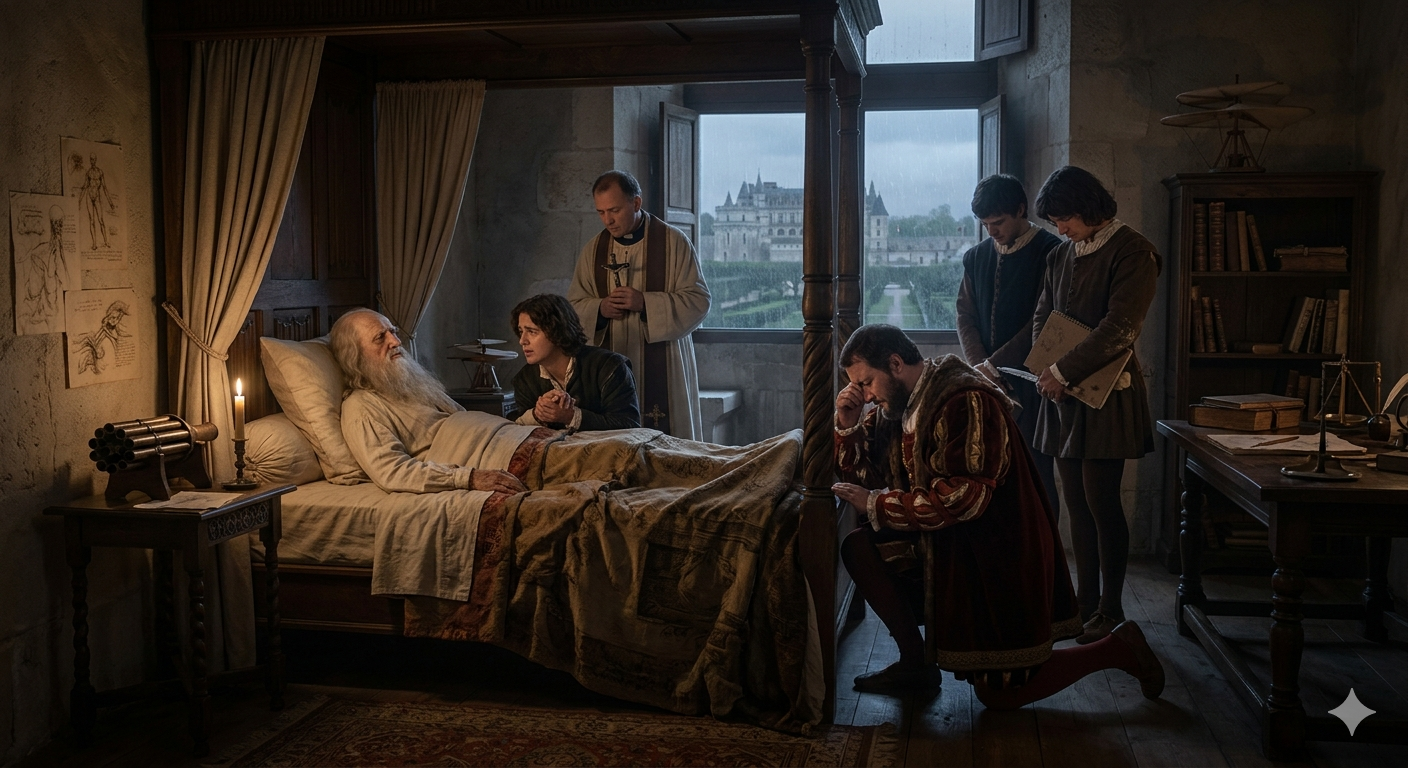
Leonardo da Vinci died in his bedchamber at the Château du Clos Lucé on May 2, 1519, shortly before 1:00 a.m. He was 67 years old an unusually long life for the period.
The circumstances of his death inspired one of the most famous legends in art history. Giorgio Vasari, in his 1550 Lives of the Most Excellent Painters, Sculptors, and Architects, wrote that King Francis I had rushed to Leonardo’s bedside and that Leonardo died in the king’s arms the ultimate tribute of a great ruler to a great artist. The story captured the imagination of later generations and was depicted in celebrated paintings by the French artist François-Guillaume Ménageot in 1781 and by Jean-Auguste-Dominique Ingres in 1818.
Historians are skeptical. No contemporary document confirms the king’s presence at the deathbed, and court records suggest Francis I may have been elsewhere. But the legend endures and it reflects something true, if not literally accurate: that the relationship between this French king and this Italian genius was genuinely one of mutual admiration, intellectual kinship, and warmth that was unusual between monarchs and their court artists.
Leonardo was buried with the ceremony he had requested. His body was interred on August 12, 1519, in the collegiate church of Saint-Florentin on the grounds of the Château d’Amboise. Francesco Melzi wrote to Leonardo’s half-brothers in Italy to inform them of the master’s death. His letter is one of the most moving tributes ever paid by a student to a teacher, describing Leonardo as “the best of fathers” and his death as a loss that he felt to his very marrow.
The church of Saint-Florentin was demolished during the French Revolution and again under Napoleon I. Leonardo’s grave was lost. In 1863, a French historian named Arsène Houssaye conducted excavations on the site and identified skeletal remains believed to be Leonardo’s. Those remains were transferred to the Chapel of Saint-Hubert in the gardens of the Château d’Amboise, where they lie today beneath a tombstone remade in 1930 by Italian sculptor La Monaca. The Château d’Amboise and the Chapel of Saint-Hubert are open to visitors daily, making Leonardo’s final resting place accessible to those who wish to pay their respects. For visitors planning a trip, the Château Royal d’Amboise official website provides details on visiting the chapel.
What Leonardo Left Behind: An Immortal Legacy Across Art and Science
Leonardo da Vinci left behind roughly fifteen paintings that survive with certainty, along with approximately 7,000 pages of notebooks. Those numbers are almost absurdly small for a man who worked for five decades. He was too curious, too restless, too unwilling to call anything finished. He abandoned commissions, left masterpieces unresolved, and spent years on anatomical studies and hydraulic engineering that no patron had asked for and no artist required.
And yet the influence of what he did complete has been incalculable. The Mona Lisa redefined portraiture. The Last Supper redefined narrative painting. His sfumato technique the soft, hazy blending of light and shadow that gives his figures their extraordinary three-dimensionality was studied, imitated, and never fully replicated by generations of painters after him. Raphael, who was 30 years younger, was so influenced by Leonardo that elements of Leonardo’s compositional approach can be traced directly into the Raphael’s greatest works.
His anatomical notebooks, when finally published and studied in the 19th century, revealed a man who had understood the mechanics of the human body with a precision that anticipated modern medicine. His engineering designs the helicopter, the tank, the solar concentrator were not buildable with the materials of his time, but they were conceptually sound. His observations on geology, botany, hydrology, and optics were acute enough that modern scientists have revisited them and found them still worth taking seriously.
Leonardo da Vinci died as he had lived in motion, in the middle of projects he had not finished, in the service of a patron who admired him, surrounded by a devoted companion who would spend the rest of his own long life protecting the notebooks. He was the supreme example of what the Renaissance meant when it spoke of the universal man not just a great painter, not just a great engineer, but a mind that refused to accept that any part of the world was beyond its reach.
He died in France. His notebooks are scattered across the libraries of Europe. His paintings hang in the greatest museums of the world. And yet in some essential way, Leonardo da Vinci has never quite left.