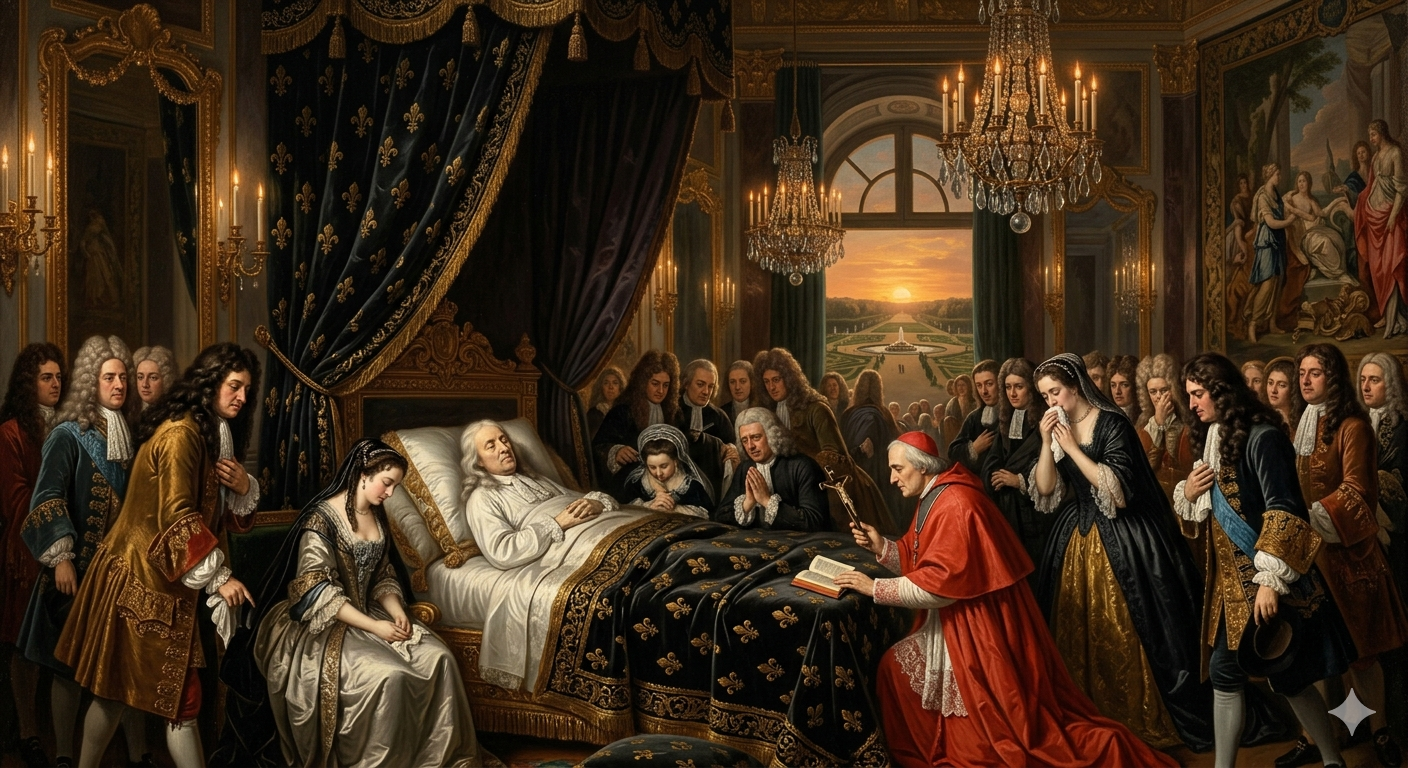
On September 1, 1715, at 8:15 in the morning, the Palace of Versailles witnessed the end of an extraordinary chapter in European history when King Louis XIV of France breathed his last breath, just four days before his 77th birthday. The Sun King’s death marked the conclusion of a remarkable 72-year reign that began when he was barely five years old and had fundamentally transformed not only France but the entire political and cultural landscape of Europe. His passing represented far more than the death of a monarch; it signified the end of the absolute monarchy’s golden age and the beginning of a new era that would eventually lead to revolutionary changes across the continent. The king who had once declared “L’état, c’est moi” (I am the state) died after a prolonged and agonizing illness that stripped away the divine grandeur he had cultivated throughout his reign, leaving behind a legacy of unprecedented royal power, architectural magnificence, and cultural achievement that would influence European civilization for centuries to come.
The Unprecedented 72-Year Reign: From Child King to Absolute Monarch
Louis XIV’s extraordinary reign began on May 14, 1643, when he ascended to the French throne as a child of four years and eight months following the death of his father, Louis XIII. This early accession to power meant that Louis XIV would rule France for longer than any other European monarch in recorded history, a record that remains unbroken to this day. During the first years of his reign, his mother Anne of Austria served as regent, while Cardinal Jules Mazarin effectively governed France, shaping the young king’s understanding of absolute monarchy and the divine right of kings that would define his entire approach to rulership.
The transformation of France under Louis XIV’s personal rule, which began in earnest after Mazarin’s death in 1661, was nothing short of revolutionary. The king centralized power in ways that previous French monarchs had never achieved, systematically dismantling the independent power of the nobility while creating a court culture at Versailles that made the aristocracy dependent on royal favor for their social status and economic survival. This political revolution was accompanied by military expansion that made France the dominant European power, cultural achievements that established French as the language of diplomacy and high culture throughout Europe, and architectural projects that created some of the world’s most magnificent palaces and gardens.
The length of Louis XIV’s reign allowed him to implement long-term policies and projects that would have been impossible for shorter-lived monarchs. The construction of Versailles, which took decades to complete, became both a symbol of royal power and a practical tool for controlling the French nobility. The king’s military campaigns expanded French territory and influence while his patronage of arts and letters created the cultural supremacy that made France the envy of Europe. Religious policies, including the revocation of the Edict of Nantes in 1685, demonstrated the king’s commitment to absolute authority in both secular and spiritual matters.
By the time of his death in 1715, Louis XIV had outlived not only most of his contemporaries but also his son and grandson, creating a succession crisis that would have profound implications for France’s future. His great-grandson, who would become Louis XV, was only five years old when the Sun King died, meaning that France would be governed by a regency for many years to come. This generational gap highlighted the unusual longevity of Louis XIV’s reign while raising questions about the sustainability of absolute monarchy in an age of increasing intellectual and political challenges to royal authority.
The Final Illness: August 1715 and the King’s Declining Health
The beginning of Louis XIV’s final illness can be traced to August 10, 1715, when the king returned from a hunting expedition at his beloved Château de Marly complaining of severe pain in his left leg. At first, the royal physician Guy-Crescent Fagon diagnosed the problem as sciatica, a relatively minor ailment that was expected to resolve with rest and appropriate treatment. However, the pain persisted and worsened over the following days, remaining localized to a specific area of the leg rather than spreading or diminishing as would be expected with a muscular or nervous condition.
Within days of the initial diagnosis, alarming black marks began to appear on the king’s leg, indicating the onset of what doctors would eventually recognize as senile gangrene. This condition, caused by poor circulation and tissue death, was particularly dangerous for elderly patients and represented a serious threat to the king’s life. The appearance of these dark spots marked the beginning of what would become a three-week struggle against an inexorably advancing disease that medieval medicine was powerless to combat effectively.
Dr. Fagon, who had served as the king’s personal physician for many years, found himself facing a medical crisis that challenged all the resources of 18th-century medicine. The royal doctors attempted various treatments including bloodletting, purging, and the application of various poultices and medicaments, but none of these traditional remedies proved effective against the advancing gangrene. The king’s condition continued to deteriorate despite the best efforts of his medical team, and by August 26, the gangrene had spread to the bone, making recovery virtually impossible.
The progression of Louis XIV’s illness was carefully documented by court observers and medical attendants, providing historians with detailed accounts of the king’s suffering and the court’s response to his declining health. The king maintained his royal composure and continued to conduct official business when possible, but the increasing pain and the visible symptoms of his disease made it clear to everyone at Versailles that the end of the reign was approaching. The contrast between the king’s physical deterioration and his continued efforts to maintain royal dignity created a poignant spectacle that would be remembered long after his death.
The medical aspects of Louis XIV’s final illness reflect both the limitations of early 18th-century medicine and the particular challenges of treating an elderly monarch whose lifestyle and previous medical treatments may have contributed to his susceptibility to circulatory problems. The king’s advanced age, combined with decades of rich diet, limited exercise, and various medical interventions including frequent purging and bloodletting, had likely weakened his constitution and made him vulnerable to the kind of vascular problems that led to gangrene.
The Royal Deathbed: Ceremony and Suffering at Versailles
The final days of Louis XIV’s life were played out against the elaborate ceremonial backdrop of Versailles, where the rituals of absolute monarchy continued even as the king lay dying in agony. The Sun King’s bedroom, which had been the center of court life for decades through the elaborate ceremonies of the lever and coucher, now became a stage for a more somber drama as courtiers, family members, and officials gathered to witness the end of the longest reign in French history. The king’s determination to maintain royal dignity even while suffering from advanced gangrene demonstrated his commitment to the theatrical aspects of monarchy that he had perfected throughout his reign.
Madame de Maintenon, the king’s morganatic wife whom he had secretly married after the death of Queen Marie-Thérèse, played a central role in the deathbed scenes that unfolded during Louis XIV’s final weeks. The king bid farewell to her three separate times as his condition fluctuated between apparent improvement and obvious decline, reflecting both his deep affection for her and his understanding that death was approaching. These intimate moments between the royal couple provided a stark contrast to the formal court ceremonies that continued around them, revealing the human emotions beneath the elaborate protocols of absolute monarchy.
The court ceremonies surrounding the king’s deathbed reflected centuries of French royal tradition while adapting to the particular circumstances of Louis XIV’s prolonged illness. Courtiers maintained their attendance routines, officials continued to present state business when the king was able to receive them, and the elaborate etiquette of Versailles continued to govern behavior even in the presence of death. This insistence on maintaining normal court life while the king was obviously dying demonstrated both the institutional strength of absolute monarchy and the psychological difficulty of accepting that even the Sun King was mortal.
On August 29, a desperate attempt was made to save the king’s life when a man named Brun, who claimed to possess a miracle cure, was granted permission to approach the royal bedside. This intervention, which reflected the court’s willingness to try any possible remedy, briefly appeared to improve the king’s condition and raised hopes that recovery might still be possible. However, the temporary improvement proved illusory, and by August 30 and 31, Louis XIV was drifting in and out of consciousness as his body finally began to succumb to the advanced gangrene.
The final moments of Louis XIV’s life were witnessed by a small group of intimate courtiers and family members who had maintained vigil throughout his illness. The king’s last words, prayers, and gestures were carefully recorded by observers who understood the historical significance of the moment and wanted to preserve details of how the Sun King faced death. These accounts provide intimate portraits of a monarch who had spent his entire adult life as the center of European attention now reduced to human frailty and dependence on others for basic care.
The Medical Crisis: Gangrene and 18th-Century Treatments
The medical aspects of Louis XIV’s final illness provide fascinating insights into both the state of early 18th-century medicine and the particular health challenges faced by European monarchs of the period. The gangrene that ultimately killed the Sun King was a condition that contemporary physicians understood in only limited ways, lacking the knowledge of bacterial infection and circulatory physiology that would later allow more effective treatment of such conditions. Dr. Guy-Crescent Fagon, despite his experience as royal physician, found himself essentially powerless against a disease process that modern medicine would recognize as requiring immediate surgical intervention.
The treatment methods attempted during Louis XIV’s illness reflected the medical orthodoxy of the time, which relied heavily on the humoral theory of disease and the belief that most illnesses resulted from imbalances in the body’s natural fluids. Bloodletting, which had been used throughout the king’s life as a preventive and therapeutic measure, continued to be employed even as his condition worsened, potentially weakening him further at a time when his body needed all available resources to fight infection. Purging and the administration of various herbal preparations represented additional attempts to restore bodily balance according to contemporary medical theory.
The progression of gangrene in Louis XIV’s leg followed a predictable pattern that 18th-century physicians could observe but not effectively combat. The initial pain and swelling gave way to the characteristic blackening of tissue as cells died from lack of blood supply, followed by the spread of infection to surrounding healthy tissue and eventually to the bone itself. Once the gangrene had reached the bone, as occurred in the king’s case by August 26, recovery became virtually impossible given the medical knowledge and surgical techniques available at the time.
The royal physicians’ inability to save their most important patient highlighted the limitations of medical knowledge during the late 17th and early 18th centuries, when even the most skilled practitioners lacked understanding of infection control, antiseptic procedures, and circulatory physiology. The irony was not lost on contemporary observers that the king who had commanded armies, controlled a vast kingdom, and intimidated other European monarchs was ultimately defeated by a medical condition that modern physicians could treat relatively easily. This contrast between royal power and human vulnerability became a frequent theme in contemporary commentaries on the king’s death.
The medical attention lavished on Louis XIV during his final illness also reflected the elaborate court hierarchy that governed every aspect of life at Versailles. Multiple physicians, surgeons, and apothecaries were involved in the king’s care, with their various roles and responsibilities carefully defined according to court protocol. This bureaucratization of medical care, while ensuring that the king received attention from multiple specialists, may have hindered effective treatment by preventing any single practitioner from taking decisive action or implementing radical treatments that might have offered better hope of recovery.
The Succession Crisis: From Sun King to Child Monarch
The death of Louis XIV created an immediate succession crisis that would have profound implications for France’s political future, as his designated heir was his five-year-old great-grandson who would become Louis XV. This situation arose because both the king’s son, the Grand Dauphin, and his grandson, the Duke of Burgundy, had predeceased him, leaving a child as the only direct male heir to the throne. The prospect of a lengthy regency raised concerns about political stability and the continuity of royal authority that had been so carefully constructed during the Sun King’s seven-decade reign.
In anticipation of this succession problem, Louis XIV had attempted to establish a Regency Council that would limit the power of Philippe II, Duke of Orléans, his nephew, who would naturally assume the role of regent during the young king’s minority. The dying king was well aware of Philippe’s ambitious nature and his potentially different vision for French governance, so he tried to create institutional constraints that would preserve his own political legacy while ensuring stable government during the transition period. However, these carefully laid plans would prove insufficient to prevent significant changes in French political practices after his death.
Philippe II of Orléans moved quickly to consolidate power after Louis XIV’s death, demonstrating the political acumen that the late king had feared. On September 2, just one day after Louis XIV’s death, Philippe went before the Parlement of Paris to have the king’s will annulled and to have himself declared sole regent with full authority over the realm. This bold political maneuver effectively negated Louis XIV’s attempt to constrain regency power and established Philippe as the de facto ruler of France until young Louis XV could reach his majority.
The power struggle that emerged immediately after Louis XIV’s death reflected broader tensions within the French political system about the nature and limits of royal authority. While the Sun King had successfully concentrated power in his own hands, the question of how that power should be exercised during a regency exposed fundamental disagreements about French governance. Some courtiers and officials favored maintaining the absolute monarchy system that Louis XIV had perfected, while others saw the regency as an opportunity to introduce more collegial or consultative approaches to royal decision-making.
The geographical symbolism of the succession transition was evident when the court left Versailles for Vincennes just one week after Louis XIV’s death, effectively abandoning the palace that had been the center of French political and cultural life for decades. This move, which lasted until December 1715, represented both practical considerations about the appropriateness of maintaining the elaborate Versailles court during a regency and symbolic recognition that the age of Louis XIV had truly ended. The young king was subsequently moved to the Tuileries Palace in Paris, while Philippe II established his government at the Palais-Royal, further emphasizing the break with Louis XIV’s governmental practices.
The Final Farewell: Death Scene and Last Words
The death of Louis XIV on September 1, 1715, was witnessed by a small group of intimate family members and court officials who had maintained vigil throughout his final days. According to contemporary accounts, the king maintained consciousness until nearly the end, allowing him to participate in the religious observances that were considered essential for a Christian monarch’s death. His final hours were marked by prayers, blessings, and formal farewells that reflected both his personal piety and his understanding of the ceremonial requirements of royal death.
The Sun King’s last recorded words and actions revealed both his human frailty and his continued concern for royal dignity even at the moment of death. He reportedly whispered final prayers while clutching a crucifix, demonstrating the sincere religious faith that had characterized his later years, particularly following his secret marriage to Madame de Maintenon. These intimate details of his death scene, carefully recorded by observers, provided a stark contrast to the elaborate public ceremonies that had characterized most of his reign and showed the very human reality beneath the divine monarchy that Louis XIV had so carefully constructed.
Contemporary accounts describe the exact moment of the king’s death at 8:15 in the morning, when his breathing finally stopped after days of labored respiration caused by the systemic effects of advanced gangrene. The immediate aftermath of his death was marked by both profound grief from those who had served him loyally for decades and practical considerations about announcing the succession and managing the transition of power. The formal announcement of the king’s death followed established protocols, but the emotional impact on those present was evidently profound.
The reaction of court officials and family members to Louis XIV’s death reflected the complex mixture of personal loss and political calculation that characterized the end of any long reign. Madame de Maintenon, who had been the king’s closest companion during his final years, withdrew from court life entirely after his death, retiring to the convent of Saint-Cyr that she had founded under royal patronage. Other courtiers immediately began positioning themselves for advantage under the new regency, demonstrating how quickly the political dynamics at Versailles could shift following a change in royal leadership.
The preservation of details about Louis XIV’s final moments reflected contemporary understanding of the historical significance of his death and the desire to create an accurate record for posterity. The careful documentation of his last words, final religious observances, and the exact time of death would later become important elements in the historical narrative of his reign and would influence how later generations remembered the Sun King’s legacy. These detailed accounts also served practical purposes in establishing the precise moment when royal authority transferred to his successor and the regency began.
The State Funeral: Pageantry and Politics in Death
Following Louis XIV’s death, his body lay in state for eight days in the Mercury Room at Versailles, where courtiers, officials, and dignitaries could pay their final respects to the monarch who had dominated European politics for seven decades. This extended period of viewing reflected both the traditional requirements of royal funeral protocol and the practical necessity of allowing sufficient time for the elaborate preparations required for a state funeral of unprecedented magnitude. The choice of the Mercury Room, one of the grand state apartments at Versailles, emphasized the continued importance of ceremonial display even in death.
The transportation of Louis XIV’s body from Versailles to the Royal Basilica of Saint-Denis on September 9, 1715, represented one of the most elaborate funeral processions in French history. Saint-Denis, which had served as the burial place of French kings since the 7th century, was the appropriate final resting place for a monarch who had so successfully embodied the traditions and grandeur of French royalty. The journey from Versailles to Saint-Denis became an opportunity to display the wealth, power, and ceremonial sophistication that had characterized Louis XIV’s reign while providing a final public spectacle of absolute monarchy.
The funeral ceremonies at Saint-Denis followed traditional French royal funeral rites while incorporating specific elements that reflected Louis XIV’s unique status as the longest-reigning monarch in French history. The elaborate tomb prepared for the Sun King was designed to match the magnificence of his reign and to ensure that his final resting place would reflect the glory he had brought to France during his seven decades on the throne. The religious services combined Catholic funeral mass with specific prayers and ceremonies reserved for deceased monarchs, emphasizing both the spiritual and temporal aspects of royal authority.
The political dimensions of Louis XIV’s funeral were evident in the careful attention paid to precedence, protocol, and symbolic representation throughout the ceremonial proceedings. Foreign ambassadors, French nobles, church officials, and government ministers all participated in carefully choreographed ceremonies that demonstrated France’s continued strength and stability despite the king’s death. These funeral rites served not only to honor the deceased monarch but also to reinforce the legitimacy of the succession and the continuity of royal authority under the new regency.
The cost and complexity of Louis XIV’s funeral reflected both the financial resources of the French monarchy and the importance of maintaining royal prestige during a potentially vulnerable transition period. The elaborate ceremonies, expensive decorations, and extended public displays required substantial expenditures at a time when the royal treasury was already strained by decades of warfare and lavish court spending. However, the political necessity of demonstrating continued royal magnificence outweighed these financial concerns, ensuring that the Sun King received a funeral worthy of his unprecedented reign.
The Legacy of Europe’s Longest Reign
The death of Louis XIV marked not only the end of an individual life but the conclusion of an era that had fundamentally transformed both France and Europe as a whole. His 72-year reign had established new standards for royal power, created unprecedented levels of administrative centralization, and produced cultural achievements that would influence European civilization for centuries to come. The longevity of his rule had allowed him to implement long-term policies and projects that shorter-reigned monarchs could never have accomplished, creating a legacy that extended far beyond France’s borders.
The architectural legacy of Louis XIV’s reign, exemplified by the Palace of Versailles and its gardens, represented revolutionary innovations in royal residence design that influenced palace construction throughout Europe. These magnificent buildings and landscapes were not merely expressions of royal taste but carefully designed tools for political control that demonstrated how architectural grandeur could reinforce monarchical authority. The cultural influence of Versailles extended beyond France as other European monarchs attempted to create similar expressions of absolute power in their own kingdoms.
The administrative and military innovations developed during Louis XIV’s reign established new models for European statecraft that would influence governmental development for generations. The king’s success in centralizing authority, professionalizing the military, and creating effective bureaucratic institutions provided examples that other monarchs attempted to emulate while also creating the foundation for France’s continued importance as a major European power. These institutional developments proved more durable than the personal charisma of any individual monarch and continued to influence French governance long after the end of absolute monarchy.
The international impact of Louis XIV’s reign was evident in the diplomatic, military, and cultural changes that occurred throughout Europe during his seven decades on the throne. French became the language of international diplomacy, French cultural models influenced art and literature across the continent, and French military innovations changed the nature of European warfare. The Sun King’s death thus marked the end of a period when France had achieved unprecedented influence over European civilization and politics.
The economic and social consequences of Louis XIV’s long reign were equally significant, as his policies had created both unprecedented royal magnificence and substantial financial problems that would challenge his successors for decades to come. The cost of maintaining Versailles, fighting numerous wars, and supporting an elaborate court lifestyle had strained French resources while creating social tensions that would eventually contribute to revolutionary challenges to royal authority. Understanding these long-term consequences helps explain why Louis XIV’s death marked not only the end of his personal reign but the beginning of a gradual transition away from absolute monarchy toward new forms of political organization.
The Immediate Aftermath: Regency and Political Transformation
The period immediately following Louis XIV’s death witnessed significant changes in French governmental practices as Philippe II of Orléans established his regency and began implementing policies that differed markedly from those of the late king. The departure of the court from Versailles represented more than a change of residence; it symbolized a fundamental shift away from the elaborate ceremonial monarchy that the Sun King had perfected toward a more pragmatic and less formal approach to royal governance. This transition reflected both practical considerations about governing during a regency and philosophical differences about the appropriate role of monarchy in French society.
Philippe II’s success in annulling Louis XIV’s will and establishing himself as sole regent demonstrated the limits of even the most carefully constructed royal authority when faced with determined political opposition. The relative ease with which the new regent overcame the institutional constraints that Louis XIV had attempted to establish revealed important truths about the nature of absolute monarchy and the dependence of royal power on personal relationships and political alliances rather than formal constitutional arrangements.
The reaction of foreign courts to Louis XIV’s death reflected both respect for his historical significance and immediate calculations about how the change in French leadership might affect European politics. Other European monarchs who had spent decades dealing with the Sun King’s dominance in Continental affairs now faced the prospect of dealing with an inexperienced regent governing in the name of a child king. This situation created opportunities for diplomatic realignments and new approaches to international relations that had been impossible during Louis XIV’s active reign.
The financial challenges facing the French monarchy after Louis XIV’s death became immediately apparent as the regency government attempted to address the substantial debts accumulated during the late king’s wars and court expenditures. The elaborate lifestyle that had made Versailles the envy of Europe had been maintained at enormous cost, creating fiscal problems that would require innovative solutions and potentially unpopular policies to resolve. These financial difficulties would prove to be among the most persistent legacies of Louis XIV’s reign and would continue to challenge French governments for decades.
The cultural and intellectual changes that began to emerge after Louis XIV’s death reflected broader European trends toward new forms of artistic expression, scientific inquiry, and philosophical thought that had been constrained during the height of absolute monarchy. The regency period saw the beginning of cultural developments that would later be recognized as early manifestations of Enlightenment thought, suggesting that the Sun King’s death marked not only a political transition but also the beginning of important intellectual and cultural transformations that would eventually challenge traditional assumptions about royal authority and social organization.
Historical Assessment: The Sun King’s Place in European History
The death of Louis XIV provides an opportunity to assess the historical significance of a reign that fundamentally altered the political, cultural, and social landscape of early modern Europe. His 72-year rule represented the apex of absolute monarchy, demonstrating both the potential achievements and ultimate limitations of concentrated royal power. The longevity of his reign allowed historians to observe the full development of absolute monarchical institutions from their emergence during his minority through their mature expression in the elaborate court life of Versailles to their initial challenges during his final years.
Comparative analysis of Louis XIV’s reign with other long-ruling European monarchs reveals the unique circumstances that allowed him to achieve unprecedented levels of royal authority and cultural influence. While other monarchs had ruled for extended periods, none had combined longevity with such systematic development of royal institutions, cultural patronage, and international influence. The Sun King’s success in creating a model of kingship that influenced monarchical practice throughout Europe established him as one of the most significant rulers in Western civilization.
The economic and social costs of Louis XIV’s reign became more apparent after his death, as subsequent French governments struggled to address the financial problems and social tensions that had accumulated during his seven decades of rule. Modern historical analysis has highlighted the contradictions between the magnificent achievements of his reign and the underlying problems that would eventually contribute to the crisis of the French monarchy in the 18th century. Understanding these contradictions helps explain both the immediate impact of his death and the longer-term consequences of absolute monarchy for French political development.
The cultural legacy of Louis XIV’s reign extended far beyond France and continued to influence European artistic, architectural, and intellectual development long after his death. The standards of royal patronage, artistic excellence, and cultural sophistication established during his reign provided models that later monarchs and governments attempted to emulate while also inspiring reactions against the formality and hierarchy that characterized absolute monarchical culture. This cultural influence represents one of the most enduring aspects of the Sun King’s historical significance.
The international consequences of Louis XIV’s death were immediately evident in the diplomatic realignments and military conflicts that followed as European powers adjusted to the new political realities created by French royal succession and regency government. The balance of power that the Sun King had established through seven decades of warfare and diplomacy began to shift as other European nations recognized opportunities to advance their interests against a temporarily weakened France. These immediate international consequences of his death highlighted the extent to which European politics had revolved around Louis XIV’s personal authority and strategic vision, making his passing a genuinely transformative moment in Continental history.