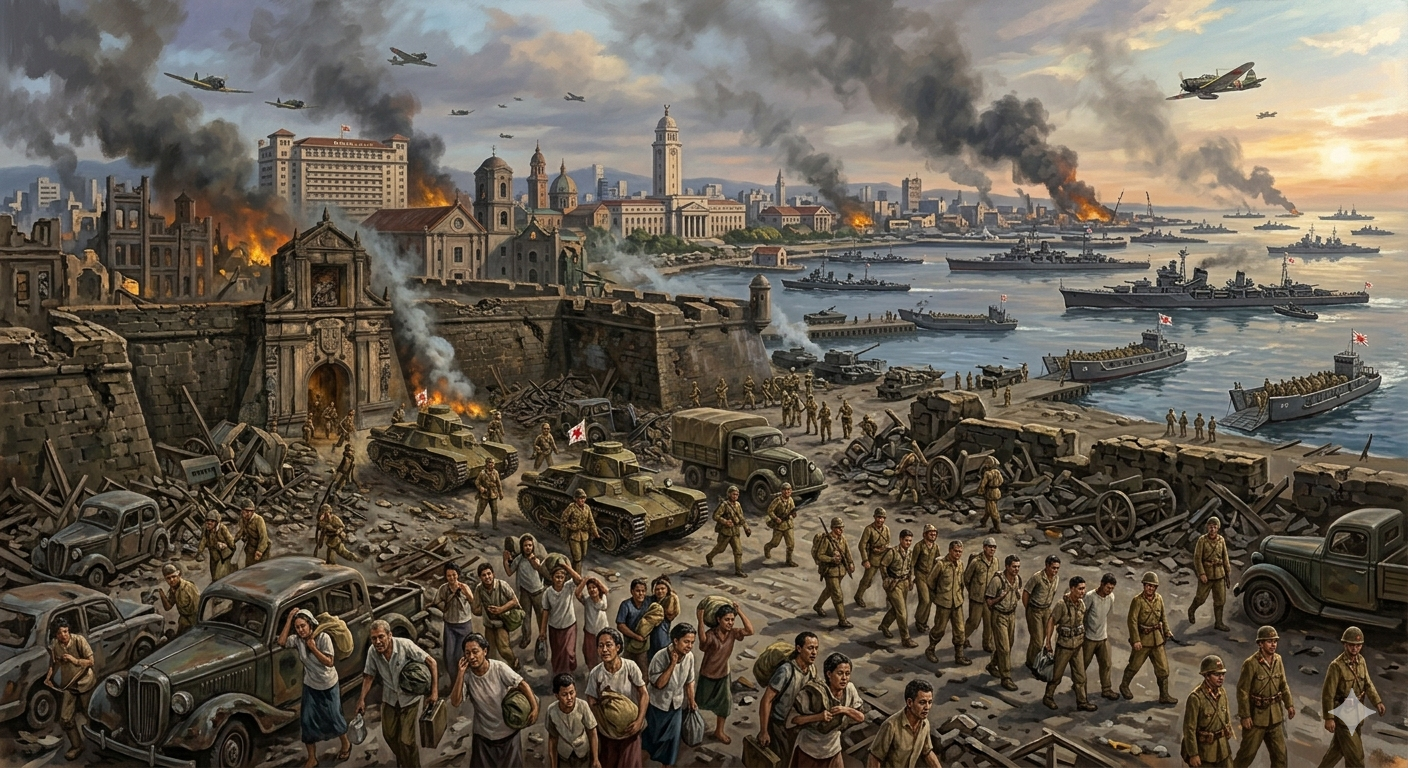
On the morning of January 2, 1942, columns of Japanese soldiers marched through the wide, eerily quiet streets of Manila. The city that had long been called the Pearl of the Orient — a vibrant colonial capital built at the mouth of the Pasig River on the shores of Manila Bay — offered no resistance. The American and Filipino defenders had already withdrawn. The flags had been taken down. The Philippine Commonwealth government had fled. General Douglas MacArthur had declared the city an open city and moved his headquarters to the fortress island of Corregidor. When the advance units of General Masaharu Homma’s Japanese Fourteenth Army entered Manila that morning, they passed through a city whose half a million inhabitants waited in dread and silence, uncertain what the next chapter of their lives under foreign occupation would bring. The fall of Manila was not a battle. It was a surrender of a city before the battle could come to it — a calculated sacrifice made in the hope of preserving civilian lives. What followed was nearly three years of occupation that would reshape the Philippines, the Pacific War, and the lives of everyone caught between two empires at war.
The Strategic Importance of Manila and Why Japan Needed It
Manila had been one of the most prized colonial cities in Asia for more than three centuries, first under Spanish rule and then, after 1898, under the United States. Its deep natural harbor at Manila Bay offered one of the finest anchorages in the Pacific Ocean and was the anchor of American naval power in the western Pacific. The city itself had grown into a sophisticated administrative, commercial, and cultural capital, home to major government buildings designed by American architect Daniel Burnham that mirrored Washington D.C.’s grand National Mall, and streets named after American states running between avenues named for figures like Admiral George Dewey and President William Howard Taft. For Japan’s imperial planners, capturing Manila was not merely a military objective — it was a strategic imperative.
Japan’s grand strategy in late 1941 required the rapid seizure of the resource-rich territories of Southeast Asia: the Dutch East Indies, with their vast oil reserves; Malaya, with its rubber and tin; and the Philippines, with their deep-water ports and commanding position over the sea lanes connecting Japan to its new conquests. The Philippines were an American commonwealth, promised independence by 1946, and American military planners understood them as both a potential buffer against Japanese expansion and a target that Tokyo would prioritize. Without controlling Manila Bay, Japan could not safely operate its naval and merchant fleets through the waters of the western Pacific. The fall of Manila was, in Japanese strategic thinking, a prerequisite for everything else.
Pearl Harbor and the Opening Blows: December 8, 1941
The war arrived in the Philippines just ten hours after the bombs fell on Pearl Harbor, Hawaii. On December 8, 1941 — December 7 in Hawaii, due to the International Date Line — Japanese aircraft based in Formosa (Taiwan) attacked American military installations across Luzon. The most catastrophic blow came at Clark Field, approximately forty-five miles north of Manila, where the United States Army Air Forces Far East Air Force had based most of its combat aircraft. At 12:40 p.m. on December 8, Japanese bombers arrived over Clark Field and found nearly every American aircraft lined up neatly on the ground. Zero fighters swept in behind the bombers to strafe the runway. By the end of that single day, the strength of the Far East Air Force had been cut in half, and within a few more days it had been effectively destroyed as a fighting force. The fighter base at Iba on the western coast of Luzon was struck almost simultaneously, and Del Carmen airfield was hit shortly after.
The loss of American air power over the Philippines in the very first hours of the war was a catastrophe from which General MacArthur’s command never recovered. Without air cover, the American Asiatic Fleet — the naval force based in Manila Bay — had no option but to withdraw. On December 12, 1941, it departed Philippine waters for Java, leaving the defenders of the islands without naval support. The stage was set for the Japanese land invasion.
The Invasion Begins: Homma’s Fourteenth Army Lands at Lingayen Gulf
General Masaharu Homma, the 54-year-old commander of the Imperial Japanese Fourteenth Army, was a cultivated officer with a reputation as a moderate who had traveled widely and held literary ambitions. He had been assigned what Imperial General Headquarters expected to be a relatively straightforward campaign to subdue the Philippines within fifty days. His invasion force of approximately 43,000 men came ashore at two principal landing points in a coordinated operation: at Lingayen Gulf on the northwestern coast of Luzon on December 22, 1941, and at Lamon Bay on the southeastern coast the same day. The landings at Lingayen Gulf were the main thrust, and despite poor weather and rough seas, Homma’s forces secured their objectives and began advancing toward the Central Luzon Plain and Manila.
MacArthur’s defending forces, which on paper numbered around 130,000 men but in reality consisted largely of poorly trained and inadequately equipped Filipino reservists alongside approximately 22,000 American troops, were unable to hold the beaches. The Far East Air Force, destroyed in the opening strikes, could provide no air cover. The navy was gone. MacArthur had originally planned to defend the Philippines at the shoreline under a strategy called Rainbow 5, but now he reverted to the older War Plan Orange-3 — the strategy of retreating to the Bataan Peninsula and the island of Corregidor to conduct a defensive holding action until relief could arrive from the American Pacific Fleet. Both his North Luzon Force and his South Luzon Force began a difficult fighting withdrawal southward and westward toward Bataan, conducted across difficult terrain and under constant Japanese pressure.
MacArthur Declares Manila an Open City: December 26, 1941
As the Japanese closed in and it became clear that Manila could not be defended without turning the densely populated city into a battlefield, General MacArthur and Philippine Commonwealth President Manuel L. Quezon made a fateful decision. On December 26, 1941, MacArthur issued a formal proclamation declaring Manila an open city. The text of the proclamation was explicit: “In order to spare the Metropolitan area from the possible ravages of attack, either by air or ground, Manila is hereby declared an open city without the characteristics of a military objective. In order that no excuse may be given for possible mistake, the American High Commissioner, the Commonwealth Government and all combatant military installations will be withdrawn from its environs as rapidly as possible.”
MacArthur had already moved his headquarters from Manila to the island of Corregidor on December 24. President Quezon, following MacArthur’s advice, also departed for Corregidor, assigning Jorge B. Vargas — the mayor of Manila — to remain behind to protect the welfare of the city’s population and to serve as the interface between the civilian government and the incoming Japanese forces. The proclamation was published in Manila’s newspapers and broadcast over the radio so that the approaching Japanese forces would be aware that no military defense was being mounted.
The declaration did not, however, entirely spare Manila from Japanese bombs. On December 27 and 28, Japanese aircraft struck the port area and several other districts, killing approximately forty civilians and wounding around 150 others. Whether these strikes were deliberate violations of the open city declaration or the result of poor Japanese bombing accuracy remained disputed. What was not disputed was that the attacks damaged the port facilities that Japan would soon need for its own operations, and that they caused significant fear and suffering among a civilian population that had been assured the city was undefended. MacArthur protested furiously to Washington that the Japanese had violated all “civilized processes of international law,” though American forces were themselves still using Manila for logistical purposes at the time of the declaration, a fact that complicated any claim to strict open city status under the Hague Conventions.
Japanese Forces Enter Manila: January 2, 1942
With the withdrawal of American and Filipino combat forces to the Bataan Peninsula essentially complete by early January 1942, there was nothing left in Manila to fight. On January 2, 1942, the leading elements of General Homma’s Fourteenth Army marched into the city from the north. They were met not by soldiers but by Manila’s civilian population and by the officials whom President Quezon had left behind to manage the handover. Mayor Jorge Vargas, acting in his capacity as the representative of what remained of the Philippine Commonwealth civil government, received the Japanese commanders and complied with their authority in hopes of protecting Manila’s residents from the worst consequences of military occupation.
The occupation was formalized swiftly. On January 3, 1942, General Homma proclaimed that the Philippines had been “emancipated” — a word that carried the ideological weight of Japan’s stated mission across Southeast Asia — and that it would be incorporated into the Greater East Asia Co-Prosperity Sphere, the imperial framework by which Japan justified its conquest of Asian territories from European and American colonial powers. Japanese military administration was established immediately. On January 23, 1942, a Central Administration Organization was created, together with a Philippine Executive Commission staffed by Filipino collaborators who would oversee civilian affairs under the constant supervision and control of Japanese military advisors. The Filipino commissioners had no real authority; their function was to provide a veneer of Filipino governance over what was in practice direct Japanese military rule.
One of the first and most chilling acts of the new occupiers was the conversion of the University of Santo Tomas — one of the oldest universities in Asia, founded by the Dominican Order in 1611 — into an internment camp for enemy civilians. American, British, and other Allied civilians living in Manila, numbering approximately 4,255 people, were herded into the sprawling fifty-acre campus on Espaňa Boulevard. They would remain imprisoned there for the next three years under conditions of progressive deprivation: 466 would die in captivity from disease, malnutrition, and the general misery of confinement. Fort Santiago, the ancient Spanish citadel at the mouth of the Pasig River that had once been used by colonial authorities to imprison Filipino revolutionaries, was reopened as a dungeon for suspected Filipino spies, American prisoners, and political opponents of the new order.
The Defenders Fall Back: Bataan and Corregidor
While Manila fell without a military battle, the campaign for the Philippines was far from over. MacArthur’s forces — approximately 76,000 American and Filipino troops, though many were sick, hungry, and under-equipped — had established a defensive perimeter on the Bataan Peninsula. The Battle of Bataan began on January 7, 1942, and the defenders fought with extraordinary stubbornness for ninety-nine days, far longer than Japanese planners had anticipated. Homma’s Fourteenth Army, which had expected to subdue Bataan in fifty days, found itself stalled by determined resistance from men fighting in tropical heat and jungle terrain on rapidly dwindling rations. The defenders were put on half rations almost immediately, then quarter rations, and they battled malaria, dengue fever, dysentery, and beriberi alongside the Japanese infantry pressing from the north.
MacArthur himself was ordered by President Franklin D. Roosevelt to leave the Philippines and take command of Allied forces in Australia, ensuring that American strategic leadership would not be captured by the Japanese. On the night of March 11, 1942, he departed Corregidor aboard a Navy PT boat, leaving behind Lieutenant General Jonathan M. Wainwright in command. MacArthur’s famous pledge — “I shall return” — became both a personal vow and a rallying cry for Filipino resistance throughout the occupation. Bataan finally fell on April 9, 1942, when Major General Edward P. King surrendered to Colonel Motō Nakayama of the 14th Army, telling his troops as he did so: “You men remember this. You did not surrender. You had no alternative but to obey my order.” The 13,000 survivors on Corregidor surrendered on May 6, 1942, with Lieutenant General Wainwright delivering his forces unconditionally to the Japanese.
Three Years of Occupation: Life Under Japanese Rule in Manila
The three years that followed the capture of Manila were marked by hardship, resistance, and collaboration in constantly shifting proportions. The Japanese reorganized the city’s economy on a command basis, confiscating warehouses of rice, sugar, and canned goods for military use, seizing vehicles, medicines, and department store inventories, and suppressing the free press and the American-established educational system. Place names across the city were changed. The political and cultural identity that Manila had developed over centuries of Spanish and then American colonial rule was deliberately dismantled and replaced with the ideological framework of the Co-Prosperity Sphere.
Philippine resistance never died. A highly effective guerrilla movement operated across the archipelago, and by the time American forces returned in 1944, Filipino guerrilla units controlled roughly sixty percent of the islands — mostly the forested and mountainous areas beyond Japanese garrison reach. In Manila itself, resistance was quieter but persistent: intelligence networks fed information to MacArthur’s headquarters in Australia, and underground organizations maintained contact with the exiled Philippine Commonwealth government, which had established itself first in Corregidor and then in the United States.
President Manuel Quezon died in exile on August 1, 1944, and was succeeded as president of the Commonwealth government-in-exile by Sergio Osmeña. The following October, true to his word, MacArthur returned. On October 20, 1944, Allied forces under his command landed on the island of Leyte, accompanied by Osmeña. “People of the Philippines: I have returned,” MacArthur broadcast to the islands. The liberation campaign that followed would be as brutal and costly as any fighting in the Pacific Theater. The Battle of Manila in February 1945 — the bloody struggle to retake the city from its Japanese defenders — would leave Manila one of the most devastated capitals in the entire war, second only to Warsaw in the scale of its destruction. The Japanese soldiers who had entered its streets so quietly in January 1942 would be driven out three years later at a cost of tens of thousands of Filipino civilian lives and immeasurable cultural and architectural heritage.
The Meaning of Manila’s Fall: A Turning Point in the Pacific War
The capture of Manila on January 2, 1942, stands as one of the defining moments of the early Pacific War. It was the first fall of a major Allied capital to Japanese forces, and it demonstrated with brutal clarity the gap that had opened between American military planning and military preparedness in the western Pacific. The destruction of the Far East Air Force on the ground in the opening hours of the Philippine campaign represented one of the most avoidable catastrophes in American military history, and it condemned MacArthur’s forces to fight without air cover or naval support against an enemy that enjoyed overwhelming superiority in both. The decision to declare Manila an open city — though it spared the city from the immediate destruction of battle — could not save its people from the years of occupation that followed.
The fall of the Philippines also profoundly shook the global perception of Western imperial power in Asia. The rapid collapse of American and British military forces across Southeast Asia in late 1941 and early 1942 — not only in the Philippines but in Malaya, Singapore, Burma, and Hong Kong — shattered the image of Western invincibility that had underpinned colonial rule across the region for generations. Japan’s proclamations of Asian liberation rang hollow to those who lived under its occupation, but the precedent of a non-Western power dismantling a Western empire by military force had been set, and it would not be unmade even after Japan’s eventual defeat.
General Homma was tried by an American military tribunal after the war and executed on April 3, 1946, outside Manila — convicted not of the campaign itself but of failing to prevent his subordinates from committing atrocities during the Bataan Death March. The city he had captured without a fight in January 1942 had by then been rebuilt enough to hold the proceedings. Manila endured. But the Pearl of the Orient that Japanese soldiers had marched into on that quiet January morning was gone, replaced by a survivor of occupations, battles, and a kind of suffering that left its mark on every street.