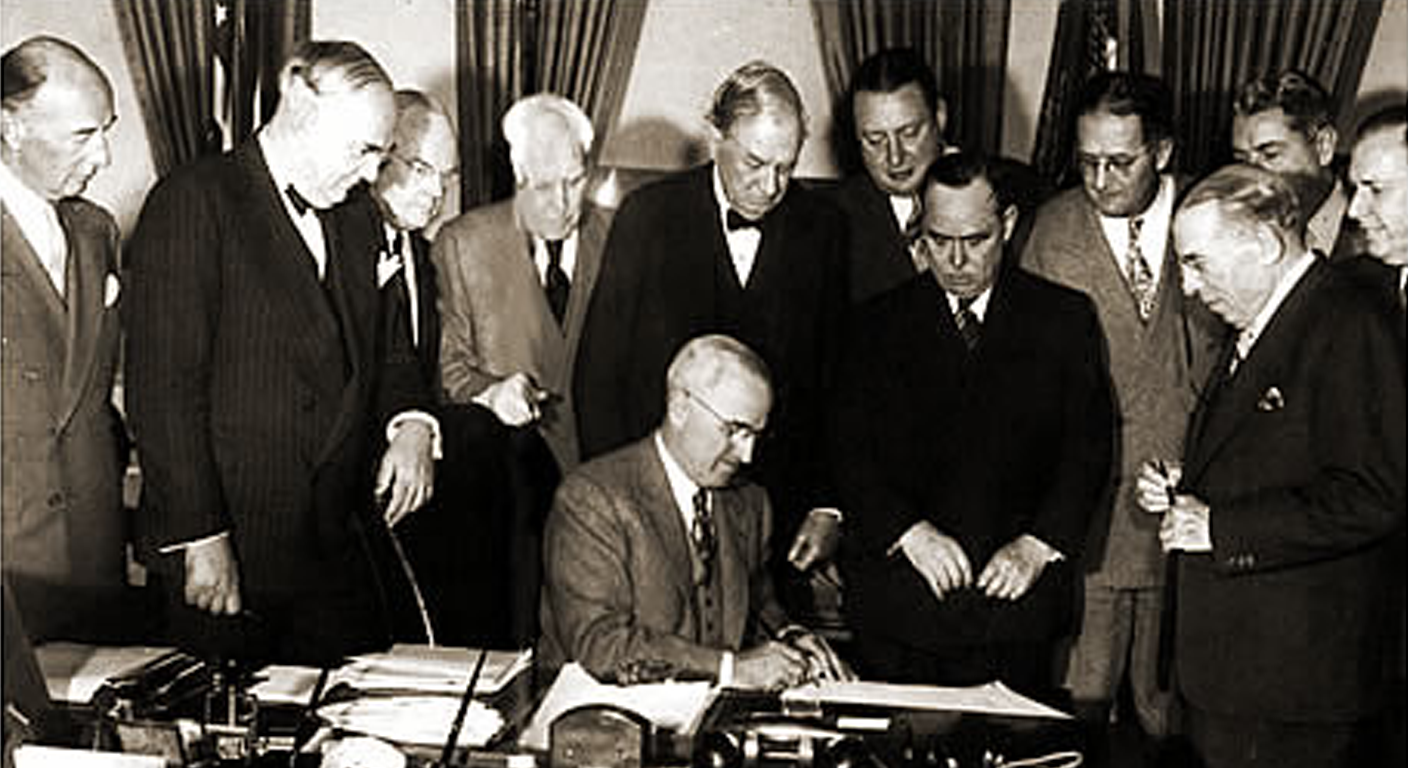
On April 3, 1948, President Harry S. Truman sat down at his desk in the White House and signed into law the Economic Cooperation Act of 1948 — the legislation that would be known to history as the Marshall Plan. With that signature, the United States committed itself to the most ambitious program of foreign economic assistance ever undertaken by any nation in history: $13.3 billion in aid, distributed over four years, to seventeen nations across Western Europe, with the explicit goals of rebuilding shattered economies, stabilizing democratic governments, removing the trade barriers that had contributed to global economic collapse and two world wars, and — running beneath every other stated purpose like a dark current — preventing the spread of Soviet communism into the democratic West.
It had been less than three years since the guns fell silent in Europe. In those three years, the continent had neither recovered nor stabilized. Cities lay in rubble. Industrial output had collapsed. The winter of 1946-47 had been the harshest in living memory, compounding the catastrophe of the worst spring harvest since the nineteenth century. Millions of people were hungry, cold, unemployed, and increasingly desperate. Communist parties, funded and directed from Moscow, were making significant gains in France and Italy — precisely the scenario that American strategists had spent years dreading. The question that confronted Harry Truman and his Secretary of State George C. Marshall in the early months of 1947 was not simply how to help Europe recover, but whether, without American intervention on a scale without precedent in peacetime, Europe would survive as a collection of free, democratic nations at all.
Europe in Ruins: The Catastrophic Human and Economic Cost of World War II
The scale of devastation from World War II in Europe is almost impossible to convey in numbers alone, but those numbers are necessary. The war killed an estimated 70 to 85 million people worldwide, approximately 40 million of them in Europe. Germany, the aggressor nation and the principal theater of the war’s final year, had seen its major cities reduced to rubble by Allied bombing campaigns and street-by-street ground combat—Dresden, Hamburg, Cologne, Frankfurt, Berlin, and dozens of others were shadows of their former selves. Poland had lost roughly 17 percent of its total population. The Soviet Union had suffered 27 million deaths. France, the Netherlands, Belgium, Norway, Greece, Yugoslavia, and virtually every nation that had been occupied or fought over had suffered devastating losses of human life, infrastructure, industrial capacity, and agricultural production.
The physical destruction, as terrible as it was, would eventually have been rebuilt. What threatened to prevent reconstruction was the economic paralysis that followed the war’s end. European currencies were devalued or worthless. Savings had been wiped out. Trade networks had been severed. The transportation infrastructure — the railroads, bridges, roads, and ports that any modern economy requires to function — had been systematically destroyed by both sides during the war. Agricultural production in 1945 stood at roughly half of pre-war levels, leaving populations that had already endured years of wartime rationing now facing genuine famine conditions. Coal production in Germany — which had historically fueled the industrial heart of the continent — was a fraction of what it had been. In France, industrial output was at 38 percent of 1938 levels. In Greece, the economy was collapsing under the pressure of a communist insurgency supported from across the northern border.
The winter of 1946-47 made everything worse. It was the coldest European winter in decades, with temperatures in Britain dropping far below freezing and coal reserves, already critically low, running out entirely in some areas. The Thames froze. Factories shut down for lack of fuel. The spring that followed produced one of the worst harvests in living memory. Britain, exhausted by the war, was spending through its American loans at a rate that made financial collapse imminent; the country would announce in February 1947 that it could no longer afford to sustain its military and economic commitments in Greece and Turkey, effectively handing the United States a choice between filling the vacuum or watching two strategically vital nations fall under Soviet or communist influence. The world, and the United States, were at a turning point.
George C. Marshall: The Architect of Victory Who Became the Architect of Peace
George Catlett Marshall was born on December 31, 1880, in Uniontown, Pennsylvania. He graduated from the Virginia Military Institute in 1901 and spent the following four decades in the United States Army, rising through every rank to become, in 1944, General of the Army — a five-star rank created specifically for him and the four other officers who held it during World War II. Winston Churchill called him the ‘organizer of victory,’ and it was not an exaggeration. As Army Chief of Staff from 1939 to 1945, Marshall built the American military from a small, underfunded peacetime establishment into the most powerful fighting force in the history of the world, overseeing the recruitment, training, equipping, and deployment of twelve million soldiers. He was, by universal acknowledgment among his peers and his enemies, the indispensable man of the Allied war effort.
Marshall’s reputation was unique in American public life: he was genuinely nonpartisan, genuinely incorruptible, and genuinely indifferent to credit. When President Truman decided that the great European recovery program should be named after someone, he specifically chose Marshall’s name rather than his own, reasoning that a program named ‘the Truman Plan’ would struggle to win Republican votes in a Congress controlled by Republicans, while a program associated with the universally respected Army Chief of Staff would have the best possible chance of bipartisan support. Marshall, characteristically, neither sought the honor nor particularly welcomed it — but he accepted it because Truman asked and because the program needed to succeed. Truman’s instinct was correct: it was the ‘Marshall Plan,’ not the ‘Truman Plan,’ and that naming choice proved to be one of the most consequential decisions in the history of American foreign policy.
In January 1947, Truman appointed Marshall as Secretary of State. Marshall came to the position with limited experience in civilian diplomacy but with the enormous prestige of his wartime record and the moral authority that came from being a man whom everyone — Democrats, Republicans, military officers, foreign leaders — trusted completely. He had attended the Moscow Conference of Foreign Ministers in March and April 1947, and what he witnessed there had been decisive in shaping his view of the situation. Soviet Foreign Minister Vyacheslav Molotov and the Soviet delegation showed no interest in a genuine peace settlement for Germany; they seemed, in fact, to be deliberately prolonging the impasse, apparently calculating that continued economic desperation in Western Europe would create the conditions for communist electoral victories in France and Italy. Marshall returned from Moscow convinced that the Soviet Union actively wanted Western Europe to remain in economic crisis, and that the United States had no time to lose.
The Harvard Speech: June 5, 1947 and the Most Consequential Commencement Address in History
When Harvard University invited Secretary of State Marshall to receive an honorary degree at its June 1947 commencement, the university’s administration was not expecting a major policy announcement. Marshall himself had told university officials that he would make a speech at the afternoon alumni association meeting, but had downplayed its significance. There was no advance notification to the press that an important address would be delivered. Harvard’s president, James B. Conant, had no expectation of a landmark moment. The speech was drafted by Charles ‘Chip’ Bohlen, a Russia specialist and accomplished diplomat, drawing on memoranda from George F. Kennan, the head of the State Department’s newly created Policy Planning Staff, and from William L. Clayton, the Under Secretary of State for Economic Affairs who had recently returned from Europe deeply alarmed by what he had seen.
On June 5, 1947, in the early afternoon, Marshall stood before the Harvard alumni association gathering in the university yard and delivered a speech of fewer than 1,500 words that would change the course of history. He described the situation in Europe with unsparing precision: the destruction of the business structure, the breakdown of the division of labor, the destruction of the fabric of the European economy. He argued that the problem was one of the whole fabric of European economy — not a set of specific, isolated difficulties to be addressed piecemeal, but a structural collapse requiring a comprehensive response. He proposed that the European nations themselves take the initiative in drawing up a cooperative plan for their own recovery, which the United States would then help finance. ‘Our policy is directed not against any country or doctrine,’ Marshall said, ‘but against hunger, poverty, desperation, and chaos.’
Crucially, Marshall made clear that the offer was open to all European nations, including those in the Soviet sphere — a deliberate decision that placed the burden of exclusion on the Soviet Union rather than the United States. If the Soviets rejected the program (as Marshall and Kennan expected they would), it would be Soviet refusal, not American ideology, that divided Europe into two economic blocs. The speech was heard as a direct invitation by the governments of Western Europe. British Foreign Secretary Ernest Bevin called it ‘a lifeline to sinking men.’ French Foreign Minister Georges Bidault immediately contacted Bevin, and within two weeks they had jointly invited all twenty-two European nations to send representatives to Paris to begin drawing up the cooperative recovery plan that Marshall had called for.
Soviet Rejection and the Division of Europe: Molotov’s Walkout at Paris
The Paris meeting that opened in late June 1947 to discuss the Marshall offer immediately became the defining moment in the crystallization of the Cold War’s European geography. Soviet Foreign Minister Vyacheslav Molotov arrived in Paris with a large delegation, suggesting that Stalin was at least considering participation. But the conditions of the Marshall offer — that the European nations would cooperate in drawing up a unified recovery plan, that they would open their economic data to American scrutiny, and that the aid would be structured to encourage European economic integration rather than national autarky — were precisely the conditions the Soviet Union found unacceptable. Economic transparency and supranational cooperation were incompatible with Stalin’s model of a tightly controlled Soviet bloc, and the prospect of American economic influence penetrating Eastern Europe through a nominally multilateral program was not something Stalin was willing to permit.
On July 2, 1947, Molotov walked out of the Paris conference, denouncing the Marshall Plan as American ‘economic imperialism’ and a scheme to interfere in the internal affairs of sovereign nations. He had previously sent a telegram to Moscow seeking guidance; Stalin’s response was to order Soviet withdrawal from the negotiations. Under Soviet pressure, Czechoslovakia, Poland, Hungary, and the other Eastern European nations that had initially expressed interest in the Marshall offer were compelled to withdraw as well — in several cases reversing decisions they had already made to attend. Czechoslovakia’s Foreign Minister Jan Masaryk reportedly said after receiving Soviet pressure to withdraw: ‘I went to Moscow as the foreign minister of an independent state; I returned as a Soviet slave.’ The Soviets would instead create the Comecon — the Council for Mutual Economic Assistance — in January 1948 as their own alternative bloc organization, extracting an estimated $14 billion from Eastern Europe between 1948 and 1953.
The Soviet rejection transformed the Marshall Plan from a potentially universal European recovery program into an explicitly Western one — and in so doing, it effectively drew the line that would define European geopolitics for the next four decades. The Committee of European Economic Cooperation (CEEC) met in Paris from July 12, 1947 onward with representatives from sixteen nations: Austria, Belgium, Denmark, France, Greece, Iceland, Ireland, Italy, Luxembourg, the Netherlands, Norway, Portugal, Sweden, Switzerland, Turkey, and the United Kingdom. By September 1947, the CEEC had produced a report estimating that the sixteen nations needed $19.1 billion over four years. After negotiations with the Truman administration — during which State Department officials including George Kennan made clear what kind of plan would be politically viable in the United States Congress — the Europeans submitted a request for $22 billion. Truman would cut this to $17 billion in the bill he sent to Congress in December 1947.
The Truman Doctrine and the Political Architecture of American Support
The Marshall Plan did not emerge in isolation. It was built on the foundation of a broader transformation in American foreign policy that had been taking shape since at least 1946, when diplomat George Kennan — then serving in Moscow — had sent his famous ‘Long Telegram’ to Washington, warning that the Soviet Union was ideologically committed to the destruction of liberal capitalism and could not be mollified by concessions or goodwill. Kennan’s analysis provided the intellectual architecture for what would become the doctrine of ‘containment’ — the idea that the United States should prevent the expansion of Soviet power without necessarily seeking to reverse it where it already existed, using economic, political, and if necessary military means to hold the line of Soviet influence at its existing boundaries.
The Truman Doctrine, announced by President Truman in a speech to a joint session of Congress on March 12, 1947 — three months before Marshall’s Harvard speech — had given political expression to the containment strategy in its most urgent immediate form. Truman had asked Congress for $400 million in emergency military and economic aid to Greece and Turkey, explaining that Britain could no longer sustain its commitments in those countries and that if the United States did not act, both nations would likely fall under communist or Soviet control. ‘I believe that it must be the policy of the United States to support free peoples who are resisting attempted subjugation by armed minorities or by outside pressures,’ Truman declared — words that would define American foreign policy for decades. Congress approved the aid, and the communist insurgency in Greece was eventually defeated.
The Truman Doctrine established the principle; the Marshall Plan translated it into a comprehensive economic program. Together, they represented a revolution in American foreign policy — a fundamental abandonment of the tradition of avoiding permanent entanglements in European affairs that had defined American strategy since George Washington’s Farewell Address. The isolationist impulse was still strong in America in 1947: the country had just emerged from the most expensive and exhausting war in its history, the American people wanted peace and prosperity rather than global commitments, and a Republican Congress was in no mood to spend enormous sums of taxpayer money abroad. The achievement of the Truman administration and its allies in Congress was to make the case that American security and prosperity were inseparably bound to European stability—that the United States could not prosper in a world where Europe had collapsed and that a Europe under Soviet domination would threaten American interests far more than the cost of the Marshall Plan.
The Key Figures: Truman, Marshall, Vandenberg, Hoffman, and Kennan
Harry S. Truman was 63 years old when he signed the Marshall Plan into law — a plain-spoken Missouri farmer’s son who had never expected to become president, who had been in office for barely three years following Franklin Roosevelt’s death in April 1945, and who was facing the most consequential set of foreign policy decisions in the country’s history with a team of advisors whose talents dwarfed his own formal education but whose trust he had fully earned. Truman’s contribution to the Marshall Plan was fundamentally political: he made the case to the American people through speeches, radio addresses, and personal lobbying; he managed the Congressional relationships that were essential to passage; and he chose to name the program after Marshall rather than himself — a display of strategic selflessness that may have been the most important single decision he made in the whole Marshall Plan saga.
George Catlett Marshall was the plan’s intellectual author and most important advocate. As Secretary of State he served as the lead-off witness in the Senate hearings in January 1948, testifying about the urgency of European recovery with the measured authority of a man whose word on matters of national security had never been successfully questioned. He insisted, repeatedly, that the program should be managed by an independent civilian agency rather than the State Department or the military, and that it should be led by a businessman rather than a government official — criteria that pointed directly toward his preferred administrator.
Senator Arthur Hendrick Vandenberg of Michigan was the Marshall Plan’s indispensable political champion on the Republican side of the aisle. As chairman of the Senate Foreign Relations Committee, Vandenberg controlled the legislative calendar and the political relationships that would determine whether the plan passed the Senate. He was a former isolationist who had been converted to internationalism by the attack on Pearl Harbor — a transformation he understood as a personal moral journey, not merely a pragmatic adjustment — and who brought to the cause of the Marshall Plan the zeal of a convert. Vandenberg’s support gave the plan the bipartisan credibility it needed to survive the deep suspicion of foreign commitments that ran through the Republican caucus. He worked closely with Marshall and the State Department staff, helping to shape the bill in ways that made it more acceptable to Congressional conservatives without gutting its essential structure. The Senate passed the Economic Cooperation Act on March 13, 1948 by a vote of 69 to 17; the House passed it on April 2, 1948 by a vote of 329 to 74 — overwhelming majorities that reflected Vandenberg’s months of groundwork.
Paul Gray Hoffman, the head of the Studebaker Corporation and a moderate Republican businessman with a reputation for integrity and managerial competence, was appointed by Truman as the first administrator of the Economic Cooperation Administration (ECA) — the independent agency created by the Act to manage the Marshall Plan’s implementation. The choice of a Republican businessman to lead the program was both practical and political: it reassured Congressional Republicans that the billions being spent would be managed with businesslike discipline rather than government bureaucracy, and it meant that future Republican criticism of the program would reflect on one of their own. Hoffman proved to be an inspired choice — creative, energetic, and committed to the plan’s goals of genuine European economic integration rather than merely national subsidies. He was Vandenberg’s personal favorite for the position, and Marshall never interfered with his management of the ECA after Hoffman took command.
Averell Harriman, the wealthy diplomat and businessman who served as the ECA’s special representative in Europe, and William L. Clayton, the Under Secretary for Economic Affairs whose alarming reports from Europe in the spring of 1947 helped drive the urgency of the Marshall proposal, were also crucial figures in the plan’s creation and implementation. George Kennan, whose Policy Planning Staff memoranda had shaped the intellectual framework for the Harvard speech and whose theory of containment provided the strategic rationale for the program, was perhaps the most important thinker in the entire enterprise — a man who understood Soviet intentions with a clarity that his superiors trusted and acted upon.
Selling the Marshall Plan: The Public Campaign for American Support
The Marshall Plan faced genuine political opposition in the United States, and the Truman administration could not take its passage for granted. In the early autumn of 1947, public opinion polls showed that roughly half of Americans had even heard of the plan, and among those who had, significant numbers were opposed. The arguments against were real and had genuine resonance: the United States had already provided approximately $11 billion in European relief aid between the war’s end and mid-1947; the American people had just made enormous economic sacrifices to win the war and wanted the peace dividend; isolationist sentiment was strong, particularly in the Midwest; and conservative Republicans objected on principle to what they saw as government interference in free markets and the creation of dependency through foreign welfare programs. Representative Frederick Smith of Ohio captured a widespread reaction when he complained that Truman had effectively told the nation that ‘we have lost the peace, that our whole war effort was in vain.’
The administration responded with the most ambitious public education campaign in American political history up to that point. Cabinet members, including Marshall himself, crossed the country giving speeches. Dean Acheson, then Under Secretary of State and soon to become Secretary of State himself, was one of the most effective advocates, making the case that European economic recovery was essential to American prosperity — that without functioning European economies, the markets for American exports would collapse, the agricultural surpluses that kept American farmers afloat would have nowhere to go, and the American economy would suffer the consequences. Business groups, farm organizations, labor unions, and civic groups were mobilized in support. The argument that European prosperity served American economic self-interest, alongside the argument about the communist threat, proved persuasive: by December 1947, two-thirds of Americans had heard of the Marshall Plan and only 17 percent were opposed.
The Communist coup in Czechoslovakia in February 1948 — in which the Soviet-backed Czechoslovak Communist Party seized power, eliminating the last functioning democracy in Eastern Europe and shocking Western public opinion — was the event that arguably provided the final push needed to secure Congressional passage. The coup demonstrated concretely that the Soviet threat to Western European democracy was not hypothetical, and it occurred precisely as Congressional debate on the Marshall Plan was reaching its critical phase. Senator Vandenberg, speaking on the Senate floor, called it a ‘shock to the civilized world.’ Within weeks, the Senate voted overwhelmingly for passage. The coup in Prague had been the Marshall Plan’s most effective advertisement.
April 3, 1948: The Signing and the Creation of the ECA
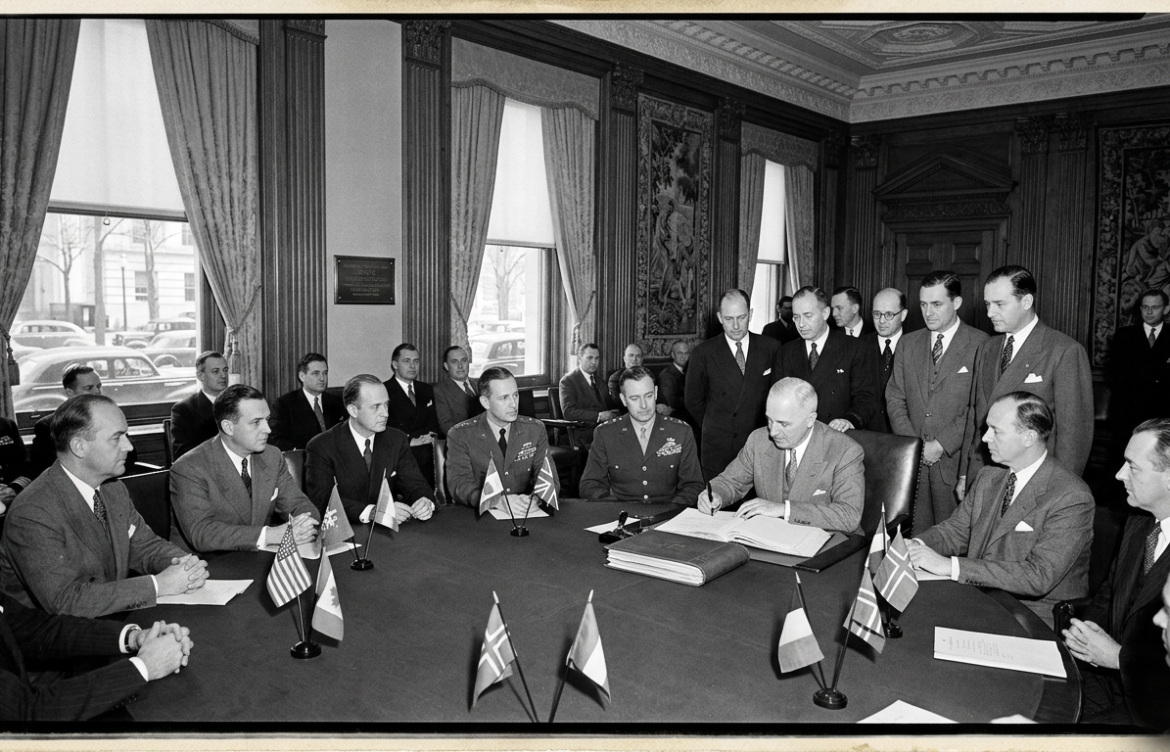
On April 3, 1948, nine months and twenty-eight days after George Marshall had stood in Harvard Yard and delivered his cautious, underplayed call for a new American commitment to European recovery, President Harry Truman signed the Economic Cooperation Act into law. The ceremony was not the elaborate public spectacle that might have been expected for legislation of such historic importance — Truman’s signings tended to be relatively businesslike affairs, attended by the key Congressional sponsors and administration figures rather than massive public events. But its significance was immediately recognized. The Act authorized $5.3 billion for the program’s first twelve months of operation, with the expectation of further appropriations to follow.
The Act created the Economic Cooperation Administration (ECA) as an independent agency to administer the program — Marshall had insisted on independence from both the State Department and the military, understanding that European acceptance of the program would be easier if it was managed by civilian businessmen rather than government officials or soldiers. Paul Hoffman was confirmed as ECA administrator. Averell Harriman was appointed as the ECA’s special representative in Europe, based in Paris, where the Organization for European Economic Cooperation (OEEC) — the European counterpart to the ECA, created by the sixteen recipient nations to coordinate their requests and manage their implementation — was already meeting. The OEEC, which held its first official meeting on April 15, 1948, was itself a significant achievement: it was the first major multilateral economic organization in European history, and it laid the institutional groundwork for the broader European economic integration that would follow.
The Act’s formal title — the Economic Cooperation Act of 1948, Title I of the Foreign Assistance Act of 1948 (Public Law 80-472) — reflected the framework within which the program operated. The preamble stated its purpose clearly: ‘To promote world peace and the general welfare, national interest, and foreign policy of the United States through economic, financial, and other measures necessary to the maintenance of the conditions abroad in which free institutions may survive.’ It was simultaneously a humanitarian program, a Cold War strategy, and an expression of the new American understanding of its own interests in a world where economic collapse anywhere threatened stability everywhere.
How the Marshall Plan Worked: Aid Distribution, Counterpart Funds, and Conditions
The Marshall Plan operated in ways that were both simpler and more sophisticated than popular mythology sometimes suggests. The bulk of the $13.3 billion ultimately appropriated under the program — approximately 70 percent — was distributed as direct grants that recipient nations were not required to repay. The remaining 30 percent was in the form of loans. The money was used primarily to purchase commodities from the United States and elsewhere — food, fuel, fertilizer, raw materials, machinery, and equipment — that European nations desperately needed but could not afford with their depleted foreign currency reserves. The program thus served American economic interests simultaneously with European ones: American farmers, manufacturers, and workers benefited from the export demand that Marshall Plan purchases created, and the program was partly sold to Congress on exactly those grounds.
One of the plan’s most innovative features was the counterpart fund mechanism. When the ECA provided dollars to a recipient country to purchase American goods, the country deposited an equivalent amount in its own currency into a ‘counterpart fund’ — a locally held account managed jointly by the American ECA mission in the country and the local government. Eighty percent of these counterpart funds were available to the local government for domestic recovery investment, such as infrastructure rebuilding, housing, and industrial plant; the remaining 20 percent was reserved for ECA use, typically for purchasing strategic materials or administrative expenses. The counterpart fund mechanism meant that the Marshall Plan generated local-currency investment far exceeding the direct dollar grants, and it gave the ECA significant leverage to promote the economic policy reforms — reduced trade barriers, currency stabilization, balanced budgets — that American planners believed were essential for sustainable recovery rather than mere temporary relief.
The Marshall Plan was also conditional in important ways. The ECA and the Truman administration pushed the recipient nations consistently toward economic integration, the reduction of tariffs and trade barriers, currency convertibility, and the kinds of free-market reforms that American planners believed had been absent from the interwar European economy and had contributed to the economic nationalism and instability that had fed the rise of fascism. Not all recipient nations embraced these conditions equally enthusiastically — the United Kingdom, in particular, was resistant to European integration and reluctant to sacrifice its bilateral sterling arrangements — but the overall pressure of the program was toward a more open, integrated, and market-oriented Western European economy. This pressure would bear its most significant long-term fruit in the institutions that the Marshall Plan helped create: the OEEC, which eventually became the Organization for Economic Cooperation and Development (OECD), and the patterns of European cooperation that eventually led, through the European Coal and Steel Community, to the European Economic Community and ultimately the European Union.
The Recipients: Seventeen Nations and the Political Geography of the Cold War
The seventeen nations that ultimately participated in the European Recovery Program represented the Western half of the European continent, minus only the Soviet-dominated East. The United Kingdom, the largest single recipient in absolute terms, received approximately $3.2 billion — reflecting both its size and its status as a major wartime belligerent that had been economically exhausted by the effort. France received approximately $2.7 billion, the second largest share, partly because of its industrial importance to the continent and partly because of the specific political concern about the strength of the French Communist Party, which had won approximately 28 percent of the vote in the 1946 elections and was the largest political party in France. West Germany — formally the three Western occupation zones, which became the Federal Republic of Germany in 1949 — received approximately $1.4 billion, a figure that reflected American understanding that German industrial recovery was essential to the recovery of the rest of the continent.
Italy, which had been an Axis power and thus received less per capita than nations that had resisted Nazi Germany, nonetheless received approximately $1.5 billion. The urgency of Italy’s situation was underscored by the April 1948 Italian elections — which took place just three weeks after Truman signed the Marshall Plan — in which the Italian Communist Party and its allies posed a genuine electoral threat that was seen in Washington as potentially equivalent to the Czech coup. The Italian Christian Democrats ultimately won the election decisively, and American economic, diplomatic, and covert pressure — including the explicit message that Marshall Plan aid would be at risk if Italy elected a communist government — was widely credited with contributing to the outcome. This episode illustrated both the political dimension of the Marshall Plan and the extent to which its architects understood it as an instrument of Cold War competition as much as pure humanitarian relief.
The smaller nations of Western Europe — Belgium, the Netherlands, Luxembourg (which functioned as a unit through their customs union, the Benelux), Denmark, Norway, Sweden, Austria, Greece, Turkey, Portugal, Switzerland, Iceland, and Ireland — also received Marshall Plan assistance, though in smaller absolute amounts. Greece, still fighting a communist insurgency with American backing under the Truman Doctrine, received particular attention as the front line of the anti-communist struggle. Austria, divided like Germany into occupation zones, was in a precarious position between East and West. Sweden and Switzerland, both neutral during the war, received less per capita than the nations that had fought the Axis. Ireland received aid despite having remained neutral throughout the war.
Results and Impact: The Western European Economic Miracle
By any measure, the Marshall Plan was one of the most successful foreign policy initiatives in American history — and in the history of international economic cooperation more broadly. Between 1948 and 1951, the four years the program was in full operation before being superseded by the Mutual Security Act in 1951, the recipient nations experienced an aggregate increase in their gross national products of between 15 and 25 percent. Industrial production in Western Europe surpassed pre-war levels by the final year of the program. Agricultural output recovered. Trade revived. The communist parties in France and Italy, while remaining significant, saw their share of the vote decline as economic conditions improved and the appeal of radical alternatives diminished with prosperity. The iron grip of the severe postwar economic crisis was broken within three or four years of the program’s start.
Germany’s recovery was particularly dramatic. When the Marshall Plan began, Germany’s industrial output was still constrained by Allied occupation policies designed to prevent a resurgent German military threat; permitted steel production had been capped at 25 percent of pre-war capacity. As Marshall and other American planners came to understand that a permanently weakened Germany would prevent the recovery of the rest of the continent, these restrictions were progressively relaxed. Permitted steel production rose to 50 percent of pre-war capacity in 1947, and the currency reform of June 1948 — which replaced the worthless Reichsmark with the new Deutsche Mark — provided the stable monetary foundation on which genuine economic recovery could be built. The German ‘economic miracle’ of the 1950s was not solely a product of the Marshall Plan, but the Plan provided the essential starting conditions without which the miracle could not have occurred.
For the United States, the benefits were substantial as well. Marshall Plan purchases created enormous export demand for American goods, benefiting American farmers, manufacturers, and workers directly. The establishment of stable, democratic, prosperous Western European governments created reliable allies and trading partners that would prove invaluable throughout the Cold War. The NATO alliance, formally established in April 1949, was built on the political foundation that the Marshall Plan had created: nations that were economically stable and democratically governed were nations that could be reliable military partners. The Marshall Plan was thus the economic complement to NATO’s military architecture — together, they defined the Western alliance that would contain Soviet power for the following four decades.
The plan’s impact on European integration was longer-lasting and in some ways more profound than its direct economic effects. The requirement that European nations cooperate in drawing up a unified recovery plan, the creation of the OEEC, the counterpart fund mechanisms that required bilateral negotiations between the ECA and recipient governments — all of these pushed European nations toward habits of cooperation and joint economic governance that had been entirely absent before the war. The OEEC evolved into the OECD. The patterns of European economic integration encouraged by Marshall Plan conditions eventually contributed to the European Coal and Steel Community (1951), the European Economic Community (1957), and ultimately the European Union. The Marshall Plan did not create European integration, but it provided the institutional and political impulse without which the process of integration would have been far slower and far more uncertain.
Controversy and Criticism: Was the Marshall Plan More Than Simple Altruism?
The Marshall Plan has been celebrated so consistently since its inception that it is easy to forget that it had critics at the time and that subsequent scholarship has raised important questions about its motivations, conditions, and ultimate effects. The Soviet critique — that it was American economic imperialism designed to penetrate and dominate European economies through dollar dependence — was self-serving, but it was not entirely without substance. The conditions attached to Marshall Plan aid, while less onerous than critics charged, did push European economies toward American models of free-market capitalism, currency convertibility, and trade liberalization in ways that served American economic interests as much as European ones.
Some economic historians have argued that the Marshall Plan was less economically decisive than its admirers claim. The aid amounted to roughly 3 percent of the combined national incomes of the recipient nations between 1948 and 1951 — significant, but not by itself sufficient to explain the scale of the recovery. Many recipient economies were already recovering before the first Marshall Plan dollar arrived, driven by their own reform efforts and by the underlying resilience of European industrial capacity. On this view, the Marshall Plan provided the ‘margin’ that made recovery possible and sustainable, rather than being its primary driver. The plan was, on this reading, more important as a political signal — demonstrating American commitment and creating the stable expectations under which European businesses and governments could plan for the future — than as a direct economic intervention.
The exclusion of Eastern Europe and the role the plan played in hardening the division of the continent are also subjects of ongoing historical debate. Marshall had genuinely offered the program to all European nations, and some historians have argued that American planners expected and even hoped that the conditions attached to the offer would ensure Soviet rejection — that the design of the program was deliberately calibrated to be unacceptable to Moscow. Other historians believe the offer was genuine and that the Soviet rejection was a free choice that accelerated the Cold War division unnecessarily. The truth, as with most major historical questions, probably lies in the complex intentions of multiple actors whose motivations were not identical.
George Marshall’s Nobel Peace Prize and the Enduring Legacy of the Plan
In 1953, George C. Marshall received the Nobel Peace Prize — the only professional soldier in American history to be so honored — for his work on the European Recovery Program. The Nobel Committee’s decision was itself a statement about what the Marshall Plan had meant to the world: not merely a foreign aid program or a Cold War strategy, but a demonstration that it was possible to respond to the devastation of total war with generosity and vision rather than retribution and division. Marshall’s brief acceptance speech was characteristically modest; he spoke of the importance of education in building understanding between peoples, and of the need for the kind of leadership that preferred long-term peace to short-term advantage. He died on October 16, 1959, at Walter Reed Army Medical Center in Washington, D.C., at the age of seventy-eight.
The plan’s legacy has been institutionalized in multiple ways. The German Marshall Fund of the United States was created in 1972 — announced by West German Chancellor Willy Brandt in a speech at Harvard University’s commencement, exactly twenty-five years after Marshall’s original speech — as a permanent institution to strengthen transatlantic cooperation in the spirit of the Marshall Plan. The fund has operated continuously since its founding, supporting research, exchange programs, and policy dialogue between the United States and Europe. The Organization for Economic Cooperation and Development, the successor institution to the OEEC, has grown to include 38 member countries from around the world and remains one of the most important multilateral economic institutions in existence.
In subsequent decades, ‘another Marshall Plan’ has become the default analogy whenever a major international reconstruction challenge presents itself. The phrase has been applied to proposed programs for the reconstruction of Eastern Europe after the Cold War, for African economic development, for reconstruction in Iraq and Afghanistan, for climate change mitigation, and for numerous other challenges. This invocation is itself a tribute to the original: it acknowledges that the Marshall Plan represented something that international policy communities continue to aspire toward — a combination of strategic vision, generous scale, practical conditionality, and genuine effectiveness that has rarely been achieved before or since. Most of the ‘Marshall Plans’ proposed since 1952 have never materialized, which only underlines how exceptional the original was.
Conclusion: April 3, 1948 and the Decision That Defined an Era
When Harry Truman signed the Economic Cooperation Act on April 3, 1948, he was doing something that American presidents before him had explicitly warned against: committing the United States to a permanent, sustained entanglement in European affairs in peacetime. George Washington’s Farewell Address had cautioned against ‘permanent alliances.’ John Quincy Adams had warned that America ‘goes not abroad in search of monsters to destroy.’ The Monroe Doctrine had defined the Western Hemisphere as America’s sphere and suggested that European affairs were, by implication, not America’s business. The Marshall Plan represented the final, irreversible abandonment of that tradition — the recognition, forged in the fires of two world wars and a Great Depression, that in the modern world there was no meaningful distinction between American security and global stability, that democracy in Europe was a necessary condition for democracy in America, and that the cost of preventing another catastrophic European collapse was worth bearing.
The Marshall Plan worked. It worked economically, lifting Western Europe from the edge of collapse to prosperity within a generation. It worked politically, stabilizing democratic governments and reducing the appeal of communism in the critical years when the ideological competition was most acute. It worked strategically, laying the foundation for the NATO alliance and the Western coalition that would ultimately outlast the Soviet Union. It worked institutionally, creating the habits and organizations of European economic cooperation that eventually produced the European Union. And it worked morally, demonstrating that it was possible for a powerful nation, in the aftermath of a devastating war, to choose rebuilding over retribution, generosity over exploitation, and long-term stability over short-term advantage.
The men who made it happen — Truman, Marshall, Vandenberg, Kennan, Clayton, Acheson, Hoffman, Harriman — were neither saints nor visionaries in any simple sense. They were practical, serious people who understood the problems they faced with unusual clarity and who had the political skill, the institutional authority, and the moral courage to act on that understanding in ways that transcended narrow partisan or national interest. The Marshall Plan stands, more than three-quarters of a century after Truman’s pen touched that page on April 3, 1948, as perhaps the most convincing evidence in modern history that foreign policy can be both strategically effective and genuinely humane — that what is right and what is prudent can, under the right circumstances and with the right leadership, be the same thing.