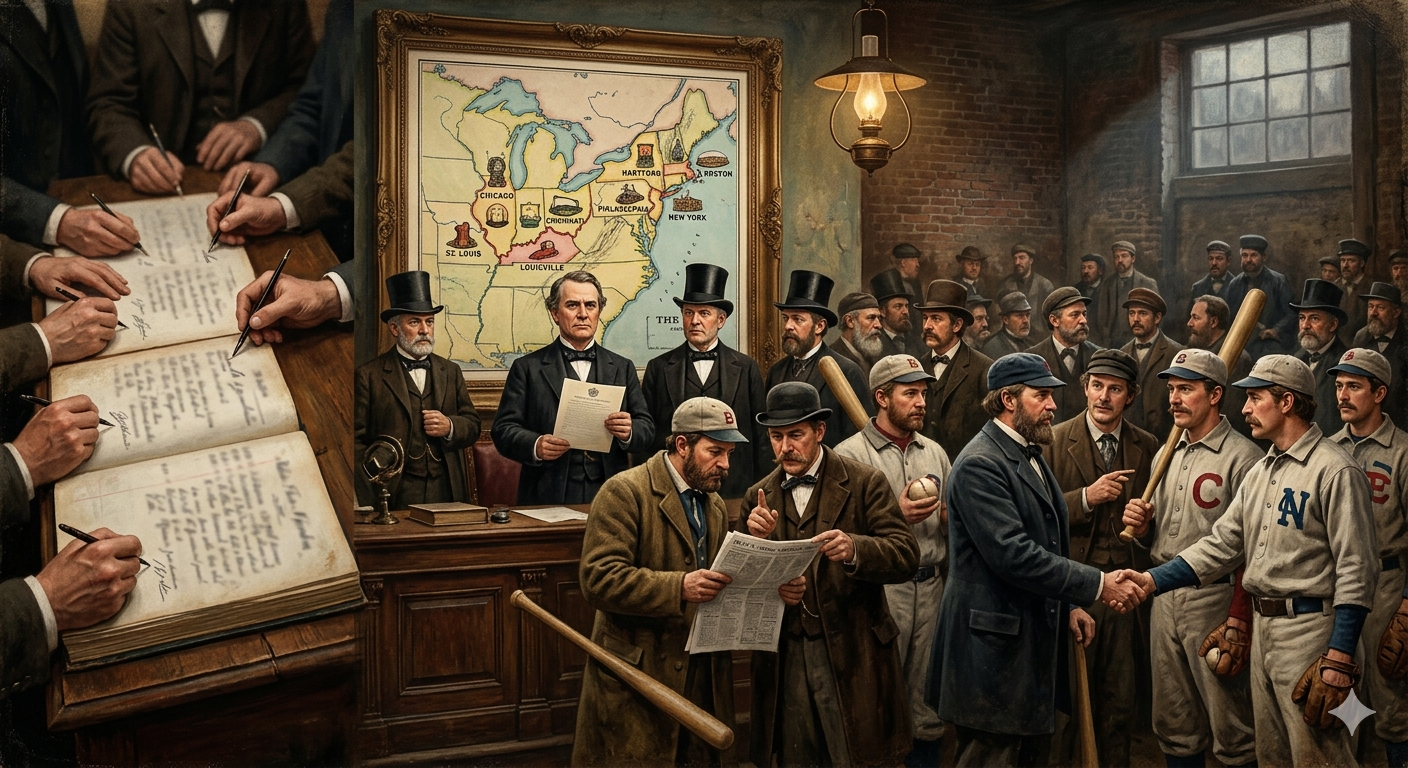
On the afternoon of February 2, 1876, a group of baseball club owners gathered in a private room at the Grand Central Hotel in New York City. They had been invited under the guise of discussing reforms to the existing baseball organization. Most of the eastern representatives had no idea what was truly about to happen.
The meeting was orchestrated by William Ambrose Hulbert, president of the Chicago White Stockings and a businessman who had grown furious at the disorder plaguing professional baseball in America. By the time the delegates left that room, they had dissolved one league and created another. The National League of Professional Base Ball Clubs, born at that meeting, is the oldest surviving professional sports league on earth.
Its founding did not merely reorganize baseball. It invented the very model of how professional sports leagues are built and governed — a blueprint still followed by the NFL, NBA, NHL, and leagues around the world.
Baseball Before the National League: The Chaos of the National Association
To understand why the National League was necessary, one must understand what professional baseball looked like before 1876. The game had been growing in American life since the mid-nineteenth century, shaped by the Knickerbocker rules of 1845 and spread by returning Civil War veterans who carried it from city to city across the country.
By 1869, the Cincinnati Red Stockings had become America’s first openly professional baseball club. Two years later, in 1871, the National Association of Professional Base Ball Players was founded — the sport’s first attempt at a national professional league structure.
The National Association was a player-based organization, and that structural fact was at the root of all its problems. Any professional club could join the championship competition for a fee of just ten dollars, which flooded the league with clubs of wildly unequal quality, some representing tiny towns with almost no fan base.
Teams routinely skipped scheduled games when they had fallen out of title contention, seeing no financial reason to make expensive road trips. Players jumped from team to team every season, selling themselves to the highest bidder in a practice known as “revolving.” Gambling was rampant at ballparks, with gamblers mingling openly among fans and some players maintaining troubling relationships with those who bet on games.
The Boston Red Stockings dominated the competition almost unchallenged, winning four consecutive NA championships. This made the rest of the league feel pointless to fans outside of Boston. Henry Chadwick, the game’s most prominent sportswriter, publicly lamented that the association was pulling baseball into “a slough of corruption and disgrace.”
William Hulbert: The Chicago Businessman Who Decided to Build Something New
William Ambrose Hulbert was born on October 23, 1832, in Burlington Flats, New York. He moved with his family to Chicago at the age of two and spent the rest of his life there. He was a businessman through and through — a Beloit College graduate who built a successful coal and grocery operation and earned a seat on the Chicago Board of Trade.
His civic pride for Chicago was legendary. He is said to have declared he would “rather be a lamppost in Chicago than a millionaire in any other city.” When he became a financial backer of the Chicago White Stockings in 1871 and assumed the club’s presidency in 1875, he brought the mindset of a hard-nosed commercial operator to a world run mostly by enthusiasts.
What turned Hulbert from an irritated club president into a revolutionary was a specific injustice. In 1874, he signed shortstop Davy Force — a notorious contract jumper — to a deal for the 1875 season. Force then signed a second contract with the Philadelphia Athletics. When Hulbert protested to the National Association’s judiciary committee, he initially won. But after a Philadelphia man was elected president of the Association, the decision was reversed.
Hulbert was furious. He saw it as corrupt favoritism by eastern clubs toward their own. Determined to respond, he spent the 1875 season secretly building an unbeatable team — and planning an entirely new league to play in.
The Secret Player Raids of 1875: Spalding, Anson, and the Coup in the Making
During the 1875 season, while still technically a National Association member, Hulbert quietly signed four of Boston’s biggest stars away from the dominant Red Stockings. He secured pitcher Albert Goodwill Spalding, second baseman Ross Barnes, catcher Deacon White, and outfielder Cal McVey. He also persuaded first baseman Adrian “Cap” Anson to leave the Philadelphia Athletics.
Spalding was no ordinary signing. He was one of baseball’s most respected and widely admired players. His defection to Chicago caused a scandal of the first magnitude across the sport.
When news of these signings leaked before the end of the 1875 season, Boston and Philadelphia were outraged. There was open talk of expelling Hulbert and his club from the Association before the 1876 season even began. For Hulbert, this threat made his plan urgent. If he was going to be expelled anyway, he would leave first — and take the best players in the game with him.
The Secret Planning: Louisville’s Galt House and the Constitution of December 1875
The formal conspiracy to create a new league began not in New York but in Louisville, Kentucky. On December 16 and 17, 1875, representatives of the four western clubs — Chicago, Cincinnati, Louisville, and St. Louis — gathered at the elegant Galt House hotel under the cover of routine business discussions.
Hulbert and Spalding had already been working together on the constitution for the new league. Spalding had been a guest at Hulbert’s home during December 1875 as the two men drafted the founding document side by side. Lawyers in St. Louis formally wrote up the final constitution on January 9, 1876.
The four western clubs voted to authorize Hulbert and Charles A. Fowle of St. Louis to travel to New York with proxy votes, giving them the power to commit all four clubs to whatever arrangement Hulbert could negotiate. On January 23, 1876, formal invitations went to the four strongest eastern clubs — the Athletic Base Ball Club of Philadelphia, the Boston Red Stockings, the Hartford Dark Blues, and the Mutual Base Ball Club of New York. The letter invited them to send representatives “clothed with full authority” to meet on February 2.
The eastern clubs accepted, most not yet knowing the full scale of what was being proposed.
The Grand Central Hotel Meeting: February 2, 1876, and the Birth of the National League
The gathering at the Grand Central Hotel on February 2, 1876, was the most consequential meeting in the history of American professional sports. The eastern representatives present were George W. Thompson for the Philadelphia Athletics, Nicholas T. Apollonio for Boston, Morgan G. Bulkeley for Hartford, and William H. Cammeyer for the New York Mutuals.
Also present were Harry Wright — the legendary Boston manager, reportedly there to present playing rule changes — and Lewis Meacham of the Chicago Tribune, the only journalist Hulbert had invited. Nicholas Young, the outgoing secretary of the National Association, was also in the room. He would soon become the secretary of its replacement, earning a salary of $400 and required to be bonded at $1,000.
According to accounts passed down afterward, Hulbert locked the door and told the assembled men, “Gentlemen, you have no occasion for uneasiness.” He then laid out his case for abandoning the National Association entirely. The new league would operate on entirely different principles.
Clubs — not players — would be the fundamental units of the organization. Each club would be required to complete its full schedule of games, with expulsion the penalty for failure. Gambling would be absolutely prohibited, both in ballparks and among players. Sunday baseball and drinking on the field would not be tolerated. League membership would be limited to cities with populations of at least 75,000 — Hartford was admitted only by unanimous vote as an exception. Each member club would hold exclusive territorial rights, with no rival club permitted within five miles of their city.
A standardized season of seventy games would be played against all opponents. A minimum ticket price of fifty cents would be charged, reflecting Hulbert’s belief that cheap admission cheapened the entire sport. Then, in a move he had clearly planned for dramatic effect, Hulbert produced the fully drafted constitution from his pocket.
The eastern club owners, faced with joining or being left behind as the western clubs departed, agreed. The National League of Professional Base Ball Clubs was declared into existence. Its eight founding clubs were the Chicago White Stockings, the Boston Red Stockings, the Cincinnati Red Stockings, the Hartford Dark Blues, the Louisville Grays, the Mutual Club of New York, the Athletic Club of Philadelphia, and the St. Louis Brown Stockings.
Morgan Bulkeley as President and Hulbert’s Real Power Behind the Scene
After the founding declaration was signed, the meeting closed with the election of a league president by random drawing. The first name drawn was Morgan G. Bulkeley of the Hartford Dark Blues — a man from one of New England’s most distinguished families. His father had founded the Aetna Life Insurance Company, and Bulkeley was himself a respected financier who would later become governor of Connecticut and a United States senator.
Bulkeley was elected president unanimously for the 1876 season. But his association with baseball was essentially finished nine months later. He served his single year as NL president and returned to business and politics in Connecticut, never meaningfully involved in the game again.
Hulbert assumed the league presidency in 1877 and held it until his death, ruling with the iron authority he had always intended to exercise. His choice to put Bulkeley forward as president had been shrewd — Bulkeley’s sterling reputation gave the new league respectability while Hulbert operated as its true power from his position as Chicago’s club president.
The First Season, the First Firsts, and the First Expulsions
The National League’s inaugural season opened on April 22, 1876, at Philadelphia’s Jefferson Street Grounds. The Boston Red Stockings defeated the Philadelphia Athletics 6–5 in the first official game in National League history. On May 2, 1876, Ross Barnes of Chicago hit the first National League home run, an inside-the-park variation, against Louisville. On July 15, George Bradley of St. Louis pitched the first no-hitter in league history, shutting out Hartford.
Hulbert’s Chicago White Stockings, loaded with the talent raided from Boston, won the first National League pennant with a record of 52–14. Albert Spalding, the star pitcher who had left Boston for Chicago, was the ace of the staff. He would later found the sporting goods company that still bears his name.
But the league’s authority was almost immediately tested. The New York Mutuals and the Philadelphia Athletics, struggling financially and out of championship contention, both refused to make their scheduled western road trips late in the season. They preferred to play local games that cost less and generated more money. This was exactly the behavior that had destroyed the National Association.
At the league’s first annual meeting, Hulbert expelled both the New York and Philadelphia clubs — stripping the two most populous cities in the United States of their franchises. The message was unmistakable: no club was too large or too important to escape the consequences of breaking league rules.
The following year, when four Louisville Grays players were found to have deliberately thrown games in exchange for payments from gamblers, Hulbert banned all four from professional baseball for life. It was the first lifetime ban for game-fixing in the sport’s history.
The Reserve Clause and the Business Model That Lasted a Century
One of the most consequential — and eventually most controversial — innovations of the early National League was the creation of the reserve clause after the 1879 season. It allowed each club to “reserve” a set of its players whose contracts would automatically renew at the club’s option, binding those players to their teams rather than allowing them to seek higher pay elsewhere.
What began as a provision covering five players per team was expanded until it effectively bound every professional player to his club indefinitely. Players had no ability to become free agents unless released. The reserve clause remained the foundational legal instrument of Major League Baseball’s labor relations for nearly a century.
It was not successfully challenged until 1975 — almost exactly a hundred years after the National League’s founding — when arbitrator Peter Seitz’s Messersmith-McNally decision dismantled it and ushered in the modern era of free agency.
William Hulbert’s Death, Legacy, and Belated Hall of Fame Recognition
Hulbert died on April 10, 1882, at the age of forty-nine, from heart failure. Upon his death, the National League passed a resolution stating that “to him alone is due the credit of having founded the National League, and to his able leadership, sound judgment, and impartial management is the success of the league chiefly due.” Albert Spalding honored him publicly, calling on all professional baseball players to raise their hats to Hulbert’s memory.
Yet for decades, Hulbert was kept out of the Baseball Hall of Fame. When pioneering executives were first selected for the Hall in 1937, the electors chose Morgan Bulkeley as the “first president of the National League” — confusing the figurehead with the architect. The Veterans Committee finally corrected the injustice in 1995, enshrining Hulbert posthumously.
He is buried in Graceland Cemetery in Chicago under a gravestone shaped like a baseball. Carved into it are the names of the cities that belonged to the National League at the time of his death.
The National League’s Enduring Legacy as the Senior Circuit
The American League was founded by Ban Johnson in 1901 and initially declared itself a major league in competition with the National League. The two leagues made peace through the National Agreement of 1903, the framework under which they cooperated — and began playing the first World Series that same year.
The structure Hulbert invented — fixed schedules, territorial exclusivity, centralized governance, the principle that league authority supersedes any individual club — became the standard model for professional sports leagues everywhere in the world. The NHL, NBA, NFL, and scores of European football leagues all operate on the foundations Hulbert laid in that hotel room in 1876.
The National League is today called the Senior Circuit, reflecting its status as the older of the two Major League Baseball leagues. Its fifteen teams carry pennant traditions that descend directly from the eight clubs that agreed to play under its rules in the spring of 1876. The Atlanta Braves trace their lineage to the Boston Red Stockings of that founding year. The Chicago Cubs are the direct successors of Hulbert’s own Chicago White Stockings. The Cincinnati Reds carry the name and tradition of the Cincinnati Red Stockings.
What began in a locked hotel room in New York City on a February afternoon in 1876 — a group of businessmen deciding to reorganize a sport — became the architecture of professional sports itself.