Shortly before 1:00 a.m. on May 2, 2011, in a walled compound in Abbottabad, Pakistan, US Navy SEALs shot and killed Osama bin Laden the founder of al-Qaeda and the man responsible for the deadliest terrorist attack in American history.
The operation, codenamed Neptune Spear, lasted 40 minutes from start to finish. It ended a manhunt that had consumed the United States intelligence community for nearly a decade, launched two wars, and defined an era of American foreign policy unlike any since the Cold War.
At 11:35 p.m. Eastern Daylight Time on May 1 roughly eight hours after bin Laden died President Barack Obama appeared on national television and told the world: “Justice has been done.”
Who Was Osama bin Laden: From Saudi Wealth to Global Terror
Osama bin Laden was born in 1957 in Riyadh, Saudi Arabia, the son of Muhammad bin Laden a self-made billionaire who had immigrated from Yemen as a labourer and built one of the largest construction companies in the Middle East through contracts with the Saudi royal family. Osama was one of more than 50 children born to Muhammad bin Laden by multiple wives. He grew up wealthy, educated, and deeply religious.
He studied business administration and religious studies at King Abdul Aziz University in Jeddah. When the Soviet Union invaded Afghanistan in 1979, the young bin Laden was galvanized. He traveled to Afghanistan and began providing financial and logistical support to the mujahideen the Islamic fighters resisting the Soviet occupation. The experience radicalized him permanently.
In 1988, as Soviet forces were withdrawing from Afghanistan, bin Laden founded al-Qaeda — Arabic for “the Base” to continue what he saw as a global jihad beyond the borders of a single conflict. The organization set up training camps across Afghanistan, Pakistan, and Sudan, and began planning attacks against what bin Laden increasingly defined as the enemies of Islam, above all the United States.
He was expelled from Saudi Arabia in 1991 after opposing the government’s decision to allow American troops on Saudi soil during the Persian Gulf War. He settled in Sudan and then, in 1996, returned to Taliban-controlled Afghanistan, where he found a secure base of operations and sanctuary that would last until the September 11 attacks.
The Road to September 11: al-Qaeda’s War Against America
The attacks of September 11, 2001 did not come without warning. Throughout the 1990s, al-Qaeda had been steadily escalating its operations against American targets.
On February 26, 1993, Ramzi Yousef who had trained in one of bin Laden’s camps detonated a bomb in the parking garage beneath the World Trade Center in New York City. Six people were killed and over a thousand were injured. The attack failed to bring down the towers but demonstrated both the ambition and the capability of the network bin Laden was building.
On August 7, 1998, al-Qaeda operatives simultaneously bombed the US embassies in Nairobi, Kenya and Dar es Salaam, Tanzania. The near-simultaneous blasts killed more than 200 people American, Kenyan, and Tanzanian citizens and wounded nearly 4,500 more. The FBI placed bin Laden on its Ten Most Wanted Fugitives list in June 1999.
On October 12, 2000, a small boat loaded with explosives detonated beside the USS Cole during a refueling stop in the Yemeni port of Aden. Seventeen US Navy sailors were killed and nearly 40 more were wounded.
Then, on the morning of September 11, 2001, nineteen al-Qaeda operatives hijacked four commercial aircraft in the United States. Two planes were flown into the Twin Towers of the World Trade Center in New York City. A third struck the Pentagon in Arlington, Virginia. A fourth United Airlines Flight 93 crashed into a field in Shanksville, Pennsylvania, after passengers attempted to overpower the hijackers. Nearly 3,000 people died. It remains the deadliest terrorist attack in American history.
Tora Bora and the Escape: How Bin Laden Disappeared
In the immediate aftermath of September 11, President George W. Bush declared war on terrorism and authorized the CIA to launch operations in Afghanistan. On October 7, 2001, the United States and its allies began military operations in Afghanistan under Operation Enduring Freedom. The Taliban government was rapidly overthrown.
By November 2001, US intelligence had tracked bin Laden to the Tora Bora cave complex in Afghanistan’s Spin Ghar mountain range, near the eastern border with Pakistan. CIA officer Gary Berntsen requested that General Tommy Franks send US Army Rangers to seal the mountain passes into Pakistan and cut off bin Laden’s escape route. The request was denied. Afghan militia forces, whose loyalties were uncertain, were used instead. In December 2001, bin Laden and a group of al-Qaeda fighters slipped through the mountains into Pakistan. The most wanted man in the world had vanished.
For nearly ten years, he remained hidden. The CIA unit specifically dedicated to capturing bin Laden was quietly shut down in late 2005. Rumors surfaced repeatedly about his location — the tribal border regions, Pakistan’s northwest frontier, the Waziristan valleys — but no confirmed intelligence emerged. He released periodic audio and video messages to reassure followers he was alive, but gave nothing away about where he was.
What ultimately led to his discovery was not a dramatic intelligence breakthrough. It was patient, methodical analysis of a single thread: a courier.
The Courier Who Led the CIA to Abbottabad
Bin Laden had been famously careful since 1998, when a US missile strike in Afghanistan had been triggered by tracking a satellite phone call made by one of his associates. After that, he stopped using phones entirely. He communicated with the outside world exclusively through trusted human couriers — men he knew personally, who moved between locations on foot or by vehicle and delivered messages by hand.
Guantanamo Bay detainees, interrogated over several years, gave US intelligence a crucial piece of information: the pseudonym of one of bin Laden’s most trusted couriers — Abu Ahmed al-Kuwaiti. They described him as a protégé of Khalid Sheikh Mohammed, the operational mastermind of the September 11 attacks, and said he was part of bin Laden’s inner circle.
In 2007, CIA analysts learned Abu Ahmed al-Kuwaiti’s real name — Ibrahim Saeed Ahmed, a Pakistani-born Pashtun who had grown up in Kuwait. In 2009, they learned he was living in Abbottabad, Pakistan. In August 2010, CIA paramilitary operatives tracked al-Kuwaiti as he drove from Peshawar to a walled compound on the outskirts of Abbottabad — a garrison city about 35 miles northeast of Islamabad, home to the Pakistani Military Academy.
What analysts saw in satellite imagery of that compound stopped them cold.
The walls were exceptionally high — up to 18 feet — and topped with barbed wire. Balconies on the upper floors had been walled off, preventing observation from outside. There was no telephone or internet connection. The residents burned their own garbage rather than leaving it for collection. A mysterious figure who was clearly tall paced the inner courtyard but never left the walls. CIA analysts named him “the pacer” and began building the case that he was Osama bin Laden.
In 2004, courier Ibrahim Saeed Ahmed had paid $48,000 to acquire adjoining lots in Abbottabad and built the fortified compound. By late 2005, bin Laden and at least three of his wives and several children had moved in. He had been living there for approximately six years before US intelligence found him.
The CIA also ran an operation through a Pakistani doctor, Shakil Afridi, who organized a hepatitis B vaccination campaign in Abbottabad as a cover to attempt to collect DNA samples that could confirm bin Laden’s presence. The campaign never succeeded in obtaining a sample from bin Laden himself, but it deepened the CIA’s intelligence picture of the compound.
By September 2010, the CIA had concluded the compound was “custom built to hide someone of significance.” By March 2011, analysts had assembled enough evidence to present President Obama with a range of options.
The Decision and the Planning: Obama’s Four Options
President Obama received four options for dealing with the Abbottabad compound. The first was an air strike, which could destroy the entire compound with no risk to American personnel but would leave uncertain whether bin Laden was actually there and risked significant civilian casualties. The second was a drone strike targeting “the pacer” specifically, but CIA confidence that the figure was bin Laden — estimated at between 60 and 80 percent — was too low to risk a catastrophic mistake.
The third option was joint action with Pakistan’s intelligence service, the ISI — but this was quickly ruled out. The United States did not trust that Pakistani officials would not tip off bin Laden. His compound, after all, sat less than a mile from the entrance to the Pakistan Military Academy, in a city full of retired military officers. The idea that the most wanted man in the world had been living there for six years without any Pakistani officials knowing was difficult to accept.
The fourth option was a raid by special operations forces. It was the riskiest for the operators involved, but it offered confirmation and intelligence collection that no other option could provide. Obama chose the raid.
On April 29, 2011, President Obama gave the final authorization to proceed. The mission was assigned to the Red Squadron of the Naval Special Warfare Development Group — popularly known as SEAL Team Six — which had just returned from a deployment in Afghanistan and was on scheduled leave, allowing the team to train for the mission without drawing attention.
Since April 2011, 24 members of Red Squadron had been rehearsing the raid at a full-scale replica of the Abbottabad compound constructed in North Carolina. CIA Director Leon Panetta oversaw the intelligence architecture of the operation. Joint Special Operations Command coordinated the special mission units. The 160th Special Operations Aviation Regiment — the Army’s elite “Night Stalkers” — would fly the mission in specially modified stealth Black Hawk helicopters, designed to reduce their radar signature and noise footprint.
Also participating in the raid was Cairo, a Belgian Malinois military working dog trained for bomb detection and attack. Cairo wore a vest and was deployed with the SEALs during the ground operation.
May 2, 2011: Operation Neptune Spear — 40 Minutes That Changed History
At 10:30 p.m. local time on May 1, 2011 — it was still May 1 in Washington, D.C. — two stealth Black Hawk helicopters lifted off from a US base in Jalalabad, Afghanistan, and headed for the Pakistani border. Aboard were 23 SEALs, an interpreter, and Cairo the dog. Two Chinook helicopters followed with backup forces and extra fuel, remaining at a distance.
The flight took approximately an hour. Pakistani authorities were not informed the operation was underway.
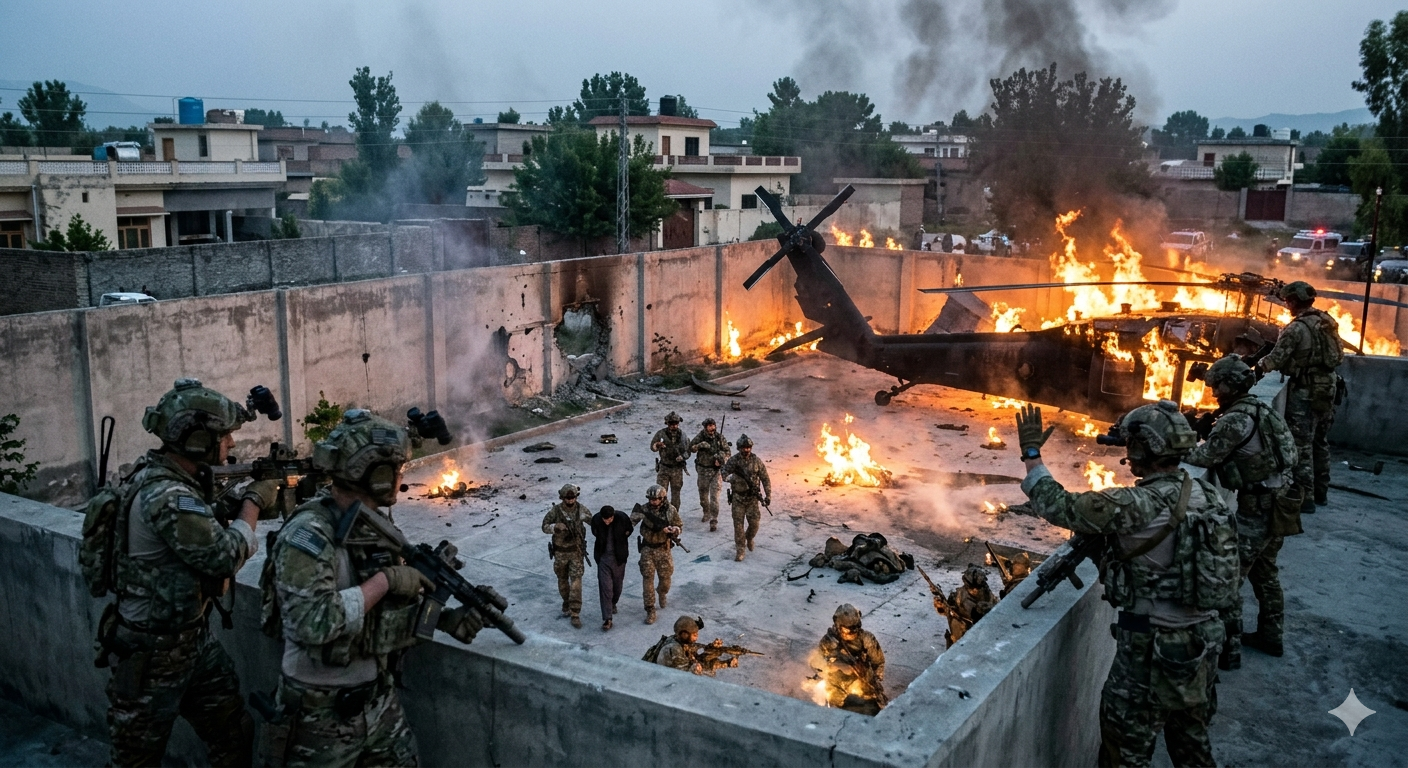
As the helicopters approached the compound, one of the Black Hawks experienced loss of lift due to the higher-than-expected air temperature inside the compound walls — a phenomenon engineers had not fully anticipated. The helicopter made a hard crash landing inside the compound walls, its tail snapping against the inner wall. No crew were seriously injured, but the mission plan was immediately altered. The SEALs regrouped, assessed the situation, and pressed forward.
Working by night-vision goggles in total darkness — power to the surrounding streets had been cut — the SEALs began systematically clearing the compound. At the guesthouse near the main building’s entrance, courier Abu Ahmed al-Kuwaiti appeared at the door armed with an AK-47 and was shot and killed. His wife was also killed in the exchange of fire. Inside the main house, another man — identified as bin Laden’s son Khalid — was killed on the stairwell.
The SEALs moved up through the building floor by floor. On the third floor, in a room at the end of the corridor, they found Osama bin Laden. He was shot twice — once in the chest, once above the left eye. His wife Amal al-Sadah, who lunged toward the operators, was shot in the leg and wounded. Bin Laden’s last reported words, shouted to his son Khalid moments before the SEALs reached him, were: “Don’t turn on the light.”
In the White House Situation Room, President Obama, Vice President Joe Biden, Secretary of State Hillary Clinton, Secretary of Defense Robert Gates, CIA Director Leon Panetta, Chairman of the Joint Chiefs Admiral Mike Mullen, National Security Advisor Tom Donilon, and other senior officials watched and listened in tense silence as the operation unfolded. The iconic photograph of that moment — Obama, leaning forward in a corner of the room, expression fixed and intent — became one of the defining images of his presidency.
At approximately 1:00 a.m. Pakistan time, the signal went out: “For God and country — Geronimo, Geronimo, Geronimo.” Geronimo was the mission code word for Osama bin Laden. Geronimo was dead.
The SEALs spent the next twenty minutes collecting intelligence from the compound — hard drives, computers, flash drives, handwritten documents, audio and video recordings, and bin Laden’s personal journal. In total they seized five computers, ten hard drives, and more than 100 storage devices. Among the files recovered were Disney movies, video games including Counter-Strike, bin Laden’s personal writings, and extensive al-Qaeda communications. The damaged Black Hawk was destroyed with explosives to prevent its classified technology from falling into other hands. A reserve Chinook was called forward to carry the team out.
As the helicopters departed, a local IT consultant named Sohaib Athar posted on Twitter: “Helicopter hovering above Abbottabad at 1AM (is a rare event).” He had no idea what he had just witnessed.
Identification, Burial at Sea, and the World’s Reaction
Bin Laden’s body was flown first to the Bagram Airfield in Afghanistan, where DNA testing and facial recognition confirmed his identity with near-certainty. The DNA was matched against samples from multiple bin Laden family members. CIA specialists placed their confidence at effectively 100 percent. His son Khalid was also confirmed dead.
From Bagram, the body was transported aboard a V-22 Osprey tiltrotor aircraft, escorted by two US Navy F/A-18 fighter jets, to the aircraft carrier USS Carl Vinson in the Arabian Sea. In the early morning hours of May 2, Islamic funeral rites were performed, with the body washed, wrapped in a white sheet, and prayers read. Bin Laden was then buried at sea, intentionally so that no physical grave would exist to become a shrine for followers.
Al-Qaeda confirmed his death in posts on militant websites on May 6. Crowds gathered spontaneously outside the White House and at Ground Zero in New York City, chanting and celebrating through the night. At Ground Zero — the site of the World Trade Center, where nearly 3,000 people had died on September 11, 2001 — the reaction was complex. For families of victims, the night held both relief and grief. The news arrived, for many of them, less as triumph than as a long-delayed and partial accounting.
Pakistan’s government was deeply embarrassed. Prime Minister Yousuf Raza Gillani addressed parliament and spoke of the violation of Pakistani sovereignty by the American raid. The question of how bin Laden had lived undisturbed for years in a garrison city, in a fortified compound a few hundred meters from Pakistan’s most prestigious military academy, was never publicly resolved.
The Legacy of the Abbottabad Raid
The killing of Osama bin Laden did not end al-Qaeda or the global threat of terrorism. His deputy, Ayman al-Zawahiri, assumed leadership of the organization and continued to direct operations from hiding until his own death in a US drone strike in Kabul in July 2022. Bin Laden’s son Hamza was reported to have been killed in a US operation in 2019, though some reports in 2024 suggested uncertainty remained about his fate.
But the raid had significance that went beyond the elimination of a single individual. It demonstrated what the CIA, JSOC, and the special operations community had become over a decade of war — a precision instrument capable of reaching into the most remote and protected locations on earth with devastating accuracy. It validated the painstaking, methodical approach to intelligence gathering that had tracked an invisible man through his courier for years.
The materials recovered from the compound provided intelligence about al-Qaeda’s global network that informed operations for years. In 2017, the Trump administration released 470,000 files recovered from the compound — documents, communications, and recordings that gave historians and analysts an unprecedented window into al-Qaeda’s inner workings in the final years of bin Laden’s life.
The 40-minute raid in Abbottabad closed one of the darkest chapters in the history of American national security. It did not close the chapter on terrorism. But for the families of nearly 3,000 people killed on September 11, 2001, and for the families of the thousands more killed in wars that followed, May 2, 2011 was a date that will never be forgotten.