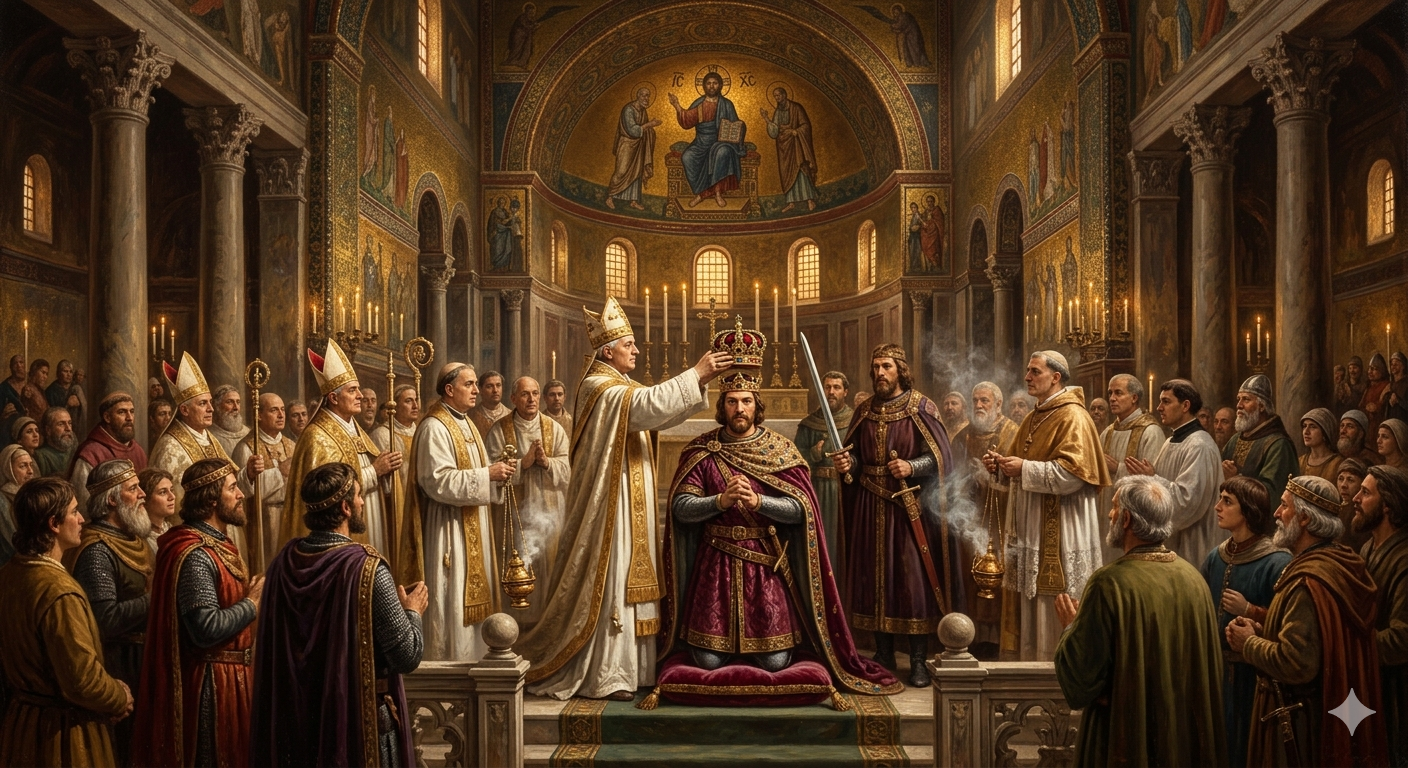
On February 2, 962, inside the solemn grandeur of Old St. Peter’s Basilica in Rome, a ceremony took place that would define European civilization for nearly nine centuries. Pope John XII placed the imperial crown upon the head of Otto I, King of Germany and Italy, and proclaimed him Emperor of the Romans. In that single act, the concept of a universal Christian empire in the West — dormant for decades since the disintegration of the Carolingian world — was resurrected in new form. The institution that grew from that coronation would eventually be named the Holy Roman Empire, and it would endure, in one form or another, until Napoleon Bonaparte forced its last emperor to lay down his crown in 1806. Otto I, remembered to history as Otto the Great, had become the most powerful ruler in Europe, the protector of the Western Church, and the self-proclaimed successor to the ancient emperors of Rome.
The Rise of Otto I: Son of Henry the Fowler and King of the Germans
Otto I was born on November 23, 912, in Wallhausen, in the Saxon heartland of what is now central Germany. He was the eldest son of Henry I of East Francia, known to history as Henry the Fowler — a name he acquired, according to legend, because he was out hawking when messengers arrived to inform him he had been elected king. Henry I was the founder of the Ottonian dynasty, which belonged to the ancient Liudolfing line of Saxon nobles. Otto’s mother was Matilda of Ringelheim, the daughter of Dietrich of Ringelheim, a Saxon count in Westphalia. From his earliest years, Otto was shaped by the martial culture of Saxony and by his father’s patient, pragmatic approach to building royal power through alliance and negotiation rather than outright conquest alone.
In 929, at the age of approximately seventeen, Otto married Edith of Wessex, the daughter of King Edward the Elder of England and the sister of the then-reigning King Æthelstan. The marriage was a prestigious diplomatic match and brought with it a substantial dowry, including the prosperous town of Magdeburg — a city that would remain deeply significant to Otto throughout his life and reign. When Henry I died in July 936, Otto was elected German king by the German dukes at Aachen, the former capital of Charlemagne, and was crowned and anointed by Hildebert, Archbishop of Mainz, with the Archbishop of Cologne also participating in the ceremony. The historian Widukind of Corvey recorded that the coronation banquet was attended by the dukes of Lorraine, Bavaria, Franconia, and Swabia, who served as the new king’s household servants — a symbolic demonstration of royal superiority over the other great lords of the realm.
Taming the Dukes: How Otto Broke the Power of the German Nobility
Where his father Henry I had managed his vassal dukes through careful compromise, Otto I moved decisively to assert royal supremacy from the outset of his reign. This ambition brought him into immediate conflict with the other great dynasties of the realm. Eberhard of Franconia and the Bavarian nobleman Eberhard of Bavaria, joined by discontented Saxon nobles led by Otto’s own half-brother Thankmar, rose against him in a series of early rebellions that tested the young king’s resolve. Otto suppressed these revolts with a combination of military force and political shrewdness, executing or exiling the most intransigent opponents while reintegrating others into the royal system through carefully managed appointments.
His core strategy for consolidating power was to place members of his own family in the most important duchies of the kingdom, transforming what had been a collection of quasi-independent principalities into a network of royally controlled territories. His brother Henry became Duke of Bavaria. His brother Bruno was given authority over Lorraine. His own son William was appointed Archbishop of Mainz. By controlling the Church as well as the secular nobility, Otto created a system in which clerics — who were celibate and therefore produced no heirs to inherit their positions — could serve as loyal agents of royal power, returning their lands and offices to the crown upon death. This approach, which scholars later termed the Ottonian Imperial Church System, became one of the defining features of his reign and a model that his successors would both embrace and contest.
When his first wife Edith died in 946, Otto was left a widower with a single son from that marriage, a young man named Liudolf. Otto’s second marriage, in 951, to Adelaide of Italy — a widowed queen of remarkable political acumen — proved both a powerful dynastic alliance and a source of fresh internal tension. When Adelaide gave birth to sons, Liudolf grew fearful of being displaced as heir. In 953, Liudolf rebelled in league with Conrad, Duke of Lorraine, and the Archbishop of Mainz, triggering a civil war that spread across much of the kingdom. It was a crisis that, paradoxically, helped cement Otto’s authority — the rebels made the catastrophic error of allying themselves with the pagan Magyars, whose devastating raids into southern Germany in 954 turned public opinion sharply against them. At the Diet of Auerstadt, Conrad and Liudolf were stripped of their titles and Otto’s authority was fully restored.
The Battle of Lechfeld in 955: Otto Saves Christendom from the Magyar Menace
The decisive moment that transformed Otto from a capable German king into a figure of pan-European stature came on August 10, 955, on the plain of the Lechfeld near the city of Augsburg in Bavaria. The Magyars — a fierce confederation of nomadic horse warriors from the Carpathian Basin, known to Western Christendom as Hungarians — had been raiding deep into the heart of Europe for decades, terrorizing Germany, France, and Italy alike. In the summer of 955, they invaded Bavaria with a force of between eight thousand and ten thousand cavalry, siege engines, and infantry, laying siege to Augsburg with the intent of destroying the German army in open battle.
Otto moved rapidly to relieve the city, assembling an army of approximately eight thousand heavy cavalry divided into eight legions, drawn from Saxony, Franconia, Bavaria, Swabia, and Bohemia. Under his command were Burchard III, Duke of Swabia, and Bohemian troops led by Duke Boleslaus I. His brother Henry I, Duke of Bavaria, was present but gravely ill, and Conrad, his former son-in-law, arrived with a substantial force of Franconian knights at a critical moment, according to the chronicler Widukind of Corvey. Though outnumbered nearly two to one, Otto’s heavy cavalry struck the Magyar force in a devastating charge that shattered their formations. The battle lasted three days, from August 10 to August 12, 955, and ended in the near-total destruction of the Hungarian army. The three Magyar commanders — Harka Bulcsú, Lél, and Súr — were captured and executed. The Hungarians never again invaded Western Europe. Celebrations erupted in churches across Germany, with bishops attributing the victory to divine intervention and as confirmation of Otto’s God-given right to rule.
The victory at the Lechfeld was followed the same year by a decisive defeat of the Slavic Obotrites in the north at the Battle of Recknitz. From 955 onward, Otto would face no further rebellion from within Germany. The duchies were firmly under royal authority. He turned his gaze southward, toward Italy and, ultimately, Rome.
The Road to Rome: Pope John XII, Berengar II, and the Invitation to an Emperor
In the years following the Battle of Lechfeld, Italy descended into political chaos. Berengar II of Ivrea, whom Otto had nominally accepted as his vassal following the first Italian campaign of 951, proved an ungovernable and aggressive subordinate. After the deaths of Liudolf in 957 and Henry I of Bavaria in November 955, Berengar grew bolder. He attacked the March of Verona in 958, a territory Otto had previously stripped from him, and then turned his aggression against the Papal States themselves, threatening Rome and its territory.
Pope John XII found himself in an increasingly desperate position. Born Octavian, a member of the powerful Tusculum family, he had become pope in December 955 at an extraordinarily young age — likely in his late teens or very early twenties — and his pontificate had been marked from its beginning by political turbulence. Medieval chroniclers, particularly the partisan Liudprand of Cremona, portrayed him as dissolute and worldly, though many of those accounts carry the biases of Otto’s later allies. What is beyond dispute is that by 960, with Berengar’s forces pressing on the Papal States and the young pope unable to defend himself, John XII sent envoys north to Otto’s court appealing urgently for military assistance.
Several other influential Italian leaders simultaneously appealed to Otto, including the Archbishop of Milan and the bishops of Como and Novara. The pope made a decisive promise: if Otto came to Italy and rescued the Church from Berengar, John XII would crown him Emperor — a title that had lain vacant in the West since the death of Berengar I of Italy in 924, nearly forty years earlier. For Otto, who had long fashioned himself as the new Charlemagne and who understood the immense prestige that the imperial title would confer, it was an offer too significant to refuse. In May 961, before departing for Italy, he secured the election and coronation of his six-year-old son Otto II as German king, ensuring continuity of rule in his absence. He then descended into northern Italy in August 961 through the Brenner Pass at Trento.
The Coronation of February 2, 962: A New Emperor and a New Empire
Otto’s Italian campaign was swift and almost entirely unopposed. He moved toward Pavia, the former Lombard capital of Italy, where he celebrated Christmas of 961 and assumed the title King of Italy. Berengar II’s armies refused to engage Otto’s forces in open battle, retreating to their hilltop strongholds as he advanced southward. Otto entered Rome on January 31, 962. There, in a formal ceremony laden with ritual and symbolism, he swore a solemn oath before Pope John XII, pledging to defend the pope and the Holy Roman Church, to make no laws or regulations in Rome without the pope’s consent, and to return to papal control any territory of Saint Peter that came within his power. Pope John XII, together with the Roman nobility, swore allegiance to Otto in return, vowing loyalty over the relics of Saint Peter.
Three days later, on February 2, 962, the coronation ceremony was held at Old St. Peter’s Basilica — the great early Christian church that stood on the Vatican hill, on the site where St. Peter’s Basilica stands today. Pope John XII placed the imperial crown upon Otto’s head and proclaimed him Emperor of the Romans. He also anointed Adelaide of Italy, Otto’s wife and queen, as Empress, recognizing her as co-ruler. The coronation was the first time the imperial title had been conferred in the West in nearly four decades and marked the moment that historians traditionally regard as the foundation of the Holy Roman Empire — though that specific name would not be used until the thirteenth century. At the time, the concept articulated by the ceremony was known as translatio imperii, the Latin phrase for “transfer of rule,” reflecting the medieval understanding that the supreme imperial authority of ancient Rome had been transferred to the new Germanic dynasty.
On February 12, 962, just ten days after the coronation, Emperor Otto I and Pope John XII convened a synod in Rome to formalize their relationship. At this synod, the pope approved the establishment of the Archbishopric of Magdeburg — a project long cherished by Otto, intended to commemorate his victory at the Lechfeld and to serve as a missionary center for the Christianization of the Slavic peoples to the east. The following day, Otto and John XII ratified the Diploma Ottonianum, also known as the Privilegium Ottonianum. This foundational document confirmed John XII as the spiritual head of the Church and established Otto as its secular protector, recognizing the Pope’s control over the Papal States and even expanding papal territory to include the Exarchate of Ravenna and the Duchy of Spoleto. Critically, it also established that newly elected popes were required to swear loyalty to the Emperor before being consecrated — a provision that gave the imperial throne substantial leverage over the papacy and that would become the source of intense conflict in the century that followed.
The Falling-Out With Pope John XII: Power, Betrayal, and the Deposition of a Pope
The alliance between Otto and John XII did not survive the pressures of imperial power. Otto left Rome on February 14, 962, to pursue Berengar II, who was eventually captured and taken to Germany in 963. As Otto’s dominance over Italy became undeniable, John XII grew increasingly alarmed. The young pope had invited a protector; he found himself facing a master. He began secretly communicating with the Magyars and the Byzantine Empire in an attempt to construct a coalition against Otto, and also entered into negotiations with Berengar’s son Adalbert. When Otto’s agents intercepted John’s envoys, the emperor returned to Rome in November 963 with his army.
Otto summoned a synod of bishops — an obedient council drawn from his allies — which formally deposed Pope John XII, charging him with a litany of offenses that Liudprand of Cremona gleefully catalogued in his chronicles. John fled Rome before the synod concluded, and Otto installed in his place Pope Leo VIII, a Roman layman who was rushed through all orders of holy consecration in a single day. When Otto departed, the Romans immediately expelled Leo and restored John XII, who died suddenly on May 14, 964, reportedly during an adulterous encounter, at approximately twenty-seven years of age. Over the following years, Otto intervened in Rome on multiple further occasions — suppressing a Roman rebellion against Leo VIII in 964, and after Leo’s death in 965, placing his own candidate on the throne as Pope John XIII, whose election the Romans again refused to accept until forced to do so by a third imperial military intervention in 966.
The Legacy of the February 2 Coronation: An Empire That Lasted Nearly Nine Centuries
The coronation of February 2, 962 set in motion institutional forces that shaped European history for nearly nine hundred years. Otto I died on May 7, 973, at his residence in Memleben, Thuringia — the same place where his father Henry the Fowler had died thirty-seven years earlier — after falling ill with fever following a tour of Saxony during which he had received foreign ambassadors and dignitaries at Easter. He was sixty years old. He was buried at the Cathedral of Magdeburg beside his first wife Edith of Wessex. His son succeeded him as Emperor Otto II and later arranged the marriage of his own son, Otto III, to Theophanu, a Byzantine princess whose arrival in Rome in 972 had marked the formal recognition by the Eastern Roman Empire of Otto I’s imperial title. The Ottonian line of emperors continued until 1024.
Beyond the dynastic succession, the institution Otto founded — what later generations would call the Holy Roman Empire — endured as the organizing framework of central European politics until it was finally dissolved by Napoleon in 1806, after 844 years. Within that institution, the relationship between emperor and pope that Otto himself inaugurated through the Privilegium Ottonianum remained one of the defining tensions of medieval civilization, eventually erupting into the Investiture Controversy of the eleventh and twelfth centuries, in which popes and emperors fought bitterly over who held the right to appoint Church officials.
Otto’s reign also stimulated what scholars call the Ottonian Renaissance — a revival of art, manuscript illumination, architecture, and learning that drew on both the traditions of the Carolingian court and contact with Byzantine culture, leaving a rich cultural legacy in the churches and monasteries of the former Holy Roman Empire that is still visible today. It was an empire born of a military king’s ambition, a desperate pope’s appeal, and a ceremony in a Roman basilica on a winter’s day in 962 — and it changed the world.