On January 2, 1905, in the frozen hills above the harbor of Port Arthur — a deep-water naval base at the tip of the Liaodong Peninsula in southern Manchuria — a white flag was raised over the last Russian defensive lines. Lieutenant General Baron Anatoly Stoessel, commander of the Russian garrison, had sent word to his Japanese counterpart, General Nogi Maresuke, offering to surrender. The decision stunned both sides. It stunned the Japanese because they had been battering Port Arthur’s fortifications for five relentless months and had come to regard it as almost impregnable. And it stunned many of Stoessel’s own officers — men who had fought and bled for every inch of the fortress — because they believed there was still enough ammunition and food inside the walls to keep fighting. When Japanese forces entered Port Arthur and catalogued what the Russians had left behind, their astonishment turned to anger at their own losses: warehouses still held months of supplies. Russia’s most important Pacific naval base, the jewel of its Far Eastern ambitions, had fallen not from starvation or exhaustion but from the unilateral decision of one man who believed the cause was lost.
The Strategic Prize: Why Port Arthur Mattered to Both Russia and Japan
Port Arthur — known today as Lüshunkou, a district of the modern Chinese city of Dalian — had been at the center of great-power competition in the Far East since the end of the First Sino-Japanese War of 1894–95. Japan had won that conflict decisively, and the Treaty of Shimonoseki had ceded to Japan the Liaodong Peninsula, including Port Arthur. However, Russia, France, and Germany immediately applied diplomatic pressure in what became known as the Triple Intervention, forcing Japan to relinquish the peninsula on the grounds that its control would threaten peace in the region. Just three years later, in 1898, Russia turned that intervention to its own advantage by leasing Port Arthur and the surrounding peninsula from China on a twenty-five-year agreement, establishing it as the home base of the Imperial Russian Navy’s Pacific Squadron. It was the only warm-water port Russia controlled in the Pacific, and it gave Russian naval power direct access to the Yellow Sea and the sea lanes of the western Pacific.
For Japan, watching Russia build a naval fortress on territory that had been taken from Tokyo by diplomatic maneuvering was a source of deepening strategic anxiety. Russia was simultaneously pressing into Manchuria and Korea — both of which Japan regarded as essential to its own sphere of influence — while laying rails for the Trans-Siberian Railroad that would allow it to project military power rapidly across the vast distances of the Asian continent. By early 1904, negotiations between the two empires over spheres of influence in Manchuria and Korea had collapsed entirely. Japan decided to act.
The Opening Attack: Japan Strikes Before War Is Declared
On the night of February 8, 1904, while the Imperial Russian Navy’s Pacific Squadron lay at anchor in the outer roadstead of Port Arthur’s harbor, Japanese destroyers under the overall command of Admiral Togo Heihachiro launched a surprise torpedo attack. The assault damaged two of Russia’s most powerful battleships and one cruiser before the Russians could mount a coherent response, dealing a psychological and material blow from which the Pacific Squadron never fully recovered. The formal declaration of war followed on February 10, 1904, by which point Japan had already secured a significant strategic advantage. Czar Nicholas II and his military advisors had seriously underestimated Japan’s military capabilities, a miscalculation that would prove catastrophic.
Japanese ground forces landed on the Liaodong Peninsula in May 1904 and fought their way southward against Russian resistance. At the Battle of Nanshan on May 25–26, 1904, Japanese forces broke through the outer Russian defensive positions at the narrow neck of the peninsula, sending the Russian land forces retreating toward Port Arthur. By July 30, 1904, Lieutenant General Baron Anatoly Stoessel had withdrawn the Russian field armies into the port’s fortifications and the formal siege began.
The Defenders and the Besiegers: The Key Commanders of the Siege
The men who commanded on both sides of the siege walls shaped its course as much as the terrain and the weapons. On the Russian side, the most capable military mind was Major General Roman Kondratenko, an engineering officer who had spent the months before the siege dramatically improving Port Arthur’s defenses. Kondratenko’s 8th Siberian Rifles worked under constant pressure to reinforce the ring of forts and hilltop positions that constituted Port Arthur’s outer defense perimeter. He planted land mines, strung miles of barbed wire improvised from telegraph line when the real thing ran short, and designed a system of interlocking trenches and concrete emplacements that transformed the natural hillscape around the harbor into an extraordinarily formidable defensive position. He was also one of the most vigorous opponents of surrender within the Russian command.
Standing in sharp contrast to Kondratenko was the overall garrison commander, Stoessel himself — a man whose decorative military style and fondness for dramatic communiqués to the Czar concealed what his contemporaries and later historians judged to be fundamental incompetence. He enforced harsh discipline, flogged soldiers for drunkenness, allowed Port Arthur to function before the siege as a supply depot for Russian forces elsewhere in Manchuria rather than building up its own stockpiles, and spent much of the siege writing complaining letters to the Tsar about the navy’s failure to cooperate with his plans. His deputy, Lieutenant General Alexander Fok, shared his defeatism and was widely regarded by his fellow officers as incompetent. Colonel Nikolai Tretyakov, who commanded the defenders of the crucial hill positions on the western perimeter, and General Karl Smirnov, the city’s military governor, were consistently more resolute and more willing to keep fighting.
Facing them across the siege lines was General Nogi Maresuke, a 54-year-old Japanese officer of samurai lineage who had captured Port Arthur from Chinese forces in 1894 in a single day’s combat, at a cost of just sixteen Japanese dead. His appointment as commander of the Third Army was partly based on that earlier success, and it nearly proved his undoing. The Port Arthur of 1904 bore almost no resemblance to the one he had known a decade before. What had been a lightly defended Chinese port was now one of the most heavily fortified positions in the world, and Nogi’s initial confidence that he could overwhelm it with frontal infantry assaults would cost his army tens of thousands of lives and bring him to the edge of professional and personal ruin.
Five Months of Blood: The Battle for the Hills of Port Arthur
The formal siege of Port Arthur ran from August 1, 1904 to January 2, 1905 — five months of some of the most brutal and technically innovative fighting the world had yet seen. The outer defense perimeter of Port Arthur was anchored by a series of heavily fortified hills — Hsiaokushan and Takushan to the east, and Namakoyama, Akasakayama, 174-Meter Hill, 203-Meter Hill, and False Hill to the west — arranged in an arc that made the harbor almost unreachable from the land. The Japanese Third Army, approximately 150,000 strong and supported by 474 artillery guns, faced a garrison of roughly 40,000 to 50,000 Russian soldiers and sailors.
Nogi launched his first major general assault on August 19, 1904, directing his main force against 174-Meter Hill, with flanking attacks along the line from Fort Sung-shu to the Chi-Kuan Battery. The assault was a bloodbath. Colonel Tretyakov’s defenders — two East Siberian regiments reinforced by sailors — refused to give way, and the Japanese attack collapsed at enormous cost. Nogi persisted through August and into September with further costly assaults that gained minimal ground. By mid-September, his army had suffered catastrophic casualties while the Russian positions remained largely intact. Field Marshal Oyama Iwao, commander-in-chief of Japanese forces in Manchuria, was becoming increasingly alarmed at the inability of the Third Army to break through — his forces elsewhere in Manchuria desperately needed the men tied down at Port Arthur.
The strategic turning point of the entire siege came when General Kodama Gentaro, Oyama’s chief of staff, personally visited Nogi at the front and identified what had been missed by both commanders: 203-Meter Hill, the commanding height on the western perimeter, offered unobstructed views directly down into Port Arthur’s harbor. If the Japanese could take it and establish forward artillery observers on its summit, they could rain heavy shells onto the Russian Pacific Squadron sheltering below. The fleet was the real prize; Port Arthur was its home. Taking 203-Meter Hill did not require capturing the entire fortress — it required dominating the harbor.
Beginning on November 30, 1904, after weeks of tunneling and sapping work and the deployment of massive new Armstrong 11-inch siege guns, Nogi directed his forces in a series of ferocious assaults on 203-Meter Hill. The fighting was hand-to-hand in the final stages, with Japanese troops storming through machine gun fire and electrified barbed wire to clear the Russian defenders. By December 6, 1904, the hill had been taken at a cost of approximately 14,000 Japanese casualties in that sector alone. British military observer Lieutenant General Sir Ian Hamilton, who visited 203-Meter Hill shortly afterward, described the summit as having been “sliced into numberless deep gashes” and cemented together with “human flesh and blood.”
Once Japanese forward artillery observers occupied the heights, the destruction of Russia’s Pacific Squadron was rapid and methodical. Heavy shells fell directly onto the anchored warships below. Four battleships and four cruisers were sunk in days. Captain Nikolai Essen of the battleship Sevastopol, the last remaining Russian warship, fought off wave after wave of Japanese torpedo boat attacks — surviving 124 torpedoes fired at her — before scuttling the vessel himself on the night of January 2, 1905, opening the sea cocks to ensure she sank on her side and could not be raised and repaired by the Japanese. The other six ships were eventually salvaged and recommissioned into the Imperial Japanese Navy.
The Death of Kondratenko and the Collapse of Russian Resolve
As December 1904 wore on, the remaining Russian forts fell one by one to Japanese mining operations. On December 18, Japanese engineers detonated a 1,800-kilogram mine under Fort Chikuan, which fell the same night. On December 28, Fort Erhlung was similarly undermined and destroyed. On December 31, a series of mines exploded under Fort Sungshu — the last surviving major Russian fortress — and it too fell. On January 1, 1905, the Wantai position finally succumbed to Japanese attack.
The single greatest blow to Russian resistance had come two weeks earlier, on December 15, 1904, when General Roman Kondratenko — the engineering genius who had built Port Arthur’s defenses and the most determined advocate for fighting on — was killed by an artillery shell at Fort Tongchikuan. His death removed the most resolute voice in the Russian command. Stoessel replaced him with the defeatist Fok, the very officer who had been arguing for surrender since early December. The spirit that had held the fortress together for five months had died with Kondratenko on the floor of that bombarded fort.
The Surrender of January 2, 1905: Stoessel’s Unilateral Decision
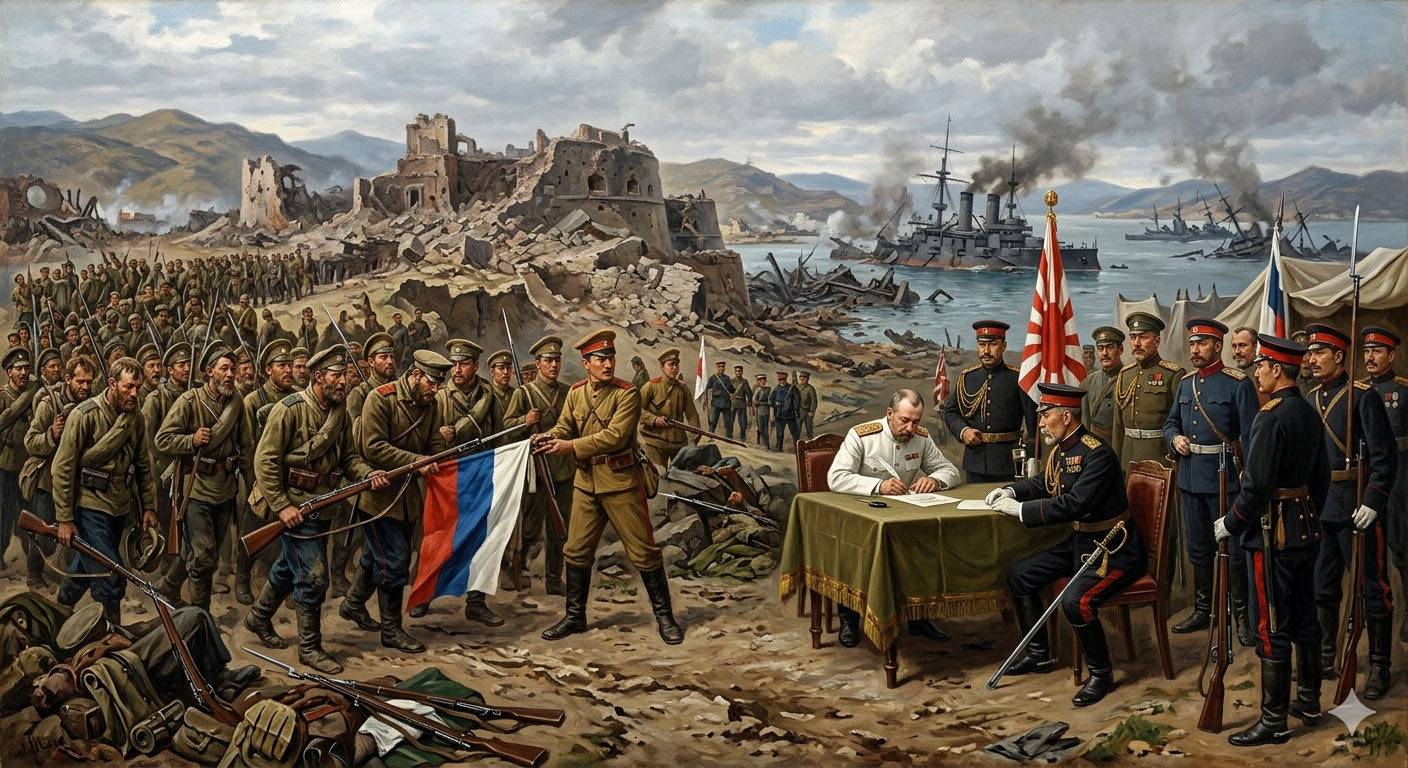
On January 1, 1905, without consulting any of his senior officers — neither General Smirnov, the city’s military governor, nor Colonel Tretyakov, who commanded the front-line defenses — Stoessel and Fok sent a message under a flag of truce to a visibly surprised General Nogi, offering to surrender Port Arthur. Smirnov and Tretyakov, when they learned what had been done in their names, were outraged. Smirnov had argued to the last that there was still ammunition and will enough to repel at least two more major Japanese assaults. “When the big gun ammunition has run out,” he had declared at an earlier council, “we shall still have 10,000,000 rounds of small arms ammunition. After that, we shall have our bayonets.”
The surrender was formally accepted and the documents were signed on January 5, 1905, in the northern suburb of Shuishiying. The terms were relatively honorable: the Russian garrison was taken into captivity, but civilians were permitted to leave. Russian officers were given the choice of accompanying their men into prisoner-of-war camps or accepting parole on the condition that they take no further part in the war. Few chose captivity. When Japanese forces entered the port and conducted their inventory, they were astonished to discover vast stores of food and ammunition still intact in Port Arthur’s warehouses — enough to have sustained the garrison for months. The fortress had not been taken by starvation or the exhaustion of fighting capacity. It had been surrendered by one man who had lost the will to continue.
The Human Cost: Casualties, Captives, and Nogi’s Grief
The siege of Port Arthur was the longest and most violent land battle of the Russo-Japanese War and one of the bloodiest sieges in the history of modern warfare. Russian land forces suffered approximately 31,306 casualties during the five-month siege, of whom at least 6,000 were killed outright. At the end of the siege, the Japanese captured 878 Russian army officers and 23,491 other ranks, of whom 15,000 were wounded. They also seized 546 artillery guns and 82,000 artillery shells. The entire Russian Pacific Fleet based at Port Arthur was either sunk, scuttled, or eventually captured and incorporated into the Japanese navy.
Japanese losses were staggering. The Third Army sustained approximately 57,780 killed, wounded, or missing across the entire siege — a figure that haunted Nogi Maresuke to the end of his life. Both of his sons had died in the fighting in Manchuria. When the siege ended, Nogi reported directly to Emperor Meiji, broke down weeping while describing the battles, and asked to be permitted to commit ritual suicide in atonement for the lives he had spent. Emperor Meiji refused, telling Nogi that all responsibility for the war rested with imperial orders and that Nogi must remain alive at least as long as the emperor himself lived. Nogi kept his word — and on September 13, 1912, hours after Emperor Meiji’s funeral cortège left Tokyo, he and his wife Shizuko dressed in white kimonos, knelt before their family shrine, and took their own lives in an act of ritual devotion that shocked the Western world.
The Aftermath: Court Martial, Treaty of Portsmouth, and the Birth of Modern War
Back in Russia, the consequences of the surrender were immediate and severe. Stoessel, Fok, and Smirnov were all court-martialed upon their return to St. Petersburg. In February 1908, Stoessel was formally convicted of cowardice and dereliction of duty, sentenced to death — a sentence commuted by Czar Nicholas II, who pardoned him in 1909 after a year of imprisonment. The fall of Port Arthur sent shockwaves through the Russian Empire that extended far beyond the military. The humiliation of a European great power by an Asian nation was without precedent in the modern era, and the domestic political consequences were explosive. The news of the surrender contributed directly to the revolutionary upheaval that erupted across Russia in January 1905, an uprising that became known as the Russian Revolution of 1905 and forced Nicholas II to issue the October Manifesto, granting limited constitutional reforms.
With Port Arthur secured, Nogi marched his Third Army northward with 120,000 surviving men to join Field Marshal Oyama at the Battle of Mukden in February–March 1905 — a massive engagement that the Japanese also won. In May 1905, the Russian Baltic Fleet, which had sailed 18,000 nautical miles around Africa and India in a desperate attempt to relieve Port Arthur — only to arrive after the fortress had already fallen — was virtually annihilated by Admiral Togo at the Battle of Tsushima. These cascading disasters compelled Czar Nicholas to accept the mediation offer of United States President Theodore Roosevelt. The resulting Treaty of Portsmouth, signed on September 5, 1905, at the Portsmouth Naval Shipyard in New Hampshire, formally ended the war. Under its terms, Russia transferred its lease on Port Arthur and the Liaodong Peninsula to Japan, recognized Korea as part of the Japanese sphere of influence, and ceded the southern half of Sakhalin Island to Japan.
The siege of Port Arthur also served as a military laboratory observed with intense interest by European armies who would soon fight their own war. The combination of massed machine gun fire, deep trench networks, barbed wire obstacles, mining operations, and prolonged siege artillery barrages against fortified lines previewed with terrible clarity the conditions that would define the Western Front in the First World War barely a decade later. The blood-soaked hills of Port Arthur had shown the world what modern industrial warfare could do to human bodies — and the world did not heed the warning.