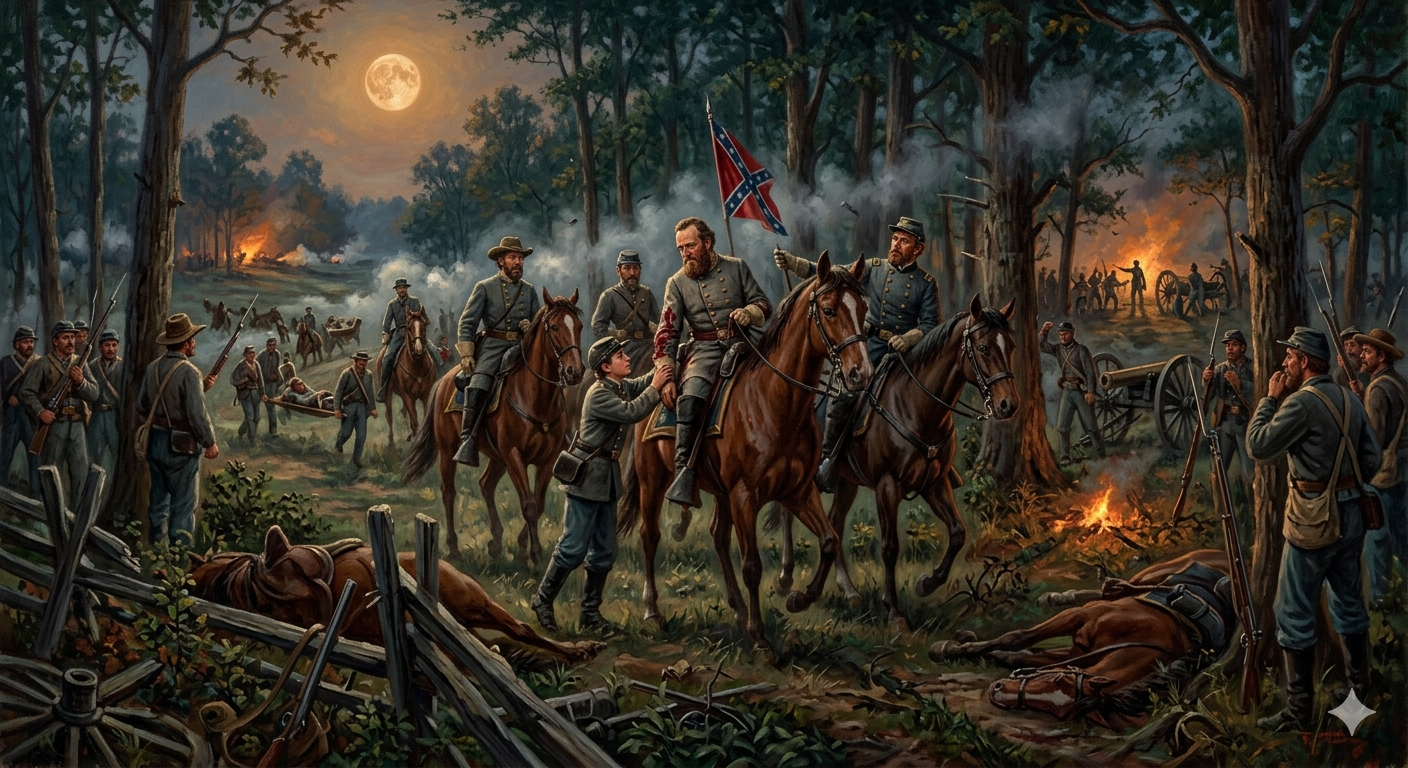
At approximately 9:30 p.m. on May 2, 1863, Lieutenant General Thomas Jonathan “Stonewall” Jackson was riding back toward his own lines through the darkness of the Virginia woods when a volley of musket fire erupted from the shadows. The shots came from Confederate soldiers of the 18th North Carolina Infantry, who had mistaken their own general and his staff for Union cavalry.
Three bullets struck Jackson. Two tore through his left arm. One shattered his right hand. It was the worst possible moment for the South to lose its most feared battlefield commander: the very night that Jackson had just delivered one of the most brilliant tactical victories of the entire Civil War.
Eight days later, Jackson was dead. The Army of Northern Virginia would never fight the same way again.
Who Was Thomas “Stonewall” Jackson: From Orphan to Confederate Legend
Thomas Jonathan Jackson was born on January 21, 1824, in Clarksburg, Virginia, in territory that is now West Virginia. His early life was shaped by loss and hardship. His father, Jonathan Jackson, a lawyer, died of typhoid fever when Thomas was just two years old. His older sister Elizabeth died in the same outbreak. His mother, Julia Beckwith Neale, struggled to survive and remarried, but died when Thomas was seven. He was left an orphan, taken in by his uncle Cummins Jackson, on whose farm he spent the rest of his boyhood working and reading whatever books he could borrow.
Despite receiving almost no formal education, Jackson secured an appointment to the United States Military Academy at West Point. He arrived there in 1842 poorly prepared compared to his classmates. He was socially awkward, physically ungainly, and had weak eyesight. But he studied harder than almost anyone else in his class and steadily moved up the rankings, graduating in 1846 in the top third of a class of 59 cadets.
He served as an artillery officer in the Mexican-American War, where he distinguished himself at the battles of Veracruz, Cerro Gordo, and Chapultepec, and first came to the attention of the man who would become his great collaborator: Robert E. Lee. After the war, Jackson spent nearly a decade teaching at the Virginia Military Institute in Lexington, where students found him a dull and rigid instructor but a man of absolute personal integrity and ferocious religious conviction. He was a devout Presbyterian deacon, famously refusing to write letters on Sundays or conduct non-essential business on the Sabbath.
When Virginia seceded from the Union in April 1861 following the fall of Fort Sumter, Jackson resigned from VMI, was commissioned a colonel in the Confederate Army, and was ordered to Harper’s Ferry to organize volunteers. At the First Battle of Bull Run in July 1861, he earned the name that would follow him forever. As Union forces threatened to break the Confederate line and Confederate units began to fall back, General Barnard Elliott Bee rallied his troops by pointing to Jackson’s brigade and shouting: “There is Jackson standing like a stone wall!” The nickname stuck, the Confederate line held, and the Union army retreated in disorder back toward Washington.
By the spring of 1863, Stonewall Jackson was a lieutenant general commanding the Second Corps of the Army of Northern Virginia, widely regarded as the most effective corps commander in either army. He had led brilliant campaigns through the Shenandoah Valley in 1862, outmaneuvering and defeating superior Union forces at Front Royal, Winchester, Cross Keys, and Port Republic. He had fought with distinction at Second Bull Run, Harpers Ferry, Antietam, and Fredericksburg. Robert E. Lee trusted him more than any other officer in the Confederate Army. The two men together had become an almost unbeatable combination.
The Battle of Chancellorsville and Lee’s Most Audacious Gamble
In late April 1863, Union Major General Joseph Hooker, commanding the Army of the Potomac, launched a new offensive against Lee’s army at Fredericksburg with a force of approximately 130,000 men. Lee had fewer than 60,000 available. Hooker had developed what he called a “perfect plan”: he would send the bulk of his army on a wide flanking march to cross the Rappahannock River upstream and come around behind Lee’s position, while another force attacked frontally at Fredericksburg. Caught between two pincers, Lee would have no choice but to retreat or fight on unfavorable ground. Hooker was so confident of success that he publicly boasted that Lee “either has to fly or come out and fight me on my own ground.”
Lee did neither. He met Hooker’s advance with characteristic aggression, marching most of his army to confront the Union flanking force while leaving only a small force to hold Fredericksburg. By May 1, Hooker’s army had advanced through the dense, tangled forest known as the Wilderness and reached a crossroads plantation called Chancellorsville. But faced with Lee’s aggressive response, Hooker lost his nerve and ordered his entire force to pull back into defensive positions. The initiative passed to Lee.
On the night of May 1, Lee and Jackson met near an intersection of forest roads and hatched one of the most daring plans in American military history. Jackson proposed taking his entire corps, approximately 28,000 men, on a sweeping twelve-mile march around the western end of Hooker’s army to strike its unprotected right flank. The two generals would be dividing their already outnumbered army in the face of a vastly superior enemy, with Lee holding the center with barely 14,000 men while Jackson moved out of sight. If Hooker discovered either column, the Confederate army could be destroyed in detail. Lee approved the plan.
The march began at dawn on May 2. Jackson’s corps spent the entire day moving through the woods, partially visible to Union observers who reported the movement but were not believed by Hooker’s headquarters. By late afternoon, nearly 28,000 Confederate soldiers had assembled in the woods on the far western flank of the Union army. Major General Oliver Otis Howard’s Eleventh Corps held that flank, and they had almost no warning of what was coming.
The Great Flank Attack: The Rebel Yell at Twilight
At approximately 5:15 p.m. on May 2, 1863, Jackson gave the order for his corps to advance: “You can go forward, then.” What followed became one of the most celebrated tactical moments of the Civil War. Thousands of Confederate soldiers burst out of the Wilderness woods, screaming the Rebel Yell, driving deer, rabbits, and foxes before them as they crashed through the underbrush. The men of Howard’s Eleventh Corps, many of them German immigrants eating supper or stacking their weapons, were caught completely by surprise.
The Union right flank collapsed almost instantly. Entire regiments fled without firing a shot. The Confederates swept nearly three miles in a matter of hours, driving the panicked Federals back toward Chancellorsville and creating the greatest rout the Army of the Potomac had ever suffered. One Union officer described the Confederate assault as “the fury of the wildest hailstorm” as his men fled “in a mad current.”
Jackson pushed forward until darkness and the chaos of the shattered Union lines began to slow the pursuit. By 9 p.m., his corps was reorganizing after hours of hard fighting. But Jackson was not satisfied. He was thinking about a night attack, about pressing further to cut off Hooker’s army from its river crossings and trap the entire Army of the Potomac. He was in unusually high spirits. Eyewitnesses later recorded that he seemed more excited by his success than they had ever seen him.
It was that desire to keep pressing, to find a way to continue the attack before the enemy could recover, that led him to ride out beyond his own lines into the darkness.
May 2, 1863: The Accidental Volley That Wounded Stonewall Jackson
Jackson rode out along the Mountain Road with a small group of staff officers and aides to reconnoiter the ground ahead. He wanted to see for himself what lay between his current position and Hooker’s lines before organizing the night attack. The group included Lieutenant Joseph G. Morrison, Jackson’s aide-de-camp and brother-in-law, and several other officers.
At approximately 9:30 p.m., skirmishing broke out nearby. The sounds of cavalry moving through the darkness put the Confederate troops at the picket line on edge. The 18th North Carolina Infantry, stationed along the Plank Road, heard the sound of horses approaching from the direction of the enemy lines. They could not see clearly in the darkness. They assumed the worst.
A volley of musket fire erupted. Jackson’s party scattered. Morrison screamed into the dark: “Cease firing! You are firing into your own men!” A Confederate officer reportedly responded, “It’s a lie! Pour it into them!” A second volley followed, and then a third. The Confederate troops, who had been told to expect Union cavalry probes in exactly this manner, did not stop.
Jackson was struck three times. Two bullets hit his left arm: one below the elbow and one above. A third bullet struck his right hand. He had been holding his left arm raised as he often did, believing that one arm was longer than the other and that elevating it equalized his blood circulation. That habit likely saved his life momentarily by changing the angle of the wounds and preventing immediate fatal bleeding, though it could not change what came after.
A.P. Hill, the next ranking officer in the party, was also slightly wounded in the immediate aftermath when Confederate artillery, alarmed by the firing, opened up on the general area. As the group tried to carry Jackson to the rear, one of the litter-bearers was shot and Jackson was dropped painfully to the ground. He struck a stone or stump on his right side, an impact that may have contributed to the chest injury that preceded his pneumonia.
Dr. Hunter McGuire and the Amputation in the Wilderness
Jackson was eventually brought to Wilderness Tavern, where Dr. Hunter Holmes McGuire, the 27-year-old medical director of the Confederate Second Corps, was waiting. McGuire was one of the most accomplished military surgeons of the Civil War, deeply loyal to Jackson and fully aware of what was at stake. Jackson, in obvious pain and blood-soaked, greeted him: “I am badly injured, Doctor. I fear I am dying. I am glad you have come. I think the wound in my shoulder is still bleeding.”
McGuire examined the wounds and made the decision that was the only medically defensible choice available in 1863: the left arm had to come off. The two bullets had shattered the bone and torn through the blood vessels of the upper arm. In the pre-antibiotic world of Civil War medicine, a badly fractured upper arm wound almost inevitably became infected and gangrenous. Amputation was the standard treatment and, done quickly and cleanly, often gave patients a reasonable chance of survival. On the morning of May 3, McGuire amputated Jackson’s left arm close to the shoulder. Jackson was given chloroform for the procedure and appeared, initially, to be recovering well.
General Robert E. Lee received word of Jackson’s wounding and wrote to him with words of devastating tenderness: “Could I have directed events, I would have chosen for the good of the country to be disabled in your stead.” When told of the amputation, Lee said: “He has lost his left arm, but I have lost my right.” Command of the Second Corps passed temporarily to cavalry commander Major General J.E.B. Stuart, who led the corps through the hard fighting on May 3 that completed the Confederate victory at Chancellorsville.
Guinea Station and the Final Days: Death on May 10, 1863
Jackson was moved for safety to the plantation known as Fairfield, the home of Thomas and Mary Chandler near Guinea Station, approximately 27 miles from the battlefield. He was too weak to be taken farther. Thomas Chandler offered the use of his main house, but Jackson, characteristically, insisted on using the plantation’s small office building instead, not wanting to displace the family.
For several days after the amputation, the initial reports from McGuire were cautiously optimistic. Jackson rested, slept, and appeared to be stabilizing. His wife Mary Anna arrived and stayed at his bedside. His infant daughter Julia, born in November 1862 and whom Jackson had barely seen, was brought to visit him.
Then, on the morning of May 7, Jackson developed a severe pain in his right side and began running a fever. The diagnosis was pneumonia. The exact origin of the pneumonia remains debated by medical historians: the fall from the litter that night may have caused a pulmonary contusion, or a chest injury from a bullet or impact, or the pneumonia may simply have been a consequence of his weakened state and the exposure involved in being transported. The PubMed medical study of Jackson’s wounds, published in the Annals of Surgery, concluded that “Jackson’s death was a direct result of his wounds, the effects of hemorrhagic shock, a chest injury, and pneumonia.” You can read the medical analysis at PubMed’s entry on Stonewall Jackson’s wounds.
On Saturday, May 9, Jackson seemed to understand that he was dying. When Dr. McGuire told him there was no further hope, Jackson paused and said, “Very good, very good. It is all right.” On Sunday morning, May 10, 1863, at 3:15 p.m., Thomas Jonathan Jackson died. He was 39 years old. His last recorded words were: “Let us cross over the river and rest under the shade of the trees.”
What Stonewall Jackson’s Wounding Meant for the Confederacy
The immediate reaction across the South was disbelief and grief. Jackson had become more than a general. He was a symbol of Confederate resilience and invincibility, a man whose name alone caused panic in Union ranks, whose movements were studied and feared by every commander the Army of the Potomac had ever put in the field against him.
Lee reorganized the Army of Northern Virginia after Jackson’s death into three corps. He gave the Second Corps to Major General Richard Stoddert Ewell and created a new Third Corps under A.P. Hill. Neither man could match Jackson’s ability to independently execute bold flanking operations with speed and aggression. The difference was visible almost immediately. At Gettysburg in July 1863, Ewell’s hesitation on the first day, when he declined to press the attack and seize Cemetery Hill before the Union army could fortify it, has been analyzed by historians for over a century as a moment when Jackson’s presence, and his aggressive instincts, might have changed the outcome of that battle and possibly the war.
The New York Times, acknowledging the loss of an enemy commander, wrote with striking candor that his “death is a tremendous and irreparable loss to the secession cause, as no other rebel of like character has been developed during the war. He will figure in history as one of the ablest of modern military leaders.”
The American Battlefield Trust’s full account of Chancellorsville, available at the Battlefields.org Chancellorsville page, offers detailed maps and a comprehensive analysis of both Jackson’s brilliant flank march and the tragic aftermath of the friendly fire incident.
Legacy: The Man Who Stood Like a Stone Wall
Jackson was transported to Richmond for a public funeral that drew thousands of mourners. He was then buried with full military honors in Lexington, Virginia, in what is now the Stonewall Jackson Memorial Cemetery. His amputated left arm, buried separately near the site of the Wilderness Tavern field hospital in Spotsylvania County, Virginia, has its own grave marker that still exists today, tended by the United States National Park Service.
His last words were repeated in pulpits and parlors across the South. Ernest Hemingway borrowed them for the title of his 1950 novel “Across the River and Into the Trees.” Generations of military historians have studied his campaigns, particularly the Shenandoah Valley Campaign of 1862 and the flank march at Chancellorsville, as models of operational art and strategic deception.
The questions that his death left unanswered have never ceased to fascinate. If Jackson had not ridden out into the darkness on the night of May 2, 1863, if the 18th North Carolina Infantry had not opened fire, if the night attack he was planning had succeeded and sealed Hooker’s fate completely, the Civil War might have followed a different course entirely.
What history knows for certain is this: on the night of May 2, 1863, the most dangerous soldier in the Confederate Army was shot by his own men in the dark. It was not the last battle of the Civil War, but it was the last battle that Robert E. Lee ever truly won. The Library of Congress maintains an extensive biography of Jackson that examines his campaigns and legacy, accessible at the Library of Congress Stonewall Jackson biography page.
The night that ended Stonewall Jackson began the slow end of Confederate hopes for independence. No volley in the American Civil War had consequences more far-reaching than the one fired in darkness along the Plank Road by men who were only trying to protect their own lines.