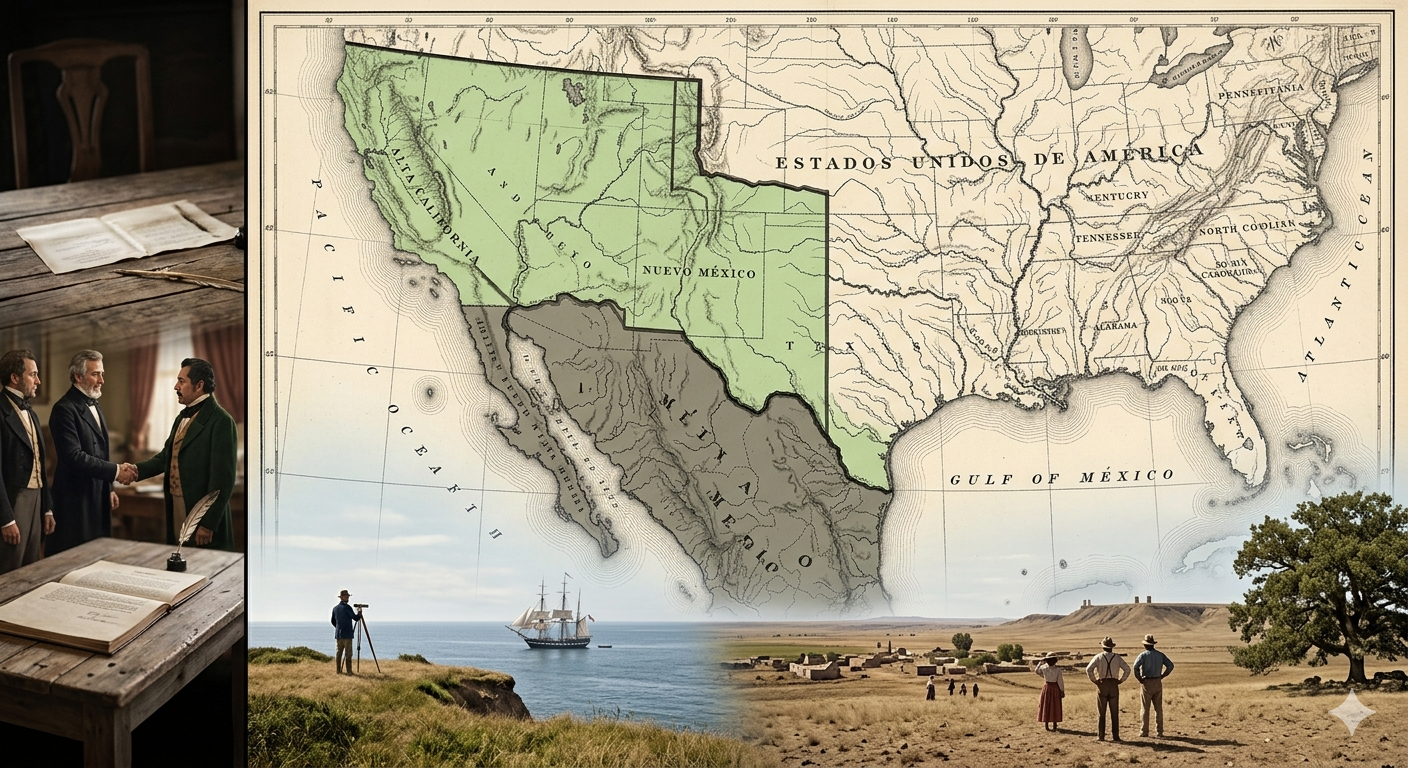
On the morning of February 2, 1848, in the city of Guadalupe Hidalgo — a sanctuary town north of Mexico City to which the Mexican government had fled as American troops occupied the capital — two nations signed a document that would reshape the map of North America more dramatically than any agreement since the Louisiana Purchase. The Treaty of Guadalupe Hidalgo, whose full formal name was the Treaty of Peace, Friendship, Limits, and Settlement between the United States of America and the United Mexican States, ended a war that had begun almost two years earlier over a disputed border in Texas. It forced Mexico to cede 55 percent of its national territory — approximately 525,000 square miles — to the United States in exchange for $15 million. The land that changed hands that day would eventually become the American states of California, Nevada, Utah, New Mexico, most of Arizona and Colorado, and parts of Oklahoma, Kansas, and Wyoming. Mexico recognized the Rio Grande as the boundary of Texas and surrendered every claim it had once held north of that river. It was, by almost any measure, one of the most consequential and contested acts of territorial transfer in modern history.
The Doctrine That Lit the Fuse: Manifest Destiny and the Ambitions of James K. Polk
To understand the Treaty of Guadalupe Hidalgo, one must understand the political atmosphere in which the war that produced it was conceived. In 1845, a New York Democratic journalist named John L. O’Sullivan articulated a belief that had been quietly animating American expansionist politics for decades, declaring it the “manifest destiny” of the United States to overspread the continent “allotted by Providence for the free development of our yearly multiplying millions.” The phrase caught fire and became the organizing ideology of a generation of American politicians, newspaper editors, and settlers who believed the United States was divinely appointed to stretch from the Atlantic to the Pacific Ocean, by whatever means proved necessary.
No American president embodied this conviction more completely than James Knox Polk, who was elected in 1844 on an explicitly expansionist platform. Polk openly coveted Texas, California, New Mexico, and much of the American Southwest. He also settled the long-running dispute over the Oregon Territory with Britain in the Oregon Treaty of June 15, 1846, fixing the northern border at the 49th parallel and securing the Pacific Northwest for the United States. But Oregon came through diplomacy. California and the Southwest would not. In November 1845, Polk dispatched diplomat John Slidell to Mexico City with an offer to purchase California and New Mexico for up to $25 million and to resolve the disputed Texas border along the Rio Grande. The Mexican government, internally divided, politically unstable, and unwilling to appear to sell national territory under duress, refused even to receive Slidell officially. The negotiations never began.
Blood on American Soil: The Disputed Border and the Outbreak of War
Texas had won independence from Mexico in 1836 after a bitter military struggle, and the Republic of Texas claimed a southern border at the Rio Grande. Mexico disputed this, insisting the true boundary was the Nueces River, approximately 150 miles to the north, and had repeatedly warned the United States that annexing Texas would mean war. When President John Tyler, in one of his final acts in office, secured Texas’s annexation through a joint congressional resolution signed on March 1, 1845, Mexico broke off diplomatic relations. Texas formally entered the Union on December 29, 1845, and the disputed strip of land between the Nueces and the Rio Grande became an armed standoff waiting to ignite.
Polk supplied the spark. On January 13, 1846, he ordered General Zachary Taylor — who had been stationed at Corpus Christi on the Nueces River since July 1845 — to advance south to the Rio Grande, entering the territory Mexico claimed as its own. Taylor’s troops built Fort Texas on the north bank of the river, directly across from the Mexican town of Matamoros, and blockaded the river mouth. On April 25, 1846, Mexican cavalry under the command of General Mariano Arista crossed the Rio Grande and ambushed an American patrol in the disputed strip, killing approximately a dozen soldiers. Taylor reported the engagement to Washington: American blood had been shed on what Polk was ready to call American soil. On May 11, 1846, Polk sent a war message to Congress, and on May 13 the United States formally declared war on Mexico — a vote that former President John Quincy Adams resisted with a resounding “No” in the House chamber. Congressman Abraham Lincoln, a first-term Whig from Illinois, would later challenge Polk to identify the exact “spot” where American blood had been shed, skeptical of the pretext. The young Ulysses S. Grant, who fought in the war as a junior officer, later wrote that he regarded it as “one of the most unjust ever waged by a stronger nation against a weaker nation.”
The War Itself: Taylor, Scott, Santa Anna, and the March to Mexico City
The Mexican-American War lasted from May 1846 to September 1847 in its main military phase, and the American campaign was prosecuted on three simultaneous fronts reflecting Polk’s strategic design. General Zachary Taylor would secure northern Mexico. Colonel Stephen W. Kearny would lead roughly 1,600 soldiers westward from Fort Leavenworth to seize New Mexico and then push on to California. Naval forces under Commodore John D. Sloat would occupy California’s Pacific ports from the sea. A third campaign, the decisive blow, would be entrusted to General Winfield Scott, who would assault Mexico through the port of Veracruz and drive inland to the capital.
Taylor won the first battles of the war at Palo Alto and Resaca de la Palma on May 8 and 9, 1846, defeating Mexican General Mariano Arista and forcing his army back across the Rio Grande. He captured Monterrey in September 1846 after four days of fighting. Meanwhile, the United States dealt with the unpredictable figure of Antonio López de Santa Anna, the charismatic strongman who had commanded the Mexican forces at the Alamo in 1836 and had oscillated between exile and power throughout his turbulent career. Santa Anna had been living in Cuba when the war began, and he secretly led Polk to believe that if allowed to pass through the American naval blockade, he would negotiate a peace favorable to the United States. Polk agreed, and Santa Anna slipped back into Mexico — then promptly assumed command of the Mexican army and led it into battle against the Americans, double-crossing Polk entirely.
At the Battle of Buena Vista on February 22–23, 1847, Santa Anna’s force of approximately 20,000 men attacked Taylor’s army of fewer than 5,000. Colonel Jefferson Davis — future president of the Confederate States of America — helped rally the American lines at a critical moment, and the battle ended in a Mexican withdrawal. Santa Anna declared a great victory before returning south, and shortly afterward assumed the Mexican presidency again. Despite everything, Taylor became a national hero in the United States, a fame that would propel him to the presidency in the election of 1848.
The decisive campaign fell to Winfield Scott. After assembling his “Army of Invasion” on Lobos Island in the Gulf of Mexico, Scott landed at Veracruz on March 9, 1847, and seized the city after a brief siege. He then drove inland along the same route Hernán Cortés had taken three centuries earlier, winning battles at Cerro Gordo, Contreras, Churubusco, Molino del Rey, and finally Chapultepec — the fortified hilltop that commanded the western approaches to Mexico City. On September 14, 1847, Winfield Scott’s forces entered Mexico City. The Mexican capital was in American hands. Santa Anna fled. The war’s military phase was over.
Nicholas Trist and the Treaty That Defied Orders
With Mexico City occupied, the question turned to peace — and the story of how the treaty was actually negotiated is one of the stranger episodes in American diplomatic history. President Polk had sent Nicholas Philip Trist, the chief clerk of the State Department, to Mexico alongside Scott’s army with full plenipotentiary powers to negotiate a peace agreement. Trist was a well-connected Democrat, grandson-in-law of Thomas Jefferson, fluent in Spanish, and deeply familiar with Latin American affairs. He arrived in Mexico in May 1847 and immediately developed a warm professional relationship with General Scott that made Polk deeply suspicious — Scott was a Whig who had been considered for his party’s presidential nomination, and Polk viewed the friendship as politically dangerous.
Peace negotiations stalled for months as the Mexican government collapsed and reformed in the wake of Scott’s advance. After Scott captured Mexico City, further negotiations broke down over Mexican domestic instability and the scale of American territorial demands. Polk, frustrated by the slow pace, recalled Trist in October 1847, ordering him to abandon the talks and return to Washington. The intended message was that the United States was not eager for peace on current terms and might seek even more territory. But Trist — believing he was on the verge of a workable agreement, and convinced that abandoning the negotiations would lead to an extended guerrilla war devastating to both nations — ignored his recall order entirely. He stayed in Mexico, resumed talks with the Mexican delegation, and on January 24, 1848, finalized the draft terms of what would become the Treaty of Guadalupe Hidalgo.
The Mexican representatives who signed the treaty on February 2, 1848, were Luis G. Cuevas, Bernardo Couto, and Miguel Atristain, acting as plenipotentiary representatives of Mexico. Trist signed on behalf of the United States. The signing took place at the main altar of the old Basilica of Guadalupe at Villa Hidalgo, even as American troops under Scott continued to occupy Mexico City. When Polk received the treaty, he was furious with Trist for his insubordination — but the terms met the minimum requirements of American territorial ambition. Polk forwarded it to the Senate rather than repudiate it, noting privately that rejecting a satisfactory treaty on the grounds that it was negotiated by a dismissed diplomat would look absurd to history.
The Terms of the Treaty: What Mexico Surrendered and What the United States Promised
The Treaty of Guadalupe Hidalgo was comprehensive in its scope and profoundly unequal in its consequences. Under Article V, the treaty established the boundary between the two nations, running from the Gulf of Mexico up the main channel of the Rio Grande to the southern boundary of New Mexico, west along that boundary to the Gila River, down the Gila to its intersection with the Colorado River, and then along the old Spanish-Mexican dividing line between Upper and Lower California to the Pacific Ocean. Mexico ceded to the United States all of its territory north and west of this line — approximately 525,000 square miles — including the present-day states of California, Nevada, Utah, most of Arizona, and significant portions of Colorado, New Mexico, Oklahoma, Kansas, and Wyoming. Mexico also formally relinquished all claims to Texas and acknowledged the Rio Grande as its northeastern boundary, ending the border dispute that had nominally triggered the war.
Under Article XII, the United States agreed to pay Mexico $15 million “in consideration of the extension acquired by the boundaries of the United States.” Under Article XV, the United States also agreed to assume responsibility for all claims made by American citizens against the Mexican government, up to $3.25 million — a figure that effectively reduced the cash payment Mexico received to around $11.75 million. Historians have frequently noted the stark arithmetic: for the price of a moderately large real estate transaction, the United States acquired territory that would eventually yield the gold of California, the silver of Nevada, the copper of Arizona, and the oil of Texas — wealth that would dwarf the purchase price many thousands of times over.
The treaty also included important provisions for the approximately 80,000 Mexican nationals living in the ceded territories. Articles VIII and IX offered them a choice: they could relocate to Mexico and retain Mexican citizenship, or remain in the United States and receive the full rights of American citizens — property rights, religious protections, and civil liberties — within one year of the treaty’s ratification. Those who did not actively choose Mexican citizenship within that year would automatically become American citizens. However, when the United States Senate ratified the treaty on March 10, 1848, by a vote of 34 to 14, it deleted Article X entirely. Article X had guaranteed that the United States government would honor all land grants that Mexico had previously made in the ceded territories. Its removal would prove catastrophic for thousands of Mexican and Spanish-speaking landowners whose titles were subsequently challenged, litigated, and in many cases stripped away by American courts and settlers over the following decades.
The Senate’s Ratification Battle and the Slavery Question That Would Not Go Away
The Senate’s ratification of the Treaty of Guadalupe Hidalgo was far from automatic, and the debate it generated exposed the deepest fault line in American political life. On August 8, 1846 — while the war was still raging — Congressman David Wilmot of Pennsylvania had introduced a rider to an appropriations bill stipulating that slavery would be permanently prohibited in any territory acquired from Mexico. The Wilmot Proviso, as it became known, passed the House twice but was blocked in the Senate, and it crystallized the conflict between northern free-soil advocates and southern slaveholders that the war had dramatically intensified. Southern Democrats supported the war as an opportunity to add slave-owning territory to the Union and preserve their political weight against the faster-growing North. Northern Whigs, following former President Adams and the moral tradition of antislavery politics, opposed it as an instrument of Southern slave power expansion.
The treaty ratified on March 10, 1848, and proclaimed effective on July 4, 1848, after ratifications were exchanged at Querétaro on May 30, 1848, did not resolve this conflict — it accelerated it. The acquisition of California proved particularly explosive when gold was discovered at Sutter’s Mill on January 24, 1848 — just nine days before the treaty was signed — setting off the California Gold Rush and bringing tens of thousands of migrants flooding into the territory. California applied for statehood in 1850, and the question of whether it would enter the Union free or slave dominated American politics until the Compromise of 1850, itself only a temporary truce. The tensions generated by the territory acquired through Guadalupe Hidalgo contributed directly to the breakdown of the sectional compromise that had held the Union together and were among the proximate causes of the Civil War that erupted in 1861.
The Gadsden Purchase of 1853 and the Final Southern Border
The Treaty of Guadalupe Hidalgo left one significant boundary dispute unresolved. The surveyors tasked with marking the Gila River boundary in the southwestern desert discovered that the Disturnell map used as the treaty’s reference was inaccurate in several critical respects, leading to ambiguities about the exact location of the line separating the American and Mexican territories in the region between the Rio Grande and the Colorado River. The proposed route of a southern transcontinental railroad also ran through a strip of territory that remained legally Mexican under the Guadalupe Hidalgo line. To resolve both issues, Secretary of War Jefferson Davis urged the Gadsden Purchase, negotiated in 1853 by James Gadsden, the American minister to Mexico, and signed on December 30, 1853. The purchase added approximately 29,670 additional square miles of Mexican territory — corresponding to the southern portions of present-day Arizona and New Mexico — to the United States for $10 million. Together, the Treaty of Guadalupe Hidalgo and the Gadsden Purchase established the southern border of the contiguous United States as it exists today.
The Enduring Legacy: A Treaty That Remade a Continent
The Treaty of Guadalupe Hidalgo is one of the most consequential documents in the history of the Western Hemisphere. It transferred more than half of Mexico’s national territory to the United States, extended American sovereignty to the Pacific Ocean, and fulfilled the territorial vision of Manifest Destiny in a single stroke. The war it ended took the lives of approximately 25,000 Mexicans and nearly 14,000 American soldiers — the majority from disease rather than combat — and left Mexico politically shattered and economically devastated for a generation.
For Mexico, the treaty’s legacy is one of national trauma and contested memory. The loss of California, New Mexico, Arizona, Nevada, Utah, and the other ceded territories — taken not because Mexico had been unwilling to coexist but because the United States had been unwilling to accept its borders — remains a defining wound in Mexican historical consciousness. For the millions of Mexicans who suddenly found themselves living in the United States, the treaty’s promises of citizenship and property protection proved hollow for most. The deletion of Article X stripped away the legal shield that should have protected their land grants, and subsequent American legal and political practices effectively dispossessed a large proportion of the former Mexican landholding class in California, New Mexico, and Texas over the following decades.
General Winfield Scott, who had won the war, never achieved the presidency he coveted. Nicholas Trist, who had negotiated the peace against Polk’s orders, was dismissed without pay, saw his career in ruins, and spent years seeking compensation from the government for his service — a claim Congress finally honored in 1871, thirty-three years after the treaty was signed. President Polk did not seek a second term, and died on June 15, 1849, just three months after leaving office, at the age of fifty-three. Zachary Taylor, the general, became president but died in office sixteen months into his term in July 1850. The treaty they had collectively produced outlasted them all, reshaping a continent in ways that none of them fully foresaw.