On the morning of May 1, 1960 May Day, the Soviet Union’s proudest national holiday an American spy plane took off from Peshawar, Pakistan, and began a nine-hour mission deep into Soviet airspace. It never reached its destination.
At 8:55 a.m., a Soviet surface-to-air missile struck the U-2 reconnaissance aircraft over the city of Sverdlovsk in the Ural Mountains. The plane broke apart in the thin upper atmosphere. The pilot, Francis Gary Powers, parachuted to the ground and was immediately captured by Soviet authorities.
What happened next shook the world. The U-2 incident shattered a fragile diplomatic thaw between the United States and the Soviet Union, destroyed a long-awaited summit conference in Paris, and exposed the secret world of Cold War aerial espionage in a way that neither superpower had planned or wanted.
The Cold War Intelligence Problem: Why America Built the U-2
To understand why Francis Gary Powers was flying over the Soviet Union in 1960, you have to understand the fear that gripped Washington in the decade before.
After World War II, the United States and the Soviet Union emerged as the two dominant superpowers in a world divided by ideology and armed with nuclear weapons. The fundamental problem for American national security was simple and terrifying: nobody in Washington knew exactly what the Soviets were building. Soviet leader Nikita Khrushchev boasted publicly that the USSR had developed large numbers of intercontinental ballistic missiles capable of striking American cities. American generals and intelligence analysts had no reliable way to verify or disprove these claims.
In 1955, President Dwight D. Eisenhower proposed a solution at a summit conference in Geneva an “Open Skies” arrangement under which the United States and Soviet Union would permit mutual aerial inspections of each other’s nuclear facilities and military installations. Khrushchev rejected it outright. The Soviets, Eisenhower said, had created “a fetish of secrecy” that left the free world flying blind.
The CIA had an answer ready. Since 1954, engineers at Lockheed’s secret Skunk Works facility in California led by designer Kelly Johnson had been developing an extraordinary aircraft. The U-2, nicknamed the “Dragon Lady,” was a single-engine jet capable of flying at altitudes exceeding 70,000 feet approximately 13 miles above the earth. At that height, it was initially far above the reach of both Soviet fighter jets and surface-to-air missiles. It was equipped with cameras so powerful that, according to CIA boasts, they could photograph the headlines of Russian newspapers from the edge of the atmosphere.
CIA Director Allen Dulles oversaw the program, and Eisenhower personally approved each overflight mission. The first U-2 reconnaissance flight over Soviet territory took place on July 4, 1956, passing over Moscow and Leningrad. The Soviets detected it on radar immediately — but they could not reach it. For nearly four years, they could only watch on their screens as the phantom aircraft drifted untouchably across their skies.
Francis Gary Powers: The Man Inside the Cockpit
Francis Gary Powers was born on August 17, 1929, in Jenkins, Kentucky, the son of Oliver Powers, a coal miner, and his wife Ida. He was the only boy among six children. His father, who struggled financially throughout his life, wanted his son to become a physician. Powers chose instead to become a pilot.
He served in the United States Air Force and in 1956 was recruited by the CIA to fly U-2 missions. He was 26 years old. By 1960, he had accumulated over 600 hours of flight time in U-2 aircraft — more than any other pilot in the program. He was, in every professional sense, the most experienced U-2 pilot the CIA had.
What Powers also carried on every mission was a reminder of the stakes. He wore a hollowed-out silver dollar on a chain around his neck. Inside it was a grooved needle coated with deadly shellfish toxin. If he were captured and faced torture, he could take his own life by pricking his skin with the needle. It was standard CIA issue. Whether to use it, the agency told him, was “more or less up to” the pilot.
Powers also carried — though this detail would not emerge until later — a small personal diary, started at the suggestion of his cellmate after his capture. In it he wrote about the “tortures and unknown horrors” he had feared as he parachuted toward the Russian steppe on that May morning.
Operation Grand Slam: The Mission of May 1, 1960
The flight that Powers was conducting on May 1, 1960, was codenamed “Grand Slam.” It was among the most ambitious missions the U-2 program had ever attempted.
Powers took off from a secret U.S. base at Peshawar Airport in Pakistan. His planned route would carry him 2,900 miles across Soviet territory — from Pakistan northward over Central Asia, past the Aral Sea, over Sverdlovsk in the Ural Mountains, then through Kirov, Arkhangelsk, and Murmansk, before landing at Bodø Military Airfield in Norway. Along the way, his cameras would photograph key Soviet military installations: the ICBM launch complexes at Baikonur Cosmodrome and Plesetsk Cosmodrome, and Chelyabinsk-65, a major Soviet plutonium processing facility.
The mission had been postponed repeatedly by bad weather. By the time Powers finally took off on May 1, 1960, the timing was extraordinarily sensitive. A major Four-Power Summit was scheduled to open in Paris on May 16 — just fifteen days away. The summit was to include Eisenhower, Khrushchev, British Prime Minister Harold Macmillan, and French President Charles de Gaulle. Its agenda included the future of divided Berlin, a nuclear test ban treaty, and the possibility of a broader arms control agreement. It represented the most promising diplomatic opening between East and West since the beginning of the Cold War.
Eisenhower had been warned. His aides told him the flight was risky given the summit’s proximity. He approved it anyway — one flight too many.
May 1, 1960: The Shoot-Down Over Sverdlovsk
By 1960, the Soviet military had been furiously developing a new generation of surface-to-air missiles capable of reaching the U-2’s altitude. The SA-2 Guideline missile, known in Soviet nomenclature as the S-75 Dvina system, represented a quantum leap in Soviet air defense capability.
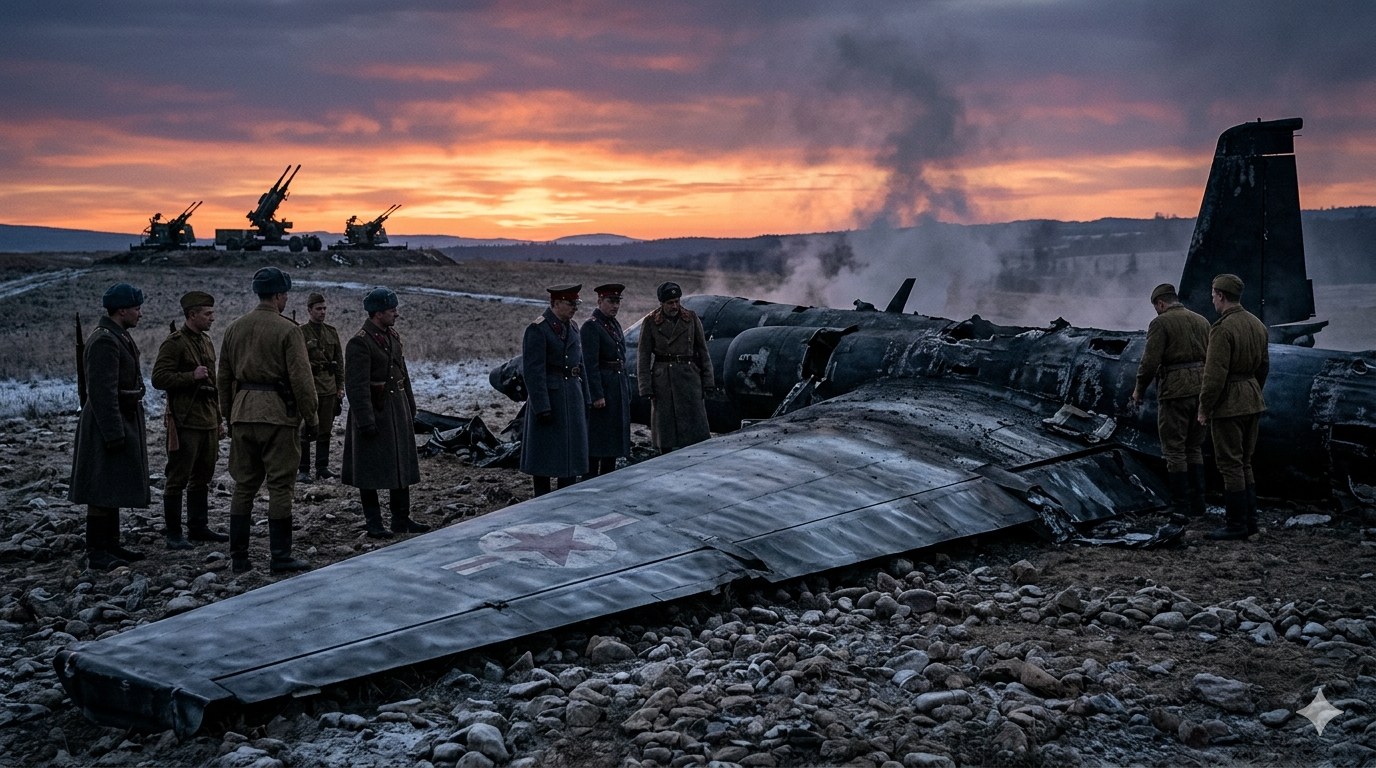
At 8:55 a.m. on May 1, 1960, as Powers flew at approximately 70,500 feet over Sverdlovsk, Soviet air defense batteries tracked him on radar and launched. The S-75 missile detonated close enough to Powers’ aircraft to tear it apart. The U-2 broke up in the thin air of the upper atmosphere. Powers found himself falling at tremendous speed. He could not activate the plane’s self-destruct mechanism — an explosive charge designed to destroy the camera and sensitive equipment — because he was thrown from the cockpit before he could reach the controls. He managed to deploy his parachute and floated slowly down toward the Russian steppe below.
Waiting for him on the ground were Soviet civilians and KGB officers. He was captured within minutes. He did not use the poison needle.
The wrecked U-2 scattered across a wide area, but significant pieces were recovered — including, critically, the high-resolution camera system and developed film showing Soviet military installations. The Soviets had not merely shot down an American spy plane. They had caught it almost intact, with the evidence of its mission undeniable and on display.
The Cover-Up That Failed: NASA Weather Planes and a Captured Pilot
In Washington, the initial response was denial.
Eisenhower had been at his retreat at Camp David when he learned the plane was missing. His aides assured him that the U-2 would have “virtually disintegrated” before hitting the ground, and that the pilot — who, like all U-2 pilots, was not a uniformed military officer but a CIA civilian contractor — would not have survived. On that assumption, Eisenhower approved a cover story: a NASA weather research aircraft had gone missing north of Turkey after its pilot reported oxygen difficulties.
To bolster the story, a U-2 aircraft at NASA’s Flight Research Center at Edwards Air Force Base in California was quickly painted in NASA colors and shown to the press on May 5. The cover story was elaborately constructed and utterly false.
On May 5, Khrushchev addressed the Supreme Soviet and announced that an American spy plane had been shot down over Soviet territory, calling it “an aggressive act” by the United States. He said nothing about the pilot — allowing the Americans to assume Powers was dead and to commit fully to the weather research cover story. The trap was deliberate and perfectly set.
On May 7, Khrushchev sprung it. He announced to the world that Francis Gary Powers was alive, in Soviet hands, and had confessed to being a CIA spy. The plane’s wreckage — including the camera system and photographs of Soviet military sites — was put on public display at Gorky Park in Moscow. Crowds lined up to see the evidence of American espionage. The cover story collapsed in a single press conference.
The United States was exposed to the world as having lied not just to the Soviet Union, but to its own allies and citizens. The Pakistani government, embarrassed by the revelation that the flight originated from its territory, issued a formal apology to the Soviet Union.
The Paris Summit Collapse and the End of the Spirit of Camp David
Khrushchev and Eisenhower had met at Camp David in September 1959 and achieved what journalists called the “Spirit of Camp David” — a rare moment of genuine warmth and diplomatic promise between the two leaders. They had discussed reducing nuclear tensions and opening a broader dialogue. Both men seemed, for a brief moment, to want the same thing.
The U-2 incident destroyed it.
Khrushchev traveled to Paris for the scheduled summit on May 16, 1960. But at the very opening of the conference — with Eisenhower, Macmillan, and de Gaulle all present — he launched into a thunderous denunciation of the United States. He demanded that Eisenhower immediately halt all U-2 flights, issue a formal apology to the Soviet people, and punish those responsible. He also withdrew a standing invitation for Eisenhower to visit the Soviet Union.
Eisenhower offered to suspend the flights for the remainder of his presidency — but he refused to apologize. He was not willing to suggest that gathering intelligence about Soviet military capabilities had been wrong. On May 11, he had publicly acknowledged authorizing the U-2 program, calling such espionage “a distasteful but vital necessity” and invoking the memory of Pearl Harbor as justification. He was not going to take that back.
Khrushchev walked out. The summit was adjourned on May 17 after barely two days. Any chance of a meaningful arms control agreement, a nuclear test ban treaty, or a resolution of the Berlin crisis evaporated. Eisenhower later called the U-2 affair one of the worst debacles of his presidency.
The Trial of Francis Gary Powers: Moscow, August 1960
On August 17, 1960 — his thirty-first birthday — Francis Gary Powers appeared in the dock of the Supreme Court of the Soviet Union in Moscow’s Hall of Columns. The trial was heavily publicized and ran for three days, August 17–19.
Powers had been interrogated extensively by the KGB for months at their headquarters on Dzerzhinsky Square in Moscow. He answered questions about the nature of his mission but refused to reveal specific altitude or camera information. Roman Rudenko, the Procurator General of the Soviet Union — the same man who had served as Soviet prosecutor at the Nuremberg war crimes trials — led the prosecution. Powers’ Soviet defense counsel was Mikhail I. Grinev.
In the courtroom, Powers made what was described as a “voluntary confession,” telling the court he was “deeply repentant and profoundly sorry” for his actions. He pleaded guilty. The tribunal — presided over by Lieutenant General Borisoglebsky, Major General Vorobyev, and Major General Zakharov — convicted him of espionage under Soviet law and sentenced him to ten years of confinement: three years in prison followed by seven years in a labor camp.
His family had traveled to Moscow for the trial. His wife, Barbara Gay Powers, and her mother attended. His father, Oliver Powers, came with his personal attorney, Carl McAfee.
Powers served his prison sentence at Vladimir Central Prison, approximately 150 miles east of Moscow. He was kept in building number two. His cellmate was Zigurds Krūmiņš, a Latvian political prisoner who encouraged him to keep a diary. Powers did — and also learned carpet weaving from Krūmiņš to pass the time.
The Spy Swap on the Bridge of Spies: February 10, 1962
Rudolf Ivanovich Abel — his real name was William Fischer, but he was known by his cover identity — was perhaps the most accomplished Soviet spy ever caught on American soil. He had operated a KGB intelligence network inside the United States for nine years before being betrayed in 1957 by a subordinate, KGB Lieutenant Colonel Reino Häyhänen, who defected to the West in Paris. Abel was arrested by the FBI in his Brooklyn apartment and convicted of espionage. His defense attorney, James B. Donovan, had argued against the death penalty, reasoning that a living Abel might one day be useful in a prisoner exchange. The federal judge agreed.
That foresight proved exactly right. On February 10, 1962, in the freezing early morning in divided Berlin, two men walked toward each other across the Glienicke Bridge — the span connecting West Berlin to Potsdam in East Germany. On one side stood Francis Gary Powers, after one year, nine months, and ten days in Soviet captivity. On the other side stood Rudolf Abel. At 8:52 a.m., Berlin time, both men crossed the white line at the center of the bridge simultaneously.
At virtually the same moment, at Checkpoint Charlie on another Berlin border crossing, American student Frederic Pryor — who had been detained by East German authorities since August 1961 — was released to American officials.
Powers came home to a complicated reception. Some critics branded him a coward for not using the poison needle to kill himself rather than face capture. Others questioned why he had not activated the plane’s self-destruct mechanism. A Congressional hearing in March 1962 reviewed his conduct and officially exonerated him, finding that he had acted appropriately throughout. In 2012, the Air Force posthumously awarded him the Silver Star Medal for his “exceptional loyalty” to the United States during his captivity.
After returning to the United States, Powers worked as a test pilot for Lockheed and later flew traffic-reporting helicopters for Los Angeles television station KNBC. He died on August 1, 1977 sixteen days before his forty-eighth birthday when his helicopter ran out of fuel and crashed. He is buried at Arlington National Cemetery. The 2015 Steven Spielberg film Bridge of Spies, starring Tom Hanks as James Donovan, brought the story of the swap to a new generation of audiences.
The Legacy of the U-2 Incident: Satellites, Secrecy, and the Cold War’s Darkest Turning
The U-2 incident had consequences that stretched far beyond the failed Paris summit.
Most immediately, it ended American manned reconnaissance overflights of Soviet territory. Eisenhower suspended the flights, and they were never resumed. The technology that replaced them spy satellites, beginning with the Corona program in 1960 — proved more effective and far less politically dangerous. The first Corona satellite imagery of Soviet territory was retrieved in August 1960, just three months after Powers was shot down. Satellites could not be captured and their pilots could not be put on trial.
The incident also accelerated the development of more sophisticated surveillance systems. The CIA fast-tracked the A-12 OXCART, a Mach-3 successor to the U-2 that first flew in 1962. The U-2 itself, however, proved extraordinarily durable — it was U-2 imagery that detected Soviet missiles being installed in Cuba during the 1962 Cuban Missile Crisis, and the aircraft remains in service with the United States Air Force to this day.
The U-2 incident demonstrated with brutal clarity how fragile diplomatic progress between superpowers could be — and how a single mission, a single missile, and a single surviving pilot could undo months of careful statecraft. It was a lesson neither Washington nor Moscow forgot quickly.
When Eisenhower’s press secretary James Hagerty was asked what lessons he had drawn from the affair, his answer was as blunt as it was memorable: “Don’t get caught.”