How Czechoslovakia Peacefully Dissolved into the Czech Republic and Slovakia on January 1, 1993
Date of Dissolution: January 1, 1993 | Also Known As: The Velvet Divorce
Czech Leader: Vaclav Klaus (Prime Minister) | Slovak Leader: Vladimir Meciar (Prime Minister)
President at Time of Dissolution: Vaclav Havel | Duration of Union: 1918-1992 (74 years)
At the stroke of midnight on December 31, 1992, a nation that had existed for seventy-four years quietly ceased to be. Without a single shot fired, without riots in the streets, without the intervention of foreign armies, the Czech and Slovak Federative Republic — known to the world as Czechoslovakia — dissolved into two separate, sovereign states: the Czech Republic and the Slovak Republic. The peaceful dismantling of this Central European federation, which took legal effect on January 1, 1993, became known to history as the Velvet Divorce, a name drawn deliberately from the Velvet Revolution of 1989 that had first freed the country from four decades of communist rule. It remains, to this day, one of the most orderly and dignified separations of a nation-state in the entire history of modern politics.
Unlike the simultaneous breakup of Yugoslavia — which produced years of ethnic warfare, mass atrocities, and international military intervention — or the turbulent dissolution of the Soviet Union, the partition of Czechoslovakia was achieved through negotiation, legal mechanisms, and the mutual consent of elected political leaders. No army mobilized. No borders were forcibly redrawn by violence. No minority populations were expelled or persecuted. The two peoples who had shared a state since 1918 simply agreed, through their political representatives, that the time had come to go their separate ways. To understand how and why this extraordinary event occurred, it is necessary to begin not in 1992 but in 1918, with the very birth of Czechoslovakia itself.
The Birth of Czechoslovakia in 1918: A Union Born of Necessity and Shared Aspiration
Czechoslovakia came into existence on October 28, 1918, on the ruins of the Austro-Hungarian Empire, which had been shattered by the catastrophic losses of the First World War. The new state was created from two distinct lands and peoples who had spent centuries under different imperial masters. The Czech lands — Bohemia and Moravia — had been governed from Vienna as part of the Austrian half of the Habsburg Empire. Slovakia, by contrast, had been ruled from Budapest as part of the Hungarian half, and the Slovak people had spent centuries resisting a policy of forced Magyarization that sought to suppress their language, culture, and national identity.
The two principal architects of the new Czechoslovak state were Tomas Garrigue Masaryk, a Czech philosopher and politician who became the country’s first president, and Edvard Benes, who served as foreign minister and later as president in his own right. Masaryk, with the backing of the Allied powers — particularly the United States under President Woodrow Wilson — argued successfully that the Czechs and Slovaks were sufficiently related, linguistically and culturally, to form a single viable democratic state. On October 30, 1918, Slovak political leaders signed the Martin Declaration, formally expressing their desire to join the new republic, though Slovaks later commemorated this date separately from the October 28 Czech founding date — an early signal of the asymmetry that would define the union throughout its history.
From the very beginning, the relationship between the Czech and Slovak halves of the new state was marked by fundamental imbalances. The Czech lands of Bohemia and Moravia were industrialized, urbanized, and relatively prosperous, having been the most economically advanced region of the entire Austro-Hungarian Empire. Slovakia, on the other hand, was predominantly agrarian, deeply Catholic, and far less economically developed. Literacy rates, industrial output, and political experience diverged sharply between the two regions. Many Slovaks quickly came to feel that the promised partnership between the two peoples was being managed as a subordinate relationship, with political and administrative power concentrated in Prague and Czech officials frequently placed in administrative positions throughout Slovakia.
Decades of Tension: The Interwar Period, World War II, and the Long Communist Era
The tensions between Czech centralism and Slovak desire for greater autonomy simmered throughout the interwar period. The Great Depression hit Slovakia particularly hard, exacerbating economic grievances. Slovak nationalist politicians, most prominently Andrej Hlinka and later Jozef Tiso of the Slovak People’s Party, built a mass movement demanding Slovak autonomy or outright independence. When Nazi Germany dismembered Czechoslovakia following the Munich Agreement of September 1938 — which saw Britain and France abandon the country to Hitler’s demands — the stage was set for the first actual dissolution of the state. On March 14, 1939, the day before German troops occupied the Czech lands and created the Protectorate of Bohemia and Moravia, the Slovak parliament declared an independent Slovak state under Jozef Tiso, a Catholic priest who led the country as a puppet regime aligned with Hitler’s Third Reich.
When the war ended in 1945 and Soviet forces liberated Prague, former President Edvard Benes returned from exile and Czechoslovakia was reunified. However, the postwar elections of 1946 brought the Communist Party of Czechoslovakia to power, and in February 1948 a communist-orchestrated coup d’etat completed the transformation of the country into a one-party state firmly within the Soviet bloc. For the next four decades, Czechoslovakia was ruled by the Communist Party, which suppressed political opposition, nationalized private property, collectivized agriculture, and subordinated the country’s foreign policy to Moscow. One significant structural change of the communist era was the federalization of the state in 1969, following the crushing of the Prague Spring reform movement by Soviet-led Warsaw Pact forces in August 1968. Under Gustav Husak, Czechoslovakia was reorganized as a federation of two constituent republics — the Czech Socialist Republic and the Slovak Socialist Republic — each with its own parliament and government, though real power remained with the central Communist Party apparatus. This federalization established the internal administrative boundary that would become the international border in 1993.
The Velvet Revolution of 1989: Freedom Arrives and Old Fault Lines Reopen
The collapse of communist rule in Czechoslovakia came swiftly and without bloodshed in the autumn of 1989, as part of the wider wave of democratic revolutions that swept Eastern Europe. On November 17, 1989 — International Students’ Day — riot police in Prague violently suppressed a peaceful student demonstration, igniting mass protests across the country. By November 20, an estimated 500,000 people had gathered in Prague’s Wenceslas Square. The entire top leadership of the Communist Party, including General Secretary Milos Jakes, resigned on November 24. On December 29, 1989, the Federal Assembly elected the playwright and dissident Vaclav Havel as President of Czechoslovakia, and Alexander Dubcek — the symbol of the Prague Spring — became speaker of the Federal Assembly. The Velvet Revolution was complete. Czechoslovakia was free.
Freedom, however, immediately reopened the old questions about the relationship between Czechs and Slovaks that communist rule had suppressed rather than resolved. Almost as soon as the political shackles of one-party rule were removed, debates erupted about the structure of the common state. Slovak politicians pressed for greater recognition of Slovak national identity and a more balanced relationship between the two republics. Even the name of the state became a flashpoint in what became known as the Hyphen War — Slovaks objected to the word Czechoslovakia, arguing that it grammatically subordinated Slovakia to the Czech lands. A compromise reached in April 1990 renamed the state the Czech and Slovak Federative Republic. These early tensions foreshadowed the deeper constitutional crisis that would develop over the following two years.
The Three Key Stakeholders: Vaclav Havel, Vaclav Klaus, and Vladimir Meciar
Three individuals above all others defined the political drama that led to the dissolution of Czechoslovakia. The first was Vaclav Havel, born in 1936, the playwright and human rights activist who became the country’s moral and political symbol. Havel was a deeply committed Czechoslovak who believed passionately in the unity of Czechs and Slovaks and consistently opposed dissolution. His political vision was cosmopolitan and humanistic; he saw the common state as an achievement worth preserving and regarded the push for separation as a failure of political imagination. When the Slovak parliament declared Slovak sovereignty in July 1992, Havel resigned from the Czechoslovak presidency on July 20, 1992, unwilling to preside over the dissolution he had fought to prevent. He later accepted the presidency of the new Czech Republic, a role he held until 2003.
The second crucial figure was Vaclav Klaus, born in 1941, an economist and politician of a very different temperament. Klaus was head of the Civic Democratic Party (ODS), which became the dominant party in the Czech lands following the June 1992 elections. A committed free-market economist deeply influenced by Margaret Thatcher and Milton Friedman, Klaus believed in rapid privatization and the transformation of the Czech economy along Western capitalist lines. He had little patience for what he saw as Slovak demands for special economic treatment or slower reform. To Klaus, a clean separation was ultimately preferable to an unworkable federation that would drag the more economically dynamic Czech Republic into prolonged conflict with a less reform-minded Slovak counterpart.
The third key figure was Vladimir Meciar, born in 1942, a lawyer and politician who had been a Communist Party member in his youth, later expelled after supporting the 1968 Prague Spring reforms. Meciar led the Movement for a Democratic Slovakia (HZDS), which won the Slovak elections in June 1992 on a platform of Slovak sovereignty and resistance to rapid economic privatization. Meciar was a populist and nationalist who pushed for a loose confederation with maximum Slovak sovereignty and international legal recognition — a formulation fundamentally incompatible with a genuine federal state. Where Klaus demanded a tight, functioning federation or outright separation, Meciar pushed for a confederal arrangement that made any workable compromise almost impossible to achieve.
Economic Divergence: The Structural Roots of the Czech-Slovak Political Conflict
The tensions between the Czech and Slovak halves of the federation in the early 1990s were deeply rooted in structural economic differences that the rapid transition from communism made impossible to ignore. Under communist rule, Slovakia had actually benefited from significant industrial investment — particularly in heavy industry, arms manufacturing, and defense production — that had narrowed some of the economic gap with the Czech lands. But the post-1989 transition to a market economy threatened to reverse those gains. Defense spending was cut dramatically after the end of the Cold War, devastating Slovak arms factories. The rapid privatization program championed by Klaus hit Slovakia particularly hard, as its industries were often less competitive and less attractive to foreign investors than those in Bohemia and Moravia.
Slovaks increasingly felt that federal economic policies were designed to serve Czech interests at Slovak expense. A 1990 survey found that 61 percent of Slovaks believed the Czechs did not consider Slovaks equal partners in the federation — a perception with deep historical roots stretching back to 1918. Meanwhile, many Czechs grew frustrated with what they perceived as Slovak demands for subsidies and special treatment that would undermine the Czech Republic’s own economic transformation. The two sides were, in fundamental respects, pulling in opposite directions. This structural economic asymmetry provided the material foundation for the political divergence that the June 1992 elections would make catastrophically visible.
The June 1992 Elections: The Turning Point That Made Dissolution Effectively Inevitable
The parliamentary elections of June 5-6, 1992 proved to be the decisive moment that transformed the dissolution of Czechoslovakia from a theoretical possibility into a near-certainty. In the Czech lands, Vaclav Klaus’s Civic Democratic Party (ODS) won decisively, making Klaus the prime minister of the Czech Republic. In Slovakia, Vladimir Meciar’s Movement for a Democratic Slovakia (HZDS) won a plurality, returning Meciar as Slovak prime minister. The elections produced two fundamentally incompatible political mandates: Klaus’s mandate was for rapid economic transformation within a functioning federation; Meciar’s was for maximum Slovak sovereignty and a loose confederalism that bordered on independence. There was no political middle ground between these positions.
Negotiations between the two sides began in June 1992 but quickly revealed the unbridgeable nature of the divide. Klaus made his position explicit: the choice was between a functioning federation with real central authority or two separate independent states. He would not accept the confederal model Meciar demanded. On July 17, 1992 — barely six weeks after the elections — the Slovak National Council passed the Declaration of Slovak Sovereignty, formally asserting Slovakia’s right to self-determination and its primacy over federal law. Vaclav Havel, recognizing that the state he had led and loved was being dissolved against his wishes and against the wishes of the majority of the population, resigned from the Czechoslovak presidency on July 20, 1992. His resignation removed the last significant political obstacle to dissolution.
The Meeting Under the Tree: Klaus and Meciar’s Historic Agreement at Villa Tugendhat
On August 26, 1992, one of the most consequential private meetings in Central European political history took place in the garden of the Villa Tugendhat in Brno — a modernist architectural masterpiece designed by Ludwig Mies van der Rohe. It was here, in what became known as the meeting under the tree, that Vaclav Klaus and Vladimir Meciar reached a final and irreversible agreement to dissolve Czechoslovakia into two independent states. The meeting was held in private, reflecting the extent to which the entire dissolution process was driven by the decisions of political elites rather than the expressed will of ordinary citizens.
A government poll conducted in September 1992 found that only 37 percent of Slovaks and 36 percent of Czechs actually favored dissolution. The majority of citizens in both republics still preferred some form of common state. Yet neither Klaus nor Meciar was willing to submit the question to a popular referendum. Klaus argued that the election results had already provided a clear mandate, and that the two incompatible political visions made separation the only rational outcome. Meciar had little interest in risking a referendum that might deny Slovakia the sovereignty he sought. Critics, including Havel himself, argued that the dissolution was, strictly speaking, unconstitutional, since the federal constitution contained no provision for such a separation — a charge that haunts the process’s democratic legitimacy to this day.
The Constitutional and Legal Mechanics of Dismantling a Nation-State
With the political decision made, the task that remained was the legal engineering of an unprecedented national dissolution. Slovakia adopted its constitution on September 1, 1992. The Czech Republic adopted its constitution on December 16, 1992. On November 25, 1992, the Federal Assembly passed Constitutional Act 542, formally agreeing to the dissolution of Czechoslovakia as of December 31, 1992. In the weeks leading up to the dissolution, dozens of detailed agreements were negotiated covering virtually every aspect of the shared federal state — from the division of the federal army’s 100,000 soldiers and its equipment to the allocation of gold reserves held in Prague, from the distribution of embassies and diplomatic assets abroad to the settlement of shared government institutions. Federal assets were divided in a ratio of approximately two to one, reflecting the ratio of Czech to Slovak population within the federation.
One of the most sensitive practical questions involved the common currency. Czech fears that Slovakia’s weaker economy would drive capital flight and currency devaluation led to an accelerated decision to separate the currencies. On February 8, 1993 — less than six weeks after the dissolution — the two countries introduced separate national currencies. Czech banknotes were distinguished from Slovak ones by stamps that had been prepared in secret during 1992. New coins were minted throughout 1993. Slovakia would later adopt the euro on January 1, 2009, while the Czech Republic retained the Czech koruna. Both new states were simultaneously admitted to the United Nations on January 19, 1993, recognized as equal successor states to Czechoslovakia — a status that allowed seamless continuity of Czechoslovakia’s existing international memberships.
Midnight, December 31, 1992: The Moment a Nation of 74 Years Ceased to Exist
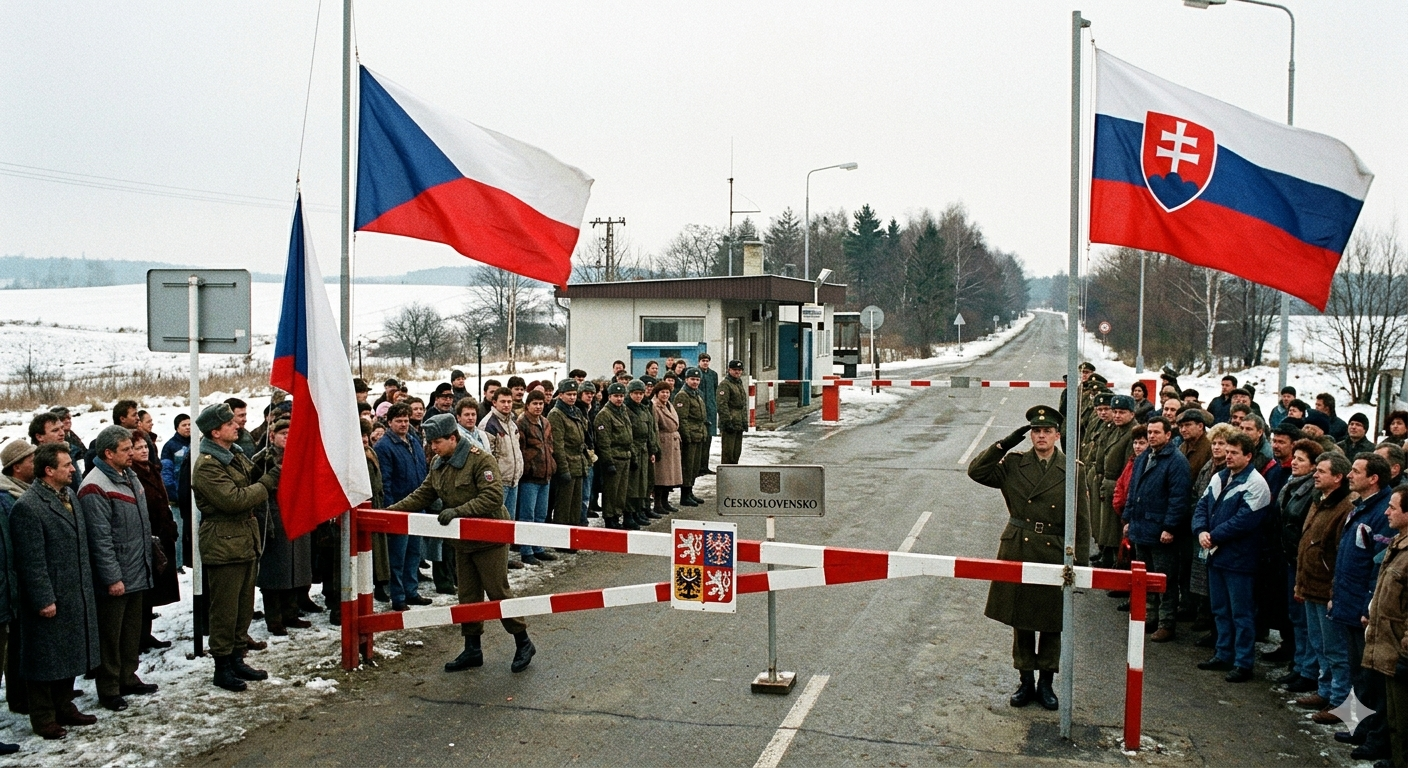
As revelers across Prague and Bratislava gathered to celebrate the New Year on the evening of December 31, 1992, they were also witnessing a unique and unrepeatable historical event. At midnight, the Czech and Slovak Federative Republic — the state that Tomas Masaryk and Edvard Benes had brought into being on October 28, 1918 — ceased to exist. Two new states, the Czech Republic and the Slovak Republic, came into being simultaneously. In Prague, the moment was greeted with a mixture of celebration and quiet sadness; many Czechs felt ambivalent about a separation they had not voted for. In Bratislava, the mood was more celebratory among Slovak nationalists, though even there a significant portion of the population felt sorrow at the end of a shared history.
On January 1, 1993, all citizens of the former Czechoslovakia automatically became citizens of one of the two new states, based on their prior republic citizenship, permanent residence, birthplace, and family connections. Citizens were given one year to claim the citizenship of the other republic under certain conditions. No one was displaced by force; no populations were transferred. The border between the two new states ran along the existing internal administrative boundary established in 1969, though a few minor boundary disputes in communities that straddled the border took several additional years to resolve through bilateral agreements. The orderly international recognition of both states, in sharp contrast to the diplomatic chaos that accompanied the dissolution of Yugoslavia and the Soviet Union, reflected the fundamentally cooperative nature of the entire process.
Public Opinion Then and Now: A Divorce the Majority Did Not Vote For
The question of whether the Czech and Slovak peoples wanted the dissolution of their common state has been one of the most persistent and uncomfortable questions surrounding the Velvet Divorce. The evidence from contemporary polling is clear: in September 1992, on the eve of the dissolution being finalized, only 36 percent of Czechs and 37 percent of Slovaks favored the split. A strong majority in both republics wished to preserve some form of common state. These numbers make the Velvet Divorce one of the most unusual instances in modern political history of a national partition carried out against the expressed preferences of the majority of the people being divided.
Public attitudes in the years since have shown only modest change. A December 2017 poll on the twenty-fifth anniversary of the dissolution found that only 42 percent of Czechs and 40 percent of Slovaks agreed with the decision. What almost no one in either country advocates, however, is reunification. The two nations have built separate identities, institutions, and national narratives over three decades. As Fedor Gal, a Slovak former dissident and public figure, observed on the anniversary of the split: the fact is that the common state does not exist and will almost certainly never exist again.
The Velvet Divorce as a Global Model for Peaceful State Dissolution
The dissolution of Czechoslovakia has attracted sustained attention from political scientists, historians, and policymakers precisely because of its peaceful and orderly nature. In a world where state dissolution almost invariably means war, refugee crises, and humanitarian catastrophe — as Yugoslavia, the Soviet Union, Sudan, and others have demonstrated — the Velvet Divorce stands as a rare and instructive exception. It has been invoked repeatedly in discussions of contemporary separatist movements, including Scottish independence, Catalan independence, and debates about other multinational states facing internal tensions. Policymakers studying how a monetary union might dissolve without causing financial chaos have pointed specifically to the Czech-Slovak currency separation of February 1993 as a model.
What made the Velvet Divorce possible where other separations became violent? Analysts identify several critical factors. There was no significant history of ethnic violence or atrocity between Czechs and Slovaks; despite political disagreements, the two peoples had coexisted without bloodshed. Both sides shared a commitment to democratic norms and legal process. The geopolitical context of 1992 — with both states oriented toward European integration — incentivized peaceful resolution. And crucially, Klaus and Meciar, though opponents in almost every other respect, shared the practical judgment that a violent or chaotic separation would be catastrophic for both sides. Czechoslovakia remains the only former Eastern Bloc state to have achieved an entirely peaceful dissolution.
The Two Successor States Today: Different Paths to a Common European Home
More than thirty years after the dissolution, both the Czech Republic — which adopted the informal short-form name Czechia in 2016 — and the Slovak Republic have established themselves as stable, prosperous European democracies. Both joined NATO in 1999 and the European Union in 2004. Slovakia adopted the euro on January 1, 2009, while the Czech Republic retained its national currency. Slovakia became, on a per-capita basis, one of the world’s largest producers of automobiles through the 2000s and 2010s, attracting massive automotive investment from Volkswagen, PSA Peugeot Citroen, Kia, and Jaguar Land Rover. The Czech Republic consistently ranked among the most economically developed of the post-communist transition states, with Prague becoming one of Europe’s most visited cities.
The relationship between the Czech Republic and Slovakia remains uniquely close. Citizens of both countries could live and work freely in the other’s territory even before EU membership. Czech and Slovak remain mutually intelligible — a fact that media, academic, and cultural exchanges keep alive across the border. Both nations joined the Schengen Area in 2007, effectively making the border between them invisible to daily life. The Velvet Divorce did not end the story of Czechs and Slovaks — it began a new chapter in which two nations, shaped by a shared history of seventy-four years, found their separate voices while remaining, in the assessment of analysts who study their relationship, more closely linked than any other two independent countries in Europe.
Key Facts: The Dissolution of Czechoslovakia (The Velvet Divorce)
Formal Name of State Dissolved: Czech and Slovak Federative Republic | Date: January 1, 1993
Successor States: Czech Republic (Prague) and Slovak Republic (Bratislava)
Key Czech Figure: Vaclav Klaus, Prime Minister, leader of Civic Democratic Party (ODS), born 1941
Key Slovak Figure: Vladimir Meciar, Prime Minister, leader of Movement for Democratic Slovakia (HZDS), born 1942
President Who Resigned in Protest: Vaclav Havel (resigned July 20, 1992; later became first Czech Republic President)
Constitutional Act Dissolving the State: Constitutional Act 542, passed November 25, 1992
Declaration of Slovak Sovereignty: July 17, 1992
Meeting Under the Tree at Villa Tugendhat, Brno: August 26, 1992
Currency Separation: February 8, 1993
Both States Admitted to UN: January 19, 1993 | NATO Membership: 1999 | EU Membership: 2004
Slovakia Joined Eurozone: January 1, 2009.