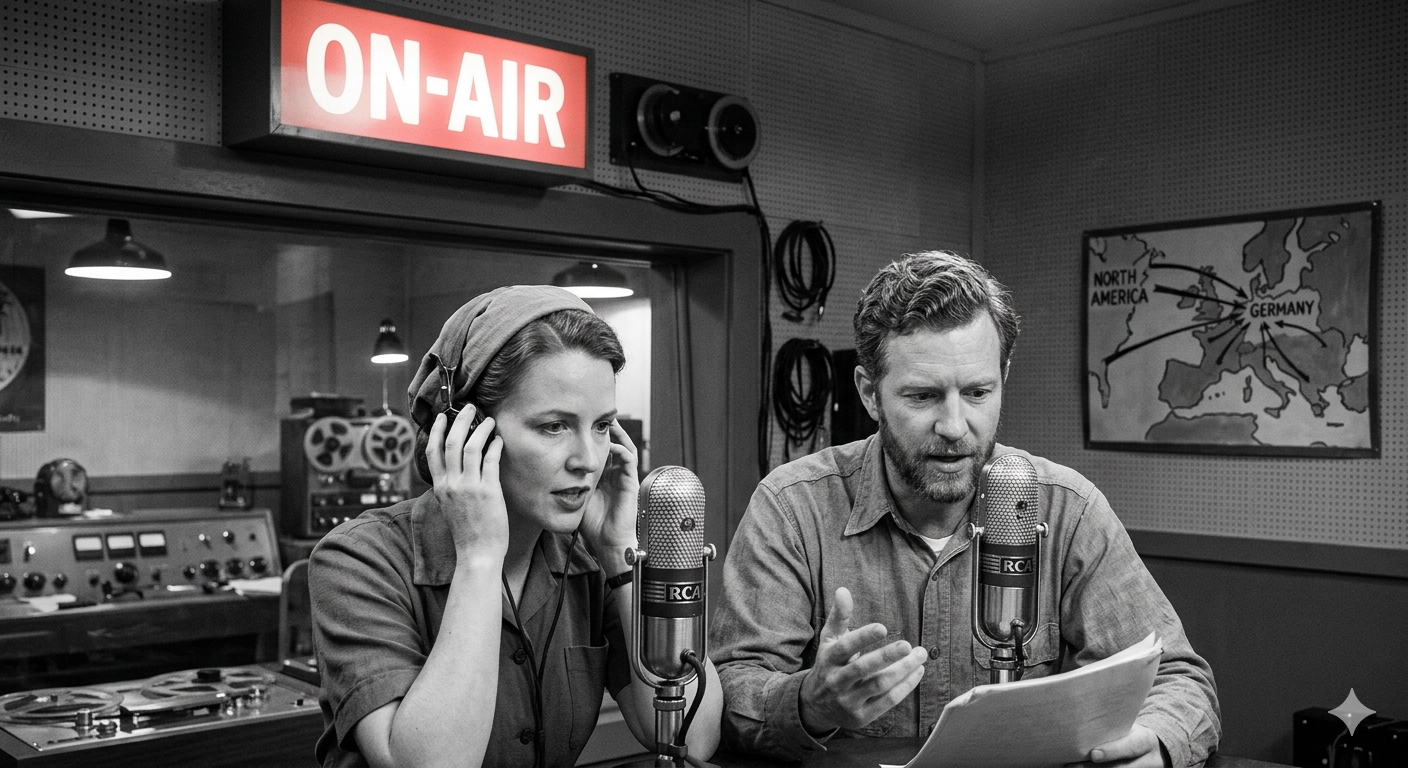
On February 24, 1942, a radio signal traveled across the Atlantic Ocean and into the homes of people living under Nazi occupation. The message was brief, direct, and unlike anything those listeners had heard from their own state-controlled broadcasts. “Here speaks a voice from America,” announced William Harlan Hale, an American writer and journalist who became the face of one of the most consequential broadcasts in the history of wartime communication. “Every day at this time we will bring you the news of the war. The news may be good. The news may be bad. We shall tell you the truth.” With those words, the Voice of America was born — not simply as a radio station, but as an act of defiance against one of the most sophisticated propaganda machines the world had ever seen.
The World Before the Broadcast: A Radio War Already Underway
By the time the United States entered World War II in December 1941 following the Japanese attack on Pearl Harbor, the major powers of Europe had already been fighting a parallel war over the airwaves for years. Nazi Germany, under the direct influence of Joseph Goebbels and his Reich Ministry of Public Enlightenment and Propaganda, had mastered the use of radio to manipulate public opinion, spread fear, demoralize enemy populations, and glorify the Third Reich. Germany’s shortwave broadcasts reached millions of listeners across Europe, North Africa, and beyond, delivering a carefully crafted version of events that served Hitler’s strategic interests.
Britain, France, Germany, and the Soviet Union had all established international radio networks long before America entered the conflict. The United States was, remarkably, one of the last major powers to launch such an effort. While American commercial radio stations were among the most technically advanced in the world, Washington had not yet built a coordinated international broadcasting system capable of countering the torrent of Axis propaganda being beamed into occupied territories and neutral countries. That situation was about to change.
The Men Who Built the Voice: Franklin Roosevelt, Robert Sherwood, and the Foreign Information Service
The groundwork for what would become the Voice of America was laid even before Pearl Harbor. President Franklin D. Roosevelt, who understood both the power of radio communication and the danger of unchecked enemy propaganda, had already authorized the creation of the Office of the Coordinator of Information (COI) in mid-1941. This office was placed under the command of Colonel William J. Donovan, who was known widely as “Wild Bill” Donovan and would later become the wartime head of the Office of Strategic Services, the precursor to the Central Intelligence Agency.
Within the COI, a division called the Foreign Information Service (FIS) was specifically tasked with developing America’s capacity for international broadcasting. Roosevelt appointed Robert E. Sherwood to lead the FIS. Sherwood was no ordinary bureaucrat. He was an acclaimed American playwright, a Pulitzer Prize winner, and one of Roosevelt’s most trusted speechwriters and information advisors. He understood storytelling, audience, and persuasion at the deepest level, and he brought those instincts to the project of crafting America’s voice for the world. It was Sherwood who would eventually coin the phrase “The Voice of America” to describe the shortwave network taking shape under his direction.
Even before the formal launch, Sherwood’s FIS had already begun providing war news and commentary to American commercial shortwave stations on a voluntary basis, starting in the weeks following the Pearl Harbor attack. One of the very earliest transmissions went out from the San Francisco office of the FIS via General Electric’s station KGEI, aimed at the Philippines, and was broadcast in English shortly after the United States entered the war in December 1941.
Hiring John Houseman: Hollywood Meets Psychological Warfare
To produce these broadcasts, Sherwood turned to a man with an unconventional background for the role: John Houseman, a Romanian-born theatrical producer and director whose legal name at the time was Jacques Haussmann. Houseman was officially brought on board in late 1941 or very early 1942, hired in part because of his extraordinary ability to make radio come alive as a dramatic medium. He had famously collaborated with Orson Welles on the 1938 broadcast of “War of the Worlds,” a production so realistic that it caused widespread public panic — and that ability to make radio feel urgently real was precisely what the Roosevelt administration believed would be effective against Nazi propaganda.
Nelson Poynter, a high-level official within the Coordinator of Information, captured the thinking behind Houseman’s selection in a memo dated January 11, 1942, addressed to Sherwood. He wrote that the task of international propaganda broadcasting was “a different, tougher assignment than to sell a cereal or a toothpaste” and that they were “fighting a religious fanatical crusade” in which America needed to “sell the religion of democracy.” Houseman, Poynter argued, had the “professional craftsmanship, the imagination, and the personality to do this.” Houseman formally became the Chief of Radio Production for the Coordinator of Information and later held the title of Chief of Radio Program Bureau in the newly created Office of War Information.
The First Broadcast: February 1942 and the Promise of Truth
The question of exactly when the Voice of America went on the air has been a subject of historical debate. According to research by Dr. Walter R. Roberts, who began his own government career with the VOA during the war, the first German-language broadcast may have gone on the air as early as February 1, 1942, when it was transmitted under the name “Stimmen aus Amerika,” which translates to “Voices from America.” Many official VOA promotional materials, including a brochure printed in 1970, cited February 24, 1942 as the formal start date, and that is the date most commonly recognized in historical records. The broadcast originated from 270 Madison Avenue in New York City, using BBC medium and long-wave transmitters to reach European audiences, running initially for about fifteen minutes.
Regardless of the precise date, the content of that first broadcast established a template that defined the organization for decades. William Harlan Hale signed on in German and made a promise that audiences behind enemy lines desperately needed to hear: that America would deliver the news whether it was good or bad, and that the truth would always be told. The broadcast opened with the playing of “The Battle Hymn of the Republic,” a choice that immediately distinguished it from the triumphalist music typically used to open Nazi transmissions. President Roosevelt himself approved the broadcast, based on recommendations from both Donovan and Sherwood.
How the Nazi Propaganda Machine Made VOA Necessary
To understand why the Voice of America mattered so profoundly to European listeners, it is essential to understand the information environment they were living in. In Nazi-occupied territories, shortwave radios were declared illegal by German authorities. Any person caught listening to foreign broadcasts — particularly those coming from Britain or America — could face imprisonment, torture, or summary execution. The Nazi regime maintained control over virtually all domestic media, ensuring that the only news citizens received was carefully filtered to support the war effort and the ideology of the Third Reich.
Goebbels’ propaganda machine was extraordinarily effective at controlling narrative. It had spent years perfecting techniques for blending truth with fabrication, creating emotional appeals that bypassed critical thinking, and discrediting foreign sources as liars and enemies. Into this environment, the VOA and Britain’s BBC were broadcasting the only alternative sources of information available to millions of people who suspected they were being lied to but had no way to verify what was actually happening in the war. For those brave enough to risk listening, the voice coming from America carried enormous weight precisely because it acknowledged uncertainty and promised honesty rather than guaranteeing good news.
Austrian-born VOA broadcaster Robert Bauer, who lived from 1910 to 2003, was one of the most remarkable figures in this story. Bauer had escaped the Nazis on three separate occasions and ended up on Hitler’s personal “Most Wanted” list because of his anti-Nazi broadcasting and his habit of openly mocking Hitler over the airwaves. His voice was a living rebuke to the idea that Germans had no alternative to the regime’s propaganda.
The Office of War Information Takes Over: Elmer Davis and Structural Change
In June 1942, through President Roosevelt’s Executive Order 9182, the organizational structure overseeing American information and propaganda operations underwent a significant reorganization. The Coordinator of Information was split into two separate entities: the Office of Strategic Services (OSS), which handled covert intelligence and special operations, and the Office of War Information (OWI), which took over responsibility for public information and broadcasting. The VOA came under the jurisdiction of the OWI, and Elmer Davis, an American radio journalist with a reputation for crisp, clear, and credible reporting, became the director of the OWI. Davis brought a journalistic sensibility to the role that helped shape the editorial standards of the organization.
Under the OWI, the Voice of America expanded rapidly. The organization reached an agreement with the British Broadcasting Corporation to share medium-wave transmitters throughout Great Britain, enormously extending its reach. As Allied forces advanced across North Africa and Italy, VOA expanded into Tunis in North Africa and into Palermo and Bari in Italy, following the frontlines and establishing new transmission points in liberated territory. The American Broadcasting Station in Europe was also established during this period as a complementary outlet. Asian transmissions, which had begun with a single transmitter in California in 1941, were expanded with additional facilities in Hawaii and later in the Philippines after its recapture from Japanese forces.
The Rapid Growth of a Wartime Broadcasting Operation
The growth of the Voice of America from February 1942 onward was extraordinary by any measure. In March 1942, VOA was broadcasting for only six and a quarter hours each day. By April 1942, that had expanded to twenty-four hours a day. Initially, the service broadcast in four languages: English, German, French, and Italian. The interval signal between programs was a brass band playing “Yankee Doodle.” By the end of World War II, the VOA had thirty-nine transmitters sending music, news, and commentary in forty different languages, reaching audiences across Europe, Asia, North Africa, and Latin America.
One of Houseman’s most distinctive programming innovations was a show called “ACE: America Calling Europe,” a half-hour news program that employed what was then a novel multi-voice format. Rather than a single broadcaster reading the news straight through, the program rotated between different narrators and languages every quarter hour, with commentators inserting quotes and additional context. This approach gave the broadcasts a sense of depth and credibility that contrasted sharply with the monolithic, single-voice authority of Nazi state radio. Veteran VOA employee Alan L. Heil Jr., who wrote a comprehensive history of the organization, noted that these early programs, although dedicated to offering facts, clearly reflected Houseman’s creative instincts as a producer.
Cultural programming also played an important role in VOA’s early mission. On the Columbia Broadcasting System, the musical show “Viva America,” which ran from 1942 to 1949, featured the Pan American Orchestra and celebrated musicians from both North and South America, including Alfredo Antonini, Juan Arvizu, Eva Garza, and John Serry Sr. By 1945, that program was carried by 114 stations on CBS’s La Cadena de las Américas network across twenty Latin American nations, serving President Roosevelt’s broader policy of Pan-Americanism in South America.
The Pledge That Defined a Generation of Listeners
Among the most significant aspects of the Voice of America’s founding philosophy was its explicit commitment to truth-telling — even uncomfortable truth. The founding pledge, delivered in those first German-language broadcasts, was not simply a slogan. It represented a deliberate counter-strategy to Nazi propaganda, which listeners increasingly recognized as manipulation. The promise that VOA would report bad news as readily as good news gave the broadcasts a credibility that no purely cheerleading service could have achieved.
This credibility mattered enormously in practical terms. People living under occupation who risked their lives to huddle around an illegal shortwave radio did so because they believed the information was genuine. The BBC from London and the VOA from New York were, for many people in German-controlled Europe, the only windows onto an honest account of the war’s progress. When Allied forces suffered setbacks or defeats, VOA reported them. When the news was grim, VOA said so. This consistency built trust among audiences that persisted long after the war ended.
The Name That Almost Wasn’t: How “Voice of America” Became Official
Despite the enduring fame of the name, the phrase “Voice of America” was not consistently used in 1942 to describe the broadcasts. Dr. Walter Roberts, who conducted extensive research into the origins of the organization, concluded that while Sherwood and Houseman intended the network to be known by that name, the early transmissions used a variety of identifiers. Some recordings introduce the service as “The United States of America Calling the People of Europe.” Others used the German phrase “Stimmen aus Amerika.” The OWI press release issued on December 7, 1942, used the lowercase phrase “voice of America” as a descriptive term rather than as a formal name, with the “v” in “voice” not capitalized.
For a period in 1944, staff were even instructed to refer to the service as the “Voice of the United States of America,” a name that appeared on studio microphone photographs for several years before being dropped. It was not until after the war that the name “Voice of America” became consistently and officially applied to all of the network’s programming and promotional materials. The formal institutional identity caught up, in other words, with the enormous informal reputation the broadcasts had already built.
After the War: From Nazi Counter-Propaganda to Cold War Broadcasting
With the end of World War II in 1945, the United States government transferred jurisdiction over the Voice of America to the State Department, formally making it an instrument of American foreign policy. In 1953, during the early years of the Cold War, administration of the VOA was moved again, this time to the newly created United States Information Agency (USIA). The shift in organizational home reflected a shift in mission: the enemy was no longer Nazi Germany but Soviet Communism, and the audiences the VOA needed to reach were no longer only in Western Europe but behind the Iron Curtain.
Foy Kohler, who served as director of VOA from 1949 to 1952, was a firm believer that the organization was serving its purpose in the fight against communism. By the 1960s, VOA was broadcasting to every continent in several dozen languages, and its reach extended to the Soviet Union, Eastern Europe, China, and beyond. The Russians responded by attempting to jam VOA signals and by making listening a criminal offense — a reaction that itself testified to how seriously they took the broadcasts. After the fall of the Soviet Union, it was confirmed through interviews and released documents that VOA broadcasts had played a meaningful role in keeping people in communist countries informed about the outside world and connected to an alternative vision of political life.
Edward R. Murrow, one of the most celebrated broadcast journalists in American history, eventually became head of the USIA during the Kennedy administration, bringing his legendary reputation for integrity and his commitment to honest journalism to bear on the organization. Henry Loomis served as director of the VOA from 1958 to 1965 and also helped shape its identity during a critical Cold War period.
The Lasting Legacy of February 1942
The Voice of America that began transmitting in the winter of 1942 grew into one of the most far-reaching international news organizations in history. By 2002, it was broadcasting more than 900 hours of programming every week in 53 languages, reaching a worldwide audience of approximately 94 million people through radio, satellite television, and the internet. By its 80th anniversary in 2022, that audience had grown to more than 311 million people weekly across 47 languages, according to VOA’s own figures.
What began as a fifteen-minute shortwave broadcast in German from a building on Madison Avenue in New York City had become a global institution rooted in a single founding principle: that truth, even unwelcome truth, is more powerful than carefully engineered deception. That principle, articulated by William Harlan Hale in the very first broadcast and championed by Robert E. Sherwood, John Houseman, Elmer Davis, and the thousands of journalists and broadcasters who followed them, remains the defining legacy of the day the Voice of America first went on the air.
In a world where Nazi propaganda had persuaded millions of people to accept lies as reality, the founders of the Voice of America made a bet that audiences who had access to honest information would ultimately choose truth. The history of the twentieth century suggests they were right.