The Morning That Changed Spain Forever: An Overview of the 11-M Attacks
On the morning of Thursday, March 11, 2004, Spain experienced the deadliest terrorist attack in its modern history. In the space of just three minutes, ten bombs concealed in backpacks detonated aboard four commuter trains traveling through the heart of Madrid during the peak of the morning rush hour. The explosions killed 191 people and injured approximately 1,800 to 2,500 more, drawing comparisons in scale and method to the September 11, 2001 attacks on the United States. The attack was the most lethal terrorist strike on European soil since the December 1988 bombing of Pan Am Flight 103 over Lockerbie, Scotland, and it remains the deadliest Islamist terrorist attack in European history. Known in Spain by the abbreviation 11-M, for 11 de marzo, the bombings reshaped Spanish politics, altered the course of the country’s general elections held just three days later, forced a reckoning with Spain’s participation in the Iraq War, and prompted a sweeping and often bitterly contested reassessment of the nation’s counterterrorism policies and international alliances.
The attack unfolded against the backdrop of an already turbulent period in Spain’s national life. Prime Minister José María Aznar of the conservative Partido Popular — the People’s Party — had controversially supported the United States-led invasion of Iraq in 2003, a position that placed him sharply at odds with approximately 90 percent of the Spanish population. His government had deployed around 1,400 Spanish troops to Iraq as part of the international coalition, a decision made without the approval of the Spanish Parliament and one that had become the defining fault line of the upcoming election campaign. When the bombs detonated on the morning of March 11, Spain was three days away from a general election in which the Popular Party was leading in the polls by approximately five percentage points. The attacks that morning would invert that lead entirely, with consequences that reverberated far beyond the immediate horror of the carnage.
Spain Before the Bombs: The Political and Security Context of Early 2004
To fully understand the significance and impact of the 11-M attacks, it is necessary to understand the Spain into which the bombers struck. For more than three decades, Spain had lived under the shadow of domestic terrorism perpetrated by Euskadi Ta Askatasuna, the Basque separatist organisation universally known by its Basque initials ETA, which translates as Basque Homeland and Liberty. Since its founding in the late 1950s under the Franco dictatorship, ETA had killed more than 800 people through bombings, assassinations, and other acts of political violence. The organisation’s campaign of terror had shaped Spanish security policy, public perception of terrorism, and the political calculus of every government since the transition to democracy in the late 1970s. Spaniards were, by 2004, deeply experienced in living with domestic terrorism — but their entire frame of reference was built around a known enemy with a known ideology, known methods, and known demands.
At the same time, Spain had been developing, largely below the radar of public awareness, a significant problem with Islamist extremism. The country’s intelligence services had monitored radical Islamist cells operating on Spanish soil since the mid-1990s. Imad Eddin Barakat Yarkas, a Syrian-born resident of Madrid known by the alias Abu Dahdah, had led an al-Qaeda cell in Spain that had been connected to the Hamburg cell responsible for the September 11 attacks. Abu Dahdah was arrested in November 2001 and subsequently prosecuted. Despite this, and despite the May 2003 bombings in Casablanca, Morocco — in which 33 people were killed and which had a demonstrable connection to Spain — the Spanish government did not fundamentally recalibrate its counterterrorism resources to prioritise the Islamist threat over the more familiar threat from ETA. This institutional blindspot would prove catastrophic.
On a jihadist web forum in the months before the March 2004 attacks, a memorandum titled Jihadi Iraq: Hopes and Risks had been circulated. The document assessed the strategic vulnerabilities of Western democracies contributing troops to the American-led coalition in Iraq and labelled Spain as the domino piece most likely to fall first among the coalition partners, noting that Prime Minister Aznar’s position on Iraq did not reflect the position of the Spanish people and that an attack timed to coincide with Spain’s general elections could therefore produce decisive political results. The memo specifically singled out the upcoming March 2004 election. Spanish security services would later face serious questions about why this intelligence had not been acted upon more aggressively.
The Bombing Network: Who Planned and Carried Out the 11-M Attack
The terrorist network responsible for the 11-M attacks was assembled between March 2002 and November 2003, according to a detailed analysis of the judicial records from the subsequent criminal proceedings. The network that coalesced around the attack was composed of four relatively small clusters of individuals, drawing on the remnants of earlier Islamist cells that had operated in Spain and on newly arrived individuals with prior links to jihadist organisations across North Africa and the Middle East. The network was not a single disciplined organisation but a loose coalition united by shared ideology rather than formal membership in a single group.
The most significant organisational thread connecting the perpetrators ran through the Moroccan Islamic Combatant Group, known in French by the acronym GICM — Groupe Islamique Combattante du Maroc. This organisation had deep historical roots in the Afghan jihad of the 1980s and had developed close relationships with al-Qaeda’s leadership, providing logistical support, false documents, and passage to Europe for al-Qaeda operatives. Its members had also been implicated in the May 2003 bombings in Casablanca, which targeted sites associated with Western and Jewish interests and killed 33 people. Mohamed Darif, a Moroccan professor of political science at Hassan II University in Mohammedia, observed in 2004 that the GICM’s history was directly tied to the rise of al-Qaeda, and that since its inception in the late 1990s the group had provided al-Qaeda with logistical support in Morocco, including safe houses, false documents, and cover identities.
The operational chief of the 11-M cell is believed to have been Sarhane Ben Abdelmajid Fakhet, a Tunisian national known to his associates as El Tunecino — the Tunisian. Fakhet had lived in Spain for several years and had become radicalised through his contact with various Islamist networks in Madrid. The cell also included Jamal Ahmidan, a Moroccan known as El Chino — the Chinese — who played a key role in the logistical dimensions of the attack, particularly in securing the explosives. Ahmidan was a former drug dealer whose criminal network provided crucial practical support: his connections enabled the cell to obtain explosives through a trade involving hashish and other narcotics. The explosives used in the bombings, later identified as Goma-2 ECO, were stolen from a mine in the Asturias region of northern Spain. The miner who supplied them was a Spaniard named José Emilio Suárez Trashorras, who had already been convicted of explosives trafficking in 2001 but had subsequently found employment at a mine, giving him renewed access to commercial-grade explosive materials.
Jamal Zougam, born on October 5, 1973, in Morocco, emerged as one of the most directly implicated individuals in the physical execution of the attack. Zougam operated a mobile phone shop in the Lavapiés neighbourhood of Madrid called Nuevo Siglo — the New Century. He was known to Spanish intelligence as a person of interest due to his connections with radical Islamist figures, including associates of Abu Dahdah and individuals connected to the Casablanca bombings. He had been questioned by Spanish authorities in connection with those bombings in 2003 but released for lack of evidence of any completed criminal act. Investigators believe Zougam played a dual role in the 11-M attack: he is believed to have sold the mobile phones that were used as remote detonators for the bombs, and witnesses placed him on one of the targeted trains on the morning of the attack.
March 11, 2004: The Sequence of Explosions — Minutes by Minute
On the morning of March 11, 2004, a Thursday, the four commuter trains that would be targeted had all originated from Alcalá de Henares, a city approximately 35 kilometres east of central Madrid. The trains were operating on Line C-2 of Madrid’s Cercanías commuter rail network, heading westward toward Atocha — the central mainline station of Madrid and one of the busiest rail hubs in Spain. During the morning rush hour, trains on this line carried workers, students, and commuters from the eastern suburbs and satellite towns toward the city center. The carriages were packed.
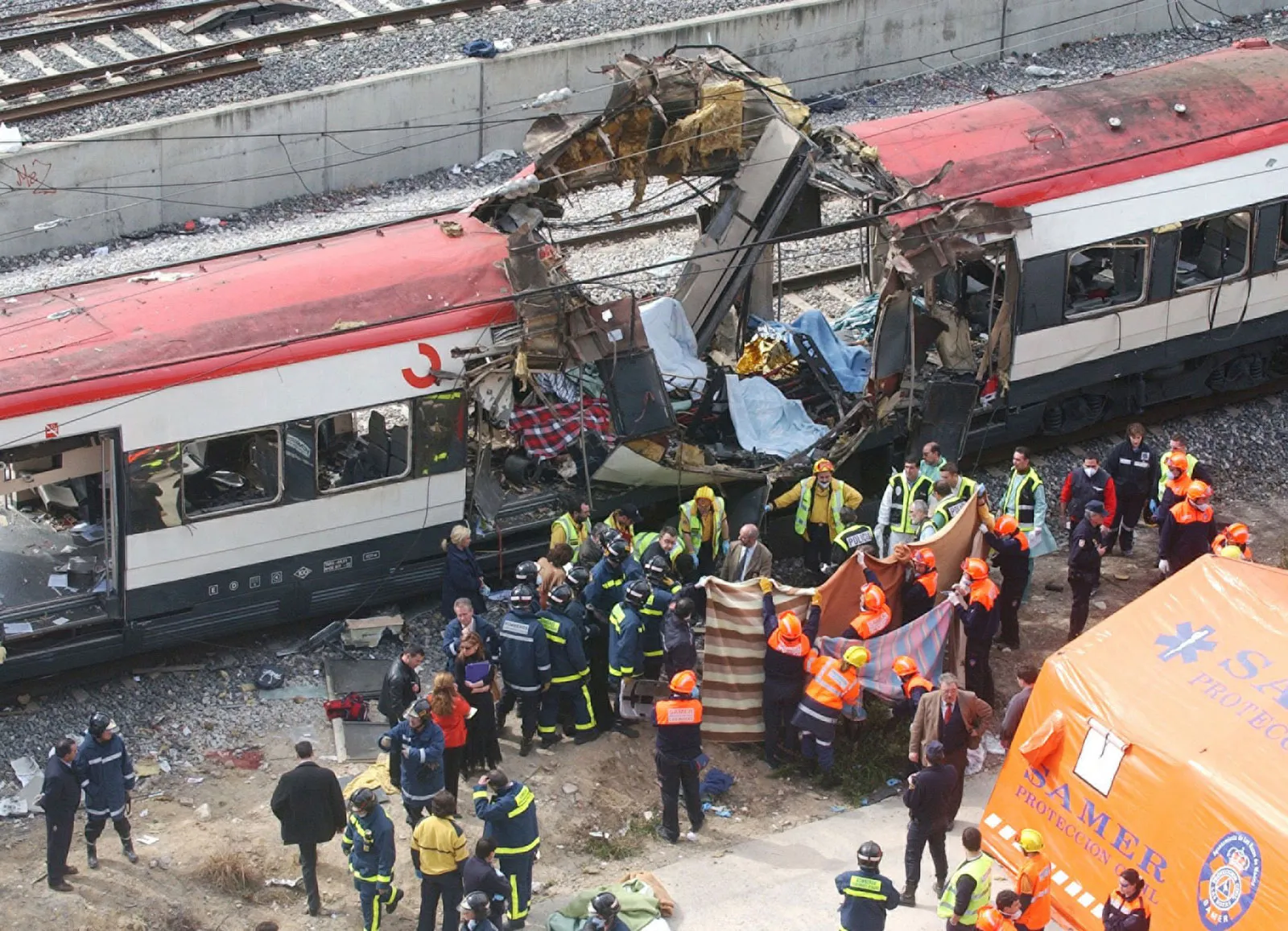
The first explosion occurred at 7:37 in the morning, when a bomb detonated aboard commuter train number 21431 at Atocha station. The attack had been carefully choreographed so that multiple devices would explode in near-simultaneous succession, maximizing casualties and preventing emergency responders from concentrating resources at a single location. Within the space of approximately three minutes, between 7:37 and 7:40 AM, ten bombs had exploded across the four trains. Seven of the ten devices detonated at or near Atocha, making that station the most devastated single location. Three additional explosions struck trains at El Pozo del Tío Raimundo station and at Santa Eugenia station, both to the southeast of the city centre.
The devices themselves had been concealed inside backpacks and sports bags placed on board the trains by the perpetrators, who then disembarked before the explosions were triggered. The bombs were detonated remotely using mobile phones set to activate at predetermined times, a method that allowed the attackers to be away from the scene when the devices went off. All ten of the bombs that detonated were improvised explosive devices, constructed using Goma-2 ECO as the primary explosive charge. Investigators later determined that thirteen devices in total had been placed on the trains. Two of the three unexploded bombs were discovered and rendered safe by TEDAX — the Spanish police’s bomb disposal unit — through controlled detonations. A third unexploded device was not found until later in the day.
The carnage at each blast site was enormous. Entire carriages were destroyed. Bodies and injured passengers were hurled from the trains by the force of the explosions. Emergency services were overwhelmed almost instantly. Madrid’s hospital system activated its mass casualty protocols as the wounded flooded into emergency rooms across the city. Citizens lined up for hours to donate blood. One hundred and ninety-one people died as a direct result of the attack, and the injuries sustained by the survivors ranged from burns, shrapnel wounds, and blast injuries to traumatic amputations and severe psychological trauma. The victims came from 17 different countries, reflecting the international character of Madrid’s urban population and the diversity of people who use its commuter rail system every morning.
The Initial Blame: Aznar, ETA, and the Catastrophic Misattribution
Within hours of the bombings, the government of Prime Minister José María Aznar began attributing the attacks to ETA. Interior Minister Ángel Acebes appeared at a press conference and stated flatly: There is no doubt ETA is responsible. The Spanish government maintained this position for two full days, even as evidence began pointing rapidly in a different direction. The decision to attribute the attack to ETA was not simply an error of analysis — it was, according to the overwhelming weight of subsequent investigation and scholarly consensus, a politically motivated calculation. Political analysts noted that if ETA had been responsible, the attack would likely have been interpreted by voters as the dying gasp of a weakened terrorist organisation that had been brought to its knees by the PP government’s tough counterterrorism posture. If, on the other hand, the attack was the work of Islamist extremists, the most obvious political reading would be that Spain had been targeted specifically because of Prime Minister Aznar’s decision to join the Iraq coalition — an interpretation that would devastate the government’s electoral prospects.
The evidence against ETA began accumulating immediately. ETA itself issued a denial of responsibility — a striking departure from the organisation’s history of claiming credit for its attacks, and one that was at once noted by investigators and commentators alike. The tactics used in the bombings were also inconsistent with ETA’s established methods: the organisation had historically used car bombs rather than backpack devices concealed on commuter trains, and had typically given advance warnings to avoid mass civilian casualties. The sheer scale of destruction — ten simultaneous bombs killing nearly 200 people — was far beyond anything ETA had previously attempted. A Renault Kangoo van discovered parked near Alcalá de Henares station contained detonators, audio tapes with Qur’anic verses, and mobile phones — materials entirely inconsistent with ETA and entirely consistent with Islamist extremism.
On March 13, 2004, the day before the general election, Spanish police arrested the first suspects: three Moroccan nationals and two Pakistani Muslims were detained. This confirmed, definitively, that the attacks had not come from ETA but from an Islamist network. That same evening, as news of the arrests spread, the streets of Madrid, Barcelona, and other Spanish cities filled with spontaneous protesters chanting we want to know the truth before we vote — a direct accusation that the government had been concealing or distorting information about the attack’s origins for electoral reasons. The protests reflected the depth of public fury not just at the bombings themselves but at the perception that the government had tried to manage the truth for political advantage at a moment of national tragedy. The political damage was catastrophic and irreversible.
The Election of March 14, 2004: How the Bombings Toppled a Government
The general election held on March 14, 2004 — just three days after the bombings — produced one of the most dramatic electoral reversals in modern Spanish history. Before the attack, the incumbent Partido Popular had been leading in opinion polls by approximately five percentage points. The result, when the votes were counted, was a victory for the opposition Spanish Socialist Workers’ Party, the PSOE, led by José Luis Rodríguez Zapatero, by a margin of approximately five percentage points. The swing was a full ten-point reversal from pre-election polling, and its cause has been debated by political scientists, historians, and commentators ever since.
Analysts identified four principal forces that converged to produce the electoral reversal. A latent desire for change had already existed among a significant portion of the electorate before March 11. The widespread public opposition to Spain’s involvement in the Iraq War — a war supported by Aznar but rejected by roughly 90 percent of Spaniards — provided a predisposition against the PP among many voters. The shock and grief caused by the attacks themselves motivated participation among voters who might otherwise have stayed home, increasing turnout significantly. And the perception, widespread and ferocious by election day, that the government had deliberately misled the public about the bombings’ origin in order to protect its electoral position, transformed ordinary political dissatisfaction into something approaching democratic fury. Research published in The Review of Economics and Statistics by economist José García Montalvo calculated that the attack mobilised approximately 1.7 million additional voters who had not previously planned to vote, discouraged roughly 300,000 PP-leaning voters from participating, and converted approximately 1.1 million voters from the PP to the PSOE — a combined effect sufficient to explain the entire magnitude of the electoral reversal.
José Luis Rodríguez Zapatero became Prime Minister of Spain in mid-April 2004. One of his first and most prominent acts in office was to fulfil the PSOE’s campaign pledge to withdraw Spanish troops from Iraq. The withdrawal was completed in May 2004, making Spain the first country to pull its forces out of the coalition specifically in response to domestic political pressure following a terrorist attack. Honduras, which had a small contingent of troops in Iraq under Spanish command, also withdrew. The withdrawal was celebrated by many in Spain but condemned internationally by coalition partners, who characterised it as a capitulation to terrorism. The episode became a defining and controversial case study in the relationship between terrorism, public opinion, and democratic decision-making — a demonstration, as analysts at the Soufan Center would later note, that terrorism could be tactically effective at a level that was genuinely dangerous: political violence leading to direct policy change in a functioning democracy.
The Investigation: How Police Identified the Perpetrators
The investigation into the 11-M bombings was one of the most complex in Spanish history, involving the Policía Nacional, the Guardia Civil, the Centro Nacional de Inteligencia (CNI), and cooperation from intelligence and law enforcement agencies across Europe and North Africa. Within hours of the attacks, investigators began finding clues at the blast sites and in the areas around Alcalá de Henares, where the trains had originated.
A critical breakthrough came from the thirteenth bomb — one of the three devices that had failed to detonate on the trains. The unexploded bomb was found inside a bag and contained a mobile phone that had been set to serve as the timer and detonation mechanism. The phone’s SIM card had not been destroyed and was recovered intact. Analysis of the SIM card provided investigators with a trail of contacts and call records that led directly to Jamal Zougam. On March 13, two days after the attack, police arrested Zougam along with two other Moroccan nationals, Mohamed Chaoui and Mohamed Bekkali, and two Pakistani nationals. The Renault Kangoo van found near Alcalá de Henares was also a significant source of evidence, containing detonators and materials that established a direct operational connection between the attackers’ staging area and the trains.
The Guardia Civil launched an unprecedented nationwide review of explosives usage and records across Spain. Between March and November 2004, officers conducted 166,000 separate inspections, during which they seized more than three tonnes of explosives, eleven kilometres of detonating cord, and more than 15,000 detonators. The investigation traced the Goma-2 ECO explosive used in the bombings to a mine in Asturias, where José Emilio Suárez Trashorras had worked. Trashorras had obtained the explosives through a drug-for-dynamite exchange with Jamal Ahmidan’s network — a transaction in which hashish was traded for commercial explosives, a detail that illustrated the fluid interaction between criminal underworld networks and Islamist terrorist cells in the financing and resourcing of the attack.
The investigation also confirmed the pre-attack planning. Three individuals reported by witnesses to have been seen on the platform at Alcalá de Henares wearing ski masks and boarding and disembarking from trains in the hour before the attack corresponded to members of the cell who had placed the backpacks aboard the carriages. Intelligence analysis of the broader network identified connections stretching back through the dismantled Abu Dahdah cell to al-Qaeda training camps in Afghanistan and to the GICM in Morocco, though no evidence emerged of direct operational financing, coordination, or command from al-Qaeda central leadership.
April 3, 2004: The Leganés Siege and the Suicide of the Ringleaders
The investigation’s most dramatic episode came just over three weeks after the attack. On April 2, 2004, a failed attempt was made to bomb a section of the AVE high-speed rail line connecting Madrid and Seville — Spain’s prestige infrastructure project — using explosives of the same type as those employed on March 11. The bombing was thwarted, the device discovered and rendered safe, and the incident provided investigators with additional physical evidence and intelligence that helped narrow their focus on the suspects still at large.
On April 3, 2004, Spanish police identified an apartment in Leganés — a town in the southern suburbs of Madrid — as the base of operations being used by several of the principal suspects in the 11-M attack, including Sarhane Ben Abdelmajid Fakhet, the Tunisian, and Jamal Ahmidan, the Chinese, along with five other associates. Officers from the Grupo Especial de Operaciones — Spain’s elite special police assault unit, equivalent to a SWAT team — surrounded the apartment and attempted to negotiate a surrender. The suspects refused to cooperate. At 9:03 in the evening, as GEO officers began to breach the apartment, the suspects detonated explosives inside, killing themselves and one GEO officer named Francisco Javier Torronteras, and wounding eleven other police officers in the blast. In total, seven of the principal ringleaders of the 11-M attack died in the Leganés explosion, along with the police officer, making it one of the most costly counterterrorism operations in the history of Spanish law enforcement.
The self-destruction of the Leganés cell had important implications for the subsequent criminal proceedings. The individuals who died there were widely believed to include the operational masterminds of the March 11 attack. Their deaths meant that many of the most critical questions about the planning, financing, and command structure of the operation could not be answered through direct testimony. The prosecution would therefore have to build its case primarily around the surviving and arrested suspects, many of whom were peripheral rather than central figures, and around documentary and physical evidence.
The Trial at the Audiencia Nacional: Verdicts, Sentences, and Controversies
After 21 months of intensive investigation led by examining magistrate Judge Juan del Olmo, 29 individuals were brought to trial before the Audiencia Nacional — Spain’s highest criminal court — on charges ranging from mass murder and attempted murder to membership in a terrorist organisation and explosives trafficking. The trial opened in 2007 and was presided over by Judge Javier Gómez Bermúdez. It was one of the largest and most complex criminal proceedings in Spanish history, involving thousands of pages of evidence, hundreds of witnesses, and defendants from multiple countries.
On October 31, 2007, Judge Gómez Bermúdez delivered the verdicts. Twenty-one of the 29 defendants were found guilty of at least some of the charges they faced. Seven defendants were acquitted of all charges. The three defendants convicted of the most serious charge — mass murder — and given the heaviest sentences were Jamal Zougam, Othman El Gnaoui, and José Emilio Suárez Trashorras. Zougam was convicted of 191 counts of murder and 1,856 counts of attempted murder — one count for each person killed and each person injured — and received a total nominal sentence of 42,922 years in prison. Gnaoui, found guilty as a right-hand man of the cell’s operational chief, received a similarly enormous symbolic sentence. Suárez Trashorras, the Spanish miner who had supplied the explosives, was convicted of being a necessary co-operator in the attack and received a sentence in the range of 25,000 to 35,000 years. Under Spanish law, which has no provision for life imprisonment and no death penalty, the maximum time any individual can actually serve for a terrorism conviction is 40 years, making all of these multi-thousand-year sentences largely symbolic expressions of the gravity of the crimes.
The most significant acquittal was that of Rabei Osman El Sayed Ahmed, an Egyptian known to investigators as Mohamed the Egyptian. Italian police had provided Spanish authorities with wiretapped recordings in which Osman apparently boasted that the Madrid bombings were his project, suggesting a key planning role in the attack. However, the Spanish court found that the translation of these Arabic-language recordings was insufficiently reliable to establish guilt beyond reasonable doubt, and the court acquitted Osman of all charges related to the bombings. He was nonetheless serving a sentence in Italy for membership in a terrorist organisation, having been convicted there on the strength of the same recordings. The acquittal shocked many observers and was seen by victims’ families and some commentators as a significant failure of justice.
The verdict also explicitly rejected any involvement by ETA in the 11-M attacks, dismantling the conspiracy theories that had circulated in conservative Spanish media and political circles since 2004. According to El País, the court dismantled one by one all conspiracy theories and demonstrated that any link with or involvement in the bombings by ETA was either misleading or entirely groundless. The court also found that the attacks had been carried out by the defendants acting through their own shared Islamist ideology without a direct order or financing from Osama bin Laden’s central al-Qaeda organisation, though the ideological inspiration of al-Qaeda was clear throughout.
The Victims: 191 Lives Lost from 17 Nations
The 191 people killed in the 11-M bombings came from 17 different countries, a reflection of the cosmopolitan character of Madrid in the early twenty-first century. The majority of the dead were Spanish nationals, but among them were citizens of Romania, Morocco, Ecuador, Poland, Colombia, Bulgaria, Peru, the Dominican Republic, the Philippines, the United States, Cuba, Honduras, Ukraine, China, and others. Many were working-class commuters making their daily journey from the eastern suburbs into the city for factory shifts, office jobs, and construction work. They were young and old, men and women, parents and children. The youngest victims were teenagers travelling to school. Some were immigrants who had come to Spain seeking a better life and had built their lives in the apartment blocks and neighbourhoods of Madrid’s suburban orbit.
Pilar Manjón, who lost her twenty-year-old son Daniel in the attack at El Pozo station, became one of the most prominent advocates for the victims and their families in the years following 11-M. She led the Asociación 11-M Afectados del Terrorismo — the Association of Those Affected by the Terrorism of March 11 — and became a passionate, sometimes combative, public voice demanding that justice be fully served and that the truth about the bombings be completely and honestly established. When the October 2007 verdicts were delivered, she expressed deep disappointment at the acquittals, saying the result seemed soft and expressing anguish that murderers were going free.
The day following the bombings — March 12, 2004 — saw one of the largest demonstrations in Spanish history. An estimated 11 million people participated in marches across Spain, including approximately 2.3 million in Madrid alone. Spaniards of every political persuasion and social background poured into the streets to grieve, to express solidarity with the victims, and to proclaim their rejection of political violence. The unity of March 12, however, was short-lived. The fury over the government’s ETA attribution, which deepened as evidence of Islamist responsibility became overwhelming by election eve, shattered the initial solidarity and polarised the country along pre-existing ideological lines. Unlike the London bombings of July 2005, which broadly unified British society in grief and defiance, the Madrid bombings ultimately divided Spanish society — a division rooted not in the attack itself but in the political exploitation of its attribution that followed.
Al-Qaeda’s Role: Inspiration, Connection, and the Question of Direct Control
One of the most enduring questions surrounding the 11-M bombings concerns the precise relationship between the Madrid attack and al-Qaeda as an organisation. The Spanish judicial proceedings concluded that the perpetrators had been inspired by al-Qaeda’s ideology and had connections to individuals with al-Qaeda ties, but that there was no evidence of direct operational financing, planning, or command from al-Qaeda’s central leadership. The attack was, in the court’s assessment, the product of a locally assembled network acting in solidarity with al-Qaeda’s stated objectives rather than as a directed cell acting under al-Qaeda’s orders.
Several pieces of evidence complicated this picture. Two days after the attack, on March 13, 2004, a person identifying himself as Abu Dujana al-Afghani claimed in a videotaped statement to be al-Qaeda’s military spokesman in Europe and declared that the Madrid bombings had been carried out in response to Spain’s involvement in Iraq and Afghanistan. In August 2007, al-Qaeda’s leadership publicly stated that it was proud of the Madrid 2004 bombings. Osama bin Laden referenced the Madrid attack in a statement released in April 2004, shortly after the bombings. Despite these public acknowledgments, Spanish investigators and the Audiencia Nacional found that the bombers had operated without receiving a direct operational directive from bin Laden’s organisation. They were, in the terminology that would become central to counterterrorism analysis in the following decade, a self-radicalised cell inspired by al-Qaeda’s ideology and emboldened by its example but not directly commanded or funded by its central apparatus.
Mustafa Setmarian Nasar, also known as Abu Mus’ab al-Suri, a Syrian-born terrorist and prolific al-Qaeda theorist who had lived in both Madrid and London before relocating to Afghanistan, was named by some investigators as a possible intellectual influence on the attack. Al-Suri had written extensively about the strategy of leaderless jihad — small autonomous cells carrying out attacks inspired by a shared ideology rather than directed by a central command — and the 11-M attack fitted this operational model almost exactly. He remained a fugitive until his capture by Pakistani authorities in 2005.
The ETA Controversy: Conspiracy Theories, Political Divisions, and the Long Shadow of Misattribution
The government of Prime Minister José María Aznar’s insistence that ETA was responsible for the 11-M attacks — maintained for two full days in the face of rapidly mounting contradictory evidence — became one of the most damaging and divisive episodes in Spanish political life since the transition to democracy. The controversy did not end with Aznar’s electoral defeat on March 14. In the years that followed, significant portions of the Spanish conservative media and elements within the Partido Popular continued to promote or tolerate theories suggesting that ETA had been involved in the bombings, either as a direct participant or in some form of collaboration with the Islamist cell. These theories were amplified by outlets including the newspaper El Mundo and the radio broadcaster Cadena COPE.
The conspiracy theories took various forms. Some alleged that there had been a cover-up by the Socialist government of Zapatero to protect ETA for political reasons. Others pointed to a van containing 500 kilograms of explosives — intercepted on the outskirts of Madrid eleven days before the bombings — that had been linked to ETA and suggested this was evidence of ETA’s involvement in the plot. The Spanish judiciary investigated these claims and found them groundless. The European Strategic Intelligence and Security Center concluded that there was not any terror case whatsoever in which Islamist internationalists had collaborated with non-Muslim groups, making the alleged ETA-Islamist alliance not just unsupported by evidence but theoretically implausible on ideological grounds. According to El País, the Audiencia Nacional had dismantled each of these theories in turn. Despite this, the controversy left lasting damage to Spain’s political culture, entrenching divisions that persisted for years.
The International Response and the Aftermath of the Bombings
The international response to the 11-M bombings was immediate and widespread. Terror alerts were issued in capitals across Europe and around the world in the hours after the attack. In France, the national security plan known as Vigipirate was elevated to its orange level, indicating a heightened threat. Italy declared a state of high alert. Governments across the European Union expressed solidarity with Spain and pledged cooperation in the investigation. The attack accelerated efforts within the European Union to strengthen intelligence sharing, harmonise counterterrorism laws, and develop more effective mechanisms for cross-border police cooperation.
On March 25, 2004, a memorial service for the victims of the attack was held at the Almudena Cathedral in Madrid. The service was attended by Spain’s King Juan Carlos I and Queen Sofía, the families of the victims, and an extraordinary gathering of international leaders who came to pay their respects. British Prime Minister Tony Blair, French President Jacques Chirac, German Chancellor Gerhard Schröder, and United States Secretary of State Colin Powell were among those present. The ceremony represented both a moment of collective mourning and a display of international solidarity with the Spanish people.
The European Parliament subsequently designated March 11 as the European Day of Remembrance of Victims of Terrorism — an annual commemoration that has been observed across EU member states since 2005. The date serves as a moment to honour not just the victims of 11-M but all those killed in terrorist attacks across the continent.
Memorials, Commemoration, and the Ongoing Quest for Truth
In the years following the bombings, several permanent memorials were established in Madrid to honour the victims. A memorial forest was planted in the El Retiro park — one of Madrid’s most beloved public spaces — as a place for quiet contemplation and remembrance. At Atocha station, where the greatest loss of life had occurred, a memorial was created that became the site of the annual commemorations organised by the Asociación 11-M Afectados del Terrorismo. A cylindrical glass and steel monument — a blue-lit tower inscribed with messages of condolence sent by citizens from around the world — was installed in the station, visible to the millions of travellers who pass through Atocha every year.
Despite the 2007 court verdict, many of the families of the victims expressed the view that justice had been only partially served. The acquittals of several senior defendants, the deaths in Leganés of the men most likely to have been the operational masterminds, and the court’s finding that no single intellectual author of the attack had been identified, all contributed to a sense among some victims’ families that the full truth had not been established. Twenty years after the attack, survivors and bereaved families continued to call for a complete and honest accounting of what happened on March 11, 2004, and of how the system — both the security apparatus and the political class — had failed to prevent it.
Scholarly and journalistic investigations in the years after 11-M established, with considerable confidence, that the decision to carry out a terrorist attack in Spain had been made in December 2001 in the Pakistani city of Karachi, and that the planning had been ratified at a meeting of representatives from three Maghrebi jihadist organisations held in Istanbul in February 2002 — more than a year before Spain’s participation in the Iraq War began. This finding undercut the popular narrative that the bombings were a direct and simple consequence of Aznar’s Iraq policy, even as it remained true that Spain’s international profile and its positioning in the global war on terror made it a chosen target for jihadist violence.
The Legacy of 11-M: Terrorism, Democracy, and the Lessons of Madrid
The 2004 Madrid train bombings left a legacy that extended far beyond Spain’s borders. For European counterterrorism policy, 11-M was a watershed event that demonstrated the vulnerability of open, democratic societies to coordinated mass-casualty attacks by domestically embedded networks. It revealed critical failures in intelligence sharing, in the prioritisation of threats, and in the political willingness to confront uncomfortable security realities. In Spain itself, the bombings prompted sweeping reforms of the national counterterrorism architecture, including a significant reorientation of resources toward the monitoring of Islamist networks, enhanced cooperation between the police and intelligence services, and a restructuring of the relationship between domestic security and international intelligence partnerships.
For the broader global conversation about terrorism and democracy, the 11-M attack presented a deeply uncomfortable question that scholars and policymakers are still grappling with today: what happens when terrorism is tactically successful? The attacks achieved their apparent strategic objective — removing Spain from the Iraq coalition — by influencing the outcome of a democratic election. Whether the attacks caused the electoral reversal through the shock and grief they produced, through the outrage generated by the government’s misattribution to ETA, or through a combination of both, the net result was indistinguishable from the attackers’ stated goal. This precedent, in which political violence in a democracy produced measurable and lasting policy change, became one of the most studied and debated episodes in the academic literature on terrorism’s effectiveness.
The Soufan Center, reflecting on the fifteenth anniversary of the bombings in 2019, noted that 11-M set a dangerous precedent: attacks designed specifically to impact democratic governments in the lead-up to national elections. This model — targeting the political rather than merely the physical fabric of a democracy — has remained a template that security analysts continue to study and guard against. The warning is as relevant today as it was in the spring of 2004, when the commuters of Madrid boarded their trains in the darkness of a March morning, unaware that they were about to become the victims of an attack whose consequences would reach far beyond the broken carriages and the grieving streets of one of Europe’s great cities.
March 11, 2004 — 11-M — remains embedded in the memory of Spain and of Europe. It is remembered for the 191 lives extinguished in the space of three minutes on a Thursday morning. It is remembered for the dignity and grief of the eleven million Spaniards who marched the following day. It is remembered for the political upheaval that followed and the long, bitterly contested national reckoning with the truth. And it is remembered as a stark reminder that terrorism, at its most calculated and its most ruthless, aims not merely to kill but to destroy the trust, the unity, and the democratic confidence on which open societies are built — and that the defence of those values demands vigilance, honesty, and institutional courage of precisely the kind that was found wanting in Madrid in the days before and the days after the bombs went off.