Hollywood’s Biggest Night Returns: The 96th Oscars at a Glance
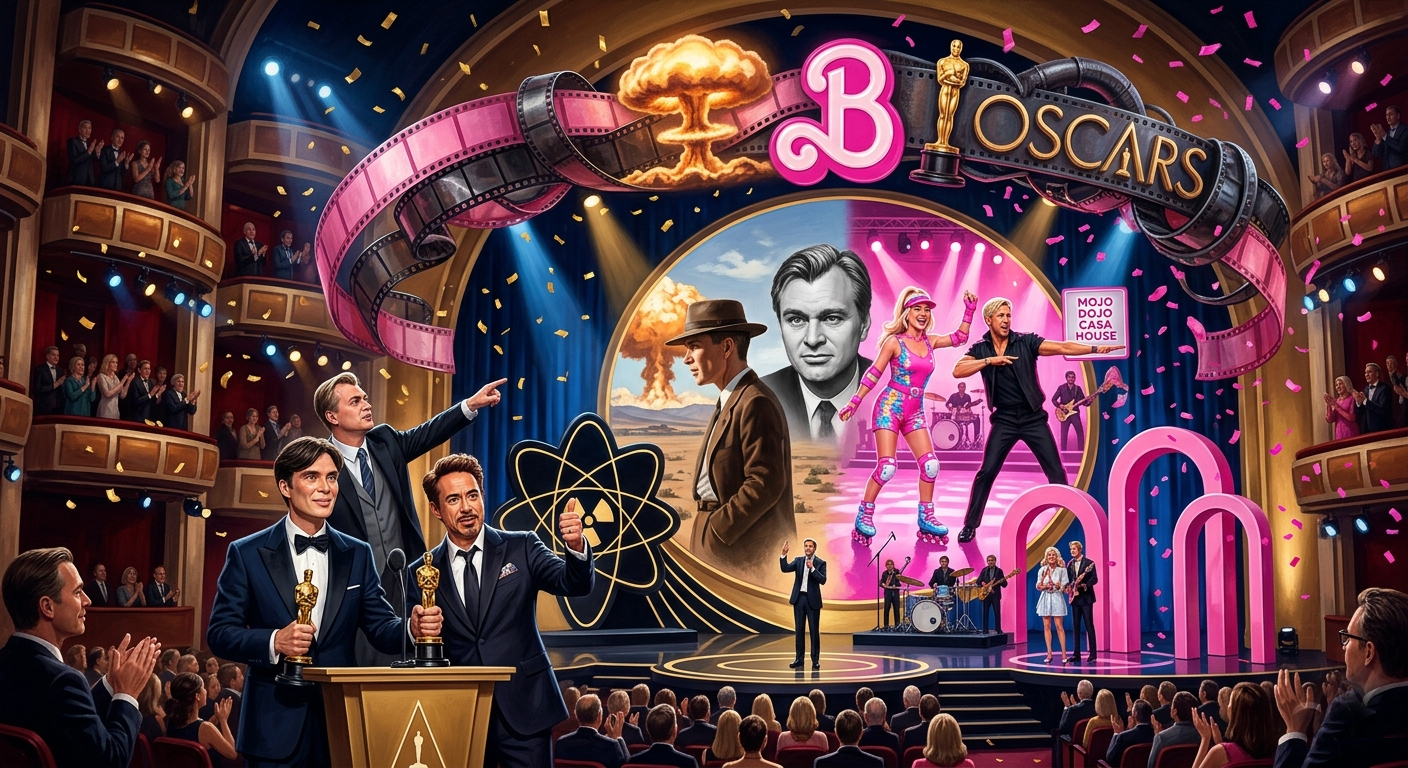
On the evening of Sunday, March 10, 2024, the entertainment world gathered at the Dolby Theatre at Ovation Hollywood in Los Angeles, California, for the 96th Annual Academy Awards — more commonly known as the Oscars. The ceremony honored the finest achievements in filmmaking across 2023, a year that had been shaped just as much by two of the biggest cultural events in recent Hollywood memory: the extraordinary box office explosion of Barbenheimer, and the twin strikes by the Writers Guild of America and the Screen Actors Guild and American Federation of Television and Radio Artists that together shut down most film and television production in the United States for more than 100 days. Against this backdrop, the Academy of Motion Picture Arts and Sciences prepared its most-watched ceremony in years.
The telecast aired live on ABC and reached audiences in more than 200 territories worldwide. It was produced by Raj Kapoor, Katy Mullan, and Molly McNearney, with Rob Paine as co-executive producer and veteran television director Hamish Hamilton at the helm. The Academy’s chief executive officer, Bill Kramer, and its president, Janet Yang, had announced the production team in October 2023, describing them as bringing a fresh vision and tremendous live television expertise to the reinvigorated show. The nominees for all 23 competitive categories had been announced on January 23, 2024, at the Samuel Goldwyn Theater in Beverly Hills by actress Zazie Beetz and actor Jack Quaid. When the final count was tallied, Christopher Nolan’s Oppenheimer led all contenders with 13 nominations, followed by Yorgos Lanthimos’s Poor Things with 11, and Martin Scorsese’s Killers of the Flower Moon with 10.
The ceremony began at 7 p.m. Eastern Time, an hour earlier than the traditional start, a scheduling shift that the Academy hoped would allow the broadcast to close at a reasonable hour on the East Coast. It ran 3 hours and 26 minutes — one of the shorter telecasts of the modern era, and the show ended on time. The broadcast drew 19.49 million viewers in the United States, a substantial audience for a major awards ceremony. Later that year, in July 2024, the broadcast received seven Emmy Award nominations at the 76th Primetime Emmy Awards, and ultimately won four of them: Outstanding Variety Special (Live), Outstanding Directing for a Variety Special, Outstanding Music Direction, and Outstanding Production Design for a Variety Special. It was the first time since the 63rd Academy Awards ceremony in 1991 that an Oscars broadcast had won a top Primetime Emmy Award for variety programming.
The Barbenheimer Phenomenon and the Films That Defined 2023
To fully appreciate what the 96th Academy Awards represented, one must understand the cinematic landscape of 2023 from which its nominees emerged. On July 21, 2023, two major studio films opened on the same day to extraordinary public enthusiasm. Greta Gerwig’s Barbie, starring Margot Robbie as Stereotypical Barbie and Ryan Gosling as Ken, was released by Warner Bros. Pictures. Christopher Nolan’s Oppenheimer, a three-hour IMAX biographical epic about J. Robert Oppenheimer and the creation of the atomic bomb, was released by Universal Pictures. The internet had coined the term Barbenheimer to describe the phenomenon of moviegoers attending both films on the same day, often dressing up for the occasion and racing between theaters. The dual opening became not just a box office success story but a genuine cultural event, arguably saving the theatrical exhibition industry from its post-pandemic doldrums.
Barbie earned more than 1.4 billion dollars at the global box office, becoming the highest-grossing film of 2023 and the highest-grossing film ever directed by a woman. Oppenheimer earned over 952 million dollars globally, making it the highest-grossing R-rated film and biographical film in history. Both films arrived at the Academy Awards with strong nomination tallies and devoted fan bases. Barbie received 8 nominations, including Best Picture, Best Supporting Actor for Ryan Gosling, Best Supporting Actress for America Ferrera, and Best Original Song for both Billie Eilish and Finneas O’Connell’s heartbreaking ballad What Was I Made For and Ryan Gosling’s anthemic I’m Just Ken. Oppenheimer, meanwhile, arrived with 13 nominations and the weight of critical consensus behind it as the year’s most accomplished filmmaking achievement.
The two films had together dominated not only the box office but nearly every precursor awards ceremony in the lead-up to the Oscars, including the BAFTAs, the Golden Globes, and the Critics Choice Awards. The industry and the public were watching to see which cultural titan would prevail on Oscar night, or whether the Academy would find room to honor both. The answer, when all was said and done, leaned decisively toward the atomic bomb and away from Barbie Land, but not before the evening had delivered one of the most celebrated and talked-about live performances in the ceremony’s nearly century-long history.
Jimmy Kimmel Returns as Host for the Fourth Time
Television host and producer Jimmy Kimmel returned to the Oscars stage for the fourth time, having previously hosted in 2017, 2018, and 2023. Kimmel had explained to the Hollywood Reporter that his decision to return was directly inspired by the Barbenheimer phenomenon. He opened the ceremony by walking out to Dua Lipa’s Dance the Night, one of the popular tracks from the Barbie soundtrack that had notably not received an Oscar nomination because the Academy’s rules allow only two songs per film in the Best Original Song category. The choice of entrance music was a winking acknowledgment of the evening’s central cultural tension.
Kimmel’s opening monologue covered a range of targets. He joked about the box-office misfire Madame Web, about the increasingly epic length of contemporary films, and, more controversially, about the personal struggles of Oppenheimer cast member Robert Downey Jr., who had battled severe addiction decades earlier. These jokes drew criticism from some quarters, even as Downey himself appeared to take them in stride from his seat in the audience. Kimmel also addressed directly the absence of Barbie director Greta Gerwig from the Best Director category, a widely publicized omission that many industry observers considered one of the year’s most glaring snubs. Looking at the audience of Academy members, Kimmel quipped, I know you are clapping, but you are the ones who didn’t vote for her, by the way. Don’t act like you had nothing to do with this.
One of the ceremony’s most celebrated bits involved actor John Cena, who arrived onstage apparently wearing nothing at all, in a tribute to the fiftieth anniversary of a legendary streaking incident during the 1974 Academy Awards. Cena held a large Best Costume Design envelope strategically in front of himself as he approached the microphone to present that category’s winner, which went to Holly Waddington for Poor Things. The nudity, it was later revealed, was not entirely literal, as Cena was wearing minimal undergarments, but the appearance was sufficiently startling to generate enormous laughter and become one of the night’s most-shared images. Kimmel later tossed Cena a gown to cover himself with.
The ceremony also included an unexpected but warmly received political moment near its end. During the broadcast, former President Donald Trump posted a message on his Truth Social platform criticizing Kimmel’s performance as host. Kimmel read the post aloud to the audience from the stage, then responded: Thanks for watching, but isn’t it past your jail time? — a reference to Trump’s ongoing legal proceedings. The exchange delighted much of the audience and generated immediate coverage across social media platforms.
Earlier in the evening, Kimmel had brought onstage a group of IATSE union members — the International Alliance of Theatrical Stage Employees — to honor the below-the-line workers whose labor disputes had defined much of the previous year. Kimmel told the assembled crowd that Hollywood is at its heart a union town, and urged the industry to stand with its workers in upcoming contract negotiations. The gesture was seen as a sincere acknowledgment of the strikes that had reshaped the film calendar and delayed numerous productions into 2024 and beyond.
Ryan Gosling and the I’m Just Ken Phenomenon: The Performance That Stole the Oscars
If the 96th Academy Awards is remembered for one thing above all else, it will almost certainly be Ryan Gosling’s performance of I’m Just Ken from the Barbie soundtrack. The song, a sentimental 1980s-style power ballad written and produced by Mark Ronson and Andrew Wyatt, had been released as part of Barbie the Album ahead of the film’s premiere and had rapidly accumulated more than 100 million streams on Spotify. It won Best Song at the 29th Critics’ Choice Awards and was nominated for Best Song Written for Visual Media at the 66th Annual Grammy Awards. At the Oscars, it was nominated for Best Original Song alongside What Was I Made For from the same film, as well as The Fire Inside from Flamin’ Hot performed by Becky G, It Never Went Away from American Symphony performed by Jon Batiste, and Wahzhazhe (A Song for My People), a tribal Osage-language composition from Killers of the Flower Moon performed by Scott George and the Osage Singers.
The question of whether Gosling would perform the song live at the Oscars had been a topic of considerable speculation in the weeks leading up to the ceremony. He had chosen not to sing at the 2017 Academy Awards, when his co-star John Legend performed City of Stars from La La Land instead. At the Oscars nominees luncheon on February 12, 2024, Mark Ronson told Good Morning America that he envisioned the performance involving Gosling, a thousand Kens, and a unicorn. The confirmation that Gosling would perform came only a few weeks before the ceremony. What was publicly unknown was how thoroughly the production had been planned for months prior.
Oscars producer Molly McNearney later revealed that her team had been meeting with Gosling on Zoom calls for months, along with choreographer Mandy Moore — the same Mandy Moore who had choreographed Gosling in La La Land — and Barbie director Greta Gerwig, who weighed in creatively on the number’s structure. Gosling himself had mapped out almost every element of the performance. He wanted to start in the audience, make his way to the stage, light the Ken-delabras, join ten dejected Kens on the stairs, and build to a finale with Kens streaming in from everywhere. He also requested that the production blast the lyrics on screen so the entire audience could sing along. Rehearsals began approximately four weeks before the ceremony, with Gosling’s vocal team and Moore’s associate choreographer Gillian Myers working on finding the movement language for the actor, who would be dancing, climbing stairs, and descending into the audience — all while singing live.
What the audience at the Dolby Theatre witnessed on March 10, 2024 became an instant piece of pop cultural history. Gosling was seated behind Margot Robbie in the audience when the performance began. He was wearing a custom Gucci suit in a sparkling, rhinestone-studded hot pink, paired with matching pink leather gloves and pink Gucci sunglasses. He began singing I’m Just Ken while still in his seat, causing Robbie, seated directly in front of him, to giggle. He removed his black cowboy hat and placed it on his sister’s head, then rose and began making his way toward the stage as Mark Ronson joined him on bass, and Andrew Wyatt took his position at the piano.
What followed was an extravaganza involving a 40-piece orchestra, 62 dancing Kens, more than 24 enormous Barbie-head props, a staircase bathed in pink light, and a tribute to Marilyn Monroe’s famous Diamonds Are a Girl’s Best Friend sequence from Gentlemen Prefer Blondes — all intentional, as Gosling himself had suggested the homage to the classic number from the 1953 film. His fellow Barbie cast members who had played versions of Ken — Simu Liu, Ncuti Gatwa, Kingsley Ben-Adir, and Scott Evans — were among the dancers. Wolfang Van Halen joined on guitar. Then, as the performance built toward its climax, legendary Guns N’ Roses guitarist Slash walked onstage to the crowd’s thunderous reaction, playing alongside Gosling as the number reached its apex.
Gosling then descended the stairs and moved back into the audience, thrusting the microphone toward his Barbie castmates. Margot Robbie, America Ferrera, and Greta Gerwig sang along. In a moment that delighted the crowd, Best Actress winner Emma Stone also chimed in with a line, later confessing backstage that she may have split the back of her dress in the excitement. Stone, who had been sitting nearby, could not contain herself. The entire Dolby Theatre rose to its feet, and the performance concluded with fireworks. By any measure, it was one of the most technically elaborate and emotionally resonant live musical numbers in Academy Awards history — an opinion widely shared by critics, audience members, and social media users within minutes of its conclusion.
Gosling later appeared on The Tonight Show with Jimmy Fallon and was asked whether he had immediately agreed to perform when the Academy asked. His answer was unambiguous: 100 percent no. He elaborated that there were a lot of ways it could go wrong. The fact that it went so spectacularly right, despite his initial hesitation and the enormous logistical complexity of the number, was a testament to months of meticulous preparation by Gosling, his creative collaborators, and the Oscars production team. It also reinforced what many viewers had long suspected about Gosling: that beneath the cool exterior of an established dramatic actor lay a performer of rare, effervescent charisma.
The Barbenheimer Rivalry Plays Out Live on Stage: Gosling and Blunt’s Memorable Exchange
One of the evening’s most charming non-musical moments came when Ryan Gosling and Emily Blunt — stars of the summer’s two biggest films, Barbie and Oppenheimer respectively — appeared together onstage to present a tribute to Hollywood’s stunt performers. Their appearance together was a direct nod to their upcoming collaboration in The Fall Guy, in which Gosling plays a stuntman and Blunt plays a film director. But before they could get to the subject of stunts, the two actors engaged in a playful back-and-forth about the Barbenheimer phenomenon that had carried both their films to cultural dominance.
Gosling opened by saying he was glad to finally put the Barbenheimer rivalry behind them. Blunt fired back that, given the way the awards season had turned out, with Oppenheimer sweeping nearly everything, it wasn’t that much of a rivalry, and suggested he let it go. Gosling then delivered his punchline: I think I’ve figured out why they called it Barbenheimer and not Oppenbarbie — you guys are at the tail end of that because you were riding Barbie’s coattails all summer. The audience roared. Blunt responded with one of the sharpest retorts of the evening: Thanks for Kensplaining that to me, Mr. I Need to Paint My Abs on to Get Nominated. The exchange, brief and perfectly timed, captured the good-natured competitive spirit of a film season unlike any in recent memory and was among the evening’s most-quoted moments.
Oppenheimer Dominates: Seven Oscars Including Best Picture, Best Director, and Best Actor
When the final tally was complete, Christopher Nolan’s Oppenheimer had taken home seven Academy Awards from its thirteen nominations, making it the clear champion of the evening and one of the most decorated films in recent Oscar history. The night’s most coveted prize, Best Picture, went to the film’s producers Charles Roven, Emma Thomas, and Christopher Nolan. Producer Emma Thomas, who is married to Nolan, spoke movingly during her acceptance speech, acknowledging that she had long dreamed of this moment while believing it seemed unlikely ever to happen. Nolan and Thomas became only the second married couple to win the Best Picture Academy Award together, following Richard D. Zanuck and Lili Fini Zanuck, who won for Driving Miss Daisy in 1990.
Christopher Nolan took home his first ever Academy Award for Best Directing, a recognition that many felt was long overdue for one of the most celebrated filmmakers of his generation. Nolan had previously been nominated for Best Directing for Dunkirk in 2018 but had not won. His win for Oppenheimer brought an end to one of the most high-profile directorial absences from the winners’ list in contemporary Oscar history. Cillian Murphy, who delivered a transformative lead performance as J. Robert Oppenheimer, won Best Actor in a Leading Role, his first Oscar and the first ever won by an Irish-born actor in that category. Murphy had been widely seen as the frontrunner throughout the awards season, and his win was met with significant emotion both from the audience and from his collaborators.
Robert Downey Jr. won Best Supporting Actor for his portrayal of Lewis Strauss, the Atomic Energy Commission chairman who engineered Oppenheimer’s security hearing. It was Downey’s first ever Academy Award, a win that carried particular resonance given his personal history of addiction and his decades-long career in Hollywood. The film also won Best Cinematography for Hoyte van Hoytema, whose extraordinary IMAX photography had been widely praised as one of the most visually ambitious achievements in the film’s production. Jennifer Lame won Best Film Editing for her work assembling the film’s complex three-hour narrative, and Ludwig Goransson took home Best Original Score, completing Oppenheimer’s sweep of seven awards.
Poor Things Wins Four Awards Including Best Actress for Emma Stone
The second most-decorated film of the evening was Poor Things, Yorgos Lanthimos’s surreal, lavish, and darkly comic adaptation of Alasdair Gray’s novel, which had earned 11 nominations. The film ultimately won four Oscars, beginning with Best Actress in a Leading Role for Emma Stone, who played Bella Baxter, a young woman resurrected with the brain of an infant and set loose on Victorian Europe. Stone’s win was her second Best Actress Oscar, having previously won for La La Land in 2017 — also an Oscars year hosted by Jimmy Kimmel. Her victory made her the second woman ever to be nominated for acting and Best Picture for the same film, following Frances McDormand for Nomadland in 2020. Upon accepting her award, Stone was visibly shaken, telling the audience that it was about a team who came together to make something better than the sum of its parts.
Poor Things also won Best Production Design, Best Costume Design for Holly Waddington, and Best Makeup and Hairstyling. The film’s distinctive visual world, conceived by production designer James Price and Shona Heath, had been one of its most commented-upon qualities, and the Academy’s technical awards reflected that consensus. Waddington’s win for costumes, presented by a apparently underdressed John Cena in one of the night’s most memorable comedic bits, capped a BAFTA-aligned sweep for the film in the below-the-line categories.
Da’Vine Joy Randolph, Cord Jefferson, and the Supporting Triumphs of the Evening
Da’Vine Joy Randolph won Best Supporting Actress for her portrayal of Mary Lamb, the grieving head cook at a New England prep school in Alexander Payne’s The Holdovers. Randolph had been considered the near-certain frontrunner in her category throughout the entire awards season, having won at virtually every precursor ceremony. Her win at the Oscars was greeted with enormous warmth and made her the tenth Black actress to win Best Supporting Actress in the history of the Academy Awards. The moment was introduced by Lupita Nyong’o, whose heartfelt tribute to Randolph moved the actress visibly before she had even reached the microphone.
American Fiction, the debut feature from writer-director Cord Jefferson based on Percival Everett’s satirical novel Erasure, won Best Adapted Screenplay. Jefferson used his acceptance speech to encourage studios and streaming services to take more chances on writers who want to tell smaller, more personal stories, arguing that one 200 million dollar budget could fund one hundred 2 million dollar films. The speech was immediately celebrated online as one of the most thoughtful and practically argued calls for creative risk-taking in recent Oscar memory. The Zone of Interest, Jonathan Glazer’s harrowing film about the domestic life of a Nazi commandant living alongside the Auschwitz concentration camp, won two awards: Best International Feature Film and Best Sound. Glazer’s acceptance speech for International Feature Film was one of the most politically charged moments of the evening, as he spoke directly about the ongoing conflict in Gaza and the broader implications of dehumanization.
Billie Eilish, Barbie’s Only Oscar, and the Historic Record She Set
While the I’m Just Ken performance was the undisputed highlight of the musical portion of the evening, the Best Original Song Oscar itself did not go to Gosling’s anthem. It went instead to What Was I Made For, the deeply emotional ballad written and performed by Billie Eilish and her brother Finneas O’Connell for the Barbie soundtrack. The song, which plays during a pivotal and quietly devastating scene in the film, had been Eilish’s signature achievement of the year, winning the Grammy Award for Song of the Year among many other honors before the Oscars.
The win was historically significant for several reasons. It was Eilish’s second Academy Award, having previously won for No Time to Die, the theme song for the 2021 James Bond film. With her second win, Eilish, who was 22 at the time of the ceremony, became the youngest person ever to win two Academy Awards in any category. She and Finneas also became the youngest duo ever to achieve two Oscar wins, surpassing actress Luise Rainer, who had won her second Oscar at the age of 28 for The Good Earth. What Was I Made For was also the only win of the night for the Barbie film, which had entered the evening as one of its most-nominated pictures and departed with a single golden statuette — a disparity that many observers noted with a mixture of respect for the song and frustration at the broader shutout of a film that had meant so much to so many.
Other Notable Wins, Historic Firsts, and the Full 23-Category Sweep
The Best Animated Feature Film Oscar went to The Boy and the Heron, the deeply personal and visually breathtaking film from legendary Japanese animator Hayao Miyazaki, whose Studio Ghibli produced the film. The win was one of the most warmly received of the evening among animation enthusiasts, as Miyazaki’s masterwork had been widely described as his valedictory statement after repeated announcements of retirement throughout his career. The film was co-produced by Toshio Suzuki. Justine Triet and Arthur Harari won Best Original Screenplay for Anatomy of a Fall, Triet’s French courtroom drama about a woman accused of murdering her husband. Triet became the first French woman ever to win the Best Original Screenplay Oscar.
In the Documentary Feature Film category, 20 Days in Mariupol, Ukrainian filmmaker Mstyslav Chernov’s devastating account of the Russian siege of the Ukrainian city of Mariupol in the early weeks of the 2022 invasion, won Best Documentary Feature. It was the first Ukrainian film ever to win an Academy Award, and Chernov used his acceptance speech to speak candidly about the ongoing war in his country, telling the audience he wished he was not making the film under those circumstances. The Wonderful Story of Henry Sugar, Wes Anderson’s adaptation of a Roald Dahl short story produced in partnership with Netflix, won Best Live Action Short Film, giving Anderson his first ever Oscar win despite numerous prior nominations across his career.
Godzilla Minus One, the Japanese monster film directed by Takashi Yamazaki that had been celebrated as one of the most technically impressive kaiju films ever made on a fraction of a Hollywood budget, won Best Visual Effects. It was the first Japanese film to ever win in that category. Sean Ono Lennon, son of John Lennon and Yoko Ono, appeared onstage to accept the Best Animated Short Film award for War Is Over!, a film inspired by the 1971 anti-war song Happy Xmas (War Is Over) by John and Yoko. He used the moment to lead the audience in a Happy Birthday to his mother, Yoko Ono, who had just turned 91.
The In Memoriam segment, introduced by a tradition of paying tribute to industry figures who had passed during the preceding year, generated controversy at the 96th ceremony. Italian tenor Andrea Bocelli performed Time to Say Goodbye alongside his son Matteo Bocelli, but many audience members and viewers at home complained that the production had placed too many contemporary dancers in front of the memorial slideshow and had featured too many shots of the Bocellis singing rather than the names and faces of the deceased. Several notable industry figures were felt to have been insufficiently honored, and the segment became one of the more criticized elements of an otherwise well-received broadcast.
The ceremony’s presenting lineup reflected the Academy’s tradition of featuring former winners in the acting categories, using a Fab Five format in which five previous Oscar recipients introduce each acting nominee group. The returning class included Michelle Yeoh, Brendan Fraser, Jamie Lee Curtis, and Ke Huy Quan, who had all won the previous year, alongside returning luminaries Nicolas Cage, Matthew McConaughey, Jennifer Lawrence, Charlize Theron, Rita Moreno, Lupita Nyong’o, Mahershala Ali, and Christoph Waltz. Al Pacino, who had been expected to co-present Best Picture with his Scarface co-star Michelle Pfeiffer, ultimately presented the award alone after Pfeiffer was unable to travel from the East Coast in time.
The Governors Awards and the Academy’s Representation Standards
Before the main ceremony on March 10, the Academy had held its 14th Annual Governors Awards on January 9, 2024, at the Ray Dolby Ballroom of the Ovation Hollywood complex in Hollywood. The ceremony, originally planned for November 18, 2023, had been postponed by two months due to the 2023 Hollywood labor disputes. Three honorary Oscars were presented at the event. Angela Bassett received an honorary award in recognition of her powerful and fearless performances that had inspired audiences around the world over the course of a distinguished career. Mel Brooks received an honorary Oscar for his comedic brilliance, producing acumen, and expansive body of work spanning decades of beloved films and Broadway productions. Film editor Carol Littleton, whose career includes landmark films such as E.T. the Extra-Terrestrial and Body Heat, was recognized for her commitment to her craft and its significant elevation of the art of film editing.
The 96th Academy Awards also marked the first ceremony to formally implement a new set of representation and inclusion standards for Best Picture eligibility. The Academy had announced in September 2020 that starting with the 96th awards, all films submitted for Best Picture consideration must satisfy an established set of criteria measuring on-screen representation, diversity behind the camera, industry access and opportunities for underrepresented groups, and inclusive marketing and distribution. The standards, known formally as the Academy Aperture 2025 standards, had been announced under then-AMPAS president David Rubin and then-CEO Dawn Hudson, who described them as a measure to widen the aperture of eligibility to reflect the diverse global population both in the creation of films and in the audiences who connect with them.
The Red Carpet, Pre-Ceremony Events, and the Protest That Delayed the Broadcast
The 96th Academy Awards red carpet was one of the most anticipated in recent years, partly due to the outsized fashion expectations generated by Barbie’s pink-saturated aesthetic. The ceremony was scheduled to begin at 4 p.m. Pacific Time, with a new red carpet format beginning earlier in the afternoon. However, the evening began with an unexpected disruption. Approximately 200 pro-Palestinian protesters gathered near the Dolby Theatre, rallying against Hollywood’s perceived support of United States-funded Israeli military operations in Gaza in response to the October 7, 2023 Hamas attacks on Israel. The Los Angeles Police Department declared a citywide tactical alert, and officers maintained a multi-block security zone around the venue. The protest caused delays of up to an hour for some red carpet arrivals and pushed the broadcast start back by approximately five to six minutes.
Among the more unusual and beloved presences on the Oscars carpet and inside the ceremony was Messi, the border collie who had starred in Anatomy of a Fall and had become something of an unofficial mascot for cinephile culture over the preceding awards season. Amid reports that the dog might not attend, Messi ultimately appeared at the ceremony, and cameras caught him appearing to react to the announcement of Robert Downey Jr.’s Best Supporting Actor win — a moment that generated enormous engagement on social media. The evening ended with a shot of Messi appearing to relieve himself on a Matt Damon Hollywood Walk of Fame star, a callback to the long-running comedic feud between Damon and host Jimmy Kimmel that had been a running theme throughout multiple Kimmel-hosted ceremonies.
The Academy’s Scientific and Technical Awards, separate from the main competitive categories, had been presented on February 23, 2024, in a ceremony at the Academy Museum of Motion Pictures in Los Angeles, hosted by actress Natasha Lyonne. The awards honored innovations in filmmaking technology and craftsmanship ranging from camera systems and visual effects tools to audio engineering advancements.
The Cultural Legacy of the 96th Academy Awards and What It Meant for Hollywood
The 96th Academy Awards arrived at a particular inflection point for the American film industry, one defined by the residue of creative shutdown, the ongoing upheaval caused by streaming services, and the extraordinary proof of concept offered by Barbenheimer that original, ambitious studio filmmaking could still galvanize mass audiences. In that context, the ceremony served as both a celebration of craft and a reassertion of Hollywood’s cultural relevance.
Oppenheimer’s sweep reflected the Academy’s continued deep affection for serious, technically accomplished, auteur-driven filmmaking on a grand scale. Christopher Nolan, long considered one of the most commercially successful filmmakers who had somehow eluded Oscar recognition, finally claimed his first directing statue at the age of 53. Cillian Murphy’s win for his meticulous, inward portrayal of a man haunted by the consequences of his own genius was similarly described by critics as a long-awaited official recognition from the institution. Robert Downey Jr.’s win, meanwhile, carried the charge of personal redemption, and his speech was characteristically witty and self-aware.
For Barbie and its enormous audience, the ceremony was a night of mixed emotions. Ryan Gosling’s performance of I’m Just Ken transcended the category it was meant to represent and became something more: a piece of genuine theatrical magic, a tribute to a character who spent the entire film struggling with his own sense of worth, and an argument that big-budget popular cinema could produce moments of pure, joyful spectacle that no streaming platform or home screen could replicate. Gosling did not win Best Supporting Actor. He did not win Best Original Song. But by the almost universal consensus of those who watched, he won the night.
The 96th Academy Awards would be remembered as the Oscars where Oppenheimer made history, where Billie Eilish became the youngest two-time Oscar winner, where Justine Triet became the first French woman to win Best Original Screenplay, where Cillian Murphy became the first Irish-born Best Actor, where Godzilla Minus One made history as the first Japanese film to win Visual Effects, and where Cord Jefferson delivered one of the most memorable acceptance speeches in years. But above all, it would be remembered as the Oscars where Ryan Gosling put on a hot pink Gucci suit, descended into the audience, handed the microphone to Margot Robbie and Greta Gerwig and Emma Stone, and proved — with a 40-piece orchestra, 62 Kens, and Slash on guitar — that he was, in every sense that mattered on that particular night, Kenough.