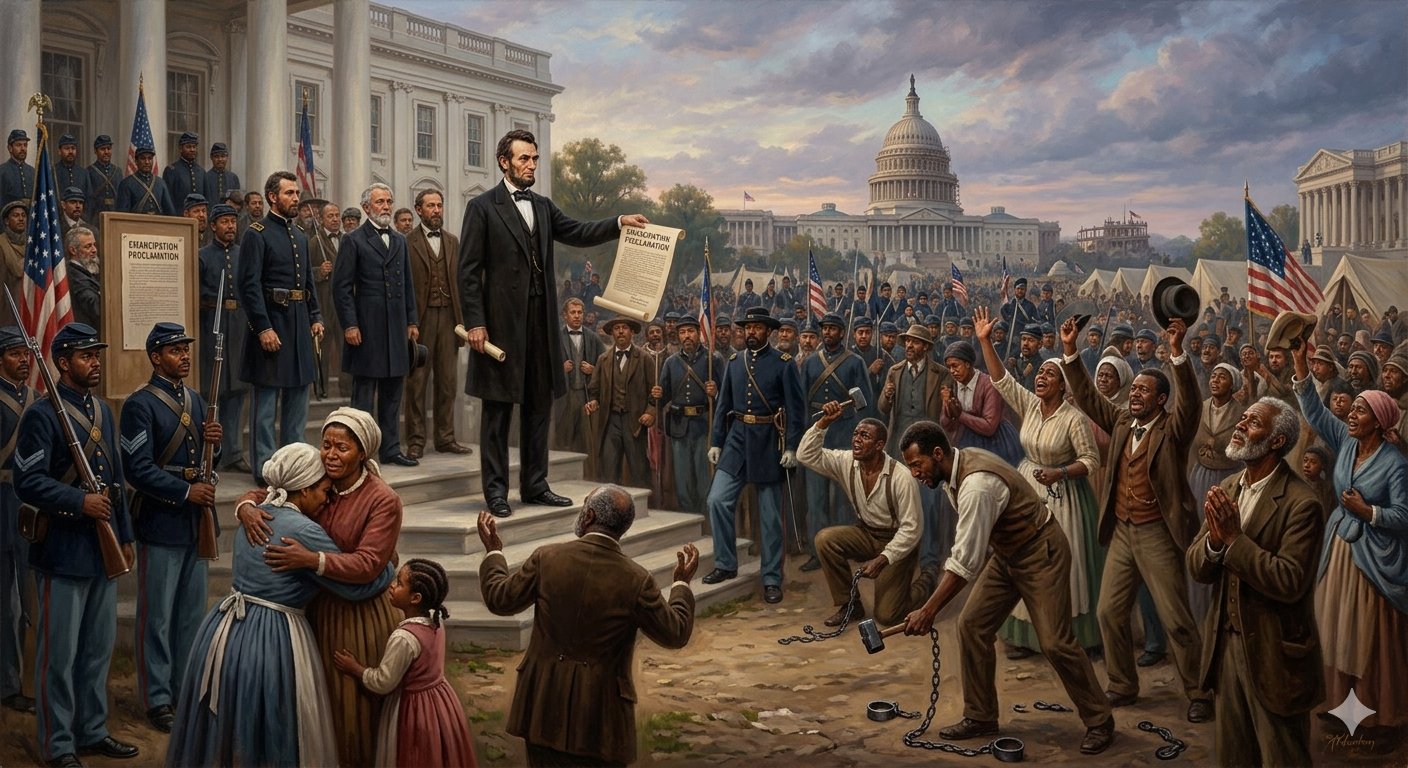
On January 1, 1863, President Abraham Lincoln issued one of the most transformative documents in American history when he signed the Emancipation Proclamation, declaring that “all persons held as slaves” within the rebellious Confederate states “are, and henceforward shall be free.” This momentous executive order, formally known as Proclamation 95, fundamentally altered the character of the American Civil War from a conflict primarily focused on preserving the Union into a moral crusade for human freedom that would reshape the very fabric of American society. The Proclamation affected the legal status of more than 3.5 million enslaved African Americans in the Confederate states, transforming them from property into free citizens with the stroke of Lincoln’s pen, while simultaneously authorizing their enlistment in the Union Army and Navy to fight for their own liberation and the preservation of the United States. This extraordinary act of presidential authority, issued under Lincoln’s wartime powers as Commander-in-Chief, represented both the culmination of growing abolitionist pressure and Lincoln’s own evolving understanding of the moral imperatives that the Civil War had unleashed. The Proclamation’s strategic timing, legal limitations, and far-reaching consequences would influence not only the immediate outcome of the Civil War but also the trajectory of American race relations, constitutional law, and the ongoing struggle for civil rights that continues to this day.
The Road to Emancipation: Lincoln’s Evolving Views on Slavery and Presidential Authority
Abraham Lincoln’s path to issuing the Emancipation Proclamation was neither direct nor inevitable, reflecting his complex evolution from a politician who sought to contain slavery without abolishing it to a wartime president who ultimately recognized that the Union could not survive half slave and half free. Lincoln’s early political career had been marked by his opposition to the expansion of slavery into new territories and his personal moral objection to the institution, but he had consistently maintained that the federal government lacked the constitutional authority to abolish slavery in the states where it already existed. This position reflected both his understanding of constitutional law and his political pragmatism in a nation deeply divided over the slavery question.
The outbreak of the Civil War in April 1861 fundamentally altered Lincoln’s understanding of presidential authority and the constitutional powers available to him as Commander-in-Chief during wartime. Initially, Lincoln insisted that the war was being fought solely to preserve the Union and that slavery would not be touched in states that remained loyal to the federal government. This position was designed to maintain the support of the crucial border states of Maryland, Delaware, Missouri, and Kentucky, where slavery remained legal but which had not joined the Confederacy. Lincoln understood that losing these strategically vital states to the Confederate cause could make Union victory impossible.
However, the military realities of the war and the actions of enslaved people themselves began to force Lincoln’s hand on the slavery question throughout 1861 and 1862. As Union armies advanced into Confederate territory, thousands of enslaved people fled to Union lines seeking freedom, creating a crisis that military commanders and the Lincoln administration struggled to address. These self-emancipated individuals, termed “contraband” by Union General Benjamin Butler, posed a dilemma: returning them to slavery would aid the Confederate war effort, but declaring them free would exceed federal authority under peacetime constitutional interpretations.
Congressional action during 1862 began to provide Lincoln with additional legal tools and political cover for more aggressive action against slavery. The Confiscation Acts of 1861 and 1862 authorized the seizure of Confederate property, including enslaved people, used to support the rebellion. More significantly, Congress passed legislation in June 1862 abolishing slavery in all federal territories, effectively repudiating the Supreme Court’s Dred Scott decision and demonstrating growing Republican Party commitment to anti-slavery action. These legislative developments helped create the political and legal foundation that would support Lincoln’s eventual decision to issue the Emancipation Proclamation.
The growing influence of Radical Republicans in Congress and the abolitionist movement throughout the North created increasing pressure on Lincoln to take more decisive action against slavery as both a moral imperative and a military necessity. Leaders like Charles Sumner, Thaddeus Stevens, and Frederick Douglass argued that the Union could not win the war while allowing the South to continue exploiting enslaved labor for military purposes. They contended that emancipation would weaken the Confederate war effort while strengthening the Union cause by allowing African Americans to serve in the military and by transforming the conflict into a moral crusade that would prevent European intervention on behalf of the Confederacy.
The Strategic Context: Military Necessity and Political Calculation
Lincoln’s decision to issue the Emancipation Proclamation was deeply influenced by strategic military and political considerations that had become increasingly apparent by the summer of 1862 as the Civil War entered its second year with no clear end in sight. The Union’s failure to achieve quick victory had demonstrated that the conflict would be longer and more costly than initially anticipated, requiring the mobilization of all available resources and the adoption of more aggressive measures to weaken Confederate resistance. The continued use of enslaved labor by the Confederacy to support its military effort represented a significant strategic advantage that Lincoln recognized needed to be neutralized.
The international dimension of the slavery question played a crucial role in Lincoln’s calculations about emancipation, particularly regarding the potential for European intervention on behalf of the Confederacy. Great Britain and France had economic interests in maintaining trade with the South and had been considering diplomatic recognition of Confederate independence, which could have led to direct military intervention to break the Union blockade of Southern ports. However, both European powers had abolished slavery in their own territories and would find it politically difficult to support a nation fighting to preserve slavery once the Union had committed itself to emancipation as a war aim.
Military commanders in the field had been pressuring the Lincoln administration for clearer guidance on how to handle the thousands of enslaved people who were fleeing to Union lines as federal armies advanced into Confederate territory. Generals like John C. Frémont and David Hunter had issued their own emancipation proclamations in their military departments, only to have Lincoln revoke them as exceeding their authority. These incidents demonstrated both the military necessity of addressing the slavery question and Lincoln’s determination to maintain personal control over such momentous policy decisions.
The Union Army’s growing manpower needs provided another compelling argument for emancipation, as military leaders recognized that African Americans could provide a significant source of additional troops if they were offered the incentive of freedom in exchange for military service. The Confederacy’s use of enslaved labor for military support roles freed white Southern men for combat duties, giving the South an advantage in mobilizing its population for war. Emancipation would not only deny this advantage to the Confederacy but also allow the Union to tap into the military potential of millions of African Americans eager to fight for their freedom.
Political considerations within the North also influenced Lincoln’s thinking about emancipation, as the 1862 midterm elections approached and public opinion showed signs of war weariness in the face of mounting casualties and limited military progress. The Radical Republicans had been gaining influence within Lincoln’s own party and were demanding more aggressive action against slavery as both a moral imperative and a military necessity. At the same time, Lincoln needed to maintain the support of War Democrats and conservative Republicans who were willing to fight to preserve the Union but might oppose a war fought primarily for abolition.
The Battle of Antietam: The Victory Lincoln Needed
The Battle of Antietam, fought on September 17, 1862, in Maryland, provided President Lincoln with the military victory he had been waiting for to issue the preliminary Emancipation Proclamation without appearing to act from a position of weakness or desperation. This bloodiest single-day battle in American history, with over 23,000 total casualties, saw Union forces under General George B. McClellan halt Confederate General Robert E. Lee’s first invasion of the North, forcing Lee’s Army of Northern Virginia to retreat back into Virginia and abandon Confederate hopes for a quick victory that might have secured European recognition of Confederate independence.
Although the tactical results of Antietam were somewhat ambiguous, with McClellan failing to pursue and destroy Lee’s retreating army despite having significant numerical advantages, the strategic implications were clear enough to provide Lincoln with the political cover he needed for his emancipation policy. The Union had demonstrated its ability to stop Confederate advances and maintain the integrity of loyal territory, while the Confederacy had failed in its attempt to shift the war to Northern soil and potentially influence European opinion in favor of Confederate recognition.
Lincoln had previously drafted a preliminary version of the Emancipation Proclamation during the summer of 1862 but had been waiting for an appropriate moment to announce it when Union military fortunes would make the proclamation appear as a measure taken from strength rather than desperation. Secretary of State William H. Seward had advised Lincoln against issuing the proclamation during the series of Union defeats in Virginia during the summer of 1862, arguing that it would appear to be “the last measure of an exhausted government, a cry for help” rather than a confident assertion of Union war aims.
The five-day interval between the Battle of Antietam on September 17 and Lincoln’s announcement of the preliminary Emancipation Proclamation on September 22 reflected the President’s careful consideration of timing and political presentation. Lincoln later told his cabinet that he had made “a solemn vow before God, that if General Lee was driven back from Pennsylvania, I would crown the result by the declaration of freedom to the slaves.” This religious framing of his decision reflected Lincoln’s understanding that emancipation needed to be presented not just as military strategy but as moral imperative supported by divine providence.
The preliminary Emancipation Proclamation announced on September 22, 1862, served both as a warning to the Confederate states and as a final opportunity for them to return to the Union before the more dramatic step of general emancipation took effect on January 1, 1863. The proclamation stated that if rebellious states did not return to Union control by the January 1 deadline, Lincoln would declare all enslaved people in those areas to be “then, thenceforward, and forever free” as a necessary war measure for suppressing the rebellion.
The Preliminary Proclamation: A Final Warning to the Confederacy
The Preliminary Emancipation Proclamation, issued by President Lincoln on September 22, 1862, served as both a strategic ultimatum to the Confederate states and a carefully calculated political maneuver designed to give the administration maximum flexibility while building support for more dramatic action if the rebellion continued. This preliminary document gave the Confederate states exactly 100 days to cease their rebellion and return to the Union before the more sweeping final Emancipation Proclamation would take effect on January 1, 1863, freeing all enslaved people in areas still in rebellion against the United States government.
The preliminary proclamation’s conditional nature reflected Lincoln’s continued hope that the war might be ended through negotiated settlement rather than the total military victory that would ultimately be required. By offering Confederate states the opportunity to return to the Union with slavery intact in exchange for ending their rebellion, Lincoln was attempting to divide Confederate public opinion and potentially encourage war-weary Southern communities to abandon the Confederate cause. This approach also helped Lincoln maintain the support of conservative Republicans and War Democrats who were willing to fight to preserve the Union but remained uncomfortable with using the war as a vehicle for social revolution.
The preliminary proclamation also served important political functions within the North by giving Lincoln’s administration time to build public support for the more radical step of general emancipation while allowing military and civilian leaders to prepare for the practical challenges of implementing such a sweeping policy change. The 100-day interval provided opportunities for public debate and discussion that would help legitimize the final proclamation when it was issued, while also giving Union military commanders time to develop strategies for managing the large numbers of newly freed enslaved people who would likely seek protection behind Union lines.
Lincoln’s decision to announce the preliminary proclamation through a cabinet meeting and subsequent public release demonstrated his understanding that such momentous policy changes required both careful constitutional justification and effective political communication. The proclamation was carefully framed as a military necessity authorized by Lincoln’s constitutional powers as Commander-in-Chief during wartime, rather than as general humanitarian policy that might exceed federal constitutional authority during peacetime. This legal framework was essential for maintaining the proclamation’s legitimacy and defending it against constitutional challenges.
The reaction to the preliminary proclamation from various constituencies provided Lincoln with valuable intelligence about how the final proclamation would be received and what political costs he might need to pay for proceeding with emancipation. Radical Republicans praised the announcement as long overdue but expressed concerns that Lincoln might still find ways to avoid following through with the final proclamation. Conservative Republicans and War Democrats expressed varying degrees of concern about the policy’s implications for Union war aims and post-war reconstruction, while Democrats generally opposed the proclamation as unconstitutional federal overreach.
January 1, 1863: The Final Emancipation Proclamation Takes Effect
On New Year’s Day 1863, President Abraham Lincoln fulfilled his promise from the preliminary proclamation by signing the final Emancipation Proclamation in the White House, officially declaring that “all persons held as slaves” within the designated rebellious states “are, and henceforward shall be free.” This historic moment, which Lincoln later described as the most important act of his presidency, was witnessed by a small group of cabinet members and administration officials who understood they were participating in one of the most significant events in American history. The president’s hand reportedly trembled slightly as he prepared to sign the document, not from nervousness but from fatigue after hours of greeting New Year’s visitors at the traditional White House reception.
The final proclamation was more specific and comprehensive than its preliminary version, explicitly naming the states and parts of states where emancipation would take effect while also authorizing the recruitment of formerly enslaved people into the Union Army and Navy. The document declared free all enslaved people in South Carolina, Mississippi, Florida, Alabama, Georgia, Louisiana, Texas, Virginia, Arkansas, and North Carolina, representing the areas still in active rebellion against the United States government. However, the proclamation carefully excluded areas under Union control, including parts of Virginia and Louisiana, as well as the loyal border states of Maryland, Delaware, Missouri, and Kentucky, where slavery remained legal.
The proclamation’s language carefully grounded Lincoln’s authority to issue such a sweeping order in his constitutional powers as Commander-in-Chief during wartime, describing emancipation as “a fit and necessary war measure for suppressing said rebellion.” This legal framework was essential for defending the proclamation against constitutional challenges while also acknowledging the limitations of presidential authority in peacetime. Lincoln concluded the document with an appeal to divine justice, stating that he believed the proclamation to be “an act of justice, warranted by the Constitution, upon military necessity” and invoking “the considerate judgment of mankind, and the gracious favor of Almighty God.”
The immediate impact of the proclamation varied dramatically depending on local circumstances, with approximately 25,000 to 75,000 enslaved people gaining immediate freedom in areas where Union forces were already present and could enforce the new policy. In most of the Confederacy, however, the proclamation remained a promise that could only be fulfilled as Union armies advanced and Confederate resistance collapsed. Nevertheless, news of the proclamation spread quickly throughout the South through both official and unofficial channels, inspiring hope among enslaved people while creating anxiety among white Southerners who recognized that their social and economic system was under unprecedented attack.
The proclamation’s authorization for the enlistment of formerly enslaved people in the Union military represented perhaps its most immediately practical provision, as it provided concrete opportunities for African Americans to participate actively in their own liberation while addressing the Union’s growing need for additional manpower. The document specifically stated that freed people “of suitable condition, will be received into the armed service of the United States to garrison forts, positions, stations, and other places, and to man vessels of all sorts in said service.” This military provision would ultimately lead to the enlistment of approximately 200,000 African Americans in Union forces, fundamentally altering both the character of the Union military and the nature of the Civil War itself.
The Legal Framework: Constitutional Authority and Wartime Powers
The Emancipation Proclamation’s legal foundation rested entirely on President Lincoln’s interpretation of his constitutional authority as Commander-in-Chief during wartime, representing a significant expansion of presidential power that would have lasting implications for American constitutional law and the balance of federal authority between executive and legislative branches. Lincoln carefully grounded his authority to issue the proclamation in Article II, Section 2 of the Constitution, which designates the president as “Commander in Chief of the Army and Navy of the United States” during times of armed conflict against the government’s authority.
This constitutional framework was essential because Lincoln and his legal advisors recognized that the federal government lacked clear peacetime authority to abolish slavery in states where it was legal under state law. The Tenth Amendment’s reservation of powers not explicitly granted to the federal government had traditionally been interpreted as protecting state authority over domestic institutions like slavery, making federal intervention legally problematic except under extraordinary circumstances like armed rebellion. Lincoln’s legal strategy therefore required demonstrating that emancipation was a legitimate military measure necessary for suppressing the rebellion rather than a general humanitarian policy that exceeded federal constitutional authority.
The proclamation’s careful limitation to areas “in rebellion against the United States” was legally essential for maintaining its constitutional validity while also reflecting the practical limitations of Lincoln’s wartime powers. The document explicitly excluded loyal border states and areas of rebellious states already under Union military control, acknowledging that Lincoln’s Commander-in-Chief powers could not justify emancipation in areas not actively engaged in armed resistance to federal authority. This geographic limitation made the proclamation legally defensible while creating the political anomaly of slavery remaining legal in loyal states while being abolished in rebellious areas.
Lincoln’s legal advisors, including Attorney General Edward Bates, had provided constitutional analysis supporting the president’s authority to issue the proclamation as a military necessity, arguing that the Constitution’s provisions for suppressing domestic insurrection and providing for the common defense justified extraordinary measures to weaken enemy resources and strengthen Union capabilities. This analysis drew on precedents from the War of 1812 and Mexican-American War where presidents had claimed expanded authority during wartime, while also referencing international law principles regarding military necessity and the treatment of enemy property during armed conflict.
The proclamation’s survival without serious constitutional challenge reflected both the political realities of wartime and the careful legal groundwork laid by Lincoln and his advisors in framing emancipation as military necessity rather than social policy. Although some Democratic politicians and constitutional scholars questioned the proclamation’s legality, the ongoing Civil War made judicial review practically impossible while the Union military’s growing dependence on African American soldiers provided compelling evidence of the proclamation’s military utility. The ultimate validation of Lincoln’s constitutional interpretation came through the political process rather than judicial review, as his reelection in 1864 provided popular endorsement of his wartime policies including emancipation.
Geographic Scope and Strategic Limitations
The Emancipation Proclamation’s geographic scope reflected a careful balance between Lincoln’s constitutional authority, military necessity, and political pragmatism that resulted in a document that was simultaneously sweeping in its moral implications and frustratingly limited in its immediate practical impact. The proclamation applied to approximately 3.5 million of the 4 million enslaved people in the United States, but it specifically excluded nearly 500,000 enslaved people in the loyal border states of Maryland, Delaware, Missouri, and Kentucky, as well as enslaved people in areas of rebellious states already under Union military control.
The exclusion of the border states represented Lincoln’s most significant strategic compromise, reflecting his understanding that attempting to abolish slavery in states that had remained loyal to the Union might drive them into the Confederacy and potentially make Union victory impossible. Maryland’s strategic location surrounding the national capital made its loyalty essential for Union survival, while Kentucky’s position controlling access to the Mississippi River valley made it crucial for Union military strategy. Missouri’s location at the gateway to the western territories made it vital for maintaining Union control over the trans-Mississippi region, while Delaware’s position on the eastern seaboard made it important for Union communications and supply lines.
The exclusion of Union-occupied areas of rebellious states created additional complications for the proclamation’s implementation, as it meant that enslaved people in cities like New Orleans, Norfolk, and parts of Virginia found themselves in the anomalous position of remaining legally enslaved despite living under Union military occupation. These exclusions were designed to encourage loyalty to the Union and reward areas that had accepted federal authority, but they created practical difficulties for military commanders who had to distinguish between enslaved people who were legally free under the proclamation and those who remained in bondage despite being under Union protection.
The proclamation’s application to areas still under Confederate control meant that its immediate practical impact was limited to regions where Union forces were present to enforce emancipation, leading critics to argue that Lincoln had freed enslaved people only in areas where the Union lacked the power to enforce freedom while leaving slavery intact in areas where federal authority could actually be exercised. This criticism missed the proclamation’s strategic purpose as a tool for undermining Confederate morale and encouraging enslaved people to flee toward Union lines, but it highlighted the document’s limitations as immediate humanitarian relief.
The geographic limitations of the Emancipation Proclamation created strong incentives for enslaved people in excluded areas to flee toward regions where the proclamation applied and where they could find protection with Union forces. This movement of population created additional pressures on the slavery system in border states while demonstrating the artificial nature of the proclamation’s geographic distinctions. The success of these escape efforts helped build political momentum for more comprehensive emancipation measures that would eventually lead to the Thirteenth Amendment’s abolition of slavery throughout the United States.
Military Impact: African Americans Join the Fight for Freedom
The Emancipation Proclamation’s authorization for the enlistment of formerly enslaved people in the Union Army and Navy represented perhaps its most immediately transformative provision, fundamentally altering the character of the Union war effort while providing concrete opportunities for African Americans to participate actively in their own liberation. The proclamation specifically stated that freed people “of suitable condition, will be received into the armed service of the United States to garrison forts, positions, stations, and other places, and to man vessels of all sorts in said service,” opening military service to a population that had been systematically excluded from armed participation in American defense.
The military recruitment of African Americans had been a contentious issue throughout the early stages of the Civil War, with many Union officers and Northern politicians arguing that arming formerly enslaved people would be both militarily ineffective and politically dangerous. These racial prejudices were overcome by military necessity as the war dragged on and Union forces faced increasing manpower shortages that made additional recruitment essential for victory. The Emancipation Proclamation provided the legal and moral framework that made large-scale African American military service both constitutionally legitimate and strategically coherent.
The implementation of African American military recruitment proceeded rapidly after the Emancipation Proclamation took effect, with the creation of the United States Colored Troops (USCT) providing organizational structure for integrating African American soldiers into the Union military system. The first official African American regiment, the 54th Massachusetts Infantry, had been authorized before the proclamation took effect, but the document’s explicit authorization for military service legitimized and accelerated recruitment efforts throughout Union-controlled territory. By the end of the Civil War, approximately 200,000 African Americans had served in Union forces, representing about 10% of total Union military manpower.
The combat effectiveness of African American troops provided powerful validation for the Emancipation Proclamation’s military provisions while challenging racial stereotypes that had been used to justify exclusion from military service. Units like the 54th Massachusetts Infantry demonstrated exceptional courage and discipline in battles like Fort Wagner, while African American soldiers throughout the war proved themselves capable of the same military virtues as their white counterparts. These military contributions provided compelling evidence that emancipation had strengthened rather than weakened the Union war effort.
The psychological impact of African American military service extended far beyond the immediate military benefits to fundamentally alter how both enslaved and free African Americans understood their relationship to American society and their potential for achieving full citizenship rights. The opportunity to bear arms in defense of the Union and their own freedom provided formerly enslaved people with concrete evidence that emancipation represented genuine liberation rather than merely a change in legal status. For white Americans, the sight of African American soldiers fighting effectively for the Union cause helped build support for emancipation while demonstrating that freedom could coexist with military discipline and patriotic service.
International Reactions: Diplomacy and European Opinion
The Emancipation Proclamation’s international impact was perhaps as significant as its domestic effects, fundamentally altering the diplomatic context of the Civil War by transforming the conflict from a domestic political dispute into a moral crusade against slavery that resonated with European public opinion and complicated Confederate efforts to secure foreign recognition and support. European powers, particularly Great Britain and France, had been seriously considering diplomatic recognition of Confederate independence during 1862, but the proclamation’s explicit commitment to emancipation made such recognition politically impossible for governments that had already abolished slavery in their own territories.
Great Britain’s position was particularly crucial for Confederate diplomatic strategy, as British recognition of Confederate independence might have led to other European powers following suit while British naval intervention could have broken the Union blockade and provided the Confederacy with access to international markets and military supplies. However, British public opinion was strongly anti-slavery, making it politically impossible for the British government to support a nation explicitly fighting to preserve slavery once the Union had committed itself to emancipation. The proclamation effectively neutralized Confederate diplomatic efforts in Britain while strengthening Union support among British liberals and working-class leaders.
French Emperor Napoleon III had been even more inclined than the British to recognize Confederate independence, partly because of his own imperial ambitions in Mexico that might be facilitated by a weakened and divided United States. However, the Emancipation Proclamation created similar political difficulties for French recognition of the Confederacy, as Napoleon III could not afford to appear to be supporting slavery in the face of French public opinion that had celebrated the abolition of slavery in French colonies during the 1840s. The proclamation therefore served as an effective diplomatic weapon that isolated the Confederacy internationally while strengthening Union moral authority.
The international reaction to the Emancipation Proclamation was not uniformly positive, with some European observers criticizing its limitations and conditional nature as evidence of Union hypocrisy on the slavery question. British liberals like John Stuart Mill questioned why Lincoln had not freed all enslaved people in the United States rather than limiting emancipation to areas in rebellion, while some European newspapers suggested that the proclamation was motivated more by military necessity than genuine moral commitment to human equality. However, these criticisms were generally overshadowed by relief that the Union had finally committed itself to the abolition of slavery.
The proclamation’s international impact extended beyond immediate diplomatic considerations to influence European public opinion about American democracy and the compatibility of republican government with human freedom. European liberals had long pointed to American slavery as evidence that republican institutions were inherently flawed and potentially hypocritical, but the Emancipation Proclamation provided evidence that American democracy was capable of moral progress and social reform. This improved international reputation for American democracy would have lasting benefits for American diplomatic relations and international influence throughout the remainder of the 19th century and beyond.
Opposition and Criticism: Political Resistance to Emancipation
The Emancipation Proclamation faced significant opposition from multiple constituencies within the North, reflecting the complex racial attitudes, constitutional concerns, and political calculations that complicated Union support for the Civil War and raised questions about whether the American people were prepared for the social revolution that emancipation would ultimately require. Democratic politicians, conservative Republicans, and many Union military officers criticized the proclamation on constitutional, strategic, and racial grounds, creating political challenges that Lincoln and his administration needed to manage carefully throughout the remainder of the war.
Democratic Party opposition to the Emancipation Proclamation was immediate and intense, with party leaders arguing that Lincoln had exceeded his constitutional authority while transforming a war to preserve the Union into a crusade for abolition that many Northern voters had not endorsed. Democratic politicians like New York Governor Horatio Seymour and Ohio Congressman Clement Vallandigham argued that the proclamation violated constitutional limits on federal power while creating unnecessarily radical war aims that would make negotiated peace impossible and prolong the conflict unnecessarily. These Democratic critics maintained that the war should be fought solely to restore the Union without addressing slavery, which they viewed as a state rather than federal issue.
Military opposition to the Emancipation Proclamation came from some Union officers who questioned both its military effectiveness and its impact on army morale, particularly among soldiers who had enlisted to preserve the Union rather than to abolish slavery. General George B. McClellan, who commanded the Army of the Potomac during the early stages of the war, privately criticized the proclamation as politically motivated policy that would complicate military operations while potentially alienating conservative supporters of the war effort. Other military officers expressed concerns that the proclamation might provoke Confederate retaliation against Union prisoners of war or inspire slave insurrections that could complicate Union military operations in occupied territory.
Racial prejudice within the North created additional opposition to the Emancipation Proclamation from white workers and immigrants who feared that freed enslaved people would migrate northward and compete for employment while driving down wages and working conditions. These economic concerns were particularly strong in cities like New York, Detroit, and Cincinnati, where working-class whites already competed with free African Americans for jobs and housing. The infamous New York City Draft Riots of July 1863 demonstrated how racial antagonism could be combined with opposition to the war and emancipation to create violent resistance to Union policies.
Constitutional scholars and legal experts also raised questions about the proclamation’s legal basis and long-term implications for American constitutional government, arguing that Lincoln’s expansion of presidential authority during wartime set dangerous precedents that could be used by future presidents to justify similar extraordinary measures during peacetime. Critics like Joel Parker, a Harvard Law School professor, argued that the proclamation exceeded the president’s commander-in-chief powers and violated the Fifth Amendment’s protection against the seizure of property without due process of law. These constitutional concerns reflected broader anxieties about wartime expansion of federal authority and its compatibility with traditional American limited government principles.
The Thirteenth Amendment: Making Freedom Constitutional
The Emancipation Proclamation’s limitations as a wartime measure issued under presidential authority created the need for more permanent constitutional protection for emancipation, leading Lincoln and Republican leaders to pursue the Thirteenth Amendment as a way to ensure that slavery would be permanently abolished throughout the United States regardless of future political changes or legal challenges to presidential wartime powers. Lincoln recognized that his proclamation might be overturned by future presidents or declared unconstitutional by federal courts once the war ended and his commander-in-chief powers were no longer applicable, making constitutional amendment essential for securing the permanent abolition of slavery.
The constitutional amendment process required approval by two-thirds majorities in both houses of Congress followed by ratification by three-fourths of the states, creating political challenges that were even more daunting than those faced by the Emancipation Proclamation. The Republican Party’s growing strength in Congress during the war years provided the foundation for amendment passage, but securing the necessary Democratic support required careful political maneuvering and strategic compromises that demonstrated Lincoln’s skills as both a political strategist and moral leader committed to the abolition of slavery.
The Senate passed the Thirteenth Amendment on April 8, 1864, by a vote of 38 to 6, with Republican senators providing nearly unanimous support while most Democratic senators opposed the measure. However, the House of Representatives initially failed to achieve the necessary two-thirds majority when the amendment first came to a vote on June 15, 1864, with the measure receiving 93 votes in favor and 65 opposed, falling 13 votes short of the required supermajority. This initial defeat demonstrated the continuing strength of Democratic opposition to emancipation and the political challenges that Lincoln faced in securing permanent constitutional protection for freedom.
Lincoln made passage of the Thirteenth Amendment a central issue in his 1864 reelection campaign, arguing that constitutional amendment was necessary to ensure that the sacrifices made during the Civil War would result in permanent abolition of slavery rather than merely temporary wartime measures that might be reversed once peace was restored. His decisive victory over Democratic nominee George B. McClellan provided a popular mandate for emancipation while strengthening Republican positions in Congress and making amendment passage politically feasible during the lame-duck session of the 38th Congress.
The House of Representatives finally passed the Thirteenth Amendment on January 31, 1865, by a vote of 119 to 56, with several Democratic members changing their positions following Lincoln’s reelection and intense lobbying by the Lincoln administration. The amendment’s passage required careful vote-counting and strategic persuasion, including promises of patronage appointments and other political incentives for wavering members. Lincoln’s personal involvement in the lobbying effort demonstrated his understanding that constitutional amendment was essential for securing his emancipation legacy and ensuring that the Civil War would result in permanent rather than temporary abolition of slavery.
Legacy and Long-term Impact: Transforming America Forever
The Emancipation Proclamation’s long-term impact extended far beyond its immediate effects during the Civil War to fundamentally transform American society, law, and politics in ways that continue to influence the nation more than 160 years after Lincoln signed the historic document. The proclamation established the constitutional and moral foundation for the civil rights movement of the 20th century while creating new understanding of federal authority and presidential power that would shape American governance throughout the modern era. The document’s promise of freedom, though initially limited in scope and enforcement, provided the legal and symbolic framework that would eventually lead to full citizenship rights for African Americans.
The proclamation’s transformation of the Civil War from a conflict over union to a moral crusade against slavery had profound implications for how Americans understood their national identity and founding principles. Lincoln’s argument that the nation could not survive “half slave and half free” was validated by the war’s outcome and the constitutional amendments that followed, demonstrating that American democracy required the extension of freedom and equality to all inhabitants regardless of race or previous condition of servitude. This expanded understanding of American democratic principles would influence subsequent struggles for civil rights and social justice throughout American history.
The precedent established by Lincoln’s use of presidential wartime powers to issue the Emancipation Proclamation had lasting implications for the development of executive authority and the balance of power between the federal government and individual states. Future presidents would cite Lincoln’s example when claiming extraordinary powers during national emergencies, while constitutional scholars would continue to debate the appropriate limits of presidential authority during times of crisis. The proclamation thus contributed to the ongoing evolution of American constitutional government and the expansion of federal authority that characterized the modern American state.
The military service of African Americans authorized by the Emancipation Proclamation established important precedents for future integration of the armed forces while demonstrating the compatibility of racial equality with military effectiveness. The courage and competence displayed by African American soldiers during the Civil War provided evidence that contradicted racial stereotypes and supported arguments for full citizenship rights that would be advanced by civil rights leaders throughout the post-war era. The tradition of African American military service established during the Civil War would continue through subsequent American wars and contribute to the eventual integration of the armed forces during the 20th century.
The international impact of the Emancipation Proclamation helped establish the United States as a leader in the global struggle against slavery and human bondage while enhancing American moral authority in international affairs. The proclamation’s commitment to human freedom resonated with liberation movements throughout the world and contributed to the eventual abolition of slavery in Brazil, Cuba, and other nations where the institution persisted after the American Civil War. The document thus represents not only a crucial moment in American history but also a significant contribution to the global advancement of human rights and dignity that continues to influence international relations and humanitarian policy in the contemporary world.