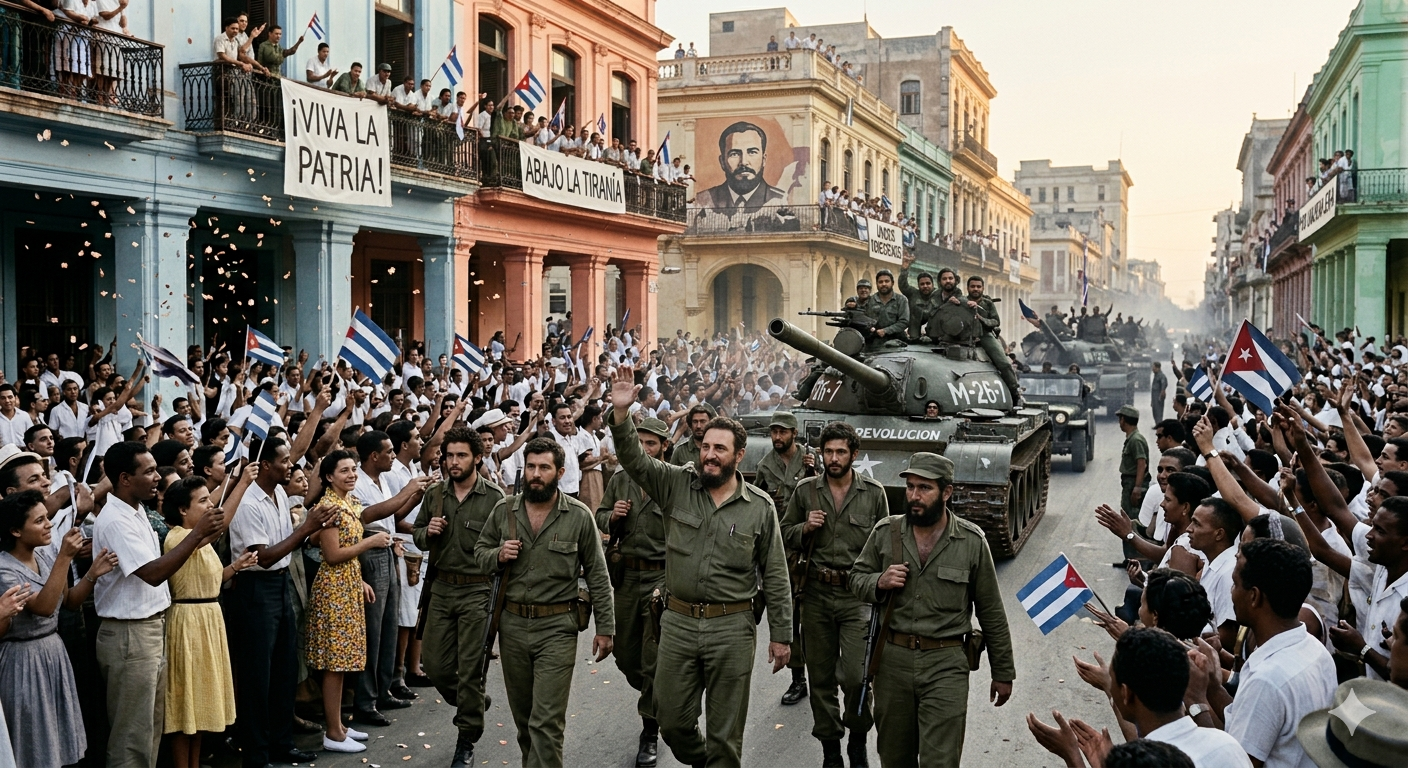
On January 1, 1959, the Cuban Revolution reached its climactic victory when Fulgencio Batista fled Cuba in the early morning hours, abandoning his dictatorship and paving the way for Fidel Castro’s revolutionary forces to establish what would become the first communist state in the Western Hemisphere. This momentous triumph marked the end of a brutal seven-year struggle that had transformed a failed attack on the Moncada Barracks in 1953 into a successful guerrilla war that captured the imagination of the oppressed Cuban people and ultimately toppled one of Latin America’s most entrenched military dictatorships. The revolutionary victory represented far more than a simple change of government, as Castro’s 26th of July Movement had fundamentally challenged the existing social, economic, and political order that had dominated Cuba since its independence from Spain in 1898, promising radical reforms that would redistribute land, nationalize foreign-owned industries, and establish a socialist system that prioritized social justice over capitalist profit. The triumph of the Cuban Revolution sent shockwaves throughout the Western Hemisphere and beyond, as it demonstrated that even small guerrilla forces could successfully challenge established governments when they enjoyed popular support and pursued effective military and political strategies that exploited the weaknesses and contradictions of their opponents. The victory would have profound consequences not only for Cuba but for the entire Cold War struggle between the United States and the Soviet Union, as Castro’s revolution would eventually align Cuba with the communist bloc and transform the island nation into a strategic Soviet ally just ninety miles from the American mainland, fundamentally altering the geopolitical balance in the Caribbean and Latin America for decades to come.
The Rise of Fulgencio Batista: Dictatorship and Corruption in Pre-Revolutionary Cuba
Fulgencio Batista’s path to power and his eventual downfall began with his military coup on March 10, 1952, when he seized control of the Cuban government just three months before scheduled elections that polls suggested he would lose decisively to his political opponents. This brazen violation of Cuban constitutional democracy marked the beginning of a seven-year dictatorship that would be characterized by systematic corruption, brutal repression of political opposition, and the transformation of Cuba into what critics described as a playground for American tourists and organized crime while the majority of the Cuban population remained mired in poverty and political powerlessness. Batista’s coup effectively destroyed the fragile democratic institutions that had been developing in Cuba since its independence from Spain, replacing competitive elections and constitutional government with military rule and personal dictatorship that served the interests of wealthy Cuban elites and foreign corporations while ignoring the legitimate grievances and aspirations of ordinary Cuban citizens.
The Batista regime’s economic policies created a system of crony capitalism that enriched the dictator’s supporters while perpetuating the extreme inequality and economic dependence that had characterized Cuba since the colonial period, with the island’s economy remaining heavily dependent on sugar exports and American investment while failing to develop the diversified industrial base that might have provided better employment opportunities and higher living standards for the Cuban people. The regime’s close ties to American organized crime figures like Meyer Lansky and Lucky Luciano transformed Havana into a center for gambling, prostitution, and drug trafficking that generated enormous profits for regime supporters while corrupting Cuban institutions and creating a climate of lawlessness and moral decay that alienated many Cubans who had hoped for better from their independent nation.
Batista’s security apparatus, led by the notorious chief of police Esteban Ventura Novo and other brutal enforcers, employed torture, murder, and intimidation to suppress political opposition while enriching themselves through extortion, bribery, and participation in various criminal enterprises that made a mockery of law and order in Cuba. The regime’s human rights abuses became increasingly systematic and widespread as opposition to Batista’s rule grew throughout the 1950s, with political prisoners subjected to horrific torture in government facilities while student protesters and other dissidents simply disappeared without trace, their bodies sometimes found dumped in remote locations as warnings to others who might consider challenging the dictatorship.
The corruption and repression that characterized Batista’s rule gradually eroded whatever legitimacy his government might have initially possessed, creating the conditions for revolutionary opposition to develop and ultimately triumph over a regime that had lost the support of virtually all segments of Cuban society except for those who directly benefited from its criminal activities and authoritarian policies. The dictator’s increasingly desperate attempts to maintain power through escalating violence and repression only served to further alienate the Cuban people while providing Castro’s revolutionaries with powerful propaganda tools and moral justification for their armed struggle against what they accurately portrayed as an illegitimate and criminal government that had forfeited any right to rule the Cuban nation.
The Moncada Barracks Attack: The Birth of the 26th of July Movement
The Cuban Revolution began in earnest on July 26, 1953, when Fidel Castro led approximately 135 young revolutionaries in a daring but ultimately unsuccessful attack on the Moncada Barracks in Santiago de Cuba and a simultaneous assault on the barracks in Bayamo, launching what would become a six-year struggle that would culminate in the overthrow of the Batista dictatorship and the establishment of a socialist Cuba. The attack, planned as a bold stroke that would capture weapons and spark a general uprising against Batista’s regime, ended in disaster for the revolutionaries, with most of the attackers killed or captured by government forces who vastly outnumbered the poorly armed rebels and enjoyed the advantages of defensive positions and superior firepower that made the revolutionary assault virtually impossible to sustain.
Despite its immediate military failure, the Moncada attack proved to be a crucial turning point in Cuban history, as it established Fidel Castro as a national figure and created the organizational foundation for what would become the 26th of July Movement, named after the date of the attack and destined to become the primary vehicle for revolutionary opposition to the Batista dictatorship. The attack demonstrated Castro’s willingness to risk everything in the struggle against tyranny while also revealing his ability to inspire young Cubans to sacrifice their lives for the cause of national liberation and social justice, qualities that would prove essential for building the revolutionary movement that would eventually succeed where the Moncada assault had failed.
Castro’s famous “History Will Absolve Me” speech, delivered at his trial for the Moncada attack, transformed what might have been a simple criminal proceeding into a powerful indictment of the Batista regime and a manifesto for revolutionary change that articulated the grievances and aspirations of millions of Cubans who had suffered under dictatorship and economic exploitation. The speech, which lasted approximately four hours and laid out a comprehensive program for political, economic, and social reform, established Castro as a formidable political theorist and charismatic leader while providing the ideological foundation for the revolutionary movement that would eventually overthrow Batista and transform Cuban society.
The relatively lenient sentences imposed on Castro and his surviving comrades, partly as a result of public sympathy generated by his trial speech and partly due to Batista’s desire to appear magnanimous in victory, would prove to be one of the dictator’s most costly political mistakes, as it allowed the revolutionary leadership to survive, regroup, and eventually launch the guerrilla war that would destroy his regime. Castro’s imprisonment on the Isle of Pines provided him with opportunities to study revolutionary theory, plan future operations, and build the personal relationships with fellow revolutionaries like his brother Raúl Castro that would prove crucial for the success of the armed struggle that would follow his release from prison in 1955.
The amnesty that freed Castro and his comrades in May 1955 was intended by Batista as a gesture of political reconciliation that would demonstrate his confidence and magnanimity, but instead it provided the revolutionary movement with experienced leadership and martyrs whose suffering in prison had only strengthened their commitment to overthrowing the dictatorship and transforming Cuban society according to the principles articulated in Castro’s trial defense and the political program of the nascent 26th of July Movement.
Exile, Training, and Return: The Formation of the Revolutionary Army
Following their release from prison in 1955, Fidel Castro and his closest associates recognized that successful revolution would require extensive preparation, international support, and military training that could not be safely conducted within Cuba under the watchful eye of Batista’s security forces, leading them to seek exile in Mexico where they could organize, recruit, and train the revolutionary army that would eventually return to liberate their homeland. The Mexican exile period proved crucial for the development of the revolutionary movement, as it provided Castro with the opportunity to forge the international alliances, develop the military capabilities, and refine the political program that would be essential for the success of the armed struggle that was to follow.
During their time in Mexico, Castro and his comrades established contact with other Latin American revolutionaries and political exiles who shared their opposition to authoritarian rule and American imperialism in the region, building networks of support and solidarity that would prove valuable throughout the subsequent guerrilla war and the early years of revolutionary government in Cuba. The Mexican period also allowed Castro to meet and recruit Ernesto “Che” Guevara, the Argentine medical student and revolutionary theorist whose military genius, unwavering commitment to socialist principles, and international perspective would make him one of the most important leaders of the Cuban Revolution and a global icon of revolutionary struggle against oppression and exploitation.
The military training conducted in Mexico under the supervision of Alberto Bayo, a Spanish Civil War veteran and experienced guerrilla warfare instructor, provided the future Cuban revolutionaries with essential skills in weapons handling, small unit tactics, sabotage, and survival techniques that would prove invaluable during the difficult early months of the guerrilla war in Cuba’s Sierra Maestra mountains. This training, combined with intensive political education and discussion of revolutionary theory and strategy, helped forge the disciplined cadre of committed revolutionaries who would form the core of Castro’s rebel army and provide the leadership necessary to sustain a prolonged guerrilla campaign against superior government forces.
The acquisition of the yacht Granma and the planning for the revolutionary expedition’s return to Cuba represented the culmination of the Mexican exile period and the beginning of the final phase of the struggle against the Batista dictatorship, as Castro and his 82 followers prepared to launch what they hoped would be a successful invasion that would spark a general uprising and lead to the rapid overthrow of the hated regime. The coordination between the Granma expedition and planned urban uprisings in Cuba, particularly the revolt planned in Santiago de Cuba by Frank País and the local 26th of July Movement, reflected the revolutionaries’ understanding that success would require the combination of rural guerrilla warfare and urban insurrection that could overwhelm government forces and paralyze the dictatorship’s ability to maintain control.
The departure of the Granma from Mexico on November 25, 1956, marked the beginning of the final phase of the Cuban Revolution, as Castro’s small band of revolutionaries embarked on what they knew would be either a glorious victory or certain death in the struggle to liberate their homeland from tyranny and transform Cuban society according to their vision of social justice, national independence, and human dignity.
The Landing and Early Guerrilla Warfare: Survival in the Sierra Maestra
The landing of the Granma at Playa Las Coloradas on December 2, 1956, marked the beginning of perhaps the most difficult period of the entire Cuban Revolution, as Castro’s exhausted and seasick expeditionaries found themselves scattered, disoriented, and immediately under attack by Batista’s forces who had been alerted to their arrival and were determined to crush the invasion before it could gain momentum. The landing was a near-disaster for the revolutionaries, who had hoped to arrive undetected and link up with local supporters but instead found themselves struggling to survive against overwhelming odds while separated from their supplies and unable to make contact with the urban uprising that was supposed to support their invasion.
The Battle of Alegría de Pío on December 5, 1956, represented the lowest point of the revolution, as government forces surprised and scattered Castro’s already diminished band of revolutionaries, killing or capturing most of the survivors and reducing the rebel army to fewer than twenty men who managed to escape into the Sierra Maestra mountains where they would begin the slow process of rebuilding their forces and launching the guerrilla war that would eventually overthrow the Batista regime. The battle demonstrated the vulnerability of conventional military tactics against superior government forces while also revealing the importance of local knowledge, popular support, and guerrilla warfare techniques that would become the hallmarks of the successful revolutionary campaign that followed.
The survival and gradual recovery of Castro’s forces in the Sierra Maestra during the early months of 1957 was made possible by the support of local peasants who provided food, shelter, and intelligence while also serving as recruits for the growing rebel army that slowly began to establish control over remote mountain regions where government forces were reluctant to operate effectively. The revolutionaries’ success in building relationships with the rural population was based on their genuine concern for peasant welfare and their promises of land reform and social justice that contrasted sharply with the government’s neglect and exploitation of rural communities that had suffered decades of poverty and marginalization.
The development of guerrilla warfare tactics and the establishment of liberated zones in the Sierra Maestra allowed Castro’s forces to gradually expand their operations while building the military experience and political support that would be essential for the eventual expansion of the revolutionary war throughout Cuba. The rebels’ emphasis on treating prisoners humanely, paying for supplies purchased from local farmers, and conducting themselves according to strict moral codes helped distinguish them from government forces and contributed to their growing reputation as principled fighters struggling for justice rather than simple bandits or criminals seeking personal gain.
The first major victory of the guerrilla war came with the successful attack on the La Plata military barracks on January 17, 1957, which provided the rebels with weapons, ammunition, and equipment while demonstrating that they could successfully challenge government forces and begin the process of expanding their operations beyond mere survival in the mountains. This victory, though small in military terms, had enormous psychological and political significance, as it proved that the revolution was not dead and that Castro’s forces were capable of conducting successful operations against the supposedly superior government army.
International Attention and Growing Support: The New York Times Interview
The transformation of Fidel Castro from an obscure Cuban revolutionary into an international figure began with Herbert Matthews’ famous interview and subsequent articles in The New York Times in February 1957, which brought the Cuban Revolution to the attention of the American public and international observers who had previously been unaware of the guerrilla war being conducted in Cuba’s remote mountains. Matthews’ reporting portrayed Castro as a charismatic and principled leader fighting against a corrupt dictatorship, generating sympathy for the revolutionary cause while contradicting government propaganda that claimed Castro was either dead or leading only a small band of criminals with no popular support.
The international publicity generated by Matthews’ articles and subsequent media coverage had enormous impact on the development of the Cuban Revolution, as it helped legitimize the revolutionary movement in the eyes of both domestic and international audiences while putting pressure on the Batista government to justify its actions and respond to growing criticism of its human rights record and dictatorial practices. The media attention also helped attract international volunteers and supporters to the revolutionary cause while making it more difficult for the Batista regime to conduct indiscriminate attacks against civilian populations that might be witnessed and reported by foreign journalists and observers.
The growing international support for the Cuban Revolution during 1957 and 1958 reflected broader Latin American and global opposition to dictatorial rule and American imperialism that made Castro’s struggle part of larger movements for national liberation and social justice that were emerging throughout the developing world during the Cold War period. This international context provided the Cuban revolutionaries with moral support and practical assistance while also creating diplomatic pressures on the United States government to reconsider its support for the increasingly unpopular and brutal Batista dictatorship.
The impact of international media coverage on revolutionary recruitment and morale was substantial, as it demonstrated to potential supporters that the revolution was gaining momentum and international recognition while providing evidence that the struggle was part of a larger global movement for human rights and social justice rather than simply a local Cuban conflict. The publicity also helped attract educated middle-class supporters to the revolutionary cause, including urban professionals and students who might not have been willing to support what they perceived as a purely peasant uprising but were inspired by the revolution’s growing international prestige and apparent moral authority.
The diplomatic implications of growing international support for the Cuban Revolution created increasing problems for the Batista regime, which found itself increasingly isolated and criticized by foreign governments and international organizations that had previously been willing to overlook its authoritarian practices in the interest of political stability and anti-communist solidarity during the early years of the Cold War.
The Revolutionary War Expands: Multiple Fronts and Urban Resistance
By 1958, the Cuban Revolution had evolved from a small guerrilla band struggling for survival in the Sierra Maestra into a nationwide insurgency that challenged Batista’s control throughout Cuba, with revolutionary forces operating in multiple regions while urban resistance movements conducted sabotage, strikes, and other forms of opposition that gradually paralyzed the government’s ability to maintain effective control over the island. The expansion of the revolutionary war beyond its original mountain stronghold reflected the growing popular support for Castro’s movement and the increasing demoralization and ineffectiveness of government forces that were unable to cope with the combination of rural guerrilla warfare and urban insurrection that characterized the final phase of the struggle.
The opening of the Second Front in the Sierra Cristal under the command of Raúl Castro created a new theater of operations that forced the government to divide its military resources while extending revolutionary control over additional territory and population centers that could provide recruits, supplies, and political support for the expanding rebel army. Raúl Castro’s success in establishing liberated zones in eastern Cuba demonstrated the revolutionary movement’s growing military and political capabilities while also providing evidence that the techniques developed in the Sierra Maestra could be successfully applied in other regions with different geographic and social characteristics.
The establishment of the Third Front under the command of Juan Almeida Bosque in the Sierra Maestra further extended revolutionary control while creating additional challenges for government forces that were already struggling to contain Castro’s original column and the expanding operations in the Sierra Cristal. These multiple fronts forced the Batista military to spread its forces thin while operating in difficult terrain against opponents who enjoyed local support and superior knowledge of the geographic conditions that favored guerrilla warfare over conventional military operations.
The urban resistance movements that developed throughout Cuba during 1957 and 1958 played crucial roles in supporting the rural guerrilla war while conducting their own operations against government installations, transportation networks, and economic targets that gradually undermined the regime’s ability to function effectively. The coordination between rural and urban revolutionary forces reflected sophisticated strategic planning and organizational capabilities that belied government propaganda portraying the revolutionaries as simple bandits or communist agents without significant popular support or military competence.
The revolutionary movement’s success in establishing liberated territories where it could implement land reform, establish schools and medical clinics, and create alternative governmental structures provided concrete evidence of its capacity for constructive governance while demonstrating to the Cuban people that the revolutionaries offered genuine alternatives to the corruption and oppression that characterized the Batista regime. These achievements helped consolidate popular support while providing practical experience in administration and social reform that would prove valuable after the revolutionary victory.
Operation Verano: Batista’s Failed Offensive and the Turning Tide
The launching of Operation Verano in the summer of 1958 represented Batista’s last serious attempt to crush the revolutionary movement through a massive military offensive that deployed approximately 10,000 government troops against Castro’s forces in the Sierra Maestra, making it the largest and most sustained military operation of the entire Cuban Revolution and a crucial test of the rebel army’s ability to withstand concentrated government pressure while maintaining its political and military momentum. The offensive was designed to encircle and destroy Castro’s main force while demonstrating government strength and resolve to both domestic and international audiences who were increasingly questioning the regime’s ability to maintain control over Cuban territory and population.
The planning and execution of Operation Verano revealed fundamental weaknesses in the Batista military that had been developing throughout the revolutionary war, including poor leadership, inadequate training, low morale, and the use of untrained conscripts who lacked experience in mountain warfare and were often unwilling to risk their lives defending a regime they neither understood nor supported. The offensive also demonstrated the government’s failure to understand the political dimensions of guerrilla warfare, as military operations that ignored the underlying social and economic grievances that motivated revolutionary support could not succeed regardless of their scale or intensity.
Castro’s defensive strategy during Operation Verano combined traditional guerrilla tactics with innovative approaches to mobile defense that maximized the rebels’ advantages in local knowledge, popular support, and motivation while minimizing their disadvantages in numbers and heavy weapons that made direct confrontation with government forces extremely dangerous. The revolutionary forces’ ability to avoid encirclement while inflicting steady casualties on government troops gradually wore down the offensive’s momentum and effectiveness while demonstrating that the rebel army had evolved from a desperate band of survivors into a competent military force capable of defeating superior numbers under favorable conditions.
The Battle of Las Mercedes, fought from July 29 to August 8, 1958, represented the climax of Operation Verano and marked a crucial turning point in the entire Cuban Revolution, as Castro’s forces successfully escaped from what appeared to be certain destruction while inflicting heavy casualties on government troops and demonstrating that the rebel army could not be eliminated through conventional military operations. The battle’s outcome effectively ended the government’s hopes of crushing the revolution through military means while providing Castro’s forces with enormous psychological and propaganda advantages that would prove crucial during the final months of the war.
The failure of Operation Verano had devastating consequences for the Batista regime’s military and political position, as it demonstrated the government’s inability to defeat the revolutionaries despite deploying overwhelming force while also revealing the advanced state of demoralization and incompetence that characterized the Cuban military after years of fighting an increasingly unpopular and unsuccessful war. The offensive’s collapse marked the beginning of the final phase of the revolution, as government forces would never again mount such an ambitious operation against the rebels, who were now free to expand their operations and begin the series of victories that would culminate in Batista’s overthrow just five months later.
Che Guevara’s March to Santa Clara: The Final Campaign
The assignment of Ernesto “Che” Guevara to lead a revolutionary column from the Sierra Maestra to the strategic central Cuban city of Santa Clara in late 1958 represented the beginning of the final phase of the Cuban Revolution, as Castro recognized that victory would require extending revolutionary control beyond the mountain strongholds to capture major population centers and transportation hubs that were essential for government control over the island. Guevara’s mission was to advance across Cuba while avoiding major government forces, establish revolutionary control over central Cuban provinces, and ultimately capture Santa Clara, whose fall would cut government communications between Havana and the eastern provinces while demonstrating that the revolution could successfully challenge the regime in urban areas as well as rural mountains.
The march to Santa Clara showcased Guevara’s exceptional abilities as a military commander and political organizer, as he successfully led his small column across difficult terrain while recruiting additional fighters, establishing temporary liberated zones, and conducting the complex negotiations with local leaders and competing revolutionary groups that were necessary for maintaining revolutionary unity and effectiveness during the crucial final months of the war. Guevara’s success in building coalitions with other anti-Batista forces, including the Revolutionary Directorate and local resistance groups, demonstrated his political sophistication and commitment to revolutionary unity over personal or factional interests that might have undermined the common struggle against the dictatorship.
The military tactics employed during Guevara’s advance reflected his innovative approach to guerrilla warfare that combined traditional hit-and-run attacks with more ambitious operations against fixed fortifications and transportation infrastructure that gradually extended revolutionary control while demoralizing government forces and demonstrating the regime’s inability to protect its own installations and supporters. Guevara’s forces proved particularly effective at disrupting government communications and transportation networks that were essential for coordinating military operations and maintaining political control over the provinces that were supposedly under government authority.
The psychological impact of Guevara’s successful advance across Cuba was enormous, as it demonstrated to both supporters and opponents of the regime that the revolutionaries possessed the military capability and popular support necessary to challenge government control throughout the island rather than being confined to remote mountain areas where they could be contained and eventually eliminated. The march’s success also provided concrete evidence that the revolution was gaining unstoppable momentum and that government collapse was imminent, encouraging additional defections from the regime while discouraging continued resistance from military units that recognized the futility of defending a lost cause.
The coordination between Guevara’s column and other revolutionary forces advancing from different directions created a strategic situation that maximized pressure on government forces while preventing effective concentration of military resources for the defense of key installations and population centers that the regime needed to control in order to maintain any claim to legitimate authority over Cuban territory and population.
The Battle of Santa Clara: The Death Blow to Batista’s Regime
The Battle of Santa Clara, fought from December 28 to December 31, 1958, represented the decisive engagement of the entire Cuban Revolution, as Che Guevara’s forces successfully captured this crucial central Cuban city and its strategic railroad junction, effectively cutting the island in half and making it impossible for the Batista government to maintain control over eastern Cuba where the revolution had originated and continued to enjoy overwhelming popular support. The battle demonstrated the revolutionary forces’ evolution from small guerrilla bands into a competent army capable of conducting complex urban warfare against fortified positions while coordinating multiple assault columns and managing the political challenges of liberating a major city with a substantial civilian population.
The strategic importance of Santa Clara extended far beyond its immediate military value, as the city controlled the major transportation routes connecting Havana with the rest of Cuba and served as a crucial communications center that the government needed to coordinate its military operations and maintain political control over the eastern provinces where revolutionary support was strongest. The loss of Santa Clara effectively isolated Batista’s forces in Havana while cutting government communications with military units throughout eastern and central Cuba that were already demoralized and increasingly reluctant to continue fighting for a regime that appeared to be on the verge of collapse.
Guevara’s tactical approach to the Battle of Santa Clara combined conventional military assaults on government strongpoints with innovative techniques for urban guerrilla warfare that minimized civilian casualties while maximizing psychological impact on both government defenders and the local population who witnessed the revolutionary forces’ discipline, effectiveness, and commitment to protecting non-combatants. The famous derailment of an armored train carrying government reinforcements and military supplies became one of the most iconic images of the Cuban Revolution and demonstrated the rebels’ ingenuity and determination in overcoming superior government firepower and equipment through superior tactics and morale.
The collapse of government resistance in Santa Clara on December 31, 1958, coincided with similar revolutionary victories throughout Cuba that demonstrated the complete breakdown of military discipline and political authority that had been developing throughout the final months of 1958 as government forces became increasingly unwilling to fight for a regime they no longer believed could survive or protect them. The simultaneous capture of multiple cities and military installations created a cascade effect that accelerated government collapse while preventing any organized resistance or counterattack that might have prolonged the conflict.
The political implications of the Battle of Santa Clara extended far beyond its immediate military consequences, as the victory demonstrated to all Cubans that the revolution had achieved unstoppable momentum and that Batista’s dictatorship was finished regardless of what desperate measures the regime might attempt in its final hours. The battle’s outcome effectively ended any possibility of negotiated settlement or compromise that might have preserved elements of the old system while providing clear evidence that revolutionary victory was both inevitable and imminent.
Batista’s Flight and the Collapse of the Dictatorship
The flight of Fulgencio Batista from Cuba in the early hours of January 1, 1959, marked the ignoble end of a seven-year dictatorship and the complete collapse of a regime that had lost all vestiges of popular support, military effectiveness, and political legitimacy during the final months of 1958 as revolutionary forces achieved victory after victory while government resistance crumbled throughout the island. Batista’s departure was hasty and secretive, reflecting his recognition that continued resistance was impossible and that his only remaining option was to escape with his life and whatever portable wealth he could gather before revolutionary forces reached Havana and established complete control over the Cuban capital.
The circumstances of Batista’s flight revealed the extent of the regime’s demoralization and collapse, as the dictator abandoned his country without making any serious attempt to organize continued resistance or negotiate terms for surrender that might have protected his supporters or preserved some elements of the existing political and economic system. The flight was conducted with such secrecy that most government officials and military commanders learned of their leader’s departure only after he had already left the country, leaving them to face revolutionary justice without leadership or coordination that might have provided some protection or organized transition.
The immediate aftermath of Batista’s flight was marked by widespread celebrations throughout Cuba as news of the dictator’s departure spread rapidly through communities that had suffered years of oppression, corruption, and violence under his authoritarian rule, with Cubans of all social classes and political backgrounds expressing relief and joy at the end of a regime that had brought shame and suffering to their nation. The celebrations also reflected genuine hope that the revolution would fulfill its promises of social justice, economic development, and political democracy that had motivated millions of Cubans to support the struggle against dictatorship despite the enormous risks and sacrifices that such support had required.
The power vacuum created by Batista’s sudden departure was quickly filled by revolutionary forces that had been preparing for this moment and possessed both the military strength and political organization necessary to assume control of government institutions and maintain public order during the crucial transition period. The revolutionaries’ success in preventing chaos and establishing effective governance immediately after victory demonstrated their preparedness and competence while providing early evidence that they possessed the capabilities necessary for the enormous challenges of governing and transforming Cuban society according to their revolutionary principles.
The attempts by some government officials to establish a transitional military government that might preserve elements of the old system while negotiating with the revolutionaries were quickly rejected by Castro and his forces, who insisted on complete victory and total transformation of Cuban political and social institutions rather than compromise solutions that might have preserved the interests of former regime supporters or foreign investors who had benefited from Batista’s corruption and oppression.
The Triumph of the Revolution: Castro’s March to Havana
Fidel Castro’s triumphant march from Santiago de Cuba to Havana during the first week of January 1959 represented one of the most dramatic and symbolically important moments of the entire Cuban Revolution, as the revolutionary leader’s journey across the island demonstrated the complete extent of revolutionary victory while providing opportunities for millions of Cubans to personally witness and celebrate the end of dictatorship and the beginning of a new era in their nation’s history. The march was carefully orchestrated to maximize political impact and popular participation while establishing Castro’s personal authority and charismatic leadership as the central forces in the revolutionary government that would transform Cuban society according to the principles and promises that had motivated the struggle against Batista’s regime.
The enthusiastic popular reception that greeted Castro at every stop during his journey to Havana provided concrete evidence of the revolution’s genuine popular support and legitimacy while demonstrating that the victory represented far more than a simple military conquest by a small group of guerrillas but rather the culmination of a broad-based social movement that had mobilized millions of Cubans in support of fundamental political and economic change. The crowds that gathered to welcome Castro reflected the diversity of revolutionary support, including peasants, workers, students, intellectuals, and even middle-class professionals who had been alienated by Batista’s corruption and authoritarianism and who hoped that the revolution would fulfill its promises of honest government and social justice.
Castro’s speeches during the march to Havana outlined the revolutionary program and goals while establishing the moral and political framework that would guide the new government’s policies and priorities during the crucial early months when the revolution’s direction and character would be definitively established. The speeches emphasized themes of social justice, national independence, and popular democracy while also warning against counter-revolutionary activities and foreign interference that might threaten the revolution’s achievements and the Cuban people’s right to determine their own destiny without outside pressure or manipulation.
The symbolic importance of Castro’s entry into Havana on January 8, 1959, was enhanced by the dramatic circumstances of his arrival, including the famous incident with the white doves that landed on his shoulders during his speech at Camp Columbia, which was interpreted by many observers as a sign of divine approval and revolutionary legitimacy that reinforced his charismatic authority and popular appeal. The speech itself outlined the immediate tasks facing the revolutionary government while warning against the dangers of division and counter-revolution that could undermine the unity and determination necessary for successful transformation of Cuban society.
The establishment of revolutionary control over Havana and the major institutions of Cuban government proceeded smoothly and efficiently, demonstrating the revolutionaries’ organizational capabilities and their preparation for the responsibilities of governing a complex modern society while implementing the radical reforms that they had promised during the struggle against dictatorship. The peaceful transition of power and the maintenance of public order during this crucial period provided early evidence that the revolution possessed both the popular support and administrative competence necessary for successful governance and social transformation.
The Revolutionary Tribunals: Justice or Revenge?
The establishment of revolutionary tribunals throughout Cuba immediately after the triumph of the revolution represented one of the most controversial aspects of the early revolutionary government, as Castro’s forces moved quickly to prosecute and punish former Batista officials, military officers, and supporters who were accused of crimes against the Cuban people during the seven years of dictatorial rule. The tribunals were presented by the revolutionary government as instruments of popular justice designed to ensure that those responsible for torture, murder, and corruption would face appropriate punishment while providing some measure of satisfaction and closure for the families and communities that had suffered under the brutal dictatorship.
The legal and political justifications for the revolutionary tribunals reflected the new government’s determination to break completely with the past and establish new standards of justice and accountability that would prevent any return to the corruption and authoritarianism that had characterized Cuban politics for decades before the revolution. The tribunals were portrayed as necessary measures for protecting the revolution against counter-revolutionary activities while demonstrating to the Cuban people that the new government would fulfill its promises of justice and accountability rather than simply replacing one corrupt elite with another group seeking personal enrichment and political power.
The procedures and standards employed by the revolutionary tribunals were criticized by some international observers and human rights organizations who argued that the speed and scope of the prosecutions violated established principles of due process and individual rights that should have been respected regardless of the crimes committed by the defendants during the Batista period. These criticisms reflected broader concerns about the revolution’s direction and its commitment to democratic principles and constitutional government that had been promised during the struggle against dictatorship.
The sentences imposed by the revolutionary tribunals ranged from prison terms and confiscation of property to death sentences for those found guilty of the most serious crimes, with the executions being carried out publicly in some cases as demonstrations of revolutionary justice and warnings to potential counter-revolutionaries who might consider opposing the new government. The most controversial executions included those of notorious police commanders and military officers who had been responsible for particularly brutal repression during the final years of the Batista regime.
The political impact of the revolutionary tribunals was significant both domestically and internationally, as they established the tone and character of the new government while sending clear messages about its determination to pursue radical transformation regardless of opposition from former elites or international critics who might prefer more moderate and gradual approaches to political and social change. The tribunals thus represented both an instrument of justice and a political statement about the revolution’s uncompromising commitment to fundamental transformation of Cuban society and institutions.
The Establishment of Revolutionary Government and Early Reforms
The formation of the provisional revolutionary government in January 1959 under the presidency of Manuel Urrutia Lleó represented the beginning of the complex process of transforming the promises and principles of the revolutionary struggle into concrete policies and institutions that would govern Cuba according to the social justice and national independence ideals that had motivated the fight against dictatorship. The selection of Urrutia, a respected liberal judge who had defended the revolutionaries’ right to rebel against tyranny, was intended to provide continuity with Cuban constitutional traditions while ensuring that the new government would possess the legitimacy and competence necessary for implementing the radical reforms that the revolution had promised to the Cuban people.
The composition of the early revolutionary government reflected the broad coalition of anti-Batista forces that had supported the struggle against dictatorship, including representatives from the 26th of July Movement, the Revolutionary Directorate, and various civic and professional organizations that had opposed the regime through strikes, protests, and other forms of resistance. This inclusiveness was designed to maximize popular support while preventing the kind of political divisions and conflicts that might have weakened the revolution during the crucial early months when counter-revolutionary forces and foreign opponents were seeking opportunities to undermine the new government.
The first major policy initiatives of the revolutionary government focused on fulfilling the basic promises that had been made during the anti-Batista struggle,