
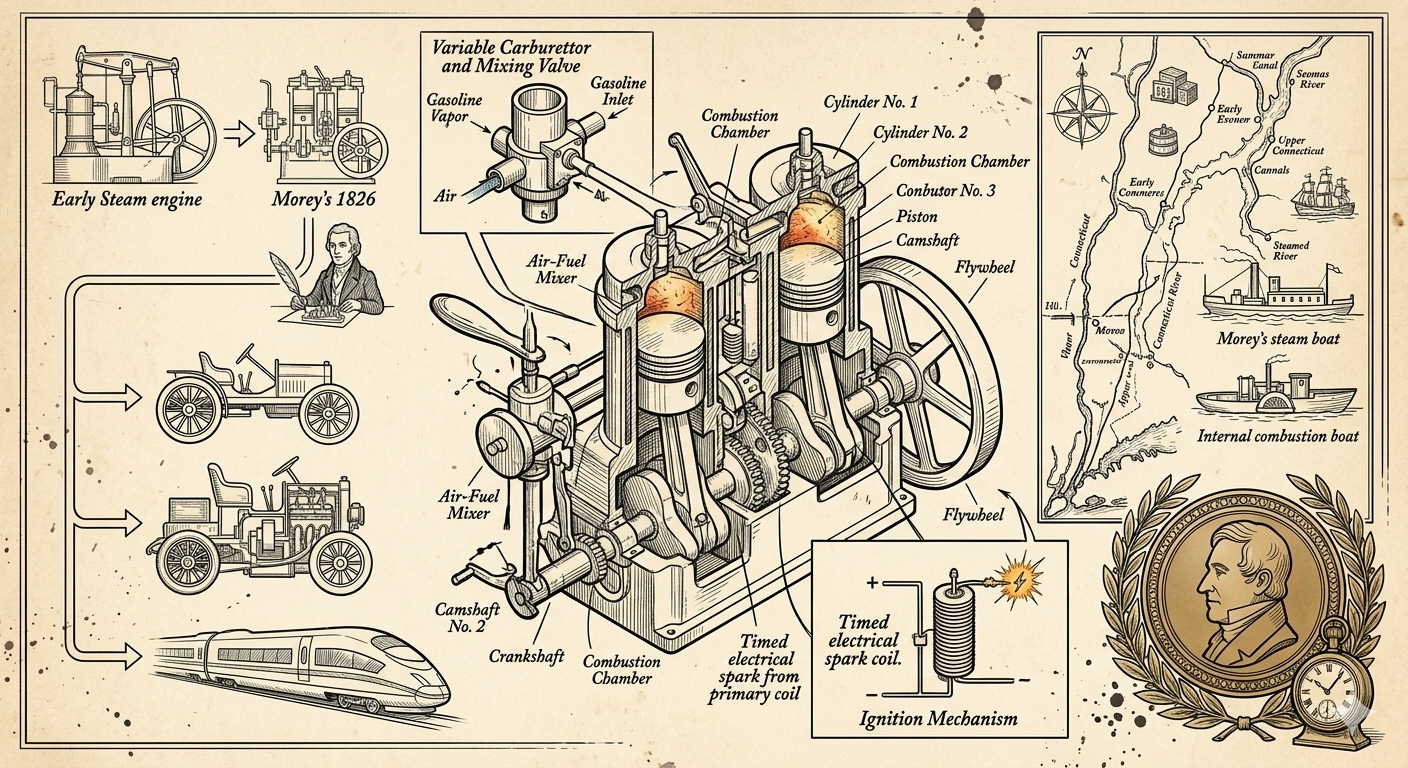
On April 1, 1826, American inventor Samuel Morey received United States Patent Number X4,378 for his groundbreaking “Gas or Vapor Engine,” marking a pivotal moment in the history of mechanical engineering and transportation. This patent represented the first documented internal combustion engine design in the United States and introduced several revolutionary concepts that would later become fundamental components of modern automotive technology. Morey’s innovative engine design, featuring the world’s first liquid fuel carburetor and advanced safety mechanisms, laid the foundation for the transportation revolution that would transform society over the following century.
The Visionary Inventor: Samuel Morey’s Early Life and Background
Samuel Morey was born on October 23, 1762, in Hebron, Connecticut, during the early years of American colonial development. Growing up in a family involved in transportation and commerce, Morey developed an early fascination with mechanical systems and power generation. His father operated a ferry service across the Connecticut River, which provided young Samuel with firsthand exposure to the challenges and possibilities of mechanical transportation. This early experience with river commerce and the locks he later designed along the Connecticut River system shaped his understanding of power transmission and mechanical efficiency.
Morey’s educational background combined practical mechanical knowledge with scientific curiosity, a combination that would prove essential for his later innovations. During the late 18th century, the Industrial Revolution was beginning to transform American society, and inventors like Morey recognized the enormous potential for mechanical power to replace human and animal labor. His diverse interests and experimental approach to problem-solving led him to pursue innovations across multiple fields, from steam engines to gas lighting systems, ultimately culminating in his revolutionary work on internal combustion engines.
The inventor’s early career demonstrated remarkable versatility and innovation. His first patent, granted in 1793, covered a steam-powered rotisserie spit, revealing his interest in applying mechanical power to everyday tasks. This early success encouraged Morey to pursue more ambitious projects, including steamboat development and advanced steam engine designs. His accumulated twenty patents throughout his career reflected a consistent pattern of identifying practical problems and developing mechanical solutions that often anticipated technological needs by decades.
The Steam Engine Foundation: Building Toward Internal Combustion
Morey’s journey toward the internal combustion engine began with extensive work on steam power systems during the 1790s. His steamboat experiments, conducted as early as 1793 on the Connecticut River, demonstrated his understanding of power transmission and mechanical propulsion. Legend suggests that Morey conducted his first steamboat trials on Sunday mornings when the local population attended church services, hoping to avoid public ridicule if his experiments failed. This cautious approach reflected both the innovative nature of his work and the skepticism that often greeted mechanical innovations during this period.
The inventor’s 1815 patent for a “revolving” steam engine marked a significant advancement in steam technology and provided crucial experience that would inform his later internal combustion work. This rotary steam engine design, described in detail in the American Journal of Science in 1819, featured several innovations that improved efficiency and reduced fuel consumption compared to contemporary designs. The engine found commercial applications in tugboats, glass manufacturing, and sawmill operations, including installation at the Boston Naval Yard. One tugboat equipped with Morey’s engine successfully sailed to South Carolina, where its performance impressed the vessel’s owner and demonstrated the practical value of the inventor’s mechanical innovations.
During his steam engine development work, Morey conducted extensive experiments with combustion and fuel gases that would prove essential for his internal combustion engine design. He observed that passing steam over burning coal or tar caused flames to burn brighter and without smoke, theorizing correctly that steam decomposition was occurring during this process. These observations caught the attention of prominent French chemist Gay-Lussac, who commented on Morey’s experiments in Annales de Chimie et de Physique in 1819. Although Gay-Lussac initially disputed Morey’s theoretical explanation, the American inventor had correctly identified the production of what is now known as town gas, a discovery that would influence his later work with explosive vapor mixtures.
The Revolutionary Discovery: Turpentine Vapor and Explosive Potential
Morey’s breakthrough discovery came during his experiments with various combustible materials and their interaction with steam and air. While investigating different fuel sources and combustion characteristics, he observed that turpentine vapor, when mixed with air in proper proportions, created a highly explosive mixture that could generate substantial mechanical force. This discovery represented a crucial leap from external combustion systems, where fuel burned outside the working cylinder, to internal combustion, where the explosive force occurred directly within the engine’s working chamber.
The significance of this discovery extended far beyond its immediate mechanical applications. Morey recognized that explosive vapor combustion could potentially provide more efficient power generation than steam engines, which required separate boilers, fuel systems, and complex steam distribution networks. The direct conversion of chemical energy to mechanical work through controlled explosions offered the possibility of more compact, efficient, and responsive power sources suitable for a wide range of applications.
Morey’s systematic approach to developing his internal combustion concept involved extensive experimentation and documentation. He wrote detailed unpublished descriptions of his engine design in 1824, which he subsequently modified in 1825 and 1826 before filing his patent application. These revisions primarily focused on improving the engine’s valve systems and optimizing the timing of fuel introduction and exhaust removal. The careful documentation of his development process demonstrates Morey’s scientific methodology and his understanding of the need for precise mechanical timing in internal combustion engines.
The Patent Details: Revolutionary Design Elements and Technical Specifications
Samuel Morey’s April 1, 1826 patent for his “Gas or Vapor Engine” introduced several revolutionary design concepts that would become standard features of modern internal combustion engines. The patent documentation described a sophisticated two-cylinder engine equipped with a carburetor system designed specifically for liquid fuel vaporization. This carburetor design represented the world’s first documented system for creating the precise air-fuel mixtures necessary for efficient internal combustion, making Morey’s patent a foundational document in automotive engineering history.
The engine’s operational principle differed significantly from modern internal combustion engines while incorporating several concepts that would later become standard. Unlike contemporary engine designs that relied on direct explosive force to drive pistons, Morey’s system used controlled explosions to expel air from cylinders through one-way valves. Following the explosion, water injection and external cooling created a vacuum within the cylinder, allowing atmospheric pressure to drive the piston through its power stroke. This atmospheric pressure principle shared similarities with early steam engine designs while incorporating the efficiency advantages of internal combustion.
Morey’s patent included detailed specifications for valve arrangements and cam systems that controlled the precise timing of fuel introduction, ignition, and exhaust removal. The engine featured water jacket cooling around the cylinders, an innovation that anticipated the cooling systems used in modern engines. The inventor also incorporated safety features that demonstrated his understanding of the potential dangers associated with explosive vapor systems. Most notably, his design included wire mesh barriers designed to prevent combustion from reaching the carburetor, a safety innovation so advanced that it was independently reinvented and patented again in 1872 after the original patent documentation was lost in the devastating 1836 Patent Office fire.
Practical Demonstrations: New York and Philadelphia Public Exhibitions
Following his successful patent application, Morey embarked on an ambitious campaign to demonstrate his internal combustion engine’s practical capabilities. His public demonstrations in New York and Philadelphia attracted considerable attention from engineers, investors, and the general public, representing some of the earliest public exhibitions of internal combustion technology in American history. These demonstrations provided crucial proof-of-concept evidence that internal combustion engines could perform useful work in real-world applications.
The Philadelphia demonstration proved particularly memorable and historically significant. Morey successfully demonstrated his engine powering both a boat and a wheeled wagon, showcasing the technology’s versatility across different transportation applications. The boat demonstration proceeded smoothly, impressing observers with the engine’s ability to provide consistent propulsion without the bulk and complexity of steam boiler systems. However, the wagon demonstration took an unexpected turn that would become part of automotive history folklore.
During the street demonstration of his engine-powered wagon on Philadelphia’s Market Street, Morey encountered operational difficulties that highlighted both the promise and challenges of early internal combustion technology. After starting the engine, he fell from the vehicle, which then proceeded to cross Market Street under its own power before ending in a ditch. Despite the demonstration’s dramatic conclusion, this event represented the second automobile ride in recorded history and the first such journey in the United States, predating the generally recognized beginning of the American automotive era by nearly seven decades.
Eyewitness accounts of both New York and Philadelphia demonstrations provided valuable documentation of early internal combustion engine performance. Observers noted the engine’s relatively quiet operation compared to steam engines, the absence of visible smoke or steam emissions, and the mechanical precision of its operation. These accounts also revealed the challenges Morey faced in controlling engine speed and power output, problems that would continue to challenge internal combustion engine developers for decades.
Technical Innovations: Carburetor Design and Safety Features
Morey’s carburetor design represented perhaps his most significant technical contribution to internal combustion engine development. The system used heated surfaces to vaporize liquid turpentine fuel, mixing the resulting vapors with air in proportions optimized for efficient combustion. This heated surface carburetor principle anticipated carburetor designs that would become standard in automotive applications decades later, demonstrating Morey’s sophisticated understanding of fuel-air mixture requirements for consistent engine performance.
The carburetor system incorporated several innovative features that addressed practical challenges associated with liquid fuel vaporization. The heated surface design ensured consistent fuel vaporization across varying ambient temperatures, while adjustable air intake controls allowed operators to optimize mixture ratios for different operating conditions. These features reflected Morey’s practical experience with fuel combustion systems and his recognition of the importance of precise mixture control for reliable engine operation.
The wire mesh safety barrier that prevented combustion from reaching the carburetor represented an advanced understanding of explosion prevention principles. This flame arrester design demonstrated Morey’s awareness of the potential dangers associated with explosive vapor systems and his commitment to developing safe, practical engine designs. The fact that this safety feature was independently reinvented and patented in 1872 underscores its technological sophistication and the advanced nature of Morey’s original design concepts.
Additional safety features incorporated into Morey’s design included pressure relief valves, temperature monitoring systems, and emergency shutdown procedures. These safety considerations reflected the inventor’s understanding that successful commercialization of internal combustion technology would require public confidence in the safety and reliability of explosive vapor systems. His comprehensive approach to safety engineering anticipated many of the safety standards that would become mandatory in later automotive development.
Commercial Challenges and Market Reception
Despite the technical sophistication and successful demonstrations of his internal combustion engine, Morey encountered significant challenges in commercializing his invention. The American industrial landscape of the 1820s was dominated by steam power and water-powered mills, with limited infrastructure or market demand for the specialized fuels and maintenance required by internal combustion systems. Potential investors and manufacturers struggled to envision practical applications for internal combustion technology that could compete with established steam power systems.
The economic climate of the mid-1820s also worked against Morey’s commercialization efforts. The United States was experiencing economic uncertainty following the Panic of 1819, and investors were generally cautious about supporting unproven technologies. Steam engine technology had achieved widespread commercial acceptance and offered the advantage of using readily available fuel sources, while Morey’s engine required specialized liquid fuels that were not widely available or economically competitive with coal and wood.
Morey’s attempts to find buyers for his patent rights reflected the broader challenges facing innovative technologies during this period. A letter from Reverend Dana of Orford, written in October 1829, documented Morey’s trip to Baltimore in search of potential buyers. Dana wrote that “the Capt. is determined to make one more vigorous effort, to sell his patent right for some of his modern inventions [he later singles out the vapor engine], and if he does not now succeed, he will give the matter up, and return to Orford, to spend his days in quiet.” This correspondence reveals Morey’s growing frustration with his inability to commercialize what he recognized as revolutionary technology.
The failure to achieve commercial success during Morey’s lifetime reflected not the inadequacy of his technical innovations, but rather the premature nature of his invention relative to market conditions and supporting infrastructure. The sophisticated manufacturing techniques, precision materials, and specialized fuel distribution systems required for successful internal combustion engine commercialization would not become available until decades later, when industrial development had advanced sufficiently to support mass production of complex mechanical systems.
International Context: Contemporary Internal Combustion Development
Morey’s internal combustion engine patent emerged during a period of intense international innovation in power generation and mechanical engineering. While his work represented the first documented internal combustion engine patent in the United States, European inventors were simultaneously pursuing similar technologies through different approaches. Understanding this international context illuminates both the originality of Morey’s contributions and the broader technological momentum driving internal combustion development during the early 19th century.
The French inventor François Isaac de Rivaz had received a patent for a hydrogen and oxygen-powered internal combustion engine in 1807, nearly two decades before Morey’s patent. De Rivaz’s engine successfully powered a crude four-wheeled wagon over a distance of 100 meters in 1813, demonstrating the feasibility of internal combustion propulsion for land vehicles. However, de Rivaz’s engine relied on hydrogen gas rather than liquid fuel and lacked the sophisticated carburetor system that distinguished Morey’s design.
British inventors also contributed to early internal combustion development during this period. Robert Street had patented an internal combustion engine design in 1794, making him potentially the first inventor to use liquid petroleum fuel in an internal combustion system. However, Street’s engine design lacked the advanced features that characterized Morey’s system, particularly the sophisticated carburetor and safety systems. Thomas Mead also received a British patent for a gas engine in 1794, contributing to the growing international interest in internal combustion technology.
The Italian engineers Eugenio Barsanti and Felice Matteucci would later receive what many consider the first patent for a practical internal combustion engine in London on June 12, 1854. Their design used the vacuum created by cooling combustion gases to drive pistons, a principle that shared similarities with Morey’s atmospheric pressure approach. However, Morey’s earlier patent and his use of liquid fuel and advanced carburetor design established his priority in several crucial areas of internal combustion technology.
The Lost Patent and Historical Rediscovery
The historical significance of Samuel Morey’s internal combustion engine patent was nearly lost to posterity due to the catastrophic Patent Office fire of December 15, 1836. This devastating blaze destroyed thousands of early American patent documents, including Morey’s original internal combustion engine patent and supporting documentation. The loss of these crucial historical records meant that Morey’s contributions to automotive technology remained largely unknown to later generations of engineers and historians for more than a century and a half.
The 1836 Patent Office fire had far-reaching consequences for American technological history, eliminating documentation for thousands of early innovations and making it difficult for later inventors to verify the originality of their designs. In Morey’s case, the loss of his patent documentation meant that his flame arrester design was independently reinvented and patented in 1872 by inventors who were unaware of his prior work. This pattern of “reinvention” due to lost documentation affected numerous early American innovations and complicated efforts to establish accurate historical timelines for technological development.
The remarkable rediscovery of Morey’s patents occurred in 2004 when ten of his patent documents, including the crucial internal combustion engine patent, were found in the Dartmouth College archives. This discovery revolutionized understanding of early American automotive history and established Morey’s rightful place as a pioneer of internal combustion technology. The Dartmouth archives had preserved these documents independently of the Patent Office, creating an invaluable historical record that had survived nearly two centuries of potential loss or destruction.
The rediscovery of Morey’s patents sparked renewed interest in his contributions to automotive technology and led to a reassessment of early American innovation in mechanical engineering. Historians and engineers began to recognize that American inventors had been pursuing internal combustion technology much earlier than previously documented, and that the foundations of the American automotive industry could be traced back to innovative work conducted decades before the generally recognized beginning of the automotive era.
Modern Recognition and Historical Impact
Contemporary recognition of Samuel Morey’s contributions to internal combustion technology has grown significantly since the rediscovery of his patents in 2004. Charles Duryea, who produced the first gasoline-powered automobile in America in 1893, was among the first twentieth-century figures to recognize Morey’s historical significance. Duryea funded the creation of two working replicas of Morey’s engine, one of which is now housed in the Smithsonian Institution while the other is owned by renowned inventor Dean Kamen. These replicas provide tangible evidence of Morey’s technical sophistication and allow modern engineers to study his innovative design concepts.
The Smithsonian’s recognition of Morey’s engine as a significant artifact in American technological history reflects the growing appreciation for his contributions to automotive development. Museum displays featuring Morey’s engine help educate visitors about the deep historical roots of American automotive innovation and challenge common assumptions about the timeline of internal combustion engine development. The preservation and exhibition of these replicas ensure that Morey’s legacy will continue to inspire future generations of engineers and inventors.
Modern automotive enthusiasts have also embraced Morey’s legacy, with notable figures like comedian and car collector Jay Leno highlighting his contributions to automotive history. Leno’s recognition of Morey’s work has helped bring the inventor’s story to a broader audience and demonstrated the continuing relevance of early automotive innovations. This popular recognition complements academic and museum efforts to preserve and promote understanding of Morey’s historical significance.
A historical marker in Vermont commemorates Morey’s achievements with an inscription that captures the scope of his innovations: “Samuel Morey, resident of Orford (New Hampshire) and later Fairlee (Vermont), successfully operated a steamboat on the Conn. River in 1793. Making over 4000 experiments, this early scientist patented an internal combustion engine in 1826 to anticipate the age of the motor car and airplane.” This recognition acknowledges not only his specific contributions to internal combustion technology but also his broader vision of the transformative potential of mechanical power.
Technical Legacy and Modern Applications
The technical innovations incorporated into Samuel Morey’s 1826 internal combustion engine patent established foundational principles that continue to influence modern automotive engineering. His carburetor design anticipated the fuel-air mixing systems that would become standard in internal combustion engines for more than a century, from early automotive applications through the era of electronic fuel injection systems. The heated surface carburetor principle that Morey pioneered demonstrated a sophisticated understanding of fuel vaporization requirements that would be refined and developed by countless later engineers.
Morey’s emphasis on safety engineering, particularly his flame arrester design, established precedents for the comprehensive safety systems that characterize modern automotive technology. Contemporary automotive engineers continue to grapple with challenges related to fuel system safety, emission control, and explosion prevention that Morey identified and addressed in his original design. His recognition that successful internal combustion technology would require both performance and safety considerations anticipated the regulatory environment that would eventually govern automotive development.
The atmospheric pressure principle used in Morey’s engine design, while not adopted in modern automotive applications, contributed to understanding of pressure differentials and vacuum systems that continue to play important roles in automotive technology. Modern brake boosters, emission control systems, and various engine accessories rely on vacuum principles that trace their conceptual origins to early atmospheric engines like Morey’s design.
Morey’s systematic approach to engine development, including his extensive documentation and iterative design improvements, established methodological precedents that continue to characterize modern automotive engineering. His practice of conducting thousands of experiments, carefully documenting results, and systematically refining designs anticipated the research and development methodologies that would become standard in the automotive industry.
Educational and Inspirational Impact
Samuel Morey’s story continues to provide valuable educational content for students of engineering, history, and innovation studies. His journey from initial concept through patent application to attempted commercialization illustrates the complex challenges facing innovative technologies and the importance of persistence in technological development. Educational institutions use Morey’s example to demonstrate how individual inventors can contribute to transformative technological changes that may not be fully realized for decades.
Engineering education programs often cite Morey’s work as an example of the importance of fundamental research and the unexpected ways that early innovations can influence later technological developments. His systematic experimental approach and careful documentation practices provide models for contemporary engineering students learning about proper research methodologies and the importance of thorough technical documentation.
The interdisciplinary nature of Morey’s work, spanning mechanical engineering, chemistry, materials science, and safety engineering, demonstrates the value of broad technical knowledge in innovation. Modern engineering curricula increasingly emphasize the importance of interdisciplinary approaches to problem-solving, and Morey’s example illustrates how combining knowledge from multiple fields can lead to breakthrough innovations.
Morey’s story also provides important lessons about the relationship between technological innovation and market acceptance. His experience demonstrates that technical excellence alone is insufficient for commercial success, and that successful innovation requires consideration of economic conditions, infrastructure requirements, and market readiness. These lessons remain highly relevant for contemporary entrepreneurs and innovators working to commercialize advanced technologies.
The Enduring Legacy of Visionary Innovation
Samuel Morey’s April 1, 1826 patent for the internal combustion engine represents far more than a single technical achievement; it embodies the spirit of American innovation and the transformative power of visionary thinking. His recognition that controlled explosive force could provide efficient mechanical power anticipated the fundamental principle that would eventually power the automotive revolution and transform global transportation systems. The sophisticated technical solutions he developed for fuel vaporization, combustion control, and safety systems established engineering principles that continue to influence automotive development more than two centuries later.
The story of Morey’s internal combustion engine patent illustrates the complex relationship between individual innovation and technological progress. While his specific engine design was never commercially successful during his lifetime, the concepts and principles he pioneered provided essential foundations for the internal combustion engines that would eventually revolutionize transportation, manufacturing, and virtually every aspect of modern industrial society. His work demonstrates how individual inventors can contribute to technological transformations whose full impact may not be realized for generations.
Today, as the automotive industry undergoes another fundamental transformation toward electric and alternative power sources, Samuel Morey’s legacy provides valuable perspective on the continuous nature of technological evolution. His willingness to challenge conventional thinking, pursue innovative solutions, and persist despite commercial disappointments exemplifies the inventive spirit that continues to drive automotive innovation. The internal combustion engine that began with Morey’s 1826 patent has powered more than two centuries of transportation development and now serves as the technological foundation being transformed by the next generation of automotive innovators.
The rediscovery of Morey’s patents and the growing recognition of his contributions ensure that his place in automotive history will be preserved and celebrated. His story reminds us that the technologies we take for granted often have deep historical roots extending back to visionary individuals who possessed the courage to imagine and create mechanical solutions to human challenges. Samuel Morey’s internal combustion engine patent stands as a testament to the power of individual innovation and the enduring impact of revolutionary thinking on technological progress and human advancement.