Introduction: The Day the World Came to Hyde Park
On the morning of May 1, 1851, Queen Victoria rode in a carriage through the streets of London to Hyde Park accompanied by her husband Prince Albert, and their children. The crowds lining the route were enormous. Soldiers lined the roads, flags of every nation snapped in the breeze, and somewhere inside the vast glittering structure that had risen impossibly fast from the lawns of England’s most celebrated royal park, a two-hundred-piece orchestra and a choir of six hundred voices were rehearsing the national anthem. When the queen stepped inside the Crystal Palace — a building of cast iron and glass so large that the full-grown elm trees of Hyde Park had been enclosed within it rather than felled — and saw for the first time the full spectacle of what her husband had spent two years bringing into existence, she wrote in her diary that it was ‘the greatest day in our history and the triumph of my beloved Albert.’
The event that opened that morning was formally titled the Great Exhibition of the Works of Industry of All Nations, though it would be remembered forever simply as the Great Exhibition, or — in acknowledgment of the astonishing building that housed it — as the Crystal Palace Exhibition. It was, by any measure, the most ambitious public event ever attempted in the history of civilization to that point. More than 13,000 exhibitors from across Britain, its empire, and 44 foreign nations had gathered their finest products, inventions, and cultural treasures beneath a single roof. The building itself was three times the size of St Paul’s Cathedral. And the public response, over the five and a half months the exhibition remained open, would shatter every expectation: more than six million visitors passed through the Crystal Palace’s doors, equivalent to a third of the entire population of Britain at the time.
The Great Exhibition was not merely an event; it was a declaration. It announced to the world that Britain, at the height of its Industrial Revolution and imperial power, stood at the summit of human achievement in manufacturing, engineering, science, and design. It was also, in ways its organizers only partly anticipated, a profound democratic experiment — an occasion on which factory workers and agricultural labourers, travelling on the new railway network from every corner of the country, could stand in the same vast hall as foreign dignitaries, aristocrats, and heads of state, and marvel together at the wonders of the age. The Great Exhibition of 1851 was, as one contemporary newspaper wrote, a moment when ‘all races of the world were mobilized for the same purpose for the first time since the creation of the world.’
Part I: The Origins and Vision — How the Great Exhibition Was Conceived
The French Industrial Expositions and the Seed of an Idea
The story of the Great Exhibition begins not in London but in Paris, where a series of national industrial exhibitions had been demonstrating the commercial and cultural potential of large-scale public displays of manufactured goods since the early nineteenth century. France had staged eleven such expositions between 1798 and 1849, each growing in scale and ambition. These events — the Expositions of Products of French Industry — had become enormously popular public occasions, celebrating the achievements of French manufacturing and attracting hundreds of thousands of visitors. They also served a clear commercial and political purpose: by gathering the finest products of national industry in one place and displaying them to an admiring public, they stimulated both domestic consumer enthusiasm and international commercial prestige.
In 1849, a British civil servant named Henry Cole visited the eleventh Quinquennial Paris Exhibition and was struck by both the scale of what France had accomplished and by a significant gap he identified in the model: the French expositions were purely national events, open only to French exhibitors. There was no international dimension, no mechanism by which the products and achievements of different nations could be placed alongside one another and compared. Cole saw in this gap an extraordinary opportunity — not merely to replicate the French model in Britain, but to expand it into something genuinely unprecedented: the world’s first international exhibition of manufactured products.
Henry Cole: The Civil Servant Who Dreamed of a World Exhibition
Henry Cole was born in Bath on July 15, 1808, the son of Captain Henry Robert Cole of the 1st Dragoon Guards. He had entered the civil service as a young man and eventually rose to become an assistant keeper at the Public Record Office, but his intellectual energies ranged far beyond his official duties. Cole was a man of remarkable versatility: he studied watercolour painting under the artist David Cox, exhibited work at the Royal Academy, wrote and published children’s books under the pseudonym Felix Summerly, designed a prize-winning teapot for the Minton pottery company, and is widely credited with introducing the world’s first commercial Christmas card in 1843. His consuming professional passion, however, was the improvement of standards in industrial design — the belief that manufactured goods could and should be made both more useful and more beautiful, and that the application of artistic principles to mass production would benefit commerce, culture, and society alike.
Through his membership of the Society for the Encouragement of Arts, Manufactures and Commerce — the Royal Society of Arts — Cole had been working throughout the 1840s to build momentum for a series of exhibitions of manufactures in London. Three such exhibitions had been held in 1847, 1848, and 1849, each growing in popularity. By the time of the third exhibition, it was clear that the public appetite for such events was genuine and substantial. Cole began planning something on an altogether different scale — and began, with characteristic energy and persistence, the work of persuading the most powerful figure he could recruit to his cause.
Prince Albert: The Driving Force Behind the Exhibition
Albert Francis Charles Augustus Emmanuel, Prince of Saxe-Coburg and Gotha, had married Queen Victoria in February 1840 and had spent the years since his arrival in Britain seeking a role commensurate with his considerable intellectual gifts and reforming instincts. He was deeply interested in the relationship between art, manufacturing, and industry — in the idea that the Industrial Revolution, which was transforming British society with unprecedented speed, could be guided by aesthetic and educational principles rather than allowed to produce ugliness and exploitation unchecked. In 1843, Albert had become President of the Society of Arts, and it was in this capacity that his collaboration with Henry Cole began.
Cole had been working to secure Albert’s enthusiastic support for the expanded international exhibition since at least 1848. By the summer of 1849, Prince Albert was not merely sympathetic to the idea — he had become its most powerful and articulate champion. It was Albert who insisted that the exhibition should be international rather than purely British, and it was Albert who understood that only a royal commission with the authority and prestige of the Crown could raise the funds, navigate the political obstacles, and command the public confidence that so ambitious a project would require. On June 30, 1849, a decisive meeting at Buckingham Palace confirmed that the exhibition would be international in scope, and that a Royal Commission should be established to oversee it.
The Royal Commission of 1851 and the Gathering of Stakeholders
On October 17, 1849, a large public meeting was convened at the residence of the Lord Mayor of London, at which Henry Cole, serving as the authorized spokesman for Prince Albert, presented the plan to an audience of influential businessmen and bankers. The response was encouraging, and the process of formalizing the institutional framework moved forward rapidly. Queen Victoria granted the charter for the Royal Commission for the Exhibition of 1851 on January 3, 1850. Prince Albert was appointed president, and an Executive Committee was formed that included Henry Cole, John Scott Russell (who served as joint secretary), Charles Wentworth Dilke, Matthew Digby Wyatt, and Francis Fuller.
The commission brought together some of the most distinguished figures of Victorian public life. The building committee — charged with designing and constructing the exhibition venue — was chaired by Sir William Cubitt and included the engineers Isambard Kingdom Brunel and Robert Stephenson, and the architects Charles Barry and Thomas Leverton Donaldson. George Wallis, a designer and educator, also played a significant role in the organization. Together, these individuals constituted a remarkable concentration of Victorian talent, ambition, and institutional authority — yet the most consequential contribution to the exhibition would come from an entirely unexpected quarter.
Part II: Building the Crystal Palace — Joseph Paxton’s Architectural Miracle
The Design Competition and the Rejection of All 245 Entries
The Royal Commission’s most urgent challenge in early 1850 was finding a building large enough to house the exhibition, capable of being constructed within the extraordinary time constraint of approximately twelve months, and — critically — temporary enough to be dismantled after the event, so as not to permanently alter Hyde Park. On March 13, 1850, the building committee opened a design competition, inviting submissions that had to conform to several specifications: the building must be temporary, simple, as cheap as possible, and deliverable in time for the May 1851 opening. Within three weeks, 245 entries had been received, including 38 submissions from international competitors in Australia, the Netherlands, Belgium, Hanover, Switzerland, Brunswick, Hamburg, and France.
The committee reviewed all 245 designs and rejected every one. Two entries had been singled out for particular praise — one by Richard Turner, who had co-designed the Palm House at Kew Gardens, and one by the French architect Hector Horeau — but both were judged too expensive at their estimated cost of around £300,000. The committee then attempted to design a building itself, and the result was a cumbersome structure incorporating a massive cast iron dome designed by Isambard Kingdom Brunel. Even Brunel’s admirers found the design uninspiring, and it attracted none of the public enthusiasm that the exhibition itself was generating. With time running out and no acceptable design in hand, the project appeared to be in serious difficulty.
Joseph Paxton: The Gardener Who Designed a Palace
Joseph Paxton was born in 1803 in Worcestershire and had spent most of his career not as an architect but as a gardener — and not just any gardener, but the head gardener of the sixth Duke of Devonshire at Chatsworth House in Derbyshire, one of the grandest private estates in England. In this role, Paxton had overseen the construction of some of the most innovative glass structures in Britain, including the Great Stove at Chatsworth, a vast greenhouse that was the largest glass building in the world when it was completed in 1840. He had also built a specialized lily house to accommodate the Victoria amazonica water lily — a tropical plant that had recently been brought to England from South America — and had been so successful in coaxing the lily to flower, including producing blooms that had never before been achieved in England, that his daughter Alice had been photographed for the newspapers standing on one of the plant’s enormous floating leaves.
It was the structure of the Victoria amazonica’s leaves that would directly inspire the Crystal Palace. The lily’s leaves were remarkable natural engineering achievements — enormous flat surfaces supported by an intricate network of ribs and girders radiating from a central spine, capable of supporting considerable weight across a wide span. Paxton had studied this structure carefully in designing the lily house, and the principles he drew from it — lightweight structural ribs supporting a thin surface membrane — would inform the most famous building of the Victorian era.
The Doodle on a Sheet of Pink Blotting Paper — June 11, 1850
On June 9, 1850, Paxton attended a meeting at the offices of the building commission and spoke with Henry Cole about the exhibition building problem. Cole, who had become an enthusiastic supporter of Paxton’s work, encouraged him to develop his own proposal. Paxton left the meeting ‘fired with enthusiasm,’ went immediately to Hyde Park to walk the site, and two days later — on June 11, 1850, while attending a board meeting of the Midland Railway in Derby — produced the most consequential architectural sketch of the Victorian era. On a sheet of pink blotting paper, in the spare moments of a railway board meeting, Paxton doodled the essential concept of the Crystal Palace. The rough sketch — now preserved in the Victoria and Albert Museum — incorporated all the basic features of the finished building: a vast prefabricated structure of cast iron and glass, modular in design, capable of rapid assembly and equally rapid dismantling.
Within two weeks of that railway board meeting, Paxton had transformed the blotting-paper doodle into detailed architectural plans, structural calculations, and cost estimates. His submission was budgeted at a remarkably low £85,800 — less than 30 percent of the estimated cost of Richard Turner’s rejected design, and a fraction of what a traditional brick-and-mortar building would have cost. The commission accepted Paxton’s scheme and gave its public endorsement to the design in July 1850. The construction contract was awarded to Fox, Henderson and Co., whose director Charles Fox would himself be knighted for his contribution to the project.
Dimensions, Materials, and the Engineering Marvel of Construction
The statistics of the Crystal Palace are staggering by any era’s standards, and in 1850 they were simply without precedent. The building stretched 1,851 feet in length — a measurement that was not coincidental but was chosen to match the year of the exhibition — with an interior height of 128 feet and a floor area of approximately 990,000 square feet. It was three times the size of St Paul’s Cathedral. The building was constructed entirely from prefabricated cast iron columns and beams, assembled on site using a system of modular units based on a 10-inch by 49-inch module — the size of the largest pane of glass that could be manufactured at the time. The 293,000 panes of glass required for the building were supplied by the Chance Brothers glassworks in Smethwick — the only facility in Britain capable of producing glass at that scale — which had to recruit additional labour from the Saint-Gobain glassworks in France to meet the enormous order.
The construction process itself was a feat of Victorian industrial organization. By the end of December 1850, approximately 2,000 workers were employed on the building, rising to around 5,000 navvies involved at various stages of the project. The entire structure was completed in just thirty-nine weeks — from the acceptance of Paxton’s design to the grand opening on May 1, 1851. This achievement was made possible by the modular prefabrication system, which allowed components to be manufactured simultaneously in factories across Britain and assembled on site like an enormous three-dimensional jigsaw puzzle. The building’s design also incorporated one of its most celebrated features almost accidentally: Paxton added a high barrel-vaulted transept across the centre of the main gallery, at ninety degrees to the primary axis, which allowed the large elm trees that had been growing in Hyde Park for decades to be enclosed within the building rather than felled. This elegant solution transformed what had been a major controversy into one of the building’s most charming features.
The Name That Stuck: How ‘Crystal Palace’ Was Born
The building did not initially have a popular name. It was referred to officially as the ‘Great Exhibition building’ or simply as the exhibition hall. The name that would attach itself permanently to the structure — and eventually to the entire area of south London where it was later relocated — came from the world of Victorian journalism and satire. In July 1850, the playwright Douglas Jerrold wrote a piece in the satirical magazine Punch about the forthcoming exhibition, in which he referred to a ‘crystal palace.’ The phrase captured the public imagination instantly. By the time the building opened in May 1851, ‘Crystal Palace’ had become its universal and unofficial name — the name by which it would be known for the rest of its existence, and by which the memory of the exhibition has been transmitted to posterity.
Part III: Controversy, Opposition, and the Road to Opening
Parliamentary Critics and The Times — The Battle Over Hyde Park
The Great Exhibition and its proposed venue in Hyde Park attracted fierce opposition long before the building was completed. The most vocal institutional critic was The Times newspaper, which campaigned strenuously against the use of one of London’s most treasured public parks as a construction site. Parliamentary opposition was led by Colonel Charles Sibthorp, a Conservative Member of Parliament for Lincoln and one of the most notoriously reactionary figures in Victorian politics, who denounced the exhibition as ‘one of the greatest humbugs, frauds and absurdities ever known.’ Sibthorp’s objections were a mixture of xenophobia — he was appalled by the prospect of foreign visitors flooding into London — and genuine concern about the precedent of allowing a commercial enterprise to occupy royal parkland. His opposition was vigorous, persistent, and ultimately futile, but it reflected a broader current of anxiety in conservative British opinion about the exhibition’s internationalism and its implicit challenge to traditional social hierarchies.
The concerns about Hyde Park were not entirely irrational. The exhibition’s opponents pointed out that the construction of a building of such vast dimensions would inevitably damage the park, and that the millions of visitors expected to attend would cause disruption to the surrounding area of west London. Members of Parliament who lived or owned property near Hyde Park were particularly alarmed. The Times editorialized repeatedly against the project, and its support for the opposition gave the anti-exhibition campaign a degree of public credibility that the commission could not entirely ignore. Prince Albert, who followed the controversy closely and was personally wounded by some of the more vitriolic criticism, came close to despair on several occasions as the political resistance intensified.
How Paxton’s Design Resolved the Great Elm Tree Controversy
One of the most symbolically charged aspects of the Hyde Park controversy concerned the park’s elm trees. The site selected for the exhibition building contained several large, mature elm trees that had been growing in Hyde Park for generations and were regarded with considerable affection by Londoners. Critics of the exhibition argued that constructing a building on the site would inevitably require the felling of these trees, and the prospect aroused strong public sentiment against the project. This was not a trivial objection: the destruction of beloved old trees in a public park for the purposes of a commercial exhibition struck many Victorians as an act of vandalism against the shared environment.
Paxton’s solution was characteristically elegant. By adding the high barrel-vaulted transept to the centre of his design, he was able to increase the interior height of the building at its central point to a level that allowed the largest of the elm trees to be enclosed within the structure, standing inside the Crystal Palace with their branches spreading freely in the glass-covered air. Visitors to the exhibition could stand beneath full-grown trees that had been growing in Hyde Park before the exhibition was even conceived, their roots still in the earth of the park, their canopy visible against the glass ceiling above. The sparrows that nested in the elm trees presented a different sort of problem: shooting birds inside a glass building was obviously impossible, and the queen herself mentioned the difficulty to the Duke of Wellington. The Iron Duke’s solution was characteristically laconic: ‘Sparrowhawks, Ma’am.’
Funding the Exhibition: Public Subscription and Financial Risk
From the outset, Prince Albert had insisted that the Great Exhibition would be entirely self-financing — that it would receive no government money and would depend entirely on public subscription for its initial capital and on ticket revenues for its operational income. This was a deliberate political choice, designed to demonstrate the viability of voluntary public support for large-scale cultural enterprise and to insulate the project from the objections of those in Parliament who would have used any government funding as a lever for obstruction. The commission raised its initial capital through subscriptions from businesses, merchants, and wealthy individuals, and committed to building the Crystal Palace and running the exhibition without a penny of taxpayer money.
The financial risk was considerable. If the exhibition failed to attract sufficient visitors, the commission would be left with debts it could not repay and a catastrophic public failure attached to the names of Prince Albert and Queen Victoria. The building itself, at a budgeted cost of £85,800, was only the beginning of the financial exposure. The total cost of mounting the exhibition was far greater, and the margin between financial success and ruinous failure depended entirely on whether the British public — and foreign visitors — would come in sufficient numbers.
Part IV: The Grand Opening of May 1, 1851 — Queen Victoria and the Ceremony of the Age
The Opening Ceremony: Orchestras, Choirs, and the Queen’s Arrival
On the morning of May 1, 1851, London was in a state of extraordinary excitement. The streets between Buckingham Palace and Hyde Park were lined with enormous crowds. Queen Victoria described the scene in her diary with evident joy: the park presented ‘a wonderful spectacle, crowds streaming through it — carriages and troops passing.’ As the royal procession approached the Crystal Palace, she noted that ‘the sun shone and gleamed upon the gigantic edifice, upon which the flags of every nation were flying.’ Inside the building, a full orchestra of two hundred musicians, a choir of six hundred voices, and a massive pipe organ had assembled to provide a musical backdrop worthy of the occasion. When Queen Victoria and Prince Albert entered the building and took their places at the centre of the nave, the assembled musicians and singers launched into a thunderous rendition of the national anthem, followed by the ‘Hallelujah’ chorus from George Frideric Handel’s Messiah. The sound in a building of that size, under glass, would have been overwhelming.
The opening ceremony was attended by more than 25,000 people who had obtained season tickets or official invitations — members of the Royal Commission, parliamentarians, foreign diplomats, representatives of the exhibiting nations, and distinguished guests from every sphere of Victorian public life. The ceremony included a prayer by the Archbishop of Canterbury and an address by Prince Albert, who spoke of the exhibition as an embodiment of the idea that the nations of the world could come together in peaceful competition and mutual respect — a vision that was, perhaps, more idealistic than the realities of Victorian imperialism fully supported, but which was sincerely held and powerfully expressed. Queen Victoria formally declared the Great Exhibition open, and the Crystal Palace’s doors were thrown wide for what would prove to be the most visited public event in British history to that date.
Queen Victoria’s Personal Connection to the Exhibition
Queen Victoria was not merely a ceremonial presence at the Great Exhibition; she was a deeply engaged participant. She visited the Crystal Palace a remarkable 34 times during the exhibition’s run, sometimes accompanied by members of her family and sometimes alone, wandering the galleries and examining exhibits with evident fascination. Her diary entries from these visits constitute one of the most vivid personal records of the exhibition’s contents and atmosphere: she wrote of hydraulic machines and pumps, of filtering machines and sugar-purifying apparatus, of printing machines that could produce hundreds of sheets per minute, and of the overwhelming abundance of things on display — ‘I cannot complain about nothing good to see — in fact, there are too many to see.’
The queen’s enthusiasm was genuine and unaffected. She understood, better than almost anyone, what the exhibition represented for her husband — the culmination of years of work and the public vindication of his vision — and her vocal delight in everything she saw was both a personal expression and a political endorsement. Her enthusiasm also helped to legitimize the exhibition for a British public that might otherwise have been more ambivalent about an event so explicitly international in character. When the queen was seen to delight in the exhibits of France, Prussia, and the United States alongside those of Britain and its colonies, it sent a powerful signal about the spirit in which the Great Exhibition was to be received.
Part V: Inside the Crystal Palace — The Exhibits, the Wonders, and the Spectacle
The Layout and Organization of the Exhibition Space
The interior of the Crystal Palace was divided along a single grand principle: the western half of the building was devoted to Britain and its colonial territories, while the eastern half housed the exhibits of the 44 foreign nations that had accepted the invitation to participate. This arrangement was partly a reflection of organizational logic and partly a statement about the exhibition’s underlying purpose: by placing Britain at the centre of the building — in the half that contained the building’s most prominent features, including the great elm trees and the Crystal Fountain — the exhibition made visible the proposition that Britain occupied the central position in the world of industrial civilization.
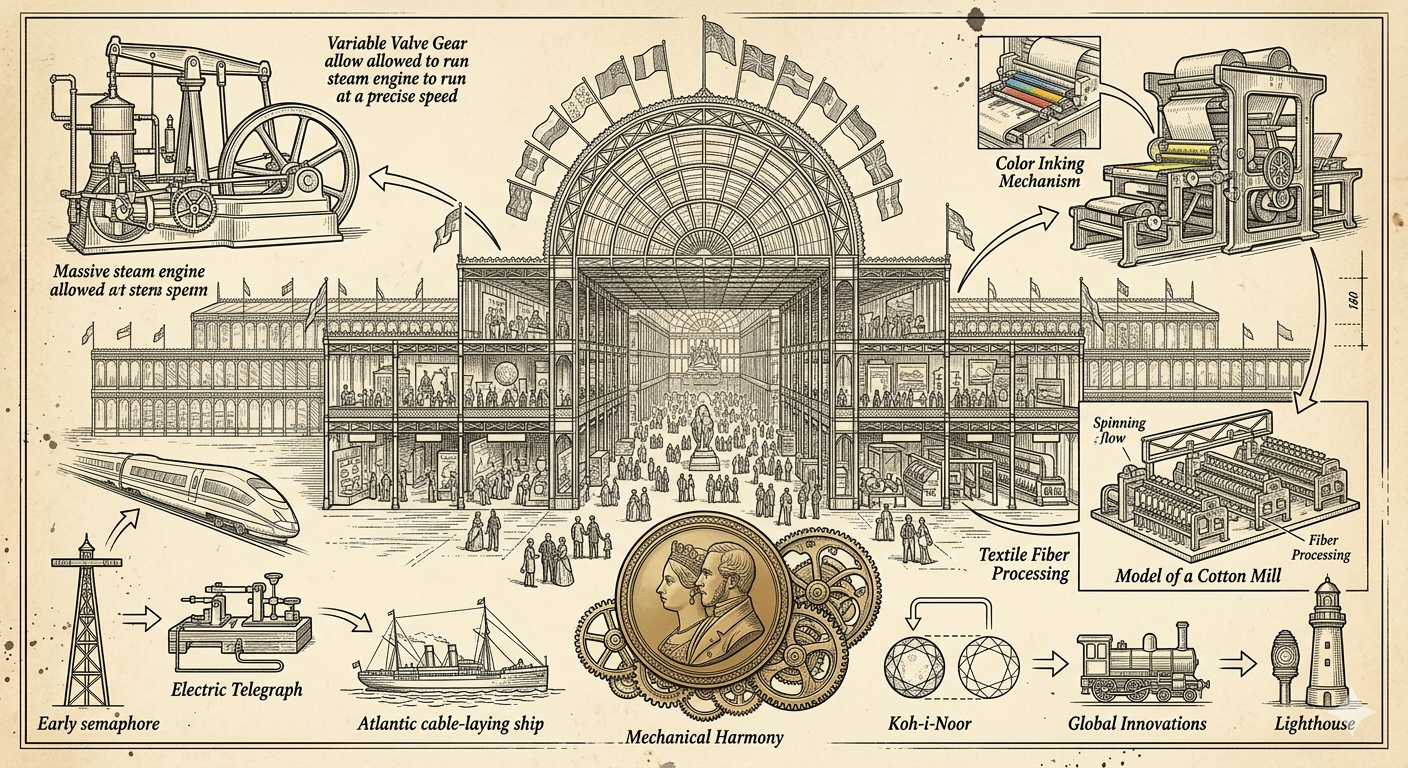
The exhibits were organized into four broad divisions: raw materials, machinery, manufactures, and fine arts. The raw materials section displayed the natural products of countries across the globe, from mineral samples and agricultural produce to exotic woods and fibres. The machinery section was one of the most popular parts of the exhibition, featuring working demonstrations of steam engines, hydraulic presses, spinning machines, printing machines, and the full range of industrial technology that the mid-nineteenth century had produced. The manufactures section displayed finished goods of every description, from ceramics and glass to textiles, furniture, and firearms. The fine arts section included sculpture and architectural models, though painting was explicitly excluded from the exhibition’s scope.
The Star Attractions: The Koh-i-Noor Diamond, the Crystal Fountain, and More
Among the 100,000 or more objects on display in the Crystal Palace, certain exhibits attracted disproportionate public attention and became the defining attractions of the event. The Koh-i-Noor diamond — whose name means ‘Mountain of Light’ in Persian — was one of the most anticipated exhibits. At the time of the exhibition, it was the world’s largest known diamond, and it had been surrendered to Queen Victoria in 1850 following the British annexation of the Punjab and the signing of the Treaty of Lahore after the Second Anglo-Sikh War. The gem was displayed in the India section of the exhibition, where it was expected to be one of the great sensation. Unfortunately, the diamond disappointed many visitors: its cut left it looking somewhat dull under the available lighting, and spectators struggled to appreciate its fabled brilliance. Prince Albert personally intervened, commissioning a special display cabinet with concealed lamps and strategically placed mirrors designed to enhance the stone’s appearance, but the improvements were modest, and public interest in the diamond eventually waned.
Far more universally admired was the Crystal Fountain at the very centre of the building — an extraordinary object standing twenty-seven feet tall and constructed from four tons of pink-tinted glass. The fountain, created by the firm of F. & C. Osler of Birmingham, was both a dazzling technical achievement and a symbolic centrepiece, its cascading water catching and refracting the light that poured through the glass ceiling above. It became one of the most reproduced images of the entire exhibition, featuring in drawings, engravings, and early photographs. Other memorable exhibits included the neo-Gothic medieval court designed by the celebrated architect and designer Augustus Welby Northmore Pugin, filled with ecclesiastical metalwork and decorated furniture that demonstrated the Victorian passion for Gothic Revival aesthetics. The India section was particularly admired for its rich textiles and its display of a howdah mounted on a stuffed elephant. Frederick Bakewell demonstrated a precursor to the fax machine. American exhibitors contributed Colt’s repeating pistol, McCormick’s mechanical reaper, Goodyear india rubber goods, false teeth, and artificial legs.
British Industrial Supremacy on Display: Steam, Steel, and Innovation
The British sections of the exhibition were dominated by the machinery and heavy industrial equipment that had made Britain the workshop of the world. Enormous steam engines stood in the nave, their pistons moving in slow, stately demonstration cycles that gave visitors an impression of the colossal power at Britain’s industrial command. Hydraulic presses capable of lifting weights that would have been incomprehensible to an earlier generation towered over visitors. Automated cotton-spinning machines — the ‘cotton mules’ that had transformed the textile industry of the north of England — demonstrated the mechanical ingenuity that had made British cloth the cheapest and most abundant in the world. Working printing machines produced hundreds of sheets per minute, making visible the technology that was beginning to transform literacy and communication across the industrialized world.
Among the more unusual British exhibits was a demonstration by the American-born locksmith Alfred Charles Hobbs, who used the exhibition as a platform to demonstrate publicly the inadequacy of several of the most respected British security locks — including the Bramah lock, which had stood unchallenged for decades. Hobbs opened the Bramah lock in fifty-one hours, causing considerable embarrassment to its manufacturers and a significant sensation in the press. William Chamberlin Jr. of Sussex exhibited what may have been the world’s first voting machine, which counted votes automatically and employed an interlocking mechanism to prevent multiple voting. And the Crystal Palace’s Retiring Rooms — the first major installation of public flush toilets in Britain, designed by sanitary engineer George Jennings — were used by 827,280 visitors, each of whom paid one penny for the facility. The phrase ‘spending a penny’ became a popular euphemism that would persist in the English language for generations.
Foreign Nations and the Global Panorama of Industry and Culture
The eastern half of the Crystal Palace presented a panorama of the world’s manufacturing and cultural achievements that was genuinely extraordinary for any Victorian who had not traveled widely. France sent 1,760 exhibits, including fine furniture, porcelain, textiles, and luxury goods that demonstrated the French tradition of combining artistic refinement with industrial production. The United States contributed 560 exhibits, many of them distinctly American in character — the practical, functional, sometimes eccentric inventions of a young industrial nation developing its own technological tradition. Prussia, Austria, the German states, Belgium, and the Netherlands displayed manufacturing products ranging from precision instruments to musical instruments. The empire of China contributed decorative arts and curiosities. The colonies of the British Empire were represented throughout the British sections, with the Caribbean exhibits notably displaying raw agricultural produce — including sugarcane — in ways that reflected, and implicitly celebrated, the exploitative colonial economic model that underpinned British imperial wealth.
The Minton ceramics firm exhibited its new majolica ware — a type of brightly coloured, tin-glazed pottery that would go on to achieve worldwide commercial success — at the Great Exhibition, and the display helped launch majolica as a global fashion. Mathew Brady, the American photographer, was awarded a medal for his daguerreotypes. The early eighth-century Tara Brooch, discovered only in 1850, was exhibited by the Dublin jeweller George Waterhouse alongside a display of Celtic Revival jewellery. The overall effect of the international sections was to create, for millions of British visitors who had never left their country, a vivid sense of the diversity and richness of the wider world — a sensation that was both genuinely educational and, in the imperial context of the exhibition, carefully curated to suggest British superiority.
Part VI: Six Million Visitors — Who Came to the Great Exhibition and How
Shilling Days and the Democratization of the Exhibition
When the Great Exhibition opened on May 1, 1851, tickets were priced at £1 on the first two days — a sum equivalent to more than £100 in twenty-first century money and far beyond the means of most working-class Britons. For the following three weeks, the price remained at five shillings, still too expensive for factory workers and agricultural labourers. The exhibiting commission had initially expected the exhibition to attract its largest audiences from the middle and upper classes, but by the end of May, it was apparent that the volumes of visitors were falling short of projections, and that the working classes had been effectively excluded by the pricing structure. The total after three weeks was only around 200,000 visitors.
The commission’s response was decisive and consequential. From the end of May, Monday through Thursday admissions were reduced to one shilling — a price that, while still a significant expense for a working family, was within reach for many who had saved specifically for the occasion. This simple pricing change transformed the character of the exhibition. The crowds that poured into Hyde Park on shilling days included factory workers from Manchester and Birmingham, agricultural labourers from the English counties, miners from Wales and the north of England, and domestic servants from across the country. More than 4.5 million of the total 6 million visitors came on shilling days. The Great Exhibition became, for a brief and extraordinary period, a genuinely democratic public space in which social class was temporarily less visible than shared amazement.
Thomas Cook, the Railways, and the Birth of the Excursion Industry
The Great Exhibition would not have attracted six million visitors without the railway network that had been spreading rapidly across Britain since the 1830s. For millions of people who lived outside London and had never before had occasion or means to travel to the capital, the combination of the exhibition’s extraordinary public profile and the availability of organized railway excursions made a visit to Hyde Park a practicable ambition for the first time. Thomas Cook — who had already been experimenting with organized railway excursions for temperance society meetings and working-class day trips since the early 1840s — arranged travel to the Great Exhibition for approximately 150,000 people, making the 1851 exhibition one of the decisive moments in the development of his travel business and, more broadly, of the commercial tourism industry that would transform leisure culture for the remainder of the century.
Church groups, trade associations, friendly societies, and employers organized group excursions to the exhibition, often providing financial assistance to help workers who could not otherwise have afforded the journey. Some employers gave their workers days off specifically to attend the exhibition, recognizing that it represented a rare opportunity for working people to see the products of their own industry assembled in one place and to understand something of the wider world of manufacturing in which their labour participated. The social experience of the journey itself — the shared excitement of the railway trip, the arrival in London, the walk through Hyde Park — was for many visitors as memorable as the exhibition itself.
Famous Visitors: From Charles Dickens to Karl Marx
The Great Exhibition attracted every stratum of Victorian society, from the humblest factory worker on a shilling day to the most illustrious figures of the age. Among the famous names recorded as visitors were the novelists Charles Dickens and Charlotte Bronte; the naturalist Charles Darwin; the philosopher and economist Karl Marx, who was living in London at the time and visited the exhibition as part of his study of industrial capitalism; and the social reformer and journalist Henry Mayhew, who subsequently wrote a comic novel about the exhibition with satirical illustrations by George Cruikshank. Queen Victoria, as already noted, visited 34 times in addition to her three formal visits with her family. The exhibition also attracted numerous foreign heads of state and dignitaries, for whom it served as both a diplomatic occasion and an opportunity to assess British industrial capabilities with a view to understanding the competitive landscape of the emerging global economy.
Among the more critically inclined visitors was the critic John Ruskin, who found the Crystal Palace aesthetically reprehensible, describing it in The Stones of Venice — published in 1851, the year of the exhibition — as the result of ‘some very ordinary algebra.’ The designer and artist William Morris, who would later become the leading figure of the Arts and Crafts movement, was also unimpressed, an attitude that would eventually crystallize into a broad cultural reaction against the mass-produced industrial aesthetics that the exhibition celebrated. These critical voices were, in 1851, a minority — but they anticipated cultural currents that would become increasingly significant in the decades to follow.
Part VII: The Closing of the Exhibition and the Fate of the Crystal Palace
October 1851: The Final Days and the Closing Ceremony
The Great Exhibition closed to the general public on October 11, 1851, with a final total attendance of 6,039,195 visitors — a number that exceeded even the most optimistic projections the commission had entertained when the exhibition opened. The average daily attendance across the full run was 42,831, with a peak single day of 109,915 visitors recorded on October 7, 1851. On October 15, Prince Albert presided over the official closing ceremony of the exhibition — a rather more sombre occasion than the triumphal opening, tinged with the melancholy of ending something that had captured the public imagination so completely. The financial result was equally gratifying: after all costs had been met, the exhibition showed a surplus of £186,000, equivalent to more than £33 million in contemporary values.
The Crystal Palace Dismantled and Reborn at Sydenham Hill
With the exhibition closed, the question of what to do with the Crystal Palace became urgent. The terms under which Paxton had been permitted to build in Hyde Park required that the structure be dismantled after the event, and the Royal Parks were determined to reclaim their territory. A consortium of prominent businessmen stepped forward to purchase the building, and in 1854 the Crystal Palace was dismantled — pane by glass pane and beam by beam — and transported approximately seven miles south to Sydenham Hill, at that time a quiet village in the Kent countryside on the outskirts of London. The relocation cost more than £1 million, substantially more than the original construction cost, and required the building to be significantly enlarged in the process. At its new home, the Crystal Palace was surrounded by parkland that included prehistoric animal sculptures created by the naturalist and artist Benjamin Waterhouse Hawkins — the first large-scale three-dimensional reconstructions of dinosaurs ever made.
At Sydenham, the Crystal Palace enjoyed a long and eventful second life as a public entertainment venue, hosting concerts, exhibitions, sporting events, and other cultural occasions. It became one of the defining landmarks of south London, beloved by the communities that grew up around it. The football club that later became Crystal Palace FC was founded in the grounds of the building in 1861 and played its early matches there, giving the club the name it still carries today. However, the building was plagued throughout its Sydenham years by chronic financial problems, and it was declared bankrupt in 1911. On the night of November 30, 1936, a catastrophic fire broke out in the building and burned it to the ground. The flames were visible across large parts of London, and newspaper reports described them as lighting up the night sky for miles around. The building was inadequately insured, and no attempt was made to rebuild it.
Part VIII: The Legacy of the Great Exhibition — Museums, Education, and a Changed World
Albertopolis: How £186,000 Built a Cultural Quarter
The financial surplus from the Great Exhibition did not sit idle. Prince Albert had from the beginning intended that any profit from the event should be used to advance the educational and cultural purposes that had motivated him to support the exhibition in the first place. In August 1851, while the exhibition was still running, Albert had already stated publicly that he wished to use the proceeds to establish permanent educational institutions in London. The commission used the £186,000 surplus to purchase a substantial tract of land in South Kensington, to the south of the exhibition site, and this land became the foundation for a concentration of museums, colleges, and cultural institutions that Londoners nicknamed, half-affectionately and half-ironically, ‘Albertopolis.’
The institutions that grew from the Great Exhibition’s financial legacy are among the most visited and celebrated in the world today. The Victoria and Albert Museum — which began as the Museum of Ornamental Art in Marlborough House and was moved to its current South Kensington location under Henry Cole’s direction — is the world’s largest museum of applied and decorative arts. The Natural History Museum, housing one of the greatest natural history collections on earth, stands a short walk away. The Science Museum, whose origins trace directly to collections assembled for and after the exhibition, is one of the most important science museums in the world. Imperial College London, now one of the world’s leading universities for science and engineering, developed from institutions established in Albertopolis in the years after the exhibition. The Royal Albert Hall, opened in 1871 and named in memory of Prince Albert, who had died in 1861, forms the centrepiece of this remarkable cultural district. The Albert Memorial in Hyde Park, unveiled by Queen Victoria in 1872, depicts Prince Albert holding a catalogue of the Great Exhibition — a permanent testament to his role as its guiding spirit.
The Spark That Lit the World — International Exhibitions After 1851
The Great Exhibition of 1851 was not merely an event; it was an institution that spawned an entire global tradition. Its extraordinary success prompted a succession of international exhibitions in cities across the world that continued almost without interruption for the remainder of the nineteenth century and well into the twentieth. Paris held its own Exposition Universelle in 1855, followed by further exhibitions in 1867, 1878, 1889, and 1900. Dublin hosted an international exhibition in 1853. New York mounted its own Crystal Palace exhibition in 1853. Vienna held a world exhibition in 1873, Philadelphia in 1876, Chicago in 1893 — where the World’s Columbian Exposition attracted more than 27 million visitors — and Paris again in 1900. Each of these events was, in a direct and acknowledged sense, the descendant of the Great Exhibition of 1851.
The model that the Great Exhibition established — a temporary purpose-built venue, exhibitors organized by nation and by category of product, a broad public audience accessible through tiered pricing, and a cultural and commercial purpose that combined national prestige with international fraternity — became the template for the World’s Fair tradition that continued throughout the twentieth century and into the twenty-first. The Universal Expositions registered today with the Bureau International des Expositions, the intergovernmental organization that coordinates world fairs, trace their institutional lineage directly to the event that Queen Victoria declared open in Hyde Park on May 1, 1851.
Henry Cole’s Lasting Contribution — The Birth of Modern Museums and Design Education
Henry Cole’s contribution to the Great Exhibition extended far beyond his role in conceiving and organizing the event. In the years following the exhibition, Cole channelled its financial legacy and cultural momentum into a sustained effort to transform the institutional landscape of British education and the arts. As the first General Superintendent of the Department of Practical Art — established by the government to improve standards of art and design education in Britain — Cole oversaw the development of a national network of art schools that would train a generation of British designers. He became the first Director of what was initially called the South Kensington Museum, which would eventually become the Victoria and Albert Museum, serving in that role from 1857 to 1873. He was appointed a Companion of the Order of the Bath for his work on the Great Exhibition and was knighted by Queen Victoria in 1875. He died in 1882 and is buried in Brompton Cemetery. The Prince Consort, who had relied on Cole so consistently that he was heard to remark ‘we must have steam, get Cole,’ did not live to see most of these institutions reach their mature form: Prince Albert died at Windsor Castle on December 14, 1861, at the age of forty-two.
Joseph Paxton and the Architecture of the Future
For Joseph Paxton, the Crystal Palace was both a personal triumph and the capstone of a remarkable career. He was knighted by Queen Victoria in recognition of his achievement, becoming Sir Joseph Paxton. The Crystal Palace’s impact on architecture was profound and lasting: it demonstrated that prefabricated iron and glass construction could achieve not merely functional but genuinely beautiful results at a scale previously unimagined, and it opened the way for the great railway stations, exhibition halls, covered markets, and eventually the glass-curtain-wall skyscrapers that would define the architecture of the twentieth century. Paxton served as a Member of Parliament for Coventry from 1854 until his death on June 8, 1865, and his original blotting-paper sketch for the Crystal Palace remains on display at the Victoria and Albert Museum — a monument to the power of a brilliant idea conceived in the margins of a railway board meeting.
The building that Paxton designed was not, in any conventional sense, architecture at all. It had no walls in the traditional meaning of the word, no structural mass, no sense of enclosure through weight and solidity. It was light made material, a greenhouse expanded to the scale of a city. It anticipated by decades the structural logic of modernist glass-and-steel construction, and its influence on architects from the mid-nineteenth century onward was incalculable. When the architectural historian Nikolaus Pevsner wrote in the twentieth century about the roots of modern architecture, the Crystal Palace occupied a central place in his analysis. It was, he argued, the first building of a new architecture — not because it was comfortable or beautiful in conventional terms, but because it solved a structural problem with pure ingenuity and no regard for tradition.
Part IX: The Great Exhibition’s Broader Significance — Empire, Class, and Victorian Values
The Exhibition as a Statement of British Imperial Power
The Great Exhibition was, among many other things, an act of political communication. It announced to the world, with unmistakable clarity, that Britain in 1851 stood at the summit of industrial civilization — that the processes of mechanization and industrialization that had been transforming the country since the mid-eighteenth century had produced a manufacturing capacity and a technological sophistication unmatched by any other nation on earth. The fact that Britain occupied one entire half of the exhibition building while all the other nations of the world shared the remaining half was a spatial statement of British supremacy that no visitor could fail to register.
The exhibition also displayed the products of British imperialism with extraordinary directness. The India section, which drew enormous crowds and was one of the most admired parts of the exhibition, showed the richness and variety of the subcontinent’s cultural production in a context that framed it as a British achievement — as evidence of the productive capacity of an empire governed from London. The Koh-i-Noor diamond, surrendered to Queen Victoria by treaty following the violent conquest of the Punjab, sat in a display case in the same section as a symbol of British military power and colonial appropriation. The Caribbean exhibits displayed raw agricultural produce grown by formerly enslaved people in ways that implicitly presented colonial exploitation as a form of productive enterprise. These aspects of the exhibition were not incidental; they were integral to its purpose as a celebration of British imperial civilization.
Social Reform, Class Relations, and the Power of Shared Wonder
At the same time, the Great Exhibition contained within it a genuinely progressive social dimension that cannot be dismissed. Prince Albert’s insistence on the introduction of shilling days, which made the exhibition accessible to working-class Britons, reflected a sincere belief that the democratization of access to industrial knowledge and cultural experience was both morally important and practically beneficial — that workers who understood the products of their own labour within the wider context of global manufacturing would be more engaged, more productive, and more invested in the society that their work sustained. The millions of factory workers, agricultural labourers, and domestic servants who visited the Crystal Palace on shilling days were being offered something genuinely unprecedented: the opportunity to stand in the same building as members of the aristocracy and the diplomatic corps of foreign nations, and to be astonished by the same wonders.
The social experiment was not without its tensions and contradictions. But the experience of millions of ordinary Britons who traveled to London for the first time, saw the Crystal Palace for the first time, and stood before the products of the world’s industry for the first time, was one of genuine and lasting significance. Many left accounts of the experience in letters and diaries that convey a palpable sense of expanded horizons — of having seen something that enlarged their understanding of the world and their sense of their own place within it. In this respect, the Great Exhibition did achieve something of what Prince Albert had hoped: it was, however briefly and imperfectly, an occasion when the barriers of class and nationality were not so much abolished as made temporarily less absolute.
Conclusion: The Great Exhibition and the Making of the Modern World
The Great Exhibition of 1851 opened on May 1 of that year and closed on October 15, covering a span of 167 days. In that time, it received 6,039,195 visitors, displayed more than 100,000 objects from 13,000 exhibitors representing Britain and 44 foreign nations, generated a surplus of £186,000, established the template for the World’s Fair tradition, directly funded three of London’s greatest museums and contributed to the founding of two of its leading universities, and permanently changed the way that nations thought about displaying their industrial and cultural achievements to one another and to the world.
The exhibition was the product of an extraordinary convergence of individual talent and institutional energy. Prince Albert of Saxe-Coburg and Gotha brought to it the vision, the prestige, and the tireless personal commitment that kept the project on course through political opposition and logistical crisis. Henry Cole brought the organizing intelligence, the commercial energy, and the relentless practical drive that transformed a grand idea into a functioning reality. Joseph Paxton brought the architectural genius that produced, in nine months from a doodle on a blotting-paper sheet, the most celebrated building of the Victorian era. The engineers, contractors, glassmakers, and builders who constructed the Crystal Palace brought the industrial capability that made it possible to erect a building of unprecedented size and complexity in less than a year. And the six million visitors who came from every part of Britain and the world brought the human meaning that made the whole enterprise matter.
The legacy of the Great Exhibition is visible in the streets of London to this day. The Victoria and Albert Museum, the Natural History Museum, and the Science Museum — all founded with the exhibition’s profits, all located in the Albertopolis that Prince Albert envisioned — receive millions of visitors each year, carrying forward the exhibition’s original purpose of making the achievements of human creativity and ingenuity accessible to the widest possible public. The Royal Albert Hall bears the name of the man who made it all possible. The Albert Memorial in Hyde Park — less than a mile from the site where the Crystal Palace once stood — depicts him holding the catalogue of the exhibition that was his greatest achievement and his most enduring legacy.
The Crystal Palace itself is gone, destroyed by fire in November 1936. But its footprint is still visible in Hyde Park, marked by South Carriage Drive, and the area of south London to which it was relocated still bears its name. The event it housed was, as Queen Victoria understood when she stood inside it on May 1, 1851 and felt her heart ‘swell with thankfulness,’ something larger than any building could contain — a moment when Britain, and through Britain the world, paused to take stock of what the Industrial Revolution had made possible, and to imagine what might be built from its achievements.
Key Dates and Complete Timeline of the Great Exhibition of 1851
1798 — France stages its first Exposition of Products of French Industry, establishing the national exhibition model that will inspire the Great Exhibition.
1808 (July 15) — Henry Cole is born in Bath, England.
1819 (August 26) — Prince Albert of Saxe-Coburg and Gotha is born at Schloss Rosenau, Bavaria.
1843 — Prince Albert becomes President of the Society for the Encouragement of Arts, Manufactures and Commerce (the Royal Society of Arts). Henry Cole introduces the world’s first commercial Christmas card.
1847 — Henry Cole organizes the first Exhibition of Art Manufactures in London, under the patronage of Prince Albert.
1848 — A second, enlarged Exhibition of Art Manufactures is held in London.
1849 — A third Exhibition of Art Manufactures is held in London, now clearly popular. Henry Cole visits the 11th Quinquennial Paris Exhibition and conceives the idea of an international exhibition. Joseph Paxton grows the first Victoria amazonica flowers to bloom in England at Chatsworth.
1849 (June 30) — Meeting at Buckingham Palace confirms the exhibition will be international and a Royal Commission should be established.
1849 (October 17) — Large public meeting at the Lord Mayor of London’s residence; Henry Cole presents the plan to London’s business community.
1850 (January 3) — Queen Victoria grants the charter for the Royal Commission for the Exhibition of 1851. Prince Albert is appointed president; Executive Committee formed including Cole, Russell, Dilke, Wyatt, and Fuller.
1850 (March 13) — The building committee opens its design competition for the exhibition venue.
1850 — Within three weeks of the competition opening, 245 designs are submitted and all are rejected. The committee’s own composite design, featuring a dome by Isambard Kingdom Brunel, also fails to gain approval.
1850 (June 9) — Joseph Paxton meets Henry Cole and leaves fired with enthusiasm to develop his own design.
1850 (June 11) — While attending a Midland Railway board meeting in Derby, Paxton sketches his famous concept for the Crystal Palace on a sheet of pink blotting paper.
1850 (July) — The Royal Commission accepts Paxton’s design; construction contract awarded to Fox, Henderson and Co.
1850 (July, Punch magazine) — The playwright Douglas Jerrold coins the name ‘Crystal Palace’ in an article about the forthcoming exhibition.
1850 (September) — Construction begins on the Crystal Palace in Hyde Park. The building must be erected in under nine months.
1850 (December) — Approximately 2,000 workers are employed on the Crystal Palace construction; the raising of the enormous transept ribs draws crowds to watch.
1851 (May 1) — Queen Victoria formally opens the Great Exhibition of the Works of Industry of All Nations in the Crystal Palace, Hyde Park, in front of more than 25,000 invited guests. The exhibition is declared open.
1851 (May 2) — Tickets priced at one pound on the first two days, before being reduced to five shillings for the following three weeks.
1851 (late May) — ‘Shilling Days’ introduced, reducing Monday-Thursday admission to one shilling. Attendance surges dramatically.
1851 (October 7) — Peak daily attendance of 109,915 visitors recorded.
1851 (October 11) — The Great Exhibition closes to the general public.
1851 (October 15) — Official closing ceremony, presided over by Prince Albert. Final attendance total: 6,039,195 visitors. Surplus: £186,000.
1852 — The Royal Commission uses the surplus to purchase land in South Kensington for the development of Albertopolis.
1854 — The Crystal Palace is dismantled and re-erected at Sydenham Hill in south London, where it is enlarged and opened as a public venue.
1856 — Joseph Paxton dies on June 8, aged 62.
1857 — Henry Cole becomes first Director of the South Kensington Museum (later the Victoria and Albert Museum).
1861 (December 14) — Prince Albert dies at Windsor Castle, aged 42.
1871 — The Royal Albert Hall opens in South Kensington, named in memory of Prince Albert.
1872 — The Albert Memorial is unveiled in Hyde Park, depicting Prince Albert holding the catalogue of the Great Exhibition.
1875 — Henry Cole is knighted by Queen Victoria.
1882 — Henry Cole dies.
1909 — The Natural History Museum, whose origins trace to the Great Exhibition’s legacy institutions, opens its current building in South Kensington.
1911 — The Crystal Palace at Sydenham is declared bankrupt.
1936 (November 30) — The Crystal Palace at Sydenham Hill is destroyed by fire. The flames are visible across large parts of London.
2012 — The footprint of the original Crystal Palace in Hyde Park is marked by South Carriage Drive, allowing visitors to appreciate its enormous scale.