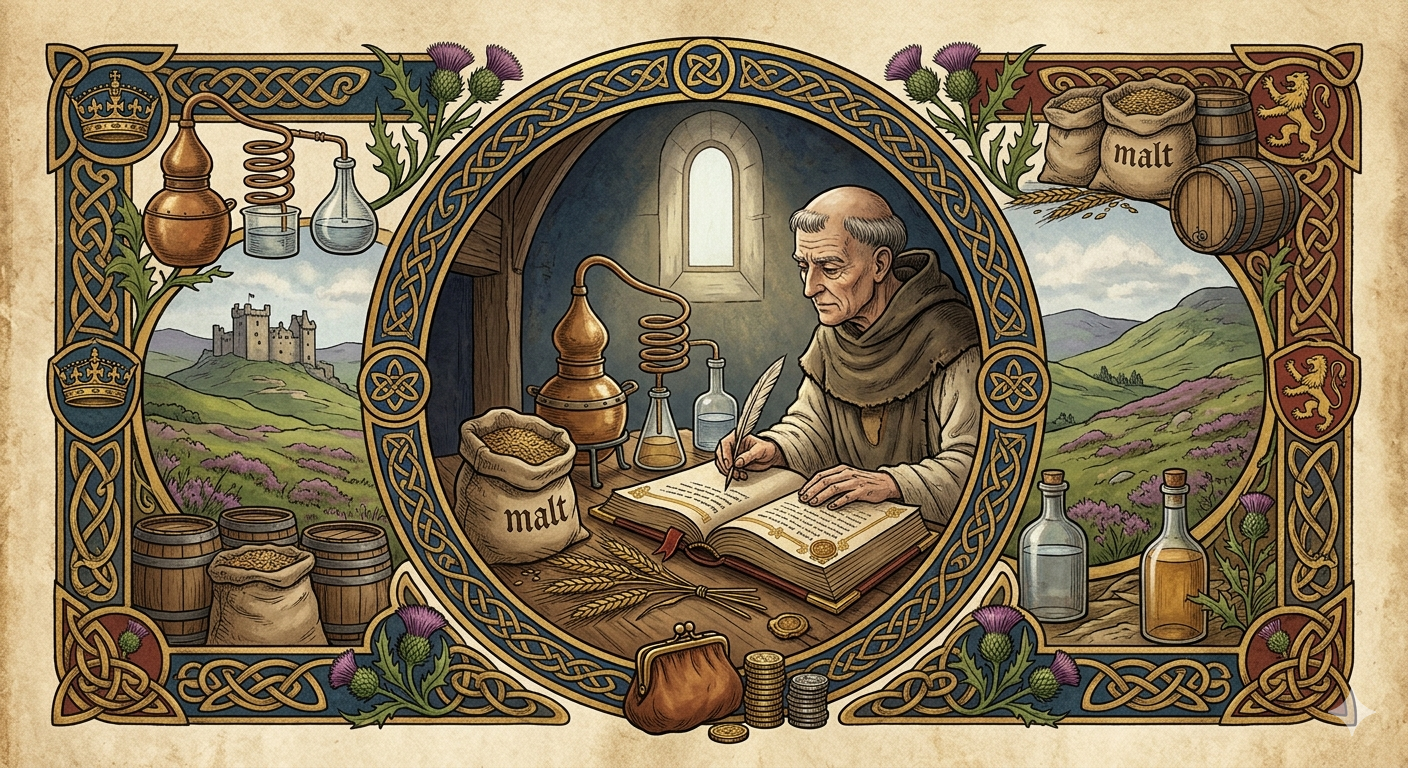
On June 1, 1494, a single entry in the Scottish Exchequer Rolls would forever change the documented history of one of Scotland’s most celebrated exports. This unassuming Latin inscription, recording the allocation of “VIII bolls of malt to Friar John Cor to make aqua vitae” by order of King James IV, represents the earliest known written reference to what would eventually become known as Scotch whisky. This momentous historical document not only provides the first official evidence of whisky production in Scotland but also reveals that distillation was already a well-established practice by the late 15th century, suggesting a rich tradition that had been developing for generations before it was ever committed to written record.
The Historical Context of Medieval Scotland’s Royal Administration
The Scottish Exchequer Rolls, known in Latin as the “Rotuli Scaccarii Regum Scotorum,” represented the backbone of medieval Scotland’s financial administration and royal accounting system. These meticulously maintained records documented all royal income and expenditure throughout the kingdom, serving as both a practical administrative tool and a historical chronicle of royal activities, purchases, and governmental operations. The Exchequer, derived from the checkered tablecloth used for counting money, was the central financial institution of medieval Scottish governance, responsible for collecting taxes, managing royal revenues, and maintaining detailed accounts of all financial transactions conducted on behalf of the Crown.
During the reign of King James IV, who ruled Scotland from 1488 to 1513, the Scottish royal administration had reached a level of sophistication that required comprehensive record-keeping for all expenditures, no matter how seemingly minor. The inclusion of malt allocation for spirit production in these official rolls demonstrates that whisky-making had achieved sufficient importance and scale to warrant royal attention and investment. This suggests that by 1494, the production of aqua vitae was not merely a local or monastic curiosity but had become significant enough to merit inclusion in the formal accounting procedures of the Scottish Crown.
The political and economic context of late 15th-century Scotland was marked by increasing centralization of royal power and the development of more sophisticated governmental institutions. King James IV, often regarded as one of Scotland’s most capable medieval monarchs, was known for his interest in technology, learning, and innovation. His reign saw significant developments in Scottish military technology, including the establishment of artillery foundries and the modernization of Scottish fortifications. The royal investment in aqua vitae production can be understood within this broader context of royal patronage for technological and craft innovations that could serve both practical and ceremonial purposes within the royal court.
The timing of this first written record also coincides with a period of relative stability in Scottish-English relations, allowing for greater focus on domestic development and cultural refinement. The royal court of James IV was noted for its sophistication and cultural achievements, attracting scholars, artists, and craftsmen from across Europe. The documentation of aqua vitae production suggests that distilled spirits had already achieved recognition as a valuable commodity worthy of royal attention and investment, indicating that Scottish distillation techniques had reached a level of refinement that made their products desirable for royal consumption or diplomatic purposes.
Brother John Cor: The Benedictine Monk Who Made History
The central figure in this historic record is Brother John Cor, also recorded as John Carr in some historical documents, a Benedictine monk whose name has become forever associated with the earliest documented whisky production in Scotland. Brother John was a member of the monastic community, most likely associated with Lindores Abbey in Fife, which had been founded in 1191 by David, Earl of Huntingdon, and had become one of Scotland’s most important religious and educational institutions. The abbey’s strategic location in the fertile Howe of Fife provided ideal conditions for agriculture and the cultivation of barley, making it a natural center for grain processing and, by extension, distillation activities.
Monastic communities throughout medieval Europe had long been at the forefront of technological and agricultural innovation, and Scottish monasteries were no exception to this pattern. The Benedictine order, to which Brother John belonged, had a particular reputation for scholarly learning and practical skills, including expertise in medicine, brewing, and distillation. The production of aqua vitae within monastic settings served multiple purposes: the distilled spirit was valued for its medicinal properties, its ability to preserve other medicines, and its utility in creating tinctures and herbal remedies that formed an essential part of medieval healthcare practices.
Brother John’s expertise in distillation would have been part of a broader monastic tradition of natural philosophy and practical chemistry that had been developing throughout the medieval period. Monastic libraries contained treatises on alchemy and distillation techniques, many translated from Arabic and Greek sources, that provided the theoretical foundation for practical distillation work. The scale of production indicated by the allocation of eight bolls of malt suggests that Brother John was not merely an experimenter but an experienced practitioner whose skills had been proven sufficiently valuable to warrant royal commissioning.
The fact that the royal order was directed specifically to Brother John by name indicates that he had already established a reputation for his distillation skills and that the quality of his aqua vitae had come to royal attention through previous production. This personal recognition in royal records suggests that Brother John represented the pinnacle of distillation expertise available in late 15th-century Scotland and that his methods and products had achieved a standard of excellence worthy of royal patronage. His work represents not just the beginning of documented Scottish whisky history but also the culmination of decades or perhaps centuries of undocumented experimentation and refinement in distillation techniques.
The Significance of Eight Bolls of Malt: Understanding Medieval Measurements and Production Scale
The specific quantity mentioned in the Exchequer Rolls entry, “VIII bolls of malt,” provides crucial insight into both the scale of medieval whisky production and the sophisticated measurement systems employed in 15th-century Scottish commerce and administration. A boll was a standard Scottish unit of measurement for grain, roughly equivalent to approximately six imperial bushels or about 240 liters of grain. This standardized measurement system was essential for consistent trade and taxation throughout the Scottish kingdom, and its use in the Exchequer Rolls entry demonstrates the formal, official nature of this aqua vitae production commission.
The quantity of eight bolls represents a substantial amount of raw material, sufficient to produce approximately 35 stone of malt, which modern calculations suggest could yield around 1,500 bottles of distilled spirit at contemporary strength levels. This significant volume clearly indicates that the intended production was not for small-scale experimental or medicinal purposes but rather for substantial consumption, possibly for royal ceremonies, diplomatic functions, or distribution among the royal household and court. The scale suggests that aqua vitae had already achieved recognition as a valuable and desirable commodity worthy of significant royal investment.
The specification of malt rather than raw grain in the records is particularly significant, as malting represents a sophisticated understanding of the brewing and distillation process. Malting involves the controlled germination of barley to convert starches into fermentable sugars, a process that requires considerable expertise and infrastructure. The fact that the royal order specified malt indicates that Brother John and his contemporaries had already developed advanced techniques for grain preparation that would optimize the quality and yield of their distilled product. This level of sophistication suggests that Scottish distillation had moved well beyond crude experimental stages to become a refined craft with established best practices.
The economic value represented by eight bolls of malt would have been considerable in the medieval Scottish economy, where grain was a precious commodity that formed the basis of both sustenance and wealth. The royal willingness to allocate such significant resources to aqua vitae production demonstrates both the perceived value of the final product and the importance placed on maintaining high-quality distillation capabilities within the kingdom. This investment indicates that Scottish rulers recognized distilled spirits not merely as luxury items but as valuable commodities that could serve important diplomatic, ceremonial, and medicinal functions within the royal administration.
Aqua Vitae: The Latin Origins of Scotland’s National Spirit
The term “aqua vitae,” meaning “water of life” in Latin, reveals the medieval understanding of distilled spirits as substances possessing almost mystical properties related to health, vitality, and spiritual well-being. This designation was not unique to Scotland but was used throughout medieval Europe to describe various distilled spirits, reflecting a common understanding of distillation as a process that could extract the essential life force from natural materials. The use of Latin terminology in the Scottish Exchequer Rolls also demonstrates the international character of medieval distillation knowledge and the scholarly context within which these techniques were developed and transmitted.
The concept of aqua vitae was deeply rooted in medieval alchemical and medical traditions that viewed distillation as a means of purification and concentration. Alchemists and natural philosophers believed that distillation could separate the pure essence of a substance from its crude material form, creating products with enhanced potency and therapeutic value. This philosophical framework provided the intellectual justification for the significant investment in distillation equipment and expertise that the Exchequer Rolls entry represents, as aqua vitae was valued not merely as an intoxicating beverage but as a powerful medicine and preservative.
The transition from the Latin “aqua vitae” to the Gaelic “uisge beatha” and eventually to the English “whisky” represents a linguistic evolution that parallels the cultural development of Scottish distillation traditions. The Gaelic term “uisge beatha” provided a direct translation of the Latin concept while adapting it to Scottish linguistic and cultural contexts. This linguistic adaptation suggests that by the time of the Exchequer Rolls entry, Scottish distillation had already begun to develop distinctive national characteristics that would eventually distinguish Scottish whisky from other European aqua vitae traditions.
The medieval understanding of aqua vitae as both medicine and beverage helps explain why monastic communities like Brother John’s were among the primary centers of distillation expertise. Monasteries served as medieval hospitals and centers of learning where medical knowledge was preserved and developed. The production of aqua vitae fit naturally within this context as both a therapeutic agent and a preservative medium for other medicines. The high alcohol content of distilled spirits made them invaluable for creating tinctures and extracts of medicinal herbs, ensuring that the active compounds could be preserved and concentrated for therapeutic use.
The Role of Lindores Abbey in Early Scottish Distillation
While the Exchequer Rolls do not explicitly identify Brother John Cor’s location, historical evidence strongly suggests his association with Lindores Abbey in Fife, which has consequently claimed the title of Scotland’s first whisky distillery. Founded in 1191 by David, Earl of Huntingdon, Lindores Abbey had become one of Scotland’s most influential religious houses by the late 15th century, known for its scholarly activities, agricultural innovations, and technological expertise. The abbey’s location in the fertile agricultural region of Fife provided ideal conditions for barley cultivation and the development of brewing and distillation techniques.
The Benedictine community at Lindores had developed extensive expertise in various forms of food and beverage production, including brewing, which provided the foundational knowledge necessary for distillation. The transition from brewing to distillation represented a natural progression for monastic communities that already possessed the equipment, expertise, and raw materials necessary for fermentation processes. The abbey’s well-documented involvement in agricultural innovation and technological development makes it a logical center for early distillation experiments and the refinement of aqua vitae production techniques.
Lindores Abbey’s strategic importance extended beyond its religious functions to encompass significant political and economic influence within medieval Scotland. The abbey maintained close relationships with the Scottish royal court and was frequently involved in matters of national importance. This political connection helps explain how Brother John Cor’s distillation expertise came to royal attention and why the king would have commissioned such a substantial production of aqua vitae from the abbey. The monastery’s reputation for excellence in various crafts and technologies would have made it a natural choice for important royal commissions.
The archaeological and architectural remains of Lindores Abbey provide physical evidence of the sophisticated infrastructure that would have supported early distillation activities. The abbey complex included extensive kitchens, brewing facilities, and storage areas that could have been adapted for distillation purposes. The presence of reliable water sources, fuel supplies, and grain storage facilities created an ideal environment for developing and refining distillation techniques. The monastery’s self-sufficient agricultural system ensured a steady supply of high-quality barley that could be malted and processed for aqua vitae production.
Modern archaeological investigations at Lindores Abbey have revealed evidence consistent with early distillation activities, including remnants of heating systems and drainage facilities that could have supported distillation operations. While definitive proof of 15th-century distillation equipment remains elusive, the physical evidence suggests that the abbey possessed the infrastructure necessary for sophisticated chemical and alchemical activities. The combination of documentary evidence from the Exchequer Rolls and archaeological findings at Lindores creates a compelling case for the abbey’s role as Scotland’s earliest documented whisky production center.
The Medieval Distillation Process and Technical Innovation
The production of aqua vitae in Brother John Cor’s time required sophisticated understanding of distillation principles and access to specialized equipment that represented significant technological advancement for the medieval period. The distillation process involved multiple stages, beginning with the malting of barley to convert starches into fermentable sugars, followed by fermentation to produce alcoholic wash, and finally distillation to concentrate the alcohol and create the finished spirit. Each stage required specific expertise and equipment, indicating that Scottish distillation had achieved considerable technical sophistication by the late 15th century.
The distillation equipment available to Brother John would have been considerably different from modern apparatus but based on the same fundamental principles of heating, vaporization, and condensation that govern contemporary distillation. Medieval stills were typically constructed from copper or bronze, materials chosen for their excellent heat conduction properties and their resistance to corrosion from acidic fermented liquids. These early stills often featured simple pot designs with attached condensation chambers, though some evidence suggests that more sophisticated column-style apparatus may have been employed in advanced monastic distilleries.
The heating systems used in medieval distillation required careful temperature control to optimize alcohol extraction while avoiding the production of harsh or unpalatable compounds. Brother John and his contemporaries would have relied on wood-fired heating systems that demanded constant attention and considerable skill to maintain appropriate temperatures throughout the distillation process. The development of effective temperature control techniques represents a significant technological achievement that required both theoretical understanding of distillation principles and practical experience gained through extensive experimentation.
The quality control methods employed in medieval aqua vitae production would have relied heavily on sensory evaluation and traditional testing techniques passed down through generations of practitioners. Brother John would have used visual inspection, aroma assessment, and taste evaluation to determine when fermentation was complete and when distillation had achieved the desired concentration and purity. These quality assessment methods, while seemingly primitive compared to modern analytical techniques, were surprisingly effective and formed the foundation of quality standards that would characterize Scottish whisky production for centuries.
The storage and aging of medieval aqua vitae presents an interesting historical question, as the Exchequer Rolls provide no information about how the finished product was handled after distillation. While extended aging in wooden casks would not become standard practice until much later, medieval distillers did employ various storage methods to preserve and potentially improve their spirits. Some evidence suggests that aqua vitae was stored in wooden vessels, ceramic containers, or even metal receptacles, each of which would have imparted different characteristics to the finished product and contributed to the development of regional style variations.
Royal Patronage and the Cultural Significance of Medieval Distillation
The inclusion of aqua vitae production in the royal Exchequer Rolls reflects the significant cultural and ceremonial importance that distilled spirits had achieved within the Scottish royal court by the late 15th century. King James IV’s personal commission of this substantial production suggests that aqua vitae served important functions beyond mere consumption, possibly including diplomatic gifts, ceremonial presentations, and royal hospitality for important visitors. The scale of the commission indicates that distilled spirits had become integral to the ceremonial and political culture of the Scottish monarchy.
The royal patronage of distillation activities also demonstrates the crown’s recognition of the economic potential of aqua vitae production within the broader Scottish economy. By the late 15th century, Scottish rulers were actively seeking to develop domestic industries that could reduce dependence on foreign imports and create valuable export commodities. The investment in aqua vitae production can be seen as part of this broader economic strategy, aimed at developing uniquely Scottish products that could compete in international markets and enhance the kingdom’s economic independence.
The ceremonial applications of aqua vitae within the royal court would have extended to various religious and secular occasions where the “water of life” served symbolic as well as practical functions. Medieval understanding of distilled spirits emphasized their purifying and life-giving properties, making them appropriate for ceremonial use in religious contexts and formal court proceedings. The high alcohol content and preservative properties of aqua vitae also made it valuable for creating ceremonial drinks that could incorporate expensive imported spices and herbs, creating luxury beverages worthy of royal consumption.
The diplomatic significance of high-quality aqua vitae cannot be underestimated in the context of late medieval European politics, where the exchange of valuable and exotic gifts played a crucial role in international relations. Scottish aqua vitae, produced under royal patronage and representing the pinnacle of Scottish distillation expertise, would have served as an impressive diplomatic gift that demonstrated Scottish sophistication and technological achievement. The unique character of Scottish-produced spirits could have helped distinguish Scottish diplomatic presentations from those of other European powers.
The educational and technological implications of royal patronage for distillation extended beyond immediate production benefits to encompass the preservation and development of technical knowledge. Royal support provided the resources and security necessary for systematic experimentation and improvement of distillation techniques, ensuring that valuable technological knowledge would be preserved and transmitted to future generations. This patronage system created an environment in which traditional craft knowledge could be combined with scholarly learning to achieve continuous improvement in production methods and product quality.
The Economic Impact of Early Whisky Documentation
The formal recording of aqua vitae production in the Scottish Exchequer Rolls marked a crucial transition in the economic status of Scottish distillation, elevating it from an undocumented craft activity to a recognized component of the royal economy worthy of official accounting and administrative attention. This transition had profound implications for the development of Scottish distillation as both a domestic industry and a potential source of royal revenue through taxation and regulation. The precedent established by this early documentation would eventually lead to the comprehensive regulatory framework that would govern Scottish whisky production for centuries to come.
The economic significance of the eight bolls of malt allocated to Brother John Cor extended beyond the immediate value of the raw materials to encompass the much greater value added through the distillation process. Medieval economic theory recognized that skilled craftsmanship could substantially increase the value of raw materials, and distillation represented one of the most dramatic examples of this value-adding process. The transformation of relatively common barley malt into precious aqua vitae created economic value that could be captured by skilled practitioners and their patrons, providing strong incentives for further investment in distillation expertise and equipment.
The establishment of documented, official aqua vitae production also created opportunities for the development of quality standards and brand recognition that would prove crucial for the long-term success of Scottish whisky in international markets. The royal commission represented an early form of quality certification, indicating that Brother John’s products had achieved standards worthy of royal consumption and distribution. This royal endorsement provided a foundation for developing reputation and market recognition that would eventually contribute to the global success of Scottish whisky as a premium product category.
The taxation implications of documented distillation would prove to be both a blessing and a curse for the Scottish whisky industry throughout its subsequent history. While official recognition provided legitimacy and protection for distillation activities, it also made them subject to royal taxation and regulation that would sometimes conflict with the economic interests of producers. The Exchequer Rolls entry represents the beginning of a complex relationship between Scottish distillers and governmental authority that would characterize the industry’s development through periods of both cooperation and conflict.
The regional economic development implications of early documented distillation were particularly significant for areas like Fife, where Lindores Abbey was located. The establishment of sophisticated distillation facilities created demand for supporting industries and services, including cooperage, transportation, and specialized agricultural production. The concentration of distillation expertise in particular regions began the process of geographic specialization that would eventually create the distinct Scottish whisky regions recognized today, each with its own characteristic styles and production methods.
The Evolution from Aqua Vitae to Modern Scotch Whisky
The five centuries that separate Brother John Cor’s documented aqua vitae production from modern Scottish whisky represent a continuous process of refinement, innovation, and cultural development that has transformed a medieval medicine and curiosity into one of the world’s most sophisticated and regulated spirit categories. Understanding this evolutionary process requires recognition of both the fundamental continuities that link medieval and modern Scottish distillation and the profound changes that have occurred in production methods, quality standards, and market contexts.
The basic distillation principles employed by Brother John Cor remain fundamentally unchanged in modern Scottish whisky production, though the equipment, scale, and precision of contemporary distillation represent enormous advances over medieval techniques. Modern pot stills operate on the same principles of heating, vaporization, and condensation that Brother John would have recognized, though computer-controlled temperature management and sophisticated metallurgy have dramatically improved the consistency and efficiency of the distillation process. The continuity of these fundamental techniques provides a direct link between the earliest documented Scottish whisky production and contemporary craft.
The development of aging requirements represents one of the most significant changes in Scottish whisky production since the medieval period, transforming what was originally consumed as a clear, unaged spirit into the complex, amber-colored beverage that defines modern Scotch whisky. The requirement that Scottish whisky be aged in oak casks for a minimum of three years, established by 20th-century legislation, created entirely new dimensions of flavor development and quality improvement that medieval producers could not have anticipated. This aging process has become so central to Scottish whisky identity that it is difficult to imagine the category without it.
The evolution of raw material specifications and production standards represents another major development in the transition from medieval aqua vitae to modern Scotch whisky. While Brother John Cor used malted barley as his primary raw material, modern Scottish whisky production encompasses a range of grain types and production methods, from single malt whiskies made exclusively from malted barley to grain whiskies incorporating other cereals and continuous distillation techniques. The development of these diverse production methods has created the complex landscape of Scottish whisky categories that characterizes the modern industry.
The globalization of Scottish whisky markets represents perhaps the most dramatic change from the medieval period, when aqua vitae production served primarily local and royal consumption patterns. Modern Scotch whisky is consumed worldwide and has become one of Scotland’s most important export industries, generating billions of pounds in annual revenue and supporting thousands of jobs throughout Scotland. This global success has been built upon the foundation of quality and distinctiveness that can be traced back to the medieval origins of Scottish distillation, demonstrating the enduring value of the traditions established by practitioners like Brother John Cor.
Modern Recognition and Historical Preservation
The contemporary recognition of the 1494 Exchequer Rolls entry as the founding document of Scottish whisky history has led to extensive efforts to preserve and commemorate this crucial historical moment. Lindores Abbey, identified as the likely location of Brother John Cor’s distillation activities, has become a pilgrimage site for whisky enthusiasts and historians seeking to connect with the origins of Scottish distillation. The abbey ruins have been preserved as a historical monument, and modern distillation activities have been established on the site to honor the location’s historical significance.
The Scottish whisky industry has embraced the historical significance of the 1494 Exchequer Rolls entry as a foundational element of industry identity and marketing strategy. Many Scottish distilleries incorporate references to this historical moment in their promotional materials and brand narratives, emphasizing the ancient origins and continuous traditions that distinguish Scottish whisky from other international spirit categories. This historical consciousness has become an important component of Scottish whisky’s competitive advantage in global markets, where consumers increasingly value authenticity and traditional production methods.
Academic and scholarly interest in the historical origins of Scottish whisky has generated extensive research into medieval distillation techniques, the social and economic context of early spirit production, and the cultural significance of distilled beverages in Scottish society. This scholarly attention has revealed the sophisticated nature of medieval distillation and challenged earlier assumptions about the primitive character of historical production methods. Contemporary research continues to uncover new evidence about early Scottish distillation and its connections to broader European traditions of brewing and distillation.
The preservation of historical documents like the Scottish Exchequer Rolls has become recognized as crucial for understanding not only the history of Scottish whisky but also broader patterns of medieval economic and technological development. Modern archival techniques and digital preservation methods ensure that these irreplaceable historical sources will be available to future researchers and continue to provide insights into the origins and development of one of Scotland’s most important cultural and economic traditions.
The celebration of Scottish whisky’s historical origins through festivals, educational programs, and cultural events has helped maintain public awareness of the industry’s medieval roots while supporting contemporary production and marketing activities. These commemorative activities serve both educational and promotional purposes, ensuring that the historical significance of Brother John Cor’s contribution to Scottish culture will be remembered and celebrated by future generations of whisky producers and consumers.
The Enduring Legacy of Scotland’s First Written Whisky Record
The single Latin entry in the Scottish Exchequer Rolls of June 1, 1494, recording the allocation of eight bolls of malt to Brother John Cor for aqua vitae production, represents far more than a simple administrative record. This brief documentation marks the beginning of the written history of what would become one of Scotland’s most important cultural exports and economic industries. The legacy of this moment extends across five centuries of continuous development, innovation, and refinement that have established Scottish whisky as the global standard for quality distilled spirits.
The historical significance of this first written record lies not only in its documentary value but also in what it reveals about the sophisticated nature of late medieval Scottish society. The fact that distillation had achieved sufficient importance to warrant inclusion in royal financial records demonstrates that 15th-century Scotland possessed the technical knowledge, economic infrastructure, and cultural appreciation necessary to support advanced craft production. This early sophistication provides the foundation for understanding how Scottish whisky achieved its subsequent global prominence and distinctive character.
The transition from Brother John Cor’s medieval aqua vitae to modern Scotch whisky represents one of the most successful examples of traditional craft evolution in response to changing market conditions, technological developments, and regulatory frameworks. The ability of Scottish whisky producers to maintain the essential character and quality standards established in the medieval period while adapting to modern production requirements and global market demands demonstrates the enduring value of traditional knowledge and time-tested production methods.
The preservation and commemoration of this historical moment continues to provide inspiration and guidance for contemporary Scottish whisky producers who recognize their role as inheritors and custodians of a tradition that extends back more than five centuries. The connection to Brother John Cor and the medieval origins of Scottish distillation serves as both a source of pride and a standard of excellence that continues to influence production decisions and quality standards throughout the Scottish whisky industry.
The story of the first written record of Scotch whisky thus represents not merely a historical curiosity but a living tradition that continues to evolve while maintaining its connection to the medieval foundations established by Brother John Cor and his contemporaries. The Latin inscription in the Scottish Exchequer Rolls of 1494 serves as both the beginning of documented Scottish whisky history and a testament to the enduring power of traditional craftsmanship to create products of lasting value and global significance. This remarkable continuity between medieval origins and contemporary excellence ensures that Brother John Cor’s contribution to Scottish culture will continue to be remembered and celebrated as long as Scottish whisky continues to be produced and enjoyed around the world.