On June 1, 1533, Westminster Abbey witnessed one of the most controversial and historically significant coronations in English royal history when Anne Boleyn was crowned Queen of England. This magnificent ceremony, conducted on Whit Sunday by Archbishop Thomas Cranmer, marked not only the elevation of a new queen but also the culmination of a religious and political revolution that would forever alter the course of English history. Anne Boleyn’s coronation was unprecedented in many ways: she was visibly pregnant during the ceremony, she was crowned with St. Edward’s Crown traditionally reserved for reigning monarchs, and she would be the last queen consort to be crowned separately from her husband. The lavish four-day celebration that surrounded her coronation represented King Henry VIII’s determined effort to legitimize his controversial second marriage and establish the succession he so desperately sought.
The Political and Religious Context Leading to Anne’s Coronation
The coronation of Anne Boleyn cannot be understood without examining the complex web of political, religious, and personal factors that led to this momentous occasion. Henry VIII’s desperate desire for a male heir had driven him to challenge papal authority and fundamentally reshape English religious and political structures. His marriage to Catherine of Aragon had lasted over twenty years but had failed to produce the surviving male heir that Henry believed essential for the stability of the Tudor dynasty. Despite Catherine’s one surviving child, Princess Mary, Henry remained convinced that only a male heir could prevent the civil wars that had plagued England during the previous century.
Anne Boleyn had first caught the king’s attention around 1526, when she served as a lady-in-waiting to Queen Catherine. Unlike Henry’s previous mistresses, Anne refused to become merely another royal conquest, instead holding out for marriage and the crown. Her refusal to succumb to the king’s advances without the promise of marriage demonstrated both her ambition and her understanding of the political realities surrounding royal succession. This strategy proved remarkably successful, as Henry became increasingly obsessed with making Anne his queen and securing the annulment of his first marriage.
The legal and theological challenges surrounding Henry’s proposed annulment created a crisis that would ultimately lead to England’s break with Rome. Henry argued that his marriage to Catherine had been invalid from the beginning because she had previously been married to his deceased brother Arthur, Prince of Wales. The king cited Leviticus 20:21, which states that a man who marries his brother’s wife shall remain childless, as divine confirmation that his marriage had been cursed. However, Pope Clement VII, influenced by political pressure from Catherine’s nephew, Emperor Charles V, refused to grant the annulment, setting the stage for Henry’s declaration of independence from papal authority.
The appointment of Thomas Cranmer as Archbishop of Canterbury in 1532 provided Henry with the ecclesiastical authority he needed to resolve his matrimonial difficulties. Cranmer, a committed Protestant reformer, was sympathetic to Henry’s cause and prepared to challenge papal authority when necessary. His elevation to the archbishopric was crucial for the subsequent annulment proceedings and Anne’s coronation, as he would serve as both the ecclesiastical judge who declared Henry’s first marriage invalid and the prelate who crowned the new queen.
The Secret Marriages: November 1532 and January 1533
The path to Anne Boleyn’s coronation involved not one but potentially two secret marriage ceremonies, reflecting both the delicate political situation surrounding the union and the urgent need to legitimize any children born from the relationship. The first of these ceremonies allegedly took place on November 14, 1532, St. Erkenwald’s Day, according to the chronicler Edward Hall. This ceremony was conducted in extreme secrecy at Dover, possibly before or immediately after Henry and Anne’s return from their diplomatic mission to Calais, where Henry had met with French King Francis I to secure French support for his matrimonial cause.
The secrecy surrounding this first ceremony was so complete that even Thomas Cranmer, the Archbishop of Canterbury, remained unaware of the marriage for several weeks. The witnesses to this first ceremony were reportedly minimal, including only the most trusted members of Henry’s inner circle who could be relied upon to maintain absolute discretion about the proceedings. The timing of this ceremony was strategically important, as it occurred while Henry was still technically married to Catherine of Aragon, making the legality of the union questionable until the annulment could be formally declared.
The second, more widely acknowledged marriage ceremony took place on January 25, 1533, St. Paul’s Day, at Whitehall Palace. This ceremony was slightly less secretive than the first, though still conducted with extraordinary discretion to avoid political complications. According to Cranmer’s later testimony, this January ceremony was attended by a small group of witnesses, including Sir Henry Norris and Sir Thomas Heneage of the Privy Chamber, along with Lady Berkeley. The presence of these court officials provided the marriage with greater legal standing while still maintaining the secrecy necessary to avoid immediate political repercussions.
The timing of the January ceremony was particularly significant because Anne was already pregnant, a condition that would become apparent during her coronation ceremony several months later. Cranmer later wrote that “she was married much about St Paul’s Day last, as the condition thereof doth well appear, by reason she is now somewhat big with child.” This pregnancy added urgency to the need for formal recognition of the marriage and Anne’s status as queen, as any child born from the union needed to be unquestionably legitimate to serve as Henry’s heir.
The existence of two potential marriage dates has created historical debate among scholars, with some arguing that the November ceremony was merely a betrothal or private exchange of vows, while the January ceremony represented the formal, legally binding marriage. Regardless of the precise details, both ceremonies served the crucial function of establishing Anne’s claim to queenship and ensuring that her children would be considered legitimate heirs to the English throne.
The Annulment of Henry’s First Marriage
The formal annulment of Henry VIII’s marriage to Catherine of Aragon was essential for establishing the legitimacy of his union with Anne Boleyn and her subsequent coronation. Archbishop Thomas Cranmer began formal proceedings for the annulment in May 1533, conducting hearings at Dunstable Priory where Catherine was invited to appear but refused to attend, maintaining that the case should be heard in Rome rather than by English ecclesiastical courts. This refusal allowed Cranmer to proceed with the case in Catherine’s absence, ensuring that the proceedings would conclude in Henry’s favor.
On May 23, 1533, Cranmer formally declared that Henry’s marriage to Catherine of Aragon had been null and void from the beginning. This declaration was based on the argument that Catherine’s previous marriage to Henry’s brother Arthur had been consummated, making her subsequent marriage to Henry invalid under canon law. The annulment effectively erased twenty-four years of marriage and declared Princess Mary illegitimate, though Parliament would later restore her to the succession through the Third Succession Act of 1543.
The timing of the annulment was carefully coordinated with plans for Anne’s coronation, ensuring that she would be crowned as Henry’s legitimate queen rather than as a mistress or unofficial wife. Cranmer announced the validity of Henry’s marriage to Anne Boleyn on May 28, 1533, just four days before her coronation ceremony. This sequence of events was designed to provide maximum legitimacy for Anne’s queenship and to establish beyond question that any children born from the marriage would be legitimate heirs to the throne.
The international reaction to the annulment was swift and largely negative. Pope Clement VII condemned Henry’s actions and excommunicated him in July 1533, though the formal announcement of the excommunication was delayed until 1538. Emperor Charles V, Catherine’s nephew, refused to recognize the annulment and continued to regard Catherine as the legitimate Queen of England. This international opposition would continue throughout Anne’s brief queenship and contribute to the political isolation that would ultimately lead to her downfall.
The domestic reaction to the annulment was mixed, with significant portions of the English population remaining loyal to Catherine of Aragon and refusing to acknowledge Anne as their rightful queen. This popular resistance would become evident during Anne’s coronation procession, when the crowds that gathered to witness the spectacle were notably subdued and sometimes openly hostile to the new queen.
The Magnificent Coronation Procession: May 31, 1533
The day before Anne Boleyn’s coronation, London witnessed one of the most elaborate royal processions in English history, as the pregnant queen made her triumphant journey from the Tower of London to Westminster Palace. This procession, which took place on May 31, 1533, was designed to showcase Anne’s new status as queen and to demonstrate the wealth and power of the Tudor monarchy to both domestic and international audiences. The pageantry was intended to overwhelm any opposition to Anne’s queenship through sheer spectacle and magnificence.
The procession began at the Tower of London, where Anne had spent the night in royal tradition before her coronation. The Tower had served as the traditional starting point for coronation processions since medieval times, and its use for Anne’s procession emphasized the continuity between her coronation and those of previous English monarchs. The choice of the Tower also had symbolic significance, as it represented royal power and authority, lending additional legitimacy to Anne’s controversial position as queen.
Anne appeared for the procession dressed in magnificent robes that emphasized both her royal status and her pregnancy. She wore a surcoat and robe of purple velvet trimmed with ermine, colors and materials that were traditionally associated with royalty. Her hair was worn loose and flowing, as was customary for unmarried women and new queens, and she wore a circlet of gold set with precious stones. The visible signs of her pregnancy were deliberately displayed rather than concealed, as the promise of an heir was central to the justification for her controversial elevation to queenship.
The procession route took Anne through the heart of London, allowing maximum exposure to the citizens whose acceptance was crucial for the success of Henry’s matrimonial revolution. The journey included stops at various points where elaborate pageants had been prepared by the city guilds and corporations. These pageants featured allegorical representations of virtues, biblical scenes, and historical parallels designed to celebrate Anne’s queenship and to suggest divine approval for her elevation. However, contemporary accounts suggest that the crowds were notably restrained in their enthusiasm, with many observers remaining silent rather than cheering the new queen.
The organization of the procession reflected careful attention to protocol and hierarchy, with various nobles and court officials assigned specific roles that demonstrated their support for Anne’s queenship. The participation of these prominent figures was crucial for establishing Anne’s legitimacy, as their presence suggested that the English nobility had accepted the new queen. However, the absence of certain key figures, including several prominent noblemen and ecclesiastics who disapproved of Henry’s actions, was also notable and suggested the divisions that Anne’s elevation had created within English society.
The Coronation Ceremony at Westminster Abbey
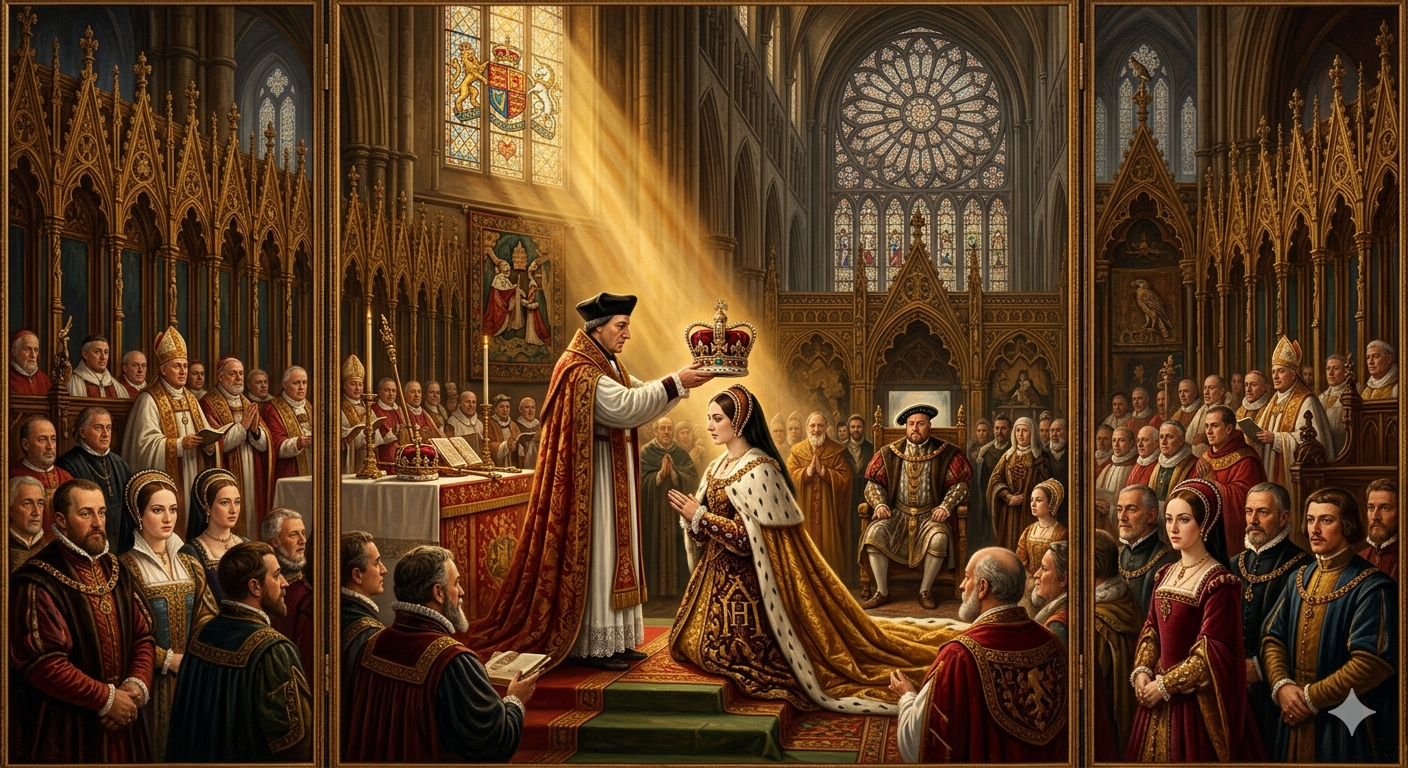
The coronation of Anne Boleyn at Westminster Abbey on June 1, 1533, represented the climax of Henry VIII’s efforts to establish his second marriage and secure the succession. The ceremony began early in the morning when Anne was escorted from Westminster Palace to the abbey, where she was received by Archbishop Thomas Cranmer and a gathering of bishops, abbots, and other ecclesiastical dignitaries. The timing of the ceremony on Whit Sunday was symbolically significant, as this feast day commemorated the descent of the Holy Spirit upon the apostles and was associated with divine inspiration and the founding of the Christian church.
Anne arrived at Westminster Abbey wearing robes of purple velvet and ermine, with her hair flowing freely and crowned with a circlet of gold and precious stones. Her appearance was designed to emphasize both her royal dignity and her condition as an expectant mother, as the promise of an heir remained central to the justification for her controversial coronation. The visible signs of her pregnancy, which was well advanced by this time, served as a constant reminder of the potential male heir that had driven Henry’s matrimonial revolution.
The coronation ceremony followed traditional patterns established for English queens, but with several unprecedented modifications that reflected Anne’s unique position. Most notably, she was crowned with St. Edward’s Crown, the ancient crown traditionally reserved for reigning monarchs rather than queen consorts. This choice was highly symbolic, suggesting that Anne possessed royal authority in her own right rather than merely reflecting her husband’s status. The use of this crown was intended to emphasize the legitimacy of her position and to suggest that she and her unborn child possessed divine sanction for their elevation.
Archbishop Cranmer conducted the anointing and coronation with particular solemnity, recognizing the political and religious significance of the moment. The anointing with holy oil was performed according to ancient traditions, but the circumstances were unprecedented given the recent break with Rome and the controversial nature of Anne’s marriage. Cranmer’s role in the ceremony was particularly significant, as he had been the ecclesiastical authority who had declared Henry’s first marriage invalid and had thus made Anne’s coronation possible.
Following the anointing and crowning, Anne was presented with the traditional regalia of English queenship, including the rod and sceptre. The Queen’s sceptre had been specifically refurbished for the occasion by the royal goldsmith Cornelis Hayes, demonstrating the careful preparation that had gone into every aspect of the ceremony. After receiving the regalia, Anne prostrated herself before the altar in a gesture of humility and devotion, though this traditional element of the ceremony proved physically challenging given her advanced pregnancy.
The Coronation Banquet and Celebrations
Following the coronation ceremony, Anne Boleyn was conducted back to Westminster Hall for the traditional coronation banquet, one of the most elaborate feasts in the history of the English court. The banquet was designed to demonstrate the wealth and magnificence of the Tudor monarchy while providing an opportunity for the nobility to pay homage to their new queen. The setting in Westminster Hall, with its magnificent hammerbeam roof and associations with royal ceremony, provided an appropriately grand venue for this celebration of Anne’s elevation to queenship.
The organization of the banquet followed strict protocols of precedence and honor that reflected the complex hierarchies of Tudor society. Anne was seated at the high table under a cloth of estate, with the most prominent nobles and ecclesiastics arranged according to their rank and their relationship to the crown. The seating arrangements served multiple purposes, both honoring the new queen and demonstrating which members of the nobility had chosen to support her controversial elevation. The participation of key figures in the banquet was crucial for establishing Anne’s legitimacy and showing that the English elite had accepted the new political reality.
The menu for the coronation banquet reflected both traditional English royal cuisine and influences from Anne’s time at the sophisticated French court. Multiple courses were served, featuring elaborate dishes prepared by the royal kitchens and presented with the ceremonial flourishes appropriate for such a significant occasion. The abundance and variety of food served were intended to demonstrate royal wealth and generosity while providing sustenance for the hundreds of guests who had gathered to honor the new queen.
The entertainment during the banquet included music, dancing, and various forms of courtly performance designed to celebrate Anne’s coronation and to provide appropriate festivity for the occasion. Court musicians performed compositions specifically created for the coronation, while other entertainers provided diversions that would have been familiar to guests accustomed to the elaborate ceremonials of the Tudor court. The entertainment served both to honor Anne and to maintain the celebratory atmosphere that was essential for the success of the entire coronation program.
The political significance of the banquet extended beyond mere celebration, as it provided an opportunity for Henry and Anne to receive formal acknowledgment of their marriage from the assembled nobility. The presence of prominent figures at the banquet constituted a form of tacit acceptance of Anne’s queenship, while the absence of certain individuals suggested ongoing resistance to the new arrangements. The careful management of guest lists and seating arrangements reflected the political calculations that surrounded every aspect of Anne’s coronation.
International Reactions and Diplomatic Consequences
The coronation of Anne Boleyn sent shockwaves throughout European diplomatic circles, as foreign powers struggled to respond to Henry VIII’s dramatic break with established matrimonial and religious protocols. The most immediate and significant reaction came from Pope Clement VII, who had been hoping that Henry might still be persuaded to abandon his matrimonial revolution and return to his first wife Catherine of Aragon. Anne’s coronation made clear that Henry was fully committed to his new course, prompting the Pope to begin proceedings for Henry’s excommunication, though the formal announcement would be delayed for several years.
Emperor Charles V, as Catherine of Aragon’s nephew, viewed Anne’s coronation as a direct affront to his family’s honor and a challenge to the established religious and political order of Christian Europe. Charles had significant influence over Pope Clement VII due to his control over much of Italy, and he used this influence to pressure the Pope to take stronger action against Henry’s matrimonial irregularities. The Emperor’s opposition to Anne’s queenship would continue throughout her brief reign and would contribute to the diplomatic isolation that characterized Henry’s relationship with continental Europe during this period.
The French reaction to Anne’s coronation was more complex, reflecting the delicate balance of Franco-English relations during this period. King Francis I had met with Henry and Anne during their visit to Calais in 1532 and had provided some degree of recognition for their relationship. However, France’s own relationship with the papacy and the need to maintain diplomatic flexibility meant that French support for Henry’s actions remained qualified and contingent. The French court continued to maintain diplomatic relations with England while avoiding full endorsement of Henry’s break with Rome.
The reaction from other European courts varied depending on their own relationships with both England and the papacy. Some Protestant German princes viewed Henry’s actions with sympathy, seeing them as part of the broader European movement away from papal authority. However, most Catholic monarchs regarded Anne’s coronation as illegitimate and continued to recognize Catherine of Aragon as the rightful Queen of England. This division would contribute to England’s diplomatic isolation during the early years of Henry’s break with Rome.
The domestic reaction to international criticism of Anne’s coronation was mixed, with some English subjects viewing foreign opposition as unwelcome interference in English affairs, while others saw it as confirmation of their own reservations about Henry’s actions. The government’s response emphasized English independence and the right of English monarchs to determine their own matrimonial arrangements without foreign interference, establishing themes that would become central to English national identity during the Tudor period.
The Public Reception and Popular Response
The public reaction to Anne Boleyn’s coronation revealed the complex and often contradictory attitudes of ordinary English subjects toward their new queen. Contemporary accounts consistently describe the crowds that gathered for the coronation procession as unusually subdued and restrained, in marked contrast to the enthusiastic receptions typically accorded to royal ceremonials. This lack of popular enthusiasm reflected widespread loyalty to Catherine of Aragon, who remained beloved by many English subjects, as well as religious conservatism that viewed Henry’s actions as contrary to divine law.
The silence of the crowds during Anne’s procession was so notable that it was commented upon by various contemporary observers, including foreign diplomats who had expected to witness the traditional displays of popular enthusiasm that accompanied royal celebrations. Some accounts suggest that the crowds were not merely silent but occasionally openly hostile, with reports of individuals refusing to remove their hats as the queen passed or making disparaging comments about her condition and her controversial path to queenship.
The contrast between the magnificent pageantry organized for Anne’s coronation and the cool reception from ordinary Londoners highlighted the gulf between official celebration and popular sentiment. The city guilds and corporations had spent considerable sums preparing elaborate displays and pageants for the procession, but their efforts failed to generate the spontaneous popular enthusiasm that had characterized previous royal ceremonials. This disconnect between official celebration and popular reception would prove to be a persistent problem throughout Anne’s brief queenship.
Religious opposition to Anne’s coronation was particularly significant among conservative Catholics who viewed her elevation as illegitimate and contrary to divine law. Many clergy refused to acknowledge her as queen, while some actively preached against her right to the crown. This religious opposition was often expressed in indirect ways that avoided direct confrontation with royal authority while making clear the clergy’s disapproval of the new arrangements.
The popular perception of Anne as an adulteress and usurper rather than a legitimate queen would persist throughout her reign and would contribute to the ease with which Henry was later able to move against her. The failure to win popular acceptance during her coronation established a pattern of public hostility that would make Anne vulnerable when her political fortunes declined. The contrast between the elaborate ceremonial recognition of her queenship and the popular rejection of her legitimacy foreshadowed the instability that would characterize her brief reign.
The Significance of St. Edward’s Crown
One of the most remarkable and unprecedented aspects of Anne Boleyn’s coronation was her crowning with St. Edward’s Crown, an ancient piece of regalia traditionally reserved for reigning monarchs rather than queen consorts. This choice represented a dramatic departure from established protocol and was designed to emphasize Anne’s unique status and the legitimacy of her position as England’s rightful queen. The use of this crown sent a clear message about Henry VIII’s determination to establish Anne’s authority and to suggest that she possessed royal power in her own right rather than merely reflecting her husband’s status.
St. Edward’s Crown, named after Edward the Confessor, was regarded as the most sacred and prestigious piece of the English crown jewels. Its use in coronations dated back centuries and was associated with the divine sanction of English monarchy. By choosing this crown for Anne’s coronation, Henry and his advisors were making the strongest possible statement about her legitimacy and her right to rule. The symbolic weight of this decision cannot be overstated, as it placed Anne on the same ceremonial level as reigning monarchs and suggested that her authority derived from divine appointment rather than merely from her marriage to the king.
The decision to use St. Edward’s Crown also reflected practical considerations related to Anne’s pregnancy and the succession crisis that had motivated Henry’s matrimonial revolution. By crowning Anne with the traditional crown of English monarchs, the ceremony emphasized that any children born from the marriage would be legitimate heirs with unquestionable claims to the throne. This was particularly important given the controversial nature of Anne’s elevation and the questions that had been raised about the validity of her marriage to Henry.
The modification of traditional coronation protocol through the use of St. Edward’s Crown also demonstrated Henry’s growing independence from established religious and legal authorities. Just as he had challenged papal authority in his matrimonial affairs, he was now asserting the right to modify traditional ceremonial practices to suit his political needs. This flexibility in adapting ancient traditions to contemporary requirements would become a characteristic feature of Henry’s approach to kingship during this period.
The symbolic significance of St. Edward’s Crown would prove to have lasting implications for Anne’s historical legacy. Her status as the only English queen consort to be crowned with this ancient regalia has remained a notable feature of her historical importance, distinguishing her coronation from those of Henry’s subsequent wives and emphasizing the unique circumstances that surrounded her elevation to queenship.
Archbishop Thomas Cranmer’s Pivotal Role
Archbishop Thomas Cranmer played a central and indispensable role in Anne Boleyn’s coronation, serving not only as the officiating prelate for the ceremony but also as the key ecclesiastical figure who had made the coronation possible through his annulment of Henry’s first marriage. Cranmer’s appointment as Archbishop of Canterbury in 1532 had been crucial for Henry’s matrimonial plans, as his predecessor had been unwilling to challenge papal authority on the annulment question. Cranmer’s Protestant sympathies and his loyalty to Henry made him the ideal choice for implementing the king’s ecclesiastical revolution.
Cranmer’s conduct of Anne’s coronation ceremony was performed with particular attention to traditional forms and ceremonies, despite the controversial nature of the occasion. His careful adherence to established coronation protocols was designed to emphasize the legitimacy of Anne’s elevation and to counter arguments that her queenship lacked proper ecclesiastical sanction. The archbishop’s obvious comfort with the ceremonial aspects of the coronation helped to establish the normalcy of the proceedings despite their unprecedented political context.
The personal relationship between Cranmer and Anne Boleyn was significant for understanding the religious dimensions of her coronation. Anne had long been sympathetic to Protestant reform ideas, and her elevation to queenship provided opportunities for advancing religious changes that both she and Cranmer favored. The coronation ceremony thus represented not only a political triumph for Anne but also a victory for the Protestant reform movement within the English church, as it demonstrated the ascendancy of reform-minded ecclesiastics like Cranmer.
Cranmer’s later testimony about the timing of Anne’s marriage to Henry provides crucial evidence for understanding the sequence of events leading up to the coronation. His letter describing the coronation, in which he revealed that Anne “was married much about St Paul’s Day last, as the condition thereof doth well appear, by reason she is now somewhat big with child,” demonstrates his intimate knowledge of the matrimonial arrangements and his role in legitimizing the union through ecclesiastical authority.
The archbishop’s willingness to crown Anne despite ongoing papal opposition demonstrated the extent of the English church’s break with Rome and the emergence of a distinctly English ecclesiastical authority. Cranmer’s actions during the coronation ceremony represented a point of no return in the English Reformation, as they demonstrated that English ecclesiastical authorities were prepared to act independently of papal direction in matters of fundamental importance to the English crown.
The Pregnancy Announcement and Succession Implications
Anne Boleyn’s visible pregnancy during her coronation ceremony was perhaps the most politically significant aspect of the entire event, as it represented the fulfillment of Henry VIII’s desperate hopes for a legitimate male heir. The timing of the coronation was carefully calculated to coincide with the advanced stages of Anne’s pregnancy, ensuring that her condition would be obvious to all observers and would serve as visible justification for the controversial matrimonial revolution that had brought her to the throne. The pregnancy represented Henry’s ultimate vindication for his challenge to papal authority and his break with Catherine of Aragon.
Contemporary sources consistently comment on Anne’s pregnant condition during the coronation ceremonies, with various observers noting the obvious signs of her advanced pregnancy. Archbishop Cranmer’s later letter specifically references her condition as evidence for the timing of her marriage to Henry, while other accounts describe the physical challenges that her pregnancy created during the coronation ceremony itself. The prostration before the altar, a traditional element of coronation ceremonies, was noted as being particularly difficult for Anne to perform given her condition.
The gender expectations surrounding Anne’s pregnancy were crucial for understanding the political significance of her coronation. Henry and his supporters were confident that Anne would produce the male heir that had eluded his first marriage, and the coronation ceremony was designed to establish the legitimacy of this expected prince. The use of St. Edward’s Crown and the elaborate ceremonial recognition of Anne’s queenship were calculated to ensure that any son born from the marriage would have an unquestionable claim to the English throne.
The international implications of Anne’s pregnancy were also significant, as foreign powers had to consider the possibility that Henry’s matrimonial revolution might succeed in producing a legitimate male heir. The prospect of a new Tudor prince with unquestioned legitimacy would fundamentally alter the diplomatic calculations surrounding Henry’s break with Rome and his challenge to established matrimonial law. Anne’s pregnancy thus represented not only personal triumph but also potential vindication of Henry’s entire ecclesiastical and political strategy.
The ultimate outcome of Anne’s pregnancy, the birth of Princess Elizabeth on September 7, 1533, would prove to be one of history’s great ironies. While Henry was initially disappointed that Anne had produced a daughter rather than the expected son, Princess Elizabeth would eventually become one of England’s greatest monarchs, vindicating her parents’ controversial union in ways that neither Henry nor Anne could have anticipated during the coronation ceremony.
The Four-Day Celebration and Court Festivities
The coronation of Anne Boleyn was not confined to a single day but extended across four days of elaborate celebrations that were designed to demonstrate the wealth and magnificence of the Tudor court. These extended festivities served multiple purposes, including providing opportunities for the nobility to demonstrate their acceptance of the new queen, showcasing royal wealth and power to both domestic and international audiences, and creating a sense of celebration and legitimacy around Anne’s controversial elevation. The scale and duration of these celebrations were unprecedented for a queen consort’s coronation and reflected Henry’s determination to establish Anne’s status beyond question.
The celebrations began with Anne’s arrival at the Tower of London, where she spent the night before her coronation procession in accordance with ancient tradition. The Tower had served as the traditional starting point for coronation ceremonies since medieval times, and its use for Anne’s coronation emphasized the continuity between her elevation and those of previous English monarchs. The choice of the Tower also provided opportunities for elaborate ceremonial arrivals and departures that added to the overall spectacle of the coronation celebrations.
The second day of celebrations featured the magnificent procession from the Tower to Westminster Palace, which provided the most public element of the entire coronation program. This procession allowed ordinary Londoners to witness the new queen and to participate in the ceremonial recognition of her status, though as previously noted, the popular response was notably subdued. The elaborate pageants and displays organized by the city guilds represented significant investments in demonstrating loyalty to the new queen, even if popular enthusiasm was limited.
The third day featured the coronation ceremony itself at Westminster Abbey, followed by the elaborate banquet at Westminster Hall. These ceremonies represented the most solemn and significant elements of the coronation program, providing both religious sanction for Anne’s queenship and opportunities for the nobility to demonstrate their acceptance of the new political arrangements. The combination of religious ceremony and secular celebration was designed to address all aspects of Anne’s elevation to queenship.
The fourth and final day of celebrations provided additional opportunities for court festivities and entertainment, allowing the extended celebration to conclude on a note of triumph and satisfaction. These concluding celebrations served to emphasize the successful completion of Henry’s matrimonial revolution and to establish a sense of normalcy around Anne’s position as queen. The extended nature of these celebrations was intended to overwhelm any opposition through sheer spectacle and to create lasting impressions of Anne’s legitimacy and importance.
The Legacy and Historical Significance
Anne Boleyn’s coronation on June 1, 1533, stands as one of the most consequential royal ceremonies in English history, marking not only the elevation of a controversial queen but also the culmination of a religious and political revolution that would reshape England forever. The ceremony represented the triumph of Henry VIII’s determination to secure his dynasty through a male heir, even at the cost of breaking with Rome and challenging centuries of established matrimonial law. While Anne ultimately failed to produce the male heir that Henry sought, her coronation set in motion changes that would prove far more significant than anyone could have anticipated at the time.
The constitutional implications of Anne’s coronation were profound and lasting, as it demonstrated the English monarchy’s willingness to act independently of papal authority in matters of fundamental importance to the crown. The ceremony established precedents for monarchical independence from foreign religious authority that would influence English governance for centuries to come. The success of Henry’s challenge to papal authority in matrimonial matters provided a foundation for the broader English Reformation that would follow during his reign and those of his successors.
The religious significance of Anne’s coronation extended beyond its immediate political implications to encompass broader questions about the relationship between church and state in English society. The ceremony demonstrated that English ecclesiastical authorities, represented by Archbishop Cranmer, were prepared to support royal policy even when it conflicted with papal direction. This ecclesiastical independence would prove crucial for the development of the Anglican Church and the establishment of distinctly English approaches to Christian doctrine and practice.
The social and cultural impact of Anne’s coronation was equally significant, as it challenged traditional assumptions about queenship, legitimacy, and royal authority. Anne’s elevation from relatively modest nobility to queenship demonstrated the fluidity of social hierarchies during this period, while her controversial path to the crown raised questions about the relationship between personal morality and political legitimacy that would resonate throughout English history.
The ultimate tragedy of Anne Boleyn’s brief queenship, which ended with her execution on May 19, 1536, adds poignancy to the triumph of her coronation ceremony. The elaborate celebrations of June 1533 would prove to be the pinnacle of her success, as her failure to produce a male heir and her husband’s roving eye would lead to her dramatic downfall within three years. However, the daughter born from her controversial marriage, Princess Elizabeth, would eventually vindicate Anne’s coronation by becoming one of England’s greatest monarchs, ensuring that the ceremony of June 1, 1533, would be remembered as the beginning of the Elizabethan age rather than merely as a controversial episode in Tudor matrimonial history.
The coronation of Anne Boleyn thus represents a pivotal moment in English history when personal ambition, political necessity, and religious reform converged to create lasting changes in English society and governance. The magnificent ceremony at Westminster Abbey on June 1, 1533, marked not only the crowning of a new queen but also the birth of a new England that would emerge from the Tudor revolution to become a major European power and the foundation of a global empire.