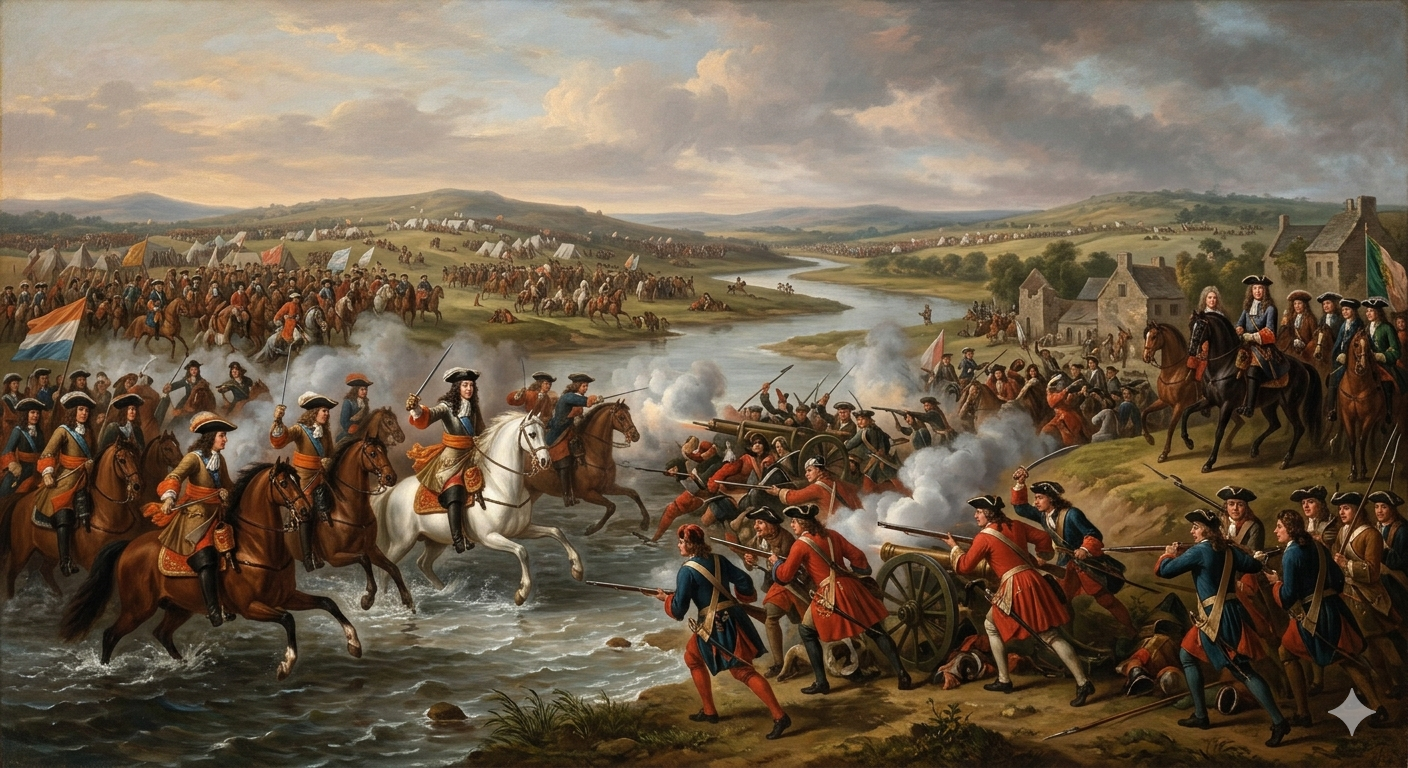
On July 1, 1690, the banks of the River Boyne in County Meath, Ireland, witnessed one of the most significant battles in British and Irish history when King William III of England decisively defeated the deposed Catholic monarch James II. This pivotal confrontation, fought between approximately 36,000 Williamite forces and 25,000 Jacobite troops, would forever alter the religious, political, and social landscape of Ireland while securing Protestant succession to the English throne. The Battle of the Boyne was not merely a military engagement but the climactic moment of a broader European conflict that pitted Protestant against Catholic, legitimacy against usurpation, and national sovereignty against foreign intervention. The victory established William’s authority beyond question and marked the beginning of Protestant ascendancy in Ireland that would endure for centuries.
The Revolutionary Context: The Glorious Revolution and James II’s Exile
The roots of the Battle of the Boyne trace back to the tumultuous events of 1688, known as the Glorious Revolution, when the Protestant nobility of England invited William of Orange to depose the Catholic King James II. James’s attempts to restore Catholicism to England had alienated the predominantly Protestant political establishment, who feared the return of Catholic absolute monarchy and the persecution of Protestant subjects. His promotion of Catholics to key positions in government, the military, and universities, combined with his Declaration of Indulgence that suspended penal laws against Catholics and Protestant dissenters, created widespread anxiety about his ultimate intentions.
The birth of James Francis Edward Stuart, James II’s son with his Catholic queen Mary of Modena, in June 1688 precipitated the crisis that would lead to revolution. The prospect of a Catholic dynasty continuing indefinitely prompted seven prominent English nobles to invite William of Orange, the Protestant husband of James’s daughter Mary, to intervene and secure Protestant interests. William, who was Stadtholder of the Dutch Republic and James’s nephew, had his own strategic reasons for accepting this invitation, as he sought to bring England into his coalition against the expansionist policies of Louis XIV of France.
William landed at Brixham in Devon on November 5, 1688, with a carefully prepared invasion force of approximately 15,000 Dutch, German, and English troops. The invasion succeeded not through military conquest but through the rapid collapse of support for James II among the English political and military establishment. Key military commanders, including John Churchill, the future Duke of Marlborough, and James’s own younger daughter Princess Anne, defected to William’s cause. Faced with this comprehensive abandonment by his supporters, James fled to France in December 1688, effectively abdicating his throne.
Parliament subsequently declared that James had abdicated by fleeing the realm and offered the crown jointly to William and Mary, who were crowned as co-monarchs in April 1689. This parliamentary settlement established important constitutional principles about the limits of royal power and the Protestant succession, but it left unresolved the question of James’s supporters, particularly in Ireland, where Catholic loyalty to the deposed king remained strong.
James II’s Irish Campaign: The Jacobite Strategy and French Alliance
James II’s exile in France provided him with the opportunity to mount a campaign to reclaim his throne, and Ireland presented the most promising theater for such an attempt. The overwhelmingly Catholic population of Ireland had benefited from James’s policies of religious tolerance and Catholic advancement, and many Irish Catholics viewed his deposition as a Protestant usurpation that threatened their newly acquired rights and privileges. Additionally, Ireland’s strategic location made it an ideal base from which to threaten England while enjoying French military and financial support.
Louis XIV of France saw James’s cause as an opportunity to open a second front against William’s Grand Alliance and to divert English resources from the continental war. French support for James was both strategic and ideological, as Louis sought to restore a Catholic ally to the English throne while weakening his Dutch opponent who had emerged as the leader of European resistance to French expansion. The French king provided James with money, military advisors, and eventually substantial troop reinforcements for his Irish campaign.
James landed at Kinsale in Cork on March 12, 1689, accompanied by French officers and supplies. His arrival was greeted enthusiastically by Irish Catholics who saw him as their legitimate monarch and the champion of Catholic rights. Richard Talbot, Earl of Tyrconnell, who had served as James’s Lord Deputy in Ireland, had spent months preparing for the king’s return by purging Protestant officials from the government and military while promoting Catholics to positions of authority. This preparation ensured that James would find a receptive and organized base of support upon his arrival.
The Jacobite Parliament that convened in Dublin in May 1689 represented the high point of Catholic political power in Ireland since the Reformation. This assembly passed legislation reversing the Cromwellian land settlements that had dispossessed Catholic landowners and restored confiscated estates to their original Catholic owners. The parliament also repealed Poynings’ Law, which had subordinated the Irish Parliament to English control, asserting Ireland’s legislative independence under James’s sovereignty. These measures demonstrated that the Jacobite cause in Ireland represented not merely personal loyalty to James but a comprehensive program for Catholic political and economic restoration.
The Siege of Derry and Protestant Resistance in Ulster
The conflict in Ireland began in earnest with the siege of Derry, which became a symbol of Protestant resistance to Jacobite rule and Catholic resurgence. The siege commenced on April 18, 1689, when Jacobite forces under Richard Hamilton attempted to capture this strategically important Protestant stronghold in Ulster. The defenders of Derry, led by military governor Robert Lundy initially and later by Presbyterian ministers and citizen leaders, refused to surrender despite facing severe hardships from the prolonged blockade.
The siege of Derry lasted for 105 days and became one of the most celebrated examples of Protestant courage and determination in the face of Catholic oppression. The defenders endured extreme hunger, disease, and constant bombardment while maintaining their resistance to Jacobite demands for surrender. The dramatic relief of the city on July 30, 1689, when ships from the English fleet broke through the boom across the River Foyle, provided William’s supporters with a powerful symbol of Protestant deliverance and divine favor.
Simultaneously, Protestant forces in Enniskillen maintained another center of resistance that tied down significant Jacobite resources and demonstrated that Protestant Ulster would not submit easily to James’s rule. The Enniskillen men, as they became known, conducted effective guerrilla warfare against Jacobite forces while maintaining communication with England and coordinating their resistance with other Protestant strongholds. Their success in repelling Jacobite attacks helped establish Ulster as a bastion of Williamite support that would prove crucial for William’s eventual campaign.
The Protestant resistance in Ulster had significant strategic implications beyond its immediate military impact. These successful defensive actions demonstrated that James’s support in Ireland was not universal and that religious divisions would play a crucial role in determining the conflict’s outcome. The siege of Derry and the resistance at Enniskillen also provided William with time to organize his response while serving as rallying points for Protestant opinion throughout the British Isles and Protestant Europe.
Duke of Schomberg’s Campaign and Military Preparation
In response to the Protestant resistance in Ulster and the need to support William’s allies in Ireland, the English government dispatched a substantial military expedition under the command of Friedrich Hermann von Schomberg, Duke of Schomberg. This experienced Prussian general, who had served with distinction in European armies for decades, landed at Bangor in County Down on August 13, 1689, with approximately 20,000 troops drawn from English, Dutch, German, and Huguenot units.
Schomberg’s campaign faced immediate challenges from both military and logistical perspectives. The duke established his base at Carrickfergus and began advancing south toward Dublin, but his multinational army suffered from supply problems, disease, and communication difficulties. The harsh Irish winter of 1689-1690 proved particularly devastating to troops unaccustomed to local conditions, with many continental soldiers succumbing to disease and exposure. Schomberg’s cautious approach to military operations also frustrated his more aggressive subordinates who favored immediate action against the Jacobites.
The military stalemate that developed during the winter months allowed both sides to consolidate their positions and prepare for the decisive campaign that would come with better weather. Schomberg used this time to improve his supply lines, integrate his diverse troops into a more cohesive fighting force, and gather intelligence about Jacobite dispositions and intentions. Despite the difficulties of the winter encampment, Schomberg’s presence in Ireland maintained pressure on the Jacobites while providing a foundation for William’s eventual arrival.
James II used the winter respite to strengthen his own forces through French reinforcements and improved organization of Irish troops. In March 1690, approximately 6,000 French regulars under the command of the Comte de Lauzun arrived to bolster Jacobite forces. These professional soldiers brought expertise and equipment that significantly enhanced the military capabilities of James’s army, though they also introduced tensions between French and Irish commanders over strategy and tactics.
William III’s Arrival and Strategic Planning
King William III’s decision to personally take command of the Irish campaign reflected both the strategic importance he attached to resolving the conflict and his need to demonstrate royal leadership in military affairs. William landed at Carrickfergus on June 14, 1690, with reinforcements of approximately 15,000 additional troops, bringing the total Williamite force to over 36,000 men. His arrival immediately energized the Williamite cause while providing unified command for what had previously been a somewhat fragmented military effort.
William’s military reputation had been established through his successful defense of the Dutch Republic against French expansion, and he brought to Ireland extensive experience in European warfare. His strategic vision encompassed not only the immediate Irish campaign but also its relationship to the broader European conflict against Louis XIV. William understood that a decisive victory in Ireland would free English resources for continental operations while eliminating a potential threat to his rear.
The king’s strategic planning for the Irish campaign emphasized speed and decisiveness. He recognized that prolonged operations in Ireland would drain resources needed for the continental war while providing opportunities for French intervention or domestic opposition to develop. William’s intention was to crush Jacobite resistance quickly through overwhelming force and superior tactics, then return to England to focus on the wider European conflict.
Upon his arrival, William immediately began preparing for a march on Dublin, correctly identifying the Irish capital as the strategic center of Jacobite power. His plan involved advancing south along the eastern coast of Ireland, using his naval superiority to maintain secure supply lines while forcing James to either retreat without fighting or offer battle under disadvantageous circumstances. This strategic approach reflected William’s understanding that time favored his enemies, as prolonged campaigning would allow French reinforcements to arrive while potentially encouraging domestic opposition to his absence from England.
The Opposing Forces: Military Composition and Leadership
The Williamite army that assembled for the march on Dublin represented one of the most cosmopolitan military forces of the era, reflecting William’s position as both King of England and Stadtholder of the Dutch Republic. The approximately 36,000 troops under William’s command included English regiments, Dutch battalions, German mercenaries, Danish auxiliaries, and Huguenot refugees who had fled France following Louis XIV’s revocation of the Edict of Nantes. This diverse composition provided William with experienced soldiers and officers while demonstrating the international character of the Protestant coalition against Louis XIV.
The English contingent formed the largest single component of William’s army and included both regular regiments and militia units raised specifically for the Irish campaign. These forces were generally well-equipped and disciplined, though many lacked combat experience compared to their continental counterparts. The Dutch battalions were among William’s most reliable troops, having fought alongside him in previous campaigns against France. The German and Danish auxiliaries provided additional professional experience and specialized capabilities, particularly in artillery and engineering.
The Jacobite army opposing William presented its own unique characteristics, combining Irish Catholic levies with French regular troops and a small number of English and Scottish Jacobite volunteers. James’s force totaled approximately 25,000 men, though this number included troops of varying quality and experience. The Irish component consisted largely of recently raised regiments whose enthusiasm exceeded their military training, while the French contingent brought professional competence but limited familiarity with Irish conditions and terrain.
Leadership quality represented a crucial advantage for the Williamite side. William himself was an experienced commander with proven ability in both strategic planning and battlefield tactics. His subordinate commanders included veterans of European warfare such as Schomberg, who despite his advanced age remained one of the era’s most respected generals. The Williamite officer corps also included capable leaders like Ginkel, Portland, and Solms who would play crucial roles in the coming battle.
James II’s military leadership proved less effective, despite his personal courage and previous naval experience. His strategic decisions often reflected political rather than military considerations, and his relationship with his French advisors created tensions that undermined unified command. The Earl of Tyrconnell provided local knowledge and political leadership but lacked extensive military experience, while French commanders like Lauzun brought professional competence but limited understanding of Irish political complexities.
The Strategic Approach to the River Boyne
As William’s army advanced southward toward Dublin in late June 1690, James faced the critical decision of where and how to offer battle to his rival. The strategic situation strongly favored retreating toward the more defensible terrain of western Ireland, where sympathetic populations and difficult terrain would favor defensive operations. However, James chose instead to make his stand along the River Boyne, near the town of Drogheda, approximately thirty miles north of Dublin.
James’s decision to fight at the Boyne reflected both political and military considerations. Politically, he needed to demonstrate that he could defend Ireland’s capital and protect the Catholic population that had rallied to his cause. A retreat without fighting would have severely damaged Jacobite morale and might have triggered defections among Irish supporters who expected their king to defend their homeland. Military considerations also supported this choice, as the Boyne position offered certain tactical advantages including a river barrier and elevated ground for artillery placement.
The River Boyne at this location presented a significant obstacle to advancing armies, with its relatively deep waters and limited number of suitable crossing points. James positioned his forces along the southern bank of the river, taking advantage of commanding heights that provided excellent observation of the northern approaches. The Jacobite deployment concentrated the majority of forces in the center around Oldbridge, where the main Dublin-Drogheda road crossed the river, while detaching smaller forces to guard other potential crossing points at Slane and Rosnaree.
William’s reconnaissance of the Jacobite position revealed both its strengths and potential weaknesses. While the river obstacle and elevated positions favored the defenders, the extended frontage required to cover all potential crossing points had stretched James’s forces relatively thin. William also possessed significant advantages in artillery, with approximately eight times more cannon than his opponent, and his professional engineers could identify and exploit weaknesses in the Jacobite defensive arrangements.
The strategic context of the approaching battle extended beyond the immediate military situation to encompass broader questions of legitimacy and international relations. For William, victory at the Boyne would secure his position as King of England while demonstrating to European allies his ability to defeat French-supported opponents. For James, success would vindicate his claims to restoration while potentially encouraging domestic opposition to William’s rule in England and Scotland.
The Battle Plan: William’s Three-Pronged Strategy
After careful reconnaissance and consultation with his senior commanders, William developed a sophisticated battle plan that sought to exploit the extended nature of the Jacobite position while maximizing his numerical and qualitative advantages. The plan called for a coordinated three-pronged attack that would prevent James from concentrating his forces at any single point while creating multiple threats that would overwhelm Jacobite defensive capabilities.
The right wing of William’s attack, assigned to Count Meinhard Schomberg, son of the Duke of Schomberg, consisted of approximately 10,000 men tasked with crossing the river at Slane and Rosnaree, several miles upstream from the main Jacobite position. This force included cavalry and infantry units capable of rapid movement once across the river. The mission of this flanking force was to threaten the Jacobite rear and western flank, potentially cutting off retreat routes toward Dublin while forcing James to divert troops from his main defensive line.
The center attack, under the personal command of Duke Friedrich von Schomberg, involved approximately 20,000 troops who would attempt multiple crossings between Oldbridge and Drogheda. This massive frontal assault was designed to pin down the majority of Jacobite forces while allowing William’s superior artillery to inflict maximum damage on concentrated enemy positions. The center attack would also serve as the primary effort if the flanking movements encountered unexpected difficulties or delays.
William himself would lead the left wing attack with approximately 8,000 men, crossing the river at additional points downstream from the main crossing. This personal leadership by the king was intended to inspire his troops while demonstrating his commitment to victory. The left wing attack would also provide tactical flexibility, allowing William to exploit any weaknesses that developed in the Jacobite line or to support either the center or right wing attacks as circumstances required.
The coordination of these three simultaneous attacks represented a sophisticated example of early modern military planning that reflected William’s experience in European warfare. The plan required precise timing and communication to ensure that all three efforts commenced simultaneously, preventing James from shifting troops to counter individual threats. Success depended on maintaining pressure along the entire front while exploiting any gaps or weaknesses that developed in the Jacobite defensive line.
The Morning of Battle: July 1, 1690
The Battle of the Boyne commenced in the early morning hours of July 1, 1690, when Count Meinhard Schomberg began leading his flanking force toward the upstream crossings at Slane and Rosnaree. The morning mist that covered the river valley provided some concealment for the initial movements, though Jacobite sentries soon detected the Williamite approach and began raising alarm throughout the defensive line. The battle that would determine the fate of two kingdoms had begun with the measured advance of professional soldiers toward their deadly appointment with history.
Schomberg’s flanking force encountered its first resistance at Rosnaree, where approximately 800 Jacobite dragoons under Sir Neil O’Neill had been posted to guard the ford. These Irish cavalry fought with determination and skill, seeking to delay the Williamite crossing long enough for reinforcements to arrive from the main defensive position. The dragoons’ resistance proved more effective than expected, holding up Schomberg’s advance for several crucial hours while inflicting casualties on the attacking force.
The prolonged resistance at Rosnaree had important strategic implications for the developing battle. James’s commanders, alerted to the flanking movement, dispatched a significant portion of their reserve forces under the command of the Duke of Berwick, James’s illegitimate son, to counter this threat. This redeployment weakened the Jacobite center precisely as William’s main attacks were beginning to develop, creating the tactical opportunity that the Williamite plan had been designed to exploit.
In the center, Duke Friedrich von Schomberg began organizing his massive assault force for multiple crossings of the main river line. The duke divided his 20,000 troops into three assault columns that would attempt simultaneous crossings at Drybridge, Yellow Island, and Oldbridge. This dispersion of effort was intended to prevent the Jacobites from concentrating their defensive fire while creating multiple penetration points that could be exploited once footholds were established on the southern bank.
William’s artillery, positioned on the commanding heights north of the river, began a sustained bombardment of the Jacobite positions designed to suppress defensive fire and create confusion among the defenders. The Williamite guns, significantly superior in both number and quality to their Jacobite counterparts, maintained this preparatory fire for several hours while the assault columns moved into position for their dangerous river crossings.
The River Crossings: Courage Under Fire
The actual crossings of the River Boyne represented some of the most dramatic and dangerous moments of the entire battle, as Williamite troops waded through waist-deep water while under intense fire from Jacobite positions on the commanding southern bank. The crossing at Oldbridge, where the main Dublin-Drogheda road traversed the river, became the scene of particularly fierce fighting as both sides recognized its strategic importance for the battle’s outcome.
The Williamite assault troops, many of them experienced veterans of European campaigns, demonstrated remarkable courage and discipline as they advanced through the river under increasingly heavy fire. The crossing was complicated by the depth of the water, the slippery stones on the riverbed, and the weight of equipment that each soldier carried. Despite these obstacles and the lethal fire from the opposite bank, the attackers maintained their formation and continued their advance toward the Jacobite defensive positions.
The Jacobite defenders, fighting from prepared positions on elevated ground, initially inflicted severe casualties on the exposed attacking forces. Irish and French troops fired coordinated volleys into the closely packed assault columns while Jacobite artillery added to the carnage. The river itself became contested ground as wounded soldiers struggled in the current while their comrades pressed forward over their bodies toward the increasingly desperate fight for the southern bank.
Duke Friedrich von Schomberg, despite his advanced age of seventy-four years, personally led the assault at Oldbridge in an effort to inspire his troops and demonstrate aristocratic leadership in combat. The elderly general’s presence at the point of greatest danger exemplified the military values of his era while providing crucial leadership during the most critical moments of the assault. His conspicuous courage attracted the attention of both his own troops and enemy marksmen who recognized the importance of eliminating senior commanders.
As the morning progressed, sheer weight of numbers and superior training began to tell in favor of the Williamite attackers. Despite fierce resistance and heavy casualties, elements of Schomberg’s assault force began establishing footholds on the southern bank at multiple points along the defensive line. These penetrations, once achieved, provided platforms for additional troops to cross while creating gaps in the Jacobite defensive coordination that could be exploited by follow-up forces.
The Death of Duke Schomberg and Its Impact
The most dramatic and significant casualty of the river crossings was Duke Friedrich von Schomberg himself, whose death while leading the assault at Oldbridge sent shockwaves through both armies and fundamentally altered the character of the battle. The elderly general, having successfully led his troops across the river and established a foothold on the southern bank, was killed by enemy fire while organizing the assault on Jacobite positions beyond the river. His death represented not only a personal tragedy but also a significant military loss for William’s forces.
Schomberg’s death occurred when he advanced too far forward in his effort to maintain momentum in the attack, placing himself within range of Jacobite marksmen who had identified him as a crucial target. Contemporary accounts suggest that he was struck by multiple bullets while attempting to rally his troops for a final assault on the main Jacobite defensive line. The loss of such an experienced and respected commander at the critical moment of battle threatened to disrupt Williamite coordination and morale just when success seemed within reach.
The immediate impact of Schomberg’s death was felt throughout the Williamite ranks, as news of the general’s fall spread among troops who had come to rely on his leadership and expertise. The potential for demoralization and confusion was significant, as battlefield communications in this era depended heavily on personal leadership and visual recognition of commanders. The loss of such a prominent figure could have triggered a collapse of morale that might have turned victory into defeat.
However, the professionalism and training of William’s multinational army proved adequate to absorb this shock and maintain operational effectiveness. Subordinate commanders quickly stepped forward to assume control of their units while maintaining the pressure on Jacobite positions. The death of Schomberg, rather than causing collapse, seemed to inspire his troops to fight harder in honor of their fallen leader, transforming personal loss into military determination.
William himself, observing the battle from his position with the reserve forces, recognized both the crisis and the opportunity that Schomberg’s death had created. The king’s decision to personally cross the river and take direct command of the assault represented a crucial moment in his reign, demonstrating the personal courage and military leadership that would define his kingship. This royal intervention at the moment of greatest danger would prove decisive for both the immediate battle and William’s long-term political authority.
William’s Personal Intervention and Royal Leadership
King William III’s decision to personally cross the River Boyne and join the assault on Jacobite positions represented one of the most significant moments of his military and political career. The king’s intervention came at the precise moment when the battle hung in the balance, with Schomberg’s death threatening to disrupt Williamite momentum despite the successful river crossings. William’s appearance on the battlefield, mounted on his distinctive white horse and easily recognizable to both armies, immediately transformed the character of the engagement.
William crossed the river at Mill’s Ford, accompanied by his personal guard and staff officers, in full view of both armies. This dramatic gesture served multiple purposes: it demonstrated royal commitment to victory, inspired Williamite troops who could see their king sharing their dangers, and potentially demoralized Jacobite defenders who witnessed the enemy’s supreme commander taking personal risks to achieve victory. The sight of William personally leading the charge became one of the iconic images of the battle.
The king’s presence on the battlefield allowed him to make tactical adjustments in real-time while providing unified command for what had threatened to become a fragmented assault. William’s experience in European warfare enabled him to identify and exploit weaknesses in the Jacobite defensive line that might not have been apparent to subordinate commanders. His personal leadership also ensured continued coordination between the various assault columns and prevented the confusion that Schomberg’s death might otherwise have caused.
James II, observing William’s personal intervention from his command position, faced a critical decision about how to respond to this dramatic escalation. The sight of his rival personally leading the assault created pressure for James to provide similar leadership for his own troops. However, James’s advisors, particularly his French commanders, counseled against exposing the king to the same dangers that William was accepting, arguing that James’s preservation was more important than short-term tactical advantage.
The contrast between William’s active battlefield leadership and James’s more cautious approach became apparent to soldiers on both sides and contributed to the psychological dynamics that would ultimately determine the battle’s outcome. William’s willingness to share his soldiers’ risks while James remained in a safer command position reinforced existing perceptions about the two kings’ characters and their commitment to their respective causes.
The Jacobite Response and Defensive Fighting
The Jacobite defensive response to William’s multi-pronged assault demonstrated both the courage of individual soldiers and the limitations of hastily organized defensive positions under extreme pressure. James’s forces fought with determination and skill, particularly considering that many Irish troops lacked extensive military training and experience. The combination of Irish enthusiasm and French professional expertise created a more formidable resistance than William might have expected from purely numerical considerations.
The Jacobite commanders, led by the Duke of Berwick at the upstream crossing and the Earl of Tyrconnell in the center, attempted to coordinate a flexible defense that would counter each Williamite threat as it developed. This approach required rapid movement of reserves between threatened points while maintaining sufficient strength at each position to prevent Williamite breakthroughs. The extended frontage that the Jacobites were required to defend made this coordination extremely difficult.
Irish troops fighting in defense of their homeland and their religious beliefs demonstrated remarkable tenacity and courage despite facing overwhelming odds. Many Irish regiments fought to the last man rather than retreat, inspired by their commitment to the Catholic cause and their loyalty to James as their legitimate king. These displays of heroism, while ultimately unsuccessful in preventing defeat, created lasting legends and contributed to the development of Irish national consciousness.
The French contingent within James’s army provided crucial professional expertise and steady performance under pressure. French officers and non-commissioned officers helped maintain unit cohesion and tactical effectiveness even as the situation deteriorated. The presence of these experienced soldiers also provided confidence to Irish troops who might otherwise have wavered under the intense pressure of William’s assault.
However, the fundamental problem facing the Jacobite defense was the impossibility of matching William’s superior numbers while simultaneously defending multiple crossing points. Each successful Williamite penetration required the commitment of reserves that weakened other defensive positions, creating a cascading series of crises that ultimately overwhelmed Jacobite capabilities. The defensive strategy, while sound in theory, proved inadequate against the scale and coordination of William’s attack.
The Collapse of Jacobite Resistance
As William’s personal intervention began to tip the balance of battle decisively in favor of the Williamite forces, the carefully coordinated Jacobite defense began to show signs of strain and eventual collapse. The combination of superior numbers, better artillery support, successful river crossings at multiple points, and effective royal leadership created a convergence of pressures that the outnumbered Jacobite forces could no longer contain. The moment when organized resistance gave way to retreat marked the decisive turning point of both the battle and the broader Jacobite cause in Ireland.
The first signs of Jacobite collapse appeared along the extended flanks where Count Schomberg’s forces had successfully crossed at Slane and Rosnaree despite determined Irish resistance. The Duke of Berwick’s counter-attack against this flanking movement had initially contained the threat, but the continuous pressure from fresh Williamite troops eventually overwhelmed the defensive positions. As news of this flanking success reached other parts of the battlefield, Jacobite commanders began to realize that their position was becoming untenable.
In the center, where the main battle had raged around the Oldbridge crossing, William’s personal leadership and the weight of his assault columns finally broke through the Jacobite main line. The death of Duke Schomberg, rather than weakening the Williamite attack, had inspired his troops to fight with even greater determination while William’s arrival provided the leadership necessary to coordinate the final assault. The breakthrough in the center exposed the flanks of other Jacobite positions and made continued resistance impossible.
James II, observing the deteriorating situation from his command position, faced the bitter reality that his cause was lost and that continued fighting would only result in unnecessary casualties among his loyal supporters. The king’s decision to order a general retreat was both militarily sound and politically devastating, as it represented the effective end of his hopes for restoration to the English throne. The retreat order, when it came, probably saved many lives but confirmed William’s victory beyond doubt.
The actual process of Jacobite withdrawal demonstrated considerable military professionalism despite the circumstances of defeat. Irish and French units maintained their organization and discipline during the retreat, conducting effective rearguard actions that prevented William’s forces from achieving a complete rout. This organized withdrawal allowed the majority of James’s army to escape destruction, though it could not disguise the magnitude of their defeat or its political implications.
James II’s Flight and the End of Royal Legitimacy
The most politically significant consequence of the Battle of the Boyne was James II’s personal flight from the battlefield and his rapid departure from Ireland, which effectively ended any remaining claims to legitimacy that his cause might have possessed. James’s retreat to Dublin and his subsequent flight to France within days of the battle created a perception of abandonment among his Irish supporters while providing William with a decisive psychological victory that complemented his military success.
James’s departure from the battlefield, while militarily prudent given the hopelessness of the situation, proved politically disastrous for his long-term prospects. His Irish supporters, who had risked everything for his restoration, felt betrayed by their king’s apparent abandonment at the moment of greatest crisis. The contrast between their continued willingness to fight and die for his cause and his rapid flight to safety created lasting resentment that weakened future Jacobite efforts in Ireland.
The speed of James’s departure from Ireland also prevented any possibility of organizing effective resistance from alternative positions. Rather than attempting to rally his forces in the west of Ireland where terrain and population might have favored defensive operations, James chose immediate evacuation to France. This decision prioritized his personal safety over his political cause and effectively ceded Ireland to William without further serious resistance.
Contemporary accounts of James’s flight, particularly from hostile sources, emphasized his apparent cowardice and lack of commitment to his supporters. These accounts, while often biased, reflected genuine disappointment among Jacobite supporters who had expected their king to share their dangers and lead their resistance. The damage to James’s reputation from his flight proved irreversible and affected all subsequent Jacobite movements.
William’s propaganda machine quickly exploited James’s flight to reinforce the narrative of legitimate authority triumphing over usurpation. The contrast between William’s personal leadership on the battlefield and James’s rapid departure provided powerful imagery that supported Williamite claims about the character and legitimacy of the two kings. This propaganda victory proved almost as important as the military success in establishing William’s authority.
The Immediate Aftermath: Pursuit and Political Consequences
The immediate aftermath of the Battle of the Boyne revealed both William’s decisive military victory and his failure to achieve the complete destruction of Jacobite forces that might have ended the Irish conflict immediately. While the Williamite army had successfully crossed the river and driven James’s forces from their defensive positions, the organized nature of the Jacobite retreat prevented the kind of pursuit that could have eliminated organized resistance entirely. This partial success would have significant consequences for the continuation of the Irish war.
William’s failure to organize an effective pursuit of the retreating Jacobite forces reflected both the exhaustion of his troops after the river crossing and assault, and the effective rearguard actions conducted by Jacobite cavalry under experienced commanders. The determination of Irish horsemen to cover their retreating comrades allowed the majority of James’s infantry to escape encirclement and potential destruction. This tactical success for the defeated army preserved the core of Jacobite resistance for future operations.
The Williamite army’s entry into Dublin on July 6, 1690, marked the symbolic culmination of William’s Irish campaign and demonstrated his control over Ireland’s political center. The capital’s surrender without resistance reflected the collapse of organized Jacobite authority following James’s flight, but it also highlighted the difference between controlling key cities and pacifying the countryside where support for the defeated cause remained strong.
William’s Declaration of Finglas, issued shortly after his occupation of Dublin, demanded complete submission from all Irish Catholics while threatening confiscation of lands for those who continued resistance. This harsh policy reflected William’s desire to end the conflict quickly through intimidation, but it also strengthened the resolve of remaining Jacobite supporters who now faced dispossession regardless of their actions. The declaration thus contributed to the prolongation rather than the resolution of the conflict.
The international reaction to news of William’s victory at the Boyne provided immediate diplomatic benefits that extended far beyond Ireland. European allies of the Grand Alliance against Louis XIV received confirmation that England remained a reliable partner in the continental war, while potential French allies recognized that Louis’s strategy of supporting James had failed. The battle’s outcome thus influenced the broader European balance of power in William’s favor.
The Continuation of Jacobite Resistance: The Siege of Limerick
Despite the decisive nature of William’s victory at the Boyne and James’s subsequent flight to France, organized Jacobite resistance in Ireland did not end with the battle but instead consolidated around the fortress city of Limerick in the west. The city’s strategic location on the River Shannon, its strong fortifications, and its position in the heartland of Catholic Ireland made it an ideal center for continued resistance. The siege that developed there would demonstrate that the Battle of the Boyne, while decisive, had not ended the Irish war.
The withdrawal of surviving Jacobite forces to Limerick was organized by competent military commanders who recognized that the city offered the best prospects for sustained resistance. The fortifications of Limerick, recently improved under French direction, could withstand siege operations while the surrounding countryside provided a base of popular support for the Catholic cause. French military advisors who remained in Ireland after James’s departure helped organize the defense and maintain contact with Louis XIV for continued support.
William’s decision to personally conduct the siege of Limerick reflected his understanding that the city represented the last significant center of organized resistance to his authority in Ireland. The king’s presence at the siege also demonstrated his commitment to ending the Irish conflict definitively before returning to England and the continental war. However, the siege operations proved more difficult than William had anticipated, as the defenders fought with desperate courage and the fortifications proved more formidable than expected.
The siege of Limerick lasted from August to October 1690 and became a grueling test of endurance for both attackers and defenders. William’s forces, despite their superior numbers and equipment, found themselves bogged down in expensive siege operations that consumed time and resources needed for other purposes. The determined resistance of the garrison and civilian population demonstrated that the spirit of Jacobite resistance had not been broken by the defeat at the Boyne.
The failure of William’s first siege of